Recognition: unknown
Implications of the LISA stochastic signal from eccentric stellar mass black hole binaries in vacuum
Pith reviewed 2026-05-08 07:44 UTC · model grok-4.3
The pith
High-eccentricity stellar black hole binaries produce a LISA stochastic background distinguishable from circular ones.
A machine-rendered reading of the paper's core claim, the machinery that carries it, and where it could break.
Core claim
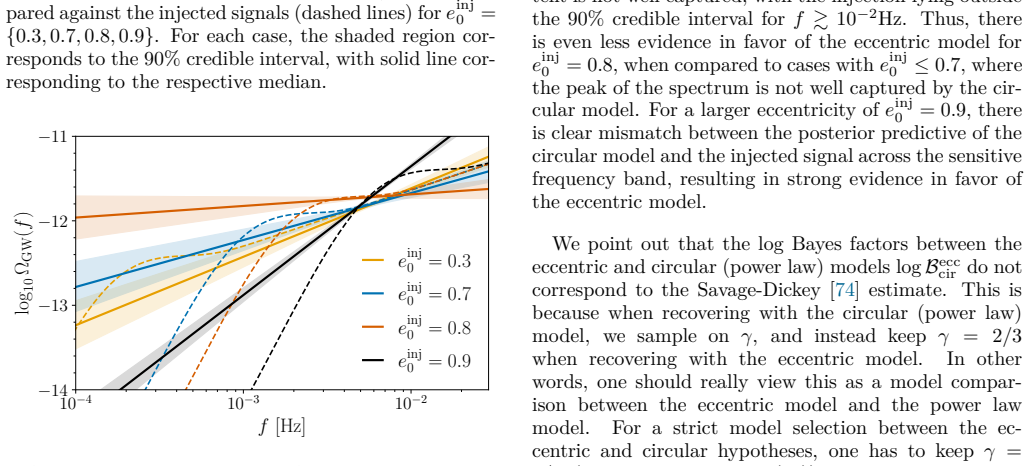
If all binaries have a high initial eccentricity e0 ≳ 0.9 at an orbital frequency of f_orb = 10^{-4} Hz, the resulting SGWB can be robustly distinguished from a background of quasi-circular sBBHs using a fully Bayesian framework. For a thermal eccentricity distribution, the SGWB is consistent with a circular model when binaries form at f_orb = 10^{-5} Hz, but leads to significant systematic biases if formation occurs at f_orb = 10^{-4} Hz. When eccentricity is properly accounted for, environmental effects such as dynamical friction can be distinguished from vacuum evolution, but only for sufficiently dense environments with gas densities ρ ≳ 10^{-7} g cm^{-3}. A LISA detection of the sBBH SG
What carries the argument
Improved SGWB models for Dirac-delta and thermal eccentricity distributions, compared via Bayesian inference to the quasi-circular case.
If this is right
- The SGWB can be robustly distinguished from quasi-circular if all binaries have high initial eccentricity at 10^{-4} Hz.
- For thermal distributions, consistency with circular models holds at 10^{-5} Hz formation but biases arise at 10^{-4} Hz.
- Environmental effects like dynamical friction are distinguishable from vacuum only in dense environments above 10^{-7} g/cm^3.
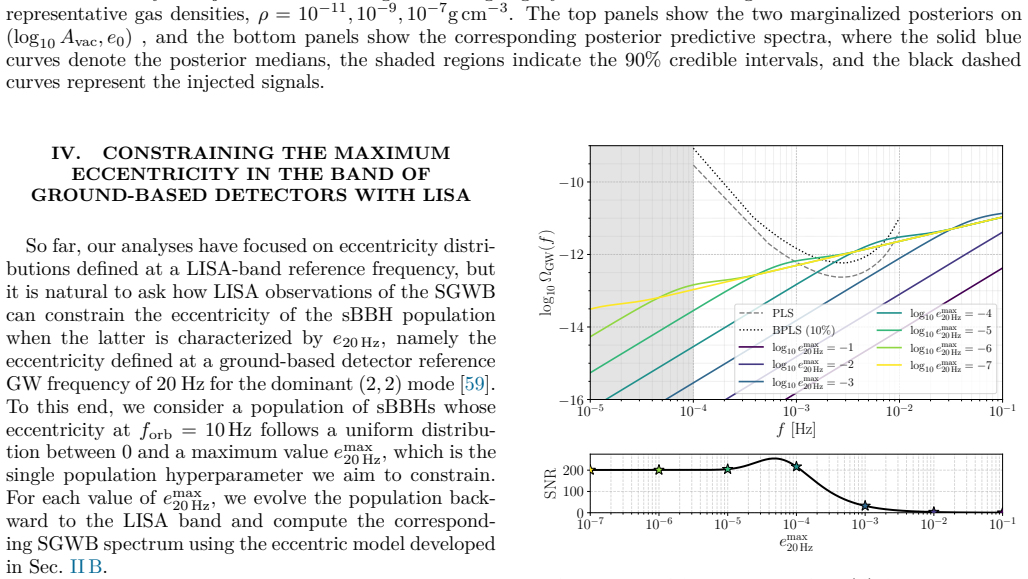
- LISA SGWB detection would upper-bound the maximum eccentricity in the ground-based detector frequency band.
Where Pith is reading between the lines
- Ignoring eccentricity could lead to misinterpretation of LISA data as evidence for certain formation channels or environments.
- Realistic astrophysical eccentricity distributions might require more detailed modeling to avoid systematic errors.
- Such bounds on eccentricity could inform template design for ground-based gravitational wave searches.
Load-bearing premise
The eccentricity distribution is limited to a Dirac delta at high values or a thermal distribution, with binaries forming at only two specific orbital frequencies.
What would settle it
A LISA measurement showing the SGWB amplitude and spectrum matching exactly the quasi-circular prediction, despite the presence of high-eccentricity binaries formed at 10^{-4} Hz, would disprove the distinguishability.
Figures



read the original abstract
Astrophysical formation channels of stellar-mass binary black holes (sBBHs) can induce significant orbital eccentricities in their early inspiral. We analyze the implications on the stochastic gravitational-wave background (SGWB) from unresolved sBBHs, which can be detected with the Laser Interferometer Space Antenna (LISA). We develop an improved SGWB model for the case of an idealized Dirac-delta eccentricity distribution, and extend it to the more astrophysical case of a thermal distribution. Using a fully Bayesian framework, we find that, if all binaries have a high initial eccentricity $e_0 \gtrsim 0.9$ at an orbital frequency of $f_{\rm orb} = 10^{-4}\,\mathrm{Hz}$, the resulting SGWB can be robustly distinguished from a background of quasi-circular sBBHs. For a thermal eccentricity distribution, the SGWB is consistent with a circular model when binaries form at $f_{\rm orb} = 10^{-5}\,\mathrm{Hz}$, but leads to significant systematic biases if formation occurs at $f_{\rm orb} = 10^{-4}\,\mathrm{Hz}$. We also show that, when eccentricity is properly accounted for, environmental effects such as dynamical friction can be distinguished from vacuum evolution, but only for sufficiently dense environments with gas densities $\rho \gtrsim 10^{-7}\,\mathrm{g\,cm^{-3}}$. Finally, we show that a LISA detection of the sBBH SGWB would place an upper bound on the maximum eccentricity of the sBBH population in the band of ground-based detectors, with direct implications for template modeling and data analysis. Our results highlight the importance of incorporating eccentricity in SGWB modeling to enable accurate astrophysical interpretation of LISA observations.
Editorial analysis
A structured set of objections, weighed in public.
Referee Report
Summary. The manuscript develops improved models for the stochastic gravitational-wave background (SGWB) from stellar-mass binary black holes (sBBHs) with eccentricity, considering both idealized Dirac-delta and thermal eccentricity distributions. Using a fully Bayesian framework, it claims that high initial eccentricities (e0 ≳ 0.9 at f_orb = 10^{-4} Hz) produce an SGWB that can be robustly distinguished from quasi-circular backgrounds with LISA; for thermal distributions the outcome depends on formation frequency, with biases at 10^{-4} Hz but consistency at 10^{-5} Hz. It further examines distinguishability of environmental effects like dynamical friction and derives an upper bound on maximum eccentricity in the ground-based detector band.
Significance. If the central claims hold, the work is significant for LISA astrophysical interpretation because it quantifies how eccentricity affects SGWB modeling and can lead to systematic biases or new constraints. The fully Bayesian framework and explicit quantification of distinctions (via Bayes factors) are clear strengths that support reproducible inference. The results underscore the importance of eccentricity for accurate vacuum vs. environmental separation, though generality is limited by the specific distributions and frequencies adopted.
major comments (2)
- [Abstract, §4 (Bayesian analysis)] The headline distinction result (abstract and §4) is conditioned on either a Dirac-delta eccentricity distribution with e0 ≳ 0.9 at exactly f_orb = 10^{-4} Hz or a thermal distribution at one of two discrete formation frequencies. Without marginalization over a continuous prior on formation frequency or a mixture of isolated/dynamical channels, the higher-harmonic excess power can be diluted, allowing the composite spectrum to be reabsorbed into a circular model with adjusted amplitude; this assumption is load-bearing for the reported Bayes-factor separation.
- [§3, §4] §3 (SGWB model) and §4: the manuscript provides no explicit validation of the eccentric energy spectrum against numerical waveforms, nor error budgets on how the improved model affects parameter degeneracies or fitting freedoms when compared to the circular baseline.
minor comments (2)
- [Abstract] The abstract omits any reference to validation procedures, error budgets, or the precise range of formation frequencies explored.
- [§2, §3] Notation for the eccentricity distribution function and the mapping from initial f_orb to observed frequencies should be stated with an explicit equation in the main text to aid reproducibility.
Simulated Author's Rebuttal
We thank the referee for their careful and constructive review of our manuscript. Their comments highlight important considerations regarding the scope of our idealized models and the robustness of our conclusions. We address each major comment point by point below, indicating where revisions will be made to the manuscript.
read point-by-point responses
-
Referee: [Abstract, §4 (Bayesian analysis)] The headline distinction result (abstract and §4) is conditioned on either a Dirac-delta eccentricity distribution with e0 ≳ 0.9 at exactly f_orb = 10^{-4} Hz or a thermal distribution at one of two discrete formation frequencies. Without marginalization over a continuous prior on formation frequency or a mixture of isolated/dynamical channels, the higher-harmonic excess power can be diluted, allowing the composite spectrum to be reabsorbed into a circular model with adjusted amplitude; this assumption is load-bearing for the reported Bayes-factor separation.
Authors: We agree that the reported Bayes-factor separations are demonstrated for the specific eccentricity distributions and discrete formation frequencies considered in the paper. These cases are explicitly chosen as illustrative examples motivated by possible astrophysical formation scenarios, as stated in the abstract and §4. We acknowledge that a full marginalization over a continuous prior on formation frequency or a mixture of channels could dilute the higher-harmonic features, potentially reducing the distinguishability. In the revised manuscript we will add an expanded discussion in §4 and the conclusions section that (i) explicitly flags this limitation, (ii) provides a qualitative estimate of how the Bayes factors could change under broader priors, and (iii) frames our results as demonstrating the conditions under which eccentricity-induced features can become detectable rather than claiming universal applicability. We do not perform the full marginalization here, as it would require a substantially expanded parameter space and computational effort beyond the scope of the present work, but the added discussion will make the load-bearing assumptions transparent. revision: partial
-
Referee: [§3, §4] §3 (SGWB model) and §4: the manuscript provides no explicit validation of the eccentric energy spectrum against numerical waveforms, nor error budgets on how the improved model affects parameter degeneracies or fitting freedoms when compared to the circular baseline.
Authors: The eccentric SGWB model in §3 is constructed from the analytic Peters-Mathews harmonic decomposition of the radiated energy, which is the standard approach for population-level stochastic-background calculations at LISA frequencies. While we did not include a direct side-by-side comparison to numerical-relativity waveforms in the original submission, the underlying single-binary expressions have been validated in the literature for the eccentricity and frequency range we consider. In the revised manuscript we will (i) add a dedicated paragraph in §3 that cites existing numerical validations of the eccentric energy spectrum for individual binaries and discusses the regime of validity of the analytic approximation, and (ii) include a brief error-budget subsection that quantifies the expected fractional uncertainty in the SGWB amplitude and its effect on the parameter degeneracies between the eccentric and circular models. This will clarify how the additional fitting freedom in the eccentric model influences the Bayes-factor comparisons reported in §4. revision: yes
Circularity Check
No significant circularity in derivation chain
full rationale
The paper constructs its SGWB model by integrating standard vacuum binary evolution equations (with eccentricity as an explicit input parameter) over redshift, mass, and frequency distributions. The reported distinctions and Bayes factors are conditional on the chosen Dirac-delta or thermal eccentricity distributions and the two discrete formation frequencies; these are not derived from the model but supplied as test cases. No equations reduce by construction to fitted quantities inside the paper, no load-bearing self-citations close a loop, and no ansatz is smuggled via prior work. The derivation remains self-contained against external benchmarks.
Axiom & Free-Parameter Ledger
free parameters (2)
- initial eccentricity e0
- formation orbital frequency
axioms (2)
- domain assumption Stellar-mass black hole binaries evolve according to vacuum general-relativity inspiral with optional environmental drag
- domain assumption Eccentricity at formation follows either a Dirac-delta or thermal distribution
Reference graph
Works this paper leans on
-
[1]
Rational Power Law
TheblackdottedcurveshowstheBayesianpower-law sensitivity (BPLS), adopting a Bayes-factor threshold of 10 with a 10% noise level uncertainty. The grey shaded region marks the frequency range outside the LISA sen- sitivity band. In the remainder of this paper, we adoptlog 10Avac = −10.3036(corresponding toAvac = 4.97×10⁻¹¹), as specified by the “Rational Po...
-
[2]
How well can we measure the initial eccentricity from a LISA detection of the stochastic signal if sBBHs fol- lowed a Dirac-delta distribution fore0? What is the impact of the Galactic foreground in inferring such signals?
-
[3]
If sBBHs eccentricity follows a thermal distribution, are there significant biases when performing param- eter estimation with a circular model? Further, can we recover informative posteriors inferring on a model that assumes a Dirac-delta distribution for the eccen- tricity?
-
[4]
resid- ual
How does including eccentricity in the vacuum SGWB model affect the detection of environmental effects, such as dynamical friction? In Sec. IIIA, we provide an overview of the Bayesian methods used. We then address each of the above ques- tions in Secs. IIIB, IIIC, and IIID respectively. A. Bayesian inference of LISA stochastic signals We employ the codeb...
2000
-
[5]
3 of Ref
Alternative derivation of eccentric SGWB For a single eccentric binary, there can be interfer- ence between Fourier harmonics due to radiation reac- tion, which for example is clearly shown in the Fourier spectrum of the waveform in Fig. 3 of Ref. [68]. Qualita- tively, such interference effects happens when the evo- lution of a given harmonic exceeds the...
-
[6]
= 3/128(2πMforb(t∗ 2))−5/3, which is found in textbooks, such as Ref. [45]. From Phinney’s theorem [27], we have that dEGW dfr = 2π2 D2 L (1 +z) 2f2 × ( ⟨ ⏐⏐˜h+(fr) ⏐⏐2 ⟩+⟨ ⏐⏐˜h×(fr) ⏐⏐2 ⟩ )⏐⏐⏐ fr=f(1+z) ,(A4) where⟨X⟩represents an average over the binary’s orbital orientation: ⟨X⟩=1 8π2 ∫ π 0 dιsinι ∫ 2π 0 dβ ∫ 2π 0 dℓc.(A5) 15 We first compute ⏐⏐˜h+,×(f...
-
[7]
From Ref
Validity of neglecting higher PN contributions In this work, we have neglected PN corrections to the modelingoftheSGWB.Typically, thePNcorrectionsget enhanced as eccentricity increases, and thus one needs to determine at what eccentricity the leading PN approxi- mation breaks down or is inaccurate. From Ref. [71], the ratio of the instantaneous orbit-aver...
-
[8]
B. P. Abbottet al.(LIGO Scientific, Virgo), Phys. Rev. Lett.116, 061102 (2016), arXiv:1602.03837 [gr-qc]
work page internal anchor Pith review arXiv 2016
-
[9]
R. Abbottet al.(LIGO Scientific, Virgo), Phys. Rev. X 11, 021053 (2021), arXiv:2010.14527 [gr-qc]
work page internal anchor Pith review arXiv 2021
-
[10]
B. P. Abbottet al.(LIGO Scientific, Virgo), Phys. Rev. X9, 031040 (2019), arXiv:1811.12907 [astro-ph.HE]
work page internal anchor Pith review arXiv 2019
-
[11]
R.Abbottet al.(KAGRA,LIGOScientific, Virgo),Phys. Rev. X13, 041039 (2023), arXiv:2111.03606 [gr-qc]
work page internal anchor Pith review arXiv 2023
- [12]
-
[13]
R. Abbottet al.(LIGO Scientific, Virgo, KAGRA), arXiv preprint (2025), arXiv:2508.18082 [gr-qc]
work page internal anchor Pith review arXiv 2025
-
[14]
GWTC-4.0: Population Properties of Merging Compact Binaries
R. Abbottet al.(LIGO Scientific, Virgo, KAGRA), arXiv preprint (2025), arXiv:2508.18083 [astro-ph.HE]
work page internal anchor Pith review arXiv 2025
-
[15]
The first gravitational-wave source from the isolated evolution of two 40-100 Msun stars
K. Belczynski, D. E. Holz, T. Bulik, and R. O’Shaughnessy, Nature534, 512 (2016), arXiv:1602.04531 [astro-ph.HE]
work page Pith review arXiv 2016
-
[16]
I. Mandel and A. Farmer, Phys. Rept.955, 1 (2022), arXiv:1806.05820 [astro-ph.HE]
- [17]
-
[18]
Eccentric Black Hole Mergers Forming in Globular Clusters
J. Samsing, Phys. Rev. D97, 103014 (2018), arXiv:1711.07452 [astro-ph.HE]
work page Pith review arXiv 2018
-
[19]
Eccentric Black Hole Mergers in Dense Star Clusters: The Role of Binary-Binary Encounters
M. Zevin, J. Samsing, C. Rodriguez, C.-J. Haster, and E. Ramirez-Ruiz, Astrophys. J.871, 91 (2019), arXiv:1810.00901 [astro-ph.HE]
work page Pith review arXiv 2019
- [20]
-
[21]
F. Antonini, S. Toonen, and A. S. Hamers, Astrophys. J. 841, 77 (2017), arXiv:1703.06614 [astro-ph.GA]
-
[22]
Y. Levin, Mon. Not. Roy. Astron. Soc.374, 515 (2007), arXiv:astro-ph/0307084
work page internal anchor Pith review arXiv 2007
- [23]
- [24]
- [25]
-
[26]
Laser Interferometer Space Antenna
P. Amaro-Seoaneet al., arXiv (2017), arXiv:1702.00786 [astro-ph.IM]
work page internal anchor Pith review arXiv 2017
-
[27]
The promise of multi-band gravitational wave astronomy
A. Sesana, Phys. Rev. Lett.116, 231102 (2016), arXiv:1602.06951 [gr-qc]
work page Pith review arXiv 2016
-
[28]
E. Barausse and L. Rezzolla, Phys. Rev. D77, 104027 (2008), arXiv:0711.4558 [gr-qc]
-
[29]
Can environmental effects spoil precision gravitational-wave astrophysics?
E. Barausse, V. Cardoso, and P. Pani, Phys. Rev. D89, 104059 (2014), arXiv:1404.7149 [gr-qc]
work page Pith review arXiv 2014
-
[30]
A. Toubianaet al., Phys. Rev. Lett.126, 101105 (2021), arXiv:2010.06056 [gr-qc]
- [31]
-
[32]
L. Sbernaet al., Phys. Rev. D106, 064056 (2022), arXiv:2205.08550 [gr-qc]
-
[33]
B. Allen and J. D. Romano, Phys. Rev. D59, 102001 (1999), arXiv:gr-qc/9710117
work page Pith review arXiv 1999
- [34]
-
[35]
Maggiore,Gravitational Waves
M. Maggiore,Gravitational Waves. Vol. 1: Theory and Experiments(Oxford University Press, 2007)
2007
-
[36]
Babaket al., JCAP08, 034, arXiv:2304.06368 [astro- ph.CO]
S. Babaket al., JCAP08, 034, arXiv:2304.06368 [astro- ph.CO]
-
[37]
G. Lehoucq, I. Dvorkin, O. S. Salafia, and S. Grimm, Mon. Not. Roy. Astron. Soc.528, 4378 (2024), arXiv:2302.02665 [astro-ph.CO]
-
[38]
M. Pieroni and E. Barausse, JCAP07, 021, [Erratum: JCAP 09, E01 (2020)], arXiv:2004.01135 [astro-ph.CO]
- [39]
-
[40]
M. Bonetti, F. Haardt, A. Sesana, and E. Ba- rausse, Mon. Not. Roy. Astron. Soc.477, 3910 (2018), arXiv:1709.06088 [astro-ph.GA]
-
[41]
M. Bonetti, A. Sesana, E. Barausse, and F. Haardt, Mon. Not. Roy. Astron. Soc.477, 2599 (2018), arXiv:1709.06095 [astro-ph.GA]
-
[42]
M. Bonetti, A. Sesana, F. Haardt, E. Barausse, and M. Colpi, Mon. Not. Roy. Astron. Soc.486, 4044 (2019), arXiv:1812.01011 [astro-ph.GA]
work page Pith review arXiv 2019
-
[43]
P. C. Peters and J. Mathews, Phys. Rev.131, 435 (1963)
1963
-
[44]
M. Enoki and M. Nagashima, Prog. Theor. Phys.117, 241 (2007), arXiv:astro-ph/0609377
- [45]
-
[46]
M. Bonetti and A. Sesana, Phys. Rev. D102, 103023 (2020), arXiv:2007.14403 [astro-ph.GA]
-
[47]
Z.-C. Liang, Z.-Y. Li, and Y.-M. Hu, arXiv (2025), arXiv:2510.25353 [gr-qc]
-
[48]
J. H. Jeans, Mon. Not. R. Astron. Soc.79, 408 (1919)
1919
-
[49]
V. A. Ambartsumian, Astron. Zh.14, 207 (1937)
1937
-
[50]
D. C. Heggie, Mon. Not. R. Astron. Soc.173, 729 (1975)
1975
- [51]
- [52]
-
[53]
Maggiore,Gravitational Waves
M. Maggiore,Gravitational Waves. Vol. 2: Astrophysics and Cosmology(Oxford University Press, 2018)
2018
-
[54]
N. Yunes, K. G. Arun, E. Berti, and C. M. Will, Phys. Rev. D80, 084001 (2009), [Erratum: Phys.Rev.D 89, 109901 (2014)], arXiv:0906.0313 [gr-qc]
work page Pith review arXiv 2009
-
[55]
Planck 2018 results. VI. Cosmological parameters
N. Aghanimet al.(Planck), Astron. Astrophys.641, A6 (2020), [Erratum: Astron.Astrophys. 652, C4 (2021)], arXiv:1807.06209 [astro-ph.CO]
work page internal anchor Pith review arXiv 2020
-
[56]
F. Pozzoli, J. Gair, R. Buscicchio, and L. Speri, Phys. Rev. D112, 064035 (2025), arXiv:2412.10468 [astro- ph.IM]
- [57]
-
[58]
F. Pozzoli, R. Buscicchio, A. Klein, and D. Chirico, arXiv e-prints , arXiv:2506.22542 (2025), arXiv:2506.22542 [astro-ph.IM]
-
[59]
Buscicchio, Federicopoz- zoli/bahamas: Zenodo release (2025)
FedericoPozzoli and R. Buscicchio, Federicopoz- zoli/bahamas: Zenodo release (2025)
2025
-
[60]
M. Tinto and S. V. Dhurandhar, Living Reviews in Rel- ativity24, 1 (2021), arXiv:gr-qc/0409034 [gr-qc]
-
[61]
D. Quang Nam, Y. Lemière, A. Petiteau, J.-B. Bayle, O. Hartwig, J. Martino, and M. Staab, Phys. Rev. D 108, 082004 (2023), arXiv:2211.02539 [gr-qc]
-
[62]
N. Karnesis, S. Babak, M. Pieroni, N. Cornish, and T. Littenberg, Phys. Rev. D104, 043019 (2021), arXiv:2103.14598 [astro-ph.IM]
-
[63]
M. J. Williams, nessai: Nested sampling with artificial intelligence (2021)
2021
- [64]
- [65]
- [66]
- [67]
- [68]
- [69]
- [70]
- [71]
- [72]
-
[73]
D. O’Neill, D. J. D’Orazio, J. Samsing, and M. E. Pessah, Astrophys. J.974, 216 (2024), arXiv:2401.16166 [astro- ph.HE]
- [74]
-
[75]
A Fourier Domain Waveform for Non-Spinning Binaries with Arbitrary Eccentricity
B. Moore, T. Robson, N. Loutrel, and N. Yunes, Class. Quant. Grav.35, 235006 (2018), arXiv:1807.07163 [gr- qc]
work page Pith review arXiv 2018
-
[76]
Abramowitz and I
M. Abramowitz and I. A. Stegun,Handbook of Mathe- matical Functions with Formulas, Graphs, and Mathe- matical Tables(Dover, 1972)
1972
-
[77]
G. N. Watson,A Treatise on the Theory of Bessel Func- tions(Cambridge University Press, 1944)
1944
- [78]
-
[79]
Damour and N
T. Damour and N. Deruelle, Annales de L’Institut Henri Poincare Section (A) Physique Theorique43, 107 (1985)
1985
- [80]
discussion (0)
Sign in with ORCID, Apple, or X to comment. Anyone can read and Pith papers without signing in.