Anti-orthotomics of frontals and their applications
Pith reviewed 2026-05-25 15:16 UTC · model grok-4.3
The pith
An explicit formula constructs the unique anti-orthotomic of any frontal f relative to a point P.
A machine-rendered reading of the paper's core claim, the machinery that carries it, and where it could break.
Core claim
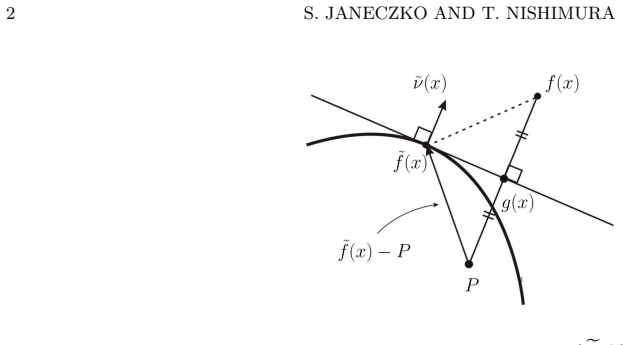
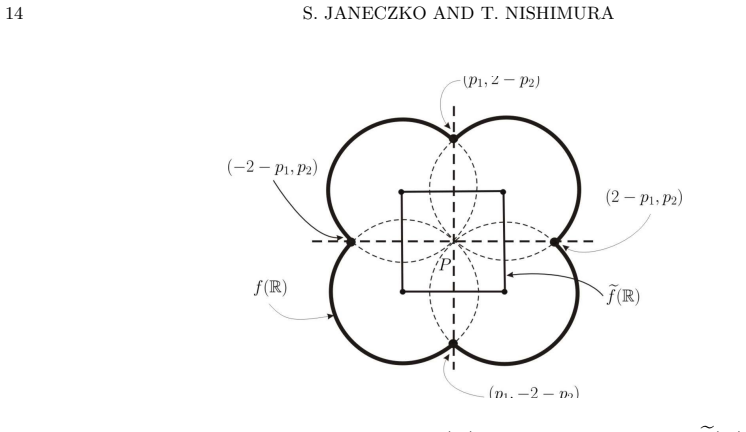
Let f: N^n → R^{n+1} be a frontal with Gauss mapping nu and let P be a point such that (f(x)-P)·nu(x) ≠ 0 for all x. Define the map by the displayed formula that subtracts from f(x) the term (||f(x)-P||² / (2(f(x)-P)·nu(x))) nu(x). Then the image map is itself a frontal whose Gauss mapping at the new point is exactly (f(x)-P)/||f(x)-P||; this map is the unique anti-orthotomic of f relative to P; the new map satisfies the non-orthogonality condition with its own Gauss image; and the Euclidean distances from the new point to P and from the new point to the original f(x) are identical.
What carries the argument
The explicit correction formula that subtracts a multiple of the original Gauss map nu from f to obtain the anti-orthotomic.
If this is right
- The same construction supplies a generalization of the Cahn-Hoffman vector formula.
- It supplies a direct optical interpretation of anti-orthotomics.
- It yields an explicit criterion that decides whether a given frontal is a front.
Where Pith is reading between the lines
- The distance equality may allow anti-orthotomics to be used as a canonical reflection construction in geometric optics.
- Uniqueness suggests the anti-orthotomic operation behaves like a well-defined involution on the space of frontals satisfying the non-orthogonality condition.
- The same formula could be tested numerically on singular surfaces to check preservation of frontality in examples.
Load-bearing premise
The vector from P to each point of f must never be perpendicular to the Gauss map nu, otherwise the correction term is undefined.
What would settle it
A concrete frontal f and point P for which the constructed map fails to have Gauss image equal to the normalized vector from P, or for which a second distinct anti-orthotomic exists.
Figures
read the original abstract
Let $f: N^n\to \mathbb{R}^{n+1}$ be a frontal with its Gauss mapping $\nu: N\to S^n$ and let $P\in \mathbb{R}^{n+1}$ be a point such that $(f(x)-P)\cdot \nu(x) \ne 0$ for any $x\in N$. In this paper, for the mapping $\widetilde{f}: N\to \mathbb{R}^{n+1}$ defined by $$ \widetilde{f}(x)=f(x)-\frac{||f(x)-P||^2}{2(f(x)-P) \cdot \nu(x)}\nu(x), $$ the following four are shown. (1) $\widetilde{f}$ is a frontal with its Gauss mapping $\widetilde{\nu}(x)=\frac{f(x)-P}{||f(x)-P||}$ at $\widetilde{f}(x)$. (2) $\widetilde{f}$ is the unique anti-orthotomic of $f$ relative to $P$. (3) The property $(\widetilde{f}(x)-P)\cdot \widetilde{\nu}(x)\ne 0 $ holds for any $x\in N$. (4) The equality $||\widetilde{f}(x)-P||=||\widetilde{f}(x)-f(x)||$ holds for any $x\in N$. Moreover, three applications of the main result are given. As the first application, a generalization of Cahn-Hoffman vector formula is given. The second application is to clarify an optical meaning of anti-orthotomics. The third application gives a criterion to be a front for a given frontal.
Editorial analysis
A structured set of objections, weighed in public.
Referee Report
Summary. The paper defines, for a frontal f: N^n → R^{n+1} with Gauss mapping ν and point P satisfying (f(x)−P)·ν(x) ≠ 0, the map tilde f(x) = f(x) − [||f(x)−P||² / (2(f(x)−P)·ν(x))] ν(x). It proves four properties: (1) tilde f is a frontal whose Gauss map at tilde f(x) is tilde ν(x) = (f(x)−P)/||f(x)−P||; (2) tilde f is the unique anti-orthotomic of f relative to P; (3) (tilde f(x)−P)·tilde ν(x) ≠ 0 holds; (4) ||tilde f(x)−P|| = ||tilde f(x)−f(x)||. Three applications follow: a generalization of the Cahn-Hoffman vector formula, an optical interpretation of anti-orthotomics, and a criterion for a given frontal to be a front.
Significance. If the proofs are correct, the explicit construction supplies a canonical anti-orthotomic for any frontal meeting the stated non-degeneracy condition. The distance equality and inherited Gauss map furnish concrete geometric relations that may be used to study singularities of fronts; the listed applications indicate direct links to classical vector formulas and to the geometry of reflection.
minor comments (3)
- [Abstract / §2] The abstract states that the four properties are shown, but the manuscript should include a short remark after the definition (near Eq. (1)) clarifying whether the uniqueness in (2) is with respect to the same non-degeneracy condition or a weaker one.
- [Throughout] Notation for the sphere S^n and the inner product should be fixed consistently; the manuscript occasionally writes · and sometimes omits the subscript on the norm when the ambient space is clear.
- [§5] The third application (criterion for a frontal to be a front) would benefit from an explicit statement of the criterion in terms of the original data f, ν, P rather than only in terms of tilde f.
Simulated Author's Rebuttal
We thank the referee for the careful reading and positive evaluation of the manuscript, including the accurate summary of the main results and applications. The recommendation for minor revision is noted. No specific major comments were provided in the report.
Circularity Check
Explicit construction; no circularity in derivation chain
full rationale
The paper defines an explicit mapping tilde f via the given formula under the non-degeneracy hypothesis (f(x)-P)·ν(x)≠0. It then directly verifies the four listed properties (frontal property with specified Gauss map, uniqueness as anti-orthotomic relative to P, inherited non-degeneracy, and distance equality) from this definition and the definition of anti-orthotomic. No step reduces a claimed prediction or uniqueness result to a fitted parameter, self-citation, or ansatz smuggled from prior work by the same authors. The construction is self-contained against the stated assumptions and does not rename a known result or import uniqueness via self-citation.
Axiom & Free-Parameter Ledger
Reference graph
Works this paper leans on
-
[1]
N. Alamo and C. Criado, Generalized antiorthotomics and singularities, Inverse Problems, 18 (2002), 881–889. ANTI-ORTHOTOMICS OF FRONTALS AND THEIR APPLICATIONS 17
work page 2002
-
[2]
V. I. Arnol’d, Singularities of Caustics and Wavefronts , Mathematics and its Applications, 62, Springer Netherland, Dordrecht, 1990
work page 1990
-
[3]
V. I. Arnol’d, S. M. Gusein-Zade, and A. N. Varchenko, Singularities of Differentiable Maps I , Monographs in Mathematics 82, Birkh¨ auser, Boston Basel Stuttgart, 1985
work page 1985
-
[4]
J. W. Bruce and P. J. Giblin, Curves and Singularities (second edition), Cambridge University Press, Cambridge, 1992
work page 1992
-
[5]
J. W. Bruce, P. J. Giblin and C. G. Gibson, On caustics by reflection, Topology, 21 (1982), 179–199
work page 1982
-
[6]
S. Fujimori, K. Saji, M. Umehara and K. Yamada, Singularities of maximal surfaces , Math. Z., 259 (2008), 827–848
work page 2008
- [7]
-
[8]
Herring, Some theorems on the free energies of crystal surfaces , Physical Review, 82 (1951), 87–93
C. Herring, Some theorems on the free energies of crystal surfaces , Physical Review, 82 (1951), 87–93
work page 1951
-
[9]
D. W. Hoffman and J. W. Cahn, A vector thermodynamics for anisotropic surfaces , Surface Science, 31 (1972), 368–388
work page 1972
- [10]
- [11]
-
[12]
G. Ishikawa, Several questions on singularities: theories and applications , RIMS Kˆ okyˆ uroku,1122 (2000), 113–126
work page 2000
-
[13]
G. Ishikawa, Opening of differentiable map-germs and unfoldings , Topics on real and complex singu- larities, 87–113, World Sci. Publ., Hackensack, NJ, 2014
work page 2014
-
[14]
Ishikawa, Singularities of frontals, Adv
G. Ishikawa, Singularities of frontals, Adv. Stud. Pure Math., 78, 55–106, Math. Soc. Japan, Tokyo, 2018
work page 2018
-
[15]
Non-uniqueness of closed embedded non-smooth hypersurfaces with constant anisotropic mean curvature
Y. Jikumatsu and M. Koiso, Non-uniqueness of closed embedded non-smooth hypersurfaces with constant anisotropic mean curvature, preprint (arXiv: 1903.03958v1 [math.DG])
work page internal anchor Pith review Pith/arXiv arXiv 1903
-
[16]
D. Kagatsume and T. Nishimura, Aperture of plane curves , J. Singul., 12 (2015), 80–91
work page 2015
-
[17]
Uniqueness of stable closed non-smooth hypersurfaces with constant anisotropic mean curvature
M. Koiso, Uniqueness of stable closed non-smooth hypersurfaces with constant anisotropic mean curvature, preprint (arXiv: 1903.03951v1 [math.DG])
work page internal anchor Pith review Pith/arXiv arXiv 1903
- [18]
-
[19]
Morgan, The cone over the Clifford torus in R4 is F-minimizing, Math
F. Morgan, The cone over the Clifford torus in R4 is F-minimizing, Math. Ann., 289 (1991), no. 2, 341–354
work page 1991
-
[20]
Nishimura, Jacobian squared function-germs, Pure Appl
T. Nishimura, Jacobian squared function-germs, Pure Appl. Math. Q., 13 (2017), 711–728
work page 2017
-
[21]
T. Nishimura and Y. Sakemi, View from inside , Hokkaido Math. J., 40 (2011), 361–373
work page 2011
-
[22]
T. Nishimura and Y. Sakemi, Topological aspect of Wulff shapes , J. Math. Soc. Japan, 66 (2014), 89–109
work page 2014
-
[23]
K. Saji, M. Umehara and K. Yamada, The geometry of fronts , Annals of Math., 169-2 (2009), 491–529
work page 2009
-
[24]
M. Takahashi, Envelopes of Legendre curves in the unit tangent bundle over the Euclidean plane , Results Math., 71 (2017), 1473–1489
work page 2017
-
[25]
M. Takahashi, Envelopes of families of Legendre mappings in the unit tangent bundle over the Eu- clidean space, J. Math. Anal. Appl., 473 (2019), 408–420
work page 2019
-
[26]
Taylor, Crystalline variational problems , Bull
J. Taylor, Crystalline variational problems , Bull. Amer. Math. Soc., 84 (1978), 568–588
work page 1978
-
[27]
V. M. Zakalyukin and A. N. Kurbatski˘ ı,Envelope singularities of families of planes in control theory , Proc. Steklov Inst. Math., 262 (2008), 66–79. Institute of Mathematics, Polish Academy of Sciences, ul. Sniadeckich 8, 00-956 W ar- saw, POLAND, and, F aculty of Mathematics and Information Science, W arsaw University of Technology, ul. Koszykowa 75, 0...
work page 2008
discussion (0)
Sign in with ORCID, Apple, or X to comment. Anyone can read and Pith papers without signing in.