REVIEW 2 major objections 1 minor 58 references
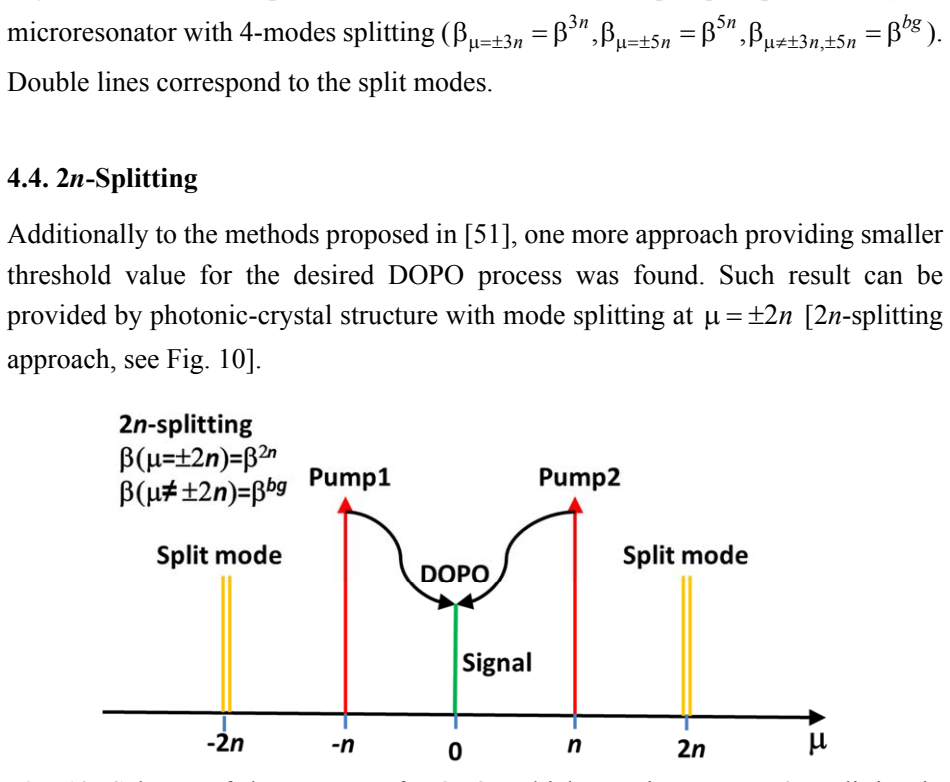
A photonic-crystal microresonator with symmetrically placed split modes lowers the pump power threshold for bichromatic degenerate optical parametric oscillations in normal dispersion.
Reviewed by Pith at T0; open to challenge. T0 means a machine referee read the full paper against a public rubric. the ladder, T0–T4 →
T0 review · grok-4.3
2026-06-26 03:14 UTC pith:LY4UIWUQ
load-bearing objection Numerical simulations claim threshold reduction for degenerate OPO via symmetric split modes under bichromatic pumping, but the complete lack of model details makes the result hard to assess. the 2 major comments →
Low-Threshold Degenerate Optical Parametric Oscillations in Bichromatically-Pumped Normal-Dispersion Photonic-Crystal Microresonator
The pith
A machine-rendered reading of the paper's core claim, the machinery that carries it, and where it could break.
Core claim
In a normal-dispersion photonic-crystal microresonator pumped bichromatically, the photonic-crystal structure inducing two split modes symmetrically positioned at a particular frequency interval from the pumped modes leads to a substantial reduction in the pump power threshold for degenerate optical parametric oscillations. The parameter range supporting this low-threshold behavior is identified, while splitting at the central signal mode increases the threshold.
What carries the argument
Photonic-crystal-induced mode splitting with symmetric placement at a specific interval from the bichromatic pumped modes, which alters mode interactions to reduce the oscillation threshold.
Load-bearing premise
The numerical model of the resonator dynamics accurately captures the physical behavior, including the effects of mode splitting and dispersion, without unmodeled losses or fabrication deviations that would alter the threshold in a real device.
What would settle it
Fabricate the photonic-crystal microresonator with the described symmetric split modes, measure the actual pump power threshold for degenerate parametric oscillations, and compare it directly to the simulated threshold without those split modes.
If this is right
- Significant reduction in pump power threshold occurs when split modes are placed symmetrically at the particular interval from the pumped modes.
- The low-threshold phenomenon is confined to a determined range of splitting parameters and dispersion values.
- Mode splitting introduced at the central signal mode instead increases the generation threshold.
- The effect is demonstrated through numerical simulation of the resonator dynamics under bichromatic pumping.
Where Pith is reading between the lines
- The design could support lower-power operation of integrated nonlinear sources if fabrication matches the modeled splitting.
- Similar symmetric splitting might reduce thresholds in related processes such as four-wave mixing or comb generation.
- Precise control over mode positions would be needed to maintain the reported threshold benefit across devices.
Editorial analysis
A structured set of objections, weighed in public.
Referee Report
Summary. The manuscript numerically studies degenerate optical parametric oscillations (OPO) excited by bichromatic pumping in a normal-dispersion photonic-crystal microresonator. It claims that a photonic-crystal structure inducing two split modes placed symmetrically at a specific frequency interval from the pumped modes yields a significant reduction in the pump power threshold. The parameter range supporting this reduction is determined, while mode splitting introduced at the central signal mode is shown to increase the threshold instead.
Significance. If the numerical results hold under a validated model, the work identifies a design principle—symmetric mode splitting via photonic-crystal perturbation—for lowering OPO thresholds in normal-dispersion microresonators, where such processes are otherwise difficult. This could inform engineering of low-power nonlinear frequency conversion in integrated photonic platforms. The approach of using controlled mode splitting to optimize coupling and dispersion offers a potentially generalizable strategy, though its practical impact depends on the fidelity of the underlying simulations to real-device physics.
major comments (2)
- [Numerical Methods / Simulation Description] The abstract states that numerical simulations demonstrate the threshold reduction, yet the manuscript provides no description of the governing equations (e.g., Lugiato-Lefever equation or coupled-mode model), discretization method, convergence checks, loss terms, or how the photonic-crystal-induced mode splitting is implemented. This absence is load-bearing for the central claim, as the reported threshold drop cannot be verified or distinguished from possible numerical artifacts without these details.
- [Results / Parameter Range Determination] The claim that symmetrically placed split modes at a 'particular interval' from the pumped modes reduces threshold (and that splitting at the signal mode increases it) is presented without quantitative specification of the interval relative to the dispersion profile, pump frequencies, or free spectral range. No equation or figure quantifies this interval or shows the associated parameter sweep, undermining assessment of the reported phenomenon's robustness.
minor comments (1)
- [Introduction] The abstract and introduction would benefit from explicit citations to prior work on bichromatic pumping and photonic-crystal microresonators to better contextualize the novelty of the mode-splitting approach.
Simulated Author's Rebuttal
We thank the referee for their thorough review and insightful comments. We address each major comment below and plan to revise the manuscript to improve clarity and completeness.
read point-by-point responses
-
Referee: [Numerical Methods / Simulation Description] The abstract states that numerical simulations demonstrate the threshold reduction, yet the manuscript provides no description of the governing equations (e.g., Lugiato-Lefever equation or coupled-mode model), discretization method, convergence checks, loss terms, or how the photonic-crystal-induced mode splitting is implemented. This absence is load-bearing for the central claim, as the reported threshold drop cannot be verified or distinguished from possible numerical artifacts without these details.
Authors: We agree with the referee that additional details on the numerical methods are necessary for verification of the results. In the revised manuscript, we will include a description of the Lugiato-Lefever equation (or coupled-mode model) employed, the discretization method used, convergence checks performed, the loss terms included, and the specific implementation of the photonic-crystal-induced mode splitting through frequency perturbations. revision: yes
-
Referee: [Results / Parameter Range Determination] The claim that symmetrically placed split modes at a 'particular interval' from the pumped modes reduces threshold (and that splitting at the signal mode increases it) is presented without quantitative specification of the interval relative to the dispersion profile, pump frequencies, or free spectral range. No equation or figure quantifies this interval or shows the associated parameter sweep, undermining assessment of the reported phenomenon's robustness.
Authors: We acknowledge that the manuscript would benefit from more explicit quantification. We will revise to specify the 'particular interval' quantitatively in relation to the dispersion profile and free spectral range, and add or clarify a figure or equation demonstrating the parameter sweep over this interval to show the range where the threshold reduction occurs. revision: yes
Circularity Check
No circularity: threshold reduction shown via forward numerical simulation of physical model
full rationale
The paper reports results from numerical simulation of degenerate OPO in a photonic-crystal microresonator under bichromatic pumping. The central claim (threshold reduction due to symmetrically placed split modes) is obtained by solving the resonator dynamics equations forward in parameter space; no parameters are fitted to the target threshold, no self-citation chain justifies a uniqueness theorem, and no ansatz is smuggled in. The derivation chain is therefore self-contained against external benchmarks and does not reduce to its own inputs by construction.
Axiom & Free-Parameter Ledger
read the original abstract
The process of excitation of degenerate optical parametric oscillations via bichromatic pump is studied numerically in normal-dispersion photonic-crystal microresonator. It is demonstrated that the photonic-crystal structure with two split modes placed symmetrically at the particular interval from the pumped modes provides significant reduction in pump power threshold for the considered process. The parameter range for this phenomenon is determined. Introduction of mode splitting at the signal mode located in the center between pumped modes leads to an increase in the generation threshold.
Figures




Reference graph
Works this paper leans on
-
[1]
Optical resonators with whis pering-gallery modes-part II: applications,
V.S. Ilchenko and A.B. Matsko, “Optical resonators with whis pering-gallery modes-part II: applications,” IEEE J. Sel. Top. Quantum Electron., 12, 15-32 (2006)
2006
-
[2]
Nonlinear and quantum optics with whispering gallery resonators,
D.V. Strekalov, C. Marquard, A.B. Matsko, et al., “Nonlinear and quantum optics with whispering gallery resonators,” J. Opt. 18, 123002 (2016)
2016
-
[3]
Nonlinear photonics wi th high-Q whispering-gallery-mode resonators,
G. Lin, A. Coillet, and Y.K. Chembo, “Nonlinear photonics wi th high-Q whispering-gallery-mode resonators,” Adv. Opt. Photon. 9, 828-890 (2017)
2017
-
[4]
Temporal solitons in optical microresonators,
T. Herr, V. Brasch, J. D. Jost , C.Y. Wang, N.M. Kondratiev, M.L. Gorodetsky, and T.J. Kippenberg, “Temporal solitons in optical microresonators,” Nat. Photonics 8, 145 (2014)
2014
-
[5]
Dissipative Kerr solitons in optical microresonators,
T.J. Kippenberg, A.L. Gaeta, M. Lipson, and M.L. Gorodetsky, “Dissipative Kerr solitons in optical microresonators,” Science 361, eaan8083 (2018)
2018
-
[6]
Photonic frequency microcombs based on dissipative Kerr and quadratic cavity solitons,
M. Nie, Y. Xie, B. Li, and S.-W. Huang, “Photonic frequency microcombs based on dissipative Kerr and quadratic cavity solitons,” Prog. Quant um Electron. 86, 100437 (2022)
2022
-
[7]
Microcombs: A novel generation of optical sources,
A. Pasquazi, M. Peccianti, L. Razzari, D. J. Moss, S. Coen, M. Erkintalo, Y.K. Chembo, T. Hansson, S. Wabnitz, P. Del’Haye, X. Xue, A.M. Weine r, and R. Morandotti, “Microcombs: A novel generation of optical sources,” Phys. Rep. 729, 1 (2018)
2018
-
[8]
Photonic-chip-b ased frequency combs,
A.L. Gaeta, M. Lipson, and T.J. Kippenberg, “Photonic-chip-b ased frequency combs,” Nat. Photonics 13, 158 (2019). 22
2019
-
[9]
Emerging material systems for integrated optical Kerr frequency combs,
A. Kovach, D. Chen, J. He, H. Choi, A.H. Dogan, M. Ghasemkha ni, H. Taheri, and A.M. Armani, “Emerging material systems for integrated optical Kerr frequency combs,” Adv. Opt. Photonics 12, 135 (2020)
2020
-
[10]
Applications of optical microcombs,
Y. Sun, J. Wu, M. Tan, X. Xu, Y. Li, R. Morandotti, A. Mitchell, and D.J. Moss, “Applications of optical microcombs,” Adv. Opt. Photonics 15, 86 (2023)
2023
-
[11]
Integrated optical frequency division for microwave and mmWave generation,
S. Sun, B. Wang, K. Liu., M. W. Harrington, F. Tabatabaei, R. Liu, J. Wang, S. Hanifi, J.S. Morgan, M. Jahanbozor gi, Z. Yang, S.M. Bowers, P.A . Morton, K.D. Nelson, A. Beling, D.J. Blumenthal, X. Yi, “Integrated optical frequency division for microwave and mmWave generation,” Nature 627, 540 (2024)
2024
-
[12]
Photonic chip-b ased low-noise microwave oscillator,
I. Kudelin, W. Groman, Q.X. Ji, J. Guo, M.L. Kelleher, D. L ee, T. Nakamura, C.A. McLemore, P. Shirmohammadi, S. Hanifi, H. Cheng, N. Jin, L . Wu, S. Halladay, Y. Luo, Z. Dai, W. Jin, J. Bai, Y. Liu, W. Zhang, C. Xiang, L. Chang, V. Iltchenko, O. Miller, A. Matsko, S .M. Bowers, P.T. Rakich, J.C. C a m p b e l l , J . E . Bowers, K.J. Vahala, F. Quinlan, ...
2024
-
[13]
All-optical frequenc y division on-chip using a sin gle laser,
Y. Zhao, J.K. Jang, G.J. Beal s, K.J. McNulty, X. Ji, Y. Oka wachi, M. Lipson, A.L. Gaeta, “All-optical frequenc y division on-chip using a sin gle laser,” Nature 627, 546 (2024)
2024
-
[14]
Microcav ity Kerr optical frequency div ision with integrated SiN photonics,
S. Sun, M.W. Harrington, F. Tabatabaei, S. Hanifi, K. Liu, J. Wang, B. Wang, Z. Yang, R. Liu, J.S. Morgan, S.M. Bowers, P.A. Morton, K.D. Ne lson, A. Beling, D.J. Blumenthal, X. Yi, “Microcav ity Kerr optical frequency div ision with integrated SiN photonics,” Nat. Photon. 19, 637 (2025)
2025
-
[15]
Microresonator -referenced soliton microcombs with zeptosecond-level timing noise,
X. Jin, Z. Xie, X. Zhang, H. Hou, B. Wu, F. Zhang, X. Zhang , L. Chang, Q. Gong, Q.-F. Yang, “Microresonator -referenced soliton microcombs with zeptosecond-level timing noise,” Nat. Photon. 19, 630 (2025)
2025
-
[16]
Selective engine ering of cavity resonance for frequency matching in optical parametric processes,
X. Lu, S. Rogers, W.C. Jiang, and Q. Lin, “Selective engine ering of cavity resonance for frequency matching in optical parametric processes,” Appl. Phys. Lett. 105, 151104 (2014). 17 G. Moille, X. Lu, J. Stone, D. Westly, and K. Srinivasan, “F ourier synthesis dispersion engineering of photoni c crystal microrings for broad band frequency combs,” Commun....
2014
-
[17]
Band flipping and bandgap closing in a photonic crystal ring and its applications,
X. Lu, A. Chanana, Y. Sun, A. McClung, M. Davanco, and K. Srinivasan, “Band flipping and bandgap closing in a photonic crystal ring and its applications,” Opt. Express 32, 20360 (2024)
2024
-
[18]
Spontaneous pulse formation in edgeless photonic crystal resonators,
S.-P. Yu, D.C. Cole, H. Jung, G.T. Moille, K. Srinivasan, a nd S.B. Papp, “Spontaneous pulse formation in edgeless photonic crystal resonators,” Nat. Photon. 15, 461 (2021)
2021
-
[19]
Next-generation soliton frequency combs in photonic-crystal and nanocomposite microresonators,
H. Liu, A. Carollo, J. Zang, and S.B. Papp, “Next-generation soliton frequency combs in photonic-crystal and nanocomposite microresonators,” arXiv:2508.13393 (2025)
-
[20]
A continuum of bright and dark- pulse states in a photonic-crystal resonator,
S.P. Yu, E. Lucas, J. Zang, and S.B. Papp, “A continuum of bright and dark- pulse states in a photonic-crystal resonator,” Nat. Commun. 13(1), 3134 (2022)
2022
-
[21]
High-Q slow light an d its localization in a photonic crystal microring,
X. Lu, A. McClung, and K. Srinivasan, “High-Q slow light an d its localization in a photonic crystal microring,” Nat. Photon. 16, 66 (2022)
2022
-
[22]
Optical-parametric oscillation in photonic-crystal ring resonators,
J.A. Black, G. Brodnik, H. Liu, S.-P. Yu, D.R. Carlson, J. Zang, T.C. Briles, and S.B. Papp, “Optical-parametric oscillation in photonic-crystal ring resonators,” Optica 9, 1183 (2022)
2022
-
[23]
Activating high-power parametric oscillation in photonic-crystal resonators,
G. Brodnik, L.M. Williams, H. Liu, D.R. Carlson, A. Dan, J.A. Black, and S.B. Papp, “Activating high-power parametric oscillation in photonic-crystal resonators,” arXiv:2504.07947 (2025)
-
[24]
Quadrature squeezing in a nanophotonic microresonator,
A.E. Ulanov, B. Ruhnke, T. Wildi, and T. Herr, “Quadrature squeezing in a nanophotonic microresonator,” Nat. Commun. 16, 10791 (2025)
2025
-
[25]
Multi-dimensional data transmission using inverse- designed silicon photonics and microcombs,
K.Y. Yang, C. Shirpurkar, A. D. White, J. Zang, L. Chang, F . Ashtiani, M.A. Guidry, D.M. Lukin, S.V. Pericherla, J. Yang, H. Kwon, J. Lu, G . H. Ahn, K. Van Gasse, Y. Jin, S.-P. Yu, T.C. Briles, J.R. Stone, D.R. Carlson, H. Song, K. Zou, H. Zhou, K. Pang, H. Hao, L. Trask, M. Li, A. Netherton, L. Rechtman, J. S. Stone, J.L. Skarda, L. Su., D. Vercruysse,...
2022
-
[26]
Synthetic reflection self-injec tion-locked microcombs,
A.E. Ulanov, T. Wildi, N.G. Pavlov, J. D. Jost, M. Karpov, and T. Herr, “Synthetic reflection self-injec tion-locked microcombs,” Nat. P hoton. 18, 294 (2024). 24
2024
-
[27]
Phot onic bandgap microcombs at 1064 nm ,
G. Spektor, J. Zang, A. Dan, T.C. Briles, G.M. Brodnik, H. Liu, J.A. Black, D.R. Carlson, and S.B. Papp; “Phot onic bandgap microcombs at 1064 nm ,” APL Photonics, 9(2), 021303 (2024)
2024
-
[28]
Laser power consumption of soliton formation in a bidirectional Kerr resonator,
J. Zang, S.-P.Yu, H. Liu, Y. Jin, T. C. Briles, D.R. Carlson, and S.B. Papp, “Laser power consumption of soliton formation in a bidirectional Kerr resonator,” Nat. Photon. 19, 510 (2025)
2025
-
[29]
Generati on of triangular pulse trains in normal-dispersion photonic crystal microresonat ors
V.E. Lobanov, O.V. Borovkova, A.K. Vorobyev, D.M. Sokol, N. Y. Dmitriev, A.E. Shitikov, D.A. Chermoshentsev, and I.A. Bilenko, “Generati on of triangular pulse trains in normal-dispersion photonic crystal microresonat ors”, Phys. Rev. A 110, 063526 (2024)
2024
-
[30]
The bandgap-detuned excitation regime in photonic-crystal resonator s,
Y. Jin, E. Lucas, J. Zang, T. Briles, I. Dickson, D. Carlson, and S.B. Papp, “The bandgap-detuned excitation regime in photonic-crystal resonator s,” Nat. Commun. 16, 5077 (2025)
2025
-
[31]
Controllable sw itching of platicon propagation direction in normal-dispersion photonic-crystal microresonators
V.E. Lobanov, O.V. Borovkova , A.E. Shitikov, I.A. Bilenko, and D.A. Chermoshentsev, “Controllable sw itching of platicon propagation direction in normal-dispersion photonic-crystal microresonators” Phys. Rev. A 112, 063526 (2025)
2025
-
[32]
Induced directional switching of platicon microcombs in photonic crystal ring resonators,
E. Lucas, S.-P. Yu, J. Zang, S.B. Papp, “Induced directional switching of platicon microcombs in photonic crystal ring resonators,” arXiv:2606.21 437 (2026)
2026
-
[33]
Stability analysis of the spatiotemporal Lugiato-Lefever model for Kerr optical frequ ency combs in the anomalous and normal dispersion regimes,
C. Godey, I. V. Balakireva, A. Coillet, and Y. K. Chembo, “Stability analysis of the spatiotemporal Lugiato-Lefever model for Kerr optical frequ ency combs in the anomalous and normal dispersion regimes,” Phys. Rev. A 89, 063814 (2014)
2014
-
[34]
Normal-dispersion microre sonator Kerr frequency combs,
X. Xue, M. Qi, and A. M. Weiner, “Normal-dispersion microre sonator Kerr frequency combs,” Nanophotonics 5, 244 (2016)
2016
-
[35]
Quantum random number generator using a microresonator-based Kerr oscillator,
Y. Okawachi, M. Yu, K. Luke, D.O. Carvalho, M. Lipson, and A.L. Gaeta, “Quantum random number generator using a microresonator-based Kerr oscillator,” Opt. Lett. 41, 4194 (2016)
2016
-
[36]
All-optical quantum random bit generation fro m intrinsically binary phase o f parametric oscillators,
A. Marandi, N.C. Leindecker, K.L. Vodopyanov, and R.L. Byer , “All-optical quantum random bit generation fro m intrinsically binary phase o f parametric oscillators,” Opt. Express 20, 19322 (2012). 25
2012
-
[37]
C oherent Ising machine based on degenerate opti cal parametric oscillators,
Z. Wang, A. Marandi, K. Wen, R.L. Byer, and Y. Yamamoto, “C oherent Ising machine based on degenerate opti cal parametric oscillators,” Ph ys. Rev. A 88, 063853 (2013)
2013
-
[38]
Inagaki, K
T. Inagaki, K. Inaba, R. Hamerly, K. Inoue, Y. Yamamoto, an d H. Takesue, Large-scale Ising spin network based on degenerate optical parametric oscillators,” Nat. Photonics 10, 415 (2016)
2016
-
[39]
Network of time- multiplexed optical parametric oscillators as a coherent Ising machine,
A. Marandi, Z. Wang, K. Takata, R. Byer, and Y. Yamamoto, “Network of time- multiplexed optical parametric oscillators as a coherent Ising machine,” Nat. Photonics 8, 937 (2014)
2014
-
[40]
Coherent Ising machines—Optical neural networks operating at the quantum limit,
Y. Yamamoto, K. Aihara, T. Leleu, K.-I. Kawarabayashi, S. Kako, M. Fejer, K. Inoue, and H. Takesue, “Coherent Ising machines—Optical neural networks operating at the quantum limit,” npj Quantum Inf. 3, 1 (2017)
2017
-
[41]
Scalable squeezed-light source for continuous-variable q uantum sampling,
Z. Vernon, N. Quesada, M. Liscidini, B. Morrison, M. Menott i, K. Tan, and J. Sipe, “Scalable squeezed-light source for continuous-variable q uantum sampling,” Phys. Rev. Appl. 12, 064024 (2019)
2019
-
[42]
On-chip χ(2) microring optical parametric oscillator,
A. W. Bruch, X. Liu, J. B. Surya, C.-L. Zou, and H. X. Tang , “On-chip χ(2) microring optical parametric oscillator,” Optica 6, 1361 (2019)
2019
-
[43]
Demonstration of chi p-based coupled degenerate optic al parametric oscillators for realizing a nanophotonic spin-glass,
Y. Okawachi, M. Yu, J. K. Jang, X. Ji, Y. Zhao, B. Y. Kim, M. Lipson, and A. L. Gaeta, “Demonstration of chi p-based coupled degenerate optic al parametric oscillators for realizing a nanophotonic spin-glass,” Nat. Commun. 11, 4119 (2020)
2020
-
[44]
Bichromatically pumped microresonator frequency combs,
T. Hansson and S. Wabnitz, “Bichromatically pumped microresonator frequency combs,” Phys. Rev. A 90, 013811 (2014)
2014
-
[45]
Dual-pumped dege nerate Kerr oscillator in a si licon nitride microresonator,
Y. Okawachi, M. Yu, K. Luke, D.O. Carvalho, S. Ramelow, A. Farsi, M.Lipson, and A.L. Gaeta, “Dual-pumped dege nerate Kerr oscillator in a si licon nitride microresonator,” Opt. Lett. 40, 5267 (2015)
2015
-
[46]
Integrated coherent Ising mac hines based on self-phase modulation in microring resonators,
N. Tezak, T. Van Vaerenbergh, J. S. Pelc, G. J. Mendoza, D. Kielpinski, H.Mabuchi, and R. G. Beausoleil, “Integrated coherent Ising mac hines based on self-phase modulation in microring resonators,” IEEE J. Sel. To p. Quantum Electron. 26, 1 (2020)
2020
-
[47]
Ising machines a s hardware solvers of combinatorial optimization problems,
N. Mohseni, P. L. McMahon, and T. Byrnes, “Ising machines a s hardware solvers of combinatorial optimization problems,” Nat. Rev. Phys. 4, 363 (2022). 26
2022
-
[48]
Scalable on-chip optoelectronic Ising machine utilizing thin-film lithium niobate photonics,
Z. Li, R. Gan, Z. Chen, Z. Deng, R. Gao, K. Chen, C. Guo, Y. Zhang, L. Liu, S. Yu, and J. Liu, “Scalable on-chip optoelectronic Ising machine utilizing thin-film lithium niobate photonics,” ACS Photonics 11, 1703 (2024)
2024
-
[49]
Near- degenerate quadrature-squeezed vacuum generation on a silicon-nitride chip,
Y. Zhao, Y. Okawachi, J.K. Jang, X. Ji, M. Lipson, and A.L. Gaeta, “Near- degenerate quadrature-squeezed vacuum generation on a silicon-nitride chip,” Phys. Rev. Lett. 124, 193601 (2020)
2020
-
[50]
Optimizat ion of the threshold for degenerate optical parametric oscillations in a bichromatically pumped microresonator,
N.S. Tatarinova, A.E. Shitikov, G.V. Grechko, A.K. Vorobyev , A.V. Masalov, I.A. Bilenko, D.A. Chermoshents ev, and V.E. Lobanov, “Optimizat ion of the threshold for degenerate optical parametric oscillations in a bichromatically pumped microresonator,” Phys. Rev. Applied 24, 024010 (2025)
2025
-
[51]
Optimization of the dual-pumped normal-dispersion integrated p arametric oscillator in the presence of thermal effects
A.K. Vorobyev, N.A. Kapridov, T.R. Yunusov, D.V. Morozov, A .N. Danilin, A.D. Ivanov, A.E. Shitikov, V.E. Lobanov, I.A. Bilenko, and D.A. Chermoshentsev, “Optimization of the dual-pumped normal-dispersion integrated p arametric oscillator in the presence of thermal effects” Phys. Rev. Applied 24, 054054 (2025)
2025
-
[52]
Modulational instability and frequency combs in whispering-gallery-mode microresonators with backscatt ering,
N.M. Kondratiev and V.E. L obanov, “Modulational instability and frequency combs in whispering-gallery-mode microresonators with backscatt ering,” Phys. Rev. A 101, 013816 (2020)
2020
-
[53]
Hierarchy o f coupled mode and envelope mode ls for bi- directional microresonators with Kerr nonlinearity,
D.V. Skryabin, “Hierarchy o f coupled mode and envelope mode ls for bi- directional microresonators with Kerr nonlinearity,” OSA Contin uum 3, 1364 (2020)
2020
-
[54]
Mode-locked da rk pulse Kerr combs in normal-d ispersion microresonators,
X. Xue, Y. Xuan, Y. Liu, P.-H. Wang, S. Chen, J. Wang, D.E. Leaird, M. Qi, and A.M. Weiner, “Mode-locked da rk pulse Kerr combs in normal-d ispersion microresonators,” Nat. Photonics 9, 594 (2015)
2015
-
[55]
Dynamics of mode-coupling-induced microresonator frequency com bs in normal dispersion,
J.K. Jang, Y. Okawachi, M. Y u, K. Luke, X. Ji, M. Lipson, a nd A.L. Gaeta, “Dynamics of mode-coupling-induced microresonator frequency com bs in normal dispersion,” Opt. Express 24, 28794 (2016)
2016
-
[56]
Normal-dispersion microcombs enabled by controllable mode interactions,
X. Xue, Y. Xuan, P.-H. Wang, Y. Liu, D.E. Leaird, M. Qi, an d A.M. Weiner, “Normal-dispersion microcombs enabled by controllable mode interactions,” Laser & Photonics Reviews 9, L23 (2015)
2015
-
[57]
Turn-key, high-efficiency Kerr comb source,
B.Y. Kim, Y. Okawachi, J.K. Jang, M. Yu, X. Ji, Y. Zhao, C. Joshi, M. Lipson, and A.L. Gaeta, “Turn-key, high-efficiency Kerr comb source,” Opt. Lett. 44, 4475 (2019). 27
2019
-
[58]
Dissipative soli tons in photonic molecules,
Ó.B. Helgason, F.R. Arteaga-Sierra, Z. Ye, K. Twayana, P.A. Andrekson, M. Karlsson, J. Schröder, and V. To rres-Company, “Dissipative soli tons in photonic molecules,” Nat. Photonics 15 (4), 305 (2021)
2021
discussion (0)
Sign in with ORCID, Apple, or X to comment. Anyone can read and Pith papers without signing in.