REVIEW 3 major objections 6 minor 68 references
Learning to Adapt Invariance in Memory for Person Re-identification
T0 review · 3 major / 6 minor · reviewed 2026-08-14 · deepseek-v4-flash
Pith's one-line read The paper claims that an unsupervised re-ID model can be adapted to a new domain almost as accurately as a supervised one by storing all target features in a memory and enforcing three invariances: self, camera style, and reliable…
desk verdict Solid extension of ECN with a genuinely new GPP neighbor selector, but the SOTA margin is undermined by hyperparameters tuned on the target test set. read the letter →
The pith
A machine-rendered reading of the paper's core claim, the machinery that carries it, and where it could break.
The reading
What carries the argument
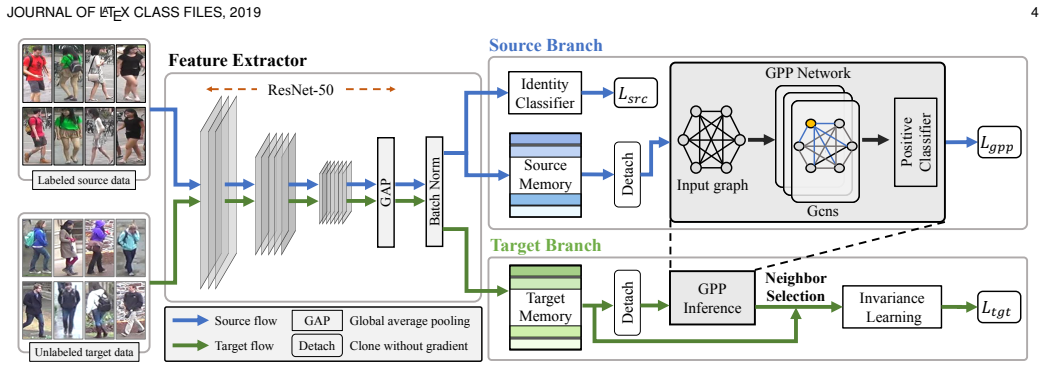
The load-bearing object is the exemplar memory, a feature bank with one slot per training image that stores the L2-normalized, continuously updated feature of every source and target sample, so similarity can be measured against the entire dataset instead of a mini-batch. On top of it sits the graph-based positive prediction (GPP) network: for a probe image it takes the top-k candidates from the memory, builds a complete graph whose node features are centered by subtracting the probe feature, refines the nodes through four graph-convolution layers, and trains a binary positive classifier on labeled source pairs; at target time the trained GPP assigns a positive probability to each candidate and the ones above threshold become the reliable neighbors for neighborhood-invariance. Camera-invariance is fed by CamStyle-transferred images, and the whole target loss is a non-parametric softmax over memory slots with temperature 0.05, which makes the global constraints cheap to evaluate.
What would settle it
Use the target training-set identity labels, which are available for evaluation but not for learning, to measure the precision of the reliable neighbors selected by GPP during training at threshold 0.9; if those neighbors are no more likely to share the probe's identity than the top-k nearest neighbors chosen by raw cosine similarity, then the source-trained positive classifier has not transferred, and the reported gains would come from exemplar- and camera-invariance alone.
Extended reading notes
Core claim
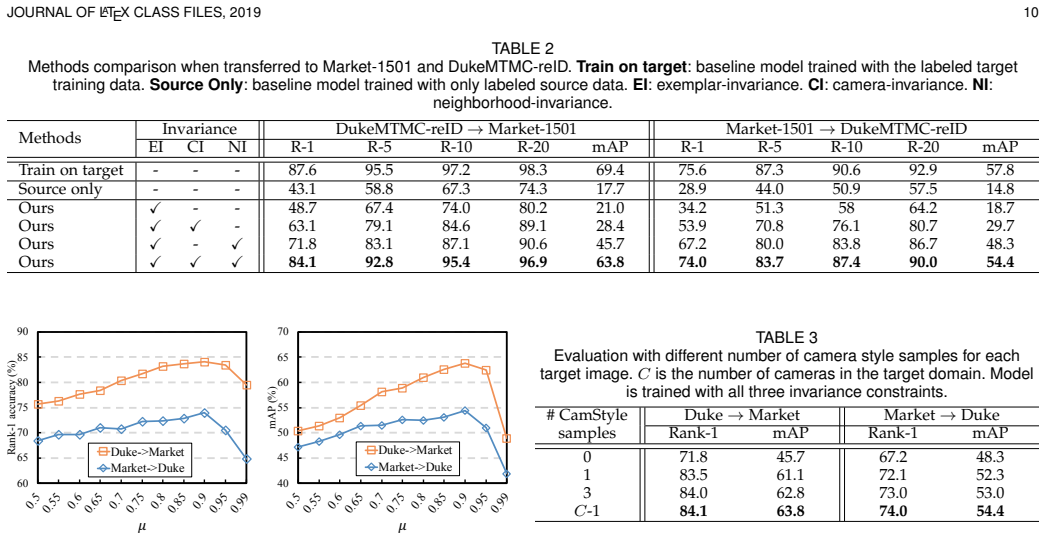
The central claim is that three types of intra-domain invariance, implemented globally rather than inside a mini-batch, are what make a re-ID model transferable. In the paper's own framing, exemplar-invariance (treat every target image as its own class), camera-invariance (pull a real image and its CamStyle-transferred twins together), and neighborhood-invariance (pull an image toward neighbors that a graph predictor believes share its identity) are individually helpful and jointly almost sufficient: on Duke-to-Market, rank-1 rises from 43.1% for the source-only baseline to 84.1%, within 3.5 points of the 87.6% supervised upper bound, and mAP reaches 63.8% versus 43.0% for the previous ECN method. The same pattern holds on Duke and on the harder MSMT17 benchmark, where the method reports rank-1 of 42.5% from Duke as source, compared with 30.2% for ECN. These numbers are the paper's claim, stated on its own terms; they are the evidence the framework is built around, not an independent verification.
Load-bearing premise
The load-bearing premise is that a positive-vs-negative classifier trained on labeled source images can still tell which unlabeled target candidates are the same person as a probe, so that the neighborhood-invariance constraint is taught from true positives rather than from false ones.
Editorial extensions
If this is right
- Without any target identity labels, the method reaches rank-1 84.1% and mAP 63.8% on Market-1501 when Duke is the source, leaving only a 3.5-point rank-1 gap to a model trained directly on labeled target data.
- Ablations show all three invariances matter together: exemplar-invariance alone gives 48.7% rank-1 in the same setting, adding camera-invariance raises it to 63.1%, and adding neighborhood-invariance reaches 84.1%, so the three constraints are complementary rather than redundant.
- The memory replaces mini-batch contrastive learning with global similarity and costs only about 0.02 seconds per iteration and 200 MB extra GPU memory over the mini-batch version, making whole-dataset constraints practical.
- GPP outperforms vanilla top-k neighbor selection in neighbor precision and in final accuracy, and its neighbor recall grows over training while vanilla recall stays flat, indicating the graph-based predictor keeps improving as the model adapts.
Reading between the lines
- An implication left implicit in the paper is that the source-trained GPP's notion of 'same person' is assumed to transfer; if the target domain changes camera geometry or viewing angles so that visual similarity across identities no longer follows the source pattern, a few labeled target pairs would probably be needed to recalibrate the positive classifier.
- The same memory-plus-GPP recipe could be carried over to other open-set unsupervised adaptation tasks where reliable positive pairs exist inside the target set, such as face re-identification across cameras, vehicle re-ID, or wildlife ID, whenever an augmentation or a graph predictor can supply trustworthy positive relations.
- A testable extension suggested by the design is to make the threshold selection soft: instead of keeping only candidates with positive probability above 0.9, the framework could weight all candidates by their predicted probability, which might reduce sensitivity to the threshold and help in domains where true positive density varies per probe.
Signed reviews
Editorial analysis
A structured set of objections, weighed in public.
Referee Report
Summary. The paper proposes an unsupervised domain adaptation (UDA) framework for person re-identification. A shared ResNet-50 backbone is trained with a labeled source domain and an unlabeled target domain. The target branch enforces three invariance constraints: Exemplar-Invariance (each image close to itself, far from all others), Camera-Invariance (each image close to its CamStyle-transferred versions), and Neighborhood-Invariance (each image close to selected reliable neighbors). An exemplar memory stores up-to-date features of the entire target set, allowing these constraints to be applied globally. Reliable neighbors are obtained either by vanilla top-k selection or by a Graph-based Positive Prediction (GPP) network, a small GCN trained on the source domain and then applied to target candidate graphs. Experiments on Market-1501, DukeMTMC-reID, and MSMT17 report large gains over the previous ECN method and claim new state-of-the-art accuracy, approaching the supervised 'train on target' upper bound.
Significance. If the reported results are protocol-clean, this is a significant advance: it demonstrates that memory-based global invariance learning combined with a graph-based neighbor selector can transfer a re-ID model across domains with no target labels, closing much of the gap to the supervised upper bound (e.g., rank-1 74.0 vs. 75.6 for DukeMTMC-reID). The method is precisely specified, and the internal ablations are informative: Table 2 shows the complementarity of EI, CI, and NI; Table 4 isolates the benefit of the exemplar memory and GPP; Fig. 8 gives a direct comparison of neighbor-selection precision/recall between VNS and GPP. The central reservation is the evaluation protocol for hyperparameters, which are selected using the target test partitions. This prevents the state-of-the-art claim from being fully certified as written, even though the underlying method and analyses are largely sound.
major comments (3)
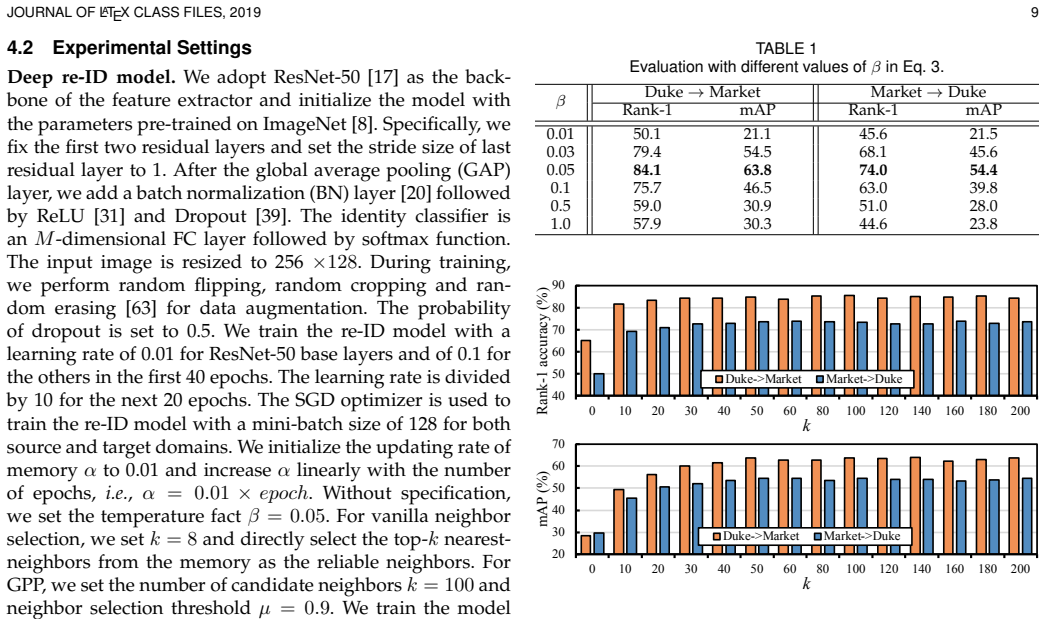
- [Section 4.3, Table 1, Figs. 6-7] The hyperparameters beta, k, and mu are selected by evaluating Rank-1 and mAP on the target test partitions for Duke-to-Market and Market-to-Duke (Table 1 for beta; Fig. 6 for k; Fig. 7 for mu), and then fixed for all remaining experiments. Because the paper's central claim in Section 4.5 is a quantitative superiority result (e.g., mAP 63.8 vs. 43.0 against ECN on Market-1501), test-set-based model selection can inflate the reported margin. Please either introduce a held-out validation partition of the target training set and report final results with hyperparameters fixed without access to the test labels, or demonstrate stability of the final numbers across a wide range of hyperparameters on such a validation split. Without this, the state-of-the-art claim is not fully supported.
- [Section 3.4.2 and Fig. 8] The load-bearing premise that a source-trained GPP network reliably identifies true positive neighbors on the target domain is supported empirically by the precision/recall curves in Fig. 8, but those curves are computed on target data with ground-truth identity labels. Please state explicitly whether these target labels were used only for offline diagnostic evaluation, or whether they also influenced any hyperparameter choice, stopping criterion, or threshold selection. If they influenced model selection, the unsupervised setting is compromised. Providing analogous curves on a target validation split would make the GPP transferability argument robust.
- [Section 3.4.2, Eq. (14), and Section 4.3] The positive-neighbor threshold mu directly controls how many pseudo-labels enter the neighborhood-invariance loss, and the paper chooses mu = 0.9 from the target test-set sensitivity curves in Fig. 7. Since Table 5 shows that the superiority of GPP over VNS depends on threshold-based selection, the test-set choice of mu is not a peripheral detail but is central to the reported improvement. The revision should make the validation procedure for mu explicit and, if necessary, soften the state-of-the-art claim until a test-set-free protocol is used.
minor comments (6)
- [Section 3.4.2] The text says 'we first compute the similarities between f(x_t_i) and features in the target memory F_s'; the symbol should be the target memory F_t, not the source memory F_s.
- [Section 4.5] The text states that the method surpasses ECN 'by 20 and 14.4 points in mAP', but Table 6 gives differences of 20.8 (63.8 - 43.0) and 14.0 (54.4 - 40.4); please correct the arithmetic or clarify the rounding.
- [Table 2] In the Duke-to-Market block, the row 'Ours w/ EI' reports '58 64.2' for R-10 and R-20; this should read '58.0 64.2' or similar, consistent with the other rows.
- [Section 3.3.2] The phrase 'temperature fact' should be 'temperature factor', and 'non-parameterized' should be 'non-parametric'.
- [Table 4] The two dash rows and the accompanying text should clarify exactly which losses are active in the no-memory baseline. As written, the reader may confuse the first row with the 'Source only' baseline, and the text does not explicitly define the mini-batch neighborhood-invariance variant used for the no-memory comparison.
- [Section 4.2] The paper states that the source and target branches share a feature extractor (Fig. 2), but it does not specify whether batch normalization statistics are computed jointly over both domains or separately. A brief sentence would improve reproducibility.
Circularity Check
No significant circularity: the framework's losses are defined from labeled source data and external target benchmarks, and no prediction reduces to its own input by construction.
full rationale
The target-domain losses are design objectives, not derived predictions. Exemplar-, camera-, and neighborhood-invariance are implemented through softmax classification over the exemplar memory (Eqs. 3-8); the only target-side supervision is self-generated pseudo-supervision from the model's own memory features and GPP predictions. GPP itself is trained on the labeled source domain with binary labels derived from source identities (Eqs. 12-13) and is then applied to target candidates (Eq. 14). This is a self-training/transductive engineering loop that can reinforce errors, but it is not a reduction of the reported result to its inputs: the SOTA numbers are measured on fixed target test sets against external baselines, and the method's components (EI, CI, NI) are ablated with the same protocol rather than being defined from the final accuracy. Target identity labels are used only for diagnostic recall/precision curves in Fig. 8, not for training. Self-citations to the authors' HHL [64] and ECN [65] motivate and compare with prior work but are not load-bearing proofs; the cited camera-invariance and neighbor-selection ideas are re-implemented and described in the paper. The one substantive concern is methodological, not circular: Section 4.3 selects beta, k, and mu using the target evaluation partitions (Table 1, Figs. 6-7) before fixing them for the SOTA tables, so the reported margins may be inflated by test-set peeking. That concern belongs under correctness risk, not under circularity, because the selected hyperparameters do not make any equation equivalent to its own input.
Assumptions & free parameters
free parameters (5)
- beta (temperature factor) =
0.05
- alpha (memory update rate) =
0.01 * epoch (linear schedule)
- k (candidate neighbors for GPP) =
100
- mu (positive neighbor threshold) =
0.9
- number of CamStyle samples per target image =
C-1 (all target cameras)
assumptions (4)
- domain assumption For a target sample, top-k nearest neighbors in the current feature space are predominantly same-identity positives.
- domain assumption A GPP network trained on the labeled source domain transfers to the unlabeled target domain.
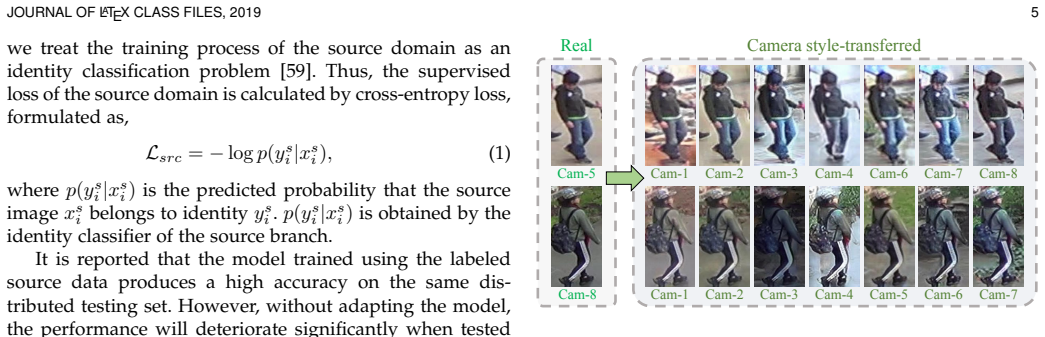
- domain assumption Camera-style transferred images preserve identity while changing style.
- domain assumption Momentum-updated memory features remain reliable representatives of the evolving feature distribution.
invented entities (2)
-
Exemplar memory (feature bank)
-
Graph-based Positive Prediction (GPP) network
Cite this review
Pith. "Pith review of Learning to Adapt Invariance in Memory for Person Re-identification." pith.science (2026). https://pith.science/paper/LYOL454M
@misc{pith2026190800485,
  author       = {Pith},
  title        = {Pith review of: Learning to Adapt Invariance in Memory for Person Re-identification},
  year         = {2026},
  howpublished = {\url{https://pith.science/paper/LYOL454M}},
  note         = {Machine review of arXiv:1908.00485}
}
read the original abstract
This work considers the problem of unsupervised domain adaptation in person re-identification (re-ID), which aims to transfer knowledge from the source domain to the target domain. Existing methods are primary to reduce the inter-domain shift between the domains, which however usually overlook the relations among target samples. This paper investigates into the intra-domain variations of the target domain and proposes a novel adaptation framework w.r.t. three types of underlying invariance, i.e., Exemplar-Invariance, Camera-Invariance, and Neighborhood-Invariance. Specifically, an exemplar memory is introduced to store features of samples, which can effectively and efficiently enforce the invariance constraints over the global dataset. We further present the Graph-based Positive Prediction (GPP) method to explore reliable neighbors for the target domain, which is built upon the memory and is trained on the source samples. Experiments demonstrate that 1) the three invariance properties are indispensable for effective domain adaptation, 2) the memory plays a key role in implementing invariance learning and improves the performance with limited extra computation cost, 3) GPP could facilitate the invariance learning and thus significantly improves the results, and 4) our approach produces new state-of-the-art adaptation accuracy on three re-ID large-scale benchmarks.
Figures

Figures from the paper (5 more)



Reference graph
Works this paper leans on
-
[1]
Do- main adaptation through synthesis for unsupervised person re- identification
Slawomir Bak, Peter Carr, and Jean-Francois Lalonde. Do- main adaptation through synthesis for unsupervised person re- identification. In Proc. ECCV, 2018
work page 2018
-
[2]
Konstantinos Bousmalis, George Trigeorgis, Nathan Silberman, Dilip Krishnan, and Dumitru Erhan. Domain separation networks. In Proc. NIPS, 2016
work page 2016
-
[3]
Spectral networks and locally connected networks on graphs
Joan Bruna, Wojciech Zaremba, Arthur Szlam, and Yann LeCun. Spectral networks and locally connected networks on graphs. In Proc. ICLR, 2014
work page 2014
-
[4]
Pau Panareda Busto and Juergen Gall. Open set domain adapta- tion. In Proc. ICCV, 2017
work page 2017
-
[5]
Deep association learning for unsupervised video person re-identification
Yanbei Chen, Xiatian Zhu, and Shaogang Gong. Deep association learning for unsupervised video person re-identification. In Proc. BMVC, 2018
work page 2018
-
[6]
Stargan: Unified generative adversarial networks for multi-domain image-to- image translation
Yunjey Choi, Minje Choi, Munyoung Kim, Jung-Woo Ha2 Sunghun Kim, and Jaegul Choo. Stargan: Unified generative adversarial networks for multi-domain image-to- image translation. In Proc. CVPR, 2018
work page 2018
-
[7]
Convolutional neural networks on graphs with fast localized spec- tral filtering
Micha ¨el Defferrard, Xavier Bresson, and Pierre Vandergheynst. Convolutional neural networks on graphs with fast localized spec- tral filtering. In Advances in neural information processing systems , pages 3844–3852, 2016
work page 2016
-
[8]
Imagenet: A large-scale hierarchical image database
Jia Deng, Wei Dong, Richard Socher, Li-Jia Li, Kai Li, and Li Fei- Fei. Imagenet: A large-scale hierarchical image database. In Proc. CVPR, 2009
work page 2009
Show all 68 references
-
[9]
Image-image domain adaptation with preserved self-similarity and domain-dissimilarity for person re- identification
Weijian Deng, Liang Zheng, Qixiang Ye, Guoliang Kang, Yi Yang, and Jianbin Jiao. Image-image domain adaptation with preserved self-similarity and domain-dissimilarity for person re- identification. In Proc. CVPR, 2018
2018
-
[10]
Unsuper- vised person re-identification: Clustering and fine-tuning
Hehe Fan, Liang Zheng, Chenggang Yan, and Yi Yang. Unsuper- vised person re-identification: Clustering and fine-tuning. ACM TOMM, 2018
2018
-
[11]
Neural turing machines
Alex Graves, Greg Wayne, and Ivo Danihelka. Neural turing machines. arXiv preprint arXiv:1410.5401, 2014
2014 arXiv
-
[12]
Viewpoint invariant pedestrian recognition with an ensemble of localized features
Douglas Gray and Hai Tao. Viewpoint invariant pedestrian recognition with an ensemble of localized features. In Proc. ECCV, 2008
2008
-
[13]
A kernel method for the two-sample- problem
Arthur Gretton, Karsten M Borgwardt, Malte Rasch, Bernhard Sch¨olkopf, and Alex J Smola. A kernel method for the two-sample- problem. In Proc. NIPS, 2007
2007
-
[14]
Dimensionality reduction by learning an invariant mapping
Raia Hadsell, Sumit Chopra, and Yann LeCun. Dimensionality reduction by learning an invariant mapping. In Proc. CVPR, 2006
2006
-
[15]
Inductive repre- sentation learning on large graphs
Will Hamilton, Zhitao Ying, and Jure Leskovec. Inductive repre- sentation learning on large graphs. In Advances in Neural Informa- tion Processing Systems, pages 1024–1034, 2017
2017
-
[16]
Delv- ing deep into rectifiers: Surpassing human-level performance on imagenet classification
Kaiming He, Xiangyu Zhang, Shaoqing Ren, and Jian Sun. Delv- ing deep into rectifiers: Surpassing human-level performance on imagenet classification. In Proc. ICCV, pages 1026–1034, 2015
2015
-
[17]
Deep residual learning for image recognition
Kaiming He, Xiangyu Zhang, Shaoqing Ren, and Jian Sun. Deep residual learning for image recognition. In Proc. CVPR, 2016
2016
-
[18]
Deep con- volutional networks on graph-structured data
Mikael Henaff, Joan Bruna, and Yann LeCun. Deep con- volutional networks on graph-structured data. arXiv preprint arXiv:1506.05163, 2015
2015 arXiv
-
[19]
In defense of the triplet loss for person re-identification
Alexander Hermans, Lucas Beyer, and Bastian Leibe. In defense of the triplet loss for person re-identification. arXiv preprint arXiv:1703.07737, 2017
2017 arXiv
-
[20]
Batch normalization: acceler- ating deep network training by reducing internal covariate shift
Sergey Ioffe and Christian Szegedy. Batch normalization: acceler- ating deep network training by reducing internal covariate shift. In Proc. ICML, 2015
2015
-
[21]
Semi-supervised classification with graph convolutional networks
Thomas N Kipf and Max Welling. Semi-supervised classification with graph convolutional networks. In Proc. ICLR, 2017
2017
-
[22]
Unsupervised person re-identification by deep learning tracklet association
Minxian Li, Xiatian Zhu, and Shaogang Gong. Unsupervised person re-identification by deep learning tracklet association. In Proceedings of the European Conference on Computer Vision (ECCV) , pages 737–753, 2018
2018
-
[23]
Unsupervised tracklet person re-identification
Minxian Li, Xiatian Zhu, and Shaogang Gong. Unsupervised tracklet person re-identification. IEEE transactions on pattern analy- sis and machine intelligence, 2019
2019
-
[24]
Harmonious attention network for person re-identification
Wei Li, Xiatian Zhu, and Shaogang Gong. Harmonious attention network for person re-identification. In Proc. CVPR, 2018
2018
-
[25]
Person re-identification by local maximal occurrence representation and metric learning
Shengcai Liao, Yang Hu, Xiangyu Zhu, and Stan Z Li. Person re-identification by local maximal occurrence representation and metric learning. In Proc. CVPR, 2015
2015
-
[26]
Network in network
Min Lin, Qiang Chen, and Shuicheng Yan. Network in network. In Proc. ICLR, 2014
2014
-
[27]
Multi-task mid-level feature alignment network for unsupervised cross-dataset person re-identification
Shan Lin, Haoliang Li, Chang-Tsun Li, and Alex Chichung Kot. Multi-task mid-level feature alignment network for unsupervised cross-dataset person re-identification. In Prco. BMVC, 2018
2018
-
[28]
Learning transferable features with deep adaptation networks
Mingsheng Long, Yue Cao, Jianmin Wang, and Michael I Jordan. Learning transferable features with deep adaptation networks. In Proc. ICML, 2015
2015
-
[29]
Taking a closer look at domain shift: Category-level adversaries for semantics consistent domain adaptation
Yawei Luo, Liang Zheng, Tao Guan, Junqing Yu, and Yi Yang. Taking a closer look at domain shift: Category-level adversaries for semantics consistent domain adaptation. In Proc. CVPR, 2019
2019
-
[30]
Geometric deep learning on graphs and manifolds using mixture model cnns
Federico Monti, Davide Boscaini, Jonathan Masci, Emanuele Rodola, Jan Svoboda, and Michael M Bronstein. Geometric deep learning on graphs and manifolds using mixture model cnns. In Proceedings of the IEEE Conference on Computer Vision and Pattern Recognition, pages 5115–5124, 2017
2017
-
[31]
Rectified linear units improve restricted boltzmann machines
Vinod Nair and Geoffrey E Hinton. Rectified linear units improve restricted boltzmann machines. In Proc. ICML, 2010
2010
-
[32]
Learning convolutional neural networks for graphs
Mathias Niepert, Mohamed Ahmed, and Konstantin Kutzkov. Learning convolutional neural networks for graphs. In Interna- tional conference on machine learning, pages 2014–2023, 2016
2014
-
[33]
Unsupervised cross-dataset transfer learning for person re-identification
Peixi Peng, Tao Xiang, Yaowei Wang, Massimiliano Pontil, Shao- gang Gong, Tiejun Huang, and Yonghong Tian. Unsupervised cross-dataset transfer learning for person re-identification. In Proc. CVPR, 2016
2016
-
[34]
Performance measures and a data set for multi- target, multi-camera tracking
Ergys Ristani, Francesco Solera, Roger Zou, Rita Cucchiara, and Carlo Tomasi. Performance measures and a data set for multi- target, multi-camera tracking. In Proc. ECCVW, 2016
2016
-
[35]
Open set domain adaptation by backpropagation
Kuniaki Saito, Shohei Yamamoto, Yoshitaka Ushiku, and Tatsuya Harada. Open set domain adaptation by backpropagation. In Proc. ECCV, 2018
2018
-
[36]
Meta-learning with memory- augmented neural networks
Adam Santoro, Sergey Bartunov, Matthew Botvinick, Daan Wier- stra, and Timothy Lillicrap. Meta-learning with memory- augmented neural networks. In Proc. ICML, 2016
2016
-
[37]
Person re-identification with deep similarity-guided graph neural network
Yantao Shen, Hongsheng Li, Shuai Yi, Dapeng Chen, and Xiao- gang Wang. Person re-identification with deep similarity-guided graph neural network. In Proc. ECCV, 2018
2018
-
[38]
Unsupervised domain adaptation for distance metric learning
Kihyuk Sohn, Wenling Shang, Xiang Yu, and Manmohan Chan- draker. Unsupervised domain adaptation for distance metric learning. In Proc. ICLR, 2019
2019
-
[39]
Dropout: a simple way to prevent neural networks from overfitting
Nitish Srivastava, Geoffrey Hinton, Alex Krizhevsky, Ilya Sutskever, and Ruslan Salakhutdinov. Dropout: a simple way to prevent neural networks from overfitting. JMLR, 2014
2014
-
[40]
End-to-end JOURNAL OF LATEX CLASS FILES, 2019 14 memory networks
Sainbayar Sukhbaatar, Jason Weston, Rob Fergus, et al. End-to-end JOURNAL OF LATEX CLASS FILES, 2019 14 memory networks. In Proc. NIPS, 2015
2019
-
[41]
Dissecting person re-identification from the viewpoint of viewpoint
Xiaoxiao Sun and Liang Zheng. Dissecting person re-identification from the viewpoint of viewpoint. In Proc. CVPR, 2019
2019
-
[42]
Beyond part models: Person retrieval with refined part pooling (and a strong convolutional baseline)
Yifan Sun, Liang Zheng, Yi Yang, Qi Tian, and Shengjin Wang. Beyond part models: Person retrieval with refined part pooling (and a strong convolutional baseline). In Proc. ECCV, 2018
2018
-
[43]
Adversarial discriminative domain adaptation
Eric Tzeng, Judy Hoffman, Kate Saenko, and Trevor Darrell. Adversarial discriminative domain adaptation. In Proc. CVPR , 2017
2017
-
[44]
Matching networks for one shot learning
Oriol Vinyals, Charles Blundell, Tim Lillicrap, Daan Wierstra, et al. Matching networks for one shot learning. In Proc. NIPS, 2016
2016
-
[45]
Transfer- able joint attribute-identity deep learning for unsupervised person re-identification
Jingya Wang, Xiatian Zhu, Shaogang Gong, and Wei Li. Transfer- able joint attribute-identity deep learning for unsupervised person re-identification. In Proc. CVPR, 2018
2018
-
[46]
Link- age based face clustering via graph convolution network
Zhongdao Wang, Liang Zheng, Yali Li, and Shengjin Wang. Link- age based face clustering via graph convolution network. In Proc. CVPR, 2019
2019
-
[47]
Person transfer gan to bridge domain gap for person re-identification
Longhui Wei, Shiliang Zhang, Wen Gao, and Qi Tian. Person transfer gan to bridge domain gap for person re-identification. In Proc. CVPR, 2018
2018
-
[48]
Memory networks
Jason Weston, Sumit Chopra, and Antoine Bordes. Memory networks. In Proc. ICLR, 2015
2015
-
[49]
Long-term feature banks for detailed video understanding
Chao-Yuan Wu, Christoph Feichtenhofer, Haoqi Fan, Kaiming He, Philipp Kr ¨ahenb ¨uhl, and Ross Girshick. Long-term feature banks for detailed video understanding. In Proc. CVPR, 2019
2019
-
[50]
Improving gener- alization via scalable neighborhood component analysis
Zhirong Wu, Alexei A Efros, and Stella X Yu. Improving gener- alization via scalable neighborhood component analysis. In Proc. ECCV, 2018
2018
-
[51]
Unsuper- vised feature learning via non-parametric instance discrimination
Zhirong Wu, Yuanjun Xiong, X Yu Stella, and Dahua Lin. Unsuper- vised feature learning via non-parametric instance discrimination. In Proc. CVPR, 2018
2018
-
[52]
Joint detection and identification feature learning for person search
Tong Xiao, Shuang Li, Bochao Wang, Liang Lin, and Xiaogang Wang. Joint detection and identification feature learning for person search. In Proc. CVPR, 2017
2017
-
[53]
Mind the class weight bias: Weighted maxi- mum mean discrepancy for unsupervised domain adaptation
Hongliang Yan, Yukang Ding, Peihua Li, Qilong Wang, Yong Xu, and Wangmeng Zuo. Mind the class weight bias: Weighted maxi- mum mean discrepancy for unsupervised domain adaptation. In Proc. CVPR, 2017
2017
-
[54]
Leveraging virtual and real person for unsupervised person re-identification
Fengxiang Yang, Zhun Zhong, Zhiming Luo, Sheng Lian, and Shaozi Li. Leveraging virtual and real person for unsupervised person re-identification. arXiv preprint arXiv:1811.02074, 2018
2018 arXiv
-
[55]
Cross- view asymmetric metric learning for unsupervised person re- identification
Hong-Xing Yu, Ancong Wu, and Wei-Shi Zheng. Cross- view asymmetric metric learning for unsupervised person re- identification. In Proc. ICCV, 2017
2017
-
[56]
Unsupervised person re-identification by deep asymmetric metric embedding
Hong-Xing Yu, Ancong Wu, and Wei-Shi Zheng. Unsupervised person re-identification by deep asymmetric metric embedding. IEEE TP AMI, 2019
2019
-
[57]
Unsupervised person re- identification by soft multilabel learning
Hong-Xing Yu, Wei-Shi Zheng, Ancong Wu, Xiaowei Guo, Shao- gang Gong, and Jian-Huang Lai. Unsupervised person re- identification by soft multilabel learning. In Proc. CVPR, 2019
2019
-
[58]
Scalable person re-identification: A bench- mark
Liang Zheng, Liyue Shen, Lu Tian, Shengjin Wang, Jingdong Wang, and Qi Tian. Scalable person re-identification: A bench- mark. In Proc. ICCV, 2015
2015
-
[59]
Person re- identification: Past, present and future
Liang Zheng, Yi Yang, and Alexander G Hauptmann. Person re- identification: Past, present and future. arXiv, 2016
2016
-
[60]
Joint discriminative and generative learning for person re-identification
Zhedong Zheng, Xiaodong Yang, Zhiding Yu, Liang Zheng, Yi Yang, and Jan Kautz. Joint discriminative and generative learning for person re-identification. In Proc. CVPR, 2019
2019
-
[61]
Unlabeled samples generated by gan improve the person re-identification baseline in vitro
Zhedong Zheng, Liang Zheng, and Yi Yang. Unlabeled samples generated by gan improve the person re-identification baseline in vitro. In Proc. ICCV, 2017
2017
-
[62]
Re- ranking person re-identification with k-reciprocal encoding
Zhun Zhong, Liang Zheng, Donglin Cao, and Shaozi Li. Re- ranking person re-identification with k-reciprocal encoding. In Proc. CVPR, 2017
2017
-
[63]
Random erasing data augmentation
Zhun Zhong, Liang Zheng, Guoliang Kang, Shaozi Li, and Yi Yang. Random erasing data augmentation. arXiv, 2017
2017
-
[64]
Generalizing a person retrieval model hetero- and homogeneously
Zhun Zhong, Liang Zheng, Shaozi Li, and Yi Yang. Generalizing a person retrieval model hetero- and homogeneously. InProc. ECCV, 2018
2018
-
[65]
Invariance matters: Exemplar memory for domain adaptive per- son re-identication
Zhun Zhong, Liang Zheng, Zhiming Luo, Shaozi Li, and Yi Yang. Invariance matters: Exemplar memory for domain adaptive per- son re-identication. In The IEEE Conference on Computer Vision and Pattern Recognition (CVPR). IEEE, 2019
2019
-
[66]
Camera style adaptation for person re-identification
Zhun Zhong, Liang Zheng, Zhedong Zheng, Shaozi Li, and Yi Yang. Camera style adaptation for person re-identification. In Proc. CVPR, 2018
2018
-
[67]
Camstyle: A novel data augmentation method for person re-identification
Zhun Zhong, Liang Zheng, Zhedong Zheng, Shaozi Li, and Yi Yang. Camstyle: A novel data augmentation method for person re-identification. IEEE TIP, 2019
2019
-
[68]
Unpaired image-to-image translation using cycle-consistent ad- versarial networks
Jun-Yan Zhu, Taesung Park, Phillip Isola, and Alexei A Efros. Unpaired image-to-image translation using cycle-consistent ad- versarial networks. In Proc. ICCV, 2017
2017
Reviewed August 14, 2026 · model on record in the stance chip above.
Discussion (0). Continue with ORCID to comment.