REVIEW 5 major objections 6 minor 38 references
RobSurv: Vector Quantization-Based Multi-Modal Learning for Robust Cancer Survival Prediction
T0 review · 5 major / 6 minor · reviewed 2026-08-16 · deepseek-v4-flash
Pith's one-line read RobSurv claims that quantizing CT-PET image features into discrete codebooks preserves survival-prediction accuracy under noise, losing only 3.8–4.5% compared with 8–12% for baselines.
desk verdict RobSurv is a plausible new VQ-based multi-modal survival architecture whose headline robustness claim doesn't yet survive contact with its own table. read the letter →
The pith
A machine-rendered reading of the paper's core claim, the machinery that carries it, and where it could break.
The reading
What carries the argument
The load-bearing object is DualVQ, a pair of modality-specific vector-quantization modules (one for CT, one for PET), each with a learned codebook of 1,024 vectors. Each module maps continuous latent features to their nearest codebook entry, turning an 8 by 8 by 8 latent volume into a set of discrete tokens; the quantization is trained with codebook, commitment, and reconstruction losses and outputs both discrete tokens and continuous features. A second module, DualPatchFuse, splits the discrete tokens into 2 by 2 by 2 patches and applies bidirectional CT-to-PET and PET-to-CT cross-attention, while the continuous path uses channel-spatial attention; alignment and preservation losses tie the two streams together. The fused representation feeds a DeepHit-style network that estimates hazards for multiple competing risks over time intervals. The mechanism's work is to make the learned representation insensitive to high-frequency noise through tokenization while keeping detail through the continuous path.
What would settle it
A reader could take any of the three datasets, add Gaussian noise to CT (standard deviation 0.1 relative to the intensity range) and high Poisson noise to PET as described in the paper's supplementary, and check whether RobSurv's concordance index drops only 3.8–4.5%; a larger drop, or a drop comparable to baseline methods, would show the robustness claim does not reproduce. A stronger test would use real low-count PET reconstructions and multi-center CT scans instead of synthetic noise.
Extended reading notes
Core claim
The paper's central claim is that discretizing CT and PET image features through learned vector-quantization codebooks gives survival prediction a noise-resistant representation, and that fusing this discrete representation with a continuous one preserves the fine-grained intensity information needed for prognosis. The architecture, RobSurv, processes each modality through separate encoders and codebooks, producing discrete tokens that capture stable anatomical and metabolic patterns, while a continuous branch retains detail. A patch-wise bidirectional cross-attention mechanism fuses CT and PET discrete tokens, and channel-spatial attention fuses the continuous streams; the combined representation feeds a discrete-time competing-risk survival network. On clean data the model reports concordance indices of 0.734 (NSCLC), 0.771 (HECKTOR), and 0.742 (H&N1), and under 50% noisy samples it reports drops of 4.5%, 3.8%, and 4.3%, respectively, while baseline models drop more steeply, with some exceeding 10 percentage points. The ablation study attributes most of the robustness to the vector-quantization module: removing it drops clean performance by about 13% and noisy performance by about 18.7%.
Load-bearing premise
The whole robustness result depends on the assumption that the synthetic noise protocol defined in the supplementary material — zero-mean Gaussian noise for CT and Poisson noise for PET, with the highest tested levels used in the main experiments — faithfully represents the noise encountered in real clinical scans.
Editorial extensions
If this is right
- If RobSurv's robustness holds, survival models can be deployed in settings where CT and PET quality varies across scanners and centers, with smaller performance penalties than current methods.
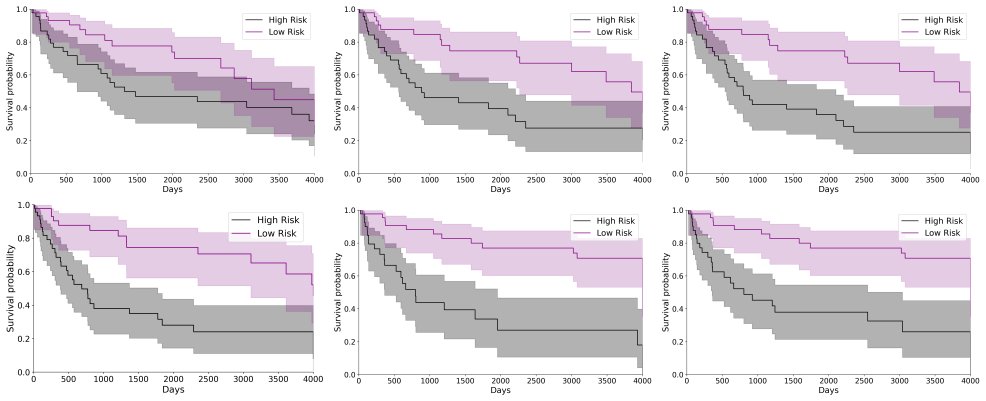
- Risk stratification remains statistically significant under noise: the paper reports log-rank p <= 0.05 separating high- and low-risk groups even with 50% noisy samples (and, per the supplementary, up to 90% noise).
- The discrete token path alone can preserve most prognostic signal: ablating the continuous branch costs only about 0.8% clean-data performance but about 2.7–2.8% under noise, showing the discrete path carries the core survival information.
- Vector quantization is the main stabilizer: removing DualVQ degrades clean performance by about 13% and noisy performance by about 18.7%, which suggests quantization, not attention alone, supplies the noise resistance.
- The method generalizes across three cancer types (head-and-neck and lung) and different imaging protocols, supporting its use across disease sites.
Reading between the lines
- Editorial inference: if the quantized codebook is the main source of noise resistance, similar discrete-bottleneck designs could stabilize other medical imaging prediction tasks (e.g., segmentation, staging, treatment-response) under acquisition noise, provided a continuous path remains for detail.
- Editorial inference: the paper's synthetic noise protocol (zero-mean Gaussian on CT, Poisson on PET) is unlikely to cover structured artifacts such as motion, metal streaks, or reconstruction differences; testing on real multi-center noisy scans would reveal whether the 3.8–4.5% degradation bound holds outside that protocol.
- Editorial inference: because the continuous branch contributes little on clean data but more under noise, a dynamic weighting that shifts toward discrete tokens as noise increases could reduce the computational overhead that the paper's limitations section acknowledges.
- Editorial inference: per-modality codebooks may offer an interpretability surface: examining which codebook entries are activated for high- versus low-risk patients could suggest imaging biomarkers for future study.
Signed reviews
Editorial analysis
A structured set of objections, weighed in public.
Referee Report
Summary. The paper introduces RobSurv, a multi-modal survival prediction framework that processes CT and PET images through two parallel pathways: a continuous feature stream and a vector-quantized discrete-token stream, with a patch-wise cross-modal fusion module (DualPatchFuse) and a competing-risks survival head. The authors evaluate on HECKTOR, H&N1, and NSCLC Radiogenomics, reporting state-of-the-art concordance indices on clean data and claiming that the model degrades by only 3.8–4.5% under synthetic noise, versus 8–12% for baselines. The central claims are robustness to noise and architectural novelty in applying vector quantization to multi-modal survival prediction.
Significance. If the reported robustness margins were statistically supported, the paper would be a useful contribution to multi-modal medical image analysis: the dual continuous/discrete representation is a sensible architectural idea, and the evaluation spans three public datasets with competing-risks survival modeling. The paper also draws attention to an important practical problem, namely performance degradation of imaging-based survival models under realistic acquisition noise. However, as presented, the quantitative claims are not internally consistent, and the robustness comparison lacks statistical support. The architectural contribution is plausible and worth further development, but the current evidence is not strong enough to support the headline '3.8–4.5% versus 8–12%' claim.
major comments (5)
- [Abstract; Table 1] The headline degradation range is internally inconsistent. From Table 1, H&N1 drops from 0.742 to 0.702, which is (0.742−0.702)/0.742 = 5.4%, not the reported 4.3%. The values for NSCLC (0.734→0.701, 4.5%) and HECKTOR (0.771→0.742, 3.8%) happen to fall inside the Abstract's stated 3.8–4.5% range, but H&N1 does not. The authors should recompute all degradations on a single stated basis (absolute or relative) and correct the abstract, text, and range accordingly.
- [§5, Table 1] The robustness comparison is not statistically established. For HECKTOR, the clean score is 0.771 ± 0.13 and the noisy score is 0.742 ± 0.14; the 0.029 difference is far smaller than the fold-to-fold standard deviation, and no paired test, bootstrap confidence interval, or within-fold comparison is reported for any degradation. Moreover, the Ctd-index is a rank-based statistic computed on different patient subsets (clean samples versus noisy samples), so the observed gaps may reflect differences in the valid-pair distribution rather than model robustness. At minimum, the authors should report paired per-fold differences with confidence intervals and verify that the result is not a subset-composition artifact.
- [Supplementary, 'Dataset for Robust Model'; §4.1] The noise-level selection procedure raises a risk of selection bias. The supplementary states that the highest noise configuration (CT σ = 0.1, PET high Poisson noise) was selected after observing RobSurv's degradation across a grid of noise levels, and only RobSurv's degradation curve is shown; no baseline model is evaluated across the same grid. Consequently, the claimed 8–12% baseline degradation comes from a single noise level chosen post hoc relative to the proposed model's performance. The authors should either pre-specify the noise levels or report all competing methods over the full noise grid, including baseline degradation curves.
- [§5, Table 1; Introduction] The claimed margins over baselines are not reproduced by Table 1. The text reports clean-data margins over TMSS of 5.2%, 4.1%, and 3.9%, and the introduction claims a 4–8% improvement; from Table 1, the clean margins over the best baseline (TMSS) are 0.734−0.708 = 0.026 (3.7%) on NSCLC, 0.771−0.751 = 0.020 (2.7%) on HECKTOR, and 0.742−0.725 = 0.017 (2.3%) on H&N1. Under noise, the margins over TMSS are 0.701−0.661 = 0.040 (6.1%), 0.742−0.712 = 0.030 (4.2%), and 0.702−0.689 = 0.013 (1.9%). The authors should clarify whether margins are absolute or relative and make every reported value consistent with Table 1.
- [§4.1, Table 1] It is unclear whether synthetic noise is added only to the test sets or also to the training data. The text says the dataset is 'augmented' with noise, while Table 1 evaluates 'clean samples' and 'noisy samples' within the same test split. If noisy samples were used in training, the comparison against baselines trained on clean data is not a clean test-time robustness comparison; if they were not, the protocol should be stated explicitly. This distinction affects the interpretation of the entire robustness claim.
minor comments (6)
- [§1 and §3.2] The fusion module is called 'DualPathFuse' in the introduction and 'DualPatchFuse' elsewhere; use a single name consistently throughout.
- [Eq. (4) and Eq. (7)] Around Eq. (4), 'referes' is a typo; in Eq. (7), the quantity A is called 'attention weights' but is defined as a value-weighted sum, so the distinction between attention weights and attention output should be clarified.
- [References] The reference [Farooq et al., 2024] cites a placeholder arXiv identifier (arXiv:2401.00000), and [Ma et al., 2024] appears to duplicate [De Biase et al., 2024] with the same title; the authors should supply correct and distinct citations.
- [§4.1 and Supplementary, 'Dataset Specifications'] The main text says HECKTOR data were collected from seven centers, while the supplementary says six; this discrepancy should be reconciled.
- [Table 1] The entry for Multimodal Dropout on HECKTOR clean samples reports a standard deviation of 0.66, which is implausibly large relative to all other entries; please check and correct this value.
- [Supplementary, 'Dataset Specifications'] The phrase 'resampling CT and PET scand' contains a typo ('scand' should be 'scans').
Circularity Check
No significant circularity: the robustness claim is an empirical comparison against external datasets and baselines; self-citations are not load-bearing, and the noise-level selection is a methodological concern, not circular reasoning.
full rationale
The paper's central claim is an empirical benchmarking result against external public datasets (HECKTOR, H&N1, NSCLC Radiogenomics) and published baselines (CoxPH, DeepSurv, DeepMTS, XSurv, MMRL, SurvRNC, TMSS). No architectural component is defined in terms of the target metric, and no predicted quantity is computed from the same fitted values that define it. The self-citations—MMRL (Farooq et al., 2024) and CoBooM (Singh and Mishra, 2024)—appear only as a baseline and as related work; neither is used to justify the DualVQ/DualPatchFuse design or to forbid alternatives. The one potentially circular-adjacent passage is the supplementary's statement that the highest noise level was selected after observing RobSurv's degradation ('Based on these findings, we selected this most challenging configuration for our main experiments'); this is an experimental-design selection effect, not a derivation, and it does not make the reported degradation equal to an input by construction. Discrepancies such as the H&N1 degradation (absolute drop 0.040, relative 5.4%, text claims 4.3%) are correctness and statistical-reporting issues, not circularity. Score 1 reflects the presence of non-load-bearing self-citations and the noise-level selection concern, not circular reasoning.
Assumptions & free parameters
free parameters (9)
- Codebook size =
1024
- Commitment loss weight alpha_1 =
0.25
- Reconstruction loss weight alpha_2 =
1.0
- Fusion weights beta_1, beta_2 =
0.5 each
- Preservation loss weight beta_3 =
0.5
- Objective weights gamma_1, gamma_2, gamma_3 =
1.0, 0.5, 2.0
- Embedding and query/key dimensions d_model, d_k =
256, 64
- Patch size =
2x2x2
- Selected noise level =
CT sigma=0.1, PET high Poisson
assumptions (4)
- domain assumption Discrete codebook tokens preserve survival-relevant prognostic information and provide noise robustness.
- domain assumption Synthetic Gaussian noise for CT and Poisson noise for PET realistically simulate clinical acquisition noise.
- domain assumption Patients have complete CT and PET scans available.
- standard math The DeepHit-style likelihood with ranking loss is an appropriate objective for censored competing-risks survival data.
Cite this review
Pith. "Pith review of RobSurv: Vector Quantization-Based Multi-Modal Learning for Robust Cancer Survival Prediction." pith.science (2026). https://pith.science/paper/LYTIGZKD
@misc{pith2026250502529,
  author       = {Pith},
  title        = {Pith review of: RobSurv: Vector Quantization-Based Multi-Modal Learning for Robust Cancer Survival Prediction},
  year         = {2026},
  howpublished = {\url{https://pith.science/paper/LYTIGZKD}},
  note         = {Machine review of arXiv:2505.02529}
}
read the original abstract
Cancer survival prediction using multi-modal medical imaging presents a critical challenge in oncology, mainly due to the vulnerability of deep learning models to noise and protocol variations across imaging centers. Current approaches struggle to extract consistent features from heterogeneous CT and PET images, limiting their clinical applicability. We address these challenges by introducing RobSurv, a robust deep-learning framework that leverages vector quantization for resilient multi-modal feature learning. The key innovation of our approach lies in its dual-path architecture: one path maps continuous imaging features to learned discrete codebooks for noise-resistant representation, while the parallel path preserves fine-grained details through continuous feature processing. This dual representation is integrated through a novel patch-wise fusion mechanism that maintains local spatial relationships while capturing global context via Transformer-based processing. In extensive evaluations across three diverse datasets (HECKTOR, H\&N1, and NSCLC Radiogenomics), RobSurv demonstrates superior performance, achieving concordance index of 0.771, 0.742, and 0.734 respectively - significantly outperforming existing methods. Most notably, our model maintains robust performance even under severe noise conditions, with performance degradation of only 3.8-4.5\% compared to 8-12\% in baseline methods. These results, combined with strong generalization across different cancer types and imaging protocols, establish RobSurv as a promising solution for reliable clinical prognosis that can enhance treatment planning and patient care.
Figures


Figures from the paper (2 more)

Reference graph
Works this paper leans on
-
[1]
A time-dependent discrimination index for survival data
[Antolini et al., 2005] Laura Antolini, Patrizia Boracchi, and Elia Biganzoli. A time-dependent discrimination index for survival data. Statistics in medicine , 24(24):3927–3944,
work page 2005
-
[10]
Survival prediction in lung can- cer through multi-modal representation learning
[Farooq et al., 2024] Aiman Farooq, Deepak Mishra, and Santanu Chaudhury. Survival prediction in lung can- cer through multi-modal representation learning. arXiv preprint arXiv:2401.00000,
arXiv 2024
-
[11]
[Gorade et al., 2024] Vandan Gorade, Sparsh Mittal, Debesh Jha, and Ulas Bagci. Synergynet: Bridging the gap be- tween discrete and continuous representations for pre- cise medical image segmentation. In Proceedings of the IEEE/CVF Winter Conference on Applications of Com- puter Vision, pages 7768–7777,
work page 2024
-
[12]
Boot- strap your own latent: A new approach to self-supervised learning
[Grill et al., 2020] Jean-Bastien Grill, Florian Strub, Flo- rent Altch ´e, Corentin Tallec, Pierre H Richemond, Elena Buchatskaya, Carl Doersch, Bernardo Avila Pires, Zhao- han Daniel Guo, Mohammad Gheshlaghi Azar, et al. Boot- strap your own latent: A new approach to self-supervised learning. In Advances in Neural Information Processing Systems,
work page 2020
-
[13]
Image-based sur- vival prediction for lung cancer patients using cnns
[Haarburger et al., 2019] Christoph Haarburger, Philippe Weitz, Oliver Rippel, and Dorit Merhof. Image-based sur- vival prediction for lung cancer patients using cnns. In 2019 IEEE 16th international symposium on biomedical imaging (ISBI 2019), pages 1197–1201. IEEE,
work page 2019
-
[17]
Artificial intelligence predictive system of individual survival rate for lung adenocarcinoma
[He et al., 2022] Tingshan He, Jing Li, Peng Wang, and Zhiqiao Zhang. Artificial intelligence predictive system of individual survival rate for lung adenocarcinoma. Compu- tational and Structural Biotechnology Journal , 20:2352– 2359,
work page 2022
-
[18]
[Katzman et al., 2018] Jared L Katzman, Uri Shaham, Alexander Cloninger, Jonathan Bates, Tingting Jiang, and Yuval Kluger. Deepsurv: personalized treatment recom- mender system using a cox proportional hazards deep neu- ral network. BMC medical research methodology , 18:1– 12,
work page 2018
-
[19]
De- noising diffusion probabilistic models for 3d medical im- age generation
[Khader et al., 2023] Firas Khader, Gustav M ¨uller-Franzes, Soroosh Tayebi Arasteh, Tianyu Han, Christoph Haar- burger, Maximilian Schulze-Hagen, Philipp Schad, Sandy Engelhardt, Bettina Baeßler, Sebastian Foersch, et al. De- noising diffusion probabilistic models for 3d medical im- age generation. Scientific Reports, 13(1):7303,
work page 2023
Show all 38 references
-
[21]
Robust deep learning for improved classification of ad/mci patients
[Li et al., 2020] Hongming Li, Mohamad Habes, and Yong Fan. Robust deep learning for improved classification of ad/mci patients. Frontiers in Aging Neuroscience, 12:32,
2020
-
[22]
Imaging-based deep graph neural networks for survival analysis in early stage lung cancer using ct: A multicenter study
[Lian et al., 2022] Jie Lian, Yonghao Long, Fan Huang, Kei Shing Ng, Faith MY Lee, David CL Lam, Ben- jamin XL Fang, Qi Dou, and Varut Vardhanabhuti. Imaging-based deep graph neural networks for survival analysis in early stage lung cancer using ct: A multicenter study. Fronti...
2022
-
[23]
Deep learning-based outcome prediction using pet/ct and automatically predicted probability maps of pri- mary tumor in patients with oropharyngeal cancer
[Ma et al., 2024] Baoqiang Ma, Alessia De Biase, Jiapan Guo, et al. Deep learning-based outcome prediction using pet/ct and automatically predicted probability maps of pri- mary tumor in patients with oropharyngeal cancer. Com- puter Methods and Programs in Biomedicine, 244:107939,
2024
-
[24]
Cancer survival: an overview of measures, uses, and inter- pretation
[Mariotto et al., 2014] Angela B Mariotto, Anne-Michelle Noone, Nadia Howlader, Hyunsoon Cho, Gretchen E Keel, Jessica Garshell, Steven Woloshin, and Lisa M Schwartz. Cancer survival: an overview of measures, uses, and inter- pretation. Journal of the National Cancer Institute...
2014
-
[26]
Merging-diverging hybrid transformer networks for survival prediction in head and neck cancer
[Meng et al., 2023] Mingyuan Meng, Lei Bi, Michael Ful- ham, Dagan Feng, and Jinman Kim. Merging-diverging hybrid transformer networks for survival prediction in head and neck cancer. In International Conference on Medical Image Computing and Computer-Assisted Inter- vention, ...
2023
-
[27]
Head and neck tumor segmenta- tion in pet/ct: the hecktor challenge
[Oreiller et al., 2022] Valentin Oreiller, Vincent Andrea- rczyk, Mario Jreige, Sarah Boughdad, Hesham Elha- lawani, Joel Castelli, Martin Valli`eres, Simeng Zhu, Juany- ing Xie, Ying Peng, et al. Head and neck tumor segmenta- tion in pet/ct: the hecktor challenge. Medical ima...
2022
-
[28]
Tmss: an end-to- end transformer-based multimodal network for segmenta- tion and survival prediction
[Saeed et al., 2022] Numan Saeed, Ikboljon Sobirov, Roba Al Majzoub, and Mohammad Yaqub. Tmss: an end-to- end transformer-based multimodal network for segmenta- tion and survival prediction. In International Conference on Medical Image Computing and Computer-Assisted In- terve...
2022
-
[29]
Survrnc: Learn- ing ordered representations for survival prediction using rank-n-contrast
[Saeed et al., 2024] Numan Saeed, Muhammad Ridzuan, Fadillah Adamsyah Maani, Hussain Alasmawi, Karthik Nandakumar, and Mohammad Yaqub. Survrnc: Learn- ing ordered representations for survival prediction using rank-n-contrast. In International Conference on Medi- cal Image Comp...
2024
-
[30]
Coboom: Codebook guided bootstrapping for medical im- age representation learning
[Singh and Mishra, 2024] Azad Singh and Deepak Mishra. Coboom: Codebook guided bootstrapping for medical im- age representation learning. In International Conference on Medical Image Computing and Computer-Assisted In- tervention, pages 23–33. Springer,
2024
-
[31]
Covid-net cxr: A deep convolutional neural net- work for screening covid-19 from chest x-rays using self- supervised learning
[Sriram et al., 2021] Arunkumar Sriram, Amir Khan, Pranav Bangalore, Ankit Mahajan, and Jayashree Kalpathy- Cramer. Covid-net cxr: A deep convolutional neural net- work for screening covid-19 from chest x-rays using self- supervised learning. arXiv preprint arXiv:2104.05283 ,
2021 arXiv
-
[32]
Long-term cancer survival prediction using mul- timodal deep learning
[Vale-Silva and Rohr, 2021] Lu´ıs A Vale-Silva and Karl Rohr. Long-term cancer survival prediction using mul- timodal deep learning. Scientific Reports , 11(1):13505,
2021
-
[33]
A novel deep learning method to predict lung cancer long-term survival with biological knowledge incorporated gene expression images and clinical data
[Wang et al., 2022] Shuo Wang, Hao Zhang, Zhen Liu, and Yuanning Liu. A novel deep learning method to predict lung cancer long-term survival with biological knowledge incorporated gene expression images and clinical data. Frontiers in Genetics, 13:800853,
2022
-
[34]
Wee and A
[Wee and Dekker, 2019] L. Wee and A. Dekker. Data from head-neck-radiomics-hn1. https://doi.org/10.7937/ tcia.2019.8kap372n,
2019
-
[35]
[Woo et al., 2018] Sanghyun Woo, Jongchan Park, Joon- Young Lee, and In So Kweon
The Cancer Imaging Archive. [Woo et al., 2018] Sanghyun Woo, Jongchan Park, Joon- Young Lee, and In So Kweon. Cbam: Convolutional block attention module. In Proceedings of the European Confer- ence on Computer Vision (ECCV) , pages 3–19. Springer,
2018
-
[36]
Vector quantized multi-modal guidance for alzheimer’s disease diagnosis based on feature imputation
[Zhang et al., 2023] Yuanwang Zhang, Kaicong Sun, Yuxiao Liu, Zaixin Ou, and Dinggang Shen. Vector quantized multi-modal guidance for alzheimer’s disease diagnosis based on feature imputation. In International Workshop on Machine Learning in Medical Imaging, pages 403–412. Springer,
2023
-
[37]
Conditional generation of 3d brain tumor regions via vq- gan and temporal-agnostic masked transformer
[Zhou and Khalvati, 2024] Meng Zhou and Farzad Khalvati. Conditional generation of 3d brain tumor regions via vq- gan and temporal-agnostic masked transformer. In Medi- cal Imaging with Deep Learning,
2024
-
[128]
The NSCLC Radiogenomics33 dataset is available via The Cancer Imaging Archive (TCIA)34 website
The intensity val-32 ues of PET are also normalized. The NSCLC Radiogenomics33 dataset is available via The Cancer Imaging Archive (TCIA)34 website. The dataset comprises CT images with tumor seg-35 mentation annotations, tumor characteristics, PET scans, and36 RNA sequence da...
2025 arXiv
-
[1972]
Survival analysis based on lung tumor segmentation using global context-aware transformer in multimodality
[Dao et al., 2022] Duy-Phuong Dao, Hyung-Jeong Yang, Ngoc-Huynh Ho, Sudarshan Pant, Soo-Hyung Kim, Guee- Sang Lee, In-Jae Oh, and Sae-Ryung Kang. Survival analysis based on lung tumor segmentation using global context-aware transformer in multimodality. In 2022 26th Internatio...
2022
-
[1982]
Deep residual learning for image recog- nition
[He et al., 2016] Kaiming He, Xiangyu Zhang, Shaoqing Ren, and Jian Sun. Deep residual learning for image recog- nition. In Proceedings of the IEEE Conference on Com- puter Vision and Pattern Recognition (CVPR), pages 770– 778,
2016
-
[2005]
Big self- supervised models advance medical image classification
[Azizi et al., 2021] Saeed Azizi, Basil Mustafa, Fiona Ryan, Zach Beaver, Jan Freyberg, Jonathan Kfinder, Else Lau, Aaron Low, Matt Mahoney, Abe Nakamoto, et al. Big self- supervised models advance medical image classification. arXiv preprint arXiv:2101.05224,
2021 arXiv
-
[2014]
Deepmts: deep multi-task learning for survival prediction in patients with advanced nasopharyngeal carcinoma us- ing pretreatment pet/ct
[Meng et al., 2022] Mingyuan Meng, Bingxin Gu, Lei Bi, Shaoli Song, David Dagan Feng, and Jinman Kim. Deepmts: deep multi-task learning for survival prediction in patients with advanced nasopharyngeal carcinoma us- ing pretreatment pet/ct. IEEE Journal of Biomedical and Health...
2022
-
[2016]
Momentum contrast for un- supervised visual representation learning
[He et al., 2020] Kaiming He, Haoqi Fan, Yuxin Wu, Sain- ing Xie, and Ross Girshick. Momentum contrast for un- supervised visual representation learning. In IEEE/CVF Conference on Computer Vision and Pattern Recognition,
2020
-
[2017]
[Bakr et al., 2018] Shaimaa Bakr, Olivier Gevaert, Sebastian Echegaray, Kelsey Ayers, Mu Zhou, Majid Shafiq, Hong Zheng, Jalen Anthony Benson, Weiruo Zhang, Ann NC Leung, et al
Available online: https://wiki.cancerimagingarchive.net/ display/Public/NSCLC+Radiogenomics. [Bakr et al., 2018] Shaimaa Bakr, Olivier Gevaert, Sebastian Echegaray, Kelsey Ayers, Mu Zhou, Majid Shafiq, Hong Zheng, Jalen Anthony Benson, Weiruo Zhang, Ann NC Leung, et al. A radi...
2018
-
[2018]
A simple framework for contrastive learning of visual representations
[Chen et al., 2020] Ting Chen, Simon Kornblith, Moham- mad Norouzi, and Geoffrey Hinton. A simple framework for contrastive learning of visual representations. In In- ternational conference on machine learning, pages 1597–
2020
-
[2019]
Evaluat- ing the yield of medical tests
[Harrell and others, 1982] Frank E Harrell et al. Evaluat- ing the yield of medical tests. Jama, 247(18):2543–2546,
1982
-
[2020]
Regression models and life- tables
[Cox, 1972] David R Cox. Regression models and life- tables. Journal of the Royal Statistical Society: Series B (Methodological), 34(2):187–220,
1972
-
[2021]
[Bakr et al., 2017] S. Bakr, O. Gevaert, S. Echegaray, K. Ayers, M. Zhou, M. Shafiq, H. Zheng, W. Zhang, A. Leung, M. Kadoch, et al. Data for nsclc radio- genomics collection. The Cancer Imaging Archive,
2017
-
[2022]
Deep learning-based outcome prediction using pet/ct and automatically predicted probability maps of primary tumor in patients with oropharyngeal cancer
[De Biase et al., 2024] Alessia De Biase, Baoqiang Ma, Ji- apan Guo, Lisanne V van Dijk, Johannes A Langendijk, Stefan Both, Peter MA van Ooijen, and Nanna M Sijtsema. Deep learning-based outcome prediction using pet/ct and automatically predicted probability maps of primary t...
2024
-
[2023]
Deephit: A deep learning approach to survival analysis with competing risks
[Lee et al., 2018] Changhee Lee, William Zame, Jinsung Yoon, and Mihaela Van Der Schaar. Deephit: A deep learning approach to survival analysis with competing risks. In Proceedings of the AAAI conference on artificial intelligence, volume 32,
2018
-
[2024]
Taming transformers for high-resolution image synthesis
[Esser et al., 2021] Patrick Esser, Robin Rombach, and Bjorn Ommer. Taming transformers for high-resolution image synthesis. IEEE/CVF Conference on Computer Vi- sion and Pattern Recognition,
2021
Reviewed August 16, 2026 · model on record in the stance chip above.
Discussion (0). Continue with ORCID to comment.