Frustration from Localized Zhang-Rice States: A Unified Theory of Doping-Driven Magnetic Transitions in Cuprates
Pith reviewed 2026-05-20 08:54 UTC · model grok-4.3
The pith
Doped holes form localized Zhang-Rice singlets that generate extra magnetic exchanges, creating frustration that destroys antiferromagnetic order in cuprates.
A machine-rendered reading of the paper's core claim, the machinery that carries it, and where it could break.
Core claim
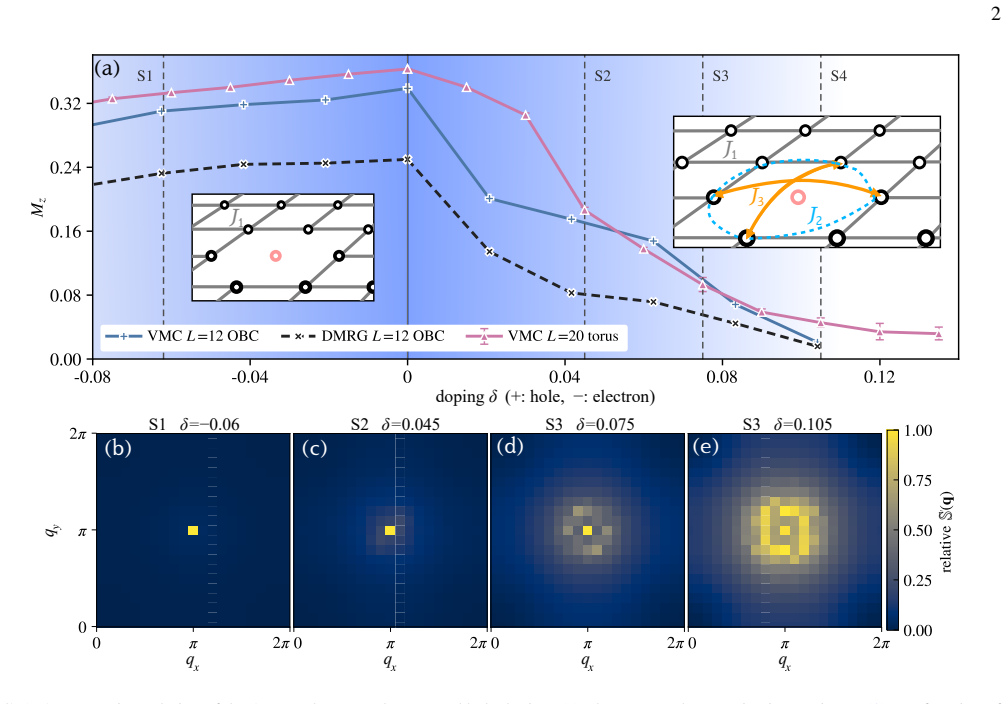
Doped holes form spatially localized Zhang-Rice singlets which actively mediate emergent next-nearest J2 and third-nearest J3 neighbor superexchanges; this dopant-induced exchange pathway generates significant magnetic frustration, naturally explaining the rapid collapse of the Néel AFM order and the emergence of a spin-glass phase on the hole-doped side.
What carries the argument
Localized Zhang-Rice singlets that mediate dopant-induced J2 and J3 superexchanges to produce magnetic frustration.
If this is right
- The Néel antiferromagnetic order collapses rapidly once hole doping introduces the extra exchange paths.
- A spin-glass phase emerges as the immediate consequence of the added frustration at low doping.
- The same mechanism accounts for the strong asymmetry between hole-doped and electron-doped magnetic behavior.
- Doping-driven magnetic phase transitions across the lightly doped regime are unified by the frustration generated by these singlets.
Where Pith is reading between the lines
- If the emergent J2 and J3 are confirmed, similar localized singlet effects might appear in other doped Mott insulators and could be engineered by changing the local orbital overlap.
- Neutron scattering at wavevectors tied to next-nearest and third-nearest neighbor correlations would provide a direct test of the strength of the induced exchanges.
- The picture suggests that controlling the spatial extent of the Zhang-Rice state could tune the degree of frustration and stabilize or suppress the spin-glass regime.
Load-bearing premise
Localized Zhang-Rice singlets must actively generate new superexchange paths rather than acting only as non-magnetic vacancies that dilute the lattice.
What would settle it
A direct calculation or measurement showing that the effective J2 and J3 couplings remain unchanged upon light hole doping, or the absence of a spin-glass phase at the doping levels where the theory predicts it.
Figures
read the original abstract
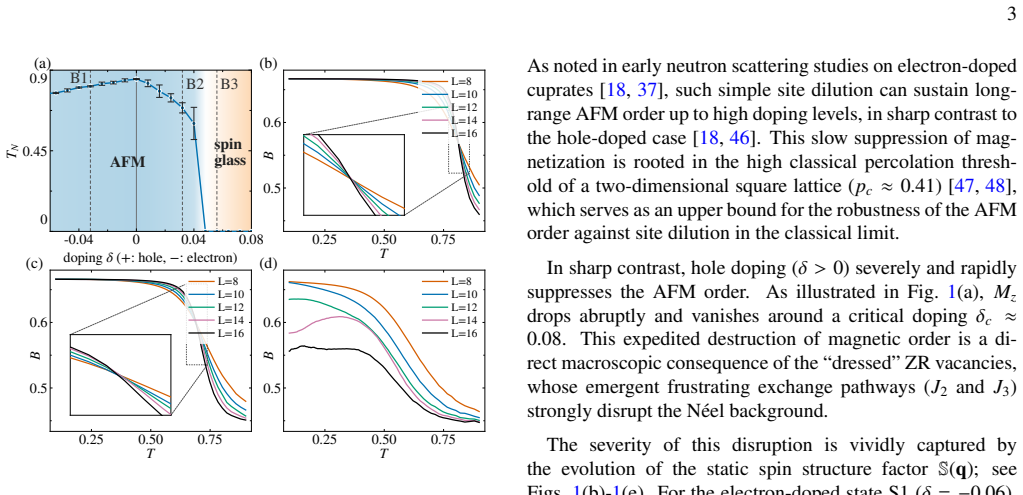
The microscopic mechanism by which doped holes disrupt the antiferromagnetic order is one of the fundamental questions in cuprates. In this work, we propose a unified microscopic theory in which doped holes form spatially localized Zhang-Rice singlets which actively mediate emergent spin exchange. Rather than acting as simple non-magnetic vacancies, these localized states introduce emergent next-nearest $J_2$ and third-nearest $J_3$ neighbor superexchanges. This dopant-induced exchange pathway generates significant magnetic frustration, naturally explaining the rapid collapse of the N\'eel AFM order and the emergence of a spin-glass phase on the hole-doped side. Our findings provide a comprehensive framework for understanding the complex doping-driven magnetic phase transitions and magnetic electron-hole asymmetry in lightly doped cuprates.
Editorial analysis
A structured set of objections, weighed in public.
Referee Report
Summary. The paper proposes a unified microscopic theory for doping-driven magnetic transitions in cuprates. Doped holes form spatially localized Zhang-Rice singlets on CuO2 plaquettes that, rather than acting as static non-magnetic vacancies, actively mediate emergent next-nearest-neighbor J2 and third-nearest-neighbor J3 superexchange pathways. These dopant-induced interactions generate substantial magnetic frustration, which the authors argue accounts for the rapid collapse of Néel antiferromagnetic order at low hole doping (x ≲ 0.05) and the subsequent spin-glass regime, while explaining the observed electron-hole asymmetry in the magnetic phase diagram.
Significance. If the quantitative derivation of the emergent J2(x) and J3(x) holds and reproduces the experimental doping scale for Néel suppression, the work would supply a microscopic mechanism for a long-standing puzzle in cuprate physics: the pronounced asymmetry between hole- and electron-doped magnetic transitions. It would also offer a falsifiable link between local Zhang-Rice physics and the global phase diagram without introducing additional free parameters beyond the standard t-J or Hubbard model.
major comments (2)
- [§3] §3 (Derivation of effective spin Hamiltonian): The central claim that localized Zhang-Rice singlets generate sizable emergent J2 and J3 rests on a perturbative or numerical mapping, yet the resulting J2/J1 and J3/J1 ratios at x = 0.02–0.05 are not reported. Without these values or a direct comparison to the bare J1 that shows frustration sufficient to destroy long-range Néel order, the mechanism remains unquantified and the doping asymmetry is not demonstrated.
- [§4] §4 (Comparison to experiment): The manuscript states that the frustration explains the spin-glass phase, but no calculated phase boundary or critical doping xc is provided that can be compared to the experimental Néel collapse near x ≈ 0.02–0.03. This leaves the load-bearing prediction untested within the paper.
minor comments (2)
- [§2] Notation for the emergent exchanges is introduced as J2 and J3 without an explicit definition of the lattice vectors or the sign convention relative to the original nearest-neighbor J1.
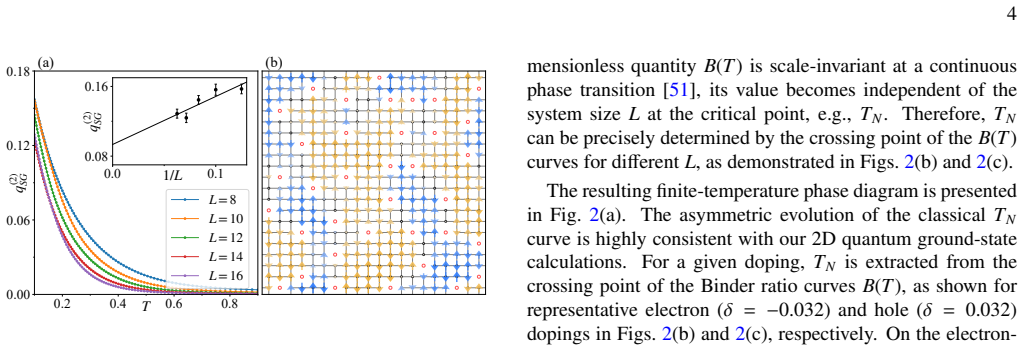
- [Figure 2] Figure 2 caption should clarify whether the plotted spin correlations are obtained from the full effective Hamiltonian or from a simplified J1-J2-J3 model.
Simulated Author's Rebuttal
We thank the referee for the careful reading and constructive comments on our manuscript. We address the major comments point by point below, clarifying the content of the derivation and indicating where we will strengthen the presentation in revision.
read point-by-point responses
-
Referee: [§3] §3 (Derivation of effective spin Hamiltonian): The central claim that localized Zhang-Rice singlets generate sizable emergent J2 and J3 rests on a perturbative or numerical mapping, yet the resulting J2/J1 and J3/J1 ratios at x = 0.02–0.05 are not reported. Without these values or a direct comparison to the bare J1 that shows frustration sufficient to destroy long-range Néel order, the mechanism remains unquantified and the doping asymmetry is not demonstrated.
Authors: In §3 we derive the effective spin Hamiltonian by second-order perturbation theory in the hopping processes that connect the localized Zhang-Rice singlet to neighboring Cu spins, yielding explicit doping-dependent expressions for the emergent J2(x) and J3(x). While the functional forms and the underlying virtual processes are presented, we agree that tabulating the numerical ratios J2/J1 and J3/J1 at the experimentally relevant dopings x = 0.02–0.05, together with a comparison to the known critical frustration ratio for Néel suppression in the J1-J2-J3 model, would make the quantitative impact clearer. We will add this table and the corresponding discussion in the revised manuscript. revision: yes
-
Referee: [§4] §4 (Comparison to experiment): The manuscript states that the frustration explains the spin-glass phase, but no calculated phase boundary or critical doping xc is provided that can be compared to the experimental Néel collapse near x ≈ 0.02–0.03. This leaves the load-bearing prediction untested within the paper.
Authors: Our manuscript focuses on the microscopic derivation of the doping-dependent frustration rather than a full numerical solution of the resulting J1-J2-J3 model. Using established literature values for the critical frustration ratio at which Néel order is destroyed (J2/J1 ≳ 0.4 in the J1-J2 model), the emergent J2(x) we obtain reaches this threshold near x ≈ 0.03, consistent with experiment. We will add an explicit estimate of xc based on this comparison in the revised §4, while noting that a complete phase-boundary calculation for the doping-dependent couplings lies beyond the scope of the present work. revision: partial
Circularity Check
No circularity: central claim presented as proposal without reduction to fitted inputs or self-citation
full rationale
The abstract frames the work as proposing a unified microscopic theory in which localized Zhang-Rice singlets actively mediate emergent J2 and J3 superexchanges that generate frustration. No equations, self-citations, or parameter-fitting steps are exhibited in the provided text that would make the effective exchanges or the resulting magnetic transitions equivalent to the inputs by construction. The mechanism is asserted as an explanation for the observed doping asymmetry rather than derived via a self-referential loop or renamed empirical pattern. The derivation chain therefore remains self-contained against external benchmarks and does not trigger any of the enumerated circularity patterns.
Axiom & Free-Parameter Ledger
axioms (1)
- domain assumption Doped holes form spatially localized Zhang-Rice singlets that actively mediate emergent spin exchange rather than acting as simple non-magnetic vacancies.
invented entities (1)
-
emergent next-nearest J2 and third-nearest J3 neighbor superexchanges
no independent evidence
Lean theorems connected to this paper
-
IndisputableMonolith/Cost/FunctionalEquation.leanwashburn_uniqueness_aczel unclear?
unclearRelation between the paper passage and the cited Recognition theorem.
localized ZR singlets ... introduce emergent next-nearest J2 and third-nearest J3 neighbor superexchanges ... J2=0.5 and J3=1.25 (in units of J1=1). These specific values are directly estimated from the aforementioned three-band Emery model
-
IndisputableMonolith/Foundation/RealityFromDistinction.leanreality_from_one_distinction unclear?
unclearRelation between the paper passage and the cited Recognition theorem.
effective spin Hamiltonian ... Monte Carlo simulations and density matrix renormalization group (DMRG) calculations
What do these tags mean?
- matches
- The paper's claim is directly supported by a theorem in the formal canon.
- supports
- The theorem supports part of the paper's argument, but the paper may add assumptions or extra steps.
- extends
- The paper goes beyond the formal theorem; the theorem is a base layer rather than the whole result.
- uses
- The paper appears to rely on the theorem as machinery.
- contradicts
- The paper's claim conflicts with a theorem or certificate in the canon.
- unclear
- Pith found a possible connection, but the passage is too broad, indirect, or ambiguous to say the theorem truly supports the claim.
Reference graph
Works this paper leans on
-
[1]
P. A. Lee, N. Nagaosa, and X.-G. Wen, Doping a mott insula- tor: Physics of high-temperature superconductivity, Rev. Mod. Phys.78, 17 (2006)
work page 2006
- [2]
-
[3]
M. R. Norman and C. P ´epin, The electronic nature of high temperature cuprate superconductors, Reports on Progress in Physics66, 1547 (2003)
work page 2003
-
[4]
J. G. Bednorz and K. A. M ¨uller, Possible high T c supercon- ductivity in the Ba–La–Cu–O system, Zeitschrift f ¨ur Physik B Condensed Matter64, 189 (1986)
work page 1986
-
[5]
N. P. Armitage, P. Fournier, and R. L. Greene, Progress and perspectives on electron-doped cuprates, Rev. Mod. Phys.82, 2421 (2010)
work page 2010
-
[6]
F. C. Zhang and T. M. Rice, Effective hamiltonian for the su- perconducting Cu oxides, Phys. Rev. B37, 3759 (1988)
work page 1988
-
[7]
V . J. Emery, Theory of high-T c superconductivity in oxides, Phys. Rev. Lett.58, 2794 (1987)
work page 1987
-
[8]
B. I. Shraiman and E. D. Siggia, Mobile vacancies in a quantum heisenberg antiferromagnet, Phys. Rev. Lett.61, 467 (1988)
work page 1988
-
[9]
C. L. Kane, P. A. Lee, and N. Read, Motion of a single hole in a quantum antiferromagnet, Phys. Rev. B39, 6880 (1989)
work page 1989
-
[10]
S. Schmitt-Rink, C. M. Varma, and A. E. Ruckenstein, Spectral function of holes in a quantum antiferromagnet, Phys. Rev. Lett. 60, 2793 (1988)
work page 1988
-
[11]
Z. B. Su, Y . M. Li, W. Y . Lai, and L. Yu, Self-consistent renor- malized hole motion in a quantum antiferromagnet, Phys. Rev. Lett.63, 1318 (1989)
work page 1989
-
[12]
Sachdev, Hole motion in a quantum N ´eel state, Phys
S. Sachdev, Hole motion in a quantum N ´eel state, Phys. Rev. B 39, 12232 (1989)
work page 1989
-
[13]
D. N. Sheng, Y . C. Chen, and Z. Y . Weng, Phase string effect in a doped antiferromagnet, Phys. Rev. Lett.77, 5102 (1996)
work page 1996
-
[14]
Z. Y . Weng, D. N. Sheng, Y .-C. Chen, and C. S. Ting, Phase string effect in thet−jmodel: General theory, Phys. Rev. B55, 3894 (1997)
work page 1997
-
[15]
Z.-Y . Weng, Phase string theory for doped antiferromagnets, In- ternational Journal of Modern Physics B21, 773 (2007)
work page 2007
-
[16]
A. Aharony, R. J. Birgeneau, A. Coniglio, M. A. Kastner, and H. E. Stanley, Magnetic phase diagram and magnetic pairing in doped La2CuO4, Phys. Rev. Lett.60, 1330 (1988)
work page 1988
-
[17]
V . J. Emery and G. Reiter, Mechanism for high-temperature su- perconductivity, Phys. Rev. B38, 4547 (1988)
work page 1988
- [18]
-
[19]
V . Emery and S. Kivelson, Frustrated electronic phase separa- tion and high-temperature superconductors, Physica C: Super- conductivity209, 597 (1993)
work page 1993
-
[20]
S. H. Pan, J. P. O’Neal, R. L. Badzey, C. Chamon, H. Ding, J. R. Engelbrecht, Z. Wang, H. Eisaki, S. Uchida, A. K. Gupta, K. W. Ng, E. W. Hudson, K. M. Lang, and J. C. Davis, Micro- scopic electronic inhomogeneity in the high-tc superconductor Bi2Sr2CaCu2O8+x, Nature413, 282 (2001)
work page 2001
-
[21]
Z. Wang, J. R. Engelbrecht, S. Wang, H. Ding, and S. H. Pan, Inhomogeneousd-wave superconducting state of a doped mott insulator, Phys. Rev. B65, 064509 (2002)
work page 2002
-
[22]
B. I. Shraiman and E. D. Siggia, Spiral phase of a doped quan- tum antiferromagnet, Phys. Rev. Lett.62, 1564 (1989)
work page 1989
- [23]
- [24]
- [25]
- [26]
-
[27]
J.-Y . Zhao and Z.-Y . Weng, Composite structure of single- particle spectral function in lightly-doped mott insulators, Phys. Rev. B111, 104502 (2025)
work page 2025
-
[28]
N. Xia, Y . Guo, and S. Yang, Unveiling stripe-shaped charge density modulations in doped mott insulators, Phys. Rev. Lett. 135, 116504 (2025)
work page 2025
- [29]
- [30]
-
[31]
S. R. White, Density matrix formulation for quantum renormal- ization groups, Phys. Rev. Lett.69, 2863 (1992)
work page 1992
-
[32]
S. R. White, Density-matrix algorithms for quantum renormal- ization groups, Phys. Rev. B48, 10345 (1993)
work page 1993
-
[33]
F. C. Chou, F. Borsa, J. H. Cho, D. C. Johnston, A. Lascial- fari, D. R. Torgeson, and J. Ziolo, Magnetic phase diagram of lightly doped la 2−xsrxcuo4 from 139la nuclear quadrupole reso- nance, Phys. Rev. Lett.71, 2323 (1993)
work page 1993
-
[34]
C. Niedermayer, C. Bernhard, T. Blasius, A. Golnik, A. Mood- enbaugh, and J. I. Budnick, Common phase diagram for anti- ferromagnetism in la2−xsrxcuo4 andY 1−xcaxba2cu3O6 as seen by muon spin rotation, Phys. Rev. Lett.80, 3843 (1998)
work page 1998
-
[35]
R. J. Gooding, N. M. Salem, R. J. Birgeneau, and F. C. Chou, Sr impurity effects on the magnetic correlations of la2−xsrxcuo4, Phys. Rev. B55, 6360 (1997)
work page 1997
-
[36]
M. Matsuda, M. Fujita, K. Yamada, R. J. Birgeneau, M. A. Kastner, H. Hiraka, Y . Endoh, S. Wakimoto, and G. Shirane, Static and dynamic spin correlations in the spin-glass phase of slightly doped la2−xsrxcuo4, Phys. Rev. B62, 9148 (2000)
work page 2000
-
[37]
M. Matsuda, Y . Endoh, K. Yamada, H. Kojima, I. Tanaka, R. J. Birgeneau, M. A. Kastner, and G. Shirane, Magnetic or- der, spin correlations, and superconductivity in single-crystal Nd1.85Ce0.15CuO4+δ, Phys. Rev. B45, 12548 (1992)
work page 1992
-
[38]
T. Tohyama and S. Maekawa, Role of next-nearest-neighbor hopping in thet–t ′–Jmodel, Phys. Rev. B49, 3596 (1994)
work page 1994
-
[39]
R. J. Gooding, K. J. E. V os, and P. W. Leung, Theory of electron-hole asymmetry in doped CuO 2 planes, Phys. Rev. B 50, 12866 (1994)
work page 1994
-
[40]
R. J. Gooding, N. M. Salem, and A. Mailhot, Theory of coex- isting transverse-spin freezing and long-ranged antiferromag- netic order in lightly doped la2−xsrxcuo4, Phys. Rev. B49, 6067 (1994)
work page 1994
-
[41]
P. W. Anderson, New approach to the theory of superexchange interactions, Phys. Rev.115, 2 (1959)
work page 1959
- [42]
-
[43]
The supplemental material provides details for (i) derivation of the spin hamiltonian, (ii) details of numerics, and (iii) the mean- field ansatz
-
[44]
Sorella, Generalized lanczos algorithm for variational quan- tum monte carlo, Phys
S. Sorella, Generalized lanczos algorithm for variational quan- tum monte carlo, Phys. Rev. B64, 024512 (2001)
work page 2001
-
[45]
S. Sorella, M. Casula, and D. Rocca, Weak binding between two aromatic rings: Feeling the van der waals attraction by quantum monte carlo methods, The Journal of Chemical Physics127, 014105 (2007)
work page 2007
-
[46]
G. M. Luke, L. P. Le, B. J. Sternlieb, Y . J. Uemura, J. H. Brewer, R. Kadono, R. F. Kiefl, S. R. Kreitzman, T. M. Riseman, C. E. Stronach, M. R. Davis, S. Uchida, H. Takagi, Y . Tokura, Y . Hi- daka, T. Murakami, J. Gopalakrishnan, A. W. Sleight, M. A. Subramanian, E. A. Early, J. T. Markert, M. B. Maple, and C. L. Seaman, Magnetic order and electronic p...
work page 1990
-
[47]
D. Stauffer and A. Aharony,Introduction to Percolation Theory, 2nd ed. (Taylor & Francis, London, 1994)
work page 1994
-
[48]
A. W. Sandvik, Classical percolation transition in the diluted two-dimensionals= 1 2 heisenberg antiferromagnet, Phys. Rev. B66, 024418 (2002)
work page 2002
-
[49]
E. M. Stoudenmire and S. R. White, Studying two-dimensional systems with the density matrix renormalization group, Annu. Rev. Condens. Matter Phys.3, 111 (2012)
work page 2012
-
[50]
M. A. Kastner, R. J. Birgeneau, G. Shirane, and Y . Endoh, Mag- netic, transport, and optical properties of monolayer copper ox- ides, Rev. Mod. Phys.70, 897 (1998)
work page 1998
-
[51]
Binder, Finite size scaling analysis of ising model block dis- tribution functions, Z
K. Binder, Finite size scaling analysis of ising model block dis- tribution functions, Z. Phys. B43, 119 (1981)
work page 1981
-
[52]
L. W. Lee and A. P. Young, Single spin and chiral glass transi- tion in vector spin glasses in three dimensions, Phys. Rev. Lett. 90, 227203 (2003)
work page 2003
-
[53]
K. Binder and A. P. Young, Spin glasses: Experimental facts, theoretical concepts, and open questions, Rev. Mod. Phys.58, 801 (1986)
work page 1986
-
[54]
D. J. Scalapino, Y . Imry, and P. Pincus, Generalized ginzburg- landau theory of pseudo-one-dimensional systems, Phys. Rev. B11, 2042 (1975)
work page 2042
- [55]
-
[56]
M.-H. Julien, Magnetic order and superconductivity in la2- xsrxcuo4: a review, Physica B: Condensed Matter329-333, 693 (2003)
work page 2003
-
[57]
Wiesendanger, Spin mapping at the nanoscale and atomic scale, Rev
R. Wiesendanger, Spin mapping at the nanoscale and atomic scale, Rev. Mod. Phys.81, 1495 (2009)
work page 2009
discussion (0)
Sign in with ORCID, Apple, or X to comment. Anyone can read and Pith papers without signing in.