Metric entropy of Fourier ratio classes on {mathbb Z}_N
Pith reviewed 2026-06-25 22:16 UTC · model grok-4.3
The pith
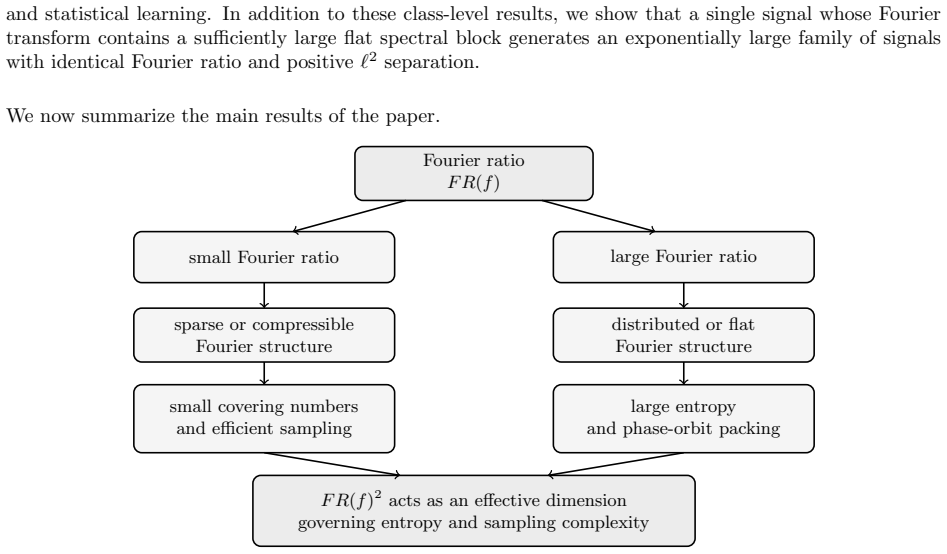
Fourier ratio squared acts as effective dimension for metric entropy of signal classes on Z_N.
A machine-rendered reading of the paper's core claim, the machinery that carries it, and where it could break.
Core claim
For the Fourier-ratio layer of size r on Z_N the metric entropy at sufficiently small fixed scales admits upper and lower bounds whose leading dependence on r and N is identical, so that FR(f)^2 functions as the effective dimension parameter controlling the cardinality of the class. The entropy bound supplies uniform guarantees for empirical approximation, while a phase-orbit packing result shows that any signal possessing a flat spectral block of size k generates an exponentially large family of signals with identical ratio and positive l2 separation.
What carries the argument
The Fourier ratio FR(f), the scalar that measures spread of the Fourier transform and interpolates between sparse and uniform spectral support, serving as the parameter that determines the entropy scaling.
If this is right
- Metric entropy of the class scales with the square of the Fourier ratio times a factor depending on N.
- Uniform bounds hold for the deviation between empirical averages and integrals over the class.
- Any signal with a flat spectral block of size k admits an exponentially large set of phase perturbations sharing the ratio and separated by a positive l2 distance.
- The Fourier ratio controls both individual approximation properties and the geometric size of entire signal classes.
Where Pith is reading between the lines
- If the ratio squared truly functions as dimension, then sampling or recovery procedures could be tuned directly to an estimated ratio value rather than to a sparsity level.
- The phase-orbit packing may supply lower bounds on the minimal number of distinct signals required to realize a given spectral-spread behavior.
- Analogous entropy statements might be pursued on other finite groups once a comparable ratio quantity is defined.
Load-bearing premise
The Fourier ratio is a well-defined scalar that meaningfully interpolates between sparse and uniform spectral support, and the entropy bounds hold once the covering scale is small enough for the r- and N-dependence to match.
What would settle it
Explicit computation of the covering number of a Fourier-ratio layer for concrete r, N, and a small fixed epsilon that fails to exhibit the predicted matching dependence on r squared would show the bounds do not coincide.
Figures
read the original abstract
We study metric entropy and uniform sampling for classes of signals on ${\mathbb Z}_N$ with prescribed Fourier ratio. The Fourier ratio measures how spread out the Fourier transform of a signal is, interpolating between sparse spectral support and nearly uniform spectral distribution. Our main result gives upper and lower bounds for the metric entropy of a Fourier-ratio layer of size $r.$ At any sufficiently small fixed covering scale, these bounds match in their dependence on $r$ and $N$ and show that $FR(f)^2$ acts as an effective dimension parameter governing the size of the class. We use the entropy estimate to obtain uniform bounds for empirical approximation over Fourier-ratio classes. We also establish a phase-orbit packing result. If a single signal has a flat spectral block of size $k,$ then phase perturbations of that signal generate an exponentially large family with the same Fourier ratio and positive $\ell^2$ separation. Together, these results show that the Fourier ratio governs not only approximation properties of individual signals, but also the geometric size and uniform sampling behavior of entire signal classes.
Editorial analysis
A structured set of objections, weighed in public.
Referee Report
Summary. The paper studies metric entropy of classes of signals on the cyclic group Z_N with a fixed Fourier ratio FR(f), a scalar measuring spectral spread that interpolates between sparse and uniform Fourier support. The central claim is that for a Fourier-ratio layer of size r, upper and lower entropy bounds match in their leading dependence on r and N at sufficiently small fixed covering scales, with FR(f)^2 serving as an effective dimension parameter. The paper also gives a phase-orbit construction yielding an exponentially large packing (hence lower bound) for signals with a flat spectral block of size k, and applies the entropy bounds to obtain uniform sampling guarantees for empirical approximation over these classes.
Significance. If the matching bounds hold, the work supplies a concrete dimension-like quantity governing the geometric size of these signal classes in harmonic analysis on finite groups, consistent with dimension-counting expectations (e.g., FR(f) ~ sqrt(N) recovers dimension N). The explicit phase-orbit packing provides a constructive lower bound aligned with FR(f)^2 scaling like k. The uniform sampling application adds practical value. These elements constitute a coherent contribution to metric entropy estimates in discrete Fourier analysis.
minor comments (3)
- [Abstract] The abstract states that the bounds match 'at any sufficiently small fixed covering scale,' but the manuscript should explicitly state the precise dependence of this scale on r and N (or confirm it is independent of post-hoc restrictions on the class) to make the 'matching' claim fully verifiable from the main theorem statement.
- [Introduction] Notation for the Fourier ratio FR(f) and the layer of size r should be introduced with a displayed definition early in the introduction or preliminaries section, including the precise normalization (e.g., whether it is an l2 or l1 quantity on the spectrum).
- The phase-orbit construction is described as producing positive l2 separation; a brief remark on whether the separation constant depends on k or N would help readers assess the strength of the lower bound relative to the entropy upper bound.
Simulated Author's Rebuttal
We thank the referee for the positive summary, significance assessment, and recommendation of minor revision. No major comments appear in the report.
Circularity Check
No significant circularity detected
full rationale
The derivation relies on standard Fourier-analytic estimates on the cyclic group Z_N to bound the metric entropy of level sets defined by the Fourier ratio FR(f). Upper bounds follow from covering arguments that treat FR(f)^2 directly as a dimension proxy, while the lower bound is supplied by an explicit phase-orbit construction on flat spectral blocks; neither step reduces to a fitted parameter renamed as a prediction nor to a self-citation chain. The subsequent uniform sampling application is a direct consequence of the entropy bound and introduces no additional circular dependence. All steps remain within the classical toolkit of harmonic analysis and are independent of any prior results by the same authors.
Axiom & Free-Parameter Ledger
axioms (2)
- standard math The discrete Fourier transform on Z_N satisfies Parseval's identity and the inversion formula.
- standard math Metric entropy of a set in a metric space is the logarithm of the minimal number of balls of given radius needed to cover the set.
Reference graph
Works this paper leans on
-
[1]
K. Aldaleh, W. Burstein, G. Garza, G. Hart, A. Iosevich, J. Iosevich, A. Khalil, J. King, N. Kulkarni, T. Le, I. Li, A. Mayeli, B. McDonald, K. Nguyen, and N. Shaffer,The Fourier Ratio and Quantitative Trigonometric Approximation, arXiv:2511.19560, 2026. 2, 3, 4
arXiv 2026
-
[2]
Anthony and P
M. Anthony and P. Bartlett,Neural Network Learning: Theoretical Foundations, Cambridge University Press, Cambridge, 1999. 14
1999
-
[3]
Boucheron, G
S. Boucheron, G. Lugosi, and P. Massart,Concentration Inequalities, Oxford University Press, Oxford, 2013
2013
-
[4]
W. Burstein, A. Iosevich, and H. S. Nathan,The Fourier Ratio: A Unifying Measure of Complexity for Recovery, Localization, and Learning, arXiv:2601.16345, 2026. 2, 3, 4
arXiv 2026
-
[5]
Foucart and H
S. Foucart and H. Rauhut,A Mathematical Introduction to Compressive Sensing, Birkh¨ auser, New York, 2013
2013
-
[6]
G. M. Goerg,Forecastable Component Analysis, Proceedings of the 30th International Conference on Machine Learning (ICML), 2013, pp. 64–72
2013
-
[7]
A. Iosevich and V. Gupta,Large values in time series and additive combinatorics, arXiv:2604.21292,
-
[8]
Vershynin,High-Dimensional Probability: An Introduction with Applications in Data Science, Cam- bridge University Press, Cambridge, 2018
R. Vershynin,High-Dimensional Probability: An Introduction with Applications in Data Science, Cam- bridge University Press, Cambridge, 2018. 6, 7 15
2018
discussion (0)
Sign in with ORCID, Apple, or X to comment. Anyone can read and Pith papers without signing in.