REVIEW 3 major objections 3 minor 39 references
Trajectory Entropy: Modeling Game State Stability from Multimodality Trajectory Prediction
T0 review · 3 major / 3 minor · reviewed 2026-08-07 · deepseek-v4-flash
Pith's one-line read The paper claims that an agent's need for deeper game-theoretic reasoning can be read off as a signal-to-noise ratio of its multimodal trajectory predictions, and that gating out low-entropy agents improves both accuracy and efficiency.
desk verdict A useful, genuinely new gating idea on GameFormer, but the missing control gates and an internal nuPlan table conflict mean the empirical case is not yet closed. read the letter →
The pith
A machine-rendered reading of the paper's core claim, the machinery that carries it, and where it could break.
The reading
What carries the argument
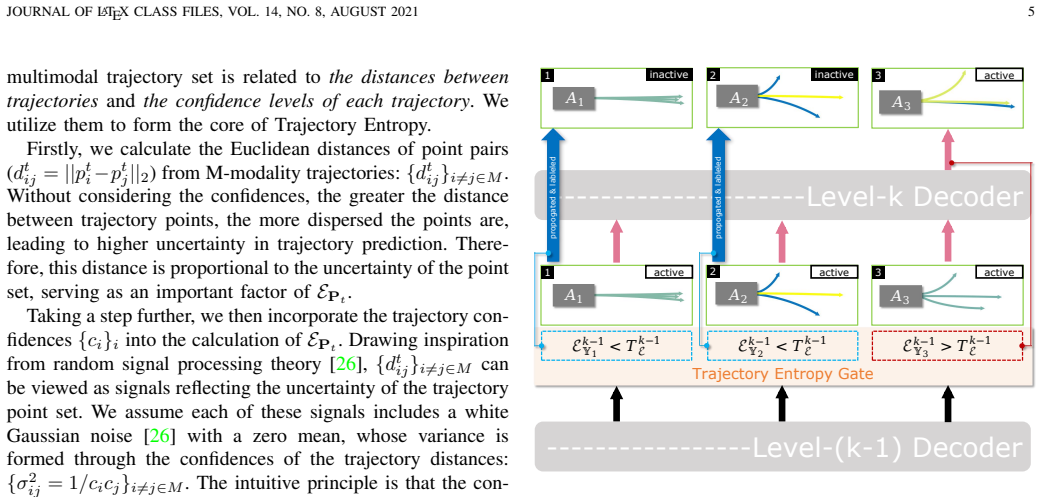
Trajectory Entropy is the central object: for an MTP output $\mathcal{Y}=\{(y_j,c_j)\}_{j=1}^{M}$, it accumulates over time steps the signal-to-noise ratios $\mathrm{SNR}^{t}_{ij}=(d^{t}_{ij})^2/\sigma^{2}_{ij}$, where $d^{t}_{ij}=\|p^{t}_i-p^{t}_j\|_2$ is the pairwise distance between predicted trajectory points and $\sigma^{2}_{ij}=1/(c_i c_j)$ is confidence-derived noise power, normalized by the expected instantaneous speed $\mathcal{E}^{t}_M(l)=\sum_j c_j l^{t}_j$. This scalar carries the argument because it converts the idea that an agent still needs negotiation into a thresholdable number: entropy below the gate threshold labels the agent inactive, and inactive predictions are propagated unchanged through all remaining game levels.
What would settle it
Take the scenes where the gate froze an agent at an early level, and compare the frozen prediction with the trajectory that agent actually follows in the logged future or in closed-loop simulation. If frozen agents frequently diverge from their realized futures by more than the deeper refinement levels would have corrected, or if unfreezing the most confidently frozen agents changes the ego plan to a safer outcome, then low entropy is not a reliable sign of a settled game state.
Extended reading notes
Core claim
Within the GameFormer level-k framework, the paper's central discovery is that an agent's multimodal trajectory prediction at a given game level already encodes whether that agent has settled into a stable policy. Low dispersion across high-confidence trajectory modes indicates low driving difficulty and a stable game state, so the agent can be frozen; high dispersion across comparable modes indicates that the agent still needs to negotiate with others. Trajectory Entropy turns this qualitative picture into a number by treating inter-modal trajectory distances as signals and confidence-derived noise powers $\sigma^2_{ij}=1/(c_i c_j)$ as the accompanying noise, accumulating signal-to-noise ratios over the time horizon with a speed-normalization factor. A gate compares this entropy against per-level thresholds and propagates inactive agents' predictions unchanged to all deeper levels. The paper claims that this gating improves accuracy on every reported metric while reducing computation, with the largest planning gain being 16.48 percent in reactive closed-loop planning on nuPlan Test14-hard.
Load-bearing premise
The load-bearing premise is that the signal-to-noise statistic built from pairwise trajectory distances and confidence-derived noise really tracks whether an agent's policy will stay unchanged in deeper reasoning levels; the paper itself concedes that the time-independence assumption behind the aggregation 'may not be flawless,' and the Gaussian noise variance is asserted rather than validated.
Editorial extensions
If this is right
- Treating all agents with the same number of reasoning levels is suboptimal; assigning each agent a depth based on its current prediction uncertainty improves both prediction accuracy and planning quality.
- Freezing stable agents reduces error propagation, because the predictions of already-settled agents no longer inject noise into deeper game levels.
- Trajectory Entropy is computed from MTP outputs alone and can therefore be inserted as a gate into other level-k or iterative game-theoretic prediction frameworks, not only the one used here.
- The per-level thresholds naturally decline with game level, reflecting that deeper reasoning concentrates predicted futures, which gives a principled way to scale the gate as the hierarchy deepens.
- On the reported benchmarks the improvements are simultaneous rather than a speed-accuracy trade-off: lower minADE, minFDE, and miss rate accompany a 23.84 percent inference-time reduction.
Reading between the lines
- Because the metric relies only on the multimodal outputs of a predictor, it could be used as a generic early-exit criterion for any iterative prediction model, not just game-theoretic planners; the authors gesture at but do not test this generality.
- The thresholds are hand-set per level and per dataset, so a natural extension is to learn them from data or tie them to a tolerated false-freeze rate, rather than tuning them separately for each scene difficulty.
- A softer version of the gate could weight deep-level computation by entropy instead of freezing agents entirely, preserving partial refinement for borderline agents; only binary gating is evaluated here.
- An implication the authors leave implicit is that confidence is not the same as correctness, so a confidently wrong low-entropy agent could be frozen exactly when it should be challenged; monitoring such cases would be a useful safety check for the gating rule.
Editorial analysis
A structured set of objections, weighed in public.
Referee Report
Summary. The paper proposes Trajectory Entropy (TE), a metric computed from multimodal trajectory prediction outputs, and uses it to gate agents in the GameFormer level-k game framework. Agents whose TE is below a threshold are frozen in subsequent game levels, which the authors argue reduces redundant computation and improves accuracy. The method is evaluated on the Waymo Open Motion Dataset and nuPlan for trajectory prediction, open-loop planning, and closed-loop planning, with claims of state-of-the-art results and up to 23.84% inference-time reduction. The central claim is that TE reveals agent game-state stability, so freezing low-TE agents is both more efficient and more accurate than the uniform level-k baseline.
Significance. If the central claim were validated, the work would offer a practically useful way to allocate variable reasoning depth in game-theoretic joint prediction and planning, with clear computational benefits. The paper provides a plausible intuition, several benchmarks, and ablations of threshold settings and normalization choices, and the proposed gating mechanism is simple enough to be adopted by other level-k frameworks. However, the evidence does not yet isolate the contribution of the TE signal, and one experiment is reported with incompatible numbers in two tables. These issues must be resolved before the central claim can be accepted.
major comments (3)
- [IV-B2 / Table VII] The same nuPlan trajectory prediction experiment is reported with incompatible numbers. Section IV-B2 states that thresholds are set to [T0=40, T1=30] for the results in Table II, and Table VII's E_t^M(l) row uses the same normalization and the same thresholds but reports minADE=0.4180, minFDE=0.8063, miss rate=0.0898, and mAP=0.2089, whereas Table II reports minADE=0.4297, minFDE=0.6876, miss rate=0.0149, and mAP=0.2118. These numbers cannot both describe the same evaluation. Please clarify which table is correct or state explicitly what differs between the two runs, because the claimed 19.89% improvement is derived from Table II.
- [IV-D / III-C] No control gate or ablation isolates the TE signal. The gating mechanism freezes low-TE agents and therefore reduces the number of refinement iterations for those agents; this reduction alone may act as a regularizer, especially when deeper game levels introduce noise. Without comparing TE gating against a random gate matched for the same freeze fraction, a gate based on top softmax confidence, and a gate based on pairwise endpoint spread, the gains in Tables I-V do not establish that the SNR-based TE, rather than the act of freezing, drives the improvement. This control is essential because the paper's central claim is that TE specifically measures game-state stability.
- [III-B] The derivation of TE rests on asserted statistical assumptions whose validity is not independently demonstrated. Equation (4) assumes that per-step uncertainties are 0-dependent, Eq. (5) postulates a Gaussian noise variance of 1/(c_i c_j), and Eq. (9) introduces a normalization factor whose choice is justified mainly by the ablation in Table VII. The paper itself concedes that Eq. (4) 'may not be flawless.' These assumptions could be acceptable if the downstream validation were clean, but the Table II/VII inconsistency and the absence of a control gate mean that the metric's validity is not yet established. Please add a direct validation of TE against a measure of state stability (for example, whether a frozen agent's trajectory actually remains unchanged in deeper levels) and a sensitivity analysis for the manually chosen thresholds in Tables I, III, IV, and V.
minor comments (3)
- [Abstract] The abstract claims 'precision improved by up to 19.89% for prediction,' but Table II shows a 19.89% reduction in miss rate, not an improvement in precision; mAP improves by only 2.62%. Please reword the abstract to state the metric accurately.
- [III-B, Eq. (9)] The definition of l_t^j is written as ||p_t^j - p_{t-1}^j||_2^2, which is a squared distance, while the text describes E_t^M(l) as the expectation of distance traveled in unit time (instantaneous speed). Please clarify whether the denominator uses speed or squared speed, since this affects the units and the claimed normalization effect.
- [Fig. 2] The caption contains a typo: 'Entrophy' should be 'Entropy.'
Circularity Check
No significant circularity: Trajectory Entropy is a defined dispersion metric and the gating improvements are empirical, not derived by construction.
full rationale
The paper defines Trajectory Entropy in Eqs. (4)-(9) as a confidence-weighted, speed-normalized measure of pairwise trajectory dispersion. This is a construction, not a prediction derived from something else. The central empirical claim is that gating agents with low TE improves GameFormer metrics; this is tested by comparing gated versus ungated inference on WOMD and nuPlan, and the comparison is not forced by the equations (the gate could plausibly hurt). The thresholds are manually selected and tuned on the same benchmarks, and Tables II and VII report inconsistent nuPlan numbers for the same configuration; these are methodological validity and reproducibility concerns, not reductions of a predicted quantity to a fitted input. The paper contains no load-bearing self-citation chain, no imported uniqueness theorem, and no ansatz hidden in citations; the cited GameFormer is an external baseline. Accordingly, under the rule that circularity must be exhibited as a specific reduction by construction, no circular step is present.
Assumptions & free parameters
free parameters (2)
- Trajectory Entropy thresholds T_E^k per level and dataset =
WOMD prediction [4.3, 4.2, 4.1]; WOMD planning [0.8, 0.75, 0.7, 0.65]; nuPlan prediction [40, 30]; nuPlan planning…
- Speed-normalization factor form =
E_t^M(l) = sum_j c_j * ||p_t^j - p_{t-1}^j||_2
assumptions (5)
- domain assumption MTP dispersion, measured by pairwise distances and confidences, is a valid proxy for agent driving complexity and game-state stability.
- ad hoc to paper Trajectory-point uncertainties are 0-dependent, so per-step uncertainties sum to total uncertainty.
- ad hoc to paper Each pairwise distance signal is corrupted by zero-mean white Gaussian noise with variance 1/(c_i c_j).
- domain assumption Agents with Trajectory Entropy below the threshold can be frozen for all subsequent game levels without degrading accuracy.
- ad hoc to paper Entropy naturally decreases with game level, so thresholds should decrease with level.
Cite this review
Pith. "Pith review of Trajectory Entropy: Modeling Game State Stability from Multimodality Trajectory Prediction." pith.science (2026). https://pith.science/paper/LZQ56ZFZ
@misc{pith2026250605810,
  author       = {Pith},
  title        = {Pith review of: Trajectory Entropy: Modeling Game State Stability from Multimodality Trajectory Prediction},
  year         = {2026},
  howpublished = {\url{https://pith.science/paper/LZQ56ZFZ}},
  note         = {Machine review of arXiv:2506.05810}
}
read the original abstract
Complex interactions among agents present a significant challenge for autonomous driving in real-world scenarios. Recently, a promising approach has emerged, which formulates the interactions of agents as a level-k game framework. It effectively decouples agent policies by hierarchical game levels. However, this framework ignores both the varying driving complexities among agents and the dynamic changes in agent states across game levels, instead treating them uniformly. Consequently, redundant and error-prone computations are introduced into this framework. To tackle the issue, this paper proposes a metric, termed as Trajectory Entropy, to reveal the game status of agents within the level-k game framework. The key insight stems from recognizing the inherit relationship between agent policy uncertainty and the associated driving complexity. Specifically, Trajectory Entropy extracts statistical signals representing uncertainty from the multimodality trajectory prediction results of agents in the game. Then, the signal-to-noise ratio of this signal is utilized to quantify the game status of agents. Based on the proposed Trajectory Entropy, we refine the current level-k game framework through a simple gating mechanism, significantly improving overall accuracy while reducing computational costs. Our method is evaluated on the Waymo and nuPlan datasets, in terms of trajectory prediction, open-loop and closed-loop planning tasks. The results demonstrate the state-of-the-art performance of our method, with precision improved by up to 19.89% for prediction and up to 16.48% for planning.
Figures


Figures from the paper (2 more)

Reference graph
Works this paper leans on
-
[1]
Z. Huang, H. Liu, J. Wu, and C. Lv, “Conditional predictive behavior planning with inverse reinforcement learning for human-like autonomous driving,”IEEE Transactions on Intelligent Transportation Systems, vol. 24, pp. 7244–7258, 2022. 1
work page 2022
-
[2]
Trajectron++: Dynamically-feasible trajectory forecasting with heterogeneous data,
T. Salzmann, B. Ivanovic, P. Chakravarty, and M. Pavone, “Trajectron++: Dynamically-feasible trajectory forecasting with heterogeneous data,” in European Conference on Computer Vision, 2020. 1
work page 2020
-
[3]
Z. Huang, H. Liu, and C. Lv, “Gameformer: Game-theoretic modeling and learning of transformer-based interactive prediction and planning for autonomous driving,” inProceedings of the IEEE/CVF International Conference on Computer Vision (ICCV), October 2023, pp. 3903–3913. 1, 3, 6, 7, 8, 9
work page 2023
-
[4]
Z. Huang, H. Liu, J. Wu, and C. Lv, “Differentiable integrated motion prediction and planning with learnable cost function for autonomous driving,”IEEE transactions on neural networks and learning systems,
-
[5]
Z. Huang, P. Karkus, B. Ivanovic, Y . Chen, M. Pavone, and C. Lv, “Dtpp: Differentiable joint conditional prediction and cost evaluation for tree policy planning in autonomous driving,” in2024 IEEE International Conference on Robotics and Automation (ICRA). IEEE, 2024, pp. 6806–6812. 1, 3
work page 2024
-
[6]
Planning- oriented autonomous driving,
Y . Hu, J. Yang, L. Chen, K. Li, C. Sima, X. Zhu, S. Chai, S. Du, T. Lin, W. Wang, L. Lu, X. Jia, Q. Liu, J. Dai, Y . Qiao, and H. Li, “Planning- oriented autonomous driving,” inProceedings of the IEEE/CVF Confer- ence on Computer Vision and Pattern Recognition, 2023. 1
work page 2023
-
[7]
Comparing models of strategic thinking in van huyck, battalio, and beil’s coordination games,
M. A. Costa-Gomes, V . P. Crawford, and N. Iriberri, “Comparing models of strategic thinking in van huyck, battalio, and beil’s coordination games,”Journal of the European Economic Association, vol. 7, no. 2-3, pp. 365–376, 2009. 1
work page 2009
-
[8]
Multimodal trajectory prediction: A survey,
R. Huang, H. Xue, M. Pagnucco, F. Salim, and Y . Song, “Multimodal trajectory prediction: A survey,” 2023. 2, 3
work page 2023
Show all 39 references
-
[9]
Edition, A
F. Edition, A. Papoulis, and S. U. Pillai,Probability, random variables, and stochastic processes. McGraw-Hill Europe: New York, NY , USA,
-
[10]
Scalability in perception for autonomous driving: Waymo open dataset,
P. Sun, H. Kretzschmar, X. Dotiwalla, A. Chouard, V . Patnaik, P. Tsui, J. Guo, Y . Zhou, Y . Chai, B. Caine, V . Vasudevan, W. Han, J. Ngiam, H. Zhao, A. Timofeev, S. Ettinger, M. Krivokon, A. Gao, A. Joshi, Y . Zhang, J. Shlens, Z. Chen, and D. Anguelov, “Scalability in perc...
-
[11]
Nuplan: A closed-loop ml-based plan- ning benchmark for autonomous vehicles,
K. T. e. a. H. Caesar, J. Kabzan, “Nuplan: A closed-loop ml-based plan- ning benchmark for autonomous vehicles,” inCVPR ADP3 workshop,
-
[12]
Social gan: Socially acceptable trajectories with generative adversarial networks,
A. Gupta, J. Johnson, L. Fei-Fei, S. Savarese, and A. Alahi, “Social gan: Socially acceptable trajectories with generative adversarial networks,” inProceedings of the IEEE conference on computer vision and pattern recognition, 2018, pp. 2255–2264. 3
2018
-
[13]
Social lstm: Human trajectory prediction in crowded spaces,
A. Alahi, K. Goel, V . Ramanathan, A. Robicquet, L. Fei-Fei, and S. Savarese, “Social lstm: Human trajectory prediction in crowded spaces,” inProceedings of the IEEE conference on computer vision and pattern recognition, 2016, pp. 961–971. 3
2016
-
[14]
Home: Heatmap output for future motion estimation,
T. Gilles, S. Sabatini, D. Tsishkou, B. Stanciulescu, and F. Moutarde, “Home: Heatmap output for future motion estimation,” in2021 IEEE International Intelligent Transportation Systems Conference (ITSC). IEEE, 2021, pp. 500–507. 3
2021
-
[15]
Multimodal trajectory predictions for autonomous driving using deep convolutional networks,
H. Cui, V . Radosavljevic, F.-C. Chou, T.-H. Lin, T. Nguyen, T.-K. Huang, J. Schneider, and N. Djuric, “Multimodal trajectory predictions for autonomous driving using deep convolutional networks,” in2019 international conference on robotics and automation (icra). IEEE, 2019, p...
2019
-
[16]
Gohome: Graph-oriented heatmap output for future motion estimation,
T. Gilles, S. Sabatini, D. Tsishkou, B. Stanciulescu, and F. Moutarde, “Gohome: Graph-oriented heatmap output for future motion estimation,” in2022 international conference on robotics and automation (ICRA). IEEE, 2022, pp. 9107–9114. 3
2022
-
[17]
Multi-modal motion prediction with transformer-based neural network for autonomous driving,
Z. Huang, X. Mo, and C. Lv, “Multi-modal motion prediction with transformer-based neural network for autonomous driving,” in2022 International Conference on Robotics and Automation (ICRA). IEEE, 2022, pp. 2605–2611. 3
2022
-
[18]
Multi-agent trajectory prediction with heterogeneous edge-enhanced graph attention network,
X. Mo, Z. Huang, Y . Xing, and C. Lv, “Multi-agent trajectory prediction with heterogeneous edge-enhanced graph attention network,”IEEE Transactions on Intelligent Transportation Systems, vol. 23, no. 7, pp. 9554–9567, 2022. 3
2022
-
[19]
Scene transformer: A unified architecture for predicting multiple agent trajectories,
J. Ngiam, B. Caine, V . Vasudevan, Z. Zhang, H.-T. L. Chiang, J. Ling, R. Roelofs, A. Bewley, C. Liu, A. Venugopalet al., “Scene transformer: A unified architecture for predicting multiple agent trajectories,”Inter- national Conference on Learning Representations, 2021. 3, 6, 7
2021
-
[20]
Motion transformer with global intention localization and local movement refinement,
S. Shi, L. Jiang, D. Dai, and B. Schiele, “Motion transformer with global intention localization and local movement refinement,”Advances in Neural Information Processing Systems, vol. 35, pp. 6531–6543, 2022. 3
2022
-
[21]
Lookout: Diverse multi-future prediction and planning for self-driving,
A. Cui, S. Casas, A. Sadat, R. Liao, and R. Urtasun, “Lookout: Diverse multi-future prediction and planning for self-driving,” inProceedings of the IEEE/CVF International Conference on Computer Vision, 2021, pp. 16 107–16 116. 3
2021
-
[22]
Deep interactive motion prediction and planning: Playing games with motion prediction models,
J. L. V . Espinoza, A. Liniger, W. Schwarting, D. Rus, and L. Van Gool, “Deep interactive motion prediction and planning: Playing games with motion prediction models,” inLearning for Dynamics and Control Conference. PMLR, 2022, pp. 1006–1019. 3
2022
-
[23]
Pip: Planning-informed trajectory prediction for autonomous driving,
H. Song, W. Ding, Y . Chen, S. Shen, M. Y . Wang, and Q. Chen, “Pip: Planning-informed trajectory prediction for autonomous driving,” inComputer Vision–ECCV 2020: 16th European Conference, Glasgow, UK, August 23–28, 2020, Proceedings, Part XXI 16. Springer, 2020, pp. 598–614. 3
2020
-
[24]
Mp3: A unified model to map, perceive, predict and plan,
S. Casas, A. Sadat, and R. Urtasun, “Mp3: A unified model to map, perceive, predict and plan,” inProceedings of the IEEE/CVF Conference on Computer Vision and Pattern Recognition, 2021, pp. 14 403–14 412. 3
2021
-
[25]
Beyond equilibrium: Predicting human behavior in normal-form games,
J. Wright and K. Leyton-Brown, “Beyond equilibrium: Predicting human behavior in normal-form games,” inProceedings of the AAAI Conference on Artificial Intelligence, vol. 24, no. 1, 2010, pp. 901–907. 3
2010
-
[26]
Porat,Digital processing of random signals: theory and methods
B. Porat,Digital processing of random signals: theory and methods. Courier Dover Publications, 2008. 5
2008
-
[27]
R. B. Ash,Information theory. Courier Corporation, 2012. 5
2012
-
[28]
Multi-agent trajectory prediction with heterogeneous edge-enhanced graph attention network,
X. Mo, Z. Huang, Y . Xing, and C. Lv, “Multi-agent trajectory prediction with heterogeneous edge-enhanced graph attention network,”IEEE Transactions on Intelligent Transportation Systems, vol. 23, no. 7, pp. 9554–9567, 2022. 6, 7
2022
-
[29]
Air2 for interaction prediction,
D. Wu and Y . Wu, “Air2 for interaction prediction,”arXiv preprint arXiv:2111.08184, 2021. 6, 7
2021 arXiv
-
[30]
Densetnt: End-to-end trajectory prediction from dense goal sets,
J. Gu, C. Sun, and H. Zhao, “Densetnt: End-to-end trajectory prediction from dense goal sets,” inProceedings of the IEEE/CVF International Conference on Computer Vision, 2021, pp. 15 303–15 312. 6
2021
-
[31]
M2i: From factored marginal trajectory prediction to interactive prediction,
Q. Sun, X. Huang, J. Gu, B. C. Williams, and H. Zhao, “M2i: From factored marginal trajectory prediction to interactive prediction,” in Proceedings of the IEEE/CVF Conference on Computer Vision and Pattern Recognition, 2022, pp. 6543–6552. 6, 7
2022
-
[32]
Motion transformer with global intention localization and local movement refinement,
S. Shi, L. Jiang, D. Dai, and B. Schiele, “Motion transformer with global intention localization and local movement refinement,”Advances in Neural Information Processing Systems, vol. 35, pp. 6531–6543, 2022. 6, 7
2022
-
[33]
Rethinking imitation-based planners for autonomous driving,
J. Cheng, Y . Chen, X. Mei, B. Yang, B. Li, and M. Liu, “Rethinking imitation-based planners for autonomous driving,” in2024 IEEE Inter- national Conference on Robotics and Automation (ICRA). IEEE, 2024, pp. 14 123–14 130. 6, 8, 9
2024
-
[34]
Parting with misconceptions about learning-based vehicle motion planning,
D. Dauner, M. Hallgarten, A. Geiger, and K. Chitta, “Parting with misconceptions about learning-based vehicle motion planning,” inPro- ceedings of The 7th Conference on Robot Learning, ser. Proceedings of Machine Learning Research, J. Tan, M. Toussaint, and K. Darvish, Eds., v...
2023
-
[35]
Congested traffic states in empirical observations and microscopic simulations,
M. Treiber, A. Hennecke, and D. Helbing, “Congested traffic states in empirical observations and microscopic simulations,”Phys. Rev. E, vol. 62, pp. 1805–1824, Aug 2000. 8, 9
2000
-
[36]
Urban driver: Learning to drive from real-world demonstrations using policy gradients,
O. Scheel, L. Bergamini, M. Wolczyk, B. Osi ´nski, and P. Ondruska, “Urban driver: Learning to drive from real-world demonstrations using policy gradients,” inConference on Robot Learning. PMLR, 2022, pp. 718–728. 8, 9
2022
-
[37]
From prediction to planning with goal conditioned lane graph traversals,
M. Hallgarten, M. Stoll, and A. Zell, “From prediction to planning with goal conditioned lane graph traversals,” in2023 IEEE 26th International Conference on Intelligent Transportation Systems (ITSC). IEEE, 2023, pp. 951–958. 8, 9
2023
-
[38]
Pluto: Pushing the limit of imita- tion learning-based planning for autonomous driving,
J. Cheng, Y . Chen, and Q. Chen, “Pluto: Pushing the limit of imita- tion learning-based planning for autonomous driving,”arXiv preprint arXiv:2404.14327, 2024. 8, 9
2024 arXiv
-
[39]
Diffusion-based planning for autonomous driving with flexible guidance,
Y . Zheng, R. Liang, K. ZHENG, J. Zheng, L. Mao, J. Li, W. Gu, R. Ai, S. E. Li, X. Zhan, and J. Liu, “Diffusion-based planning for autonomous driving with flexible guidance,” inICLR, 2025. 8, 9
2025
Reviewed August 7, 2026 · model on record in the stance chip above.
Discussion (0). Sign in to comment.