REVIEW 4 major objections 5 minor 32 references
Beyond General Prompts: Automated Prompt Refinement using Contrastive Class Alignment Scores for Disambiguating Objects in Vision-Language Models
T0 review · 4 major / 5 minor · reviewed 2026-08-15 · deepseek-v4-flash
Pith's one-line read CCAS ranks prompt candidates by semantic closeness to a target class while penalizing similarity to confusable classes, and top-ranked prompts improve zero-shot detection accuracy with no training or labeled data.
desk verdict A clean, simple prompt-ranking method with large but under-validated gains on two detection tasks; the proxy assumption between MiniLM and OWLv2 is the main weakness. read the letter →
The pith
A machine-rendered reading of the paper's core claim, the machinery that carries it, and where it could break.
The reading
What carries the argument
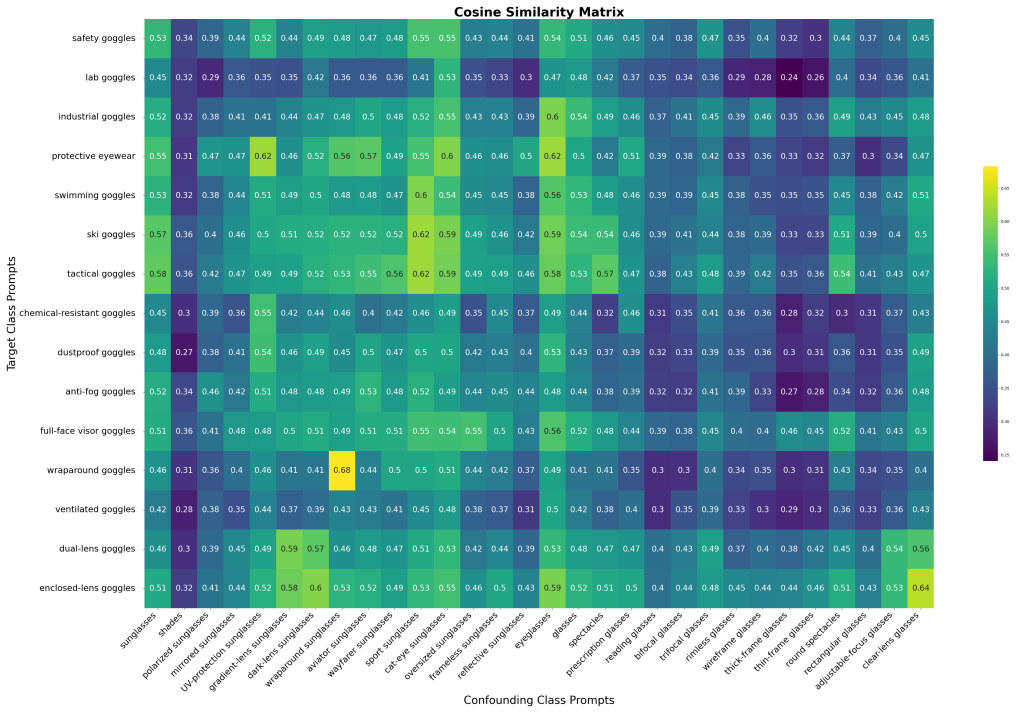
The load-bearing object is the Contrastive Class Alignment Score (CCAS), computed for each candidate prompt $t_i$ of a target class $T$ against $M$ confounding classes that each have $N$ prompts: $\operatorname{CCAS}_{\mathrm{avg}}(t_i)=\cos(\vec{t}_i,\vec{T})-\frac{1}{NM}\sum_{m=1}^{M}\sum_{k=1}^{N}\cos(\vec{t}_i,\vec{c}_{m,k})$ and $\operatorname{CCAS}_{\mathrm{max}}(t_i)=\cos(\vec{t}_i,\vec{T})-\max_{m,k}\cos(\vec{t}_i,\vec{c}_{m,k})$. The score lives entirely in text-embedding space, using cosine similarity from a sentence transformer, so it ranks prompts before any image is shown to the detector. That ordering is what turns an undifferentiated LLM-generated prompt list into a small set of high-precision prompts.
What would settle it
Enumerate a larger benchmark of target-and-confounder class groups, compute CCAS for every LLM-generated prompt, and run OWLv2 on each prompt to measure average precision; if the rank correlation between CCAS and AP is zero or negative, or if the top-ranked prompt fails to beat the base class name on average, the central claim is refuted.
Extended reading notes
Core claim
The central claim is that an automatic, training-free prompt filter can disambiguate objects for a zero-shot detector. On the Safety Goggles and Self-Driving Cars evaluations, replacing the base prompt with a top-ranked CCAS prompt raises OWLv2 average precision from 0.2555 to 0.5415 for goggles (CCAS max, top 1) and from 0.006858 to 0.3835 for stop signs (CCAS avg, top 1). The method deliberately lets imperfect LLM prompts such as 'swimming goggles' and 'ski goggles' propagate through the ranking, to show that the scoring still selects useful prompts without manual cleaning. The authors interpret the gains as coming from phrases that are specific enough to match the target while staying semantically distant from the given confounding classes.
Load-bearing premise
The load-bearing premise is that cosine similarity between sentence-transformer embeddings of prompts predicts which prompts will confuse the downstream OWLv2 detector; if this text-only proxy fails, the CCAS ranking need not improve detection.
Editorial extensions
If this is right
- If the central claim holds, a practitioner with a target class and a short list of confusable classes can get better detection precision by running the CCAS pipeline than by using the dataset class name, without touching model weights.
- Because no training or labels are involved, the same filter can be dropped in front of any open-vocabulary detector that accepts discrete text prompts.
- The observed drop from top-1 to top-3 and top-5 prompts implies that feeding fewer, higher-scoring prompts is preferable when precision is the goal.
- CCAS avg and CCAS max are both viable, with CCAS max winning on goggles and CCAS avg winning on stop signs; the right variant may depend on how concentrated the confounder similarity is.
Reading between the lines
- The paper does not test whether sentence-transformer cosine similarity tracks the internal similarity of the downstream detector; a natural extension is to compare CCAS rankings with per-prompt detector AP across a broader class set, or to replace the text-only proxy with detector-derived similarity scores.
- The method inherits the user's choice of confounding classes; automating confounder discovery from dataset labels or an ontology would remove the last human step in the pipeline.
- Because the score is text-only and detector-agnostic, it should transfer to other discrete-prompt vision tasks such as open-vocabulary segmentation or classification, where the same ambiguity-between-classes phenomenon appears.
Signed reviews
Editorial analysis
A structured set of objections, weighed in public.
Referee Report
Summary. The paper proposes an automated prompt-refinement pipeline for zero-shot object detection with vision-language models. For a target class and a set of manually chosen confounding classes, the method uses an LLM (GPT-4o) to generate N candidate prompts per class, embeds all prompts with the sentence transformer all-MiniLM-L6-v2, and ranks target-class prompts by a Contrastive Class Alignment Score (CCAS) that rewards similarity to the base class name while penalizing similarity to confounder prompts. The top-ranked prompts are then fed to OWLv2, and the paper reports average precision on two datasets: a safety-goggles dataset with confounders 'glasses' and 'sunglasses', and a self-driving-cars stop-sign dataset with confounders 'red light' and 'speed limit'. The reported results show AP improvements over the base class-name baseline for both datasets, with CCAS_max preferred on goggles and CCAS_avg preferred on stop signs.
Significance. If the central claim holds, the work offers a simple, interpretable, and training-free alternative to manual prompt engineering for zero-shot detection, with potential value in safety-critical applications where precision against visually similar distractors matters. The pipeline is appealingly transparent: the score is computed from text embeddings only, requires no detector training or labeled examples, and produces human-readable prompts. However, the significance is currently limited by the evaluation's narrow scope (two datasets, one detector), the absence of statistical validation, and the untested assumption that MiniLM cosine similarity predicts OWLv2's confusion behavior. The paper would be a useful contribution if these load-bearing points are addressed; as presented, the evidence is suggestive rather than conclusive.
major comments (4)
- [Section III, Eqs. (1)-(2)] The load-bearing assumption is that cosine similarity computed in all-MiniLM-L6-v2 embedding space predicts which candidate prompts will reduce false positives in OWLv2. This assumption is never directly tested: Tables III and IV report AP only for the baseline and for top-{1,3,5,N} prompt sets, not per-prompt AP for the full candidate pool, so there is no evidence that CCAS ordering correlates with detector precision. Please add per-prompt AP values or a rank-correlation test (e.g., Spearman) between CCAS scores and AP, and compare against a ranking obtained with OWLv2's own text encoder. Without such a validation, the central claim that CCAS identifies high-precision prompts is unsupported.
- [Section IV, Tables III-IV] The choice of scoring variant and prompt-count configuration appears post hoc: CCAS_max performs better on the goggles task, while CCAS_avg performs better on the stop-sign task, and N is set to 15 for one dataset and 25 for the other without a stated rule. Because two CCAS variants and several top-n thresholds are evaluated, the reported best improvements may reflect selection over a small grid of configurations rather than a property of a single automated pipeline. Please specify an a priori rule for selecting the variant and n (for example, based on the measured ambiguity of the base class) and validate that rule across additional datasets.
- [Section IV, Table IV] The stop-sign baseline AP of 0.0069 is unusually poor, and the large relative gains over this baseline may not indicate a generally effective method. The manuscript should report absolute AP with error bars or significance tests across a broader set of classes with non-degenerate baselines before claiming, as the abstract does, that the method 'improves object detection accuracy' in general. At minimum, the paper should acknowledge that the stop-sign result is a single extreme case.
- [Section V, Discussion] The Discussion concedes that when the base class name is already distinguishable, the baseline prompt should be preferred over CCAS-selected prompts, but it provides no criterion for detecting this situation. This concession directly limits the abstract's claim of a fully automated pipeline. Please either supply a decision rule (for example, a CCAS margin threshold that triggers fallback to the baseline) or revise the claim to scope the method to ambiguous classes.
minor comments (5)
- [Section III, Eqs. (1)-(2)] The notation is inconsistent: the equations use cos(\vec{t}_i, \vec{T}) and cos(\vec{t}_i, \vec{c}_{m,k}), but the definition list gives \vec{t}_{i,j} for the j-th candidate prompt and \vec{t}_i for the base class name, and \vec{T} is never defined. Please align the notation with the prose, which describes scores computed for each candidate prompt.
- [Figure 2 caption] The caption states that the pipeline is 'discussed in Algorithm and Experimental Evaluation,' but the manuscript contains no numbered Algorithm section. Please either add the algorithm pseudocode or correct the cross-reference.
- [Section IV] The paper does not state whether OWLv2 detections were thresholded at a fixed confidence score or how AP was computed (e.g., whether the Roboflow evaluation protocol was used). Please report the protocol so the AP numbers are reproducible.
- [References] Reference [2] renders the dataset name as 'Sugarcrepe++' while the text uses 'SugarCrepe++'; please standardize the spelling.
- [Tables I-II] The table headers 'CCAS scores averages' and 'CCAS scores maxes' are awkward; consider using 'CCAS_avg' and 'CCAS_max' to match Equations (1) and (2).
Circularity Check
No significant circularity: CCAS is an independent text-embedding heuristic evaluated against OWLv2 AP.
full rationale
The paper's central derivation is not circular. CCAS is defined in Equations (1) and (2) using cosine similarities between all-MiniLM-L6-v2 embeddings of LLM-generated target and confounding prompts; it is computed entirely from text embeddings and is never fit to OWLv2 outputs. The evaluation in Tables III and IV measures average precision on OWLv2 as an external benchmark, and no parameter of the detector is used to construct the CCAS ranking. The claim that CCAS-selected prompts improve precision is therefore a falsifiable hypothesis validated on held-out detector performance, not a prediction equivalent to its input. The authors' self-citations appear only as background support for prompt sensitivity and safety-related applications, and no load-bearing uniqueness theorem or ansatz is imported from prior work by the same authors. The unmeasured proxy correlation between MiniLM embeddings and OWLv2 confusion behavior, and the post-hoc choice between CCAS_avg and CCAS_max, are methodological or statistical concerns rather than circular reductions: they do not make the reported AP values equal to the scoring equations by construction. Accordingly, no circular step meets the evidentiary standard required to raise the score.
Assumptions & free parameters
free parameters (1)
- N (number of LLM-generated prompts per class) =
15 for the goggles task; 25 for the stop sign task
assumptions (2)
- domain assumption Cosine similarity in all-MiniLM-L6-v2 embedding space is a reliable proxy for semantic confusion between object classes in the downstream detector.
- domain assumption GPT-4o generates a diverse and useful set of prompt candidates from the given instruction.
Cite this review
Pith. "Pith review of Beyond General Prompts: Automated Prompt Refinement using Contrastive Class Alignment Scores for Disambiguating Objects in Vision-Language Models." pith.science (2026). https://pith.science/paper/M2BBHMB5
@misc{pith2026250509139,
  author       = {Pith},
  title        = {Pith review of: Beyond General Prompts: Automated Prompt Refinement using Contrastive Class Alignment Scores for Disambiguating Objects in Vision-Language Models},
  year         = {2026},
  howpublished = {\url{https://pith.science/paper/M2BBHMB5}},
  note         = {Machine review of arXiv:2505.09139}
}
read the original abstract
Vision-language models (VLMs) offer flexible object detection through natural language prompts but suffer from performance variability depending on prompt phrasing. In this paper, we introduce a method for automated prompt refinement using a novel metric called the Contrastive Class Alignment Score (CCAS), which ranks prompts based on their semantic alignment with a target object class while penalizing similarity to confounding classes. Our method generates diverse prompt candidates via a large language model and filters them through CCAS, computed using prompt embeddings from a sentence transformer. We evaluate our approach on challenging object categories, demonstrating that our automatic selection of high-precision prompts improves object detection accuracy without the need for additional model training or labeled data. This scalable and model-agnostic pipeline offers a principled alternative to manual prompt engineering for VLM-based detection systems.
Figures


Reference graph
Works this paper leans on
-
[1]
Learning to prompt for vision- language models,
K. Zhou, J. Yang, C. C. Loy, and Z. Liu, “Learning to prompt for vision- language models,”International Journal of Computer Vision, vol. 130, no. 9, pp. 2337–2348, 2022
2022
-
[2]
Sugarcrepe++ dataset: Vision-language model sensitivity to semantic and lexical alterations,
S. H. Dumpala, A. Jaiswal, C. Shama Sastry, E. Milios, S. Oore, and H. Sajjad, “Sugarcrepe++ dataset: Vision-language model sensitivity to semantic and lexical alterations,”Advances in Neural Information Processing Systems, vol. 37, pp. 17972–18018, 2024
work page 2024
-
[3]
Language- driven active learning for diverse open-set 3d object detection,
R. Greer, B. Antoniussen, A. Møgelmose, and M. Trivedi, “Language- driven active learning for diverse open-set 3d object detection,” in Proceedings of the Winter Conference on Applications of Computer Vision, pp. 980–988, 2025
work page 2025
-
[4]
A. Keskar, S. Perisetla, and R. Greer, “Evaluating multimodal vision- language model prompting strategies for visual question answering in road scene understanding,” inProceedings of the Winter Conference on Applications of Computer Vision, pp. 1027–1036, 2025
work page 2025
-
[5]
Ipo: Interpretable prompt optimization for vision-language models,
Y . Du, W. Sun, and C. Snoek, “Ipo: Interpretable prompt optimization for vision-language models,”Advances in Neural Information Processing Systems, vol. 37, pp. 126725–126766, 2024
work page 2024
-
[6]
G. Geigle, R. Timofte, and G. Glava ˇs, “African or european swallow? benchmarking large vision-language models for fine-grained object classification,”arXiv preprint arXiv:2406.14496, 2024
arXiv 2024
-
[7]
J. Kim and H. Ji, “Finer: Investigating and enhancing fine-grained visual concept recognition in large vision language models,”arXiv preprint arXiv:2402.16315, 2024
arXiv 2024
-
[8]
Litai: Enhanc- ing multimodal literature understanding and mining with generative ai,
G. Medisetti, Z. Compson, H. Fan, H. Yang, and Y . Feng, “Litai: Enhanc- ing multimodal literature understanding and mining with generative ai,” in2024 IEEE 7th International Conference on Multimedia Information Processing and Retrieval (MIPR), pp. 471–476, IEEE, 2024
work page 2024
Show all 32 references
-
[9]
Gaugetracker: Ai- powered cost-effective analog gauge monitoring system,
B. Tian, M. Wu, R. Zhang, H. Zheng, B. Chen, Y . Wang, S. Trivedi, S. Zhang, R. B. Kaufman, L. Espenhahn,et al., “Gaugetracker: Ai- powered cost-effective analog gauge monitoring system,” in2024 IEEE 7th International Conference on Multimedia Information Processing and Retriev...
2024
-
[10]
Reframing: Detector-specific prompt tuning for enhancing open-vocabulary object detection,
M. Avshalumov, Z. V olovikova, D. Yudin, and A. Panov, “Reframing: Detector-specific prompt tuning for enhancing open-vocabulary object detection,” inInternational Conference on Hybrid Artificial Intelligence Systems, pp. 128–140, Springer, 2024
2024
-
[11]
Learning to prompt for open-vocabulary object detection with vision-language model,
Y . Du, F. Wei, Z. Zhang, M. Shi, Y . Gao, and G. Li, “Learning to prompt for open-vocabulary object detection with vision-language model,” inProceedings of the IEEE/CVF conference on computer vision and pattern recognition, pp. 14084–14093, 2022
2022
-
[12]
T-rex2: Towards generic object detection via text-visual prompt synergy,
Q. Jiang, F. Li, Z. Zeng, T. Ren, S. Liu, and L. Zhang, “T-rex2: Towards generic object detection via text-visual prompt synergy,” inEuropean Conference on Computer Vision, pp. 38–57, Springer, 2024
2024
-
[13]
Fine-grained visual prompting,
L. Yang, Y . Wang, X. Li, X. Wang, and J. Yang, “Fine-grained visual prompting,”Advances in Neural Information Processing Systems, vol. 36, pp. 24993–25006, 2023
2023
-
[14]
Prompt distribution learning,
Y . Lu, J. Liu, Y . Zhang, Y . Liu, and X. Tian, “Prompt distribution learning,” inProceedings of the IEEE/CVF Conference on Computer Vision and Pattern Recognition, pp. 5206–5215, 2022
2022
-
[15]
Camosam2: Motion-appearance induced auto-refining prompts for video camouflaged object detection,
X. Zhang, K. Fu, and Q. Zhao, “Camosam2: Motion-appearance induced auto-refining prompts for video camouflaged object detection,”arXiv preprint arXiv:2504.00375, 2025
2025 arXiv
-
[16]
Segment anything,
A. Kirillov, E. Mintun, N. Ravi, H. Mao, C. Rolland, L. Gustafson, T. Xiao, S. Whitehead, A. C. Berg, W.-Y . Lo,et al., “Segment anything,” inProceedings of the IEEE/CVF international conference on computer vision, pp. 4015–4026, 2023
2023
-
[17]
Zero-shot nuclei detection via visual-language pre-trained models,
Y . Wu, Y . Zhou, J. Saiyin, B. Wei, M. Lai, J. Shou, Y . Fan, and Y . Xu, “Zero-shot nuclei detection via visual-language pre-trained models,” in International Conference on Medical Image Computing and Computer- Assisted Intervention, pp. 693–703, Springer, 2023
2023
-
[18]
Attriprompter: Auto-prompting with attribute semantics for zero-shot nuclei detection via visual-language pre-trained models.,
Y . Wu, Y . Zhou, J. Saiyin, B. Wei, M. Lai, J. Shou, and Y . Xu, “Attriprompter: Auto-prompting with attribute semantics for zero-shot nuclei detection via visual-language pre-trained models.,”IEEE Trans- actions on Medical Imaging, 2024
2024
-
[19]
Self-driving cars dataset
S. Car, “Self-driving cars dataset.” https://universe.roboflow.com/ selfdriving-car-qtywx/self-driving-cars-lfjou, jun 2023
2023
-
[20]
Gpt-4o system card,
A. Hurst, A. Lerer, A. P. Goucher, A. Perelman, A. Ramesh, A. Clark, A. Ostrow, A. Welihinda, A. Hayes, A. Radford,et al., “Gpt-4o system card,”arXiv preprint arXiv:2410.21276, 2024
2024 arXiv
-
[21]
Minilm: Deep self-attention distillation for task-agnostic compression of pre- trained transformers,
W. Wang, F. Wei, L. Dong, H. Bao, N. Yang, and M. Zhou, “Minilm: Deep self-attention distillation for task-agnostic compression of pre- trained transformers,”Advances in neural information processing sys- tems, vol. 33, pp. 5776–5788, 2020
2020
-
[22]
Scaling open-vocabulary object detection,
M. Minderer, A. Gritsenko, and N. Houlsby, “Scaling open-vocabulary object detection,”Advances in Neural Information Processing Systems, vol. 36, pp. 72983–73007, 2023
2023
-
[23]
Crowdtruth measures for language ambiguity,
A. Dumitrache, L. Aroyo, and C. Welty, “Crowdtruth measures for language ambiguity,” inProc. of LD4IE Workshop, ISWC, 2015
2015
-
[24]
Requirements for tools for ambiguity identification and measurement in natural lan- guage requirements specifications,
N. Kiyavitskaya, N. Zeni, L. Mich, and D. M. Berry, “Requirements for tools for ambiguity identification and measurement in natural lan- guage requirements specifications,”Requirements engineering, vol. 13, pp. 207–239, 2008
2008
-
[25]
Ambiguity identification and measurement in natural language texts,
M. Ceccato, N. Kiyavitskaya, N. Zeni, L. Mich, and D. M. Berry, “Ambiguity identification and measurement in natural language texts,” 2004
2004
-
[26]
Generation and comprehension of unambiguous object descriptions,
J. Mao, J. Huang, A. Toshev, O. Camburu, A. L. Yuille, and K. Murphy, “Generation and comprehension of unambiguous object descriptions,” inProceedings of the IEEE conference on computer vision and pattern recognition, pp. 11–20, 2016
2016
-
[27]
Towards explainable, safe autonomous driving with language embeddings for novelty identification and active learning: Framework and experimental analysis with real-world data sets,
R. Greer and M. Trivedi, “Towards explainable, safe autonomous driving with language embeddings for novelty identification and active learning: Framework and experimental analysis with real-world data sets,”arXiv preprint arXiv:2402.07320, 2024
2024 arXiv
-
[28]
T. E. W. Bossen, A. Møgelmose, and R. Greer, “Can vision-language models understand and interpret dynamic gestures from pedestrians? pilot datasets and exploration towards instructive nonverbal commands for cooperative autonomous vehicle,” inCVPR DriveX workshop, 2025
2025
-
[29]
Evaluating cascaded methods of vision-language models for zero-shot detection and association of hardhats for increased construction safety,
L. Choi and R. Greer, “Evaluating cascaded methods of vision-language models for zero-shot detection and association of hardhats for increased construction safety,”arXiv preprint arXiv:2410.12225, 2024
2024 arXiv
-
[30]
Evaluating vision-language models for zero- shot detection, classification, and association of motorcycles, passengers, and helmets,
L. Choi and R. Greer, “Evaluating vision-language models for zero- shot detection, classification, and association of motorcycles, passengers, and helmets,” in2024 IEEE 100th Vehicular Technology Conference (VTC2024-Fall), pp. 1–7, IEEE, 2024
2024
-
[31]
Driver activity classification using generalizable representations from vision- language models,
R. Greer, M. V . Andersen, A. Møgelmose, and M. M. Trivedi, “Driver activity classification using generalizable representations from vision- language models,” inVision and Language for Autonomous Driving and Robotics Workshop, CVPR, 2024
2024
-
[32]
Towards a multi-agent vision-language system for zero-shot novel hazardous object detection for autonomous driving safety,
S. Shriram, S. Perisetla, A. Keskar, H. Krishnaswamy, T. E. W. Bossen, A. Møgelmose, and R. Greer, “Towards a multi-agent vision-language system for zero-shot novel hazardous object detection for autonomous driving safety,”arXiv preprint arXiv:2504.13399, 2025
2025 arXiv
Reviewed August 15, 2026 · model on record in the stance chip above.
Discussion (0). Continue with ORCID to comment.