REVIEW 3 major objections 5 minor 13 references
Role-Decoupled Attention Residuals: Separating Matching and Content Retrieval Across Depth
T0 review · 3 major / 5 minor · reviewed 2026-08-06 · deepseek-v4-flash
Pith's one-line read Shared QKV depth read is a real constraint: decoupling the value route wins all ten paired pretraining runs.
desk verdict A genuinely controlled, narrowly scoped study: separating QK and V depth routes helps in short-budget pretraining, though the 343M leg is partly confounded by a kernel asymmetry. read the letter →
The pith
A machine-rendered reading of the paper's core claim, the machinery that carries it, and where it could break.
The reading
What carries the argument
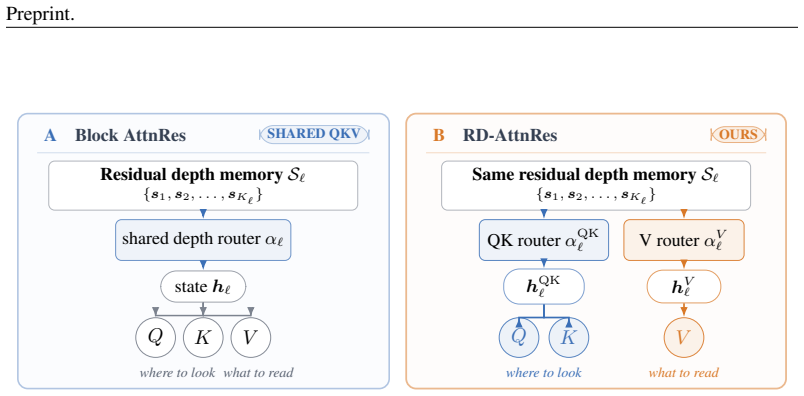
The mechanism is a role-factorized depth read. For each layer $\ell$, two zero-initialized route queries score the same residual source set $\mathcal{S}_\ell$; softmax turns each score vector into a distribution, and each distribution forms a convex mixture of the sources. Queries and keys are projected from the QK mixture, values from the V mixture. With $q^{V}_\ell = q^{QK}_\ell$ the equations collapse to the parent, so the only new learned parameters are the $L$ value-route queries. This factorization isolates the coupling being tested: it changes no token-to-token attention operation and leaves sources, normalization, attention, MLP route, and writeback untouched.
What would settle it
Run a fully crossed, tolerance-qualified backend comparison on the same paired seeds at both scales, with RD-AttnRes and Block AttnRes each executed on both the reference and fused kernels, and re-measure the paired NLL differences at 2B tokens. If the advantage shrinks to non-significance or reverses when both architectures share the same backend, the reported gain is a backend/rounding artifact rather than role decoupling.
Extended reading notes
Core claim
The central claim is that, in the tested same-parent setting, the shared QKV depth read in Block Attention Residuals is a consequential constraint rather than an innocuous implementation detail. RD-AttnRes replaces the single depth mixture with two: route queries $q^{QK}_\ell$ and $q^{V}_\ell$ score the same normalized residual sources, producing $h^{QK}_\ell$ for queries and keys and $h^{V}_\ell$ for values. Tying the two route queries recovers Block AttnRes exactly. Empirically, RD-AttnRes lowers validation negative log-likelihood in every one of the ten paired 2B-token runs, with mean reductions of 0.0301 at 120M parameters and 0.0247 at 343M, corresponding to mean perplexity reductions o
Load-bearing premise
The load-bearing premise is that the reference and fused Triton kernels implement the same mathematical operator with negligible floating-point differences; Appendix E reports that four of five 343M RD runs and one of five 120M RD runs used the fused path while all Block runs used the reference path, with no crossed, tolerance-qualified backend experiment in the archive.
Editorial extensions
If this is right
- Within the tested regime, removing the QKV depth tie improves validation NLL in all ten paired 2B-token runs at both 120M and 343M scale.
- The gain appears at every evaluation milestone (0.25B, 0.5B, 1.0B, and 2.0B tokens), but its absolute size narrows over training.
- Single-seed controls show that simply executing two routes, averaging mixtures, or freezing the value route to uniform does not reproduce the gain; only the learned independent value route does.
- The learned QK and V depth distributions stay non-collapsed (endpoint JS divergence about 0.218 at 120M and 0.215 at 343M), consistent with genuine role specialization.
- When the two route queries are tied, RD-AttnRes reduces exactly to Block AttnRes, so the improvement is attributable to the decoupling itself rather than to a different residual system.
Reading between the lines
- The authors keep Q and K tied as a design choice; one could go further and learn three independent routes, which would reveal whether QK symmetry itself is load-bearing or just a convenient reduction.
- The extra depth mixture costs $O(BT K_\ell d)$ and no $O(T^2 d)$ token-attention term; a properly fused Block baseline would show whether role decoupling can be made runtime-neutral at scale.
- The reported JS divergence is associational: a causal check would freeze or swap the learned value route after training and observe whether retrieval behavior changes, separating functional divergence from expressive freedom.
Editorial analysis
A structured set of objections, weighed in public.
Referee Report
Summary. The paper studies depth-routing residual architectures for Transformers, specifically Block Attention Residuals (AttnRes), which use a single learned depth mixture to construct the inputs to queries, keys, and values. The authors argue that this couples two functionally distinct decisions: QK routes determine where attention matches, while V routes determine what content is retrieved. They propose Role-Decoupled Attention Residuals (RD-AttnRes), which keeps a shared QK depth route and adds an independent value route over the same residual sources. The paper shows that tying the two route queries recovers Block AttnRes exactly, and that decoupling adds only one d-dimensional vector per layer and no extra token-to-token attention. The empirical protocol is a paired, preregistered pretraining comparison on FineWeb-Edu at 120M and 343M parameters, five seeds per scale, with a 2.0B-token budget. The main result is that RD-AttnRes improves validation NLL in all 10 paired runs, with mean reductions of 0.0301 and 0.0247 NLL (2.97% and 2.43% perplexity reductions). Single-seed controls at 0.5B tokens test parameter count, duplicated execution, and a frozen value route, and routing diagnostics show nonzero QK-V depth divergence. The paper carefully bounds its claims and includes an explicit evidence-boundary ledger.
Significance. If the central claim holds, the paper identifies a previously implicit design constraint in Block AttnRes and provides a minimal, auditable modification that improves short-budget pretraining across two model scales. The contribution is architectural and empirical rather than theoretical: the exact-recovery argument is elementary, but the paired experimental protocol, per-seed reporting, prespecified seeds, bootstrap/t-confidence intervals, and explicit backend audit are strengths. The paper is unusually transparent about its limitations, including the missing M-scale Tied control and the fused-versus-reference kernel asymmetry. However, the 343M result is partly confounded by a backend mismatch, and the missing M Tied control weakens the causal interpretation at that scale. The significance is therefore conditional: the 120M evidence is fairly clean, but the paper's claim of robustness across both scales is not yet fully settled.
major comments (3)
- [§5.1 and Appendix E] The M-scale result is confounded by a backend asymmetry. Appendix E states that all Block AttnRes main runs use the reference route implementation, while four of five M-scale RD runs (seeds 2025, 2026, 3407, 7777) use the fused Triton path; only seed 123 uses the reference path for RD at M. The paper asserts both kernels implement the same mathematical operator but provides no crossed, tolerance-qualified backend experiment. Table 3 shows the reference-only M seed 123 has the smallest gain (ΔNLL = −0.018), while the fused seeds drive the mean M gain of −0.0247. Because training uses BF16 autocast, accumulation-order or softmax-precision differences could systematically shift NLL. Without a crossed experiment, the 343M leg cannot separate 'role decoupling helps' from 'fused backend helps RD runs.' This directly affects the abstract's 'all 10 matched comparisons' claim and the §5.1 conclus
- [§5.3 and Table 2] The M-scale Tied control was not completed. Table 2 reports '—' for the M Tied row, and the text acknowledges this. The Tied control is important because it operationalizes the exact-recovery argument and is the most direct check that sharing the QK/V route is the source of the parent's deficit. Without an M Tied run, the claim in §5.3 that 'parameter count, duplicated execution, or a fixed value route does not reproduce the gain' is incomplete at the larger scale. The Average and Frozen-V controls at M are consistent, but they do not substitute for the Tied condition. I recommend completing the M Tied run, or, if it is infeasible, explicitly restricting the causal interpretation at M to the available controls and tempering the §1 and §7 wording accordingly.
- [§5.3 and Table 2] The controls are single-seed, at 0.5B tokens, and the S RD entry is from a separate ablation run rather than the main-run milestone. The paper acknowledges this in the text, but the abstract states that 'neither the additional parameter count, duplicated routing execution, nor a fixed value route reproduces the improvement.' This overstates the evidence: the controls are directional, unpaired across seeds, and one control cell is missing. The conclusion should be phrased as 'consistent with' rather than 'reproduces' unless the controls are completed across seeds and backends. This is not a fatal flaw, but it is load-bearing for the mechanistic interpretation.
minor comments (5)
- [§3.3] The sentence 'The only new learned parameters are the independent value queries, one vector in R^d per layer, for Ld total' is slightly ambiguous. The total should be stated as 'Ld additional parameters' to avoid implying the entire vector set is new in a non-obvious way. The subsequent parameter-count percentages are clear.
- [§5.4] The JS divergence is reported in 'natural logarithms, maximum log 2.' It would be clearer to say 'nats' and to note explicitly that the maximum possible JS divergence in nats is ln 2, so the reported values around 0.218 are not tiny compared to the maximum.
- [Table 2] The footnote that the S RD value is from an independent ablation-directory run (3.499386) while the main-run milestone is 3.498424 is important for reproducibility. Consider moving this distinction into the main text or a more prominent table note, since readers may otherwise wonder why the same condition has two values.
- [§6] The Systems caveat paragraph is commendable for its transparency, but the sentence 'Later fused route kernels improved RD-AttnRes throughput ... so those measurements are not matched efficiency evidence' could be rephrased to avoid implying that any efficiency improvement is being claimed. The paragraph already states this correctly; a minor rewording would improve clarity.
- [Appendix D] The paired-bootstrap interval uses percentile endpoints with only five differences. This is fine as a descriptive interval, but the text should perhaps note that with n=5 the bootstrap has low precision and is not a substitute for more seeds. The paper already cautions that intervals describe these seeds, so this is a minor clarification.
Circularity Check
No significant circularity: the empirical comparison is a genuine paired out-of-sample test and the exact-recovery argument is a logical identity, not a derivation from the claim.
full rationale
The paper's central claim is that decoupling the value depth route from the shared QK route improves validation NLL relative to the parent Block AttnRes architecture. This is established by ten preregistered paired 2B-token runs against an externally cited parent (Kimi Team et al., 2026), with no parameter fitted to the reported validation outcomes. The 'exact recovery' argument in Section 3.3 and Appendix B is a mathematical identity: if qV = qQK, then the RD equations reduce to the parent equations by construction; this is not a circular derivation of the empirical improvement but rather a design guarantee that the proposal is a strict superset of the baseline. The controls (Tied, Average, Frozen-V) are sanity checks, not fitted predictions. The only notable validity concern is the backend asymmetry disclosed in Appendix E: most 343M RD runs use a fused Triton kernel while all Block runs use the reference kernel, so backend-dependent floating-point differences could in principle contribute to the measured gain. That is an experimental confound and a matter of evidential strength, not circularity: the paper does not define the RD improvement in terms of those kernels, and it explicitly calls for a crossed backend study. No self-citation chain is load-bearing, no uniqueness theorem is imported from the authors' prior work, and no known result is merely renamed. The derivation chain is self-contained with respect to the architecture comparison, so the appropriate circularity score is 0.
Assumptions & free parameters
assumptions (3)
- domain assumption Block AttnRes depth-routing formulation (Equation 1) is a sound parent baseline and its archived implementation is faithful
- ad hoc to paper Reference and fused Triton kernels implement the same mathematical operator with negligible floating-point differences
- domain assumption Five paired seeds and a single corpus suffice for the paired causal attribution
Cite this review
Pith. "Pith review of Role-Decoupled Attention Residuals: Separating Matching and Content Retrieval Across Depth." pith.science (2026). https://pith.science/paper/M2LSDTBM
@misc{pith2026260801075,
  author       = {Pith},
  title        = {Pith review of: Role-Decoupled Attention Residuals: Separating Matching and Content Retrieval Across Depth},
  year         = {2026},
  howpublished = {\url{https://pith.science/paper/M2LSDTBM}},
  note         = {Machine review of arXiv:2608.01075}
}
read the original abstract
Depth-routing residual architectures allow Transformer layers to retrieve earlier representations instead of inheriting only the immediately preceding state. Existing Block Attention Residuals, however, use a single content-dependent depth mixture to construct the inputs to queries, keys, and values. This design couples two functionally different decisions: queries and keys determine where attention matches, whereas values determine what content is retrieved. We therefore ask whether matching and content retrieval should be forced to read from the same depth. We introduce Role-Decoupled Attention Residuals (RD-AttnRes), a minimal extension that shares one depth route between queries and keys while learning an independent value route over the same residual sources. Tying the two routing queries exactly recovers the parent architecture, while decoupling them adds only one model-width vector per layer and introduces no additional token-to-token attention operation. We evaluate RD-AttnRes using a frozen, paired pretraining protocol on FineWeb-Edu with five matched seeds for both 120M- and 343M-parameter models and a 2.0B-token training budget. RD-AttnRes improves validation negative log-likelihood in all 10 matched comparisons. The mean reductions are 0.0301 and 0.0247, corresponding to perplexity reductions of 2.97 percent and 2.43 percent at 120M and 343M parameters, respectively. Early-budget controls indicate that neither the additional parameter count, duplicated routing execution, nor a fixed value route reproduces the improvement. Routing diagnostics further reveal persistent divergence between the query-key and value depth distributions. These results suggest that, within the evaluated training regime, attention matching and content retrieval benefit from distinct reads over the residual hierarchy.
Figures


Figures from the paper (1 more)

Reference graph
Works this paper leans on
-
[2]
All subsequent attention, MLP routing, and writeback operations are unchanged, hence the complete model is the parent architecture. The Tied control implements this constraint and empirically matches the parent at the observed milestone up to ordinary training nondeterminism. C FULLEXPERIMENTALDETAILS C.1 DATASET AND TOKENIZER The source archive contains ...
work page 2025
-
[4]
GLU variants improve transformer.arXiv preprint arXiv:2002.05202,
Noam Shazeer. GLU variants improve transformer.arXiv preprint arXiv:2002.05202,
arXiv 2002
-
[9]
Depth-Attention: Cross-Layer Value Mixing for Language Models
8 Preprint. Boyi Zeng et al. Depth-attention: Cross-layer value mixing for language models.arXiv preprint arXiv:2606.05014,
-
[10]
Zhanchao Zhou, Tianyi Wu, Zhiyun Jiang, and Zhenzhong Lan. Value residual learning for alleviating attention concentration in transformers.arXiv preprint arXiv:2410.17897,
-
[11]
Hyper-connections.arXiv preprint arXiv:2409.19606,
Defa Zhu et al. Hyper-connections.arXiv preprint arXiv:2409.19606,
-
[12]
Relative PPL reduction is (PPLBlock −PPL RD)/PPLBlock
A COMPLETEPAIREDRESULTS Table 3: All endpoint results after 2,000,027,648 training tokens. Relative PPL reduction is (PPLBlock −PPL RD)/PPLBlock. Scale Seed Block NLL RD NLL∆NLL Block/RD PPL PPL↓ S 123 3.16700 3.13796−0.0290423.736/23.057 2.86% S 2025 3.15800 3.13104−0.0269523.523/22.898 2.66% S 2026 3.17461 3.14524−0.0293723.917/23.225 2.89% S 3407 3.178...
work page 2025
-
[2016]
Attention residuals.arXiv preprint arXiv:2603.15031,
Kimi Team, Guangyu Chen, Yu Zhang, Jianlin Su, et al. Attention residuals.arXiv preprint arXiv:2603.15031,
-
[2017]
Da Xiao, Qingye Meng, Shengping Li, and Xingyuan Yuan. MUDDFormer: Breaking residual bottle- necks in transformers via multiway dynamic dense connections.arXiv preprint arXiv:2502.12170,
Show all 13 references
-
[2019]
Delta attention residuals.arXiv preprint arXiv:2605.18855, 2026a
Cheng Luo, Zefan Cai, and Junjie Hu. Delta attention residuals.arXiv preprint arXiv:2605.18855, 2026a. Cheng Luo, Zefan Cai, and Junjie Hu. Multi-head attention residuals.arXiv preprint arXiv:2607.27230, 2026b. Matteo Pagliardini, Amirkeivan Mohtashami, Fran c ¸ois Fleuret, an...
-
[2020]
Roformer: Enhanced transformer with rotary position embedding.arXiv preprint arXiv:2104.09864,
Jianlin Su, Yu Lu, Shengfeng Pan, Ahmed Murtadha, Bo Wen, and Yunfeng Liu. Roformer: Enhanced transformer with rotary position embedding.arXiv preprint arXiv:2104.09864,
-
[2021]
Low-rank attention residuals.arXiv preprint arXiv:2607.09694,
Jonathan Su. Low-rank attention residuals.arXiv preprint arXiv:2607.09694,
-
[2024]
The fineweb datasets: Decanting the web for the finest text data at scale.arXiv preprint arXiv:2406.17557,
Guilherme Penedo, Hynek Kydl´ıˇcek, Loubna Ben Allal, Anton Lozhkov, Margaret Mitchell, Colin Raffel, Leandro von Werra, and Thomas Wolf. The fineweb datasets: Decanting the web for the finest text data at scale.arXiv preprint arXiv:2406.17557,
-
[2025]
Manifold-constrained hyper-connections.arXiv preprint arXiv:2512.24880,
Zhenda Xie et al. Manifold-constrained hyper-connections.arXiv preprint arXiv:2512.24880,
Reviewed August 6, 2026 · model on record in the stance chip above.
Discussion (0). Sign in to comment.