REVIEW 4 major objections 5 minor 15 references
Building Temperature Control: A Distributed Escort Dynamical Approach
T0 review · 4 major / 5 minor · reviewed 2026-08-14 · deepseek-v4-flash
Pith's one-line read This paper claims that a distributed escort dynamics controller drives building temperature control to output consensus, providing smooth trajectory tracking with lower startup transience than the distributed interior-point method.
desk verdict DED is a genuinely new distributed escort consensus with an elegant bound-constraint handle, but the passivity argument for convergence is unproved and needs repair. read the letter →
The pith
A machine-rendered reading of the paper's core claim, the machinery that carries it, and where it could break.
The reading
What carries the argument
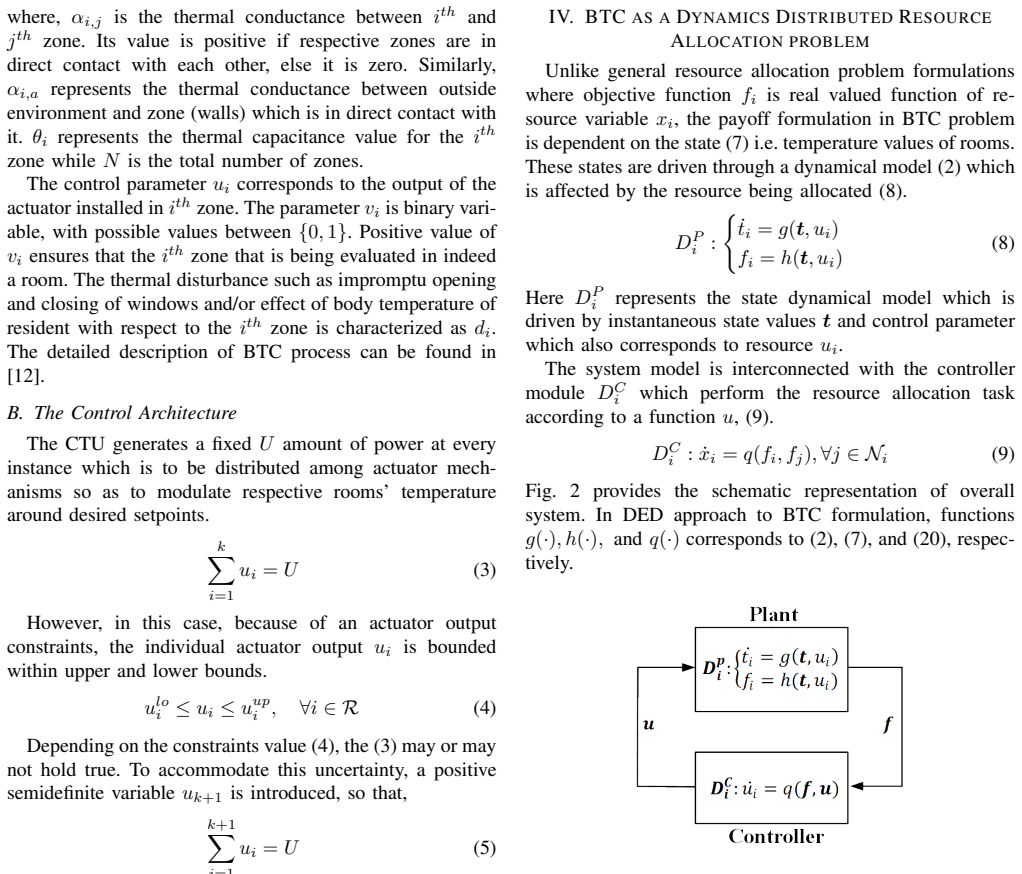
The central object is the distributed escort dynamics equation (20), $\dot{x}_i = \phi(x_i)\sum_{j\in \mathcal{N}_i} \phi(x_j)[f_j(x)-f_i(x)]$. It acts as a consensus controller: at steady state every neighbour payoff difference vanishes, giving equal payoff, while the escort function $\phi(x_i)=\eta_i\xi_i=\frac{x_i-x_i^{\mathrm{lo}}}{\sigma^{\mathrm{lo}}}\cdot\frac{x_i-x_i^{\mathrm{up}}}{\sigma^{\mathrm{up}}}$ keeps each proportion between its bounds because $\sigma^{\mathrm{lo}}>0$ and $\sigma^{\mathrm{up}}<0$. Summing (20) over the undirected graph gives zero, preserving $\sum_i x_i=1$, which is exactly the global resource constraint. The convergence mechanism is the passivity-based interconnection argument from [5]: both the temperature plant and the DED controller are claimed to be passive, so their feedback loop has a stable rest point corresponding to output consensus.
What would settle it
Take the two- or three-room BTC example and integrate the DED-controlled system while recording the signed product of payoff differences and actuator-output errors; if the accumulated integral over some finite horizon ever becomes negative, the passivity property that the convergence proof needs has failed. Equivalently, a linearization at a feasible interior point whose transfer matrix is not positive real would disprove the claimed output consensus for the general state-dependent weights.
Extended reading notes
Core claim
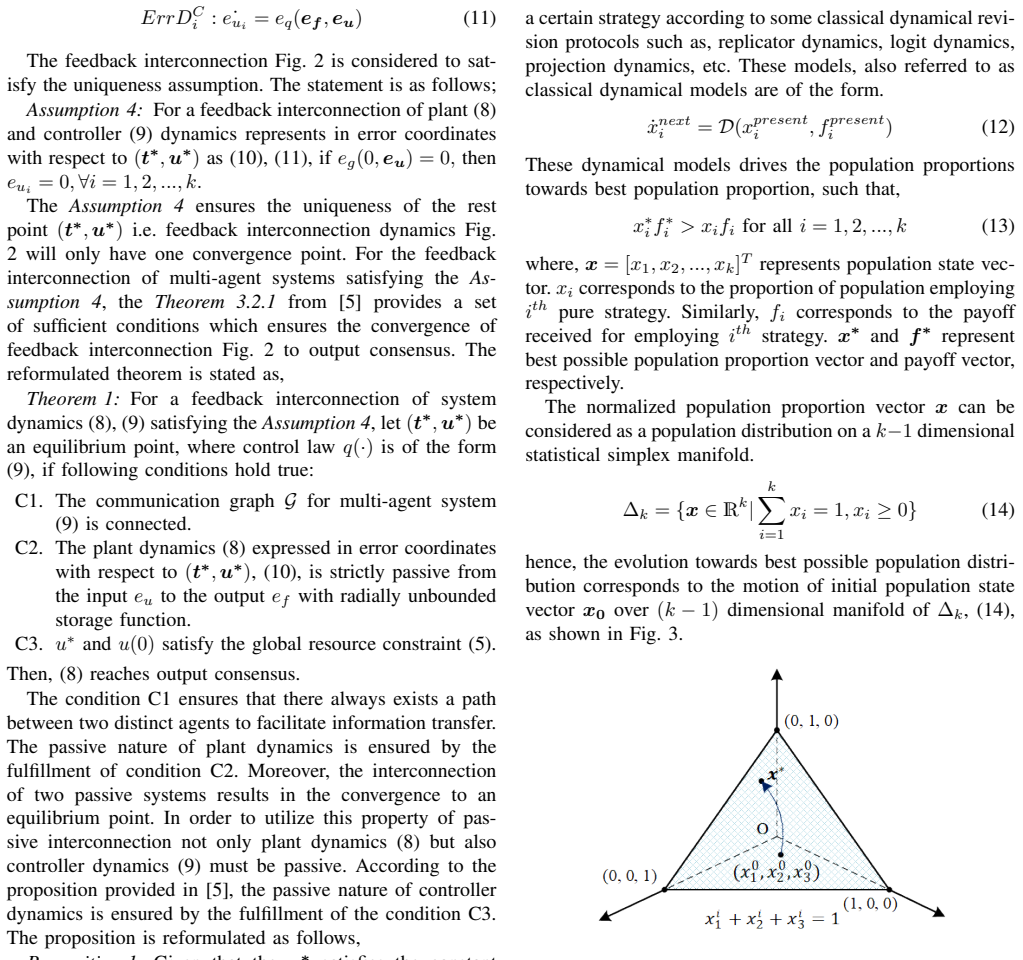
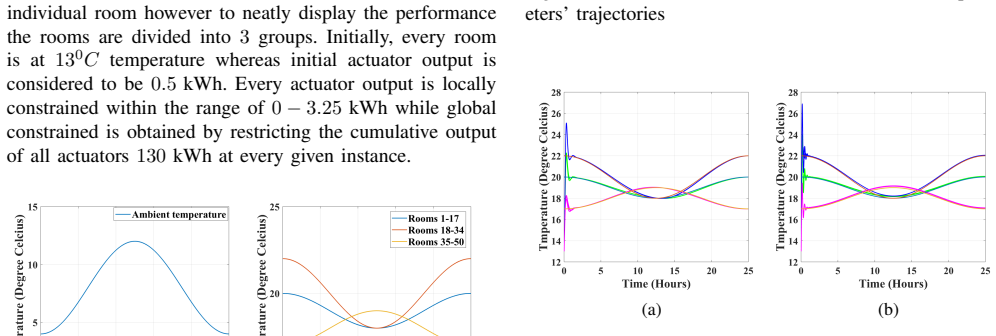
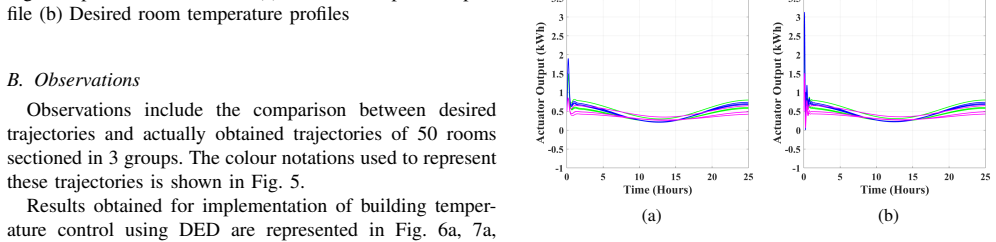
The paper's central claim is that the BTC temperature dynamics $(2)$, with each room's objective $(7)$ and driven by the consensus-like DED dynamics $(20)$, reaches an equilibrium point at which output consensus is attained. The DED update replaces the global weighted-average payoff $f_{\varphi}$ of classical escort dynamics with a sum over neighbours of $\phi(x_i)\phi(x_j)[f_j(x)-f_i(x)]$, removing the need for a central collector of all payoffs. The escort function $\phi(x_i)=\eta_i\xi_i$, formed from the intersection of the lower-bound and upper-bound simplices, keeps every actuator output inside its local limits while the undirected communication graph preserves $\sum_i x_i=1$, i.e. the fixed total resource. Relying on the passivity-based Theorem 1 from [5], the paper concludes that the plant-controller interconnection is passive and therefore converges to equal payoff; its case study reports smoother trajectory tracking and a shorter startup transient than the DIP protocol.
Load-bearing premise
Everything rests on the DED update acting as a stable, non-energy-generating component when connected to the room-temperature dynamics; the paper asserts that this stability property follows from the fixed-resource constraint, but it never derives the required property for the state-dependent weights $\phi(x_i)\phi(x_j)$.
Editorial extensions
If this is right
- A building's HVAC system could run on local neighbour communication alone while still obeying the total power budget and every actuator's limits.
- DED would avoid the central aggregation step of escort dynamics, reducing communication and computation infrastructure for buildings with many zones.
- Because the escort function directly enforces bounds, the controller should produce fewer and smaller oscillations during startup than barrier-method DIP, lowering actuator wear and temperature overshoot.
- The equal-payoff consensus gives a fairness property: the terminal power split equalizes room temperature errors rather than favouring particular zones.
Reading between the lines
- A direct passivity check of the state-dependent weights $\phi(x_i)\phi(x_j)$ would tell whether output consensus holds for all connected graphs or only for the cases simulated, since the paper leaves this unverified.
- Because the escort function is built from lower and upper bounds, the same construction can make DED track time-varying constraints by moving $x^{\mathrm{lo}}$ and $x^{\mathrm{up}}$ over time, which the paper names as future work.
- The DED protocol is not tied to HVAC physics: any fixed-resource allocation problem with box constraints and local payoff measurements, such as electric-vehicle charging or demand response, fits the same simplex-intersection formulation.
- The reported dependence of initial overshoot on the gap between initial and desired temperature suggests a tuning rule for step size based on initial error, which the paper does not explore.
Signed reviews
Editorial analysis
A structured set of objections, weighed in public.
Referee Report
Summary. This manuscript proposes a distributed escort dynamics (DED) controller for building temperature control, framed as a constrained multi-agent resource-allocation problem. The authors map the global power constraint Σ u_i = U to the invariant population size of an evolutionary game, represent per-actuator bounds via the intersection of two simplices, and construct escort functions φ(x_i) from lower- and upper-bound distances. The DED update (20) replaces the centralized average payoff in standard escort dynamics (16) with local payoff differences over a fixed undirected graph. The paper claims that, under Theorem 1 of Obando's passivity-based framework, the interconnection of the BTC plant (2) with DED reaches output consensus, and it reports a 50-room simulation comparing DED with a distributed interior-point method, with DED shown to have smaller startup transients and closer setpoint tracking.
Significance. If the convergence claims could be made rigorous, the paper would offer a distributed, constraint-satisfying alternative for HVAC resource allocation, with a clean evolutionary-game interpretation. Strengths include a fixed, non-tuned simulation scenario, a transparent comparison with DIP, and an explicit graph-theoretic formulation. The paper is less convincing as a proof: the passivity premise for the state-dependent DED weights is asserted rather than derived, and the printed invariance calculation is incorrect. The central idea is worth pursuing, but the current manuscript needs substantial mathematical revision.
major comments (4)
- [Section V-A, Eqs. (16)-(19)] The derivation of positive invariantness is incorrect as printed. Summing (16) gives Σ_i \dot{x}_i = Σ_i φ(x_i)(f_i - f_φ), not Σ_i x_i f_i - f_φ Σ_i x_i; moreover (17)-(18) define Φ(x) = Σ_i φ_i(x_i) f_i(x), which would make f_φ ≡ 1. Since the invariant-sum property is the basis for C3 and hence for the global resource constraint, this calculation must be corrected. With the standard definition Φ = Σ_i φ_i(x_i), the conclusion Σ_i \dot{x}_i = 0 does hold, but the printed argument does not establish it.
- [Section VI, passivity claim] The statement that "the fulfillment of C3 ensures that the DED model is passive in nature" is not supported. Proposition 1 in [5] is invoked for dynamics (11) under constant-population and graph-connectedness assumptions, but the DED weights ρ_ij = φ(x_i)φ(x_j) in (22) are state-dependent, so the constant-conductance passivity result does not apply directly. No storage function or dissipation inequality is provided for the map e_f -> -e_u under DED. Because this passivity is a necessary premise for the constructive feedback-interconnection argument in Theorem 1, this is a load-bearing gap. The same paragraph also asserts condition C2 by reference to [5] rather than verifying strict passivity for the specific plant (2) with disturbances d_i and ambient profile t_a.
- [Section VI, Assumption 4] The verification of Assumption 4 is not valid. From e_t = 0 the paper concludes f = 0 and hence that the DED update (20) "diminishes"; however, f = 0 makes \dot{x}_i = 0, which only means x is stationary, not that e_u = 0. The required implication in Assumption 4 is "if e_g(0,e_u) = 0 then e_u = 0", and this implication is not demonstrated. Thus the uniqueness of the rest point, a premise of Theorem 1, remains unproved.
- [Sections VI-VII, tracking claim] Theorem 1 establishes output consensus, i.e., equality of the payoffs f_i, but the application claims setpoint tracking, i.e., f_i -> 0. For f_i = t_i - t_i^set, output consensus only yields a common error; whether that common error is zero depends on whether the total resource U and the local bounds allow the setpoint trajectory to be attained. This is not derived. The simulation evidence in Fig. 8 that payoffs converge to zero therefore needs either a proof or an explicit compatibility condition; otherwise the "smooth trajectory tracking" claim exceeds what the convergence theorem supports.
minor comments (5)
- [Section V-A, Eq. (17)] The notation φ_k(x_i) should be φ_i(x_i) or φ(x_i); the index k is used both for the number of strategies and as a summation dummy.
- [Section III-B] The variable u_{k+1} is described as a "positive semidefinite variable"; since it is a scalar actuator output, the intended meaning is a nonnegative scalar variable.
- [Algorithm 1] Step 6 uses x^{i+1} = x^i + \dot{x}^i without a time step; a discrete-time implementation that preserves the constraint set needs a step size and a feasibility/stability discussion.
- [Section VII-C.1] The sentence "Fig. 10a and 10a" should read "Fig. 10a and 10b".
- [References [5] and [12]] References [5] and [12] list the same PhD thesis with different institutional addresses; this duplication should be resolved.
Circularity Check
No significant circularity: the convergence claim is conditional on an external passivity theorem and the simulation comparisons are independent outputs of a fixed closed-loop simulation.
full rationale
Reviewed the full derivation chain: temperature dynamics (2), local objective (7), DED controller (20), convergence Theorem 1, and the DED-vs-DIP simulation study. No parameter is fitted to the data used for evaluation; the operational scenario fixes the number of rooms, actuator bounds, initial states, ambient profile, and setpoint profiles before simulation, and the claimed outcomes (smooth tracking, low startup transience) are read off the resulting trajectories rather than enforced by construction. The convergence claim is imported from the external dissertation [5] through Theorem 1 and Proposition 1; [5] is not authored by the present paper's authors, and the paper does not redefine the theorem as its own output. The paper's statement that 'the fulfillment of C3 ensures that the DED model is passive in nature' is an application of Proposition 1, not a definitional identity between the controller's equations and the consensus conclusion. Whether the state-dependent weights rho_ij = phi(x_i)phi(x_j) actually satisfy the constant-weight passivity hypotheses of Proposition 1 is a genuine technical gap in the proof, but a missing verification is a correctness concern, not circularity: no equation's output is used as its own input, and no prediction is statistically forced by a fitted parameter. The 'output consensus' result is explicitly conditional on externally stated sufficient conditions C1-C3, and the simulation trajectories are independent realizations of fixed dynamics. Hence no load-bearing step reduces, by construction or by self-citation chain, to its own inputs.
Assumptions & free parameters
assumptions (5)
- domain assumption Assumptions 1-3: the communication graph G has no self-loops, is undirected, and is connected.
- domain assumption Plant dynamics (2) expressed in error coordinates is strictly passive from input e_u to output e_f, with a radially unbounded storage function (condition C2).
- ad hoc to paper Assumption 4: if e_g(0,e_u)=0 then e_u=0, i.e., the rest point (t*,u*) is unique.
- ad hoc to paper The DED controller (20) is passive from input e_f to output -e_u.
- domain assumption The bound parameters satisfy sigma_lo > 0 and sigma_up < 0, or equivalently the lower/upper constraints define a nonempty intersection with the simplex.
Cite this review
Pith. "Pith review of Building Temperature Control: A Distributed Escort Dynamical Approach." pith.science (2026). https://pith.science/paper/M2SKZWUM
@misc{pith2026190805048,
  author       = {Pith},
  title        = {Pith review of: Building Temperature Control: A Distributed Escort Dynamical Approach},
  year         = {2026},
  howpublished = {\url{https://pith.science/paper/M2SKZWUM}},
  note         = {Machine review of arXiv:1908.05048}
}
read the original abstract
The constrained multi-agent optimization problem of distributed resource allocation is addressed using the evolutionary game theoretic framework. The issue of building temperature control is analyzed in which the controller is to devise a scheme to distribute available scarce power to every room to regulate their temperature as per the comfort of user in the best possible manner. The paper correlates the global constraint of fixed resource amount with the constant population size. The respective population game is evaluated by means of a dynamical model of the evolutionary game theory to find the necessary control action. The robustness of optimal solution with respect to minor fluctuations in the temperature distribution is characterized using evolutionary stable strategy ( ESS ). Along with the global constraint, the problem formulation constitutes local constraint over an individual control unit located in every room. The classical dynamical models of evolutionary game theory such as replicator dynamics, logit dynamics, etc. fail to incorporate respective constraints. With the escort evolutionary dynamical (ED) model it is possible to address these local constraints through the concept of the intersection of simplices. However, evaluation of these classical dynamics along with ED is driven by expected payoff obtained by the overall population, which renders a centralized implementation approach. To mitigate this central dependency a distributed version of the ED model referred to as distributed escort dynamics (DED) is proposed. The control action devised adopting DED approach is shown to provide smooth trajectory tracking along with the low start-up transience when compared with distributed interior point (DIP) method.
Figures

Figures from the paper (5 more)



Reference graph
Works this paper leans on
-
[8]
Escort evolutionary game theory,
M. Harper, “Escort evolutionary game theory,” Physica D: Nonlinear Phenomena, vol. 240, no. 18, pp. 1411–1415, 2011
work page 2011
-
[10]
Distributed popula- tion dynamics: Optimization and control applications,
J. Barreiro-Gomez, G. Obando, and N. Quijano, “Distributed popula- tion dynamics: Optimization and control applications,” IEEE Transac- tions on Systems, Man, and Cybernetics: Systems , vol. 47, no. 2, pp. 304–314, 2016
work page 2016
-
[5]
Distributed methods for resource allocation: a passivity based approach,
G. D. Obando Bravo, “Distributed methods for resource allocation: a passivity based approach,” Ph.D. dissertation, Nantes, Ecole des Mines, 2015
work page 2015
-
[1]
P. Nejat, F. Jomehzadeh, M. M. Taheri, M. Gohari, and M. Z. A. Majid, “A global review of energy consumption, co2 emissions and policy in the residential sector (with an overview of the top ten co2 emitting countries),” Renewable and sustainable energy reviews , vol. 43, pp. 843–862, 2015
work page 2015
-
[2]
The potential for large-scale sav- ings from insulating residential buildings in the eu,
S. Lechtenb ¨ohmer and A. Sch ¨uring, “The potential for large-scale sav- ings from insulating residential buildings in the eu,” Energy efficiency, vol. 4, no. 2, pp. 257–270, 2011
work page 2011
-
[3]
Thermal comfort and building energy consumption implications–a review,
L. Yang, H. Yan, and J. C. Lam, “Thermal comfort and building energy consumption implications–a review,” Applied energy, vol. 115, pp. 164–173, 2014
work page 2014
-
[4]
A review on buildings energy consumption information,
L. P ´erez-Lombard, J. Ortiz, and C. Pout, “A review on buildings energy consumption information,” Energy and buildings , vol. 40, no. 3, pp. 394–398, 2008
work page 2008
-
[6]
An approximate algorithm for a weapon target assignment stochastic program,
R. A. Murphey, “An approximate algorithm for a weapon target assignment stochastic program,” in Approximation and Complexity in Numerical Optimization. Springer, 2000, pp. 406–421
work page 2000
Show all 15 references
-
[7]
Issues in multiagent resource allocation,
Y . Chevaleyre, P. E. Dunne, U. Endriss, J. Lang, M. Lemaitre, N. Maudet, J. Padget, S. Phelps, J. A. Rodriguez-Aguilar, and P. Sousa, “Issues in multiagent resource allocation,” Informatica, vol. 30, no. 1, 2006
2006
-
[9]
Escort evolutionary game dynamics approach for integral load management of electric vehicle fleets,
A. Ovalle, A. Hably, S. Bacha, G. Ramos, and J. Hossain, “Escort evolutionary game dynamics approach for integral load management of electric vehicle fleets,” IEEE Transactions on Industrial Electronics, vol. 64, no. 2, pp. 1358–1369, 2016
2016
-
[11]
Godsil and G
C. Godsil and G. F. Royle, Algebraic graph theory. Springer Science & Business Media, 2013, vol. 207
2013
-
[12]
Distributed methods for resource allocation: a passivity based approach,
G. D. O. Bravo, “Distributed methods for resource allocation: a passivity based approach,” Ph.D. dissertation, Ecole des Mines de Nantes, 2015
2015
-
[13]
The relationship be- tween indoor and outdoor temperature, apparent temperature, relative humidity, and absolute humidity,
J. L. Nguyen, J. Schwartz, and D. W. Dockery, “The relationship be- tween indoor and outdoor temperature, apparent temperature, relative humidity, and absolute humidity,” Indoor air, vol. 24, no. 1, pp. 103– 112, 2014
2014
-
[14]
Constrained evolutionary games by using a mixture of imitation dynamics,
J. Barreiro-Gomez and H. Tembine, “Constrained evolutionary games by using a mixture of imitation dynamics,” Automatica, vol. 97, pp. 254–262, 2018
2018
-
[15]
Escort evolutionary game dynamics approach for integral load management of electric vehicle fleets,
A. Ovalle, A. Hably, S. Bacha, G. Ramos, and J. Hossain, “Escort evolutionary game dynamics approach for integral load management of electric vehicle fleets,” IEEE Transactions on Industrial Electronics, vol. 64, no. 2, pp. 1358–1369, 2017
2017
Reviewed August 14, 2026 · model on record in the stance chip above.
Discussion (0). Continue with ORCID to comment.