REVIEW 3 major objections 4 minor 23 references
Online Fair Allocations with Binary Valuations and Beyond
T0 review · 3 major / 4 minor · reviewed 2026-08-07 · deepseek-v4-flash
Pith's one-line read For submodular binary valuations, a marginal-greedy algorithm computes allocations that are simultaneously non-wasteful, 1/2-EF1, 1/2-MMS, and 1/2-max-USW, and all three ratios are tight.
desk verdict Plausible and useful extension beyond OXS, but Theorem 2's 1/2-MMS proof has a load-bearing set-equality error and the lower-bound constructions are incomplete; worth a serious referee, not acceptance yet. read the letter →
The pith
A machine-rendered reading of the paper's core claim, the machinery that carries it, and where it could break.
The reading
What carries the argument
The load-bearing object is the identification of submodular binary valuations with matroid rank functions, together with the Marginal-Greedy Algorithm's rotating-priority allocation order. For any bundle, the valuation equals the size of a maximal independent subset of a matroid, a set system whose independent sets satisfy an exchange axiom; assigning an item only when its marginal value is 1 keeps every bundle independent, and the matroid exchange property is what bounds the envy between any two agents and drives the MMS contradiction. Non-wastefulness is maintained because any item with a positive marginal for someone is never discarded, and the welfare argument re-runs the same greedy rule with zero-marginal items assigned to agent 1, using submodularity to show the original output has half the optimal welfare.
What would settle it
Enumerate all two-agent partition-matroid rank functions on four items and check whether the marginal pattern claimed in the missing figure is realizable: after e1 goes to agent 1 and e2 to agent 2, there must be an e4 whose marginal value is 1 for the agent who received e3 and 0 for the other, with all earlier allocations unchanged. If no such e4 exists, the 1/2 lower bound for submodular binary valuations fails; if it exists, the tightness proof is complete.
Extended reading notes
Core claim
The central discovery is that submodular binary valuation functions—equivalently, matroid rank functions—admit an online algorithm with simultaneous constant-factor fairness and efficiency guarantees. The paper's Marginal-Greedy Algorithm assigns each arriving good to the first agent in a rotating order whose marginal value for it is 1, and discards only items that nobody values. Because a submodular binary valuation is the rank function of a matroid, each agent's bundle is an independent set and the matroid exchange property controls how much envy can accumulate: no agent can be forced to value another's bundle above twice her own after removing one item, and every agent receives at least half her maximin share. The paper claims the same algorithm is also a 1/2 approximation to utilitarian social welfare, via a submodularity induction, and that matching lower-bound examples show no deterministic online algorithm can beat 1/2 for EF1, MMS, or USW while maintaining non-wastefulness.
Load-bearing premise
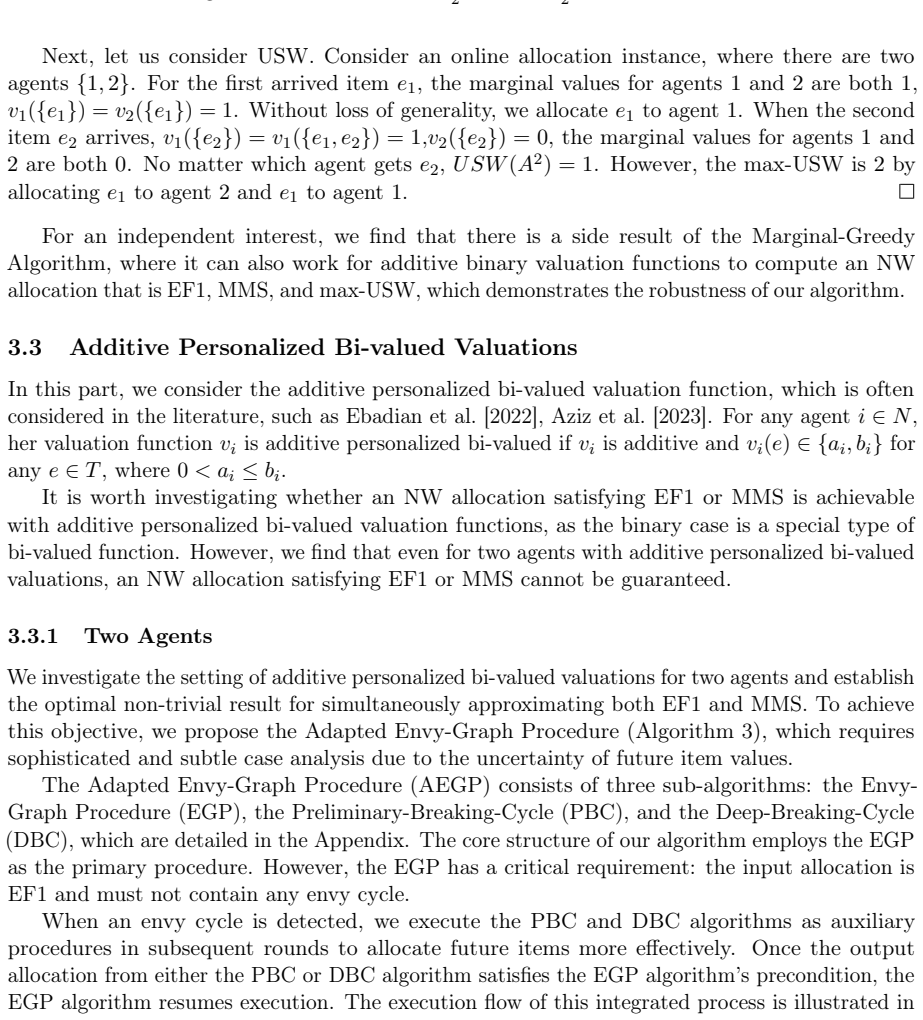
The tightness claim for submodular binary valuations assumes that, after the third item is forced to one agent, a fourth item e4 exists with exactly the marginal values needed to make any allocation have envy and MMS ratio exactly 1/2; the paper states this case by referring to a figure and never specifies e4's item category, value, or order constraints.
Editorial extensions
If this is right
- For streams of goods with submodular binary valuations, a deterministic, future-free rule simultaneously guarantees 1/2-EF1, 1/2-MMS, and 1/2-max-USW at every round, and no non-wasteful deterministic algorithm can raise any of the three ratios to 1/2+epsilon.
- Because assignment-style OXS valuations are a subclass of submodular binary valuations, the same algorithm covers online matching with class fairness and inherits the earlier 1/2 bounds while operating on a larger class.
- For two-agent additive personalized bi-valued goods, the 1/2-EF1 and 1/3-MMS pair is tight, and no positive approximation to utilitarian social welfare can be added without dropping exact fairness.
- For two-agent additive personalized bi-valued chores, a complete allocation satisfying 2-EF1 and 5/3-MMS is achievable, and no deterministic algorithm can guarantee 2-epsilon EF1 or 3/2-epsilon MMS.
- For additive binary chores, a complete allocation satisfying EF1, MMS, and minimum utilitarian social cost exists, whereas for supermodular binary chores no nontrivial approximation is possible.
Reading between the lines
- If the submodular-binary 1/2 lower bound can also be realized by coverage functions or other natural subclasses of submodular binary valuations, then the marginal-greedy rule likely marks a general frontier for diminishing-returns binary values, not just an artifact of matroid structure.
- The two-agent bi-valued results derive MMS by plugging EF1 into an implication that degrades with agent count, so for more than two agents a direct MMS argument would be needed to decide whether the same 1/2 and 1/3 ratios persist.
- The appendix's deadline-one results suggest a general principle: one round of waiting converts envy-cycle obstructions into matchings and yields exact EF1 for two-agent bi-valued instances, raising the testable question of whether d-period waiting does the same for n>2.
- The repeated incompatibility of EF1 or MMS with any positive welfare approximation in mixed binary and bi-valued settings suggests that non-wastefulness plus exact fairness is the binding constraint; allowing randomized tie-breaking or relaxing non-wastefulness might restore simultaneous welfare guarantees.
Editorial analysis
A structured set of objections, weighed in public.
Referee Report
Summary. The paper studies online fair division of indivisible goods and chores under deterministic immediate allocation. It introduces non-wastefulness for goods and completeness for chores, and proves a sequence of approximation results and impossibilities for classes beyond additive binary valuations: submodular binary valuations, additive personalized bi-valued valuations, and combinations with additive binary valuations. The headline claims are a Marginal-Greedy algorithm that simultaneously guarantees NW, 1/2-EF1, 1/2-MMS, and 1/2-max-USW for submodular binary goods with all ratios tight, a two-agent Adapted Envy-Graph Procedure achieving 1/2-EF1 and 1/3-MMS for additive personalized bi-valued goods, and analogous chores-side results including 2-EF1 and 5/3-MMS for two-agent bi-valued costs.
Significance. If the results are correct, the paper would meaningfully extend online fair allocation beyond additive binary valuations and beyond the OXS matching model of Hosseini et al. [2024], while providing tight fairness/efficiency trade-offs. The paper also makes a useful conceptual contribution by separating goods and chores constraints (non-wastefulness vs. completeness). However, several load-bearing proofs currently contain concrete gaps: a false set equality in the 1/2-MMS proof, an underspecified lower-bound construction in Theorem 3, and inconsistent ratio calculations in Theorem 11. These issues prevent the central claims from being accepted as proven, although at least the first two appear repairable with additional matroid arguments and a completed construction.
major comments (3)
- [§3.2, Theorem 2 (1/2-MMS paragraph)] The displayed chain |∪_{j∈N} C_j| = |{e : e ∈ T, A_i+e ∈ F_i}| = |∪_{j∈N} B_j| ≤ (n−1)(|A_i|+1) is false as written. The set {e ∈ T : A_i+e ∈ F_i} contains every e ∈ A_i, because A_i ∪ {e} = A_i is independent, while the union over B_j, as defined in the EF1 part of the proof, counts only items in the other agents' bundles that are addable to A_i. Thus the printed equality is off by |A_i|, and the contradiction n(|A_i|+1) < |∪ C_j| ≤ (n−1)(|A_i|+1) does not follow. Moreover, the equality v_i(X_j) = |A_i| + |C*_j| used to derive |C_j| > |A_i|+1 is not generally valid for matroid rank functions; only an inequality is available. A correct proof can likely be recovered by writing {e ∈ T : A_i+e ∈ F_i} as A_i ⊎ (∪_{j≠i} B_j), using |B_j| ≤ |A_i|+1 for each j, and bounding |X_j \ C_j| ≤ |A_i| because X_j \ C_j is an independent subset of the closure of A_i; but that argument is not what is printed. This gap is load-bearing because 1/2-MMS is one of the three guarantees in the paper's central claim for submodular binary valuations.
- [§3.2, Theorem 3 (lower bound)] The lower-bound construction is underspecified. The proof refers to Figure 1 and to 'the fourth item e4' without ever defining e4's category, value, or marginal structure. In Case 1 the proof immediately writes A4_2 = {e2, e3, e4}, and in Case 2 it asserts that 'we must allocate the fourth item e4 to agent 1 due to non-wastefulness', but the item e4 has not been introduced. Consequently the asserted equalities v(A4_1) = 1/2 v(A4_2 \ {e}) for every e ∈ A4_2 and v(A4_1) = 1/2 MMS_1 cannot be checked. Since Theorem 3 is the tightness result for all three 1/2 guarantees of the central positive claim, the omitted description of e4 is a load-bearing gap. The referenced figure is also not present in the text, so the category structure must be specified explicitly or the figure supplied.
- [§4.3, Theorem 11 (EF1 lower bound)] The EF1 lower-bound ratios are inconsistent with the claimed bound of 2. With a1 = a2 = 1 and b1 = b2 = 1/ε, the proof reports worst-case ratios 1/ε, 1 + 1/ε, (1/(2ε) + 1/2), and 2/(1+ε) in different branches. As ε → 0, the first two expressions diverge, while as ε → 1, the last two approach 1. No single choice of ε makes all displayed branches force the EF1 ratio to be at least 2−δ, so the sentence 'the lower bound of EF1 is 2' does not follow from the given instance. The proof appears to conflate upper and lower bounds on the approximation ratio. Because Theorem 11 is the tightness statement for the chore-side bi-valued results, this inconsistency is load-bearing and must be repaired.
minor comments (4)
- [§3.2, Theorem 3 (USW paragraph)] The sentence 'the max-USW is 2 by allocating e1 to agent 2 and e1 to agent 1' should read 'e1 to agent 2 and e2 to agent 1'; as printed it names the same item twice.
- [§4.2.1, proof of Theorem 8] The sentence 'the number of items with a 1 cost of agent j must be at least as large as the number of items with a 1 cost of agent j' is vacuous as printed; the second occurrence should refer to agent i.
- [Theorems 3 and 9] The proofs rely on Figures 1, 3, and 4, which are not included in the text. Since the constructions depend on the category/color structure of the matroids, the figures must be supplied or the category memberships must be specified in text.
- [§3.2, proof of Theorem 2] The MMS partition X is introduced over the full item set T, while the proof is conducted at a fixed round k with item set T^k. The relation between T and T^k should be stated explicitly to avoid ambiguity in the definitions of C_j and B_j.
Circularity Check
No significant circularity: the positive guarantees are proven against external fairness benchmarks and standard prior results, not derived from their own conclusions.
full rationale
The paper's central derivations are not circular. The algorithms are not fitted to the benchmark quantities they are claimed to achieve; EF1, MMS, USW/USC are defined independently, and the proofs compare the algorithm's output to these definitions and to optimal allocations. The supporting citations are standard external results: the matroid-rank characterization of submodular binary functions (Schrijver), submodularity preservation (Lehmann), EF1-to-MMS implications (Amanatidis; Sun), and the matroid-rank equivalence for supermodular binary costs (Barman). None of these are authored by Wang and Wei, so there is no self-citation chain and no uniqueness theorem imported from the authors' own prior work. The claimed extension beyond Hosseini et al. is not circular: that work is cited as a special-case motivation, while the present proof supplies its own greedy argument for general submodular binary valuations. I also flag two correctness concerns that are outside the circularity question: in Theorem 2 the displayed equality |∪C_j| = |∪B_j| omits the m items already in A_i, so the 1/2-MMS contradiction as written is incomplete; and Theorem 3's tightness construction refers to e4 and Figure 1 without specifying e4's category and marginal structure. These are potential proof gaps, not reductions of outputs to inputs, so they do not raise the circularity score.
Assumptions & free parameters
assumptions (4)
- standard math A submodular binary valuation is the rank function of a matroid (Schrijver 2003).
- domain assumption The envy-graph cycle elimination is valid in offline analysis, and the online algorithms must avoid cycles by construction since reallocation is impossible.
- domain assumption The adversary in lower-bound constructions can choose future items adaptively based on prior allocations, with arbitrary valuations consistent with the stated classes.
- standard math Alpha-EF1 implies alpha/((n-1)alpha+1)-MMS for goods (Amanatidis et al. 2018) and the corresponding chores implication (Sun et al. 2021).
Cite this review
Pith. "Pith review of Online Fair Allocations with Binary Valuations and Beyond." pith.science (2026). https://pith.science/paper/M3GRV2X6
@misc{pith2026250524321,
  author       = {Pith},
  title        = {Pith review of: Online Fair Allocations with Binary Valuations and Beyond},
  year         = {2026},
  howpublished = {\url{https://pith.science/paper/M3GRV2X6}},
  note         = {Machine review of arXiv:2505.24321}
}
read the original abstract
In an online fair allocation problem, a sequence of indivisible items arrives online and needs to be allocated to offline agents immediately and irrevocably. In our paper, we study the online allocation of either goods or chores. We employ popular fairness notions, including envy-freeness up to one item (EF1) and maximin share fairness (MMS) to capture fairness, and utilitarian social welfare (USW) to measure efficiency. For both settings of items, we present a series of positive results regarding the existence of fair and efficient allocations with widely studied classes of additive binary and personalized bi-valued valuation/cost functions. Furthermore, we complement our results by constructing counterexamples to establish our results as among the best guarantees possible.
Figures


Figures from the paper (2 more)

Reference graph
Works this paper leans on
-
[1]
G. Amanatidis, H. Aziz, G. Birmpas, A. Filos-Ratsikas, B. Li, H. Moulin, A. A. Voudouris, and X. Wu, ``Fair division of indivisible goods: Recent progress and open questions,'' Artificial Intelligence, vol. 322, p. 103965, 2023
work page 2023
-
[2]
M. K. Lee, D. Kusbit, A. Kahng, J. T. Kim, X. Yuan, A. Chan, D. See, R. Noothigattu, S. Lee, A. Psomas et al., ``Webuildai: Participatory framework for algorithmic governance,'' Proceedings of the ACM on human-computer interaction, pp. 1--35, 2019
work page 2019
-
[3]
M. Aleksandrov, H. Aziz, S. Gaspers, and T. Walsh, ``Online fair division: analysing a food bank problem,'' in Proceedings of the 24th International Conference on Artificial Intelligence, 2015, pp. 2540--2546
work page 2015
-
[4]
V. Gkatzelis, A. Psomas, and X. Tan, ``Fair and efficient online allocations with normalized valuations,'' in Proceedings of the 35th AAAI conference on artificial intelligence, 2021, pp. 5440--5447
work page 2021
-
[5]
S. Zhou, R. Bai, and X. Wu, ``Multi-agent online scheduling: Mms allocations for indivisible items,'' in Proceedings of the 40th International Conference on Machine Learning, 2023, pp. 42\,506--42\,516
work page 2023
-
[6]
G. Benad \`e , A. M. Kazachkov, A. D. Procaccia, A. Psomas, and D. Zeng, ``Fair and efficient online allocations,'' Operations Research, vol. 72, no. 4, pp. 1438--1452, 2024
work page 2024
-
[7]
I. Kash, A. Procaccia, and N. Shah, ``No agent left behind: Dynamic fair division of multiple resources,'' Journal of Artificial Intelligence Research, vol. 51, pp. 579--603, 2014
work page 2014
-
[8]
E. Friedman, C.-A. Psomas, and S. Vardi, ``Dynamic fair division with minimal disruptions,'' in Proceedings of the 16th ACM conference on Economics and Computation, 2015, pp. 697--713
work page 2015
Show all 23 references
-
[9]
B. Li, W. Li, and Y. Li, ``Dynamic fair division problem with general valuations,'' in Proceedings of the 27th International Joint Conference on Artificial Intelligence, 2018, pp. 375--381
2018
-
[10]
Friedman, C.-A
E. Friedman, C.-A. Psomas, and S. Vardi, ``Controlled dynamic fair division,'' in Proceedings of the 2017 ACM Conference on Economics and Computation, 2017, pp. 461--478
2017
-
[11]
Hosseini, Z
H. Hosseini, Z. Huang, A. Igarashi, and N. Shah, ``Class fairness in online matching,'' Artificial Intelligence, vol. 335, p. 104177, 2024
2024
-
[12]
Benad \`e , D
G. Benad \`e , D. Halpern, and A. Psomas, ``Dynamic fair division with partial information,'' in Proceedings of the 36th International Conference on Neural Information Processing Systems, 2022, pp. 3703--3715
2022
-
[13]
J. He, A. Procaccia, A. Psomas, and D. Zeng, ``Achieving a fairer future by changing the past,'' in Proceedings of the 28th International Joint Conference on Artificial Intelligence, 2019, pp. 343--349
2019
-
[14]
Elkind, A
E. Elkind, A. Lam, M. Latifian, T. Y. Neoh, and N. Teh, ``Temporal fair division of indivisible items,'' arXiv preprint arXiv:2410.14593, 2024
2024 arXiv
-
[15]
Cookson, S
B. Cookson, S. Ebadian, and N. Shah, ``Temporal fair division,'' arXiv preprint arXiv:2410.23416, 2024
2024 arXiv
-
[16]
Benabbou, M
N. Benabbou, M. Chakraborty, A. Igarashi, and Y. Zick, ``Finding fair and efficient allocations for matroid rank valuations,'' ACM Transactions on Economics and Computation, vol. 9, no. 4, pp. 1--41, 2021
2021
-
[17]
Barman and P
S. Barman and P. Verma, ``Existence and computation of maximin fair allocations under matroid-rank valuations,'' in Proceedings of the 20th International Conference on Autonomous Agents and MultiAgent Systems, 2021, pp. 169--177
2021
-
[18]
Barman, V
S. Barman, V. Narayan, and P. Verma, ``Fair chore division under binary supermodular costs,'' in Proceedings of the 22nd International Conference on Autonomous Agents and Multiagent Systems, 2023, pp. 2863--2865
2023
-
[19]
Munkres, ``Algorithms for the assignment and transportation problems,'' Journal of the society for industrial and applied mathematics, vol
J. Munkres, ``Algorithms for the assignment and transportation problems,'' Journal of the society for industrial and applied mathematics, vol. 5, no. 1, pp. 32--38, 1957
1957
-
[20]
Lehmann, D
B. Lehmann, D. Lehmann, and N. Nisan, ``Combinatorial auctions with decreasing marginal utilities,'' in Proceedings of the 3rd ACM conference on Electronic Commerce, 2001, pp. 18--28
2001
-
[21]
Amanatidis, G
G. Amanatidis, G. Birmpas, and E. Markakis, ``Comparing approximate relaxations of envy-freeness,'' in Proceedings of the 27th International Joint Conference on Artificial Intelligence, 2018, pp. 42--48
2018
-
[22]
A. Sun, B. Chen, and X. V. Doan, ``Connections between fairness criteria and efficiency for allocating indivisible chores,'' in Proceedings of the 20th International Conference on Autonomous Agents and Multiagent Systems, 2021, pp. 1281--1289
2021
-
[23]
Ashlagi, M
I. Ashlagi, M. Burq, C. Dutta, P. Jaillet, A. Saberi, and C. Sholley, ``Maximum weight online matching with deadlines,'' arXiv preprint arXiv:1808.03526, 2018
2018 arXiv
Reviewed August 7, 2026 · model on record in the stance chip above.
Discussion (0). Sign in to comment.