REVIEW 3 major objections 4 minor 47 references
Out-of-Length Scene Text Recognition: A Two-Axis Diagnosis and a Training-Free Fix
T0 review · 3 major / 4 minor · reviewed 2026-08-01 · deepseek-v4-flash
Pith's one-line read This paper argues that out-of-length scene text recognition is two coupled extrapolation failures, with encoder width dominant, and that a training-free crop-decode-stitch procedure lets unmodified word-level checkpoints match and partly be
desk verdict Chunk-decode-stitch is a genuinely useful, training-free fix for long-text STR, and the two-axis diagnosis is honest and well-evidenced; the main soft spots are the published-baseline comparison and the unquantified over-merge failure mode. read the letter →
The pith
A machine-rendered reading of the paper's core claim, the machinery that carries it, and where it could break.
The reading
What carries the argument
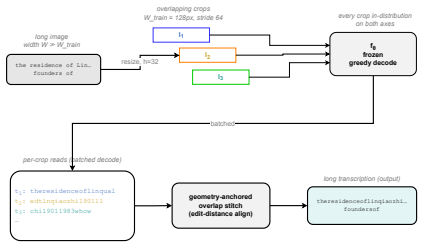
Chunk-decode-stitch, an inference-time algorithm with no learned parameters. The long image is aspect-preserving resized to the model's training height, sliced into overlapping crops at exactly the training width (default stride half the width), each crop upsampled if narrower than training width, and all crops decoded in one batched forward pass by the frozen greedy decoder with a short per-crop budget, so every decode is in-distribution on both extrapolation axes. The per-crop reads are then merged left-to-right by geometry-anchored edit-distance alignment: for each adjacent pair the expected pixel overlap is translated into a candidate character overlap, a small window of overlap lengths
What would settle it
Count how often the stitcher over-merges at repeated substrings on the hardest Long Text Benchmark bucket by running chunk-decode-stitch on images whose true overlap boundaries are known from the ground truth; if spurious merges occur in more than a small percentage of the 56+ bucket, the claimed 11–12 point margin over the published baseline on that bucket would shrink correspondingly, even though the two-axis diagnosis and per-crop reads would remain intact.
Extended reading notes
Core claim
The paper's central claim has a diagnostic and a practical half. Diagnostically, out-of-length failure is not one problem but two coupled ones—the encoder's width axis and the decoder's time axis—and they fail unequally: width-only extrapolation already does most of the damage, even when only the first 25 characters need to be read. Representation-side fixes confirm the asymmetry: a resolution-preserving rotary rescaling is a clean null, and interpolation-style rescalings recover only a small positional-geometry component, while fine-tuning recovers more CER but leaves exact-match word accuracy near zero. The remaining gap is shown to be decoding-side, since neither rescaling the decoder's p
Load-bearing premise
The headline accuracy rests on the assumption that each short crop's read is faithful enough within its window, and the geometry-anchored edit-distance matcher reliable enough, that the stitcher recovers the true overlap and does not regularly join the wrong pieces when a short string repeats; the paper documents this over-merge failure only qualitatively.
Editorial extensions
If this is right
- Any existing word-level checkpoint—including public ones that score zero on long text—can be turned into a long-text reader with no retraining, new data, or architecture change, at wall-clock parity with plain decoding.
- The dominance of the width axis redirects future length-robustness work toward encoders that stay well-conditioned as token count grows, away from positional-encoding tweaks.
- The decoder-axis gap is not a positional-encoding problem, so purpose-built decoders that re-decode or stitch remain the right target when a training budget exists, and any new long-text method should beat this training-free baseline.
- Fine-tuning for width-axis robustness and chunked decoding are near-orthogonal: once chunking feeds only in-distribution crops, width-axis fine-tuning has nothing left to correct and mildly hurts.
- The method is cost-neutral because crops are batched into one parallel forward pass per decode step, while plain decoding advances autoregressively one step at a time.
Reading between the lines
- If the width-axis diagnosis generalizes to other 2D visual encoders, length extrapolation in document understanding, full-page OCR, and dense captioning may be best addressed by giving encoders more token-count variety at training time, not by positional-frequency rescaling.
- The known but unquantified over-merge failure at repeated substrings suggests a confidence-weighted or lightly learned stitcher, or a two-dimensional crop grid, would extend the method to multi-line and vertical layouts that the current horizontal window does not handle.
- Because chunking makes width-axis fine-tuning unnecessary, one could test whether a training-time curriculum that always presents short, in-distribution crops produces a checkpoint that is long-text-capable with plain decoding, removing the stitching step entirely.
- The contrast between the null result of resolution-preserving rotary rescaling here and its reported success in language modelling is a transferable hypothesis: measure on other 2D anisotropic encoders whether interpolation-style rescaling, rather than resolution-preserving rescaling, is generally the only effective positional correction.
Editorial analysis
A structured set of objections, weighed in public.
Referee Report
Summary. The paper studies why word-level STR models (trained on <=25-character crops) fail on longer text. It decomposes out-of-length failure into an encoder-width axis and a decoder-time axis, and reports that encoder-width extrapolation dominates (Table 1). Representation-side fixes -- NTK/PI/YaRN rescaling and weighted fine-tuning -- give partial CER gains, but word accuracy remains near zero, localizing the residual gap to decoding. The paper then proposes chunk-decode-stitch: overlapping crops at training width are decoded independently and stitched by geometry-anchored edit-distance alignment. On LTB, the method reaches 42.79-43.05% bucket-average word accuracy on two base checkpoints, comparable to or above published SMTR (41.57), with a larger margin on the hardest bucket; applied to the public PARSeq checkpoint it reaches 47.11%, at wall-clock parity with plain decoding. The authors include robustness sweeps and several honest negative results.
Significance. If the headline numbers hold, this is an important result: a training-free, checkpoint-agnostic inference procedure can turn an unmodified word-level STR model into a long-text reader, and the two-axis diagnosis redirects future work from positional-frequency tweaks toward representation robustness. The paper is unusually careful in several respects: a controlled synthetic length curve, stride/phase/base-seed sweeps, reproducible code release, and honest reporting of negative results (NTK null, the failed third fine-tuning stream, the fine-tuning-seed spread for chunking). The main risks are the unquantified stitch-stage over-merge failure and the reliance on published baseline numbers rather than a same-harness re-run; both are testable and should be resolved before the central empirical claim is accepted.
major comments (3)
- [§3.5.2, §5, Table 7] The stitcher's overlap selection uses normalized edit-distance similarity over candidate overlap lengths k, with fallback below a minimum-similarity threshold. When a repeated substring occurs at a crop boundary, a wrong k can outscore the true overlap, causing non-adjacent text to be merged. Since LTB is scored by exact word match, every such merge becomes a word-level miss. Section 5 acknowledges this over-merging failure but does not quantify it, and the only manual inspection (12 hardest-bucket examples, §4.10) cannot bound its rate. The L≥56 margin (36.84 vs. SMTR 25.56) is a headline contribution; if over-merges occur on even a few percent of that bucket the margin shrinks materially. Please add an error-category breakdown on LTB separating stitcher over-merges from crop-read errors, and a targeted repeated-substring synthetic stress test, with the minimum-similarity threshold swep
- [§4.10, Table 7] The claim of matching or beating the 'published state of the art' rests entirely on published baseline numbers from Du et al. [10] rather than a same-harness re-run; resizing, decode protocol, and evaluation details may differ across runs. The public-PARSeq row (47.11) is additionally trained on a different corpus, a point the text acknowledges but which makes the 5.5-point advantage over SMTR a checkpoint-agnosticism demonstration rather than a controlled comparison. Please either re-run SMTR, LISTER, FocalSVTR, and AR-STR under the same harness and report them in Table 7, or explicitly frame the contribution as 'matching the best published number' and add uncertainty estimates. The latter is the minimum needed to avoid implying a controlled comparison.
- [§1, §5, §S3] The paper motivates the problem with 'storefront signage, multi-word phrases, dense captions' and says the method 'closes' the out-of-length failure, but the evaluation is confined to LTB's mostly regular horizontal text plus synthetic long-curved text. Dense multi-line and vertical layouts are untested, and the horizontal sliding-window prior is likely to fail or require a two-dimensional crop grid in exactly those settings. The authors list this as a limitation in §5, but it cuts against the abstract's broad claim. Please add a small dense/vertical subset, even synthetic, to bound performance, or explicitly restrict the claims to regular horizontal long text.
minor comments (4)
- [Fig. 1, §3.5.2, contribution 4] The paper repeatedly calls crop stride the 'only hyperparameter', but §3.5.2 also has a minimum-similarity threshold for the overlap match, and there is a per-crop decode budget and a width-gating threshold. Please reconcile this statement and report a threshold sweep, even if the result is insensitive.
- [§3.5.3, Table 7] The width-gating rule is stated in the method but is not applied in the main LTB table. State whether any LTB images fall below the width threshold and whether applying the gate changes the reported numbers.
- [Supplementary S1] The CER values exceeding 100% ('repetition-loop signature') should be explained in the text, since corpus-level CER is normally bounded by 100 only when deletions are unrestricted; insertions can push it above. A one-sentence clarification or a capped display would help.
- [Supplementary S2] The fine-tuning-seed sweep uses only three seeds and shows a 9.3-point A-Avg spread. The claim that 'no seed helps' is sensitive to this small n; consider adding more seeds or reporting a confidence interval.
Circularity Check
No significant circularity: the LTB accuracy of chunk-decode-stitch is an external empirical measurement, and the two-axis diagnosis has independent experimental content.
full rationale
I walked the derivation chain and found no step in which a claimed prediction or diagnosis is equivalent to its input by construction. The central headline number (42.79–43.05% bucket-average word accuracy on LTB) is measured on an external real-image benchmark against published baselines; it is not derived from the two-axis diagnosis or from the parameters of the method. The chunk-decode-stitch stitcher picks overlap by normalized edit-distance similarity between per-crop reads with a geometric fallback threshold; this is an algorithmic alignment procedure, not a parameter fitted to the LTB labels, and its output is not the same object as any fitted input. The two-axis decomposition is defined by ablations that hold one axis at its training condition (Sections 3.1, 4.3), and the claim that encoder width dominates decoder length is a measured comparison on LTB and a synthetic curve, not a definitional consequence. The conclusion that the residual gap is decoding-side rests on multiple controlled interventions (decoder-table rescaling, a rotary decoder, fine-tuning recipes) and is an interpretive inference from those experiments rather than a reduction. The base architecture is cited from the first author's prior work [14], but the paper specifies all architecture details in Sections 3.1 and 4.2, reports its standard-benchmark accuracy empirically, and the results are reproduced across two independent base-training seeds; no uniqueness theorem or unverified ansatz is imported from that self-citation. Related-work self-citations [41–43] are not load-bearing. The paper also explicitly acknowledges real limitations: the stitcher's over-merging failure at repeated substrings is 'document[ed] qualitatively but do[es] not quantify as its own error category' (Section 5), and dense multi-line or vertical layouts are untested. These are correctness and robustness caveats about whether the headline accuracy would survive harder layouts or error reclassification; they do not make the derivation circular, because the benchmark result remains a falsifiable external measurement. No equation was found that equals another by construction, and no fitted input was renamed as a prediction.
Assumptions & free parameters
free parameters (6)
- crop stride s =
64 px (50% overlap)
- crop-grid phase p =
0 (default; swept 0/16/32/48 px)
- per-crop decode budget =
30 characters
- overlap-match minimum-similarity threshold =
not stated in manuscript
- width-gating threshold =
not stated numerically ('matched to training width')
- fine-tuning two-stream weight and budget =
80/20 short-weighted; 5,000 iterations on weak base, 15,000 on strong base
assumptions (4)
- domain assumption LTB ground truth and exact-match protocol are fair enough to rank methods.
- domain assumption Published baseline numbers (Table 3 of Du et al. [10]) are directly comparable to the authors' evaluations.
- domain assumption The 36-character alphanumeric, case-insensitive, space/punctuation-stripped protocol defines the task.
- standard math Extending the additive sinusoidal decoder table is a lossless buffer extension.
Cite this review
Pith. "Pith review of Out-of-Length Scene Text Recognition: A Two-Axis Diagnosis and a Training-Free Fix." pith.science (2026). https://pith.science/paper/M3MW27MB
@misc{pith2026260723194,
  author       = {Pith},
  title        = {Pith review of: Out-of-Length Scene Text Recognition: A Two-Axis Diagnosis and a Training-Free Fix},
  year         = {2026},
  howpublished = {\url{https://pith.science/paper/M3MW27MB}},
  note         = {Machine review of arXiv:2607.23194}
}
read the original abstract
Scene Text Recognition (STR) models are trained almost exclusively on word crops of at most 25 characters, yet real deployments (signage, product labels, dense captions) require reading much longer text. This paper diagnoses that failure and then closes it. The diagnosis separates out-of-length failure into two simultaneously extrapolating axes (the encoder's width axis and the decoder's time axis) and shows that encoder width, not decoder length, is the dominant failure mode. Representation-side fixes bring only partial relief: training-free rotary rescalings recover at most 2-4 points of character error rate (CER), and a weighted fine-tuning recipe recovers 6-8 points while improving standard-benchmark accuracy, yet word accuracy on the Long Text Benchmark (LTB) stays near zero, because the residual gap lies in the decoding mechanism rather than the representation. We then close that gap at inference time, on an unmodified word-level checkpoint: the long image is sliced into overlapping crops at the model's training width, each decoded independently and in-distribution, and the reads stitched by geometry-anchored edit-distance alignment. This procedure reaches 42.79-43.05% bucket-average word accuracy on LTB across two base checkpoints, matching the published state of the art (41.57%) and beating it by 11-12 points on the hardest bucket, at wall-clock parity with plain decoding; applied unchanged to the public PARSeq checkpoint it reaches 47.11%. Once chunking is applied fine-tuning no longer helps: the decoding-side fix alone matches purpose-built architectures. We release the diagnosis harness and implementation.
Figures


Figures from the paper (1 more)

Reference graph
Works this paper leans on
-
[10]
Y . Du, Z. Chen, C. Jia, X. Gao, Y .-G. Jiang, Out of length text recognition with sub-string matching, in: Proceedings of the AAAI Conference on Artificial Intelligence, volume 39, 2025, pp. 2775–2783
2025
-
[1]
Jaderberg, K
M. Jaderberg, K. Simonyan, A. Vedaldi, A. Zisserman, Reading text in the wild with convolutional neural networks, IJCV 116 (2016) 1–20
2016
-
[2]
Gupta, A
A. Gupta, A. Vedaldi, A. Zisserman, Synthetic data for text localisation in natural images, in: CVPR, 2016, pp. 2315–2324
2016
-
[3]
Mishra, K
A. Mishra, K. Alahari, C. V . Jawahar, Scene text recognition using higher order language priors, in: BMVC, 2012
2012
-
[4]
K. Wang, B. Babenko, S. Belongie, End-to-end scene text recognition, in: ICCV , 2011, pp. 1457– 1464
2011
-
[5]
Karatzas, F
D. Karatzas, F. Shafait, S. Uchida, M. Iwamura, L. G. i Bigorda, S. R. Mestre, J. Mas, D. F. Mota, J. A. Almazan, L. P. de las Heras, ICDAR 2013 robust reading competition, in: ICDAR, 2013, pp. 1484–1493
2013
-
[6]
Karatzas, L
D. Karatzas, L. Gomez-Bigorda, A. Nicolaou, S. Ghosh, A. Bagdanov, M. Iwamura, J. Matas, L. Neu- mann, V . R. Chandrasekhar, S. Lu, et al., ICDAR 2015 competition on robust reading, in: ICDAR, 2015, pp. 1156–1160
2015
-
[7]
T. Q. Phan, P. Shivakumara, S. Tian, C. L. Tan, Recognizing text with perspective distortion in natural scenes, in: ICCV , 2013, pp. 569–576
2013
Show all 47 references
-
[8]
Risnumawan, P
A. Risnumawan, P. Shivakumara, C. S. Chan, C. L. Tan, A robust arbitrary text detection system for natural scene images, Expert Systems with Applications 41 (2014) 8027–8048
2014
-
[9]
C. Cui, R. Wang, J. Si, C. Li, X. Wang, L. Peng, Lister: Neighbor decoding for length-insensitive scene text recognition, in: Proceedings of the IEEE/CVF International Conference on Computer Vision (ICCV), 2023, pp. 19541–19551
2023
-
[11]
J. Su, M. Ahmed, Y . Lu, S. Pan, W. Bo, Y . Liu, RoFormer: Enhanced transformer with rotary position embedding, Neurocomputing 568 (2024) 127063
2024
-
[12]
S. Chen, S. Wong, L. Chen, Y . Tian, Extending context window of large language models via posi- tional interpolation, arXiv preprint arXiv:2306.15595 (2023)
2023 arXiv
-
[13]
B. Peng, J. Quesnelle, H. Fan, E. Shippole, Yarn: Efficient context window extension of large lan- guage models, in: International Conference on Learning Representations (ICLR), 2024
2024
-
[14]
Raisi, 2d rotary position embedding for scene text recognition with transformers, arXiv preprint arXiv:2607.13458 (2026).arXiv:2607.13458
Z. Raisi, 2d rotary position embedding for scene text recognition with transformers, arXiv preprint arXiv:2607.13458 (2026).arXiv:2607.13458
2026 arXiv
-
[15]
Jiang, J
Q. Jiang, J. Wang, D. Peng, C. Liu, L. Jin, Revisiting scene text recognition: A data perspective, in: Proceedings of the IEEE/CVF International Conference on Computer Vision (ICCV), 2023, pp. 20543–20554
2023
-
[16]
Atienza, Vision transformer for fast and efficient scene text recognition, in: ICDAR, 2021, pp
R. Atienza, Vision transformer for fast and efficient scene text recognition, in: ICDAR, 2021, pp. 319–334
2021
-
[17]
S. Fang, H. Xie, Y . Wang, Z. Sun, J. Gao, Read like humans: Autonomous, bidirectional and iterative language modeling for scene text recognition, in: CVPR, 2021, pp. 7098–7107
2021
-
[18]
D. B. Bautista, R. Atienza, Scene text recognition with permuted autoregressive sequence models, in: ECCV , 2022, pp. 178–196
2022
-
[19]
M. Yang, Y . Guo, Z. Chen, J. Guo, Reading and writing: Discriminative and generative modeling for self-supervised text recognition, in: CVPR, 2022, pp. 7329–7338
2022
-
[20]
Afkari-Fahandari, E
A. Afkari-Fahandari, E. Shabaninia, F. Asadi-Zeydabadi, H. Nezamabadi-Pour, A comprehensive survey of transformers in text recognition: Techniques, challenges, and future directions, ACM Com- puting Surveys 58 (2025). doi:10.1145/3771273
2025 doi
-
[21]
Kadha, B
V . Kadha, B. B. Duddeti, K. Srinadh, S. K. Buddepu, L. Janjanam, K. Medhi, From pixels to text: A deep learning survey of scene text detection and recognition, Computers and Electrical Engineering 135 (2026) 111139. doi:10.1016/j.compeleceng.2026.111139
2026
-
[22]
B. Shi, X. Bai, C. Yao, An end-to-end trainable neural network for image-based sequence recognition and its application to scene text recognition, IEEE TPAMI 39 (2016) 2298–2304
2016
-
[23]
B. Shi, M. Yang, X. Wang, P. Lyu, C. Yao, X. Bai, ASTER: An attentional scene text recognizer with flexible rectification, IEEE TPAMI 41 (2018) 2035–2048
2018
-
[24]
F. Zhan, C. Lu, ESIR: End-to-end scene text recognition via iterative image rectification, in: CVPR, 2019, pp. 2059–2068
2019
-
[25]
Y . Baek, G. Lee, D. Yun, H. Lee, What is wrong with scene text recognition model comparisons? dataset and model analysis, in: ICCV , 2021, pp. 4715–4723. 34
2021
-
[26]
Y . Du, Z. Chen, Y . Su, C. Jia, Y . Jiang, Context perception parallel decoder for scene text recognition, IEEE Transactions on Pattern Analysis and Machine Intelligence (2025) 4668–4683
2025
-
[27]
B. Zhou, A. Zhu, J. Yang, MambaSTR: Scene text recognition with masked state space model, in: Advanced Intelligent Computing Technology and Applications (ICIC), 2025
2025
-
[28]
S. Ali, T. Gao, Z. Zhu, Z. Hussain, M. Ahmed, Mamba-str: Efficient context-aware scene text recog- nition framework with selective state space modeling, Information Sciences (2026) 123242
2026
-
[29]
Tian, K.-X
S. Tian, K.-X. Zhu, H.-B. Qin, C. Yang, Dynamic receptive field adaptation for scene text recognition, Pattern Recognition Letters 178 (2024) 55–61. doi:10.1016/j.patrec.2023.12.005
2024 doi
-
[30]
Y . Du, Z. Chen, H. Xie, C. Jia, Y .-G. Jiang, Svtrv2: Ctc beats encoder-decoder models in scene text recognition, in: Proceedings of the IEEE/CVF International Conference on Computer Vision (ICCV), 2025, pp. 20147–20156
2025
-
[31]
D. H. Diaz, S. Qin, R. Ingle, Y . Fujii, A. Bissacco, Rethinking text line recognition models, arXiv preprint arXiv:2104.07787 (2021)
2021 arXiv
-
[32]
Nguyen, N
D. Nguyen, N. Tran, H. Le, Improving long handwritten text line recognition with convolutional multi-way associative memory, arXiv preprint arXiv:1911.01577 (2019)
1911 arXiv
-
[33]
Garrido-Munoz, J
C. Garrido-Munoz, J. Calvo-Zaragoza, On the generalization of handwritten text recognition models, in: CVPR, 2025
2025
-
[34]
Press, N
O. Press, N. A. Smith, M. Lewis, Train short, test long: Attention with linear biases enables input length extrapolation, in: ICLR, 2022
2022
-
[35]
L. Zhao, X. Feng, X. Feng, W. Zhong, D. Xu, Q. Yang, H. Liu, B. Qin, T. Liu, Length extrapolation of Transformers: A survey from the perspective of positional encoding, Findings of the Association for Computational Linguistics: EMNLP 2024 (2024)
2024
-
[36]
Barbero, A
F. Barbero, A. Vitvitskyi, C. Perivolaropoulos, R. Pascanu, P. Veli ˇckovi´c, Round and round we go! What makes rotary positional encodings useful?, in: International Conference on Learning Representations (ICLR), 2025
2025
-
[37]
Veisi, D
A. Veisi, D. Fartoot, H. Amirzadeh, Context-aware rotary position embedding, arXiv preprint arXiv:2507.23083 (2025)
2025 arXiv
-
[38]
Dosovitskiy, L
A. Dosovitskiy, L. Beyer, A. Kolesnikov, D. Weissenborn, X. Zhai, T. Unterthiner, M. Dehghani, M. Minderer, G. Heigold, S. Gelly, et al., An image is worth 16x16 words: Transformers for image recognition at scale, in: ICLR, 2021
2021
-
[39]
B. Heo, S. Yun, D. Han, S. Chun, C. Choi, Y . Oh, J. Kim, Rotary position embedding for vision transformer, in: ECCV , 2024, pp. 336–352
2024
-
[40]
H. Liu, S. Ren, T. Zhu, P. Wang, C. Xie, A. Yuille, Z. Zheng, F. Wang, Spiral RoPE: Rotate your rotary positional embeddings in the 2D plane, arXiv preprint arXiv:2602.03227 (2026)
2026
-
[41]
Raisi, M
Z. Raisi, M. A. Naiel, P. Fieguth, S. Wardell, J. Zelek, 2D positional embedding-based transformer for scene text recognition, Journal of Computational Vision and Imaging Systems 6 (2020) 1–4
2020
-
[42]
Raisi, M
Z. Raisi, M. A. Naiel, G. Younes, S. Wardell, J. S. Zelek, 2LSPE: 2D learnable sinusoidal positional encoding using transformer for scene text recognition, in: 18th Conference on Robots and Vision (CRV), IEEE, 2021, pp. 119–126
2021
-
[43]
Raisi, V
Z. Raisi, V . M. N. Had, A transformer-based approach with contextual position encoding for robust Persian text recognition in the wild, Journal of Artificial Intelligence and Data Mining (JAIDM) 12 (2024) 455–464
2024
-
[44]
X. Chen, S. Zhou, M. Huang, J. Feng, Y . Xiong, K. Zhou, B. Yang, Y . Zhang, H. Bao, S. Peng, C. Li, F. Shi, A 2d semantic-aware position encoding for vision transformers, arXiv preprint arXiv:2505.09466 (2025)
2025 arXiv
-
[45]
Vaswani, N
A. Vaswani, N. Shazeer, N. Parmar, J. Uszkoreit, L. Jones, A. N. Gomez, Ł. Kaiser, I. Polosukhin, Attention is all you need, in: NeurIPS, 2017, pp. 5998–6008
2017
-
[46]
K. He, X. Zhang, S. Ren, J. Sun, Deep residual learning for image recognition, in: CVPR, 2016, pp. 770–778
2016
-
[47]
gain erased at the long tail
Y . Du, Z. Chen, C. Jia, X. Yin, T. Zheng, C. Li, Y . Du, Y .-G. Jiang, SVTR: Scene text recognition with a single visual model, in: Proceedings of the Thirty-First International Joint Conference on Artificial Intelligence (IJCAI), 2022, pp. 884–890. 35 30 40 50 60 70 80 90 10...
2022
Reviewed August 1, 2026 · model on record in the stance chip above.
Discussion (0). Continue with ORCID to comment.