REVIEW 3 major objections 4 minor 53 references
Freestanding and flexible composites of magnetocaloric Gd$_5$(Si,Ge)$_4$ microparticles embedded in thermoplastic poly(methyl methacrylate) matrix
T0 review · 3 major / 4 minor · reviewed 2026-08-14 · deepseek-v4-flash
Pith's one-line read A flexible PMMA matrix acts as a pressure cell on magnetocaloric Gd$_5$Si$_{2.4}$Ge$_{1.6}$, cutting the monoclinic phase from 23% to 10%.
desk verdict Real data and a useful systematic study, but the GPa-scale pressure-cell mechanism is mechanically implausible and several internal errors need fixing. read the letter →
The pith
A machine-rendered reading of the paper's core claim, the machinery that carries it, and where it could break.
The reading
What carries the argument
The load-bearing mechanism is the mechanical clamp formed by PMMA solidifying around each grain, which the paper models as a pressure cell. The quantitative link is the thermodynamic compressibility relation $\kappa_T = -(1/V)(\partial V/\partial P)_T$, applied with $\kappa_T = 3\ \mathrm{TPa^{-1}}$ for the O(I) phase and $6\ \mathrm{TPa^{-1}}$ for the M phase, to convert measured unit-cell contractions into estimates of the pressure exerted by the polymer walls. The accompanying measurement machinery is Rietveld refinement (a standard method for fitting crystal structures to powder diffraction patterns) and a multi-phase Curie-Weiss analysis of susceptibility that independently infers the same phase fractions from magnetic data. Together these tools turn a visual observation—polymer wrapping around particles in cross-section SEM images—into a quantitative statement about phase balance and pressure.
What would settle it
Take the same 3.4 $\mu$m powder and compress it under a well-controlled, uniform pressure while measuring the X-ray diffraction pattern, then compare the amount of monoclinic phase with the value in the plastic composite. If the composite shows about 10% monoclinic phase at a pressure much lower than the estimated 2 GPa, the pressure-cell explanation is wrong. A second check: heat a finished composite above the softening point of the plastic and see whether the monoclinic fraction returns to about 23% when the plastic relaxes; if it does not, the phase change was not caused by recoverable pressure from the matrix.
Extended reading notes
Core claim
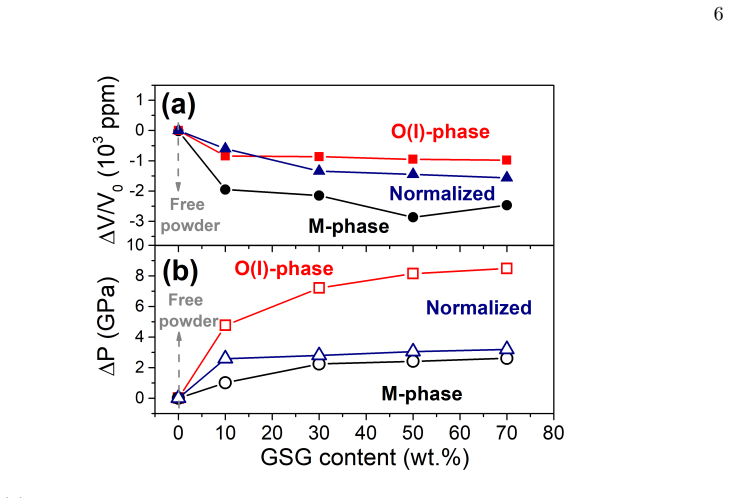
At the center of the paper is the claim that the PMMA/GSG interface behaves as a quasi-hydrostatic pressure cell. Solvent casting leaves the 3.4 $\mu$m particles embedded in a polymer that has a different thermal expansion, so upon solidification the matrix compresses the grains. Rietveld refinement of X-ray diffraction shows the O(I) phase fraction rising from 76.2% in the free powder to an average near 89% in composites, while the M phase falls from 23.4% to about 10%, and the normalized cell volume of the main phase contracts by roughly $2.5\times10^3$ ppm at the highest filler loading. Using published bulk compressibilities of 3 and 6 $\mathrm{TPa^{-1}}$ for the O(I) and M phases, the authors estimate pressures close to the value needed to drive the M-to-O(I) transition in polycrystalline material. Magnetization and Curie-Weiss analysis confirm the phase-fraction trend and show the main ferromagnetic transition near 308 K is unchanged, so the matrix does not alter the intrinsic magnetism of the powder; what changes is the balance of secondary phases and their contribution to the magnetocaloric entropy change.
Load-bearing premise
The load-bearing premise is that the measured contraction of the crystal lattice and the reduction of the secondary phase are caused by a smooth, even pressure from the plastic wrapping around each grain, and that pressure values measured on large solid pieces of the same material apply unchanged to the small grains. If the apparent shrinkage comes instead from the data-fitting procedure, from uneven stresses during film preparation, or from something other than pressure, the paper's central claim collapses.
Editorial extensions
If this is right
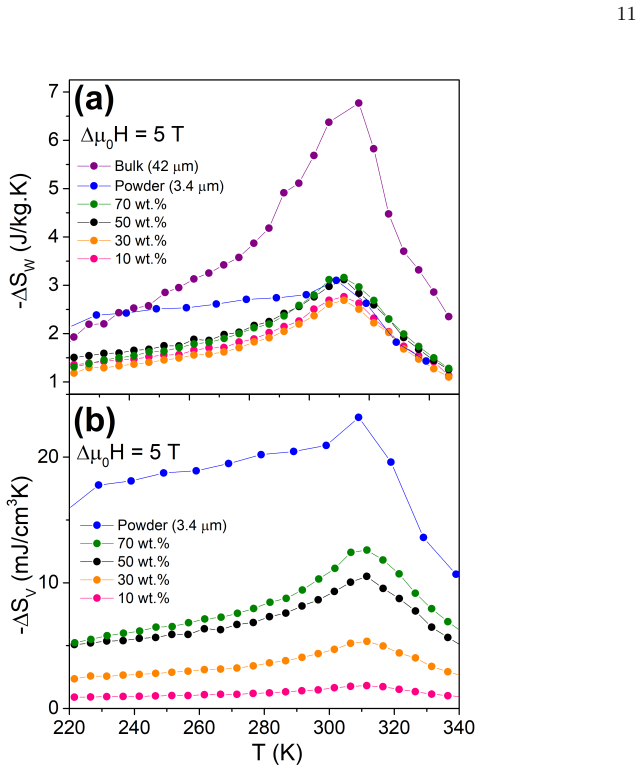
- Freestanding, bendable films with up to 70 wt.% magnetocaloric powder can be made by solvent casting, and the films retain a measurable volumetric entropy change, including values in the 5–10 mJ/cm^3 K range that the paper associates with micro-cooling applications.
- Because the M-phase fraction drops systematically when powder is embedded, the matrix pressure can be used as a composition-independent lever to reduce the parasitic secondary phase in Gd5(Si,Ge)4 powders.
- The disappearance of the M-phase bump in the entropy-change curves means the thermal-hysteresis contribution associated with the deformed monoclinic phase is weakened in composites, which should make the magnetocaloric response cleaner across a broad temperature range.
- The main O(I) transition temperature is not shifted by the polymer, so the useful working temperature of the magnetocaloric material is preserved while its mechanical form changes.
Reading between the lines
- If the pressure-cell picture is confirmed, temperature cycling of the composites would be a direct way to test whether the polymer deformation is reversible; the paper itself leaves this as an open question, and reversibility would make the matrix a reusable mechanical switch for phase balance.
- The same solvent-casting route could be used as a low-cost pressure proxy: varying polymer stiffness, cross-linking, or filler loading should tune the effective pressure on the grains, allowing a systematic map of the M-to-O(I) conversion without a high-pressure cell.
- Because the paper finds that Curie-Weiss phase fractions track the XRD values, magnetic measurements could be developed into a fast, non-destructive probe of the pressure state in such composites; that correlation is the paper's observation, while the monitoring application is a step beyond it.
Signed reviews
Editorial analysis
A structured set of objections, weighed in public.
Referee Report
Summary. The manuscript reports the fabrication and characterization of flexible composites made of 3.4 μm Gd5Si2.4Ge1.6 microparticles embedded in a PMMA matrix at 10, 30, 50, and 70 wt% filler loadings. The authors use XRD with Rietveld refinement, SEM, SQUID magnetometry, and magnetization isotherms to evaluate the structural, magnetic, and magnetocaloric properties. The central claim is that the PMMA matrix acts as a hydrostatic pressure cell on the Gd5(Si,Ge)4 grains: it is argued that interfacial pressure from the matrix contracts the unit cells, reduces the fraction of the secondary monoclinic (M) phase from about 23% in the free powder to about 10% in the composites, and weakens the M-phase contribution to the magnetocaloric response, while leaving the main orthorhombic O(I) magnetic transition essentially unchanged. The paper also reports magnetocaloric entropy changes and refrigerant capacity values for the composites.
Significance. If the pressure-cell mechanism were quantitatively established, this work would be a useful contribution to the design of flexible magnetocaloric composites and to the understanding of how a polymer matrix can alter phase balance in the strongly coupled Gd5(Si,Ge)4 system. The experimental dataset is reasonably rich: Rietveld phase fractions are cross-checked with Curie-Weiss fits of the magnetic susceptibility, and the magnetocaloric response is measured for all composites. Those cross-checks strengthen the empirical observation that embedding in PMMA reduces the detected M-phase fraction. However, the significance of the paper is conditional on the central mechanistic claim, because the magnitudes of the inferred pressures are large and the supporting evidence is indirect.
major comments (3)
- [Abstract and Table I] The abstract reports a relative unit-cell volume reduction of ~2.5×10^3 ppm for the 70 wt.% composite, but the Rietveld volumes in Table I (O(I) V = 869.0(5) Å^3 for the powder and 846.5(3) Å^3 for the 70 wt.% composite) give ΔV/V0 ≈ 2.6×10^4 ppm, i.e. 2.6%, a factor of 10 larger. This numerical discrepancy in the headline quantitative claim must be corrected, and any derived pressure estimates should be checked against the corrected value.
- [Section III.A and Fig. 2 caption] The text states that the isothermal compressibility is 3 TPa^-1 for the M phase and 6 TPa^-1 for the O(I) phase, whereas the Fig. 2 caption gives κO(I) = 3 TPa^-1 and κM = 6 TPa^-1. The pressure estimate of about 2 GPa on the M phase is consistent only with κM = 6 TPa^-1, so the in-text assignment is reversed. This internal inconsistency affects the derived pressures and must be resolved.
- [Section IV and Section III.A] The central causal claim that PMMA exerts a hydrostatic pressure of the order of 0.6 GPa or more on the embedded grains is not mechanically supported. The measured volume contractions imply 2.5-8.6 GPa if interpreted elastically through the bulk compressibilities, but a PMMA matrix with a Young's modulus of ~2-3 GPa and a thermal expansion coefficient of ~70×10^-6 K^-1, subjected to a casting temperature difference of a few tens of kelvin, can generate at most a few tens of MPa of constrained thermal stress. The manuscript itself states in Section IV that 'we can only assume that it is above the 0.6 GPa observed on M Gd5Si2Ge2 single crystals.' The observed reduction in M-phase fraction and the unit-cell volume changes could instead arise from non-hydrostatic interfacial stress, solvent or processing effects, or Rietveld fitting artifacts. The authors should either provide direct evidence for the pressure (for example, in situ high-pressure XRD, control experiments with matrices of different stiffness, or quantitative stress modeling) or explicitly demote the pressure-cell interpretation to a speculative hypothesis.
minor comments (4)
- [Abstract] The phrase 'were achiever' should be corrected to 'was achieved'.
- [Section III.A] The text states that the M-phase fraction reduces from ~22.0% in the free powder, but Table I gives 23.4(2)%; the text should match the tabulated value.
- [Fig. 2(b) and Table I] The pressure values derived from the volume contractions are shown graphically but not tabulated; given their central role, numerical values with uncertainties propagated from the Rietveld volumes and literature compressibilities should be provided.
- [Table III and Section IV] The maximum gravimetric entropy change for the 10 wt.% composite (0.99 J/kgK) is non-monotonic with respect to the 30 wt.% sample (0.46 J/kgK); the brief density explanation should be quantified or discussed in more detail.
Circularity Check
No circularity: phase fractions come from Rietveld refinement, MCE from the Maxwell relation, and the pressure estimate from measured volume changes with literature compressibility, with the paper explicitly flagging its assumptions.
full rationale
The derivation chain is self-contained against external benchmarks. The phase fractions are obtained from Rietveld refinement of XRD data, the magnetocaloric entropy change is computed from the integrated Maxwell relation applied to measured M(T,H) curves, and the pressure estimate follows from measured unit-cell volume reductions combined with published compressibilities (κ_O(I) = 3 TPa^-1 and κ_M = 6 TPa^-1, Ref. 32). The Curie-Weiss analysis is used as a cross-check of the phase fractions, not as an input that generates the main result. Self-citations (Refs. 6, 11, 25, 38) support background statements about phase control, milling behavior, and prior composite studies; they are not load-bearing for the central claim that PMMA embedding reduces the M-phase fraction and weakens its magnetocaloric contribution. The paper explicitly states that the precise applied pressure can only be assumed to be above the 0.6 GPa value observed for Gd5Si2Ge2 single crystals and calls for in situ measurements, so the pressure-cell mechanism is presented as an interpretation with acknowledged uncertainty rather than as a prediction forced by construction. No fitted parameter is renamed as a prediction, and no equation reduces to its own input. Mechanical plausibility concerns about whether PMMA can exert GPa-scale pressures are correctness risks, not circularity. The honest non-finding is therefore justified.
Assumptions & free parameters
free parameters (3)
- O(I) unit cell volume from Rietveld =
846.5 to 869.0 Angstrom^3 depending on sample
- M-phase weight fraction from Rietveld =
9.32 to 10.2% for composites; 23.4% for powder
- Curie-Weiss phase fractions =
not tabulated numerically in the text; inferred from chi^-1 fitting
assumptions (6)
- standard math Maxwell relation Delta S = integral(dM/dT)dH and Curie-Weiss law are valid for these samples.
- standard math kappa_T = -(1/V)(dV/dP)_T applies to the embedded particles with literature compressibilities.
- domain assumption Bulk compressibility values (3 and 6 TPa^-1) from Ref. 32 remain valid for 3.4 um powder inside PMMA.
- domain assumption PMMA exerts a quasi-hydrostatic, isotropic pressure on the grains.
- ad hoc to paper The pressure on the M-phase is above 0.6 GPa.
- domain assumption The Gd5Si2.4Ge1.6 density is 7.45 g/cm^3.
Cite this review
Pith. "Pith review of Freestanding and flexible composites of magnetocaloric Gd$_5$(Si,Ge)$_4$ microparticles embedded in thermoplastic poly(methyl methacrylate) matrix." pith.science (2026). https://pith.science/paper/M3NDAH5S
@misc{pith2026190803188,
  author       = {Pith},
  title        = {Pith review of: Freestanding and flexible composites of magnetocaloric Gd$_5$(Si,Ge)$_4$ microparticles embedded in thermoplastic poly(methyl methacrylate) matrix},
  year         = {2026},
  howpublished = {\url{https://pith.science/paper/M3NDAH5S}},
  note         = {Machine review of arXiv:1908.03188}
}
abstract
The implementation of processed magnetic materials onto thermoplastics can be an approach for practical application of brittle intermetallic materials with the advantage of enlarging the range of applications. In the present work, we evaluate the effect of blending magnetocaloric Gd$_5$Si$_{2.4}$Ge$_{1.6}$ micrometric particles with 3.4 $\mu$m in different weight fractions onto a flexible, transparent and non-magnetic poly(methyl methacrylate) (PMMA). A close to homogeneous grain distribution along the polymer surface were achiever by using a simple solvent casting method for evaluation of their magnetocaloric properties. From XRD analysis, it was found a relative unit cell volume reduction of $\sim$2.5$\times$10$^3$ ppm for the composite with 70 wt.\% of powder as a result of interfacial interactions between the components. Although PMMA does not influence the magnetic nature of microparticles main phase, a reduction on the amount of secondary monoclinic phase occurs for all produced composite samples. As a consequence, a weakening on the effect of secondary phases on the micropowder magnetocaloric response is observed as a result of hydrostatic pressure from the difference between thermal expansions of matrix and filler.
Figures


Figures from the paper (3 more)


Reference graph
Works this paper leans on
-
[1]
author author V. Pecharsky \ and\ author K. Gschneidner ,\ title title Phase relationships and crystallography in the pseudobinary system G d _5 S i _4 - G d _5 G e _4 , \ @noop journal journal Journal of Alloys and Compounds \ volume 260 ,\ pages 98--106 ( year 1997 ) NoStop
work page 1997
-
[2]
author author Z. Boekelheide , author Z. Hussein , author S. Harstad , author A. El-Gendy , \ and\ author R. Hadimani ,\ title title G d _5 S i _4 micro-and nano-particles for self-regulated magnetic hyperthermia , \ @noop journal journal IEEE Transactions on Magnetics \ volume 53 ,\ pages 1--4 ( year 2017 ) NoStop
work page 2017
-
[3]
author author A. Kitanovski , author J. Tu s ek , author U. Tomc , author U. Plaznik , author M. O z bolt , \ and\ author A. Poredo s ,\ title title Overview of existing magnetocaloric prototype devices , \ in\ @noop booktitle Magnetocaloric Energy Conversion \ ( publisher Springer ,\ year 2015 )\ pp.\ pages 269--330 NoStop
work page 2015
-
[4]
author author H. A. \ El-Gendy , author S. M. \ Harstad , author V. Vijayaragavan , author S. Gupta , author V. K. \ Pecharsky , author J. Zweit , \ and\ author R. L. \ Hadimani ,\ title title Ferromagnetic G d _5 S i _4 nanoparticles as T 2 contrast agents for magnetic resonance imaging , \ @noop journal journal IEEE Magnetics Letters \ volume 8 ,\ pages...
work page 2017
-
[5]
author author V. K. \ Pecharsky \ and\ author K. A. \ Gschneidner Jr ,\ title title G d _5 ( S i _x G e _ 1-x ) _4 : An extremum material , \ @noop journal journal Advanced Materials \ volume 13 ,\ pages 683--686 ( year 2001 ) NoStop
work page 2001
-
[6]
author author A. Pires , author J. Belo , author A. Lopes , author I. Gomes , author L. Morell \'o n , author C. Magen , author P. Algarabel , author M. Ibarra , author A. Pereira , \ and\ author J. Ara \'u jo ,\ title title Phase competitions behind the giant magnetic entropy variation: G d _5 S i _2 G e _2 and T b _5 S i _2 G e _2 case studies , \ @noop...
work page 2014
-
[7]
author author K. A. \ GschneidnerJr , author V. Pecharsky , \ and\ author A. Tsokol ,\ title title Recent developments in magnetocaloric materials , \ @noop journal journal Reports on progress in physics \ volume 68 ,\ pages 1479 ( year 2005 ) NoStop
work page 2005
-
[8]
author author S. Harstad , author N. D’Souza , author N. Soin , author A. A. \ El-Gendy , author S. Gupta , author V. K. \ Pecharsky , author T. Shah , author E. Siores , \ and\ author R. L. \ Hadimani ,\ title title Enhancement of -phase in PVDF films embedded with ferromagnetic G d _5 S i _4 nanoparticles for piezoelectric energy harvesting , \ @noop jo...
work page 2017
Show all 53 references
-
[9]
Ozaydin \ and\ author H
author author M. Ozaydin \ and\ author H. Liang ,\ title title Multi-energy conversion of G d _5 ( S i _2 G e _2 )-poly (vinylidene fluoride), a hybrid material , \ @noop journal journal Applied Physics Letters \ volume 105 ,\ pages 062903 ( year 2014 ) NoStop
2014
-
[10]
author author R. A. \ Booth \ and\ author S. A. \ Majetich ,\ title title The magnetocaloric effect in thermally cycled polycrystalline N i-- M n-- G a , \ @noop journal journal Journal of Applied Physics \ volume 111 ,\ pages 07A933 ( year 2012 ) NoStop
2012
-
[11]
Pires , author J
author author A. Pires , author J. Belo , author J. Turcaud , author G. Oliveira , author J. Ara \'u jo , author A. Berenov , author L. Cohen , author A. Lopes , \ and\ author A. Pereira ,\ title title Influence of short time milling in R _5 ( S i, G e) _4 , R = G d and T b, m...
2015
-
[12]
author author E. K. \ Akdogan , author M. Allahverdi , \ and\ author A. Safari ,\ title title Piezoelectric composites for sensor and actuator applications , \ @noop journal journal IEEE Transactions on Ultrasonics, Ferroelectrics, and Frequency Control \ volume 52 ,\ pages 74...
2005
-
[13]
Xiang , author H
author author F. Xiang , author H. Wang , \ and\ author X. Yao ,\ title title Dielectric properties of S r T i O _3 / POE flexible composites for microwave applications , \ @noop journal journal Journal of the European Ceramic Society \ volume 27 ,\ pages 3093--3097 ( year 200...
2007
-
[14]
author author P. J. \ Bora , author S. Harstad , author S. Gupta , author V. K. \ Pecharsky , author K. Vinoy , author P. C. \ Ramamurthy , \ and\ author R. Hadimani ,\ title title Gadolinium silicide ( G d _5 S i _4 ) nanoparticles for tuneable broad band microwave absorption...
2019
-
[15]
author author C. T. \ Laurencin , author A. Ambrosio , author M. Borden , \ and\ author J. Cooper Jr ,\ title title Tissue engineering: orthopedic applications , \ @noop journal journal Annual Review of Biomedical Engineering \ volume 1 ,\ pages 19--46 ( year 1999 ) NoStop
1999
-
[16]
author author A. G. \ Koniuszewska \ and\ author J. W. \ Kaczmar ,\ title title Application of polymer based composite materials in transportation , \ @noop journal journal Progress in Rubber, Plastics and Recycling Technology \ volume 32 ,\ pages 1 ( year 2016 ) NoStop
2016
-
[17]
Ramakrishna , author J
author author S. Ramakrishna , author J. Mayer , author E. Wintermantel , \ and\ author K. W. \ Leong ,\ title title Biomedical applications of polymer-composite materials: A review , \ @noop journal journal Composites Science and Technology \ volume 61 ,\ pages 1189--1224 ( y...
2001
-
[18]
o brich , author M. H \
author author T. Gereke , author O. D \"o brich , author M. H \"u bner , \ and\ author C. Cherif ,\ title title Experimental and computational composite textile reinforcement forming: A review , \ @noop journal journal Composites Part A: Applied Science and Manufacturing \ vol...
2013
-
[19]
Imamura , author A
author author W. Imamura , author A. Coelho , author V. Kupfer , author A. Carvalho , author J. Zago , author A. Rinaldi , author S. Favaro , \ and\ author C. Alves ,\ title title A new type of magnetocaloric composite based on conductive polymer and magnetocaloric compound , ...
2017
-
[20]
Hadimani , author S
author author R. Hadimani , author S. Gupta , author S. Harstad , author V. Pecharsky , \ and\ author D. Jiles ,\ title title Investigation of room temperature ferromagnetic nanoparticles of G d _5 S i _4 , \ @noop journal journal IEEE Transactions on Magnetics \ volume 51 ,\ ...
2015
-
[21]
Misra \ and\ author G
author author S. Misra \ and\ author G. J. \ Miller ,\ title title On the distribution of tetrelide atoms ( S i, G e) in G d _5 ( S i _x G e _ 1-x ) _4 , \ @noop journal journal Journal of Solid State Chemistry \ volume 179 ,\ pages 2290--2297 ( year 2006 ) NoStop
2006
-
[22]
Ali , author K
author author U. Ali , author K. J. B. A. \ Karim , \ and\ author N. A. \ Buang ,\ title title A review of the properties and applications of poly (methyl methacrylate) ( PMMA ) , \ @noop journal journal Polymer Reviews \ volume 55 ,\ pages 678--705 ( year 2015 ) NoStop
2015
-
[23]
\ Kim , author J
author author D.-H. \ Kim , author J. Viventi , author J. J. \ Amsden , author J. Xiao , author L. Vigeland , author Y.-S. \ Kim , author J. A. \ Blanco , author B. Panilaitis , author E. S. \ Frechette , author D. Contreras , et al. ,\ title title Dissolvable films of silk fi...
2010
-
[24]
author author J. H. \ Park \ and\ author S. C. \ Jana ,\ title title The relationship between nano-and micro-structures and mechanical properties in PMMA -epoxy-nanoclay composites , \ @noop journal journal Polymer \ volume 44 ,\ pages 2091--2100 ( year 2003 ) NoStop
2003
-
[25]
Belo , author A
author author J. Belo , author A. Pereira , author J. Ventura , author G. Oliveira , author J. Ara \'u jo , author P. Tavares , author L. Fernandes , author P. Algarabel , author C. Magen , author L. Morellon , , \ and\ author M. Ibarra ,\ title title Phase control studies in ...
2012
-
[26]
Marycz , author M
author author K. Marycz , author M. Maredziak , author J. Grzesiak , author D. Szarek , author A. Lis , \ and\ author J. Laska ,\ title title Polyurethane polylactide-blend films doped with zinc ions for the growth and expansion of human olfactory ensheathing cells ( OEC s) an...
2016
-
[27]
author author J. Rodr \' guez-Carvajal ,\ title title Recent advances in magnetic structure determination by neutron powder diffraction , \ @noop journal journal Physica B: Condensed Matter \ volume 192 ,\ pages 55--69 ( year 1993 ) NoStop
1993
-
[28]
author author V. M. \ Andrade , author R. C. \ Vivas , author S. S. \ Pedro , author J. C. G. \ Tedesco , author A. L. \ Rossi , author A. A. \ Coelho , author D. L. \ Rocco , \ and\ author M. S. \ Reis ,\ title title Magnetic and magnetocaloric properties of L a _ 0.6 C a _ 0...
2016
-
[29]
author author S. G. \ Hunagund , author S. M. \ Harstad , author A. A. \ El-Gendy , author S. Gupta , author V. K. \ Pecharsky , \ and\ author R. L. \ Hadimani ,\ title title Investigating phase transition temperatures of size separated gadolinium silicide magnetic nanoparticl...
2018
-
[30]
Toraya \ and\ author S
author author H. Toraya \ and\ author S. Tsusaka ,\ title title Quantitative phase analysis using the whole-powder-pattern decomposition method. i. S olution from knowledge of chemical compositions , \ @noop journal journal Journal of Applied Crystallography \ volume 28 ,\ pag...
1995
-
[31]
author author A. M. G. \ Carvalho , author C. S. \ Alves , author A. de Campos , author A. A. \ Coelho , author S. Gama , author F. C. \ Gandra , author P. J. \ von Ranke , \ and\ author N. A. \ Oliveira ,\ title title The magnetic and magnetocaloric properties of G d _5 G e _...
2005
-
[32]
Mudryk , author Y
author author Y. Mudryk , author Y. Lee , author T. Vogt , author K. Gschneidner Jr , \ and\ author V. Pecharsky ,\ title title Polymorphism of G d _5 S i _2 G e _2 : T he equivalence of temperature, magnetic field, and chemical and hydrostatic pressures , \ @noop journal jour...
2005
-
[33]
Kitanovski \ and\ author P
author author A. Kitanovski \ and\ author P. W. \ Egolf ,\ title title Innovative ideas for future research on magnetocaloric technologies , \ @noop journal journal International Journal of Refrigeration \ volume 33 ,\ pages 449--464 ( year 2010 ) NoStop
2010
-
[34]
Guan , author X
author author X. Guan , author X. Dong , \ and\ author J. Ou ,\ title title Magnetostrictive effect of magnetorheological elastomer , \ @noop journal journal Journal of Magnetism and Magnetic Materials \ volume 320 ,\ pages 158--163 ( year 2008 ) NoStop
2008
-
[35]
Andrade , author S
author author V. Andrade , author S. Pedro , author R. C. \ Vivas , author D. Rocco , author M. Reis , author A. Campos , author A. d. A. \ Coelho , author M. Escote , author A. Zenatti , \ and\ author A. Rossi ,\ title title Magnetocaloric functional properties of S m _ 0.6 S...
2016
-
[36]
Checca , author R
author author N. Checca , author R. Caraballo-Vivas , author R. Torr \ a o , author A. Rossi , \ and\ author M. Reis ,\ title title Phase composition and growth mechanisms of half-metal H eusler alloy produced by pulsed laser deposition: From core-shell nanoparticles to amorph...
2017
-
[37]
author author G. J. \ Miller ,\ title title Complex rare-earth tetrelides, RE _5 ( S i _x G e _ 1-x ) _4 : N ew materials for magnetic refrigeration and a super playground for solid state chemistry , \ @noop journal journal Chemical Society Reviews \ volume 35 ,\ pages 799--81...
2006
-
[38]
author author V. M. \ Andrade , author J. H. \ Belo , author M. S. \ Reis , author R. M. \ Costa , author A. M. \ Pereira , \ and\ author J. P. \ Ara \'u jo ,\ title title Lanthanum dilution effects on the giant magnetocaloric G d _5 S i _ 1.8 G e _ 2.2 compound , \ @noop jour...
-
[39]
Tawansi , author A
author author A. Tawansi , author A. El-Khodary , author H. Zidan , \ and\ author S. Badr ,\ title title The effect of M n C l _2 filler on the optical window and the physical properties of PMMA films , \ @noop journal journal Polymer Testing \ volume 21 ,\ pages 381--387 ( ye...
2002
-
[40]
Roger , author V
author author J. Roger , author V. Babizhetskyy , author K. Hiebl , author J.-F. \ Halet , \ and\ author R. Gu \'e rin ,\ title title Structural chemistry, magnetism and electrical properties of binary G d silicides and H o _3 S i _4 , \ @noop journal journal Journal of Alloys...
2006
-
[41]
Pecharsky , author K
author author A. Pecharsky , author K. Gschneidner Jr , \ and\ author V. Pecharsky ,\ title title The giant magnetocaloric effect of optimally prepared G d _5 S i _2 G e _2 , \ @noop journal journal Journal of Applied Physics \ volume 93 ,\ pages 4722--4728 ( year 2003 ) NoStop
2003
-
[42]
Zhang , author Y
author author H. Zhang , author Y. Sun , author Y. Li , author Y. Wu , author Y. Long , author J. Shen , author F. Hu , author J. Sun , \ and\ author B. Shen ,\ title title Mechanical properties and magnetocaloric effects in L a( F e, S i) _ 13 hydrides bonded with different e...
2015
-
[43]
Ramprasad , author P
author author R. Ramprasad , author P. Zurcher , author M. Petras , author M. Miller , \ and\ author P. Renaud ,\ title title Magnetic properties of metallic ferromagnetic nanoparticle composites , \ @noop journal journal Journal of Applied Physics \ volume 96 ,\ pages 519--52...
2004
-
[44]
author author O. V. \ Stolbov , author Y. L. \ Raikher , \ and\ author M. Balasoiu ,\ title title Modelling of magnetodipolar striction in soft magnetic elastomers , \ @noop journal journal Soft Matter \ volume 7 ,\ pages 8484--8487 ( year 2011 ) NoStop
2011
-
[45]
Stepanov , author S
author author G. Stepanov , author S. Abramchuk , author D. Grishin , author L. Nikitin , author E. Y. \ Kramarenko , \ and\ author A. Khokhlov ,\ title title Effect of a homogeneous magnetic field on the viscoelastic behavior of magnetic elastomers , \ @noop journal journal P...
2007
-
[46]
De Oliveira \ and\ author P
author author N. De Oliveira \ and\ author P. Von Ranke ,\ title title Theoretical aspects of the magnetocaloric effect , \ @noop journal journal Physics reports \ volume 489 ,\ pages 89--159 ( year 2010 ) NoStop
2010
-
[47]
Gschneidner , author V
author author K. Gschneidner , author V. Pecharsky , author A. Pecharsky , author V. Ivtchenko , \ and\ author E. Levin ,\ title title The nonpareil R _5 ( S i _x G e _ 1-x ) _4 phases , \ @noop journal journal Journal of Alloys and Compounds \ volume 303 ,\ pages 214--222 ( y...
2000
-
[48]
author author D. A. \ Jesson \ and\ author J. F. \ Watts ,\ title title The interface and interphase in polymer matrix composites: effect on mechanical properties and methods for identification , \ @noop journal journal Polymer Reviews \ volume 52 ,\ pages 321--354 ( year 2012...
2012
-
[49]
Gschneidner Jr \ and\ author V
author author K. Gschneidner Jr \ and\ author V. K. \ Pecharsky ,\ title title Magnetocaloric materials , \ @noop journal journal Annual Review of Materials Science \ volume 30 ,\ pages 387--429 ( year 2000 ) NoStop
2000
-
[50]
Han , author J
author author M. Han , author J. A. \ Paulsen , author J. E. \ Snyder , author D. Jiles , author T. Lograsso , \ and\ author D. Schlagel ,\ title title Thermal expansion of single-crystal G d _5 ( S i _ 1.95 G e _ 2.05 ) showing unusual first-order transformation , \ @noop jou...
2002
-
[51]
author author C. E. \ Porter \ and\ author F. D. \ Blum ,\ title title Thermal characterization of PMMA thin films using modulated differential scanning calorimetry , \ @noop journal journal Macromolecules \ volume 33 ,\ pages 7016--7020 ( year 2000 ) NoStop
2000
-
[52]
Hamann \ and\ author E
author author A. Hamann \ and\ author E. D. \ Dahlberg ,\ title title High strain magnetostriction in a ferromagnet-polymer composite , \ @noop journal journal Applied Physics Letters \ volume 110 ,\ pages 091906 ( year 2017 ) NoStop
2017
-
[53]
Crossley , author N
author author S. Crossley , author N. Mathur , \ and\ author X. Moya ,\ title title New developments in caloric materials for cooling applications , \ @noop journal journal AIP Advances \ volume 5 ,\ pages 067153 ( year 2015 ) NoStop
2015
Reviewed August 14, 2026 · model on record in the stance chip above.
Discussion (0). Continue with ORCID to comment.