REVIEW 4 major objections 6 minor 4 cited by
ReARTeR: Retrieval-Augmented Reasoning with Trustworthy Process Rewarding
T0 review · 4 major / 6 minor · reviewed 2026-08-10 · deepseek-v4-flash
Pith's one-line read ReARTeR claims that pairing a process reward model with an aligned explanation model makes retrieval-augmented reasoning reliably better on multi-step question answering across five benchmarks.
desk verdict A plausible integration of PRM-guided search, explanation-based refinement, and post-training for RAG reasoning; the results are consistently positive but the PRM-trustworthiness premise is under-verified. read the letter →
The pith
A machine-rendered reading of the paper's core claim, the machinery that carries it, and where it could break.
The reading
What carries the argument
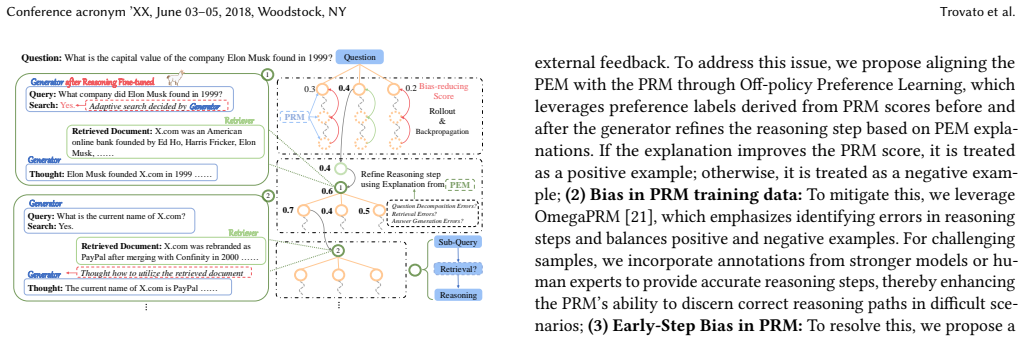
The central object is Trustworthy Process Rewarding, a pair of critics: a Process Reward Model (PRM) that emits a scalar score $R(s_t,e_t)$ for each reasoning step, and a Process Explanation Model (PEM) that emits a natural-language critique of low-scoring steps. The mechanism that carries the argument is the feedback loop tying the two together: the PRM scores a sampled step; if the score is below threshold, the PEM explains why; the generator refines the step; the PRM rescored the refined step; and the score difference labels the explanation as positive or negative for KTO-based alignment. Early-step bias is handled by the update $r_t \leftarrow r_t + \alpha(r_{t+1} - r_t)$ with adaptive stopping when $\Delta_t$ falls below $\beta$, a TD-style lookahead that rolls forward until rewards stabilize rather than always rolling to the end. Post-training transfers the same reward signal into MCTS rollouts, so the preference data used for iterative KTO updates is generated under the reward that will be used at test time.
What would settle it
Take a held-out set of multi-hop questions and compare three variants of ReARTeR: the published PRM, a PRM replaced by an oracle that scores each step by whether the final answer it leads to is correct, and a no-refinement control. If oracle-scored search does not match or beat the learned-PRM version on answer accuracy, or if learned-PRM refinement lowers accuracy relative to no refinement on a subset where the PRM's scores disagree with the oracle, the paper's trustworthiness claim is falsified. A cheaper check is to measure the agreement between PRM step scores and final-answer correctness on the steps the PEM chose to critique.
Extended reading notes
Core claim
The paper's central claim is that the bottleneck in retrieval-augmented reasoning is not search or generation alone but the trustworthiness of the process reward, and that fixing it improves both search and learning. ReARTeR makes three repairs: it collects PRM training data with Monte Carlo rollouts plus binary-search annotation and discards questions where all or no rollouts succeed, so the reward model sees balanced and discriminative examples; it corrects the PRM's early-step bias with a temporal-difference lookahead that updates a shallow step's score by the difference to the next step's score; and it aligns the explanation model to the PRM by treating explanations that raise the PRM score as positive preferences and those that lower it as negative, trained with KTO. The same reward signal then drives MCTS during post-training, producing step-level preference data for iterative KTO updates. The paper reports that this combination beats prior RAG, RAG-CoT, and PRM search baselines on all five benchmarks, for both a closed-source generator with test-time scaling only and an open-source generator with post-training plus test-time scaling.
Load-bearing premise
The whole approach assumes that the model which scores intermediate reasoning steps is reliable enough to also pick the best steps, judge the explanations, and generate the training examples; if its scores are biased, the system is trained and refined toward that bias rather than toward correct answers.
Editorial extensions
If this is right
- A verifier that can explain its low scores makes refinement actionable: instead of re-rolling or blindly editing, the generator can repair the specific decomposition, retrieval, or answer-generation error named by the PEM.
- Balanced process-supervision data plus the TD lookahead attacks the two known PRM failure modes of score skew and early-step bias, so search-based RAG needs fewer rollouts to reach a given accuracy.
- Iterative KTO on MCTS-collected step preferences lets a weaker open-source generator be post-trained toward the reasoning style of a stronger generator, narrowing the gap to closed models on multi-hop QA.
- Because the same reward model is used for data collection, search, and refinement, the framework is self-consistent: post-training optimizes exactly the objective that test-time scaling evaluates.
Reading between the lines
- The paper's improvement-rate measurement for PEM alignment is internal to the PRM: it shows explanations raise PRM scores, not that they raise final-answer correctness; an independent check with answer labels would separate alignment from true reasoning gains.
- If the PRM carries hidden bias, then both the PEM alignment and the post-training KTO updates inherit that bias, so the reported gains can be read as improvement toward the PRM's notion of a good step rather than toward ground truth.
- A natural stress test is to swap in an oracle step scorer derived from final-answer correctness and compare accuracy and sample efficiency; the framework's promise stands or falls on how close the learned PRM gets to that oracle under distribution shift.
- The same two-critic loop could transfer to other agentic search settings, such as tool use or code repair, wherever a final binary correctness signal is available to supervise the process reward.
Editorial analysis
A structured set of objections, weighed in public.
Referee Report
Summary. The paper proposes ReARTeR, a framework for retrieval-augmented multi-step reasoning that combines a Process Reward Model (PRM), a Process Explanation Model (PEM), a temporal-difference (TD) based lookahead score correction, and Monte Carlo Tree Search based post-training with KTO. At test time, the generator samples candidate reasoning steps, the PRM scores them, and low-scoring steps are refined using natural-language explanations from the PEM, with a TD-style update applied to shallow-step scores. During post-training, a warm-up stage distills reasoning traces from a strong generator, followed by iterative step-level preference optimization using PRM-guided MCTS rollouts. The paper reports accuracy gains over RAG, RAG-CoT, and CR-Planner baselines across five multi-hop QA datasets using GPT4o-mini and LLaMA3.1-8B generators.
Significance. If the reported gains are robust, ReARTeR makes a useful contribution by unifying post-training and test-time scaling for RAG reasoning, and its component design addresses real limitations of verifier-guided RAG. The empirical comparison is broad, covering five datasets, multiple baseline families, and two generator classes, and the implementation details are sufficiently concrete (FlashRAG, specific checkpoints, hyperparameters) to support reproduction. However, the central claim of 'trustworthy' process rewarding is not yet supported by the evidence presented: the PRM is used as the label source for PEM training, beam search, and post-training preferences, but no independent verification of PRM quality is provided, and the headline comparisons in Tables 1 and 2 are reported without error bars or significance tests.
major comments (4)
- [Section 3.4; Section 4.5 (Figure 5)] The PEM alignment labels are defined by whether the PRM score increases after refinement (p_t = +1 if r^2_t > r^1_t), so the 'improvement rate' in Figure 5(a) measures improvement relative to the PRM's own scoring, not correctness. Because the same PRM also selects steps during beam search and labels post-training preferences, the paper's 'trustworthy' premise is circular as presented. Please provide an independent check, e.g., measure PRM score agreement with held-out MC/ACC_R labels on a step-level subset, or show that refinements that raise PRM scores also raise ACC_L, and report the correlation between PRM-selected steps and final answer correctness.
- [Section 4.2; Section 4.3; Tables 1 and 2] No error bars, confidence intervals, or significance tests are reported, and several ablation gaps are within plausible noise (e.g., GPT4o-mini HotpotQA ACC_L 0.506 vs 0.504 w/o PRM Data; LLaMA3.1-8B 2Wiki ACC_L 0.364 vs 0.352 w/o TD-Lookahead, 0.350 w/o PRM Data). The claims of 'significant improvements' (Section 4.2) and that removing any component 'negatively impacts' performance (Section 4.3) are therefore not statistically supported. Please add multiple seeds, bootstrap/paired tests, or confidence intervals, and report them for both main and ablation tables.
- [Section 3.3; Table 2] The TD lookahead update r_t <- r_t + alpha(r_{t+1} - r_t) is asserted to reduce early-step bias and achieve a bias-variance trade-off, but no derivation, sensitivity analysis of alpha/beta/H, or direct evidence on early-step PRM accuracy is given. The ablation 'w/o TD-Lookahead' is the only evidence, and it is inconclusive without significance testing. Please report PRM accuracy or rank correlation with gold labels as a function of step depth (shallow vs deep nodes) with and without the lookahead, and compare against the plain lookahead baseline of Snell et al. [31].
- [Section 3.2; Section 3.5] The PRM used in all roles is trained on MC labels from N=5 rollouts with string-match ACC_R, and questions with MC=0 or MC=1 are discarded. This training scheme's reliability is not evaluated; in particular, there is no analysis of the PRM's calibration or of whether the discarded hard questions affect downstream performance on the test sets. Please report the PRM's held-out accuracy and the distribution of MC scores, and show that the PRM-based refinements improve answer accuracy on hard (low MC) examples.
minor comments (6)
- [Section 4.3] The text states 'presented in Table 1,' but the ablation results appear in Table 2; please correct the cross-reference.
- [Section 3.5; Figure 3] The model is introduced as PEM, but Section 3.5 and Figure 3 use 'PCM'; please standardize the acronym (likely 'PEM').
- [Section 4.5] The heading contains 'The effective of RARTPR' and the acronym mismatch 'RARTPR' should be 'ReARTeR'.
- [Section 4.1.1] The training data counts (M_r = 167,716, M_e = 769, M_w = 548) are reported without explanation of why PEM data is so much smaller than PRM data; a sentence on data curation would help.
- [Section 4.1.2] The LLM-as-Judge metric ACC_L is used without reporting judge agreement or a small human validation set; since the judge is a proprietary model, this should be stated as a limitation.
- [Figure 5] Figure 5 lacks error bars; for a metric like improvement rate derived from PRM scores, the variance is unknown.
Circularity Check
Minor internal metric circularity in PEM alignment diagnostic; central benchmark claim is externally validated.
-
fitted input called prediction
[Section 3.4 (Process Explanation Model, D_pem labeling) and Section 4.5 / Figure 5(a)]
"If 𝑟^2_𝑡 > 𝑟^1_𝑡, then (𝑠_𝑡, 𝑒^1_𝑡, 𝑐_𝑡) is labeled as a positive example with preference label 𝑝_𝑡=+1. Otherwise, it is labeled as a negative example with 𝑝_𝑡=−1 ... we first calculated the improvement rate of process reward scores for reasoning steps with low initial scores after refinement using explanations generated by PEM, both before and after alignment."
The PEM is trained with KTO to optimize preference labels p_t, and p_t is defined as +1 exactly when the PRM score increases after refinement (R(s_t,e^2_t) > R(s_t,e^1_t)). Figure 5(a) then reports the 'improvement rate'—the frequency with which refinement raises the PRM score—as evidence of successful alignment. Because this is the same quantity optimized during training, an increase after alignment is guaranteed by the training objective rather than independently confirming better reasoning. The benchmark-level ACC_L results in Table 1 and Figure 5(b) use an external LLM judge and are not subject to this construction, so the circularity is limited to this internal diagnostic.
full rationale
The paper's central empirical claim is the accuracy improvement in Table 1, measured with ACC_R (string containment) and ACC_L (GPT4-o as judge) on held-out test sets. This is an external check that does not reduce to the PRM's own scores. The PRM itself is trained on Monte Carlo rollouts scored by final-answer correctness (Eq. 3), and the post-training preference data D_u in Section 3.5 also uses MC_i from rollouts as the positive/negative signal, so an independent correctness signal is present in the training loop. The only step that reduces by construction is the PEM alignment diagnostic in Figure 5(a): its 'improvement rate' metric is exactly the sign condition used to label PEM training data in Section 3.4, so reporting an increase after alignment is expected by the optimization objective. This is a minor internal validation issue, not the load-bearing evidence for the paper's main claims. No load-bearing self-citation, imported uniqueness theorem, or ansatz-smuggling-by-citation was found. Accordingly, the overall circularity score is low despite the one internal metric being definitionally tied to its training labels.
Assumptions & free parameters
free parameters (10)
- alpha (TD discount factor) =
not specified
- beta (lookahead stop threshold) =
0.05
- H (lookahead step limit) =
3
- tau (refinement threshold) =
0.5
- M (candidate steps per timestep) =
3
- T (max reasoning steps) =
5
- N (rollouts for PRM MC labels) =
5
- lambda_0 (KTO base loss weight) =
not specified
- MC positive threshold =
0.5
- shallow node cutoff =
first 3 steps
assumptions (8)
- domain assumption MC rollouts provide valid step-level supervision labels
- domain assumption OmegaPRM binary search correctly identifies the first erroneous reasoning step
- domain assumption The PRM's scores are reliable enough to serve as preference labels for PEM alignment
- ad hoc to paper TD update r_t <- r_t + alpha(r_{t+1} - r_t) reduces early-step bias without excessive variance
- domain assumption The generator can refine a reasoning step using a natural-language explanation from PEM
- domain assumption LLM-as-judge (GPT4-o) accuracy ACC_L is a valid measure of answer correctness
- domain assumption KTO loss is appropriate for step-level binary preference data
- domain assumption Wikipedia corpus and e5-base-v2 retriever contain sufficient evidence for the test questions
invented entities (1)
-
Process Explanation Model (PEM)
Cite this review
Pith. "Pith review of ReARTeR: Retrieval-Augmented Reasoning with Trustworthy Process Rewarding." pith.science (2026). https://pith.science/paper/M3WLDAWY
@misc{pith2026250107861,
  author       = {Pith},
  title        = {Pith review of: ReARTeR: Retrieval-Augmented Reasoning with Trustworthy Process Rewarding},
  year         = {2026},
  howpublished = {\url{https://pith.science/paper/M3WLDAWY}},
  note         = {Machine review of arXiv:2501.07861}
}
read the original abstract
Retrieval-Augmented Generation (RAG) systems for Large Language Models (LLMs) hold promise in knowledge-intensive tasks but face limitations in complex multi-step reasoning. While recent methods have integrated RAG with chain-of-thought reasoning or test-time search using Process Reward Models (PRMs), these approaches encounter challenges such as a lack of explanations, bias in PRM training data, early-step bias in PRM scores, and insufficient post-training optimization of reasoning potential. To address these issues, we propose Retrieval-Augmented Reasoning through Trustworthy Process Rewarding (ReARTeR), a framework that enhances RAG systems' reasoning capabilities through post-training and test-time scaling. At test time, ReARTeR introduces Trustworthy Process Rewarding via a Process Reward Model for accurate scalar scoring and a Process Explanation Model (PEM) for generating natural language explanations, enabling step refinement. During post-training, it utilizes Monte Carlo Tree Search guided by Trustworthy Process Rewarding to collect high-quality step-level preference data, optimized through Iterative Preference Optimization. ReARTeR addresses three core challenges: (1) misalignment between PRM and PEM, tackled through off-policy preference learning; (2) bias in PRM training data, mitigated by balanced annotation methods and stronger annotations for challenging examples; and (3) early-step bias in PRM, resolved through a temporal-difference-based look-ahead search strategy. Experimental results on multi-step reasoning benchmarks demonstrate significant improvements, underscoring ReARTeR's potential to advance the reasoning capabilities of RAG systems.
Figures


Figures from the paper (2 more)


Forward citations
Cited by 4 Pith papers
-
Prompting Large Language Models with Partial Knowledge for Answering Questions with Unseen Entities
Giving an LLM a partial fact it already knows can trigger correct answers to questions it could not answer alone.
-
ComposeRAG: A Modular and Composable RAG for Corpus-Grounded Multi-Hop Question Answering
A modular, verifier-driven RAG pipeline with iterative re-decomposition outperforms fine-tuned and agentic baselines on four multi-hop QA benchmarks.
-
Curriculum Guided Reinforcement Learning for Efficient Multi Hop Retrieval Augmented Generation
EVO-RAG applies curriculum-guided reinforcement learning with time-varying reward weights to multi-hop RAG, reporting improved EM on HotpotQA, 2WikiMultiHopQA, and MuSiQue.
-
R1-Searcher++: Incentivizing the Dynamic Knowledge Acquisition of LLMs via Reinforcement Learning
R1-Searcher++ uses SFT cold-start plus reinforcement learning with group and memorization rewards to teach Qwen-2.5-7B to balance internal knowledge and external retrieval, improving accuracy and reducing retrieval calls.
Reference graph
Works this paper leans on
-
[31]
Charlie Snell, Jaehoon Lee, Kelvin Xu, and Aviral Kumar. 2024. Scaling llm test- time compute optimally can be more effective than scaling model parameters. arXiv preprint arXiv:2408.03314 (2024)
arXiv 2024
-
[1]
Josh Achiam, Steven Adler, Sandhini Agarwal, Lama Ahmad, Ilge Akkaya, Floren- cia Leoni Aleman, Diogo Almeida, Janko Altenschmidt, Sam Altman, Shyamal Anadkat, et al. 2023. Gpt-4 technical report. arXiv preprint arXiv:2303.08774 (2023)
arXiv 2023
-
[2]
Cameron B Browne, Edward Powley, Daniel Whitehouse, Simon M Lucas, Peter I Cowling, Philipp Rohlfshagen, Stephen Tavener, Diego Perez, Spyridon Samoth- rakis, and Simon Colton. 2012. A survey of monte carlo tree search methods. IEEE Transactions on Computational Intelligence and AI in games 4, 1 (2012), 1–43
2012
-
[3]
Guanting Dong, Chenghao Zhang, Mengjie Deng, Yutao Zhu, Zhicheng Dou, and Ji-Rong Wen. 2024. Progressive Multimodal Reasoning via Active Retrieval. arXiv preprint arXiv:2412.14835 (2024)
arXiv 2024
-
[4]
Abhimanyu Dubey, Abhinav Jauhri, Abhinav Pandey, Abhishek Kadian, Ahmad Al-Dahle, Aiesha Letman, Akhil Mathur, Alan Schelten, Amy Yang, Angela Fan, et al. 2024. The llama 3 herd of models. arXiv preprint arXiv:2407.21783 (2024)
arXiv 2024
-
[5]
Kawin Ethayarajh, Winnie Xu, Niklas Muennighoff, Dan Jurafsky, and Douwe Kiela. 2024. Kto: Model alignment as prospect theoretic optimization. arXiv preprint arXiv:2402.01306 (2024)
arXiv 2024
-
[6]
Wenqi Fan, Yujuan Ding, Liangbo Ning, Shijie Wang, Hengyun Li, Dawei Yin, Tat-Seng Chua, and Qing Li. 2024. A Survey on RAG Meeting LLMs: Towards Retrieval-Augmented Large Language Models. In Proceedings of the 30th ACM SIGKDD Conference on Knowledge Discovery and Data Mining (Barcelona, Spain) (KDD ’24). Association for Computing Machinery, New York, NY,...
arXiv 2024
-
[7]
Mor Geva, Daniel Khashabi, Elad Segal, Tushar Khot, Dan Roth, and Jonathan Berant. 2021. Did aristotle use a laptop? a question answering benchmark with implicit reasoning strategies. Transactions of the Association for Computational Linguistics 9 (2021), 346–361
2021
Show all 54 references
-
[8]
Xanh Ho, Anh-Khoa Duong Nguyen, Saku Sugawara, and Akiko Aizawa. 2020. Constructing A Multi-hop QA Dataset for Comprehensive Evaluation of Reason- ing Steps. In Proceedings of the 28th International Conference on Computational Linguistics. 6609–6625
2020
-
[9]
Edward J Hu, Phillip Wallis, Zeyuan Allen-Zhu, Yuanzhi Li, Shean Wang, Lu Wang, Weizhu Chen, et al. [n. d.]. LoRA: Low-Rank Adaptation of Large Language Models. In International Conference on Learning Representations
-
[10]
Jie Huang, Xinyun Chen, Swaroop Mishra, Huaixiu Steven Zheng, Adams Wei Yu, Xinying Song, and Denny Zhou. 2024. Large Language Models Cannot Self-Correct Reasoning Yet. In The Twelfth International Conference on Learning Representations. https://openreview.net/forum?id=IkmD3fKBPQ
2024
-
[11]
Soyeong Jeong, Jinheon Baek, Sukmin Cho, Sung Ju Hwang, and Jong Park
-
[12]
Soyeong Jeong, Jinheon Baek, Sukmin Cho, Sung Ju Hwang, and Jong C Park
-
[13]
Huiqiang Jiang, Qianhui Wu, Xufang Luo, Dongsheng Li, Chin-Yew Lin, Yuqing Yang, and Lili Qiu. 2023. Longllmlingua: Accelerating and enhancing llms in long context scenarios via prompt compression. arXiv preprint arXiv:2310.06839 (2023)
2023 arXiv
-
[14]
InProceedings of the 2024 Conference of the North American Chapter of the Association for Computational Linguistics: Human Language Technologies (Volume 1: Long Papers)
Adaptive-RAG: Learning to Adapt Retrieval-Augmented Large Language Models through Question Complexity. InProceedings of the 2024 Conference of the North American Chapter of the Association for Computational Linguistics: Human Language Technologies (Volume 1: Long Papers) . 7029–7043
2024
-
[15]
Jaehyung Kim, Jaehyun Nam, Sangwoo Mo, Jongjin Park, Sang-Woo Lee, Minjoon Seo, Jung-Woo Ha, and Jinwoo Shin. [n. d.]. SuRe: Summarizing Retrievals using Answer Candidates for Open-domain QA of LLMs. In The Twelfth International Conference on Learning Representations
-
[16]
Jiajie Jin, Yutao Zhu, Xinyu Yang, Chenghao Zhang, and Zhicheng Dou. 2024. FlashRAG: A Modular Toolkit for Efficient Retrieval-Augmented Generation Research. arXiv preprint arXiv:2405.13576 (2024)
2024 arXiv
-
[17]
Haitao Li, Qian Dong, Junjie Chen, Huixue Su, Yujia Zhou, Qingyao Ai, Ziyi Ye, and Yiqun Liu. 2024. LLMs-as-Judges: A Comprehensive Survey on LLM-based Evaluation Methods. arXiv preprint arXiv:2412.05579 (2024)
2024 arXiv
-
[18]
Jaehyung Kim, Jaehyun Nam, Sangwoo Mo, Jongjin Park, Sang-Woo Lee, Min- joon Seo, Jung-Woo Ha, and Jinwoo Shin. 2024. SuRe: Summarizing Retrievals using Answer Candidates for Open-domain QA of LLMs. In The Twelfth Interna- tional Conference on Learning Representations . https:...
2024
-
[19]
Yucheng Li, Bo Dong, Frank Guerin, and Chenghua Lin. 2023. Compressing Context to Enhance Inference Efficiency of Large Language Models. InProceedings of the 2023 Conference on Empirical Methods in Natural Language Processing , Houda Bouamor, Juan Pino, and Kalika Bali (Eds.)....
2023 doi
-
[20]
Xingxuan Li, Weiwen Xu, Ruochen Zhao, Fangkai Jiao, Shafiq Joty, and Lidong Bing. 2024. Can We Further Elicit Reasoning in LLMs? Critic-Guided Planning with Retrieval-Augmentation for Solving Challenging Tasks. arXiv preprint arXiv:2410.01428 (2024)
2024 arXiv
-
[21]
Liangchen Luo, Yinxiao Liu, Rosanne Liu, Samrat Phatale, Harsh Lara, Yunxuan Li, Lei Shu, Yun Zhu, Lei Meng, Jiao Sun, et al . 2024. Improve Mathematical Reasoning in Language Models by Automated Process Supervision.arXiv preprint arXiv:2406.06592 (2024)
2024 arXiv
-
[22]
Chris Yuhao Liu, Liang Zeng, Jiacai Liu, Rui Yan, Jujie He, Chaojie Wang, Shuicheng Yan, Yang Liu, and Yahui Zhou. 2024. Skywork-Reward: Bag of Tricks for Reward Modeling in LLMs. arXiv preprint arXiv:2410.18451 (2024)
2024 arXiv
-
[23]
Aman Madaan, Niket Tandon, Prakhar Gupta, Skyler Hallinan, Luyu Gao, Sarah Wiegreffe, Uri Alon, Nouha Dziri, Shrimai Prabhumoye, Yiming Yang, et al
-
[24]
Trung Quoc Luong, Xinbo Zhang, Zhanming Jie, Peng Sun, Xiaoran Jin, and Hang Li. 2024. Reft: Reasoning with reinforced fine-tuning. arXiv preprint arXiv:2401.08967 (2024)
2024 arXiv
-
[25]
Richard Yuanzhe Pang, Weizhe Yuan, Kyunghyun Cho, He He, Sainbayar Sukhbaatar, and Jason Weston. 2024. Iterative reasoning preference optimization. arXiv preprint arXiv:2404.19733 (2024)
2024 arXiv
-
[26]
Advances in Neural Information Processing Systems 36 (2024)
Self-refine: Iterative refinement with self-feedback. Advances in Neural Information Processing Systems 36 (2024)
2024
-
[27]
Skywork o1 Team. 2024. Skywork-o1 Open Series. https://huggingface.co/ Skywork. https://huggingface.co/Skywork
2024
-
[28]
Zhihong Shao, Yeyun Gong, Yelong Shen, Minlie Huang, Nan Duan, and Weizhu Chen. 2023. Enhancing retrieval-augmented large language models with iterative retrieval-generation synergy. arXiv preprint arXiv:2305.15294 (2023)
2023 arXiv
-
[29]
Ofir Press, Muru Zhang, Sewon Min, Ludwig Schmidt, Noah A Smith, and Mike Lewis. 2022. Measuring and narrowing the compositionality gap in language models. arXiv preprint arXiv:2210.03350 (2022)
2022 arXiv
-
[30]
Ofir Press, Muru Zhang, Sewon Min, Ludwig Schmidt, Noah A Smith, and Mike Lewis. 2023. Measuring and Narrowing the Compositionality Gap in Language ReARTeR: Retrieval-Augmented Reasoning with Trustworthy Process Rewarding Conference acronym ’XX, June 03–05, 2018, Woodstock, NY...
2023
-
[32]
Weijia Shi, Sewon Min, Michihiro Yasunaga, Minjoon Seo, Rich James, Mike Lewis, Luke Zettlemoyer, and Wen-tau Yih. 2023. Replug: Retrieval-augmented black-box language models. arXiv preprint arXiv:2301.12652 (2023)
2023 arXiv
-
[33]
Avi Singh, John D Co-Reyes, Rishabh Agarwal, Ankesh Anand, Piyush Patil, Xavier Garcia, Peter J Liu, James Harrison, Jaehoon Lee, Kelvin Xu, et al. 2023. Beyond human data: Scaling self-training for problem-solving with language models. arXiv preprint arXiv:2312.06585 (2023)
2023 arXiv
-
[34]
Gerald Tesauro. 1995. Temporal difference learning and TD-Gammon. Commun. ACM 38, 3 (March 1995), 58–68. https://doi.org/10.1145/203330.203343
1995
-
[35]
Richard Sutton. 2019. The Bitter Lesson. http://incompleteideas.net/IncIdeas/ BitterLesson.html Incomplete Ideas (blog), 13(1):38
2019
-
[36]
Richard S Sutton and Andrew G Barto. 2018. Reinforcement learning: An intro- duction. MIT press
2018
-
[37]
Luong Trung, Xinbo Zhang, Zhanming Jie, Peng Sun, Xiaoran Jin, and Hang Li
-
[39]
Peiyi Wang, Lei Li, Zhihong Shao, Runxin Xu, Damai Dai, Yifei Li, Deli Chen, Yu Wu, and Zhifang Sui. 2024. Math-shepherd: Verify and reinforce llms step-by-step without human annotations. In Proceedings of the 62nd Annual Meeting of the Association for Computational Linguistic...
2024
-
[40]
Harsh Trivedi, Niranjan Balasubramanian, Tushar Khot, and Ashish Sabharwal
-
[41]
Zihan Wang, Yunxuan Li, Yuexin Wu, Liangchen Luo, Le Hou, Hongkun Yu, and Jingbo Shang. 2024. Multi-step problem solving through a verifier: An empirical analysis on model-induced process supervision. arXiv preprint arXiv:2402.02658 (2024)
2024 arXiv
-
[42]
Zhenyu Wu, Qingkai Zeng, Zhihan Zhang, Zhaoxuan Tan, Chao Shen, and Meng Jiang. 2024. Enhancing Mathematical Reasoning in LLMs by Stepwise Correction. arXiv preprint arXiv:2410.12934 (2024)
2024 arXiv
-
[43]
In Proceedings of the 62nd Annual Meeting of the Association for Computational Linguistics (Volume 1: Long Papers), Lun-Wei Ku, Andre Martins, and Vivek Srikumar (Eds.)
ReFT: Reasoning with Reinforced Fine-Tuning. In Proceedings of the 62nd Annual Meeting of the Association for Computational Linguistics (Volume 1: Long Papers), Lun-Wei Ku, Andre Martins, and Vivek Srikumar (Eds.). Association for Computational Linguistics, Bangkok, Thailand, ...
-
[44]
Liang Wang, Nan Yang, Xiaolong Huang, Binxing Jiao, Linjun Yang, Daxin Jiang, Rangan Majumder, and Furu Wei. 2022. Text embeddings by weakly-supervised contrastive pre-training. arXiv preprint arXiv:2212.03533 (2022)
2022 arXiv
-
[45]
Zhilin Yang, Peng Qi, Saizheng Zhang, Yoshua Bengio, William Cohen, Ruslan Salakhutdinov, and Christopher D Manning. 2018. HotpotQA: A Dataset for Diverse, Explainable Multi-hop Question Answering. In Proceedings of the 2018 Conference on Empirical Methods in Natural Language ...
2018
-
[46]
Yile Wang, Peng Li, Maosong Sun, and Yang Liu. 2023. Self-knowledge guided retrieval augmentation for large language models.arXiv preprint arXiv:2310.05002 (2023)
2023 arXiv
-
[47]
Zhenrui Yue, Honglei Zhuang, Aijun Bai, Kai Hui, Rolf Jagerman, Hansi Zeng, Zhen Qin, Dong Wang, Xuanhui Wang, and Michael Bendersky. 2024. Infer- ence scaling for long-context retrieval augmented generation. arXiv preprint arXiv:2410.04343 (2024)
2024 arXiv
-
[48]
Yuxiang Zhang, Yuqi Yang, Jiangming Shu, Yuhang Wang, Jinlin Xiao, and Jitao Sang. 2024. OpenRFT: Adapting Reasoning Foundation Model for Domain- specific Tasks with Reinforcement Fine-Tuning. arXiv preprint arXiv:2412.16849 (2024)
2024 arXiv
-
[49]
Yuxi Xie, Anirudh Goyal, Wenyue Zheng, Min-Yen Kan, Timothy P Lillicrap, Kenji Kawaguchi, and Michael Shieh. 2024. Monte Carlo Tree Search Boosts Reasoning via Iterative Preference Learning. arXiv preprint arXiv:2405.00451 (2024)
2024 arXiv
-
[50]
Fangyuan Xu, Weijia Shi, and Eunsol Choi. 2024. RECOMP: Improving Retrieval- Augmented LMs with Context Compression and Selective Augmentation. In The Twelfth International Conference on Learning Representations. https://openreview. net/forum?id=mlJLVigNHp
2024
-
[52]
Shunyu Yao, Jeffrey Zhao, Dian Yu, Nan Du, Izhak Shafran, Karthik Narasimhan, and Yuan Cao. 2023. ReAct: Synergizing Reasoning and Acting in Language Models. In International Conference on Learning Representations (ICLR)
2023
-
[55]
Yu Zhao, Huifeng Yin, Bo Zeng, Hao Wang, Tianqi Shi, Chenyang Lyu, Longyue Wang, Weihua Luo, and Kaifu Zhang. 2024. Marco-o1: Towards open reasoning models for open-ended solutions. arXiv preprint arXiv:2411.14405 (2024)
2024 arXiv
-
[2022]
Transactions of the Association for Computational Linguistics 10 (2022), 539–554
MuSiQue: Multihop Questions via Single-hop Question Composition. Transactions of the Association for Computational Linguistics 10 (2022), 539–554
2022
-
[2023]
In Proceedings of the 61st Annual Meeting of the Association for Computational Linguistics (Volume 1: Long Papers)
Interleaving Retrieval with Chain-of-Thought Reasoning for Knowledge- Intensive Multi-Step Questions. In Proceedings of the 61st Annual Meeting of the Association for Computational Linguistics (Volume 1: Long Papers) . 10014–10037
-
[2024]
Adaptive-RAG: Learning to Adapt Retrieval-Augmented Large Language Models through Question Complexity. InProceedings of the 2024 Conference of the North American Chapter of the Association for Computational Linguistics: Human Language Technologies (Volume 1: Long Papers), Kevi...
2024 doi
Reviewed August 10, 2026 · model on record in the stance chip above.
Discussion (0). Continue with ORCID to comment.