REVIEW 2 major objections 3 minor
Post-Training in End-to-End Autonomous Driving
T0 review · 2 major / 3 minor · reviewed 2026-07-15 · grok-4.5
Pith's one-line read Open-loop imitation is not enough for safe end-to-end driving; post-training is required, and the literature splits into four supervision families.
desk verdict Abstract-only survey that organizes post-training for E2E driving into four supervision families; useful field map if the body delivers, but we cannot yet judge completeness or depth. read the letter →
The pith
A machine-rendered reading of the paper's core claim, the machinery that carries it, and where it could break.
The reading
What carries the argument
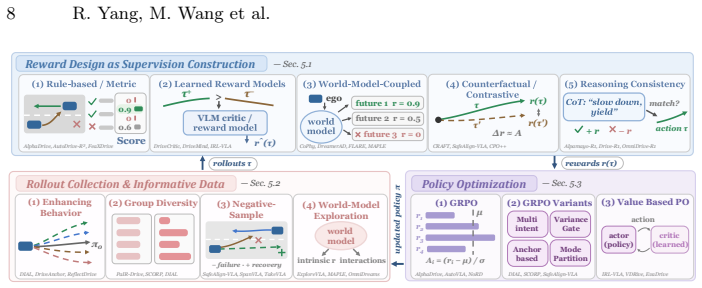
A four-family taxonomy of post-training methods, partitioned solely by the form of supervision they use. Each family is examined for its distinctive capabilities, limitations, and remaining open challenges, yielding a unified map of the field.
What would settle it
A substantial line of published post-training methods for end-to-end driving that cannot be placed in any of the four supervision families without forced merging or omission, or that demonstrably fits better under a different primary axis.
Extended reading notes
Core claim
Traditional open-loop imitation of expert demonstrations is insufficient for reliable end-to-end autonomous driving; post-training techniques that further refine the policy are required, and the existing literature organizes cleanly into four major families according to the form of supervision each family employs.
Load-bearing premise
The claim that “form of supervision” is a clean, complete, and non-overlapping axis that partitions all post-training work into exactly four families.
Editorial analysis
A structured set of objections, weighed in public.
Referee Report
Summary. This manuscript is a literature survey on post-training for end-to-end autonomous driving. It argues that open-loop imitation of expert demonstrations is insufficient for reliable E2E AD because small execution errors accumulate, recovery behaviors are scarce in training data, and long-horizon objectives (safety, comfort) are not captured by pointwise labels. Motivated by these limitations, the survey defines the scope of post-training and organizes the existing literature into four major families according to the form of supervision used. For each family it discusses capabilities, limitations, and open challenges, with the stated goal of enabling a systematic view of the area and stimulating further work on reliable and efficient post-training. A companion GitHub collection of related papers is provided.
Significance. If the four-family organization is complete, non-overlapping, and useful in practice, the survey would supply a timely and actionable map of an emerging subfield that sits between pure imitation learning and full closed-loop policy optimization. End-to-end AD (including VLA models and trajectory-generative planners) is rapidly expanding; a clear taxonomy of post-training supervision forms, together with an explicit statement of each family’s limits and open problems, would help researchers avoid redundant work and identify underexplored directions. The accompanying curated paper list is a concrete community resource. Significance therefore hinges on whether the taxonomy is shown to cover the literature without forced merges or critical omissions—an assessment that cannot be completed from the abstract alone.
major comments (2)
- [Abstract (scope and four-family organization)] The central organizational claim—that the post-training literature cleanly partitions into exactly four major families by form of supervision—is asserted in the abstract but neither names the families nor supplies completeness or non-overlap criteria. Because this partition is load-bearing for the promised “unified view,” the body must (i) define each family with explicit inclusion/exclusion rules, (ii) demonstrate that major lines of work fit without forced merges, and (iii) discuss residual or hybrid methods that sit outside the four-way split. Without that justification the survey’s primary contribution remains unverifiable.
- [Abstract (motivation paragraph)] The abstract lists three motivating failure modes of open-loop imitation (error accumulation, scarce recovery data, missing long-horizon labels) as the rationale for post-training. These are standard and plausible, yet the survey should make precise which of the four families is intended to address which failure mode, and whether any failure mode remains unaddressed by all four. Absent that mapping, the claimed causal link from “imitation is insufficient” to “these four families suffice” is incomplete.
minor comments (3)
- [Abstract] The abstract never enumerates or even briefly labels the four families. Even a parenthetical list would orient the reader and allow immediate assessment of coverage.
- [Abstract] The phrase “Vision-Language-Action models and trajectory-generative planners” is used to exemplify the E2E class; a short clarifying clause on whether the survey treats these two architectures uniformly under post-training, or whether they receive distinct treatment inside the four families, would reduce ambiguity.
- [Abstract (final sentence)] The GitHub repository is a useful resource; the camera-ready version should pin a commit or release tag so that the cited collection remains reproducible.
Circularity Check
No significant circularity: abstract-only survey organizes literature without self-definitional predictions or load-bearing self-citation chains.
full rationale
This is an abstract-only literature survey on post-training for end-to-end autonomous driving. Its central claim is organizational rather than a closed mathematical derivation: open-loop imitation is insufficient (error accumulation, scarce recovery data, missing long-horizon objectives), so post-training is needed, and the literature can be partitioned into four families by form of supervision. No equations, fitted parameters, uniqueness theorems, or ansatzes appear in the available text. There are therefore no self-definitional reductions, no fitted inputs renamed as predictions, and no uniqueness results imported from the authors. Self-citation risk cannot be assessed beyond the abstract (which does not cite specific prior works as load-bearing premises). The four-family taxonomy is asserted but not enumerated here; that is a completeness question for a survey, not circularity by construction. Per the hard rules, an honest non-finding of circularity is the correct outcome when the derivation is self-contained against external benchmarks and no quoteable reduction exists. Score 0 with empty steps.
Assumptions & free parameters
assumptions (2)
- domain assumption Open-loop imitation of expert demonstrations is insufficient for reliable end-to-end autonomous driving because of error accumulation, scarce recovery behaviors, and missing long-horizon objectives.
- ad hoc to paper The post-training literature for autonomous driving can be partitioned into four major families by form of supervision.
Cite this review
Pith. "Pith review of Post-Training in End-to-End Autonomous Driving." pith.science (2026). https://pith.science/paper/M4HF3G32
@misc{pith2026260708072,
  author       = {Pith},
  title        = {Pith review of: Post-Training in End-to-End Autonomous Driving},
  year         = {2026},
  howpublished = {\url{https://pith.science/paper/M4HF3G32}},
  note         = {Machine review of arXiv:2607.08072}
}
read the original abstract
End-to-end models that map multimodal inputs directly to future trajectories/maneuvers have emerged as an increasingly prominent research paradigm in autonomous driving. This class of models includes both Vision-Language-Action models and trajectory-generative planners. Unlike classic machine learning applications, autonomous vehicles operate in safety-critical and interaction-intensive environments where traditional open-loop imitation of expert demonstrations is not sufficient to ensure reliability. In particular, small execution errors can accumulate over time, while recovery behaviors are scarce in training data. In addition, long-horizon objectives such as safety and driving comfort are not captured by pointwise labels either. These limitations have motivated a shift toward post-training techniques, which further refine driving policies beyond pure imitation. This survey presents a unified view of post-training for autonomous driving by defining its scope and organizing the existing literature into four major families based on the form of supervision they use. For each family, we discuss its capabilities, limitations, and open challenges. We aim to facilitate a systematic understanding of this emerging area and stimulate future research on reliable and efficient post-training for autonomous driving.A collection of related papers is available at https://github.com/RYNing/Awesome-Post-Training-In-Autonomous-Driving-Papers.
Figures


Reviewed July 15, 2026 · model on record in the stance chip above.
Discussion (0). Sign in to comment.