REVIEW 3 major objections 5 minor 46 references
Analysis Methodology for Age of Information under Sequence Based Scheduling
T0 review · 3 major / 5 minor · reviewed 2026-08-12 · deepseek-v4-flash
Pith's one-line read This paper establishes O(N^4) closed-form expressions for average Age of Information under MHUI sequence scheduling in the T<L regime, for coprime periods and for at-most-one-transmission-per-frame schedules, and uses them to select…
desk verdict The T<L analysis and integer-partition machinery are genuinely new, but Eq. (5) is under-normalized by a factor of C(w,r) and the error propagates into every closed-form AoI expression. read the letter →
The pith
A machine-rendered reading of the paper's core claim, the machinery that carries it, and where it could break.
The reading
What carries the argument
The load-bearing object is the sf-word: a cyclic binary word of length $w$ whose letters record, in order, whether each of a user's scheduled transmissions succeeds ($s$) or collides ($f$). Each such word is mapped to an integer partition of $w$ with $r$ parts, and the parts index sums $b_j = \sum_k F(\zeta_w(k,j))$ of cyclic distances between transmission slots, where $\zeta_w(k,j)$ is the sum of $j$ consecutive cyclic distances $\ell_k$ between scheduled transmissions. A generating function $Q(x,y)$ in the exponents of $w$ and $r$ assembles these sums, so the huge sum over all events collapses to a coefficient extraction. The event probabilities $P_r$ in Theorem 2, which weight the whole average, come from a separate offset-counting argument based on Stirling numbers of the second kind. Together the partition machinery and the event-probability formula turn exponential enumeration over offsets into polynomial-time evaluation.
What would settle it
Check whether the event probabilities in formula (5) sum to one by direct enumeration for a small valid MHUI set, for example $N=2$ users, Hamming weight $w=2$, and sequence period $L=6$. Counting offset vectors directly gives a total probability of one half rather than one over all events; if that is confirmed, the closed-form average AoI values are not the true average over uniformly random offsets and will disagree with simulation once the probabilities are corrected.
Extended reading notes
Core claim
The central claim is that average AoI under minimum-Hamming user-irrepressible (MHUI) sequence scheduling, previously solved only for $T \ge L$, admits closed-form evaluation when $T < L$. The paper aggregates transmission outcomes (which of a user's scheduled transmissions succeed) instead of enumerating all $L^N$ offset vectors, then uses integer partitions to sum the resulting statistics. In the coprime case $\gcd(T,L)=1$, Equation (17) gives the average AoI directly from the known cyclic distances between transmissions; in the at-most-one-transmission-per-frame case, Equation (18) does the same from those distances and the within-frame positions. Both formulas claim $O(N^4)$ complexity and are reported to match simulation. The same closed forms justify a heuristic that selects construction parameters, specifically choosing $q=T$ rather than $q=2p-1$, which the numerics show both reduces AoI and cuts the transmission duty factor.
Load-bearing premise
The whole calculation depends on the formula that assigns a probability to each possible pattern of successes and collisions among a user's scheduled transmissions; if that probability count is wrong, every average Age of Information value the paper reports is wrong.
Editorial extensions
If this is right
- Average AoI for $T < L$ becomes computable in $O(N^4)$ time instead of exponential time, making schedule design feasible for dozens of users.
- For coprime $T$ and $L$, the closed form in Theorem 10 lets designers evaluate AoI directly from the transmission-distance profile without simulation.
- For schedules with at most one transmission per frame, Theorem 14 shows AoI also depends on the positions of the transmissions inside the frame, not just on their spacing.
- Choosing $q=T$ can simultaneously reduce average AoI and the duty factor, so freshness and energy efficiency do not have to be traded off in the regimes tested.
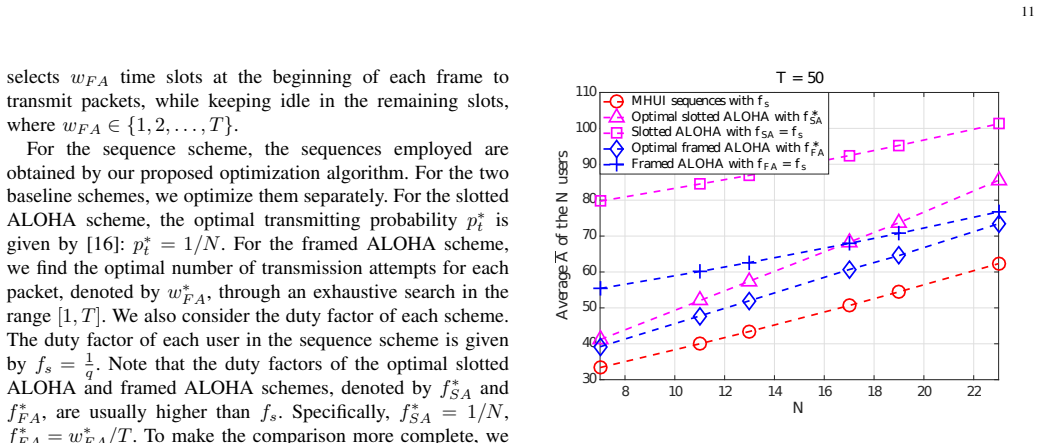
- The sequence scheme is reported to beat optimized slotted and framed ALOHA in both AoI and energy consumption in the numerical comparisons.
Reading between the lines
- The integer-partition summation appears to be a transferable device: any deterministic periodic schedule whose success pattern is cyclic and whose event probabilities are known could reuse the same coefficient extraction, not just the CRT-built MHUI sequences studied here.
- The closed forms are written for uniformly random starting offsets; if a deployment has a particular offset distribution, the same event-space decomposition could be re-weighted once the per-event probabilities are recomputed for that distribution.
- Because the paper optimizes only $q$ before sequence construction, the two optimization layers it names (parameter selection here, cyclic-shift selection in prior work) could be combined into a joint search over $q$ and shift offsets, and the numerical tables suggest the gains would compound.
Editorial analysis
A structured set of objections, weighed in public.
Referee Report
Summary. This paper studies the average Age of Information (AoI) of a user in a collision channel where N users transmit periodically generated status packets according to predetermined MHUI binary sequence schedules, without feedback or synchronization. The paper considers the regime T < L, where T is the frame (generation) period and L is the sequence period. The authors decompose the AoI computation into events characterized by the number r of successful transmission slots of the tagged user, derive a closed-form probability P_r for each event (Theorem 2, Eq. (5)), and use an integer-partition technique to sum over events in O(N^4) time for two special cases: gcd(T,L)=1 (Theorem 10, Eq. (17)) and at most one transmission slot per frame (Theorem 14, Eq. (18)). They further propose a parameter-selection heuristic (Algorithm 1) and compare with slotted and framed ALOHA baselines via simulation.
Significance. The integer-partition machinery (Lemmas 4--7, Theorem 8) is a clever and general method for summing over event patterns, and the reduction from exponential enumeration over offset vectors to polynomial complexity is a genuine contribution. The explicit closed-form expressions for the two T<L scenarios, if correct, would fill a real gap left by the authors' prior T=L analysis. The paper also offers a useful design heuristic linking q, L, T, and AoI. However, the main quantitative claims hinge on the event probability formula (5), which is under-normalized; the correctable error currently invalidates the closed-form expressions and the numerical results as printed.
major comments (3)
- [Theorem 2 / Eq. (5)] The event probability P_r in Eq. (5) is under-normalized by a factor of C(w,r). Appendix B counts, for a fixed pattern of (w−r) failed '1' positions, the number of offset vectors of the other N−1 users that realize that pattern; the counting steps (choose n users, assign them surjectively to the specified failed positions, place the remaining users away from all w positions) contain no factor choosing which (w−r) of the w positions fail. Hence the count M_r is the number of offset vectors for a specific event in E_r, and the per-event probability should be M_r/L^{N−1}. The printed formula divides by C(w,r)L^{N−1}, making each event probability C(w,r) times too small. For the minimal MHUI pair N=2, w=2, L=6 with s1=[110000] and s2=[100010], direct enumeration gives M_1=2 and M_2=2 (the four offsets τ=0,1,2,3 give one success each, and τ=4,5 give two successes). Eq. (5) then yields P_1=1/6 and P_2=1/3, so the total probability over all events is 2·(1/6)+1·(1/3)=2/3, contradicting the MHUI guarantee that every offset vector has at least one success. Deleting the C(w,r) denominator gives P_1=P_2=1/3 and total probability 1. Since Eqs. (6), (7), (14), (17) and (18) all multiply every event term by P_r, the closed-form AoI expressions are unsupported as printed.
- [Appendix B vs. Theorem 2] The proof and the theorem statement are internally inconsistent: the counting of M_r in Appendix B is per-event (it fixes the set of (w−r) collided '1's), but the theorem statement divides by C(w,r), which presupposes that M_r is the total number of offset vectors with exactly r successes. Either the denominator C(w,r) should be removed from Eq. (5), or Step 1 of the proof should include a factor C(w,r) for choosing which positions fail. The former is the minimal correction; the rest of the derivation, such as the r=1 term P_1 w F(L) in Eq. (14), is consistent with the per-event interpretation once Eq. (5) is fixed, but not with the printed formula.
- [Section VIII and Table II] All numerical validations, comparisons, and the design heuristic rely on the erroneous P_r. In particular, the claimed agreement between the closed-form expressions and simulation in Fig. 6 cannot be explained if Eq. (5) as printed was used in the analytical curves; the manuscript should be amended to use the corrected probability and the simulations, tables, and Algorithm 1 should be re-run. The optimization conclusions in Section VII may change because different r classes receive different total weight after the normalization correction.
minor comments (5)
- [Section II] Section II, last paragraph: 'this paper concentrates on addressing the case where T > L' appears to be a typo for T < L, which is the stated focus everywhere else.
- [Appendix D] In the proof of Lemma 4, 'permutations of r integers with r1 "1"s, r2 "2"s, ...' should read 'with c1 "1"s, c2 "2"s, ...' to match the notation of c.
- [Algorithm 1] Algorithm 1 lines 4-5 refer to equations (19) and (20), but the closed-form expressions are given in (17) and (18).
- [Section V.A] The upper bound on A should be written as (T+β−3)/2; as printed, 'T + β−3/2' is ambiguous.
- [Section VIII.A] The sentence 'This assumption implies that each event in E_r occurs with equal probability' conflates the number of successes r with the specific event pattern; the uniformity of offset vectors does imply symmetry among patterns for MHUI sequences, but this should be stated explicitly rather than as a direct consequence of the uniform distribution.
Circularity Check
No significant circularity: the closed-form AoI expressions are derived from explicit offset-event counting and independent CRT/MHUI structural lemmas, not from their own outputs.
full rationale
The derivation chain does not reduce to its own inputs in any load-bearing way. The paper starts from the standard renewal-theoretic AoI formula in (1) and decomposes the offset-averaged value by collision/success events in (6) and (7). The event probabilities in (5) are obtained by explicit counting of offset vectors in Appendix B, not by fitting or by assuming the target AoI values. The closed-form expressions in (17) and (18) follow from the integer-partition counting in Lemmas 4-7 and from event-level statistics supplied by Lemmas 9 and 13; those lemmas use structural facts about CRT-constructed MHUI sequences in Lemma 1, which are independent of the AoI quantity being computed. Citations to the authors' earlier paper [18] appear for background, notation, the MHUI definition, and the T=L special case in Remark 1, but they are not the engine of the new T<L derivation. The lone serious issue found in the derivation is not circularity: Eq. (5) appears to divide by an extra C(w,r), making the event probabilities under-normalized, as the skeptic's enumeration suggests; that is a normalization or correctness concern rather than a self-referential reduction. No equation or fitted quantity is reused as its own prediction, so no circular step is identified.
Assumptions & free parameters
assumptions (5)
- domain assumption Starting time offsets tau_i are independent and uniformly distributed over Z_L.
- domain assumption Slot boundaries of all users are aligned, so offsets are integer slot counts.
- domain assumption MHUI sequence sets have Hamming cross-correlation at most 1 between distinct sequences.
- domain assumption Packets expire at the end of the frame in which they are generated, and only the first successful transmission of a packet causes an AoI drop.
- standard math Standard results on Stirling numbers of the second kind and integer partition generating functions.
Cite this review
Pith. "Pith review of Analysis Methodology for Age of Information under Sequence Based Scheduling." pith.science (2026). https://pith.science/paper/M4JT3Q6K
@misc{pith2026241109460,
  author       = {Pith},
  title        = {Pith review of: Analysis Methodology for Age of Information under Sequence Based Scheduling},
  year         = {2026},
  howpublished = {\url{https://pith.science/paper/M4JT3Q6K}},
  note         = {Machine review of arXiv:2411.09460}
}
abstract
We focus on the Age of Information (AoI) performance in a system where each user generates packets periodically to send to a common access point (AP) for status updating. To avoid heavy overhead, we assume that channel sensing, feedback information from the AP, and time synchronization are not available in the system. We adopt a multi-access scheme called the sequence scheme, where each user is assigned a periodic binary sequence to schedule their transmissions. In our previous work [18], we have thoroughly studied the AoI performance under sequence scheme when the period of schedule sequences, $L$, is equal to the status generating period, $T$. The results can be extended to the case where $T>L$. However, the case of $T<L$ is not covered by [18]. Therefore, in this paper, we concentrate on analyzing the AoI performance in the case of $T<L$, which is more challenging and requires different approaches. We conduct in-depth analysis on this case and develop a mathematical tool based on integer partitions to facilitate the analysis. We derive low-complexity closed-form expressions for two scenarios under $T<L$. Based on the obtained analytical results, we propose an algorithm to optimize the construction parameters of the sequence scheme. Finally, we compare our proposed sequence scheme with two commonly used baselines, and show that our proposed scheme outperforms the baselines in terms of AoI performance while consuming less energy.
Figures


Figures from the paper (7 more)




Reference graph
Works this paper leans on
-
[18]
Age of information for periodic status updates under sequence based scheduling,
F. Liu, W. S. Wong, Y .-H. Lo, Y . Zhang, C. S. Chen, and G. Xing, “Age of information for periodic status updates under sequence based scheduling,” IEEE Trans. Commun. , 2023
work page 2023
-
[1]
Game-based channel access for AoI-oriented data transmission under dynamic attack,
Y . Yang, X. Wei, R. Xu, L. Peng, and L. Liu, “Game-based channel access for AoI-oriented data transmission under dynamic attack,” IEEE Internet Things J. , vol. 9, no. 11, pp. 8820–8837, 2021
work page 2021
-
[2]
Age of information and throughput in random access-based IoT systems with periodic updating,
Y . H. Bae and J. W. Baek, “Age of information and throughput in random access-based IoT systems with periodic updating,” IEEE Wireless Commun. Lett., vol. 11, no. 4, pp. 821–825, 2022
work page 2022
-
[3]
Minimizing age of in- formation in vehicular networks,
S. Kaul, M. Gruteser, V . Rai, and J. Kenney, “Minimizing age of in- formation in vehicular networks,” in IEEE Intl. Conf. Sensing Commun. Networking (SECON), 2011, pp. 350–358
work page 2011
-
[4]
Real-time status updates in wireless HARQ with imperfect feedback channel,
S. Rezasoltani and C. Assi, “Real-time status updates in wireless HARQ with imperfect feedback channel,” IEEE Trans. Wireless Commun. , vol. 21, no. 6, pp. 4212–4226, 2021
work page 2021
-
[5]
Z. Chen, N. Pappas, E. Björnson, and E. G. Larsson, “Age of information in a multiple access channel with heterogeneous traffic and an energy harvesting node,” in IEEE Intl. Conf. Comput. Commun. (INFOCOM) Wksp. IEEE, 2019, pp. 662–667
work page 2019
-
[6]
On the age of information in a CSMA environment,
A. Maatouk, M. Assaad, and A. Ephremides, “On the age of information in a CSMA environment,” IEEE/ACM Trans. Networking, vol. 28, no. 2, pp. 818–831, 2020
work page 2020
-
[7]
MiSTA: An age- optimized slotted ALOHA protocol,
M. Ahmetoglu, O. T. Yavascan, and E. Uysal, “MiSTA: An age- optimized slotted ALOHA protocol,” IEEE Internet Things J. , vol. 9, no. 17, pp. 15 484 – 15 496, 2022
work page 2022
Show all 46 references
-
[8]
Performance analysis of age of information in ultra-dense internet of things (IoT) systems with noisy channels,
B. Zhou and W. Saad, “Performance analysis of age of information in ultra-dense internet of things (IoT) systems with noisy channels,” IEEE Trans. Wireless Commun., vol. 21, no. 5, pp. 3493–3507, 2021
2021
-
[9]
Age of information: An introduction and survey,
R. D. Yates, Y . Sun, D. R. Brown, S. K. Kaul, E. Modiano, and S. Ulukus, “Age of information: An introduction and survey,” IEEE J. Select. Areas Commun. , vol. 39, no. 5, pp. 1183–1210, 2021
2021
-
[10]
Renewal theory and its ramifications,
W. L. Smith, “Renewal theory and its ramifications,” J. Royal Statis. Society: Series B (Methodol.) , vol. 20, no. 2, pp. 243–284, 1958
1958
-
[11]
Asynchronous grant-free uplink transmissions in multichannel wireless networks with heterogeneous QoS guarantees,
C.-S. Chang, D.-S. Lee, and C. Wang, “Asynchronous grant-free uplink transmissions in multichannel wireless networks with heterogeneous QoS guarantees,” IEEE/ACM Trans. Networking , vol. 27, no. 4, pp. 1584–1597, 2019
2019
-
[12]
Completely irrepressible se- quences for multiple-packet reception,
Y . Zhang, Y .-H. Lo, and W. S. Wong, “Completely irrepressible se- quences for multiple-packet reception,” IEEE Trans. Veh. Technol. , vol. 65, no. 8, pp. 6803–6809, 2015
2015
-
[13]
A general upper bound on the size of constant-weight conflict-avoiding codes,
K. W. Shum, W. S. Wong, and C. S. Chen, “A general upper bound on the size of constant-weight conflict-avoiding codes,” IEEE Trans. Inf. Theory, vol. 56, no. 7, pp. 3265–3276, 2010. 16
2010
-
[14]
Construction and applications of CRT sequences,
K. W. Shum and W. S. Wong, “Construction and applications of CRT sequences,” IEEE Trans. Inf. Theory , vol. 56, no. 11, pp. 5780–5795, 2010
2010
-
[15]
User-irrepressible sequences,
K. W. Shum, Y . Zhang, and W. S. Wong, “User-irrepressible sequences,” in Intl. Conf. Seq. and Their Appl. (SETA) . Springer Berlin Heidelberg, 2010, pp. 88–101
2010
-
[16]
Status updates over unreliable multiaccess channels,
R. D. Yates and S. K. Kaul, “Status updates over unreliable multiaccess channels,” in IEEE Int. Symp. Inf. Theory (ISIT) , 2017, pp. 331–335
2017
-
[17]
Sta- bilizing frame slotted Aloha-based IoT systems: A geometric ergodicity perspective,
J. Yu, P. Zhang, L. Chen, J. Liu, R. Zhang, K. Wang, and J. An, “Sta- bilizing frame slotted Aloha-based IoT systems: A geometric ergodicity perspective,” IEEE J. Select. Areas Commun. , vol. 39, no. 3, pp. 714– 725, 2020
2020
-
[19]
Minimizing the AoI in resource-constrained multi-source relaying systems: Dynamic and learning-based scheduling,
A. Zakeri, M. Moltafet, M. Leinonen, and M. Codreanu, “Minimizing the AoI in resource-constrained multi-source relaying systems: Dynamic and learning-based scheduling,” IEEE Trans. Wireless Commun., vol. 23, no. 1, pp. 450–466, 2023
2023
-
[20]
Average aoi minimization in uav-assisted data collection with rf wireless power transfer: A deep reinforcement learning scheme,
L. Liu, K. Xiong, J. Cao, Y . Lu, P. Fan, and K. B. Letaief, “Average aoi minimization in uav-assisted data collection with rf wireless power transfer: A deep reinforcement learning scheme,” IEEE Internet of Things Journal, vol. 9, no. 7, pp. 5216–5228, 2021
2021
-
[21]
Aoi-aware partial com- putation offloading in iiot with edge computing: A deep reinforcement learning based approach,
K. Peng, P. Xiao, S. Wang, and V . C. Leung, “Aoi-aware partial com- putation offloading in iiot with edge computing: A deep reinforcement learning based approach,” IEEE Trans. Cloud Computing , 2023
2023
-
[22]
On conflict-avoiding codes of length n = 4m for three active users,
M. Jimbo, M. Mishima, S. Janiszewski, A. Y . Teymorian, and V . D. Tonchev, “On conflict-avoiding codes of length n = 4m for three active users,” IEEE Trans. Inf. Theory , vol. 53, no. 8, pp. 2732–2742, 2007
2007
-
[23]
Design and construction of protocol sequences: Shift invariance and user irrepress- ibility,
K. W. Shum, W. S. Wong, C. W. Sung, and C. S. Chen, “Design and construction of protocol sequences: Shift invariance and user irrepress- ibility,” in IEEE Int. Symp. Inf. Theory (ISIT) , 2009, pp. 1368–1372
2009
-
[24]
A transmission control scheme for media access in sensor networks,
A. Woo and D. E. Culler, “A transmission control scheme for media access in sensor networks,” in ACM/IEEE Int. Conf. Mobile Computing and Networking (MOBICOM) , 2001, pp. 221–235
2001
-
[25]
A distributed TDMA scheduling algorithm using topological ordering for wireless sensor networks,
T.-T. Nguyen, T. Kim, and T. Kim, “A distributed TDMA scheduling algorithm using topological ordering for wireless sensor networks,” IEEE Access, vol. 8, pp. 145 316–145 331, 2020
2020
-
[26]
Fresh-CSMA: A distributed protocol for minimizing age of information,
V . Tripathi, N. Jones, and E. Modiano, “Fresh-CSMA: A distributed protocol for minimizing age of information,” in IEEE Int. Conf. Comput. Commun. (INFOCOM), 2023, pp. 1–10
2023
-
[27]
On Stirling numbers of the second kind,
B. C. Rennie and A. J. Dobson, “On Stirling numbers of the second kind,” J. Combinatorial Theory , vol. 7, no. 2, pp. 116–121, 1969
1969
-
[28]
Age of information: Can CR- NOMA help?
Z. Ding, R. Schober, and H. V . Poor, “Age of information: Can CR- NOMA help?” IEEE Trans. Commun. , 2023
2023
-
[29]
Peak age of information in slotted aloha networks,
S. Asvadi and F. Ashtiani, “Peak age of information in slotted aloha networks,” IEEE Trans. Commun. , 2023
2023
-
[30]
Age of information in random access channels,
X. Chen, K. Gatsis, H. Hassani, and S. S. Bidokhti, “Age of information in random access channels,” IEEE Trans. Inf. Theory , vol. 68, no. 10, pp. 6548–6568, 2022
2022
-
[31]
G. E. Andrews and K. Eriksson, Integer partitions . Cambridge University Press, 2004
2004
-
[32]
Adaptive resource allocation for diverse safety message transmissions in vehicular networks,
J. Chen, H. Wu, F. Lyu, P. Yang, Q. Li, and X. Shen, “Adaptive resource allocation for diverse safety message transmissions in vehicular networks,” IEEE Trans. Intelligent Transportation Sys. , vol. 23, no. 8, pp. 13 482–13 497, 2021
2021
-
[33]
Resource allocation and sharing in URLLC for IoT applications using shareability graphs,
F. Librino and P. Santi, “Resource allocation and sharing in URLLC for IoT applications using shareability graphs,” IEEE Internet Things J., vol. 7, no. 10, pp. 10 511–10 526, 2020
2020
-
[34]
A delay-sensitive multibase-station multichannel access system for smart factory,
Y . Peng, Z. Ning, A. Tan, S. Wang, and M. S. Obaidat, “A delay-sensitive multibase-station multichannel access system for smart factory,” IEEE Systems J., vol. 17, no. 1, pp. 188–199, 2022
2022
-
[35]
Aoi minimization for WSN data collection with periodic updating scheme,
G. Zhang, C. Shen, Q. Shi, B. Ai, and Z. Zhong, “Aoi minimization for WSN data collection with periodic updating scheme,” IEEE Trans. Wireless Commun., vol. 22, no. 1, pp. 32–46, 2022
2022
-
[36]
CRT sequences with applications to collision channels allowing successive interference cancellation,
Y . Chen, Y .-H. Lo, K. W. Shum, W. S. Wong, and Y . Zhang, “CRT sequences with applications to collision channels allowing successive interference cancellation,” IEEE Trans. Inf. Theory , vol. 64, no. 4, pp. 2910–2923, 2018
2018
-
[37]
Safety-message broadcast in vehicular ad hoc networks based on protocol sequences,
Y . Wu, K. W. Shum, W. S. Wong, and L. Shen, “Safety-message broadcast in vehicular ad hoc networks based on protocol sequences,” IEEE Trans. Veh. Technol., vol. 63, no. 3, pp. 1467–1479, 2014
2014
-
[38]
Families of finite sets in which no set is covered by the union ofr others,
P. Erdös, P. Frankl, and Z. Füredi, “Families of finite sets in which no set is covered by the union ofr others,” Israel J. of Math., vol. 51, no. 1, pp. 79–89, 1985
1985
-
[39]
Conflict-avoiding codes of prime lengths and cyclotomic numbers,
L.-C. Hsia, H.-C. Li, and W.-L. Sun, “Conflict-avoiding codes of prime lengths and cyclotomic numbers,” IEEE Trans. Inf. Theory , 2024
2024
-
[40]
A probabilistic variant of sperner’s theorem and of maximal r-cover free families,
N. Alon, S. Gilboa, and S. Gueron, “A probabilistic variant of sperner’s theorem and of maximal r-cover free families,” Discrete Mathematics, vol. 343, no. 10, p. 112027, 2020
2020
-
[41]
Shift-invariant protocol sequences for the collision channel without feedback,
K. W. Shum, C. S. Chen, C. W. Sung, and W. S. Wong, “Shift-invariant protocol sequences for the collision channel without feedback,” IEEE Trans. Inf. Theory, vol. 55, no. 7, pp. 3312–3322, 2009
2009
-
[42]
New protocol sequences for random-access channels without feedback,
W. S. Wong, “New protocol sequences for random-access channels without feedback,” IEEE Trans. Inf. Theory , vol. 53, no. 6, pp. 2060– 2071, 2007
2007
-
[43]
G. E. Andrews, The theory of partitions . Cambridge university press, 1998, no. 2
1998
-
[44]
Riordan, An introduction to combinatorial analysis
J. Riordan, An introduction to combinatorial analysis . Princeton university press, 1978
1978
-
[45]
Eywa: A general approach for scheduler design in aoi optimization,
C. Li, S. Li, Q. Liu, Y . T. Hou, W. Lou, and S. Kompella, “Eywa: A general approach for scheduler design in aoi optimization,” in IEEE Int. Conf. Comput. Commun. (INFOCOM) . IEEE, 2023, pp. 1–9
2023
-
[46]
Scheduling with age of information guarantee,
C. Li, Q. Liu, S. Li, Y . Chen, Y . T. Hou, W. Lou, and S. Kompella, “Scheduling with age of information guarantee,” IEEE/ACM Trans. Networking, vol. 30, no. 5, pp. 2046–2059, 2022
2022
Reviewed August 12, 2026 · model on record in the stance chip above.
Discussion (0). Continue with ORCID to comment.