REVIEW 3 major objections 5 minor 1 cited by
Bias Disparity in Collaborative Recommendation: Algorithmic Evaluation and Comparison
T0 review · 3 major / 5 minor · reviewed 2026-08-14 · deepseek-v4-flash
Pith's one-line read This paper claims that among collaborative recommendation algorithms, neighborhood-based methods — especially a trust-aware neighborhood model — produce recommendations with the lowest bias disparity between users' stated preferences and…
desk verdict The paper's broad algorithm comparison is useful, but the headline result on TrustKNN rests on an unnormalized disparity metric that mostly re-measures the training data. read the letter →
The pith
A machine-rendered reading of the paper's core claim, the machinery that carries it, and where it could break.
The reading
What carries the argument
The central object is the bias disparity measure $BD(G,C)=\bigl(BR(G,C)-BT(G,C)\bigr)/BT(G,C)$, which compares a group's share of a category in the training ratings ($BT$) with its share in the recommendation list ($BR$); values near zero mean the recommender preserves that group's categorical preferences. This is paired with an average disparity metric, inspired by value unfairness, which summarizes differences between protected and unprotected groups across all categories, and with a comparison protocol in which each algorithm is evaluated at a fixed ranking-quality level so that fairness is compared under matched accuracy. Item coverage is measured as the percentage of catalog items that appear somewhere in the recommendation lists.
What would settle it
Rerun all tested algorithms on the same Yelp sample with a single shared ranking-quality target — for instance, the highest nDCG that every algorithm can reach — and measure average disparity at that target; a run in which any matrix-factorization algorithm shows lower average disparity than TrustKNN would show that the paper's algorithm ranking depends on its protocol rather than on the algorithms themselves.
Extended reading notes
Core claim
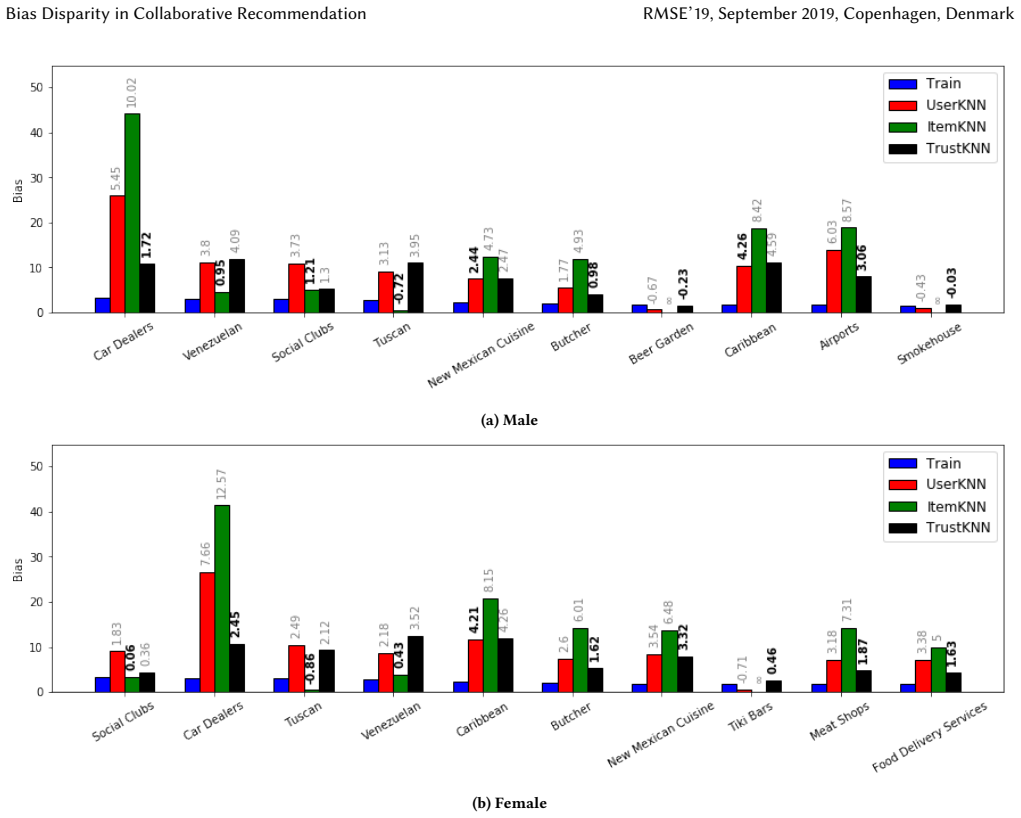
On the paper's own terms, the discovery is that the algorithm family matters for categorical bias: a trust-aware neighborhood model produced recommendation lists whose category mix most closely matched the training preferences of both male and female users, with the lowest bias disparity on 50–60% of the top ten most preferred categories and the best item coverage among neighborhood models, even though its ranking quality was slightly below plain UserKNN and ItemKNN. Among model-based algorithms, the sparse linear method SLIM had the lowest average disparity. The paper concludes that neighborhood models 'work significantly better' than model-based algorithms on this dense rating data, that trust information can improve fairness-relevant performance, and that bias disparity should be reported alongside ranking quality and item coverage when evaluating recommenders.
Load-bearing premise
The comparison protocol fixes different ranking-quality targets (nDCG ≈ 0.023 for model-based algorithms and ≈ 0.074 for neighborhood algorithms) and drops algorithms that cannot reach them, so bias disparity is never compared across algorithm families at the same ranking quality; if all algorithms were held to one target, the winner could change.
Editorial extensions
If this is right
- In dense rating domains with a trust network, neighborhood-based recommenders should be the default when minimizing bias disparity is a goal, because they preserve group category preferences better than matrix factorization.
- Trust side information is an actionable lever: the trust-aware neighborhood model outperformed all other algorithms, so collecting or propagating trust/friend links can improve fairness-relevant behavior without changing the model family.
- Among model-based algorithms, SLIM is the preferred baseline for fairness studies, because it showed the lowest average disparity while maintaining high ranking quality.
- Bias disparity results are conditional on ranking quality: comparisons made at different accuracy levels may not transfer, so fairness evaluations should always report the ranking quality at which disparity is measured.
- No single algorithm dominates on every category or group: SoReg and ListRankMF each had the lowest disparity on a substantial share of top categories, so category-level and group-level analysis is needed, not just aggregate metrics.
Reading between the lines
- A reader might infer that the paper's winner is protocol-dependent: model-based and neighborhood families were evaluated at different ranking-quality levels, so a matched-quality comparison could reorder the results.
- If the pattern extends to other dense, trust-augmented domains, system designers can reduce bias disparity simply by choosing KNN-style recommenders and exploiting existing trust links, reserving fairness constraints for settings where sparse data forces latent-factor models.
- The framing also implies that low bias disparity is not the same as low bias: a recommender that faithfully reproduces an imbalanced training distribution would score zero disparity while still being unfair, so disparity metrics need external bias audits to support fairness claims.
- A natural testable extension, which the paper flags as future work, is a sparser rating matrix with denser trust data; one would expect latent-factor models to close some of the gap, since they are designed for sparse data.
Signed reviews
Editorial analysis
A structured set of objections, weighed in public.
Referee Report
Summary. This paper compares collaborative recommendation algorithms — neighborhood-based, model-based, and trust-aware — with respect to bias disparity, a fairness measure proposed in prior work. The authors introduce an 'average disparity' metric (Eq. 4) and evaluate it along with nDCG and item coverage on a dense Yelp sample. Their central claim is that neighborhood models, especially TrustKNN, achieve lower disparity at comparable ranking quality than matrix-factorization and trust-aware model-based algorithms. The paper includes a dataset release and experiments over a large hyperparameter grid.
Significance. If the claims were fully supported, the paper would provide a practical algorithmic comparison for fairness-oriented recommender system design, which is a valuable contribution to the fairness-aware recommendation literature. The authors are to be credited for releasing their processed dataset and for including trust-aware algorithms, which are less commonly compared under fairness metrics. However, the average disparity metric introduced in Eq. (4) is not normalized and is dominated by raw training-data counts, so the headline comparison and the concluding preference for neighborhood models rest on a measure that may largely reflect dataset asymmetries rather than algorithmic behavior. The evaluation also lacks a reproducible hyperparameter-selection protocol for matched nDCG and reports no variability or significance testing. The manuscript is therefore scientifically promising but currently needs substantial methodological repair and re-analysis.
major comments (3)
- [Section 4.3.1] The average disparity metric in Eq. (4) uses raw counts NR and NT without normalizing by group size or by total number of ratings. In the described setup, recommendation lists are of size 10 per user, so NR across all users and categories is at most about 13,550 items, whereas NT is derived from 100,409 training ratings and often amounts to hundreds or thousands per category. Consequently, the term (NR - NT) is dominated by -NT, and the metric largely measures pre-existing differences between male and female groups in the training data, not the effect of the recommendation algorithm. The claim in Section 4.3.2 that TrustKNN has 'significantly better average disparity' and the Section 5 conclusion that neighborhood models outperform other algorithms are therefore not supported by this metric. Please re-define the metric using normalized quantities (e.g., preference ratios analogous to Eq. (3), or counts normalized by group totals) and re-run the comparisons.
- [Section 4.3.1] The matched-nDCG protocol is not reproducible. The text states that model-based algorithms are compared at nDCG = 0.023 ± 0.001 and neighborhood algorithms at nDCG = 0.074 ± 0.01, but it does not describe how these particular nDCG levels were chosen, how hyperparameters were selected to achieve them, or why the two families are matched at different nDCG levels. Since the fairness comparison is explicitly conditioned on equal ranking quality, comparing model-based and neighborhood algorithms at different nDCG values means the cross-family comparison is not performed at the same ranking quality. Also, algorithms that cannot reach the specified threshold are excluded (e.g., BiasedMF, SVD++, SocialMF, TrustMF, random, most popular), which can systematically change the set of algorithms being compared. Please provide the exact hyperparameter selection procedure, report the selected parameters, and either match nDCG across all families or justify why within-family matching suffices for the claims.
- [Section 4.1 and Section 4.3.2] The paper reports averaged results but provides no error bars, confidence intervals, or significance tests, despite using 5-fold cross-validation. Phrases such as 'significantly better item coverage and average disparity' (Section 4.3.2) and 'neighborhood models work significantly better' (Section 5) are therefore not backed by statistical evidence. Please add per-fold variability or a hypothesis test comparing the algorithms on the primary metrics.
minor comments (5)
- [Section 4.2] The gender inference step uses an online tool (gender-api.com) but does not report the thresholds applied for 'high accuracy and fair amount of samples.' This makes the group definitions fragile and difficult to reproduce; please provide the exact filtering criteria and ideally a manual validation subset.
- [Section 4.2] There is a typo in the equation label: 'coveraдe' should be 'coverage.' Also, the denominator |I| in Eq. (5) is the number of items, but the definition should clarify whether recommendations from all users are pooled with duplicates removed before computing coverage.
- [Section 4.3.1] The phrase 'top 10 most preferred categories' is not defined. It should be specified whether these are categories with highest PRT(G,C) from Eq. (3) computed on the training data, and whether they are computed separately for male and female groups.
- [Section 4.1] Table 1 lists the parameter grids, but the final hyperparameter values used for each algorithm are not reported anywhere. Without this information, the experiments are not reproducible even if the grid is given.
- [Section 3] In Eq. (2), the definition of P(C) contains a typo ('|C|\|m|') and the symbol m is not defined. This should be cleaned up for clarity.
Circularity Check
No significant circularity: the bias-disparity comparison is an empirical evaluation with no fitted-prediction or self-citation chain.
full rationale
The paper is an experimental comparison, not a derivation. Bias disparity (Eq. 1) and average disparity (Eq. 4) are evaluation metrics computed directly from observed ratings, recommendation lists, and demographic/category labels; no parameter is fitted to the target comparison and no result is derived from a definition of itself. Algorithm rankings come from running standard algorithms (UserKNN, ItemKNN, BiasedMF, SVD++, ListRankMF, SLIM, TrustKNN, TrustSVD, SoReg, TrustMF, SocialMF) on a public Yelp sample. The self-citations (e.g., LibRec-auto [19] and balanced neighborhoods [4]) are tooling and background, not load-bearing premises for the conclusion. Concerns that the average disparity metric is dominated by training-data counts or that the nDCG-matching protocol differs across algorithm families are validity or protocol critiques, not circularity: the metric values would change under a different protocol, but they are not equivalent by construction to the algorithm output or to fitted inputs. Therefore the circularity score is 0.
Assumptions & free parameters
free parameters (2)
- nDCG matching target (model-based) =
0.023 ± 0.001
- nDCG matching target (neighborhood) =
0.074 ± 0.01
assumptions (4)
- domain assumption Privacy/selection of protected and unprotected groups by gender inferred from user names is accurate enough for the analysis.
- domain assumption Friendship edges in Yelp can be interpreted as a trust network for trust-aware algorithms.
- ad hoc to paper The average disparity metric (Eq. 4) is a valid measure of group disparity.
- standard math The bias disparity metric of Tsintzou et al. (Eqs. 1-3) is a meaningful measure of preference reflection.
Cite this review
Pith. "Pith review of Bias Disparity in Collaborative Recommendation: Algorithmic Evaluation and Comparison." pith.science (2026). https://pith.science/paper/M4WLLXUK
@misc{pith2026190800831,
  author       = {Pith},
  title        = {Pith review of: Bias Disparity in Collaborative Recommendation: Algorithmic Evaluation and Comparison},
  year         = {2026},
  howpublished = {\url{https://pith.science/paper/M4WLLXUK}},
  note         = {Machine review of arXiv:1908.00831}
}
read the original abstract
Research on fairness in machine learning has been recently extended to recommender systems. One of the factors that may impact fairness is bias disparity, the degree to which a group's preferences on various item categories fail to be reflected in the recommendations they receive. In some cases biases in the original data may be amplified or reversed by the underlying recommendation algorithm. In this paper, we explore how different recommendation algorithms reflect the tradeoff between ranking quality and bias disparity. Our experiments include neighborhood-based, model-based, and trust-aware recommendation algorithms.
Figures


Forward citations
Cited by 1 Pith paper
-
Bias vs Bias -- Dawn of Justice: A Fair Fight in Recommendation Systems
A category-aware re-ranking method reduces group differences in recommended item categories by pulling each user's recommendations toward the historical category mix of users with a different sensitive attribute.
Reference graph
Works this paper leans on
-
[1]
Himan Abdollahpouri, Gediminas Adomavicius, Robin Burke, Ido Guy, Dietmar Jannach, Toshihiro Kamishima, Jan Krasnodebski, and Luiz Augusto Pizzato. 2019. Beyond Personalization: Research Directions in Multistakeholder Recommenda- tion. CoRR abs/1905.01986 (2019). arXiv:1905.01986 http://arxiv.org/abs/1905. 01986
arXiv 2019
-
[2]
Himan Abdollahpouri, Robin Burke, and Bamshad Mobasher. 2017. Controlling Popularity Bias in Learning-to-Rank Recommendation. In RecSys ’17 Proceedings of the Eleventh ACM Conference on Recommender Systems . 42–46
work page 2017
-
[3]
Engin Bozdag. 2013. Bias in algorithmic filtering and personalization. Ethics and information technology 15, 3 (2013), 209–227
work page 2013
-
[4]
Robin Burke, Nasim Sonboli, Masoud Mansoury, and Aldo OrdoÃśez-Gauger
-
[5]
Burke, Himan Abdollahpouri, Bamshad Mobasher, and Trinadh Gupta
Robin D. Burke, Himan Abdollahpouri, Bamshad Mobasher, and Trinadh Gupta
-
[6]
Cynthia Dwork, Moritz Hardt, Toniann Pitassi, Omer Reingold, and Richard Zemel. 2012. Fairness through awareness. In In Proceedings of the 3rd innovations in theoretical computer science conference . 214–226
work page 2012
-
[7]
Ekstrand, Mucun Tian, Ion Madrazo Azpiazu, Jennifer D
Michael D. Ekstrand, Mucun Tian, Ion Madrazo Azpiazu, Jennifer D. Ekstrand, Oghenemaro Anuyah, David McNeill, and Maria Soledad Pera. 2018. All The Cool Kids, How Do They Fit In?: Popularity and Demographic Biases in Recommender Evaluation and Effectiveness. In In Conference on Fairness, Accountability and Transparency. 172–186
work page 2018
-
[8]
Guibing Guo, Jie Zhang, Zhu Sun, and Neil Yorke-Smith. 2015. LibRec: A Java Library for Recommender Systems. In UMAP Workshops
work page 2015
Show all 33 references
-
[9]
Guibing Guo, Jie Zhang, and Neil Yorke-Smith. 2015. TrustSVD: collaborative filtering with both the explicit and implicit influence of user trust and of item ratings. In Twenty-Ninth AAAI Conference on Artificial Intelligence
2015
-
[10]
Mohsen Jamali and Martin Ester. 2010. A matrix factorization technique with trust propagation for recommendation in social networks. In In Proceedings of the fourth ACM conference on Recommender systems . 135–142
2010
-
[11]
Dietmar Jannach, Lukas Lerche, Iman Kamehkhosh, and Michael Jugovac. 2015. What recommenders recommend: an analysis of recommendation biases and possible countermeasures. User Modeling and User-Adapted Interaction 25, 5 (2015), 427–491
2015
-
[12]
Faisal Kamiran, Toon Calders, and Mykola Pechenizkiy. 2010. Discrimination aware decision tree learning. In In 2010 IEEE International Conference on Data Mining. 869–874
2010
-
[13]
Toshihiro Kamishima, Shotaro Akaho, and Jun Sakuma. 2011. Fairness-aware learning through regularization approach. In In 11th International Conference on Data Mining Workshops. 643–650
2011
-
[14]
Yehuda Koren. 2008. Factorization meets the neighborhood: a multifaceted collaborative filtering model. InProceedings of the 14th ACM SIGKDD international conference on Knowledge discovery and data mining . ACM, 426–434
2008
-
[15]
Yehuda Koren, Robert Bell, and Chris Volinsky. 2009. Matrix factorization tech- niques for recommender systems. Computer 42, 8 (2009)
2009
-
[16]
Lam and John Riedl
Shyong K. Lam and John Riedl. 2004. Shilling recommender systems for fun and profit. In Proceedings of the 13th international conference on World Wide Web . ACM, 393–402
2004
-
[17]
Weiwen Liu and Robin Burke. 2018. Personalizing Fairness-aware Re-ranking. CoRR abs/1809.02921 (2018). arXiv:1809.02921 http://arxiv.org/abs/1809.02921
2018 arXiv
-
[18]
Lyu, and Irwin King
Hao Ma, Dengyong Zhou, Chao Liu, Michael R. Lyu, and Irwin King. 2011. Recommender systems with social regularization. In Proceedings of the fourth ACM international conference on Web search and data mining . 287–296
2011
-
[19]
Masoud Mansoury, Robin Burke, Aldo Ordonez-Gauger, and Xavier Sepulveda
-
[20]
Paolo Massa and Paolo Avesani. 2007. Trust-aware recommender systems. In Proceedings of the 2007 ACM conference on Recommender systems . ACM, 17–24. Bias Disparity in Collaborative Recommendation RMSE’19, September 2019, Copenhagen, Denmark
2007
-
[21]
Xia Ning and George Karypis. 2011. SLIM: Sparse Linear Methods for Top-N Recommender Systems. In Data Mining (ICDM), 2011 IEEE 11th International Conference on. IEEE, 497–506
2011
-
[22]
Paul Resnick, Neophytos Iacovou, Mitesh Suchak, Peter Bergstrom, and John Riedl. 1994. GroupLens: an open architecture for collaborative filtering of netnews. In Proceedings of the 1994 ACM conference on Computer supported cooperative work. ACM, 175–186
1994
-
[23]
Badrul Sarwar, George Karypis, Joseph Konstan, and John Riedl. 2001. Item-based collaborative filtering recommendation algorithms. In WWW’01 Proceedings of the 10th international conference on World Wide Web . 285–295
2001
-
[24]
Yue Shi, Martha Larson, and Alan Hanjalic. 2010. List-wise learning to rank with matrix factorization for collaborative filtering. In Proceedings of the fourth ACM conference on Recommender systems . ACM, 269–272
2010
-
[25]
Virginia Tsintzou, Evaggelia Pitoura, and Panayiotis Tsaparas. 2018. Bias Dispar- ity in Recommendation Systems. CoRR abs/1811.01461 (2018). arXiv:1811.01461 http://arxiv.org/abs/1811.01461
2018 arXiv
-
[26]
Bo Yang, Yu Lei, Jiming Liu, and Wenjie Li. 2017. Social collaborative filtering by trust. IEEE Transactions on Pattern Analysis and Machine Intelligence 39, 8 (2017), 1633–1647
2017
-
[27]
Sirui Yao and Bert Huang. 2017. Beyond parity: Fairness objectives for collabora- tive filtering. In In Advances in Neural Information Processing Systems. 2921–2930
2017
-
[28]
Rich Zemel, Yu Wu, Kevin Swersky, Toni Pitassi, and Cynthia Dwork. 2013. Learning fair representations. In In International Conference on Machine Learning . 325–333
2013
-
[29]
Ziwei Zhu, Xia Hu, and James Caverlee. 2018. Fairness-aware tensor-based recommendation. In In Proceedings of the 27th ACM International Conference on Information and Knowledge Management . 1153–1162
2018
-
[30]
Malthouse
ÃŰzge SÃijrer, Robin Burke, and Edward C. Malthouse. 2018. Multistakeholder recommendation with provider constraints. In In Proceedings of the 12th ACM Conference on Recommender Systems . 54–62
2018
-
[2016]
In In UMAP (Extended Proceedings)
Towards Multi-Stakeholder Utility Evaluation of Recommender Systems. In In UMAP (Extended Proceedings)
-
[2017]
In RecSys workshop on Fairness, Accountability and Transparency in Recommender Systems
Balanced neighborhoods for fairness-aware collaborative recommendation. In RecSys workshop on Fairness, Accountability and Transparency in Recommender Systems
-
[2018]
In Proceedings of the 12th ACM Conference on Recommender Systems
Automating recommender systems experimentation with librec-auto. In Proceedings of the 12th ACM Conference on Recommender Systems. ACM, 500–501
Reviewed August 14, 2026 · model on record in the stance chip above.
Discussion (0). Continue with ORCID to comment.