Spin polarisation signatures of Fractionally Charged Skyrmions in Fractional Quantum Hall states
Pith reviewed 2026-06-27 12:06 UTC · model grok-4.3
The pith
Minimal fractionally charged skyrmions form in fractional quantum Hall states, shown by symmetric spin depolarisation.
A machine-rendered reading of the paper's core claim, the machinery that carries it, and where it could break.
Core claim
Cavity-polariton spectroscopy extracts the spin polarisation of the electron system as a function of filling factor. Complete suppression of the oscillator strength of the lowest energy excitation occurs, characteristic of singlet trion formation in fully polarised systems. At large magnetic fields, fully polarised fractional quantum Hall states exhibit symmetric depolarisation away from quantised fillings that follows the empirical law S equals nu star. This behaviour is interpreted as evidence for minimal fractionally charged skyrmions formed from bound spin-flip and quasiparticle excitations.
What carries the argument
Minimal Fractionally Charged Skyrmions (MFCS), bound states of spin-flip and quasiparticle excitations that produce the observed symmetric depolarisation law S equals nu star.
Load-bearing premise
The observed symmetric depolarisation away from quantised fillings is caused by the formation of minimal fractionally charged skyrmions rather than other spin-relaxation mechanisms.
What would settle it
High-field measurements that find either asymmetric depolarisation or a dependence on filling factor other than S equals nu star would contradict the minimal fractionally charged skyrmion interpretation.
Figures
read the original abstract
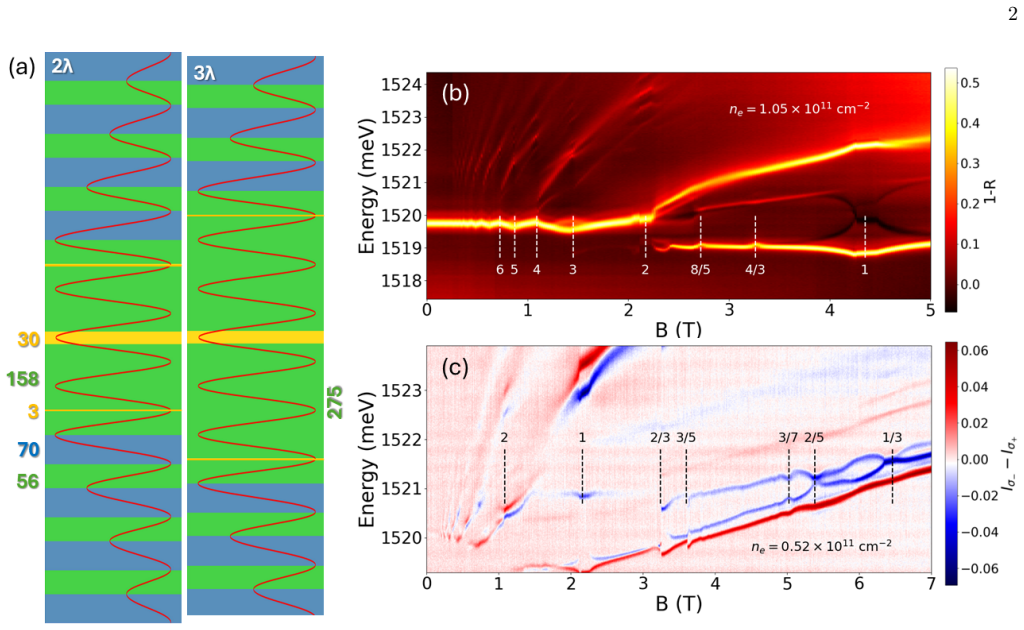
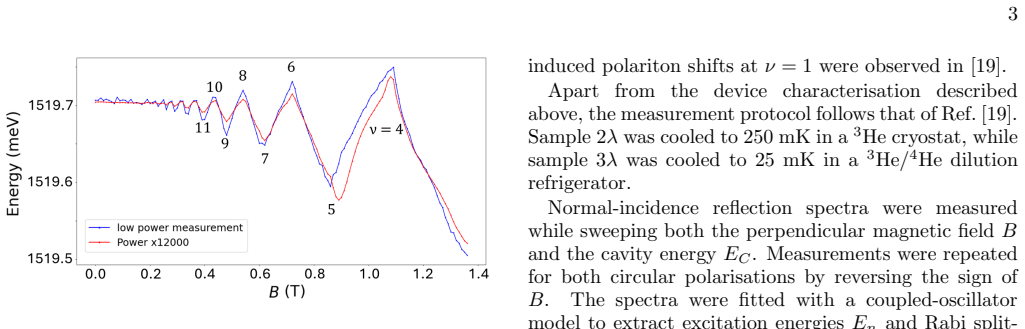
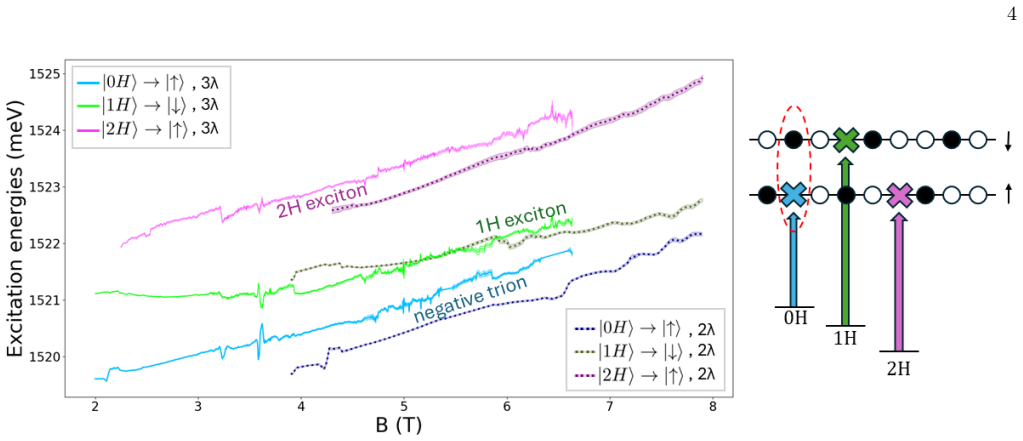
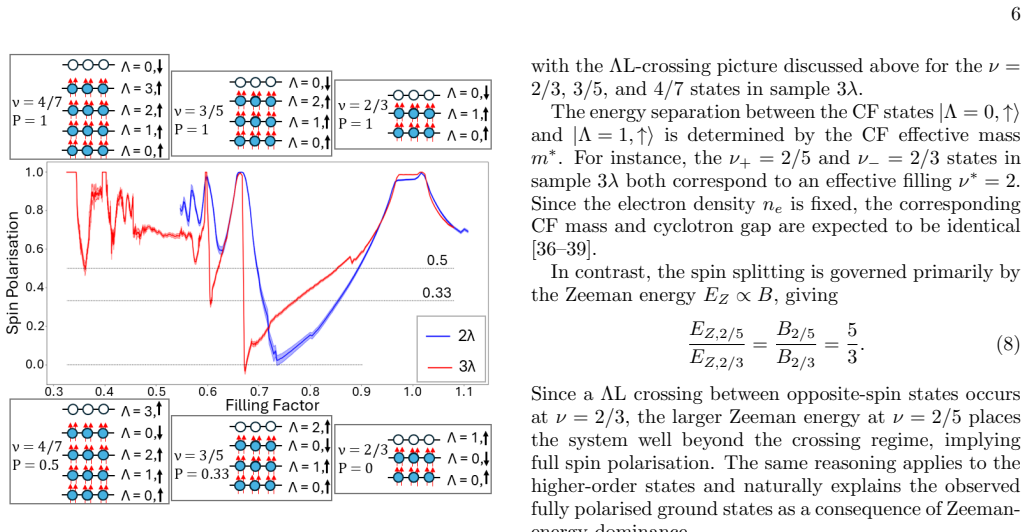
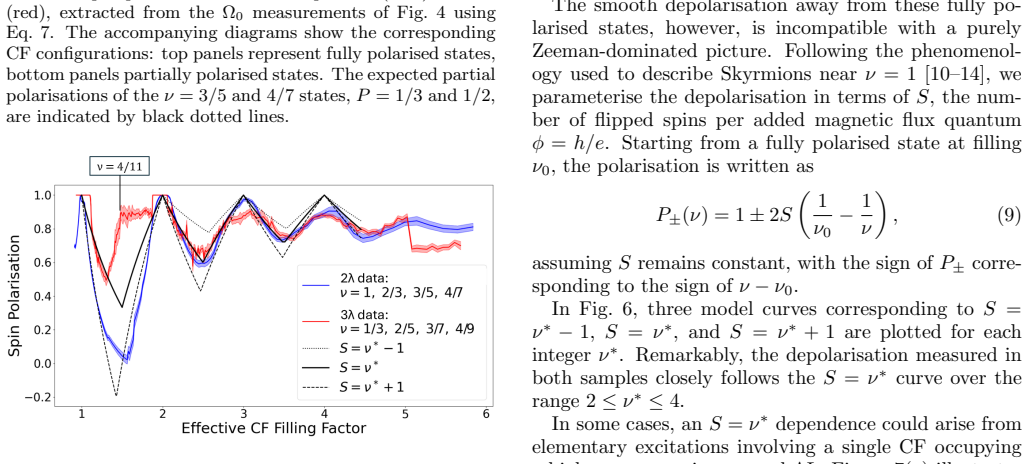
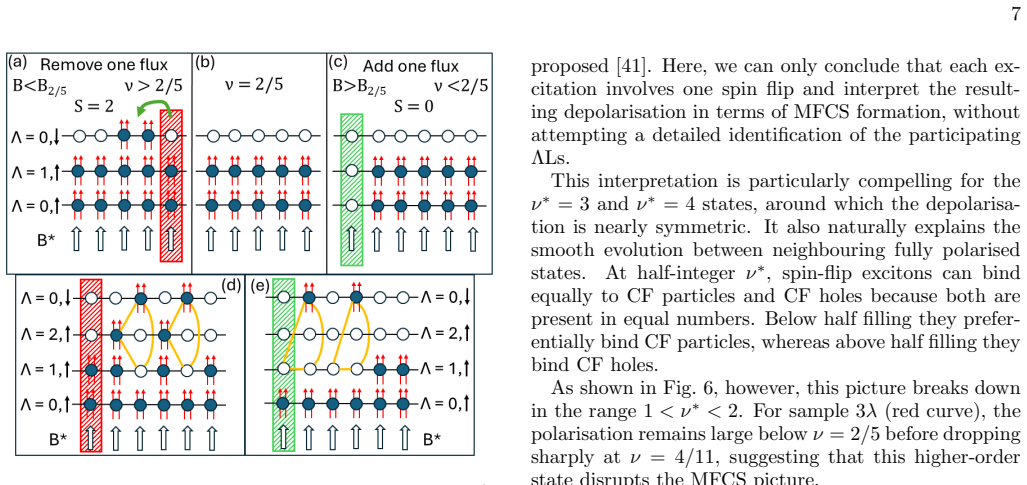
We investigate spin polarisation and low-energy excitations in fractional quantum Hall (FQH) states using cavity-polariton spectroscopy of high-mobility GaAs quantum wells. By measuring the optical coupling strength of interband Landau-level excitations over the range $1/3 \le \nu \le 1$, we extract the spin polarisation of the electron system as a function of filling factor. Complete suppression of the oscillator strength of the lowest energy excitation, characteristic of singlet trion formation in fully polarised systems, is reported for the first time in this regime. At large magnetic fields, fully polarised FQH states exhibit symmetric depolarisation away from their quantised fillings, analogous to Skyrmionic behaviour near $\nu=1$. The depolarisation follows an empirical law $S=\nu^*$, where $S$ is the number of spin flips per added magnetic flux quantum and $\nu^*$ the effective Composite Fermion filling factor. We interpret this behaviour as evidence for Minimal Fractionally Charged Skyrmions (MFCS) formed from bound spin-flip and quasiparticle excitations.
Editorial analysis
A structured set of objections, weighed in public.
Referee Report
Summary. The manuscript reports cavity-polariton spectroscopy measurements of spin polarisation in fractional quantum Hall states (1/3 ≤ ν ≤ 1) in high-mobility GaAs quantum wells. It claims complete suppression of the oscillator strength of the lowest-energy interband excitation (indicating singlet trion formation) at fully polarised FQH states, and symmetric depolarisation away from quantised fillings that follows an empirical law S=ν* (S = number of spin flips per added flux quantum, ν* = effective composite-fermion filling factor). This behaviour is interpreted as evidence for Minimal Fractionally Charged Skyrmions (MFCS) formed from bound spin-flip and quasiparticle excitations, analogous to integer-QH skyrmions.
Significance. If the data and interpretation are substantiated with quantitative analysis, the result would extend skyrmion physics into the fractional regime and demonstrate cavity-polariton spectroscopy as a probe of spin textures in FQH systems. This could impact understanding of low-energy excitations and spin-charge coupling in strongly correlated 2D electrons.
major comments (3)
- The central claim that symmetric depolarisation constitutes evidence for MFCS relies on the empirical law S=ν* being both observed and then used to support the MFCS interpretation; no independent derivation of this law from an MFCS model or quantitative contrast with alternative spin-relaxation mechanisms (e.g., unbound composite-fermion spin textures) is provided.
- No data plots, error bars, sample details, quantitative fits, or oscillator-strength extraction procedures are described, so the claimed support for the MFCS interpretation cannot be assessed; the abstract states the law and the interpretation without visible verification.
- The assumption that the cavity-polariton signal arises specifically from bound MFCS states rather than other low-energy spin-flip excitations is load-bearing but untested against alternatives in the presented material.
minor comments (1)
- The definition and range of the effective filling factor ν* should be stated explicitly with reference to composite-fermion theory.
Simulated Author's Rebuttal
We thank the referee for the constructive and detailed comments. We address each major point below and will revise the manuscript accordingly to improve clarity, add discussion of alternatives, and ensure the data analysis is fully documented.
read point-by-point responses
-
Referee: The central claim that symmetric depolarisation constitutes evidence for MFCS relies on the empirical law S=ν* being both observed and then used to support the MFCS interpretation; no independent derivation of this law from an MFCS model or quantitative contrast with alternative spin-relaxation mechanisms (e.g., unbound composite-fermion spin textures) is provided.
Authors: We agree the S=ν* law is empirical, observed directly in the data, and the MFCS interpretation is proposed by analogy to integer-QH skyrmions together with the observed symmetry. A microscopic derivation lies outside the scope of this primarily experimental study. In revision we will add a dedicated discussion section contrasting the MFCS picture with unbound composite-fermion spin textures, noting that the latter do not naturally produce the linear S=ν* dependence or the symmetric depolarisation around both integer and fractional fillings. Relevant theoretical literature on fractional skyrmions will be cited. revision: partial
-
Referee: No data plots, error bars, sample details, quantitative fits, or oscillator-strength extraction procedures are described, so the claimed support for the MFCS interpretation cannot be assessed; the abstract states the law and the interpretation without visible verification.
Authors: The full manuscript contains figures with the measured spectra, extracted spin polarisation versus filling factor (including error bars), sample parameters (mobility >10^7 cm²/Vs, density), and the fitting procedure used to obtain oscillator strengths from the polariton lineshapes. We will revise the main text to reference these elements more explicitly and add a concise methods paragraph detailing the oscillator-strength extraction and error analysis. revision: yes
-
Referee: The assumption that the cavity-polariton signal arises specifically from bound MFCS states rather than other low-energy spin-flip excitations is load-bearing but untested against alternatives in the presented material.
Authors: We acknowledge that the assignment to bound MFCS is interpretive. The complete suppression of the lowest-energy excitation at the quantised fillings and the symmetric recovery away from them are the key observations. In the revision we will expand the discussion to compare the expected signatures of alternative spin-flip excitations (e.g., unbound CF spin waves) with the data and explain why the observed S=ν* scaling favors the bound MFCS scenario. We note that future theoretical calculations of the polariton response for different excitations would be valuable. revision: partial
Circularity Check
No circularity in derivation chain; purely observational interpretation
full rationale
The paper reports cavity-polariton spectroscopy measurements of spin polarisation in FQH states and states that depolarisation away from quantised fillings 'follows an empirical law S=ν*'. It then offers an interpretation of this observed behaviour as evidence for MFCS. No first-principles derivation, model prediction, or equation is presented that reduces to the input data by construction. The law is explicitly labeled empirical (i.e., extracted from the measurements), and the MFCS claim is framed as an interpretation rather than a closed-loop result. No self-citations, ansatzes, or fitted parameters renamed as predictions appear in the text. The analysis is self-contained as an experimental observation plus post-hoc naming, with no load-bearing step that equates output to input by definition.
Axiom & Free-Parameter Ledger
free parameters (1)
- empirical depolarisation law S=ν*
axioms (1)
- domain assumption Optical coupling strength of interband Landau-level excitations measures the spin polarisation of the electron system
invented entities (1)
-
Minimal Fractionally Charged Skyrmions (MFCS)
no independent evidence
Reference graph
Works this paper leans on
-
[1]
This expression is motivated by the Jaynes–Cummings description of polaritons [35]
Forν <1, the coupling strength of trion excitation 0 is given by Ω0 =Eµ √n↓,(3) whereEis the average electric field generated in the QW by a confined cavity photon,µ=⟨1| −er|0⟩ is the dipole matrix element between the ground state|0⟩and excited state|1⟩projected onto the cavity plane, andn ↓ is the density of occupied |↓⟩states. This expression is motivat...
-
[2]
We therefore takeEto be constant
Variations ofEarising from differences between the 2λand 3λcavity modes, as well as from changes in the photon–trion overlap with magnetic field, are negligible within our experimental accuracy. We therefore takeEto be constant
-
[3]
The magnetic-field dependence of the dipole mo- ment follows that of a single-particle LL interband transition, µ∝l B = r ℏ eB ,(4) wherel B is the magnetic length,ℏthe reduced Planck constant, andethe elementary charge
-
[4]
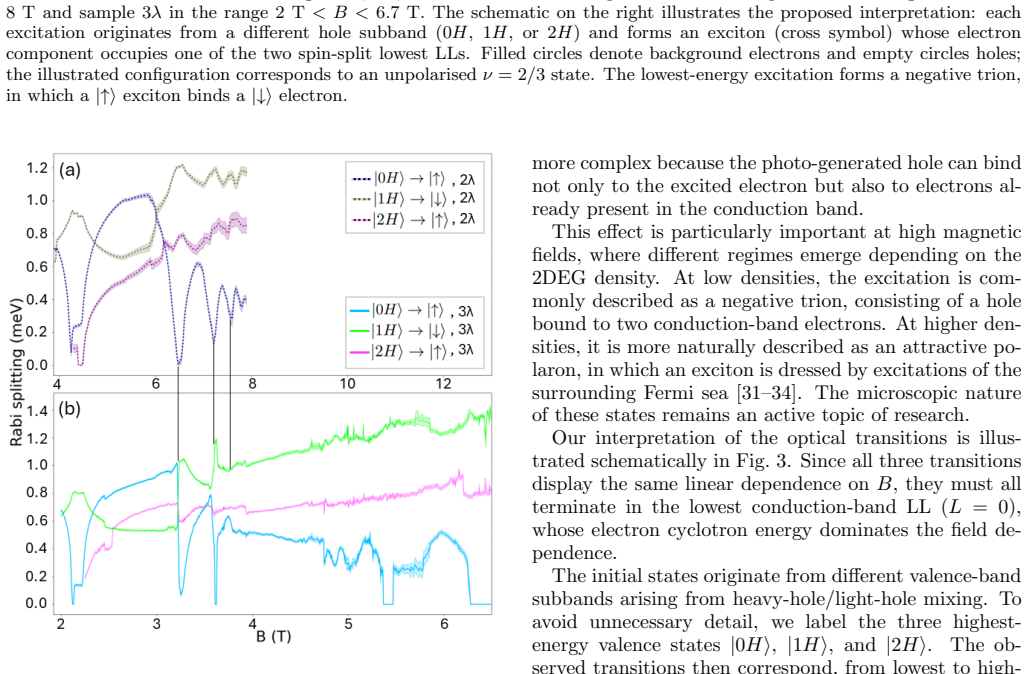
The sharp discontinuity of Ω 0 atν= 2/3 in sample 3λ(light blue curve in Fig. 4(b), nearB= 3.2 T) corresponds to a ΛL crossing within CF theory, driving the system from an unpolarised state with P= 0 (n ↓ =n e/2) to a fully polarised state with P= 1 (n ↓ = 0). The spin polarisation is defined as P= n↑ −n ↓ n↑ +n ↓ = 1−2 n↓ ne ,(5) wheren ↑ andn ↓ are the ...
-
[5]
R. B. Laughlin, Anomalous quantum hall effect: An in- compressible quantum fluid with fractionally charged ex- citations, Phys. Rev. Lett.50, 1395 (1983)
1983
-
[6]
J. K. Jain, Composite-fermion approach for the fractional quantum hall effect, Phys. Rev. Lett.63, 199 (1989)
1989
-
[7]
Nayak, S
C. Nayak, S. H. Simon, A. Stern, M. Freedman, and S. Das Sarma, Non-abelian anyons and topological quan- tum computation, Rev. Mod. Phys.80, 1083 (2008)
2008
-
[8]
L. S. Georgiev, Topological quantum computation with non-abelian anyons in fractional quantum hall states, inQuantum Systems in Physics, Chemistry, and Biol- ogy, edited by A. Tadjer, R. Pavlov, J. Maruani, E. J. Br¨ andas, and G. Delgado-Barrio (Springer International Publishing, Cham, 2017) pp. 75–94
2017
-
[9]
Nakamura, S
J. Nakamura, S. Liang, G. C. Gardner, and M. J. Manfra, Direct observation of anyonic braiding statistics, Nature Physics16, 931 (2020)
2020
-
[10]
G. S. Jeon and J. K. Jain, Nature of quasiparticle exci- tations in the fractional quantum hall effect, Phys. Rev. B68, 165346 (2003)
2003
-
[11]
J. Jain, K. Park, M. Peterson, and V. Scarola, Composite fermion theory of excitations in the fractional quantum hall effect, Solid State Communications135, 602 (2005), fundamental Optical and Quantum Effects in Condensed Matter
2005
-
[12]
Moore and N
G. Moore and N. Read, Nonabelions in the fractional quantum hall effect, Nuclear Physics B360, 362 (1991)
1991
-
[13]
Kumar, A
R. Kumar, A. Haug, J. Kim, M. Yutushui, K. Khudi- akov, V. Bhardwaj, A. Ilin, K. Watanabe, T. Taniguchi, D. F. Mross, and Y. Ronen, Quarter- and half-filled quan- tum hall states and their topological orders revealed by daughter states in bilayer graphene, Nature Communica- tions16, 7255 (2025)
2025
-
[14]
S. E. Barrett, G. Dabbagh, L. N. Pfeiffer, K. W. West, and R. Tycko, Optically pumped nmr evidence for finite- size skyrmions in gaas quantum wells near landau level fillingν= 1, Phys. Rev. Lett.74, 5112 (1995)
1995
-
[15]
E. H. Aifer, B. B. Goldberg, and D. A. Broido, Evidence of skyrmion excitations aboutν= 1 inn-modulation- doped single quantum wells by interband optical trans- mission, Phys. Rev. Lett.76, 680 (1996)
1996
-
[16]
Manfra, B
M. Manfra, B. Goldberg, L. Pfeiffer, and K. West, Opti- cal determination of the spin polarization of a quantum hall ferromagnet, Physica E: Low-dimensional Systems and Nanostructures1, 28 (1997)
1997
-
[17]
Plochocka, J
P. Plochocka, J. M. Schneider, D. K. Maude, M. Potem- ski, M. Rappaport, V. Umansky, I. Bar-Joseph, J. G. Groshaus, Y. Gallais, and A. Pinczuk, Optical absorption to probe the quantum hall ferromagnet at filling factor ν= 1, Phys. Rev. Lett.102, 126806 (2009)
2009
-
[18]
Lupatini, P
M. Lupatini, P. Kn¨ uppel, S. Faelt, R. Winkler, M. Shayegan, A. Imamoglu, and W. Wegscheider, Spin reversal of a quantum hall ferromagnet at a landau level crossing, Phys. Rev. Lett.125, 067404 (2020)
2020
-
[19]
Khandelwal, N
P. Khandelwal, N. N. Kuzma, S. E. Barrett, L. N. Pfeif- fer, and K. W. West, Optically pumped nuclear magnetic resonance measurements of the electron spin polariza- tion in gaas quantum wells near landau level filling factor ν= 1 3, Phys. Rev. Lett.81, 673 (1998)
1998
-
[20]
I. V. Kukushkin, K. v. Klitzing, and K. Eberl, Spin po- larization of composite fermions: Measurements of the fermi energy, Phys. Rev. Lett.82, 3665 (1999)
1999
-
[21]
Sasaki, Spin polarization in fractional quantum hall effect, Surf
S. Sasaki, Spin polarization in fractional quantum hall effect, Surf. Sci.532-535, 567 (2003), proceedings of the 7th International Conference on Nanometer-Scale Sci- ence and Technology and the 21st European Conference on Surface Science
2003
-
[22]
H. M. Yoo, K. W. Baldwin, K. West, L. Pfeiffer, and R. C. Ashoori, Spin phase diagram of the interacting quantum hall liquid, Nat. Phys.16, 1022 (2020)
2020
-
[23]
Williams, S
O. Williams, S. Faelt, F. Krizek, and W. Wegscheider, Spin polarization of quantum hall states for filling factors 1≤ν≤2 measured with microcavity polaritons, New J. Phys.27, 043026 (2025)
2025
-
[24]
J. G. Groshaus, P. Plochocka-Polack, M. Rappaport, V. Umansky, I. Bar-Joseph, B. S. Dennis, L. N. Pfeiffer, K. W. West, Y. Gallais, and A. Pinczuk, Absorption in the fractional quantum hall regime: Trion dichroism and spin polarization, Phys. Rev. Lett.98, 156803 (2007)
2007
-
[25]
Freytag, Y
N. Freytag, Y. Tokunaga, M. Horvati´ c, C. Berthier, M. Shayegan, and L. P. L´ evy, New phase transition be- tween partially and fully polarized quantum hall states with charge and spin gaps atν= 2 3, Phys. Rev. Lett.87, 136801 (2001)
2001
-
[26]
Ravets, P
S. Ravets, P. Kn¨ uppel, S. Faelt, O. Cotlet, M. Kroner, W. Wegscheider, and A. Imamoglu, Polaron polaritons in the integer and fractional quantum hall regimes, Phys. Rev. Lett.120, 057401 (2018)
2018
-
[27]
Kn¨ uppel, S
P. Kn¨ uppel, S. Ravets, M. Kroner, S. F¨ alt, W. Wegschei- der, and A. Imamoglu, Nonlinear optics in the fractional quantum hall regime, Nature572, 91 (2019)
2019
-
[28]
K¨ ulah, C
E. K¨ ulah, C. Reichl, J. Scharnetzky, L. Alt, W. Dietsche, and W. Wegscheider, The improved inverted algaas/gaas interface: its relevance for high-mobility quantum wells and hybrid systems, Semicond. Sci. Technol.36, 085013 (2021)
2021
-
[29]
Ababou, J
S. Ababou, J. J. Marchand, L. Mayet, G. Guillot, and F. Mollot, Characterization of dx centers in selectively doped gaas-alas superlattices, Applied Physics Letters 57, 1321 (1990)
1990
-
[30]
Miwa and T
R. Miwa and T. M. Schmidt, Dx centers in gaas/si-δ/alas heterostructure, Applied Physics Letters74, 1999 (1999)
1999
-
[31]
Bastard, E
G. Bastard, E. E. Mendez, L. L. Chang, and L. Esaki, Exciton binding energy in quantum wells, Phys. Rev. B 26, 1974 (1982)
1974
-
[32]
Whittaker and R
D. Whittaker and R. Elliott., Theory of magneto-exciton binding energy in realistic quantum well structures, Solid State Communications68, 1 (1988). 9
1988
-
[33]
D. D. Smith, M. Dutta, X. C. Liu, A. F. Terzis, A. Petrou, M. W. Cole, and P. G. Newman, Magnetoex- citon spectrum of gaas-alas quantum wells, Phys. Rev. B 40, 1407(R) (1989)
1989
-
[34]
Potemski, L
M. Potemski, L. Via, G. E. W. Bauer, J. C. Maan, K. Ploog, and G. Weimann, Magnetoexcitons in narrow gaas/ga1−xalxas quantum wells, Phys. Rev. B43, 14707 (1991)
1991
-
[35]
Shields, J
A. Shields, J. Osborne, M. Simmons, M. Pepper, and D. Ritchie, Magneto-optical spectroscopy of positively charged excitons in gaas quantum wells, Phys. Rev. B 52, R5523(R) (1995)
1995
-
[36]
Finkelstein, H
G. Finkelstein, H. Shtrikman, and I. Bar-Joseph, Opti- cal spectroscopy of a two-dimensional electron gas near the metal-insulator transition, Phys. Rev. Lett.74, 976 (1995)
1995
-
[37]
D. K. Efimkin and A. H. MacDonald, Exciton-polarons in doped semiconductors in a strong magnetic field, Phys. Rev. B97, 235432 (2018)
2018
-
[38]
Combescot, O
M. Combescot, O. Betbeder-Matibet, and F. Dubin, The many-body physics of composite bosons, Physics Reports 463, 215 (2008)
2008
-
[39]
Imamoglu, O
A. Imamoglu, O. Cotlet, and R. Schmidt, Exciton- polarons in two-dimensional semiconductors and the Tavis-Cummings model, Comptes Rendus. Physique22, 89 (2021)
2021
-
[40]
K. A. Villegas Rosales, P. T. Madathil, Y. J. Chung, L. N. Pfeiffer, K. W. West, K. W. Baldwin, and M. Shayegan, Composite fermion mass: Experimental measurements in ultrahigh quality two-dimensional electron systems, Phys. Rev. B106, L041301 (2022)
2022
-
[41]
I. V. Kukushkin, J. H. Smet, K. von Klitzing, and W. Wegscheider, Cyclotron resonance of composite fermions, Journal of Superconductivity16, 777 (2003)
2003
-
[42]
R. J. Nicholas, D. R. Leadley, M. S. Daly, M. van der Burgt, P. Gee, J. Singleton, D. K. Maude, J. C. Portal, J. J. Harris, and C. T. Foxon, The dependence of the composite fermion effective mass on carrier density and zeeman energy, Semiconductor Science and Technology 11, 1477 (1996)
1996
-
[43]
Chughtai, V
R. Chughtai, V. Zhitomirsky, R. Nicholas, and M. Henini, Measurements of composite fermion masses from the spin polarization of two-dimensional electrons in the region 1, Phys. Rev. B65, 161305 (2001)
2001
-
[44]
Wurstbauer, D
U. Wurstbauer, D. Majumder, S. S. Mandal, I. Dujovne, T. D. Rhone, B. S. Dennis, A. F. Rigosi, J. K. Jain, A. Pinczuk, K. W. West, and L. N. Pfeiffer, Observa- tion of nonconventional spin waves in composite-fermion ferromagnets, Phys. Rev. Lett.107, 066804 (2011)
2011
-
[45]
A. C. Balram, U. Wurstbauer, A. W´ ojs, A. Pinczuk, and J. K. Jain, Fractionally charged skyrmions in frac- tional quantum hall effect, Nature Communications6, 8981 (2015)
2015
discussion (0)
Sign in with ORCID, Apple, or X to comment. Anyone can read and Pith papers without signing in.