REVIEW 3 major objections 4 minor 2 cited by
Next-to-leading-order QCD corrections to double prompt $J/{\psi}$ hadroproduction
T0 review · 3 major / 4 minor · reviewed 2026-08-15 · deepseek-v4-flash
Pith's one-line read An independent NLO QCD calculation of color-singlet double $J/\psi$ hadroproduction shows that this single channel describes the LHCb data in most bins, while CMS and ATLAS require additional mechanisms.
desk verdict Independent NLO CS double-J/psi calculation that mostly confirms the known mechanism failure, but the paper's one new quantitative claim rests on an unpublished gq/qg subtraction. read the letter →
The pith
A machine-rendered reading of the paper's core claim, the machinery that carries it, and where it could break.
The reading
What carries the argument
The load-bearing device is the NRQCD factorization formula for double heavy-quarkonium hadroproduction, applied to the color-singlet Fock state $^3S_1^{[1]}$. At NLO the real-emission phase space is split into soft, hard-collinear, and hard-non-collinear regions using the two-cutoff phase-space slicing method; the analytic poles from the soft and hard-collinear pieces cancel against the virtual corrections and against the redefinition of the parton distribution functions, while the hard-non-collinear piece is integrated numerically in four dimensions. The central identity at work is this cancellation, checked by the numerical flatness of the total cross section as the slicing parameters vary.
What would settle it
Recompute the NLO cross sections for the LHCb, CMS, and ATLAS setups with a different fully differential infrared-subtraction scheme and the same inputs; if the total cross sections move beyond the quoted $\pm2\%$ slicing uncertainty, the numerical control claimed here fails. A sharper target is the $gq\to 2J/\psi+q$ hard-collinear remainder: an independent derivation of that piece that disagrees with the paper's implementation would shift the agreement with LHCb and the gap with CMS/ATLAS.
Extended reading notes
Core claim
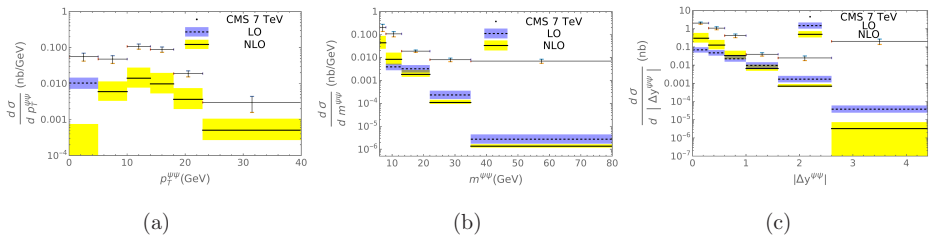
Working in NRQCD factorization, the paper computes the complete $\alpha_s$ corrections to the color-singlet $^3S_1^{[1]}$ contribution to prompt $J/\psi$ pair production, including the $gg\to 2c\bar c$ virtual and real-emission processes and the $gq(\bar q)\to 2c\bar c+q(\bar q)$ real processes. Infrared divergences are separated with the two-cutoff phase-space slicing method, and the residual dependence on the slicing parameters is shown to stay within roughly $\pm2\%$ for the total cross section. The central quantitative claims are that the NLO CS prediction agrees with LHCb in most bins -- total cross sections of $6.46^{+3.99}_{-2.01}$ nb at 7 TeV and $11.4^{+5.8}_{-3.2}$ nb at 13 TeV against measured values of $5.1\pm1.0\pm1.1$ nb and $7.9\pm1.2\pm1.1$ nb -- whereas it undershoots CMS by about a factor of 10 and ATLAS by factors of 10--12. The paper also reports that its independent calculation reproduces the earlier NLO result once the inputs are matched and an inconsistency in the hard-collinear corrections of the $gq$ and $qg$ channels in that earlier work is corrected.
Load-bearing premise
The calculation's conclusions rest on how the nearly-collinear and soft-gluon parts of the real-emission corrections are split off, a step checked for stability within about $\pm2\%$ but whose quark-gluon subtraction is validated only through private communication with an author of the earlier calculation.
Editorial extensions
If this is right
- If the CS channel alone fits LHCb in most bins, then global NRQCD fits should not infer a large color-octet component from forward LHCb double-$J/\psi$ data; the octet and other mechanisms are instead required mainly at large $m_{\psi\psi}$, large $|\Delta y_{\psi\psi}|$, and in the CMS and ATLAS acceptances.
- The NLO $K$ factors of 2--3 for the CMS and ATLAS total cross sections are far too small to close the gap, so those measurements cannot be explained by fixed-order CS QCD corrections alone.
- Fixed-order NLO predictions for the $p_T^{\psi\psi}$, $A_{pT}^{\psi\psi}$, and $|\Delta\Phi^{\psi\psi}|$ distributions are unreliable in the endpoint bins, meaning those bins should be compared with resummed or matched calculations rather than with the present fixed-order curves.
- The independent verification of the earlier NLO code, up to the identified hard-collinear inconsistency, provides a stable benchmark for future beyond-fixed-order or color-octet-improved calculations of double $J/\psi$ hadroproduction.
Reading between the lines
- If the hard-collinear $gq$/$qg$ correction in the earlier calculation is indeed incorrect, previous phenomenological conclusions drawn from that code for quark-initiated channels may shift, especially in kinematic regions where quark PDFs are not negligible.
- The discrepancies in the extracted effective double-parton-scattering cross section $\sigma_{\rm eff}$ between LHCb, ATLAS, and D0 could partly reflect that the SPS templates used in the experimental separation are not yet NLO-CS-based; re-extracting $\sigma_{\rm eff}$ with an NLO CS plus color-octet SPS template would be a direct test.
- A natural extension would be to repeat the calculation with a fully differential infrared-subtraction scheme, which would turn the private-communication validation of the $gq$/$qg$ hard-collinear terms into a publicly checkable statement.
- The paper's breakdown at small $p_T^{\psi\psi}$ suggests that resumming the soft and collinear gluon emission in that region would make the CS contribution testable in the very bins where the fixed-order prediction is currently negative.
Signed reviews
Editorial analysis
A structured set of objections, weighed in public.
Referee Report
Summary. This paper presents an independent next-to-leading-order (NLO) QCD calculation of the color-singlet (CS) contribution to prompt double J/ψ hadroproduction in the NRQCD factorization framework. The two-cutoff phase-space slicing method is used, with analytical treatment of soft and hard-collinear divergences and numerical evaluation of the hard-non-collinear contribution. The authors compare their LO and NLO predictions with LHCb 7 and 13 TeV, CMS 7 TeV, and ATLAS 8 TeV data. They find that the CS contribution describes most LHCb differential distributions, with caveats near threshold and in phase-space regions where soft/hard-collinear radiation spoils fixed-order perturbation theory, while it undershoots CMS and ATLAS cross sections by about one order of magnitude despite K factors of 2–3. They also compare with the earlier NLO calculation of Ref. [25] and report agreement after adjusting inputs and correcting a 'slightly incorrect implementation' of the hard-collinear corrections in the gq/qg channels, identified via private communication.
Significance. If the calculation is correct, this is a valuable independent cross-check of the only existing full NLO treatment of CS double J/ψ hadroproduction, and it provides a transparent, up-to-date phenomenological benchmark. The paper is careful in several respects: it documents slicing-parameter stability (Fig. 1), uses established tools for diagram generation and integral reduction (QGRAF, FORM, Reduze 2, FIRE6, Package-X, QCDloop, Cuba), and does not fit any parameter to the double-J/ψ data: the CS LDME comes from a potential model, PDFs from CTEQ, and mc = 1.5 GeV. The main limitation is that the crucial correction to the hard-collinear terms in the gq/qg channels is not presented in the paper, so the independent verification is incomplete as written.
major comments (3)
- [Section III, comparison with Ref. [25]; Section II, Eq. (4)] The paper's claim of an independent NLO verification is not fully checkable because the corrected hard-collinear treatment in the gq/qg channels is not specified. The authors state that the difference between their K = 1.04 and the K = 1.19 of Ref. [25] is traced to 'a slightly incorrect implementation of the hard-collinear corrections' and that this was confirmed by private communication [47]. Since this adjustment is the only substantive difference between the two NLO computations, the manuscript should present the explicit hard-collinear subtraction terms, or the precise correction applied to the gq/qg channels, so that the reader can verify the calculation. As it stands, the agreement with Ref. [25] is asserted on the basis of an unpublished comparison, and the central claim that the CS NLO prediction describes the LHCb data is not independently auditable.
- [Section III, Fig. 1] The slicing-stability check is performed only for the total cross section at 13 TeV LHCb. The most dramatic NLO effects appear in the differential distributions, for example the 61-fold enhancement in the last bin of dσ/dpT^{J/ψ} and the sign-changing first bins of dσ/dpT^{ψψ}, dσ/dA^{ψψ}_{pT}, and dσ/d|ΔΦ^{ψψ}|. The ±2% flatness of the total cross section does not bound the slicing error in these bins, where the soft and hard-collinear subtractions are largest. The authors should show δs-dependence curves for representative pT bins, or at least for the first bin of dσ/dpT^{ψψ}, to support the shape and normalization claims.
- [Section III, Eqs. (6)–(13)] The comparison with Ref. [25] is made only at the level of the 7 TeV LHCb total cross section. Since the alleged hard-collinear inconsistency affects the gq/qg channels, which contribute differently to the pT and rapidity distributions, a total-rate check cannot validate the differential shapes used in the LHCb/CMS/ATLAS comparisons. I ask the authors to provide a differential-level comparison with Ref. [25] under identical inputs and cuts, for at least one distribution such as dσ/dm_{ψψ} or dσ/dpT^{J/ψ}, once the corrected hard-collinear terms are specified.
minor comments (4)
- [Section II, around Eq. (4)] The notation 'HC' is used for both 'hard collinear' and 'hard non-collinear', which is confusing; please rename the latter, for instance σ_HNC.
- [Section III, first paragraph after Eq. (4)] The text says 'This is illustrated in Fig. [12]' but the figure referred to is Fig. 1; the cross-reference appears broken.
- [Figure 1 caption] The exponents are rendered as '2 − 14' and '2 − 10', which look like subtraction; please use superscripts, e.g., 2^{-14} and 2^{-10}.
- [Abstract and conclusions] The phrase 'emission of soft or hard-collinear gluons' is slightly misleading because the gq/qg channels also involve hard-collinear quarks; consider writing 'soft or hard-collinear partons'.
Circularity Check
No significant circularity: the NLO color-singlet predictions are computed from standard external inputs and compared with LHC data, with no fitted parameter or self-citation chain forcing the central result.
full rationale
The paper's central quantitative claim is that the NLO color-singlet contribution describes LHCb data in most bins and undershoots CMS and ATLAS data. This claim is the output of a fixed-order NRQCD calculation, not an input. The CS LDME is taken from the Buchmüller–Tye potential model, the PDFs are CTEQ6L1/CTEQ6M, and the charm quark mass is fixed at 1.5 GeV; none of these are fitted to the double-J/psi data, and the K factors and cross sections are derived outputs. The only potentially self-referential step is the comparison with Ref. [25], where the authors reproduce that reference by deliberately implementing what they call a 'slightly incorrect implementation of the hard-collinear corrections in the gq and qg channels' after private communication. This is a code-consistency check about agreement with a prior calculation, not a prediction from the experimental data, and it does not load-bear on the phenomenological conclusions. Any concern about the unspecified hard-collinear subtraction is a numerical-correctness risk, not a circularity, because even if that subtraction were wrong the paper's claims would change quantitatively but would not be true by construction. No uniqueness theorem, no ansatz smuggled in via citation, and no renaming of a known result is present. The derivation is self-contained against external benchmarks, so the appropriate finding is no significant circularity.
Assumptions & free parameters
free parameters (4)
- Charm quark mass mc =
1.5 GeV
- Color-singlet LDME <O> =
1.16 GeV^3
- Renormalization/factorization scale xi =
xi=1 nominal, varied 1/2 to 2
- Phase-space slicing parameters =
delta_s=1/1000, delta_c=delta_s/300
assumptions (4)
- domain assumption NRQCD factorization for double J/psi hadroproduction (Eq. (1)): the cross section is a convolution of PDFs, short-distance partonic cross sections, and NRQCD LDMEs.
- domain assumption Initial-state q qbar annihilation subprocesses can be neglected because they are 'greatly suppressed by light-quark PDFs' (Sec. II).
- standard math The two-cutoff phase-space slicing method with the stated cutoff values correctly isolates soft and collinear singularities, with residual dependence within +/-2% (Sec. II, Fig. 1).
- standard math On-shell renormalization of mc and the wave functions, and MS renormalization of alpha_s, with counterterms taken from Ref [23], are valid at NLO.
Cite this review
Pith. "Pith review of Next-to-leading-order QCD corrections to double prompt $J/{\psi}$ hadroproduction." pith.science (2026). https://pith.science/paper/M5A7TVB5
@misc{pith2026250504357,
  author       = {Pith},
  title        = {Pith review of: Next-to-leading-order QCD corrections to double prompt $J/\psi$ hadroproduction},
  year         = {2026},
  howpublished = {\url{https://pith.science/paper/M5A7TVB5}},
  note         = {Machine review of arXiv:2505.04357}
}
abstract
Within the framework of nonrelativistic-QCD (NRQCD) factorization, we perform a comprehensive investigation of the color singlet (CS) contribution to prompt $J/\psi$ pair production at the CERN Large Hadron Collider at next-to-leading order (NLO) in $\alpha_s$. Specifically, we compare our NLO predictions with measurements from the LHCb, CMS, and ATLAS Collaborations. We find that the CS contribution itself can well describe the LHCb data in most of the experimental bins, except in the regions where the fixed-order calculation is spoiled by the emission of soft or hard-collinear gluons. In the CMS and ATLAS cases, however, the CS predictions greatly undershoot both the measured total and differential cross sections, despite sizable $K$ factors, of 2--3, for the total cross sections.
Figures


Figures from the paper (2 more)

Forward citations
Cited by 2 Pith papers
-
Probing Heavy-Quark Spin Symmetry in Double $J/\psi$ Hadroproduction
A complete O(alpha_s^5) NRQCD calculation for prompt J/psi pair hadroproduction finds LHC data fix one combination of color-octet LDMEs, yielding a set that tests heavy-quark spin symmetry via eta_c data.
-
Automated NRQCD and NRQED simulations of quarkonium and leptonium production with P-wave states and physical-mass effects
MadSONS extends MadGraph to automated LO NRQCD/NRQED event generation for arbitrary S- and P-wave bound states, with dual-number projectors and physical-mass reshuffling.
Reference graph
Works this paper leans on
-
[25]
Z. G. He, X. B. Jin, B. A. Kniehl, and R. Li, “Next-to-lead ing-order relativistic and QCD corrections to prompt J/ψ pair photoproduction at future e+e− colliders,” Chin. Phys. C 48 (2024), 083107 doi:10.1088/1674-1137/ad408f [arXiv:240 4.08945 [hep-ph]]
-
[47]
Quarkonium wave functions a t the origin,
E. J. Eichten and C. Quigg, “Quarkonium wave functions a t the origin,” Phys. Rev. D 52 (1995) 1726-1728 doi:10.1103/PhysRevD.52.1726 [arXiv:h ep-ph/9503356 [hep-ph]]
-
[1]
23 (|y| − 1. 2) GeV if 1 . 2< |y|< 1. 43 pT > 4. 5 GeV if 1 . 43< |y|< 2. 2 ATLAS [14] 8 both J/ψ : pT > 8. 5 GeV, |y|< 2. 1 lower-pT J/ψ : |y|< 1. 05 central
-
[2]
05< |y|< 2. 1 forward III. PHENOMENOLOGY We first specify the inputs for our numerical analysis. At LO (NLO), we employ the CTEQ6L1 (CTEQ6M) [43] PDFs of the proton and evaluate the stron g-coupling constant α (nf ) s (µr) at one (two) loops with fixed number nf = 4 of active quark flavors and asymptotic scale parameter Λ (nf ) QCD = 215 MeV (326 MeV) [43] u...
-
[3]
Double gluo n fragmentation to J/ψ pairs at the Tevatron,
V. Barger, S. Fleming, and R. J. N. Phillips, “Double gluo n fragmentation to J/ψ pairs at the Tevatron,” Phys. Lett. B 371 (1996) 111–116 doi:10.1016/0370-2693(95)01592-2 [arXiv:hep-ph/9510457 [hep-ph]]
arXiv 1996
-
[4]
Inclusive double-quarkonium pr oduction at the Large Hadron Collider,
P. Ko, J. Lee, and C. Yu, “Inclusive double-quarkonium pr oduction at the Large Hadron Collider,” JHEP 01 (2011) 070 doi:10.1007/JHEP01(2011)070 [arXiv:1007.309 5 [hep-ph]]
-
[5]
J/psi Pair Production at the Tevatron
C.-F. Qiao, “ J/ψ pair production at the Fermilab Tevatron,” Phys. Rev. D 66 (2002) 057504 doi:10.1103/PhysRevD.66.057504 [arXiv:hep-ph/0206093 [hep-ph]]
work page Pith review arXiv 2002
-
[6]
Pair Productio n of J/ψ as a Probe of Double Parton Scattering at LHCb,
C. H. Kom, A. Kulesza, and W. J. Stirling, “Pair Productio n of J/ψ as a Probe of Double Parton Scattering at LHCb,” Phys. Rev. Lett. 107 (2011) 082002 doi:10.1103/PhysRevLett.107.082002 [arXiv:1105.4186 [ hep-ph]]
arXiv 2011
Show all 49 references
-
[7]
Observation of structure in the J/ψ -pair mass spec- trum,
R. Aaij et al. (LHCb Collaboration), “Observation of structure in the J/ψ -pair mass spec- trum,” Sci. Bull. 65 (2020) 1983–1993 doi:10.1016/j.scib.2020.08.032 [arXiv :2006.16957 [hep- ex]]
2020
-
[8]
Observation of new structure in the J /ψ J/ψ mass spectrum in proton-proton collisions at √s = 13 TeV,
A. Hayrapetyan et al. (CMS Collaboration), “Observation of new structure in the J /ψ J/ψ mass spectrum in proton-proton collisions at √s = 13 TeV,” [arXiv:2306.07164 [hep-ex]]
-
[9]
Observation of an Excess of Dichar monium Events in the Four-Muon Final State with the ATLAS Detector,
G. Aad et al. (ATLAS Collaboration), “Observation of an Excess of Dichar monium Events in the Four-Muon Final State with the ATLAS Detector,” Phys. Re v. Lett. 131 (2023) 151902 doi:10.1103/PhysRevLett.131.151902 [arXiv:2304.08962 [hep-ex]]
2023 arXiv
-
[10]
Evidence for ψψ production in π − interactions at 150 and 280 GeV/c,
J. Badier et al. (NA3 Collaboration), “Evidence for ψψ production in π − interactions at 150 and 280 GeV/c,” Phys. Lett. B 114 (1982), 457–460 doi:10.1016/0370-2693(82)90091-0 16
1982 doi
-
[11]
ψψ production and limits on beauty meson production from 400 GeV/c protons,
J. Badier et al. (NA3 Collaboration), “ψψ production and limits on beauty meson production from 400 GeV/c protons,” Phys. Lett. B 158 (1985), 85 doi:10.1016/0370-2693(85)90745-2
1985 doi
-
[12]
Observation of J /ψ -pair production in pp colli- sions at √s = 7TeV ,
R. Aaij et al. (LHCb Collaboration), “Observation of J /ψ -pair production in pp colli- sions at √s = 7TeV ,” Phys. Lett. B 707 (2012), 52-59 doi:10.1016/j.physletb.2011.12.015 [arXiv:1109.0963 [hep-ex]]
2012 arXiv
-
[13]
Measurement of the J/ψ pair production cross-section in pp collisions at √s = 13 TeV,
R. Aaij et al. (LHCb Collaboration), “Measurement of the J/ψ pair production cross-section in pp collisions at √s = 13 TeV,” JHEP 06 (2017) 047 [erratum: JHEP 10 (2017) 068] doi:10.1007/JHEP06(2017)047 [arXiv:1612.07451 [hep-ex ]]
2017 arXiv
-
[14]
Measurement of J/ψ -pair production in pp collisions at √s = 13 TeV and study of gluon transverse-momentum dependent PD Fs,
R. Aaij et al. (LHCb Collaboration), “Measurement of J/ψ -pair production in pp collisions at √s = 13 TeV and study of gluon transverse-momentum dependent PD Fs,” JHEP 03 (2024), 088 doi:10.1007/JHEP03(2024)088 [arXiv:2311.14085 [hep -ex]]
2024
-
[15]
Measurement of prompt J /ψ pair produc- tion in pp collisions at √s = 7 Tev,
V. Khachatryan et al. (CMS Collaboration), “Measurement of prompt J /ψ pair produc- tion in pp collisions at √s = 7 Tev,” JHEP 09 (2014) 094 doi:10.1007/JHEP09(2014)094 [arXiv:1406.0484 [hep-ex]]
2014 arXiv
-
[16]
Measurement of the prompt J/ψ pair production cross-section in pp collisions at √s = 8 TeV with the ATLAS detector,
M. Aaboud et al. (ATLAS Collaboration), “Measurement of the prompt J/ψ pair production cross-section in pp collisions at √s = 8 TeV with the ATLAS detector,” Eur. Phys. J. C 77 (2017) 76 doi:10.1140/epjc/s10052-017-4644-9 [arXiv:16 12.02950 [hep-ex]]
2017 doi
-
[17]
Measurement of inclusive J/ψ pair produc- tion cross section in pp collisions at √s = 13 TeV,
S. Acharya et al. (ALICE Collaboration), “Measurement of inclusive J/ψ pair produc- tion cross section in pp collisions at √s = 13 TeV,” Phys. Rev. C 108 (2023), 045203 doi:10.1103/PhysRevC.108.045203 [arXiv:2303.13431 [he p-ex]]
2023 arXiv
-
[18]
Observation and studies of double J/ψ produc- tion at the Tevatron,
V. M. Abazov et al. (D0 Collaboration), “Observation and studies of double J/ψ produc- tion at the Tevatron,” Phys. Rev. D 90 (2014) 111101(R) doi:10.1103/PhysRevD.90.111101 [arXiv:1406.2380 [hep-ex]]
2014 arXiv
-
[19]
Rigorous QCD analysis of inclusive annihilation and production of heavy quarkonium,
G. T. Bodwin, E. Braaten, and G. P. Lepage, “Rigorous QCD analysis of inclusive annihilation and production of heavy quarkonium,” Phys. Rev. D 51 (1995) 1125-1171 [erratum: Phys. Rev. D 55 (1997) 5853–5854] doi:10.1103/PhysRevD.55.5853 [arXiv: hep-ph/9407339 [hep-ph]]
1995 arXiv
-
[20]
Pair production of h eavy quarkonium and B(∗) c mesons at hadron colliders,
R. Li, Y.-J. Zhang, and K.-T. Chao, “Pair production of h eavy quarkonium and B(∗) c mesons at hadron colliders,” Phys. Rev. D 80 (2009) 014020 doi:10.1103/PhysRevD.80.014020 [arXiv:0903.2250 [hep-ph]]
2009 arXiv
-
[21]
Complete Nonrelativistic-Q CD Prediction for Prompt Double J/ψ Hadroproduction,
Z.-G. He and B. A. Kniehl, “Complete Nonrelativistic-Q CD Prediction for Prompt Double J/ψ Hadroproduction,” Phys. Rev. Lett. 115 (2015) 022002 doi:10.1103/PhysRevLett.115.022002 17 [arXiv:1609.02786 [hep-ph]]
2015 arXiv
-
[22]
Complete NRQCD prediction fo r prompt double J/ψ production at Hadron Collider,
Z.-G. He and B. A. Kniehl, “Complete NRQCD prediction fo r prompt double J/ψ production at Hadron Collider,” PoS DIS2016, 162 (2016) doi:10.22323/1.265.0162
2016 doi
-
[23]
Relativ istic correction to J/ψ and Υ pair production,
Y.-J. Li, G.-Z. Xu, K.-Y. Liu, and Y.-J. Zhang, “Relativ istic correction to J/ψ and Υ pair production,” JHEP 07 (2013), 051 doi:10.1007/JHEP07(2013)051 [arXiv:1303.13 83 [hep-ph]]
2013 doi
-
[24]
Relativistic corre ctions to prompt dou- ble charmonium hadroproduction near threshold,
Z. G. He, X. B. Jin, and B. A. Kniehl, “Relativistic corre ctions to prompt dou- ble charmonium hadroproduction near threshold,” Phys. Rev . D 109 (2024), 094013 doi:10.1103/PhysRevD.109.094013 [arXiv:2402.07773 [he p-ph]]
2024 arXiv
-
[26]
Relativistic correc tions to double charmonium production in high energy proton-proton interaction,
A. P. Martynenko and A. M. Trunin, “Relativistic correc tions to double charmonium production in high energy proton-proton interaction,” Phy s. Rev. D 86 (2012) 094003 doi:10.1103/PhysRevD.86.094003 [arXiv:1207.3245 [hep- ph]]
2012 arXiv
-
[27]
Impact of J/ψ pair production at the LHC and predictions in nonrelativistic QCD,
L.-P. Sun, H. Han, and K.-T. Chao, “Impact of J/ψ pair production at the LHC and predictions in nonrelativistic QCD,” Phys. Rev. D 94 (2016) 074033 doi:10.1103/PhysRevD.94.074033 [arXiv:1404.4042 [hep- ph]]
2016 arXiv
-
[28]
Production of J/ψ + ηc versus J/ψ + J/ψ at the LHC: Importance of Real α 5 s Corrections,
J. P. Lansberg and H.-S. Shao, “Production of J/ψ + ηc versus J/ψ + J/ψ at the LHC: Importance of Real α 5 s Corrections,” Phys. Rev. Lett. 111 (2013), 122001 doi:10.1103/PhysRevLett.111.122001 [arXiv:1308.0474 [ hep-ph]]
2013 arXiv
-
[29]
J/ψ pair hadroproduction at next-to-leading order in nonrelat ivistic-QCD at ATLAS,
L.-P. Sun, “ J/ψ pair hadroproduction at next-to-leading order in nonrelat ivistic-QCD at ATLAS,” Chin. Phys. C 48 (2024), 033102 doi:10.1088/1674-1137/ad1a98
2024 doi
-
[30]
J/ψ pair hadroproduction at next-to-leading order in nonrelat ivistic-QCD at CMS,
L.-P. Sun, “ J/ψ pair hadroproduction at next-to-leading order in nonrelat ivistic-QCD at CMS,” Chin. Phys. C 47 (2023), 093105 doi:10.1088/1674-1137/ace521 [arXiv:230 7.02809 [hep-ph]]
2023 doi
-
[31]
D ouble Prompt J/ψ Hadropro- duction in the Parton Reggeization Approach with High-Ener gy Resummation,
Z.-G. He, B. A. Kniehl, M. A. Nefedov, and V. A. Saleev, “D ouble Prompt J/ψ Hadropro- duction in the Parton Reggeization Approach with High-Ener gy Resummation,” Phys. Rev. Lett. 123 (2019) 162002 doi:10.1103/PhysRevLett.123.162002 [arXi v:1906.08979 [hep-ph]]
2019 arXiv
-
[32]
Prompt J/ψ -pair production at the LHC: impact of loop-induced contributions and of the c olour-octet mechanism,
J.-P. Lansberg, H.-S. Shao, N. Yamanaka, and Y.-J. Zhan g, “Prompt J/ψ -pair production at the LHC: impact of loop-induced contributions and of the c olour-octet mechanism,” Eur. Phys.’ J. C 79 (2019) 1006 doi:10.1140/epjc/s10052-019-7523-8 [arXiv: 1906.10049 [hep-ph]]. 18
2019 arXiv
-
[33]
D ouble prompt J/ψ production at hadron colliders,
Z.-G. He, B. A. Kniehl, M. A. Nefedov, and V. A. Saleev, “D ouble prompt J/ψ production at hadron colliders,” Mod. Phys. Lett. A 36 (2021) 2130018 doi:10.1142/S0217732321300184
2021 doi
-
[34]
Breakdown of Non relativistic QCD Factorization in Processes Involving Two Quarkonia and its Cure,
Z.-G. He, B. A. Kniehl, and X.-P. Wang, “Breakdown of Non relativistic QCD Factorization in Processes Involving Two Quarkonia and its Cure,” Phys. Re v. Lett. 121 (2018) 172001 doi:10.1103/PhysRevLett.121.172001 [arXiv:1809.07993 [hep-ph]]
2018 arXiv
-
[35]
Order- v4 corrections to S-wave quarkonium de- cay,
G. T. Bodwin and A. Petrelli, “Order- v4 corrections to S-wave quarkonium de- cay,” Phys. Rev. D 66 (2002) 094011 [erratum: Phys. Rev. D 87 (2013) 039902] doi:10.1103/PhysRevD.66.094011 [arXiv:hep-ph/0205210 [hep-ph]]
2002 arXiv
-
[36]
Automatic Feynman Graph Generation,
P. Nogueira, “Automatic Feynman Graph Generation,” J. Comput. Phys. 105 (1993), 279–289 doi:10.1006/jcph.1993.1074
1993
-
[37]
New features of FORM,
J. A. M. Vermaseren, “New features of FORM,” [arXiv:mat h-ph/0010025 [math-ph]]
-
[38]
Reduze 2 - Distributed Feynman Integral Reduction,
A. von Manteuffel and C. Studerus, “Reduze 2 - Distributed Feynman Integral Reduction,” [arXiv:1201.4330 [hep-ph]]
-
[39]
FIRE6: Feynman Integ ral REduction with modu- lar arithmetic,
A. V. Smirnov and F. S. Chukharev, “FIRE6: Feynman Integ ral REduction with modu- lar arithmetic,” Comput. Phys. Commun. 247 (2020), 106877 doi:10.1016/j.cpc.2019.106877 [arXiv:1901.07808 [hep-ph]]
2020
-
[40]
Package-X 2.0: A Mathematica package for the analytic calculation of one- loop integrals,
H. H. Patel, “ Package-X 2.0: A Mathematica package for the analytic calculation of one- loop integrals,” Comput. Phys. Commun. 218 (2017), 66–70. doi:10.1016/j.cpc.2017.04.015 [arXiv:1612.00009 [hep-ph]]
2017 arXiv
-
[41]
Scalar one-loop integra ls for QCD,
R. K. Ellis and G. Zanderighi, “Scalar one-loop integra ls for QCD,” JHEP 02 (2008), 002. doi:10.1088/1126-6708/2008/02/002 [arXiv:0712.1851 [h ep-ph]]
2008 arXiv
-
[42]
CUBA—a library for multidimensional numerical integration,
T. Hahn, “ CUBA—a library for multidimensional numerical integration,” C omput. Phys. Commun. 168 (2005), 78–95 doi:10.1016/j.cpc.2005.01.010 [arXiv:hep -ph/0404043 [hep-ph]]
2005
-
[43]
Concurrent Cuba,
T. Hahn, “Concurrent Cuba,” J. Phys. Conf. Ser. 608 (2015), 012066 doi:10.1088/1742- 6596/608/1/012066 [arXiv:1408.6373 [physics.comp-ph]]
2015 arXiv
-
[44]
Two cutoff phase space slici ng method,
B. W. Harris and J. F. Owens, “Two cutoff phase space slici ng method,” Phys. Rev. D 65 (2002), 094032 doi:10.1103/PhysRevD.65.094032 [arXiv:h ep-ph/0102128 [hep-ph]]
2002
-
[45]
New generation of parton distributions with uncertainties from global QCD analysis,
J. Pumplin, D. R. Stump, J. Huston, H.-L. Lai, P. Nadolsk y, and W.-K. Tung, “New generation of parton distributions with uncertainties from global QCD analysis,” JHEP 07 (2002) 012 doi:10.1088/1126-6708/2002/07/012 [arXiv:hep-ph/0201 195 [hep-ph]]
2002 doi
-
[46]
Strong-Coupling Constant 19 with Flavor Thresholds at Five Loops in the Modified Minimal- Subtraction Scheme,
B. A. Kniehl, A. V. Kotikov, A. I. Onishchenko, and O. L. V eretin, “Strong-Coupling Constant 19 with Flavor Thresholds at Five Loops in the Modified Minimal- Subtraction Scheme,” Phys. Rev. Lett. 97, 042001 (2006) doi:10.1103/PhysRevLett.97.042001 [arXi v:hep-ph/0607202 [hep-ph]]
2006 arXiv
-
[48]
Impr oved determination of color- singlet nonrelativistic QCD matrix elements for S-wave charmonium,
G. T. Bodwin, H. S. Chung, D. Kang, J. Lee, and C. Yu, “Impr oved determination of color- singlet nonrelativistic QCD matrix elements for S-wave charmonium,” Phys. Rev. D 77 (2008) 094017 doi:10.1103/PhysRevD.77.094017 [arXiv:0710.099 4 [hep-ph]]
2008 doi
-
[49]
Sun, private communication
L.-P. Sun, private communication. 20
Reviewed August 15, 2026 · model on record in the stance chip above.
Discussion (0). Continue with ORCID to comment.