REVIEW 4 major objections 4 minor 43 references
FlexSplat: Flexible Feed-Forward 3D Gaussian Splatting without Point Cloud Correspondence
T0 review · 4 major / 4 minor · reviewed 2026-08-12 · deepseek-v4-flash
Pith's one-line read FlexSplat shows that jointly training a geometry transformer with a query-based Gaussian decoder removes the need for camera poses in feed-forward 3D reconstruction, matching posed state-of-the-art within 0.7 dB PSNR on object-centric…
desk verdict A credible engineering contribution showing joint geometry training can make query-based Gaussian reconstruction calibration-free at small fidelity cost, but it needs a C3G comparison and a translational robustness study before the parity claim is fully earned. read the letter →
The pith
A machine-rendered reading of the paper's core claim, the machinery that carries it, and where it could break.
The reading
What carries the argument
The central mechanism is the query-based Gaussian decoder grounded in predicted geometry. A set of learnable Gaussian queries, initialized near the estimated scene center (the least-squares intersection of predicted camera optical axes), is refined over three layers; at each layer, the center of each Gaussian is projected into every input view to produce reference points, around which multi-view deformable attention samples fused depth-and-appearance features and updates the query in world space. Because attention weights are normalized jointly over all views and sampling points, moderate per-view camera and depth error is averaged down rather than propagated—the cross-view consensus that the robustness experiments probe. The depth-guided mean parameterization (back-projecting predicted depth plus a learnable offset) stabilizes convergence, and the uncertainty-weighted depth-consistency objective in the loss couples the geometry transformer's training to the reconstruction task.
What would settle it
Add translational noise of magnitude 3 percent of object scale—the head's own reported camera-center error—to the predicted cameras on the four-view GSO evaluation and measure the PSNR drop; if the drop exceeds the 0.69 dB gap to posed UniGS, then the cross-view consensus does not actually absorb the geometry error it claims to tolerate, since the paper currently probes only rotation perturbations.
Extended reading notes
Core claim
The paper claims that a jointly trained geometry front-end is sufficient to bring calibration-free operation to query-based Gaussian reconstruction. FlexSplat inherits the unitary-Gaussian decoder of LeanGaussian and UniGS—learnable 3D ellipsoids refined by multi-view deformable cross-attention—but replaces the posed-input assumption with a VGGT-based transformer that predicts per-image cameras and dense depth, fine-tuned together with the decoder under rendering and depth-consistency objectives. Predicted depth seeds a depth-guided parameterization of each Gaussian center, fused depth-and-appearance features serve as keys and values for the cross-attention, and an uncertainty-weighted depth-consistency loss aligns rendered depth to the predicted depth. Because each Gaussian aggregates evidence from all views and the update is reconciled in world space, the decoder forms a cross-view consensus that tolerates the imperfect cameras and depth it is given. On four-view GSO, FlexSplat reaches 29.73 dB PSNR and 0.949 SSIM against 30.42 dB and 0.961 for posed UniGS, with best-in-comparison LPIPS of 0.041, indicating that calibration-free operation costs less than 0.7 dB while matching perceptual quality.
Load-bearing premise
The cameras and depths predicted by the jointly trained geometry head are consistent across views in a single shared coordinate frame, so that projecting a Gaussian's center into every view samples the same surface point in each image.
Editorial extensions
If this is right
- Camera calibration can be dropped from the input of query-based Gaussian reconstruction on object-centric data: the jointly trained geometry head supplies cameras and depth, and the decoder's cross-view consensus absorbs their residual error.
- The Gaussian budget is a free hyper-parameter decoupled from image resolution and view count, so the representation stays compact—around $2\times10^4$ primitives for four $256\times256$ views versus about $2.6\times10^5$ for pixel-aligned methods.
- Because the geometry transformer is fine-tuned with the rendering and depth-consistency losses, its predicted depth and cameras are shaped by reconstruction quality rather than by standalone geometric accuracy, allowing partial self-correction.
- The robustness result—only a 0.22 dB drop at 1 degree of rotation noise—suggests that moderate camera-estimation error is tolerated gracefully at inference, which would allow sloppy capture protocols without pose refinement.
Reading between the lines
- A natural extension the paper leaves open is scene-level pose-free reconstruction; whether the cross-view consensus transfers to background-heavy scenes is untested, and the paper's own limitation section flags this.
- Since the paper's robustness study perturbs only rotation and explicitly leaves translational sensitivity to future work, the tolerance claim is only half-established; a systematic translation error in the predicted cameras might violate the shared-frame assumption more severely.
- The 1.38 dB penalty for freezing VGGT implies that the benefit comes from co-adaptation with the decoder, not from the pretrained geometry alone; a testable prediction is that any strong geometry prior fine-tuned jointly would show a similar gain.
Editorial analysis
A structured set of objections, weighed in public.
Referee Report
Summary. The paper proposes FlexSplat, a feed-forward query-based 3D Gaussian splatting method for novel view synthesis from uncalibrated, object-centric multi-view images. It replaces the posed-input assumption of prior query-based methods (LeanGaussian, UniGS) with a jointly fine-tuned VGGT geometry transformer that predicts per-image cameras and depth. These predictions are used in three ways: a depth-guided Gaussian mean parameterization (Eq. 2), multi-view deformable cross-attention over fused depth/appearance features (Eq. 3), and an uncertainty-weighted depth-consistency loss (Eq. 5). Experiments on ShapeNet-SRN and GSO report single-view and four-view results, ablations, inference times, and rotation-perturbation robustness. The central claim is that FlexSplat matches or approaches posed state-of-the-art reconstructors, staying within 0.69 dB PSNR of UniGS on four-view GSO while using no camera poses or ground-truth depth.
Significance. If fully supported, the result would be significant: it would demonstrate that a jointly trained geometry front-end can make query-based Gaussian reconstruction calibration-free at a small fidelity cost, while keeping a compact representation whose primitive count is independent of image resolution. The paper has concrete strengths: the ablation in Table 6 isolates a 1.38 dB benefit from joint training of VGGT, and the rotation-perturbation study in Table 7 gives initial evidence for the cross-view consensus mechanism. However, the stress-test concern about per-view translation errors does land. The paper never specifies how the per-view Gaussian centers of Eq. (2) are fused into the world-space center used in Eq. (3), the evaluation protocol for target-view poses is underspecified, and the robustness study explicitly covers only rotation noise. These omissions leave the headline parity claim less supported than the abstract suggests. No error bars or multiple seeds are reported, so the 0.69 dB gap to UniGS cannot be assessed statistically.
major comments (4)
- [Sec. 3.2-3.3, Eq. (2)-(3)] The paper never states how the per-view Gaussian centers mu_{n,i}, defined in the camera frame of view i by Eq. (2), are fused into the single world-space center mu_n that Eq. (3) projects into every view. This is not a presentational detail: the cross-view consensus mechanism in Sec. 3.3 is only sound if the predicted cameras share a common coordinate frame and the projections of mu_n correspond to the same surface point. Please specify the fusion operation explicitly (e.g., inverse transformation to world coordinates followed by averaging, or a learned combination) and provide evidence that the jointly predicted cameras are mutually consistent beyond a global similarity. The paper's own robustness study in Table 7 perturbs only rotation and Sec. 4.9 defers translational sensitivity to future work; because the evaluation alignment in Sec. 4.2 is only a global similarity transform, it cannot correct per-view relative translation errors. Given the reported 3% object-scale camera-center error, a translational analogue of Table 7 is needed to support the claim that the decoder absorbs residual pose error.
- [Sec. 3.2 and Sec. 4.2, Eq. (1)] The protocol for target-view poses is underspecified. Sec. 3.2 states that the target-view camera pi_j' is predicted, not given, while Sec. 4.2 describes only a global similarity alignment of the estimated cameras for evaluation. It is unclear whether held-out target views are rendered at predicted cameras and then compared with the ground-truth image at the corresponding dataset viewpoint, or at ground-truth target cameras. If target poses are predicted, the RGB supervision in Eq. (5) and the evaluation both depend on the same predicted geometry, which could bias the results; if ground-truth target poses are used for rendering while only input poses are removed, the 'no poses' claim should be qualified accordingly. Please specify the exact training and evaluation rendering protocol, including how the similarity alignment is computed for target views.
- [Table 2 and Sec. 4.4] The headline comparison in Table 2 has no error bars or multiple seeds. The paper reports FlexSplat within 0.69 dB PSNR and 0.012 SSIM of UniGS and describes the LPIPS difference (0.041 vs 0.042) as 'within noise', but no variance estimates are provided anywhere in the paper. Without repeated runs or confidence intervals, the central claim that calibration-free operation incurs only a small fidelity cost is not statistically supported. Please report error bars over at least a few seeds, per-object standard errors, or another accepted measure of variability for the main tables and state the number of runs.
- [Sec. 2, Sec. 3.4, and Table 2] The closely related pose-free query-based method C3G is cited in Sec. 2 and Sec. 3.4 as reconstructing scenes from unposed images with only about 2K Gaussians, but it is not included in Table 2 or Table 3. Since C3G is the most direct existing baseline for the paper's central claim of calibration-free query-based Gaussian reconstruction, its omission makes the comparison incomplete. Please add a comparison on GSO, or provide a clear quantitative justification for why C3G cannot be evaluated in this object-centric setting.
minor comments (4)
- [Eq. (2)] Eq. (2) uses calibrated normalized image coordinates (u1i, u2i) but never defines how these are obtained for each Gaussian query; the phrase 'the corresponding location in view i' is ambiguous. Please define the reference location used for each query before back-projection.
- [Eq. (5)] The depth-consistency term in Eq. (5) aligns rendered depth with VGGT's own predicted depth, so it is a self-consistency regularizer rather than an external geometric signal. The text should state this explicitly to avoid any impression that ground-truth depth is used.
- [Sec. 3.4 and Table 4] The claim that the Gaussian budget is 'not dictated by the number of views' is weakened by the fact that the experiments scale the budget with the view count (10K/15K/20K for 1/2/4 views). Please either hold the budget fixed in at least one experiment or soften the wording.
- [Table 3] The single-view GSO results show FlexSplat matching UniGS in LPIPS (0.149) but trailing in PSNR by 0.42 dB; the abstract's phrase 'matches the best perceptual (LPIPS) quality' should clarify that this refers to LPIPS only, not overall quality, and that the four-view and single-view claims are distinct.
Circularity Check
No significant circularity: FlexSplat is evaluated on external held-out views, and the self-referential depth-consistency term is a regularizer, not the target metric.
full rationale
The core claim, that FlexSplat matches or approaches posed state-of-the-art reconstructors without camera poses or ground-truth depth, is supported by experiments on held-out target views from ShapeNet-SRN and GSO (Tables 1-3). The evaluation protocol in Sec. 4.2 aligns predicted cameras to the evaluation frame with a global similarity transform; this is a coordinate-frame convention, not a fit of the rendered images to the ground-truth views. The depth-consistency loss in Eq. (5) aligns rendered depth with VGGT's own predicted depth, so it is self-referential as a training regularizer, but it does not define, constrain, or predict the held-out PSNR/SSIM/LPIPS numbers. No parameter is fitted to the GSO test set, and no 'prediction' reduces to a fitted constant by construction. The paper's acknowledged limitation, that translational sensitivity of the pose estimator is left to future work (Sec. 4.9 and Sec. 5), is a robustness gap rather than a circularity: it concerns an untested failure mode, not an equation that reduces to its own input. The load-bearing references (VGGT, UniGS, LeanGaussian) are external prior works, not self-citations, and no uniqueness theorem or ansatz is imported from the authors' own prior publications. Therefore no circular step can be exhibited from the paper's equations or citations, and the honest finding is no significant circularity.
Assumptions & free parameters
free parameters (3)
- Gaussian budget N_G =
10K/15K/20K for 1/2/4 input views
- Loss weights lambda_E, lambda_D, lambda_Depth, lambda_LPIPS =
not reported numerically in text
- Decoder depth L =
3
assumptions (4)
- domain assumption VGGT pretrained weights provide a useful, jointly tunable geometry prior for object-centric images.
- domain assumption Object-centric, masked imagery matches the training and evaluation domains (Objaverse-LVIS, ShapeNet-SRN, GSO).
- domain assumption The multi-view deformable cross-attention of LeanGaussian and UniGS can be inherited and remains stable when fed predicted geometry.
- standard math Global similarity alignment of predicted cameras to the evaluation frame does not inflate the reported metrics unfairly.
Cite this review
Pith. "Pith review of FlexSplat: Flexible Feed-Forward 3D Gaussian Splatting without Point Cloud Correspondence." pith.science (2026). https://pith.science/paper/M5P27MRJ
@misc{pith2026260807937,
  author       = {Pith},
  title        = {Pith review of: FlexSplat: Flexible Feed-Forward 3D Gaussian Splatting without Point Cloud Correspondence},
  year         = {2026},
  howpublished = {\url{https://pith.science/paper/M5P27MRJ}},
  note         = {Machine review of arXiv:2608.07937}
}
read the original abstract
We present FlexSplat, a feed-forward framework for novel view synthesis (NVS) from uncalibrated, object-centric multi-view image collections. A recent line of query-based methods reconstructs a compact set of 3D Gaussians by treating them as transformer queries that are refined with multi-view deformable attention; these methods, however, assume that camera poses are given. FlexSplat removes this assumption: a geometry transformer is trained jointly with the Gaussian decoder to predict per-image camera parameters and depth, which in turn ground a depth-guided Gaussian parameterization and a multi-view deformable cross-attention that aggregates evidence across all input views into a single, view-consistent set of primitives. An uncertainty-weighted depth-consistency objective lets the jointly trained geometry adapt to the reconstruction task, while the cross-view consensus formed during decoding absorbs the residual error of the estimated cameras and depth. The representation uses a compact Gaussian budget that is decoupled from the input resolution - unlike pixel-aligned methods, the primitive count does not grow with the image grid - and is not dictated by the number of views. On ShapeNet-SRN and Google Scanned Objects (GSO), FlexSplat matches or approaches posed state-of-the-art reconstructors while requiring neither camera poses nor ground-truth depth, and matches the best perceptual (LPIPS) quality among the compared methods on GSO. Our results indicate that a jointly trained geometry front-end is sufficient to bring calibration-free operation to query-based Gaussian reconstruction while staying within 0.7 dB PSNR of posed methods and matching their perceptual quality.
Figures


Figures from the paper (2 more)

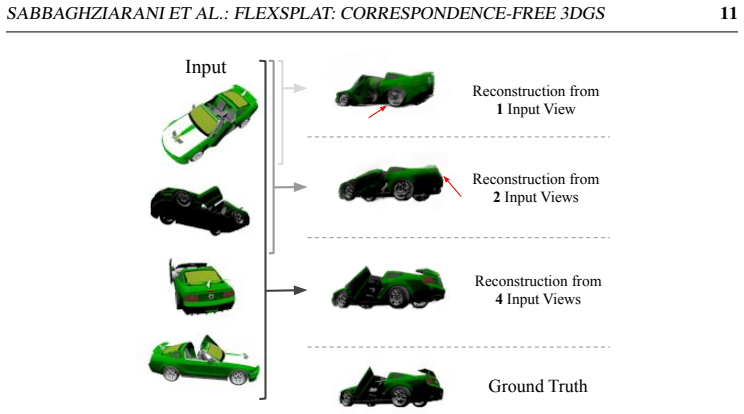
Reference graph
Works this paper leans on
-
[1]
C3G: Learning compact 3D representa- tions with 2K gaussians.arXiv preprint arXiv:2512.04021, 2025
Honggyu An, Jaewoo Jung, Mungyeom Kim, Sunghwan Hong, Chaehyun Kim, Kazumi Fukuda, Minkyeong Jeon, Jisang Han, Takuya Narihira, Hyuna Ko, Junsu Kim, Yuki Mitsufuji, and Seungryong Kim. C3G: Learning compact 3D representa- tions with 2K gaussians.arXiv preprint arXiv:2512.04021, 2025
arXiv 2025
-
[2]
Barron, Ben Mildenhall, Dor Verbin, Pratul P
Jonathan T. Barron, Ben Mildenhall, Dor Verbin, Pratul P. Srinivasan, and Peter Hed- man. Mip-NeRF 360: Unbounded anti-aliased neural radiance fields. InIEEE/CVF Conf. Comput. Vis. Pattern Recog. (CVPR), 2022
work page 2022
-
[3]
pixel- Splat: 3D gaussian splats from image pairs for scalable generalizable 3D reconstruc- tion
David Charatan, Sizhe Lester Li, Andrea Tagliasacchi, and Vincent Sitzmann. pixel- Splat: 3D gaussian splats from image pairs for scalable generalizable 3D reconstruc- tion. InIEEE/CVF Conf. Comput. Vis. Pattern Recog. (CVPR), 2024
work page 2024
-
[4]
MVSplat: Efficient 3D gaussian splatting from sparse multi-view images
Yuedong Chen, Haofei Xu, Chuanxia Zheng, Bohan Zhuang, Marc Pollefeys, Andreas Geiger, Tat-Jen Cham, and Jianfei Cai. MVSplat: Efficient 3D gaussian splatting from sparse multi-view images. InEur . Conf. Comput. Vis. (ECCV), 2024
work page 2024
-
[5]
Obja- verse: A dataset of annotated 3D objects in the wild
Matt Deitke, Dustin Schwenk, Jordi Salvador, Luca Weihs, Oscar Michel, Eli Vander- Bilt, Ludwig Schmidt, Kiana Ehsani, Aniruddha Kembhavi, and Ali Farhadi. Obja- verse: A dataset of annotated 3D objects in the wild. InIEEE/CVF Conf. Comput. Vis. Pattern Recog. (CVPR), 2023
work page 2023
-
[6]
Laura Downs, Anthony Francis, Nate Koenig, Brandon Kinman, Ryan Hickman, Krista Reymann, Thomas B. McHugh, and Vincent Vanhoucke. Google scanned objects: A high-quality dataset of 3D scanned household items. InIEEE Int. Conf. Robotics and Automation (ICRA), 2022. 14SABBAGHZIARANI ET AL.: FLEXSPLA T: CORRESPONDENCE-FREE 3DGS
work page 2022
-
[7]
NerfDiff: Single-image view synthesis with NeRF-guided distillation from 3D-aware diffusion
Jiatao Gu, Alex Trevithick, Kai-En Lin, Joshua Susskind, Christian Theobalt, Lingjie Liu, and Ravi Ramamoorthi. NerfDiff: Single-image view synthesis with NeRF-guided distillation from 3D-aware diffusion. InInt. Conf. Machine Learning (ICML), 2023
work page 2023
-
[8]
OpenLRM: Open-source large reconstruction models
Zexin He and Tengfei Wang. OpenLRM: Open-source large reconstruction models. https://github.com/3DTopia/OpenLRM, 2024
work page 2024
Show all 43 references
-
[9]
PF3plat: Pose-free feed-forward 3D gaussian splatting
Sunghwan Hong, Jaewoo Jung, Heeseong Shin, Jisang Han, Jiaolong Yang, Chong Luo, and Seungryong Kim. PF3plat: Pose-free feed-forward 3D gaussian splatting. arXiv preprint arXiv:2410.22128, 2024
2024 arXiv
-
[10]
CodeNeRF: Disentangled neural radiance fields for object categories
Wonbong Jang and Lourdes Agapito. CodeNeRF: Disentangled neural radiance fields for object categories. InInt. Conf. Comput. Vis. (ICCV), 2021
2021
-
[11]
AnySplat: Feed- forward 3D gaussian splatting from unconstrained views.ACM Trans
Lihan Jiang, Yucheng Mao, Linning Xu, Tao Lu, Kerui Ren, Yichen Jin, Xudong Xu, Mulin Yu, Jiangmiao Pang, Feng Zhao, Dahua Lin, and Bo Dai. AnySplat: Feed- forward 3D gaussian splatting from unconstrained views.ACM Trans. Graph. (TOG), 44(6), 2025
2025
-
[12]
3D gaussian splatting for real-time radiance field rendering.ACM Trans
Bernhard Kerbl, Georgios Kopanas, Thomas Leimkühler, and George Drettakis. 3D gaussian splatting for real-time radiance field rendering.ACM Trans. Graph. (TOG), 42(4), 2023
2023
-
[13]
Feature pyramid networks for object detection
Tsung-Yi Lin, Piotr Dollár, Ross Girshick, Kaiming He, Bharath Hariharan, and Serge Belongie. Feature pyramid networks for object detection. InIEEE/CVF Conf. Comput. Vis. Pattern Recog. (CVPR), 2017
2017
-
[14]
WorldMirror: Universal 3D world reconstruction with any- prior prompting.arXiv preprint arXiv:2510.10726, 2025
Yifan Liu, Zhiyuan Min, Zhenwei Wang, Junta Wu, Tengfei Wang, Yixuan Yuan, Yawei Luo, and Chunchao Guo. WorldMirror: Universal 3D world reconstruction with any- prior prompting.arXiv preprint arXiv:2510.10726, 2025
2025 arXiv
-
[15]
Srinivasan, Matthew Tancik, Jonathan T
Ben Mildenhall, Pratul P. Srinivasan, Matthew Tancik, Jonathan T. Barron, Ravi Ra- mamoorthi, and Ren Ng. NeRF: Representing scenes as neural radiance fields for view synthesis. InEur . Conf. Comput. Vis. (ECCV), 2020
2020
-
[16]
Instant neural graphics primitives with a multiresolution hash encoding.ACM Trans
Thomas Müller, Alex Evans, Christoph Schied, and Alexander Keller. Instant neural graphics primitives with a multiresolution hash encoding.ACM Trans. Graph. (TOG), 41(4), 2022
2022
-
[17]
Vision transformers for dense prediction
René Ranftl, Alexey Bochkovskiy, and Vladlen Koltun. Vision transformers for dense prediction. InInt. Conf. Comput. Vis. (ICCV), 2021
2021
-
[18]
U-Net: Convolutional net- works for biomedical image segmentation
Olaf Ronneberger, Philipp Fischer, and Thomas Brox. U-Net: Convolutional net- works for biomedical image segmentation. InInt. Conf. Medical Image Computing and Computer-Assisted Intervention (MICCAI), 2015
2015
-
[19]
Schönberger and Jan-Michael Frahm
Johannes L. Schönberger and Jan-Michael Frahm. Structure-from-motion revisited. In IEEE/CVF Conf. Comput. Vis. Pattern Recog. (CVPR), 2016
2016
-
[20]
A pixel is worth more than one 3D gaussians in single-view 3D reconstruction.arXiv preprint arXiv:2405.20310, 2024
Jianghao Shen, Nan Xue, and Tianfu Wu. A pixel is worth more than one 3D gaussians in single-view 3D reconstruction.arXiv preprint arXiv:2405.20310, 2024. SABBAGHZIARANI ET AL.: FLEXSPLA T: CORRESPONDENCE-FREE 3DGS15
2024 arXiv
-
[21]
Scene representation networks: Continuous 3D-structure-aware neural scene representations
Vincent Sitzmann, Michael Zollhöfer, and Gordon Wetzstein. Scene representation networks: Continuous 3D-structure-aware neural scene representations. InAdv. Neural Inform. Process. Syst. (NeurIPS), 2019
2019
-
[22]
Viewset diffusion: (0-)image-conditioned 3D generative models from 2D data
Stanisław Szymanowicz, Christian Rupprecht, and Andrea Vedaldi. Viewset diffusion: (0-)image-conditioned 3D generative models from 2D data. InInt. Conf. Comput. Vis. (ICCV), 2023
2023
-
[23]
Splatter image: Ultra-fast single-view 3D reconstruction
Stanisław Szymanowicz, Christian Rupprecht, and Andrea Vedaldi. Splatter image: Ultra-fast single-view 3D reconstruction. InIEEE/CVF Conf. Comput. Vis. Pattern Recog. (CVPR), 2024
2024
-
[24]
LGM: Large multi-view gaussian model for high-resolution 3D content creation
Jiaxiang Tang, Zhaoxi Chen, Xiaokang Chen, Tengfei Wang, Gang Zeng, and Ziwei Liu. LGM: Large multi-view gaussian model for high-resolution 3D content creation. InEur . Conf. Comput. Vis. (ECCV), 2024
2024
-
[25]
DreamGaussian: Generative gaussian splatting for efficient 3D content creation.Int
Jiaxiang Tang, Jiawei Ren, Hang Zhou, Ziwei Liu, and Gang Zeng. DreamGaussian: Generative gaussian splatting for efficient 3D content creation.Int. Conf. Learn. Rep- resent. (ICLR), 2024
2024
-
[26]
VGGT: Visual geometry grounded transformer
Jianyuan Wang, Minghao Chen, Nikita Karaev, Andrea Vedaldi, Christian Rupprecht, and David Novotny. VGGT: Visual geometry grounded transformer. InIEEE/CVF Conf. Comput. Vis. Pattern Recog. (CVPR), 2025
2025
-
[27]
ImageDream: Image-prompt multi-view diffusion for 3D generation.arXiv preprint arXiv:2312.02201, 2023
Peng Wang and Yichun Shi. ImageDream: Image-prompt multi-view diffusion for 3D generation.arXiv preprint arXiv:2312.02201, 2023
2023 arXiv
-
[28]
DUSt3R: Geometric 3D vision made easy
Shuzhe Wang, Vincent Leroy, Yohann Cabon, Boris Chidlovskii, and Jerome Revaud. DUSt3R: Geometric 3D vision made easy. InIEEE/CVF Conf. Comput. Vis. Pattern Recog. (CVPR), 2024
2024
-
[29]
LeanGaussian: Breaking pixel or point cloud correspondence in modeling 3D gaussians
Jiamin Wu, Kenkun Liu, Han Gao, Xiaoke Jiang, and Lei Zhang. LeanGaussian: Breaking pixel or point cloud correspondence in modeling 3D gaussians. InIEEE/CVF Conf. Comput. Vis. Pattern Recog. (CVPR), 2025
2025
-
[30]
UniGS: Modeling unitary 3D gaussians for novel view synthesis from sparse-view images
Jiamin Wu, Kenkun Liu, Yukai Shi, Xiaoke Jiang, Yuan Yao, and Lei Zhang. UniGS: Modeling unitary 3D gaussians for novel view synthesis from sparse-view images. In Int. Conf. Comput. Vis. (ICCV), 2025
2025
-
[31]
DepthSplat: Connecting gaussian splatting and depth
Haofei Xu, Songyou Peng, Fangjinhua Wang, Hermann Blum, Daniel Barath, Andreas Geiger, and Marc Pollefeys. DepthSplat: Connecting gaussian splatting and depth. In IEEE/CVF Conf. Comput. Vis. Pattern Recog. (CVPR), 2025
2025
-
[32]
InstantMesh: Efficient 3D mesh generation from a single image with sparse-view large reconstruction models.arXiv preprint arXiv:2404.07191, 2024
Jiale Xu, Weihao Cheng, Yiming Gao, Xintao Wang, Shenghua Gao, and Ying Shan. InstantMesh: Efficient 3D mesh generation from a single image with sparse-view large reconstruction models.arXiv preprint arXiv:2404.07191, 2024
2024 arXiv
-
[33]
GRM: Large gaussian reconstruction model for efficient 3D reconstruction and generation
Yinghao Xu, Zifan Shi, Yifan Wang, Hansheng Chen, Ceyuan Yang, Sida Peng, Yujun Shen, and Gordon Wetzstein. GRM: Large gaussian reconstruction model for efficient 3D reconstruction and generation. InEur . Conf. Comput. Vis. (ECCV), 2024. 16SABBAGHZIARANI ET AL.: FLEXSPLA T: CO...
2024
-
[34]
Liang, Mikael Henaff, Hao Tang, Ang Cao, Joyce Chai, Franziska Meier, and Matt Feiszli
Jianing Yang, Alexander Sax, Kevin J. Liang, Mikael Henaff, Hao Tang, Ang Cao, Joyce Chai, Franziska Meier, and Matt Feiszli. Fast3R: Towards 3D reconstruction of 1000+ images in one forward pass. InIEEE/CVF Conf. Comput. Vis. Pattern Recog. (CVPR), 2025
2025
-
[35]
No pose, no problem: Surprisingly simple 3D gaussian splats from sparse unposed images
Botao Ye, Sifei Liu, Haofei Xu, Xueting Li, Marc Pollefeys, Ming-Hsuan Yang, and Songyou Peng. No pose, no problem: Surprisingly simple 3D gaussian splats from sparse unposed images. InInt. Conf. Learn. Represent. (ICLR), 2025
2025
-
[36]
MVGamba: Unify 3D con- tent generation as state space sequence modeling
Xuanyu Yi, Zike Wu, Qiuhong Shen, Qingshan Xu, Pan Zhou, Joo-Hwee Lim, Shuicheng Yan, Xinchao Wang, and Hanwang Zhang. MVGamba: Unify 3D con- tent generation as state space sequence modeling. InAdv. Neural Inform. Process. Syst. (NeurIPS), 2024
2024
-
[37]
pixelNeRF: Neural radi- ance fields from one or few images
Alex Yu, Vickie Ye, Matthew Tancik, and Angjoo Kanazawa. pixelNeRF: Neural radi- ance fields from one or few images. InIEEE/CVF Conf. Comput. Vis. Pattern Recog. (CVPR), 2021
2021
-
[38]
Ge- oLRM: Geometry-aware large reconstruction model for high-quality 3D gaussian gen- eration
Chubin Zhang, Hongliang Song, Yi Wei, Yu Chen, Jiwen Lu, and Yansong Tang. Ge- oLRM: Geometry-aware large reconstruction model for high-quality 3D gaussian gen- eration. InAdv. Neural Inform. Process. Syst. (NeurIPS), 2024
2024
-
[39]
GS-LRM: Large reconstruction model for 3D gaussian splatting
Kai Zhang, Sai Bi, Hao Tan, Yuanbo Xiangli, Nanxuan Zhao, Kalyan Sunkavalli, and Zexiang Xu. GS-LRM: Large reconstruction model for 3D gaussian splatting. InEur . Conf. Comput. Vis. (ECCV), 2024
2024
-
[40]
Efros, Eli Shechtman, and Oliver Wang
Richard Zhang, Phillip Isola, Alexei A. Efros, Eli Shechtman, and Oliver Wang. The unreasonable effectiveness of deep features as a perceptual metric. InIEEE/CVF Conf. Comput. Vis. Pattern Recog. (CVPR), 2018
2018
-
[41]
Deformable DETR: Deformable transformers for end-to-end object detection
Xizhou Zhu, Weijie Su, Lewei Lu, Bin Li, Xiaogang Wang, and Jifeng Dai. Deformable DETR: Deformable transformers for end-to-end object detection. InInt. Conf. Learn. Represent. (ICLR), 2021
2021
-
[42]
Triplane meets gaussian splatting: Fast and generalizable single- view 3D reconstruction with transformers.arXiv preprint arXiv:2312.09147, 2023
Zi-Xin Zou, Zhipeng Yu, Yuan-Chen Guo, Yangguang Li, Ding Liang, Yan-Pei Cao, and Song-Hai Zhang. Triplane meets gaussian splatting: Fast and generalizable single- view 3D reconstruction with transformers.arXiv preprint arXiv:2312.09147, 2023
2023 arXiv
-
[43]
EW A volume splatting
Matthias Zwicker, Hanspeter Pfister, Jeroen van Baar, and Markus Gross. EW A volume splatting. InIEEE Visualization (VIS), pages 29–36, 2001
2001
Reviewed August 12, 2026 · model on record in the stance chip above.
Discussion (0). Continue with ORCID to comment.