Radiative Neutrino Mass in a Nonholomorphic T' Modular Invariant Model
Pith reviewed 2026-06-27 12:20 UTC · model grok-4.3
The pith
Nonholomorphic T' modular symmetry realizes the T4-2-i radiative neutrino mass model without tree-level seesaws and with stable dark matter.
A machine-rendered reading of the paper's core claim, the machinery that carries it, and where it could break.
Core claim
The T4-2-i topology is realized in a nonholomorphic modular-invariant framework based on T' where the modular assignments forbid tree-level seesaw operators, the even- and odd-weight Maass forms enlarge the allowed structures, and the residual Z2 from the vicinity of tau=i stabilizes the lightest odd state, allowing both fermionic and scalar dark-matter candidates that fit all experimental constraints with the fermionic case viable for both normal and inverted orderings.
What carries the argument
The nonholomorphic modular-invariant framework based on the double-cover group T' with even- and odd-weight polyharmonic Maass forms that enlarge the space of allowed modular structures while enforcing the residual Z2 symmetry.
If this is right
- Both normal and inverted neutrino mass orderings remain viable in the allowed parameter space.
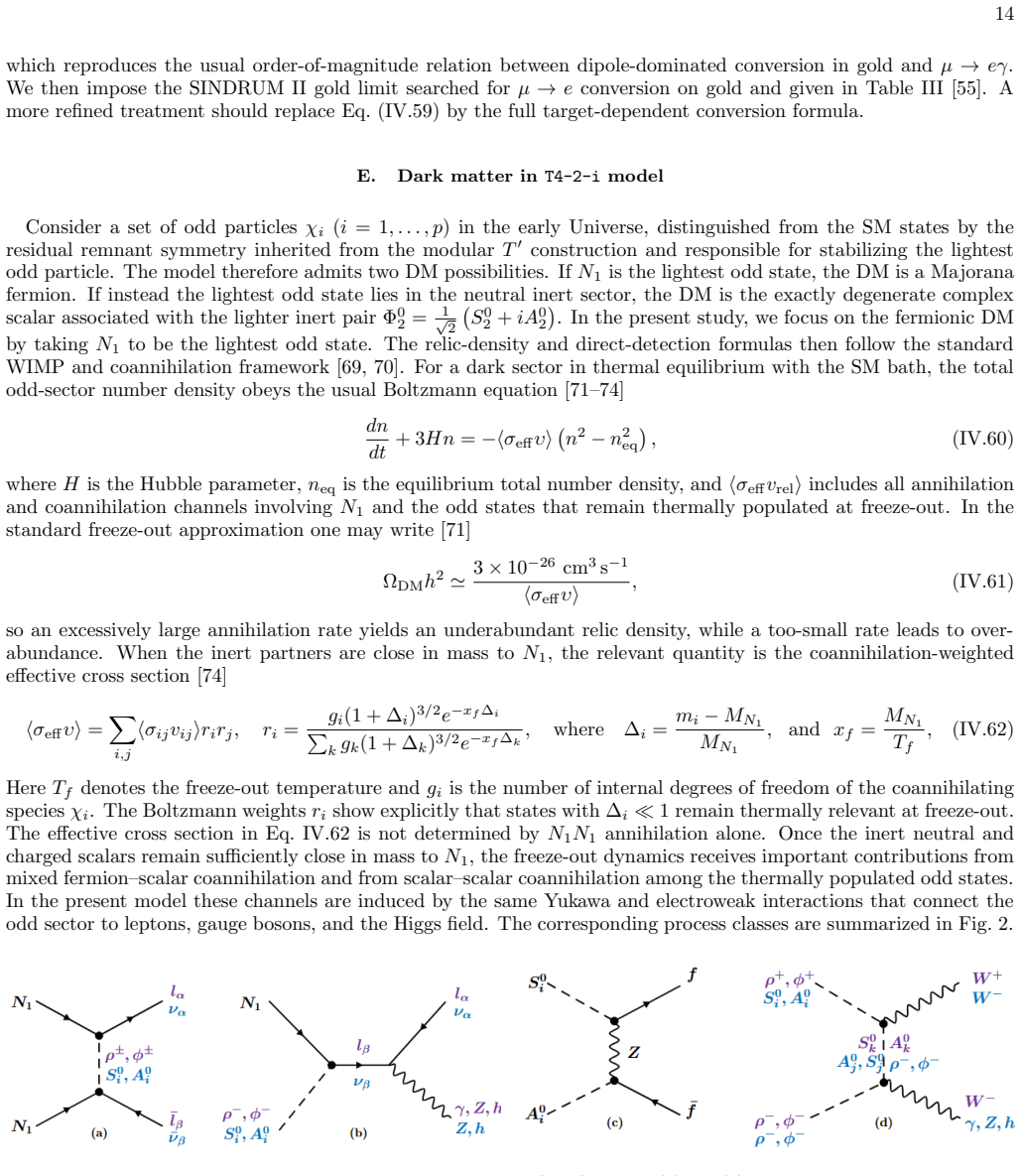
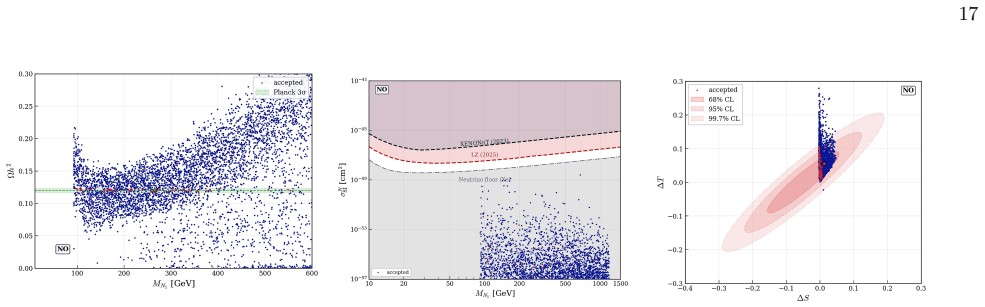
- The relic abundance is largely controlled by coannihilation with the inert scalar partners for the fermionic dark matter candidate N1.
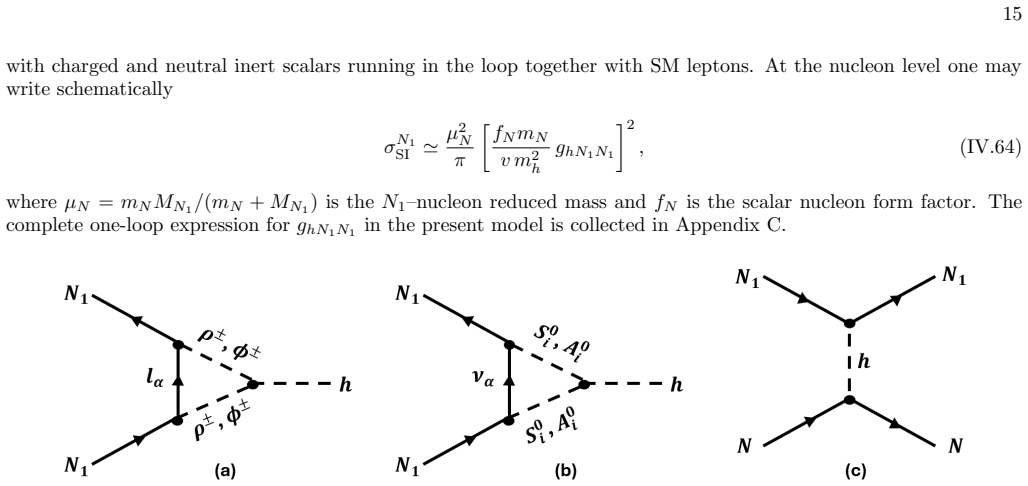
- The spin-independent direct-detection rate remains naturally suppressed because it arises only through a loop-generated Higgs portal.
- The model satisfies charged-lepton-flavor-violating bounds, electroweak precision observables, the Higgs diphoton signal strength, and the cosmological bound on the sum of neutrino masses.
Where Pith is reading between the lines
- Similar modular techniques could be used to address tree-level problems in other one-loop mass generation models.
- The fixed-point stabilization mechanism might generalize to other modular groups for automatic discrete symmetries.
- Future direct detection experiments could test the loop-suppressed portal by searching for the predicted small rates.
- Predictions for specific neutrino mixing parameters from the modular forms could be checked against upcoming oscillation data.
Load-bearing premise
The modular weights and field assignments under T' can be chosen such that all tree-level type-I and type-II seesaw operators are forbidden while the one-loop T4-2-i diagram is allowed and the Z2 symmetry remains intact.
What would settle it
An observation of a tree-level neutrino mass contribution or a spin-independent direct-detection rate inconsistent with the loop-generated Higgs portal in the parameter region that reproduces the relic abundance and neutrino data would falsify the construction.
Figures
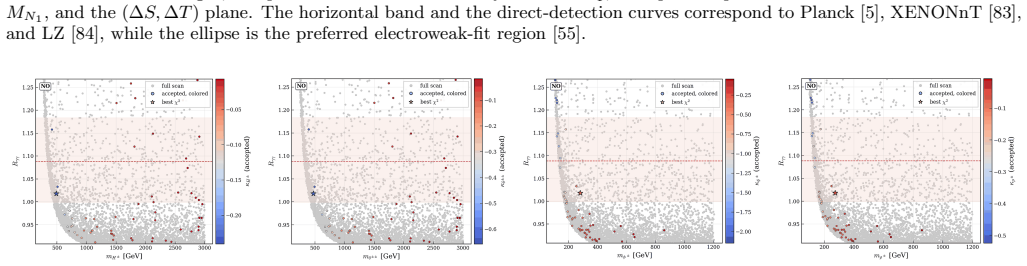
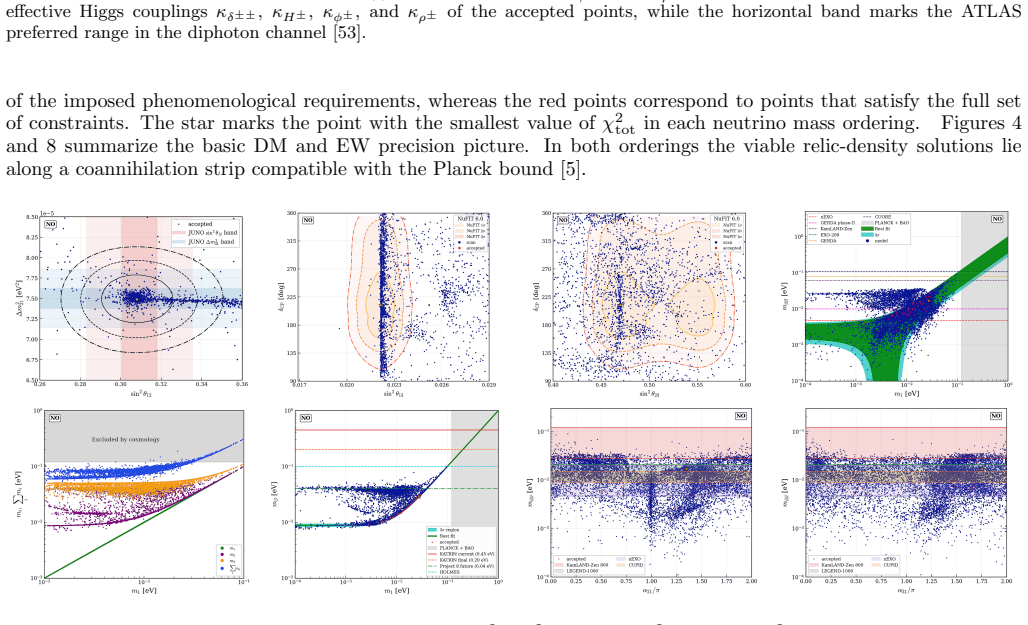
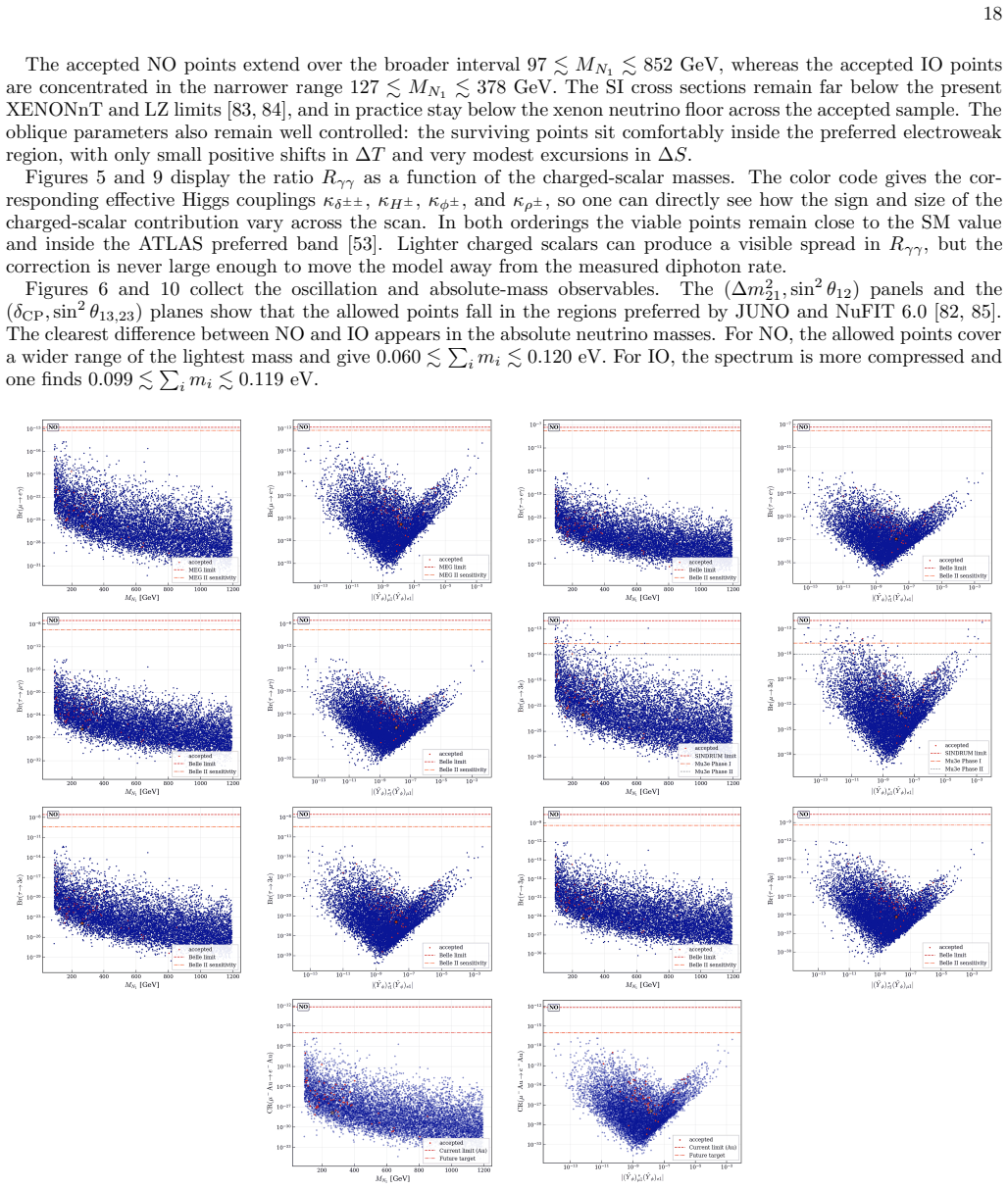
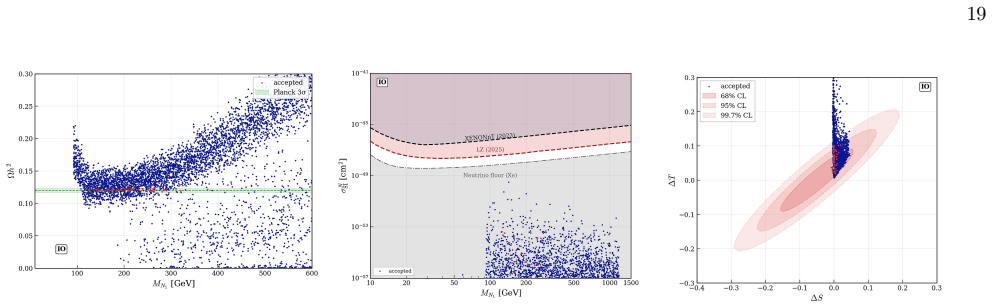
read the original abstract
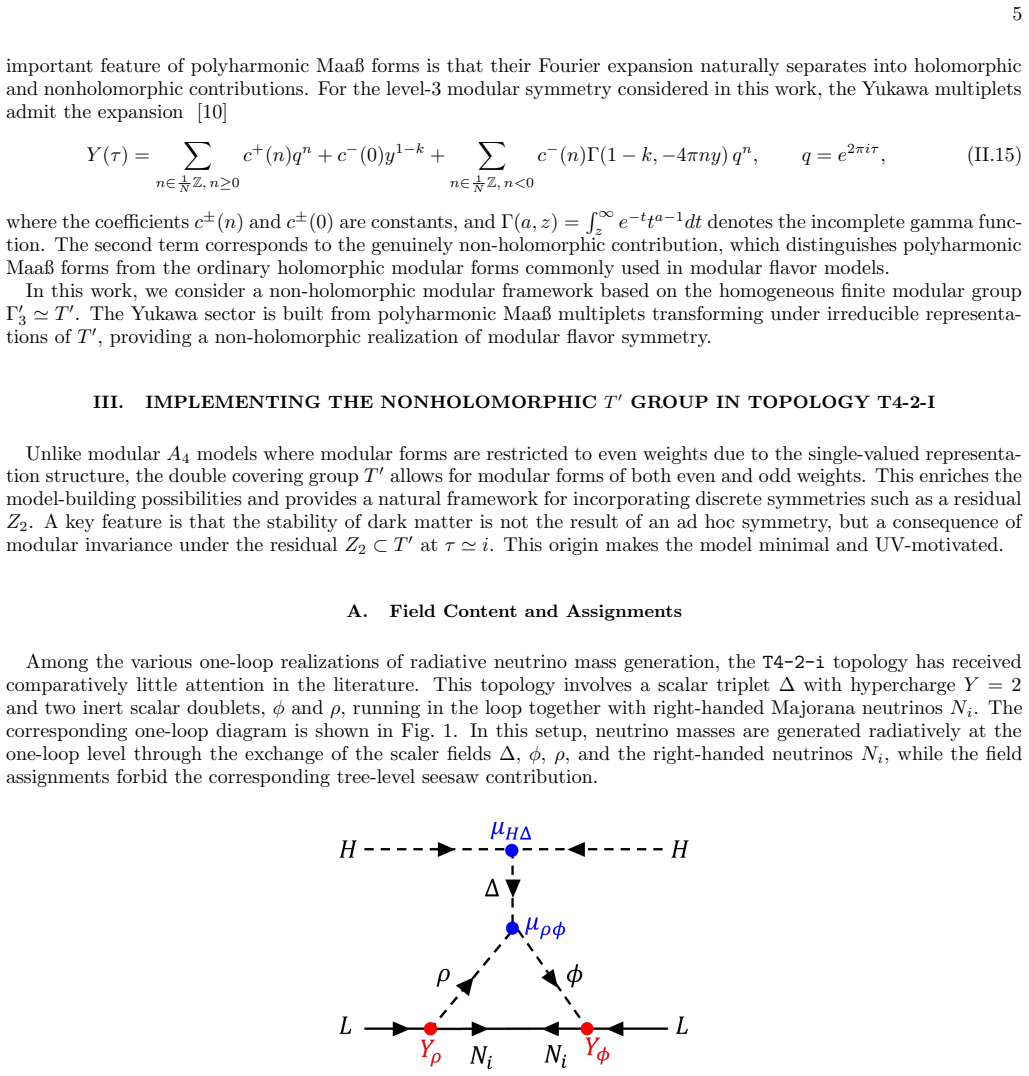
The T4-2-i topology provides a one-loop realization of Majorana neutrino mass and may be viewed as a radiative extension of the type-II seesaw, with a scalar triplet, two inert scalar doublets, and singlet fermions propagating in the loop. A central difficulty in realizing this topology lies in the simultaneous presence of tree-level type-I and type-II seesaw contributions arising from the same particle content. In addition, the stability of the dark-matter candidate typically requires the introduction of an ad hoc discrete symmetry. In this work, we revisit the T4-2-i topology within a nonholomorphic modular-invariant framework based on the double-cover group $T'$. The presence of both even- and odd-weight polyharmonic Maa{\ss} forms considerably enlarges the space of allowed modular structures, while the residual $\mathbb{Z}_2$ symmetry associated with the vicinity of the fixed point $\tau=i$ naturally stabilizes the lightest odd state. The modular assignments forbid the dangerous tree-level contributions, determine the flavor structure of the lepton sector, and allow both fermionic and scalar dark-matter candidates. We confront the model with neutrino-oscillation data, charged-lepton-flavor-violating bounds, electroweak precision observables, the Higgs diphoton signal strength, the observed dark-matter relic abundance, the cosmological bound on the sum of neutrino masses, and direct-detection limits. Focusing on the fermionic dark-matter candidate, in which the lightest odd state is the Majorana fermion $N_1$, we find that both normal and inverted neutrino mass orderings remain viable. In the allowed region, the relic abundance is largely controlled by coannihilation with the inert scalar partners, while the spin-independent direct-detection rate remains naturally suppressed because it arises only through a loop-generated Higgs portal.
Editorial analysis
A structured set of objections, weighed in public.
Referee Report
Summary. The paper constructs a nonholomorphic T' modular invariant model realizing the T4-2-i one-loop topology for radiative Majorana neutrino masses. Even- and odd-weight polyharmonic Maass forms are used to forbid tree-level type-I and type-II seesaw operators, while a residual Z2 near the τ=i fixed point stabilizes the DM candidate. The model is confronted with neutrino oscillation data, CLFV bounds, EW precision observables, Higgs diphoton strength, DM relic density, Σmν, and direct-detection limits. For fermionic DM (lightest odd state N1), viable regions exist for both normal and inverted orderings, with relic density set by coannihilation and SI DD suppressed by a loop-induced Higgs portal.
Significance. If the modular assignments correctly enforce the operator structure, the work offers a symmetry-based alternative to ad-hoc discrete symmetries in radiative seesaw models and enlarges the space of allowed modular forms. The comprehensive numerical confrontation with multiple datasets (oscillation, LFV, EWPO, Higgs, relic, Σmν, DD) is a strength, showing that coannihilation dominates the relic density while DD remains naturally small. This could inform further modular constructions linking neutrino mass and DM.
major comments (1)
- [Abstract and modular assignments section] Abstract and the section describing the modular assignments: the central claim that the chosen T' representations together with even/odd-weight polyharmonic Maass forms identically forbid all tree-level type-I and type-II seesaw operators (while permitting the T4-2-i loop and preserving the residual Z2) is load-bearing. Explicit verification—e.g., tables of allowed vs. forbidden modular forms for the relevant Yukawa and triplet couplings, or equations showing the vanishing of the forbidden structures—is required to confirm that no non-vanishing form reintroduces tree-level contributions.
minor comments (2)
- [Phenomenological analysis section] The numerical scan results (e.g., allowed regions in the mN1–mΔ plane or relic-density contours) would benefit from explicit statements of the prior ranges chosen for the Maass-form coefficients and scalar potential parameters.
- [Model setup] Notation for the polyharmonic Maass forms (even vs. odd weight) should be introduced with a brief reminder of their transformation properties under T' to aid readability.
Simulated Author's Rebuttal
We thank the referee for the careful reading of the manuscript and for identifying the need for explicit verification of the modular assignments. We agree that this is a load-bearing claim and will strengthen the presentation accordingly.
read point-by-point responses
-
Referee: [Abstract and modular assignments section] Abstract and the section describing the modular assignments: the central claim that the chosen T' representations together with even/odd-weight polyharmonic Maass forms identically forbid all tree-level type-I and type-II seesaw operators (while permitting the T4-2-i loop and preserving the residual Z2) is load-bearing. Explicit verification—e.g., tables of allowed vs. forbidden modular forms for the relevant Yukawa and triplet couplings, or equations showing the vanishing of the forbidden structures—is required to confirm that no non-vanishing form reintroduces tree-level contributions.
Authors: We agree that explicit verification of the operator structure is essential for clarity. The T' assignments (with the specified even- and odd-weight polyharmonic Maass forms) were chosen so that the tree-level type-I Yukawa coupling L H N and the type-II triplet coupling L L Δ both carry total modular weights that cannot be compensated by any allowed form of the required representation, while the one-loop T4-2-i operators are permitted. In the revised manuscript we will add (i) a table enumerating the modular weight and representation of every relevant operator, (ii) the explicit list of allowed versus forbidden Maass forms for each coupling, and (iii) a short derivation showing that the forbidden structures have vanishing modular forms. These additions will be placed in the modular-assignments section immediately after the field-content table. The residual Z2 near τ = i is preserved by the same weight assignments and will be noted explicitly. revision: yes
Circularity Check
No significant circularity; modular symmetry provides independent operator selection
full rationale
The paper selects T' representations, weights, and even/odd polyharmonic Maass forms to determine which operators are allowed or forbidden. This symmetry-based filtering is a standard construction that stands independently of the neutrino oscillation data, relic density, or direct-detection limits. Numerical scans then identify viable parameter regions consistent with those observables, but no claimed result (viability of orderings, coannihilation dominance, loop-suppressed DD) reduces by construction to a fit or self-citation. The central mechanism—simultaneous forbidding of tree-level type-I/II while permitting the T4-2-i loop and residual Z2—follows from the group-theoretic assignments rather than from re-labeling inputs. No load-bearing self-citation chains or ansatze smuggled via prior work appear in the abstract or described structure.
Axiom & Free-Parameter Ledger
free parameters (2)
- modular weights and Maass form coefficients
- scalar potential parameters and mass scales
axioms (2)
- domain assumption The T' modular assignments together with even- and odd-weight polyharmonic Maass forms forbid all tree-level type-I and type-II seesaw operators while permitting the one-loop T4-2-i diagram.
- domain assumption The residual Z2 symmetry near the tau=i fixed point is sufficient to stabilize the lightest odd state against decay.
invented entities (1)
-
polyharmonic Maass forms of both even and odd weight
no independent evidence
Forward citations
Cited by 1 Pith paper
-
Non-holomorphic $S^{\prime}_{4}$ modular symmetry for leptons and leptogenesis
36 viable non-holomorphic S'4 modular models for leptons are identified via numerical scans, with two yielding successful unflavored thermal leptogenesis from the real part of τ while fitting neutrino data.
Reference graph
Works this paper leans on
-
[1]
G. Bertone, D. Hooper, and J. Silk,Particle dark matter: Evidence, candidates and constraints,Phys. Rept.405(2005) 279–390, [hep-ph/0404175]. [5]PlanckCollaboration, N. Aghanim et al.,Planck 2018 results. VI. Cosmological parameters,Astron. Astrophys.641 (2020) A6, [arXiv:1807.06209]. [Erratum: Astron.Astrophys. 652, C4 (2021)]
Pith/arXiv arXiv 2005
-
[2]
F. Bonnet, M. Hirsch, T. Ota, and W. Winter,Systematic study of the d=5 Weinberg operator at one-loop order,JHEP 07(2012) 153, [arXiv:1204.5862]
Pith/arXiv arXiv 2012
-
[3]
M. A. Loualidi and M. Miskaoui,One-loop Type II Seesaw Neutrino Model with Stable Dark Matter Candidates,Nucl. Phys. B961(2020) 115219, [arXiv:2003.11434]
arXiv 2020
-
[4]
M. Kashav,Dominant One-Loop Seesaw Contribution Induced by Non-Invertible Fusion Algebra,arXiv:2602.14644
-
[5]
M. Kashav and S. Verma,On minimal realization of topological Lorentz structures with one-loop seesaw extensions in A 4 modular symmetry,JCAP03(2023) 010, [arXiv:2205.06545]
arXiv 2023
-
[6]
B.-Y. Qu and G.-J. Ding,Non-holomorphic modular flavor symmetry,JHEP08(2024) 136, [arXiv:2406.02527]
arXiv 2024
-
[7]
Cheshta, Priya, S. Dutt, and B. C. Chauhan,A Type-I seesaw framework with non-holomorphic modular symmetry,Eur. Phys. J. C86(2026), no. 4 400, [arXiv:2604.18070]
Pith/arXiv arXiv 2026
-
[8]
M. Abbas,Lepton masses and mixing in non-holomorphic modularA 4 with universal couplings,arXiv:2604.16130
-
[9]
H. Okada and S. Jangid,A Radiative Seesaw Model in a Noninvertible Selection Rule with the Assistance of a Nonholomorphic Modular A4 Symmetry,PTEP2026(2026), no. 5 053B05, [arXiv:2510.17292]
arXiv 2026
-
[10]
Priya, B. C. Chauhan, D. Kumar, and T. Nomura,Predictions of Modular Symmetry Fixed Points on Neutrino Masses, Mixing, and Leptogenesis,arXiv:2604.04585
- [11]
- [12]
-
[13]
X.-Y. Gao and C.-C. Li,Minimal lepton models with non-holomorphic modular A 4 symmetry*,Chin. Phys. C50(2026), no. 5 053109, [arXiv:2512.07158]
arXiv 2026
-
[14]
S. K. Nanda, M. Ricky Devi, and S. Patra,Non-HolomorphicA 4 Modular Symmetry in Type-I Seesaw: Implications for Neutrino Masses and Leptogenesis,arXiv:2509.22108
- [15]
-
[16]
X. Zhang and Y. Reyimuaji,Inverse seesaw model in nonholomorphic modular A4 flavor symmetry,Phys. Rev. D112 (2025), no. 7 075050, [arXiv:2507.06945]
arXiv 2025
-
[17]
T. Nomura and H. Okada,Neutrino mass model at a three-loop level from a non-holomorphic modular A 4 symmetry, Chin. Phys. C50(2026), no. 2 023108, [arXiv:2506.02639]
arXiv 2026
- [18]
-
[19]
T. Nomura and H. Okada,A new type of lepton seesaw model in a modularA 4 symmetry,arXiv:2503.19251
-
[20]
T. Nomura and H. Okada,Type-II seesaw of a non-holomorphic modular A4 symmetry,Phys. Lett. B868(2025) 139763, [arXiv:2408.01143]
arXiv 2025
-
[21]
B. Kumar and M. K. Das,Study of neutrino phenomenology and 0νββdecay using polyharmonic Maaβforms,Int. J. Mod. Phys. A40(2025), no. 23 2550090, [arXiv:2405.10586]
arXiv 2025
-
[22]
T. Nomura and H. Okada,A More Novel Approach of Radiative Linear Seesaw in a Modular A4 Symmetry,PTEP2025 (2025), no. 4 043B04, [arXiv:2410.21843]
arXiv 2025
-
[23]
T. Kobayashi, H. Okada, and Y. Orikasa,Zee–Babu model in a Nonholomorphic Modular A4 Symmetry and Modular Stabilization,PTEP2026(2026), no. 3 033B07, [arXiv:2502.12662]
arXiv 2026
-
[24]
H. Okada and Y. Orikasa,A radiative seesaw in a non-holomorphic modularS 3 flavor symmetry,arXiv:2501.15748
- [25]
-
[26]
G.-J. Ding, J.-N. Lu, S. T. Petcov, and B.-Y. Qu,Non-holomorphic modular S 4 lepton flavour models,JHEP01(2025) 191, [arXiv:2408.15988]
arXiv 2025
-
[27]
M. A. Loualidi, M. Miskaoui, and S. Nasri,Nonholomorphic A4 modular invariance for fermion masses and mixing in SU(5) GUT,Phys. Rev. D112(2025), no. 1 015008, [arXiv:2503.12594]
arXiv 2025
- [28]
-
[29]
X. Zhang and Y. Reyimuaji,Neutrino Mass and Leptogenesis in the Non-SUSY ModularA ′ 5 Inverse Seesaw, arXiv:2603.19104
-
[30]
C.-C. Li and G.-J. Ding,Lepton models from non-holomorphicA 5′modular flavor symmetry,JHEP01(2026) 032, [arXiv:2509.15183]
arXiv 2026
-
[31]
Feruglio,Automorphic Forms and Fermion Masses,Springer Proc
F. Feruglio,Automorphic Forms and Fermion Masses,Springer Proc. Math. Stat.396(2022) 449–455
2022
-
[32]
Borel,Automorphic forms on reductive groups, Automorphic forms and Applications,IAS/Park City Mathematics Series 12((2007)) 5–40
A. Borel,Automorphic forms on reductive groups, Automorphic forms and Applications,IAS/Park City Mathematics Series 12((2007)) 5–40
2007
-
[33]
Borel,Introduction to automorphic forms, 1966 Algebraic Groups and Discontinuous Subgroups,(Proc
A. Borel,Introduction to automorphic forms, 1966 Algebraic Groups and Discontinuous Subgroups,(Proc. Sympos. Pure Math., Boulder, Colo., 1965)9(1965) 199. 26
1966
-
[34]
Ma,Verifiable radiative seesaw mechanism of neutrino mass and dark matter,Phys
E. Ma,Verifiable radiative seesaw mechanism of neutrino mass and dark matter,Phys. Rev. D73(2006) 077301, [hep-ph/0601225]
Pith/arXiv arXiv 2006
-
[35]
I. M. ´Avila, A. Karan, S. Mandal, S. Sadhukhan, and J. W. F. Valle,Dark matter as the source of neutrino mass: Theory overview and experimental prospects,Phys. Rept.1173(2026) 1–81, [arXiv:2506.24027]
arXiv 2026
-
[36]
Konetschny and W
W. Konetschny and W. Kummer,Nonconservation of Total Lepton Number with Scalar Bosons,Phys. Lett. B70(1977) 433–435
1977
-
[37]
R. N. Mohapatra and G. Senjanovic,Neutrino Mass and Spontaneous Parity Nonconservation,Phys. Rev. Lett.44 (1980) 912
1980
-
[38]
Magg and C
M. Magg and C. Wetterich,Neutrino Mass Problem and Gauge Hierarchy,Phys. Lett. B94(1980) 61–64
1980
-
[39]
Lazarides, Q
G. Lazarides, Q. Shafi, and C. Wetterich,Proton Lifetime and Fermion Masses in an SO(10) Model,Nucl. Phys. B181 (1981) 287–300
1981
-
[40]
Schechter and J
J. Schechter and J. W. F. Valle,Neutrino Masses in SU(2) x U(1) Theories,Phys. Rev. D22(1980) 2227
1980
-
[41]
T. P. Cheng and L.-F. Li,Neutrino Masses, Mixings and Oscillations in SU(2) x U(1) Models of Electroweak Interactions,Phys. Rev. D22(1980) 2860
1980
-
[42]
A. Arhrib, R. Benbrik, M. Chabab, G. Moultaka, M. C. Peyranere, L. Rahili, and J. Ramadan,The Higgs Potential in the Type II Seesaw Model,Phys. Rev. D84(2011) 095005, [arXiv:1105.1925]
Pith/arXiv arXiv 2011
-
[43]
Kannike,Vacuum Stability Conditions From Copositivity Criteria,Eur
K. Kannike,Vacuum Stability Conditions From Copositivity Criteria,Eur. Phys. J. C72(2012) 2093, [arXiv:1205.3781]
Pith/arXiv arXiv 2012
-
[44]
Kannike,Vacuum Stability of a General Scalar Potential of a Few Fields,Eur
K. Kannike,Vacuum Stability of a General Scalar Potential of a Few Fields,Eur. Phys. J. C76(2016), no. 6 324, [arXiv:1603.02680]. [Erratum: Eur.Phys.J.C 78, 355 (2018)]
Pith/arXiv arXiv 2016
-
[45]
J. R. Ellis, M. K. Gaillard, and D. V. Nanopoulos,A Phenomenological Profile of the Higgs Boson,Nucl. Phys. B106 (1976) 292
1976
-
[46]
M. A. Shifman, A. I. Vainshtein, M. B. Voloshin, and V. I. Zakharov,Low-Energy Theorems for Higgs Boson Couplings to Photons,Sov. J. Nucl. Phys.30(1979) 711–716
1979
-
[47]
L. B. Okun,Leptons and Quarks: Special Edition Commemorating the Discovery of the Higgs Boson. North-Holland, Amsterdam, Netherlands, 1982
1982
-
[48]
M. B. Gavela, G. Girardi, C. Malleville, and P. Sorba,A Nonlinear R(xi) Gauge Condition for the Electroweak SU(2) X U(1) Model,Nucl. Phys. B193(1981) 257–268. [53]ATLASCollaboration, G. Aad et al.,A detailed map of Higgs boson interactions by the ATLAS experiment ten years after the discovery,Nature607(2022), no. 7917 52–59, [arXiv:2207.00092]. [Erratum: ...
arXiv 1981
-
[49]
M. E. Peskin and T. Takeuchi,Estimation of oblique electroweak corrections,Phys. Rev. D46(1992) 381–409. [55]Particle Data GroupCollaboration, S. Navas et al.,Review of particle physics,Phys. Rev. D110(2024), no. 3 030001
1992
-
[50]
L. Lavoura and L.-F. Li,Making the small oblique parameters large,Phys. Rev. D49(1994) 1409–1416, [hep-ph/9309262]
Pith/arXiv arXiv 1994
-
[51]
Y. Cheng, X.-G. He, F. Huang, J. Sun, and Z.-P. Xing,Electroweak precision tests for triplet scalars,Nucl. Phys. B989 (2023) 116118, [arXiv:2208.06760]. [58]MEG IICollaboration,New limit on theµ + →e +γdecay with the MEG II experiment,arXiv:2504.15711. [59]MEG IICollaboration, A. M. Baldini et al.,The design of the MEG II experiment,Eur. Phys. J. C78(2018...
arXiv 2023
-
[52]
M. Aoki, A. M. Baldini, R. H. Bernstein, C. Carloganu, S. Mihara, S. Miscetti, T. Mori, W. Ootani, F. Renga, S. Ritt, and A. Sch¨ oning,Charged Lepton Flavour Violations searches with muons: present and future,arXiv:2503.22461. [63]BelleCollaboration,Search for lepton-flavor-violatingτdecays into a lepton and a photon at Belle,JHEP10(2021) 019, [arXiv:210...
arXiv 2021
-
[53]
T. Toma and A. Vicente,Lepton flavor violation in the scotogenic model,JHEP01(2014) 160, [arXiv:1312.2840]
Pith/arXiv arXiv 2014
-
[54]
R. Kitano, M. Koike, and Y. Okada,Detailed calculation of lepton flavor violating muon-electron conversion rate for various nuclei,Phys. Rev. D66(2002) 096002, [hep-ph/0203110]
Pith/arXiv arXiv 2002
-
[55]
G. Jungman, M. Kamionkowski, and K. Griest,Supersymmetric dark matter,Phys. Rept.267(1996) 195–373, [hep-ph/9506380]
Pith/arXiv arXiv 1996
-
[56]
G. Arcadi, M. Dutra, P. Ghosh, M. Lindner, Y. Mambrini, M. Pierre, S. Profumo, and F. S. Queiroz,The Waning of the WIMP? A Review of Models, Searches, and Constraints,Eur. Phys. J. C78(2018), no. 3 203, [arXiv:1703.07364]
Pith/arXiv arXiv 2018
-
[57]
B. W. Lee and S. Weinberg,Cosmological lower bound on heavy-neutrino masses,Phys. Rev. Lett.39(1977) 165–168
1977
-
[58]
E. W. Kolb and M. S. Turner,The Early Universe, vol. 69. Taylor and Francis, 5, 2019
2019
-
[59]
Gondolo and G
P. Gondolo and G. Gelmini,Cosmic abundances of stable particles: Improved analysis,Nucl. Phys. B360(1991) 145–179
1991
-
[60]
Griest and D
K. Griest and D. Seckel,Three exceptions in the calculation of relic abundances,Phys. Rev. D43(1991) 3191–3203
1991
-
[61]
A. Alloul, N. D. Christensen, C. Degrande, C. Duhr, and B. Fuks,FeynRules 2.0 - A complete toolbox for tree-level 27 phenomenology,Comput. Phys. Commun.185(2014) 2250–2300, [arXiv:1310.1921]
Pith/arXiv arXiv 2014
-
[62]
A. Belyaev, N. D. Christensen, and A. Pukhov,CalcHEP 3.4 for collider physics within and beyond the Standard Model, Comput. Phys. Commun.184(2013) 1729–1769, [arXiv:1207.6082]
Pith/arXiv arXiv 2013
-
[63]
G. Belanger, F. Boudjema, A. Pukhov, and A. Semenov,micrOMEGAs 3: A program for calculating dark matter observables,Comput. Phys. Commun.185(2014) 960–985, [arXiv:1305.0237]
Pith/arXiv arXiv 2014
-
[64]
G. Alguero, G. Belanger, F. Boudjema, S. Chakraborti, A. Goudelis, S. Kraml, A. Mjallal, and A. Pukhov, micrOMEGAs 6.0: N-component dark matter,Comput. Phys. Commun.299(2024) 109133, [arXiv:2312.14894]
arXiv 2024
-
[65]
M. D. McKay, R. J. Beckman, and W. J. Conover,A comparison of three methods for selecting values of input variables in the analysis of output from a computer code,Technometrics42(2000), no. 1 55–61
2000
-
[66]
Virtanen, R
P. Virtanen, R. Gommers, T. E. Oliphant, M. Haberland, T. Reddy, D. Cournapeau, E. Burovski, P. Peterson, W. Weckesser, J. Bright, et al.,Scipy 1.0: fundamental algorithms for scientific computing in python,Nature methods17 (2020), no. 3 261–272
2020
-
[67]
M. A. Branch, T. F. Coleman, and Y. Li,A subspace, interior, and conjugate gradient method for large-scale bound-constrained minimization problems,SIAM J. Sci. Comput.21(1999), no. 1 1–23
1999
-
[68]
I. Esteban, M. C. Gonzalez-Garcia, M. Maltoni, I. Martinez-Soler, J. P. Pinheiro, and T. Schwetz,NuFit-6.0: updated global analysis of three-flavor neutrino oscillations,JHEP12(2024) 216, [arXiv:2410.05380]. [83]XENONCollaboration, E. Aprile et al.,First Dark Matter Search with Nuclear Recoils from the XENONnT Experiment,Phys. Rev. Lett.131(2023), no. 4 0...
Pith/arXiv arXiv 2024
-
[69]
X.-G. Liu and G.-J. Ding,Neutrino Masses and Mixing from Double Covering of Finite Modular Groups,JHEP08 (2019) 134, [arXiv:1907.01488]
arXiv 2019
-
[70]
G.-J. Ding and S. F. King,Neutrino mass and mixing with modular symmetry,Rept. Prog. Phys.87(2024), no. 8 084201, [arXiv:2311.09282]
arXiv 2024
-
[71]
G.-J. Ding, F. R. Joaquim, and J.-N. Lu,Texture-zero patterns of lepton mass matrices from modular symmetry,JHEP 03(2023) 141, [arXiv:2211.08136]
arXiv 2023
discussion (0)
Sign in with ORCID, Apple, or X to comment. Anyone can read and Pith papers without signing in.