REVIEW 5 major objections 4 minor 1 cited by
Can an Easy-to-Hard Curriculum Make Reasoning Emerge in Small Language Models? Evidence from a Four-Stage Curriculum on GPT-2
T0 review · 5 major / 4 minor · reviewed 2026-08-15 · deepseek-v4-flash
Pith's one-line read This paper claims that an ordered four-stage curriculum trains a 124-million-parameter GPT-2 to reach target reasoning accuracy in half the optimization steps of a single-phase baseline, while activating roughly an order of magnitude more…
desk verdict The curriculum setup is real and the sample-efficiency comparison is a legitimate external result, but the headline transparency numbers cannot be literal head counts and the paper's own limitations concede the probe's collapse. read the letter →
The pith
A machine-rendered reading of the paper's core claim, the machinery that carries it, and where it could break.
The reading
What carries the argument
The load-bearing mechanism is the ordered syllabus itself: four difficulty tiers (simple, basic, intermediate, complex reasoning) built by a logistic classifier over operator density, sentence count, and step delimiters, presented strictly in increasing difficulty with no optimizer resets so that weights, token embeddings, and scheduler state carry over. The paper's evidence for transparency is a gradient-based saliency probe that labels an attention head 'specialized' when its saliency on a held-out reasoning probe exceeds the 95th percentile of a random-head null distribution; these counts are used to quantify component growth, layer-wise redistribution, retention between stages, and emergence speed. Attention maps supply supporting measures—Gini sparsity, Shannon entropy, local focus within a ±2-token window, and mean key-query distance—that describe how the curriculum changes information flow.
What would settle it
Run the paper's own leakage diagnostic—randomly interleave 10% of Stage-4 problems into each earlier epoch and check whether validation accuracy remains unchanged; if it does, the curriculum's gains do not depend on strict progression. Separately, causally ablate the heads the saliency probe flags and see whether step-by-step accuracy drops; if it does not, the flagged 'reasoning heads' are not load-bearing.
Extended reading notes
Core claim
The paper's central claim is that a developmentally ordered curriculum can unlock specialized reasoning circuitry in a small transformer without adding parameters. In Cognivolve, the same GPT-2 weights are trained continuously across four difficulty tiers—simple reasoning, basic reasoning, intermediate reasoning, complex reasoning—with per-stage learning-rate ceilings and no task-specific layers. Against a matched single-phase baseline that sees the same corpus and compute budget, the curriculum run reaches success-rate thresholds of 0.25 and 0.30 in 500 updates versus 1,000, ends with an average of 6,814 gradient-salient specialized heads per checkpoint versus 873, fills previously empty late layers (12–23) with up to 193 heads each, and raises attention entropy by about 2%. The paper interprets these as signs of broader, more balanced information flow and of reasoning circuitry shifting toward deep layers, and argues this constitutes a transparency gain: the curriculum model's step-by-step reasoning traces align with gold rationales 2.9% better than baseline. It also reports that final-answer success remains 31.8% below baseline, which it attributes to termination policy and loss weighting rather than to the curriculum itself, and that the saliency probe under-detects verbal-knowledge heads in Stage 4.
Load-bearing premise
The central transparency claim rests on the assumption that the gradient-based saliency probe accurately counts distinct, functional reasoning heads, but the paper's own limitations state the probe is lossy, can inflate counts when accumulated across checkpoints, and detects zero heads in the hardest stage.
Editorial extensions
If this is right
- Curriculum ordering can substitute for compute: a small model reaches moderate reasoning accuracy in half the optimizer updates at equal parameter count and wall-clock budget.
- Small models can be trained to use deeper layers for reasoning; the baseline leaves layers 12–23 with zero specialized heads, while the curriculum fills them.
- Progression, not extra data or compute, drives the gains: shuffling the stage order or resetting the optimizer at stage boundaries fails to reproduce the benefits.
- Transparency and final accuracy can decouple: the curriculum improves step-by-step reasoning alignment while final-answer success lags, suggesting these objectives need separate tuning.
- Order-of-magnitude more specialized reasoning heads means interpretability tools can study reasoning circuits in small models, but the probe's Stage-4 blind spot limits where that analysis applies.
Reading between the lines
- The 7.8x gap in head counts should be read cautiously: the paper's own limitation statement says the saliency probe is lossy, can inflate counts when accumulated across checkpoints, and finds zero heads in Stage 4, so a causal test—ablating or silencing the flagged heads and checking whether step-by-step accuracy drops—would settle whether these are functional reasoning circuits.
- A reader could test the paper's leakage concern directly by randomly interleaving 10% of Stage-4 problems into each earlier epoch; if validation accuracy stays flat, the curriculum's gains are not due to memorizing stage boundaries.
- A natural extension is a brief mixed-stage fine-tune after Stage 4, which the paper leaves open; this could determine whether the 30% final-accuracy gap is a fixable termination artifact or a fundamental trade-off between transparency and answer accuracy.
- If the same four-stage ordering were applied to larger GPT-2 variants, the saturation point of curriculum gains would reveal how far ordering can substitute for scale before model capacity becomes the bottleneck.
Signed reviews
Editorial analysis
A structured set of objections, weighed in public.
Referee Report
Summary. The paper proposes Cognivolve, a four-stage easy-to-hard curriculum for GPT-2 small (claimed 124M parameters, 12 layers, 12 heads per layer), and compares it against a single-phase baseline trained on the same aggregated data. The authors report three main benefits of the curriculum: roughly two-fold faster attainment of moderate accuracy thresholds, an order-of-magnitude increase in the number of gradient-salient "specialized reasoning heads," and a redistribution of those heads toward deeper layers accompanied by higher-entropy attention. The paper also reports mixed final-task results: the curriculum improves step-by-step alignment by 2.9% but lags the baseline by 31.8% on final-answer success. The manuscript includes a Limitations section that candidly acknowledges the saliency probe is lossy, inflates counts under checkpoint accumulation, and fails entirely in Stage 4, and that the final accuracy gap remains unresolved.
Significance. If the central claims were valid, the result would be significant: a training curriculum that halves compute while producing more interpretable reasoning components in a small language model would be of broad interest to the efficient-NLP and interpretability communities. The paper ships code, data splits, and checkpoints, and the authors are transparent about known weaknesses. However, the quantitative backbone of the interpretability claim is internally inconsistent to the point of impossibility: reported head counts exceed the physical number of attention heads in the model, and the attention statistics are computed over 24 layers although the model is stated to have 12. These are not cosmetic issues; they invalidate the headline mechanistic evidence. The sample-efficiency comparison is also compromised by contradictory statements about the baseline's compute budget and by a final accuracy that is lower than thresholds the curriculum is claimed to have reached early in training. Because the main positive claims rest on these numbers, the significance of the paper as written is not established.
major comments (5)
- [§2.1, §3.1, Table 1, Figure 3] The model is specified in §2.1 as GPT-2 small with 12 transformer layers and 12 attention heads per layer, which gives 144 heads total. Yet §3.1 and Table 1 report 6,814 average specialized heads per checkpoint, 4,126 final total heads, and 4,355 cumulative heads, and Figure 3 and the layer-group tables are drawn over 24 layers with 288 heads. These numbers cannot be literal counts of attention heads because they exceed the model's entire head budget by more than an order of magnitude. The 12-layer/24-layer discrepancy also changes the denominator of every per-layer statistic and makes the 'layers 12–23' analysis in Figure 3 and Table 3 meaningless for the stated architecture. This is an internal inconsistency in the central metric, not a presentation issue.
- [§3.1, §3.5, Limitations] The headline transparency claim rests on counts of 'gradient-salient reasoning heads' obtained by accumulating detections across checkpoints. The Limitations section concedes that the saliency probe is lossy, 'can inflate counts when accumulated across checkpoints,' and 'fails altogether in Stage 4.' Stage 4 is exactly where the paper reports the cumulative union freezing and live heads dropping to zero. The reported order-of-magnitude gain in specialized heads is therefore an artifact-prone aggregation of a probe that the authors themselves say is not a census of distinct functional modules. Because the central claim of improved reasoning transparency is operationalized by these numbers, the transparency result is not supported as stated.
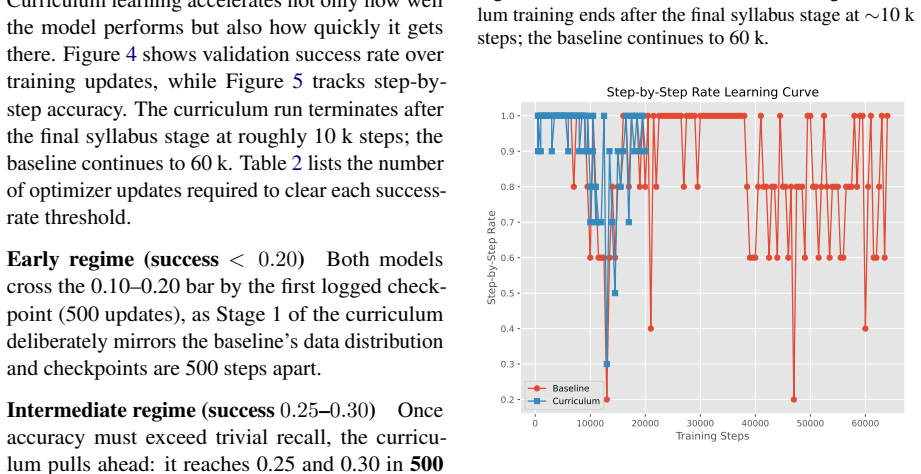
- [§2.5, §3.2, Table 2] Section 2.5 states the baseline has 'identical parameter count, compute budget, and total number of optimisation steps,' but Section 3.2 reports that the curriculum run terminates at roughly 10k steps while the baseline continues to 60k. These statements are contradictory. If the baseline actually trains for six times as many updates, the claimed 2x speed-up to reach 0.25 and 0.30 accuracy is not a controlled comparison of equal compute budgets; at minimum, the manuscript must clarify how 'identical compute budget' is compatible with a 60k-step baseline.
- [Table 2, Table 4, §3.2] There is a direct numerical inconsistency in the sample-efficiency claim. Table 2 reports that the curriculum reaches a 0.30 success rate at 500 updates, but Table 4 reports an end-of-training success rate of 0.21 for the curriculum. If the curriculum truly attained 0.30 early in training and then ended at 0.21, the claim of 'reaching target accuracy in half the optimization steps' is misleading without an explanation of the subsequent collapse. If instead the numbers come from different evaluation protocols or checkpoint averaging, that needs to be stated explicitly. As written, the two tables cannot both describe the same evaluation metric.
- [Table 3, §3.3, Appendix B] The attention-pattern analysis in Table 3 and Appendix B consistently aggregates over 'all 24×12 heads' and reports layer groups including layers 12–23, again for a model stated in §2.1 to have 12 layers and 12 heads per layer. This makes the layer-wise entropy, sparsity, local-focus, and average-distance statistics undefined for the stated architecture. Since Section 3.3 interprets these statistics as mechanistic evidence for the curriculum effect, this inconsistency further undermines the paper's central quantitative claims.
minor comments (4)
- [Figure 2 caption] Figure 2 says the shaded region denotes one standard deviation across three seeds, while Section 2.6 says all results are averaged over five random seeds. These numbers should be reconciled.
- [Table 4 vs. §3.2] Table 4 reports a baseline final success rate of 0.32, but Section 3.2 states that the baseline 'eventually nudges success above 0.4.' These are inconsistent descriptions of the same experiment.
- [§3.2 vs. §3.7] Section 3.2 says the curriculum terminates at roughly 10k steps, but Section 3.7 places the onset of the final complex-reasoning stage at approximately 11,500 updates. These numbers cannot both be correct for the same training run.
- [§3.5, Table 5] The sentence 'These cumulative tallies reach 4040, 4145 and 4355 for stages 1–3' is unclear because Table 5's 'Cumulative' column and 'Live Heads' column are not distinguished in the text; please clarify whether these are per-checkpoint live counts or cumulative unions at each stage boundary.
Circularity Check
No significant circularity: empirical curriculum-vs-baseline comparison is self-contained; head-count metric is a lossy probe explicitly disclaimed by the authors.
full rationale
The paper's central claims are empirical comparisons between a curriculum and a single-phase baseline under fixed compute, so they do not reduce to their own inputs. Sample-efficiency (Section 3.2) is measured on a held-out 1000-question test set and controlled for total updates and parameter count; no parameter is fit to that test set. The attention and head-saliency analyses are presented as observations, and the paper explicitly disclaims the head counts as a census: 'the absolute head numbers reported here should be read as relative trends, not as a census of distinct functional modules' (Section 6). The one potentially circular-looking element—defining 'specialized' heads via a gradient-saliency probe aligned with numerical reasoning—is acknowledged by the authors as lossy and probe-sensitive, and it is not used to derive the sample-efficiency or step-by-step results. There are no self-citations, no imported uniqueness theorems, and no fitted parameter renamed as a prediction. A separate internal inconsistency exists (12-layer GPT-2 small vs 24-layer analyses in Figure 3, Table 1, and Section 3.3), but that is a correctness/validity defect rather than a circular derivation. Score 0.
Assumptions & free parameters
free parameters (3)
- Stage-specific peak learning rates =
1e-4, 7e-5, 5e-5, 2e-5
- Saliency threshold percentile =
95th
- Complexity classifier features and annotations =
operator density, sentence count, delimiter count; 500 annotated examples
assumptions (3)
- domain assumption Gradient-based saliency on a reasoning probe identifies functionally specialized attention heads.
- domain assumption The synthetic FaceBook Natural Reasoning corpus and the logistic classifier's difficulty labels reflect a valid cognitive progression.
- ad hoc to paper GPT-2 small with 12 layers is the same architecture analyzed as 24 layers.
Cite this review
Pith. "Pith review of Can an Easy-to-Hard Curriculum Make Reasoning Emerge in Small Language Models? Evidence from a Four-Stage Curriculum on GPT-2." pith.science (2026). https://pith.science/paper/M5UFH6VE
@misc{pith2026250511643,
  author       = {Pith},
  title        = {Pith review of: Can an Easy-to-Hard Curriculum Make Reasoning Emerge in Small Language Models? Evidence from a Four-Stage Curriculum on GPT-2},
  year         = {2026},
  howpublished = {\url{https://pith.science/paper/M5UFH6VE}},
  note         = {Machine review of arXiv:2505.11643}
}
read the original abstract
We demonstrate that a developmentally ordered curriculum markedly improves reasoning transparency and sample-efficiency in small language models (SLMs). Concretely, we train Cognivolve, a 124 M-parameter GPT-2 model, on a four-stage syllabus that ascends from lexical matching to multi-step symbolic inference and then evaluate it without any task-specific fine-tuning. Cognivolve reaches target accuracy in half the optimization steps of a single-phase baseline, activates an order-of-magnitude more gradient-salient reasoning heads, and shifts those heads toward deeper layers, yielding higher-entropy attention that balances local and long-range context. The same curriculum applied out of order or with optimizer resets fails to reproduce these gains, confirming that progression--not extra compute--drives the effect. We also identify open challenges: final-answer success still lags a conventional run by about 30%, and our saliency probe under-detects verbal-knowledge heads in the hardest stage, suggesting directions for mixed-stage fine-tuning and probe expansion.
Figures


Figures from the paper (4 more)



Forward citations
Cited by 1 Pith paper
-
Bottom-up Domain-specific Superintelligence: A Reliable Knowledge Graph is What We Need
A language model fine-tuned on knowledge-graph-path reasoning tasks (QwQ-Med-3) beats strong baselines on a same-style benchmark but shows mixed gains on external medical QA tests.
Reference graph
Works this paper leans on
-
[1]
Yoshua Bengio, J. Louradour, R. Collobert, and J. Weston. 2009. Curriculum learning. International Conference on Machine Learning
work page 2009
-
[2]
Brown, Benjamin Mann, Nick Ryder, Melanie Subbiah, J
Tom B. Brown, Benjamin Mann, Nick Ryder, Melanie Subbiah, J. Kaplan, Prafulla Dhariwal, Arvind Neelakantan, Pranav Shyam, Girish Sastry, Amanda Askell, Sandhini Agarwal, Ariel Herbert-Voss, Gretchen Krueger, T. Henighan, R. Child, A. Ramesh, Daniel M. Ziegler, Jeff Wu, Clemens Winter, and 12 others. 2020. Language models are few-shot learners. Neural Info...
work page 2020
-
[3]
Daniel Fernando Campos. 2021. Curriculum learning for language modeling. arXiv.org
work page 2021
-
[4]
University, Melbourne, and 4 others
Yongxin Deng, Xihe Qiu, Xiaoyu Tan, Chao Qu, Jing Pan, Yuan Cheng, Yinghui Xu, Wei Chu School of Electronic, Electrical Engineering, Shanghai Institute of Intelligent Science, Shanghai, China, Inf Technology Co., Ltd., School of Art, Design, Architecture, M. University, Melbourne, and 4 others. 2024. Cognidual framework: Self-training large language model...
work page 2024
-
[5]
Sheng Guo, Weilin Huang, Haozhi Zhang, Chenfan Zhuang, Dengke Dong, Matthew R. Scott, and Dinglong Huang. 2018. Curriculumnet: Weakly supervised learning from large-scale web images. European Conference on Computer Vision
work page 2018
-
[6]
Zhaojun Guo, Jinghui Lu, Xuejing Liu, Rui Zhao, Zhenxing Qian, and Fei Tan. 2024. What makes good few-shot examples for vision-language models? arXiv.org
work page 2024
-
[7]
Gautier Izacard, Patrick Lewis, M. Lomeli, Lucas Hosseini, F. Petroni, Timo Schick, Jane A. Yu, Armand Joulin, Sebastian Riedel, and Edouard Grave. 2022. Few-shot learning with retrieval augmented language models. Journal of machine learning research
work page 2022
-
[8]
Jisu Kim and Juhwan Lee. 2024. Strategic data ordering: Enhancing large language model performance through curriculum learning. arXiv.org
work page 2024
Show all 23 references
-
[9]
Ilya Loshchilov and Frank Hutter. 2019. https://arxiv.org/abs/1711.05101 Decoupled weight decay regularization . In International Conference on Learning Representations
2019 arXiv
-
[10]
Hongjing Lu, Nicholas Ichien, and K. Holyoak. 2021. Probabilistic analogical mapping with semantic relation networks. Psychology Review
2021
-
[11]
Qian Niu, Junyu Liu, Ziqian Bi, Pohsun Feng, Benji Peng, Keyu Chen, and Ming Li. 2024. Large language models and cognitive science: A comprehensive review of similarities, differences, and challenges. arXiv.org
2024
-
[12]
Yoonjeong Park, Hyunjin Kim, Chanyeol Choi, Junseong Kim, and Jy yong Sohn. 2024. Can separators improve chain-of-thought prompting? 2024 2nd International Conference on Foundation and Large Language Models (FLLM)
2024
-
[13]
Christopher Rytting and D. Wingate. 2021. Leveraging the inductive bias of large language models for abstract textual reasoning. Neural Information Processing Systems
2021
-
[14]
Michal Tefnik and Marek Kadlcík. 2022. Can in-context learners learn a reasoning concept from demonstrations? NLRSE
2022
-
[15]
Taylor W. Webb, K. Holyoak, and Hongjing Lu. 2024. Evidence from counterfactual tasks supports emergent analogical reasoning in large language models. arXiv.org
2024
-
[16]
Jason Wei, Xuezhi Wang, Dale Schuurmans, Maarten Bosma, Ed H. Chi, F. Xia, Quoc Le, and Denny Zhou. 2022. Chain of thought prompting elicits reasoning in large language models. Neural Information Processing Systems
2022
-
[17]
Weizhe Yuan, Jane Yu, Song Jiang, Karthik Padthe, Yang Li, Dong Wang, Ilia Kulikov, Kyunghyun Cho, Yuandong Tian, Jason E Weston, and Xian Li. 2025. https://arxiv.org/abs/2502.13124 Naturalreasoning: Reasoning in the wild with 2.8m challenging questions . Preprint, arXiv:2502.13124
2025
-
[18]
Jiwen Zhang, Zhongyu Wei, Jianqing Fan, and J. Peng. 2021. Curriculum learning for vision-and-language navigation. Neural Information Processing Systems
2021
-
[19]
Yang, Ninghao Liu, Huiqi Deng, Hengyi Cai, Shuaiqiang Wang, Dawei Yin, and Mengnan Du
Haiyan Zhao, Hanjie Chen, F. Yang, Ninghao Liu, Huiqi Deng, Hengyi Cai, Shuaiqiang Wang, Dawei Yin, and Mengnan Du. 2023. Explainability for large language models: A survey. ACM Transactions on Intelligent Systems and Technology
2023
-
[20]
Zifan Zheng, Yezhaohui Wang, Yuxin Huang, Shichao Song, Bo Tang, Feiyu Xiong, and Zhiyu Li. 2024. Attention heads of large language models. Patterns
2024
-
[21]
Lanyun Zhu, Tianrun Chen, Deyi Ji, Jieping Ye, and Jun Liu. 2023. Llafs: When large language models meet few-shot segmentation. Computer Vision and Pattern Recognition
2023
-
[22]
online" 'onlinestring :=
ENTRY address archivePrefix author booktitle chapter edition editor eid eprint eprinttype howpublished institution journal key month note number organization pages publisher school series title type volume year doi pubmed url lastchecked label extra.label sort.label short.list...
-
[23]
write newline
" write newline "" before.all 'output.state := FUNCTION n.dashify 't := "" t empty not t #1 #1 substring "-" = t #1 #2 substring "--" = not "--" * t #2 global.max substring 't := t #1 #1 substring "-" = "-" * t #2 global.max substring 't := while if t #1 #1 substring * t #2 gl...
Reviewed August 15, 2026 · model on record in the stance chip above.
Discussion (0). Continue with ORCID to comment.