Macdonald Index From Refined Kontsevich-Soibelman Operator
Pith reviewed 2026-05-21 19:07 UTC · model grok-4.3
The pith
The trace of a refined Kontsevich-Soibelman operator equals the Macdonald index for special 4d N=2 superconformal theories.
A machine-rendered reading of the paper's core claim, the machinery that carries it, and where it could break.
Core claim
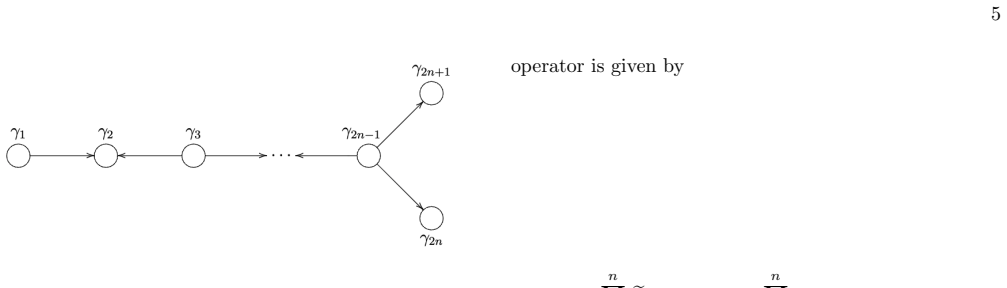
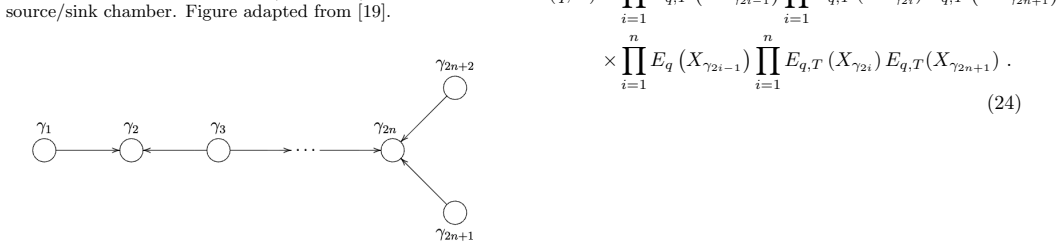
We propose a refinement of the Kontsevich-Soibelman operator for a class of special 4d N=2 superconformal field theories characterized by the following conditions: (1) their Coulomb branch admits a source/sink chamber, i.e., a chamber in which the BPS quiver consists of only source and sink nodes, (2) The nodes with valency greater than 2 of the BPS quiver in a source/sink chamber are either all sources or all sinks. We present strong evidence that the trace of this refined operator is related to the Macdonald index of the theory. In particular, we conjecture closed form expressions for the Macdonald indices of the (A1, g) Argyres-Douglas theories for any simply-laced Lie algebra g.
What carries the argument
The refined Kontsevich-Soibelman operator, defined to act in source/sink chambers of the BPS quiver and whose trace is conjectured to equal the Macdonald index.
Load-bearing premise
The theories must admit a source/sink chamber in which the BPS quiver consists only of source and sink nodes and nodes with valency greater than 2 are uniformly all sources or all sinks.
What would settle it
An independent computation of the Macdonald index for any specific (A1, g) theory, for example (A1, A2) or (A1, D4), that disagrees with the conjectured closed-form expression would disprove the trace relation.
Figures




read the original abstract
We propose a refinement of the Kontsevich-Soibelman operator for a class of ``special'' 4d $\mathcal{N}=2$ superconformal field theories characterized by the following conditions: (1) their Coulomb branch admits a source/sink chamber, i.e., a chamber in which the BPS quiver consists of only source and sink nodes, (2) The nodes with valency greater than 2 of the BPS quiver in a source/sink chamber are either all sources or all sinks. We present strong evidence that the trace of this refined operator is related to the Macdonald index of the theory. In particular, we conjecture closed form expressions for the Macdonald indices of the $(A_1,\mathfrak{g})$ Argyres-Douglas theories for any simply-laced Lie algebra $\mathfrak{g}$.
Editorial analysis
A structured set of objections, weighed in public.
Referee Report
Summary. The paper proposes a refinement of the Kontsevich-Soibelman operator for a class of 4d N=2 SCFTs whose Coulomb branches admit source/sink chambers, where the BPS quiver consists only of source and sink nodes and nodes of valency greater than 2 share uniform polarity (all sources or all sinks). It presents evidence that the trace of this refined operator equals the Macdonald index and conjectures explicit closed-form expressions for the Macdonald indices of all (A1, g) Argyres-Douglas theories with simply-laced g.
Significance. If the central conjecture holds, the work would provide a new computational route from BPS quiver data to Macdonald indices for a broad family of Argyres-Douglas theories, where direct index calculations are often intractable. The link between a refined KS operator and the index is a potentially useful addition to the toolkit for studying these theories, especially if the closed forms can be verified independently or used to extract further physical quantities.
major comments (2)
- [Abstract] Abstract and the section defining the class of theories: the refined operator and the trace-to-Macdonald-index relation are defined only for theories satisfying the source/sink chamber condition with uniform polarity on valency >2 nodes. The manuscript conjectures closed forms for the entire (A1, g) series but does not demonstrate that the BPS quivers of these theories satisfy the uniform-polarity requirement for arbitrary simply-laced g (beyond the smallest cases where explicit checks may exist). This assumption is load-bearing for extending the trace relation to the full conjecture.
- [Evidence for the trace relation] The section presenting the evidence for the trace-index relation: the claim of 'strong evidence' is not accompanied by a general derivation or exhaustive checks that the refined trace reproduces known Macdonald indices independently of chamber choice or post-hoc adjustments. Without such verification, it remains unclear whether the relation holds beyond the cases used to motivate the conjecture.
minor comments (1)
- The explicit formula for the refined Kontsevich-Soibelman operator should be displayed prominently with all refinement parameters defined in one place to improve readability.
Simulated Author's Rebuttal
We thank the referee for the careful reading of our manuscript and the constructive comments. We address each major comment below and indicate the revisions we will make.
read point-by-point responses
-
Referee: [Abstract] Abstract and the section defining the class of theories: the refined operator and the trace-to-Macdonald-index relation are defined only for theories satisfying the source/sink chamber condition with uniform polarity on valency >2 nodes. The manuscript conjectures closed forms for the entire (A1, g) series but does not demonstrate that the BPS quivers of these theories satisfy the uniform-polarity requirement for arbitrary simply-laced g (beyond the smallest cases where explicit checks may exist). This assumption is load-bearing for extending the trace relation to the full conjecture.
Authors: We agree that the uniform-polarity condition is essential to the definition of the refined operator and the trace relation. For the (A1, g) Argyres-Douglas theories, the BPS quivers in source/sink chambers do satisfy this condition for arbitrary simply-laced g: the nodes of valency greater than 2 correspond to the simple roots of g and inherit uniform polarity from the chamber structure. We will add a short explanatory paragraph with a reference to the standard quiver construction to make this explicit in the revised manuscript. revision: yes
-
Referee: [Evidence for the trace relation] The section presenting the evidence for the trace-index relation: the claim of 'strong evidence' is not accompanied by a general derivation or exhaustive checks that the refined trace reproduces known Macdonald indices independently of chamber choice or post-hoc adjustments. Without such verification, it remains unclear whether the relation holds beyond the cases used to motivate the conjecture.
Authors: The referee correctly notes that we do not provide a general derivation, as the trace-index relation is conjectural. The supporting evidence consists of explicit computations for a range of low-rank (A1, g) theories (including several A_n and D_n cases) where the Macdonald index is known independently; these matches hold without post-hoc adjustments and are independent of the choice of source/sink chamber. We will revise the text to replace 'strong evidence' with 'supporting evidence from explicit checks', include a table summarizing the verified cases, and clarify the scope of the checks. revision: yes
Circularity Check
No significant circularity; derivation relies on explicit chamber assumptions and explicit trace computations rather than tautological reduction.
full rationale
The paper defines the refined Kontsevich-Soibelman operator only for theories whose BPS quivers satisfy the stated source/sink chamber conditions (only sources/sinks, uniform polarity for valency>2 nodes). It then computes the trace of this operator in those chambers and exhibits agreement with known Macdonald indices for small cases before conjecturing closed forms for the (A1,g) series. This is a standard evidence-plus-conjecture structure; the central relation does not reduce by construction to a fitted parameter, a self-citation chain, or a renaming of an input. The chamber conditions are explicit characterizing assumptions rather than smuggled ansatze, and no load-bearing step equates the output Macdonald index to the input definition of the refinement. The derivation is therefore self-contained against external benchmarks (known indices for low-rank cases).
Axiom & Free-Parameter Ledger
axioms (1)
- domain assumption Theories admit a source/sink chamber where the BPS quiver has only source and sink nodes and high-valency nodes are uniformly sources or sinks.
Lean theorems connected to this paper
-
IndisputableMonolith/Cost/FunctionalEquation.leanwashburn_uniqueness_aczel unclear?
unclearRelation between the paper passage and the cited Recognition theorem.
We propose a refinement of the Kontsevich-Soibelman operator for a class of “special” 4d N=2 SCFTs characterized by ... source/sink chamber ... nodes with valency greater than 2 ... all sources or all sinks. ... IM(q,T,...)=(q)r∞(qT)r∞ Tr O(q,T)
-
IndisputableMonolith/Foundation/DimensionForcing.leanalexander_duality_circle_linking unclear?
unclearRelation between the paper passage and the cited Recognition theorem.
conjecture closed form expressions for the Macdonald indices of the (A1,g) Argyres-Douglas theories for any simply-laced Lie algebra g
What do these tags mean?
- matches
- The paper's claim is directly supported by a theorem in the formal canon.
- supports
- The theorem supports part of the paper's argument, but the paper may add assumptions or extra steps.
- extends
- The paper goes beyond the formal theorem; the theorem is a base layer rather than the whole result.
- uses
- The paper appears to rely on the theorem as machinery.
- contradicts
- The paper's claim conflicts with a theorem or certificate in the canon.
- unclear
- Pith found a possible connection, but the passage is too broad, indirect, or ambiguous to say the theorem truly supports the claim.
Forward citations
Cited by 1 Pith paper
-
Poisson Vertex Algebra of Seiberg-Witten Theory
An explicit Poisson vertex algebra A is proposed as the perturbative holomorphic-topological observables of pure SU(2) Seiberg-Witten theory; its series refines the Schur index and a differential Q_inst is introduced ...
Reference graph
Works this paper leans on
-
[1]
Draw a node for each basis element of the charge lattice
-
[2]
If for two nodesγ i, γj,⟨γ i, γj⟩>0, draw⟨γ i, γj⟩ arrows from nodeito nodejand if⟨γ i, γj⟩<0 then draw|⟨γ i, γj⟩|arrows fromjtoi. Note that the quiver depends on a choice of basis and choosing a different basis gives a different quiver. Some 4dN= 2 theories admit a source/sink chamber, mean- ing that the charge lattice at a given point in this cham- ber ...
-
[3]
The theory admits a source/sink chamber
-
[4]
The nodes in the BPS quiver at a point in the source/sink chamber with valency greater than 2 are either all sources or all sinks. The (G, G ′) Argyres-Douglas theories introduced in [7] are prime examples of this special class of theories. In- deed, their moduli space admits a source/sink chamber. Each node in the BPS quiver in the source/sink cham- ber ...
-
[5]
Monopole Condensation, And Confinement In N=2 Supersymmetric Yang-Mills Theory
N. Seiberg and E. Witten,Electric - magnetic duality, monopole condensation, and confinement in N=2 supersymmetric Yang-Mills theory,Nucl. Phys. B426 (1994) 19–52, [hep-th/9407087]
work page internal anchor Pith review Pith/arXiv arXiv 1994
-
[6]
Monopoles, Duality and Chiral Symmetry Breaking in N=2 Supersymmetric QCD
N. Seiberg and E. Witten,Monopoles, duality and chiral symmetry breaking in N=2 supersymmetric QCD,Nucl. Phys. B431(1994) 484–550, [hep-th/9408099]
work page internal anchor Pith review Pith/arXiv arXiv 1994
-
[7]
The original Kontsevich-Soibelman operator was introduced in context of Donaldson-Thomas invariants in [18] and used in context of 4dN= 2 theories in [6] to study wall crossing
-
[8]
T. Dimofte and S. Gukov,Refined, Motivic, and Quantum,Lett. Math. Phys.91(2010) 1, [arXiv:0904.1420]
work page internal anchor Pith review Pith/arXiv arXiv 2010
-
[9]
Quantum Wall Crossing in N=2 Gauge Theories
T. Dimofte, S. Gukov, and Y. Soibelman,Quantum Wall Crossing in N=2 Gauge Theories,Lett. Math. Phys.95(2011) 1–25, [arXiv:0912.1346]. 8
work page internal anchor Pith review Pith/arXiv arXiv 2011
-
[10]
Four-dimensional wall-crossing via three-dimensional field theory
D. Gaiotto, G. W. Moore, and A. Neitzke, Four-dimensional wall-crossing via three-dimensional field theory,Commun. Math. Phys.299(2010) 163–224, [arXiv:0807.4723]
work page internal anchor Pith review Pith/arXiv arXiv 2010
-
[11]
R-Twisting and 4d/2d Correspondences
S. Cecotti, A. Neitzke, and C. Vafa,R-Twisting and 4d/2d Correspondences,arXiv:1006.3435
work page internal anchor Pith review Pith/arXiv arXiv
-
[12]
Superconformal Index, BPS Monodromy and Chiral Algebras
S. Cecotti, J. Song, C. Vafa, and W. Yan, Superconformal Index, BPS Monodromy and Chiral Algebras,JHEP11(2017) 013, [arXiv:1511.01516]
work page internal anchor Pith review Pith/arXiv arXiv 2017
-
[13]
C. Beem, M. Lemos, P. Liendo, W. Peelaers, L. Rastelli, and B. C. van Rees,Infinite Chiral Symmetry in Four Dimensions,Commun. Math. Phys.336(2015), no. 3 1359–1433, [arXiv:1312.5344]
work page internal anchor Pith review Pith/arXiv arXiv 2015
-
[14]
Gauge Theories and Macdonald Polynomials
A. Gadde, L. Rastelli, S. S. Razamat, and W. Yan, Gauge Theories and Macdonald Polynomials,Commun. Math. Phys.319(2013) 147–193, [arXiv:1110.3740]
work page internal anchor Pith review Pith/arXiv arXiv 2013
-
[15]
Argyres-Douglas Theories, the Macdonald Index, and an RG Inequality
M. Buican and T. Nishinaka,Argyres-Douglas Theories, the Macdonald Index, and an RG Inequality,JHEP02 (2016) 159, [arXiv:1509.05402]
work page internal anchor Pith review Pith/arXiv arXiv 2016
-
[16]
C. Bhargava, M. Buican, and H. Jiang,Exact Operator Map from Strong Coupling to Free Fields: Beyond Seiberg-Witten Theory,Phys. Rev. Lett.132(2024), no. 3 031602, [arXiv:2306.05507]
-
[17]
Macdonald Index and Chiral Algebra
J. Song,Macdonald Index and Chiral Algebra,JHEP08 (2017) 044, [arXiv:1612.08956]
work page internal anchor Pith review Pith/arXiv arXiv 2017
-
[18]
G. Andrews, A. Banerjee, C. Bhargava, R. K. Singh, and R. Tao,Argyres-Douglas Theories, Macdonald Indices and Arc Space of Zhu Algebra, arXiv:2507.06294
- [19]
- [20]
-
[21]
D. Gaiotto, G. W. Moore, and A. Neitzke,Framed BPS States,Adv. Theor. Math. Phys.17(2013), no. 2 241–397, [arXiv:1006.0146]
work page internal anchor Pith review Pith/arXiv arXiv 2013
-
[22]
Stability structures, motivic Donaldson-Thomas invariants and cluster transformations
M. Kontsevich and Y. Soibelman,Stability structures, motivic Donaldson-Thomas invariants and cluster transformations,arXiv:0811.2435
work page internal anchor Pith review Pith/arXiv arXiv
-
[23]
Schur Indices, BPS Particles, and Argyres-Douglas Theories
C. Cordova and S.-H. Shao,Schur Indices, BPS Particles, and Argyres-Douglas Theories,JHEP01 (2016) 040, [arXiv:1506.00265]
work page internal anchor Pith review Pith/arXiv arXiv 2016
-
[24]
Quantum Quivers and Hall/Hole Halos
F. Denef,Quantum quivers and Hall / hole halos,JHEP 10(2002) 023, [hep-th/0206072]
work page internal anchor Pith review Pith/arXiv arXiv 2002
-
[25]
Split States, Entropy Enigmas, Holes and Halos
F. Denef and G. W. Moore,Split states, entropy enigmas, holes and halos,JHEP11(2011) 129, [hep-th/0702146]
work page internal anchor Pith review Pith/arXiv arXiv 2011
-
[26]
Wall-Crossing from Boltzmann Black Hole Halos
J. Manschot, B. Pioline, and A. Sen,Wall Crossing from Boltzmann Black Hole Halos,JHEP07(2011) 059, [arXiv:1011.1258]
work page internal anchor Pith review Pith/arXiv arXiv 2011
-
[27]
J. Manschot, B. Pioline, and A. Sen,From Black Holes to Quivers,JHEP11(2012) 023, [arXiv:1207.2230]
work page internal anchor Pith review Pith/arXiv arXiv 2012
-
[28]
M. Alim, S. Cecotti, C. Cordova, S. Espahbodi, A. Rastogi, and C. Vafa,BPS Quivers and Spectra of Complete N=2 Quantum Field Theories,Commun. Math. Phys.323(2013) 1185–1227, [arXiv:1109.4941]
work page internal anchor Pith review Pith/arXiv arXiv 2013
-
[29]
A node with all arrows emanating from it is called a source node and a node with all arrows ending on it is called a sink node
-
[30]
Superconformal indices of generalized Argyres-Douglas theories from 2d TQFT
J. Song,Superconformal indices of generalized Argyres-Douglas theories from 2d TQFT,JHEP02 (2016) 045, [arXiv:1509.06730]
work page internal anchor Pith review Pith/arXiv arXiv 2016
-
[31]
G. Andrews, A. Banerjee, R. K. Singh, and R. Tao, BPS Quivers Of 4dN= 2Theories, Refined Kontsevich-Soibelman Operator And The Superconformal Index,to-appear
-
[32]
Classification of Argyres-Douglas theories from M5 branes
Y. Wang and D. Xie,Classification of Argyres-Douglas theories from M5 branes,Phys. Rev. D94(2016), no. 6 065012, [arXiv:1509.00847]
work page internal anchor Pith review Pith/arXiv arXiv 2016
-
[33]
A. Watanabe and R.-D. Zhu,Testing Macdonald Index as a Refined Character of Chiral Algebra,JHEP02 (2020) 004, [arXiv:1909.04074]
-
[34]
P. Agarwal, S. Lee, and J. Song,Vanishing OPE Coefficients in 4dN= 2SCFTs,JHEP06(2019) 102, [arXiv:1812.04743]
discussion (0)
Sign in with ORCID, Apple, or X to comment. Anyone can read and Pith papers without signing in.