Discovering a well-conditioned analytic continuation problem via dictionary learning
Pith reviewed 2026-06-26 18:41 UTC · model grok-4.3
The pith
Regularized stochastic optimization discovers a sparse dictionary that transforms the ill-conditioned analytic continuation problem into a well-conditioned one.
A machine-rendered reading of the paper's core claim, the machinery that carries it, and where it could break.
Core claim
RSOM reformulates analytic continuation as a dictionary learning problem and discovers a sparse dictionary that maps an ill-conditioned inverse problem to a low-dimensional problem that is well-conditioned, yielding accurate results for both synthetic test problems and authentic QMC data.
What carries the argument
The regularized stochastic optimization method (RSOM), which learns a sparse dictionary to represent solutions to the analytic continuation problem.
If this is right
- Analytic continuation can be solved by reducing it to a well-conditioned low-dimensional problem via the learned dictionary.
- Dictionary learning provides a new framework that encompasses both stochastic and regularized approaches to analytic continuation.
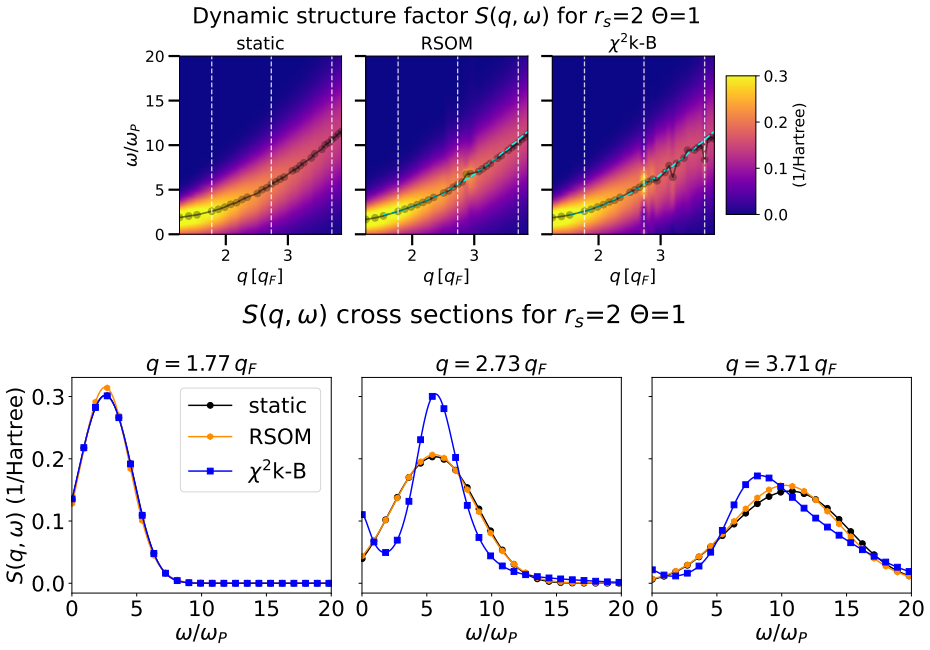
- The method produces competitive results on common synthetic test problems and real data from the electron gas.
- Future AC methods can attack the problem from the angle of dictionary learning.
Where Pith is reading between the lines
- The existence of such a dictionary implies that many existing methods implicitly rely on similar sparse representations.
- Applying RSOM to other inverse problems in physics could reveal similar well-conditioned mappings.
- Testing the stability of the learned dictionary across different temperatures or system sizes would strengthen the method.
Load-bearing premise
That a sparse dictionary learned via regularized stochastic optimization on synthetic data will exist, remain stable, and accurately reconstruct spectral functions from real quantum Monte Carlo data.
What would settle it
Applying the learned dictionary from synthetic tests to QMC data from a more complex system, such as a lattice model, and observing large discrepancies in the recovered spectral functions compared to known benchmarks.
Figures
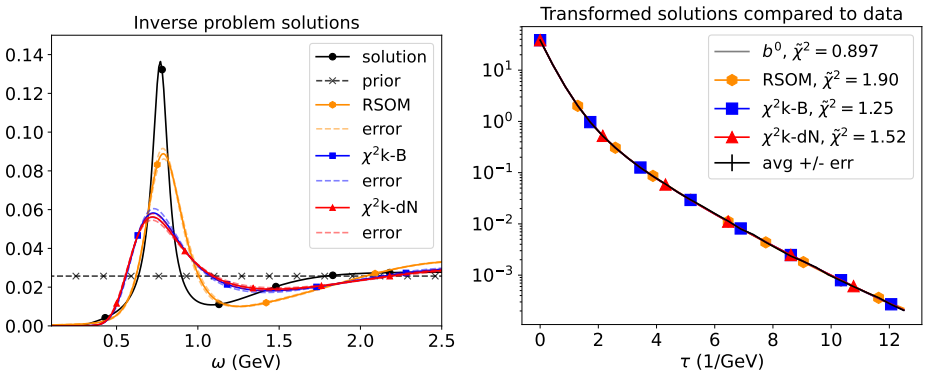
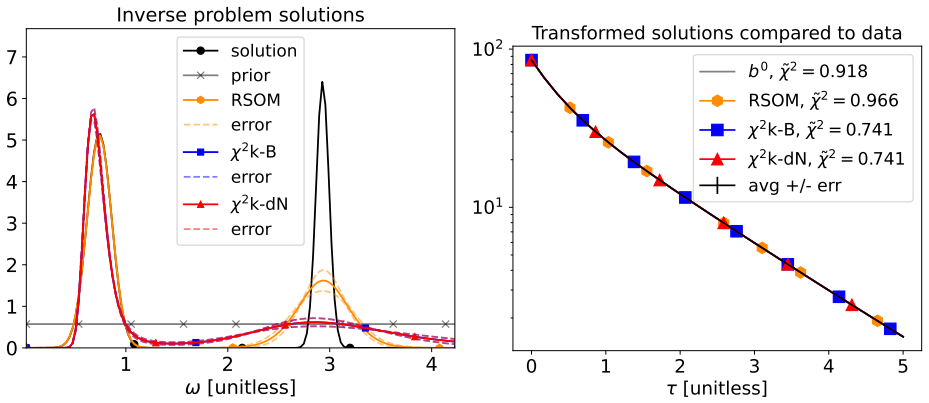
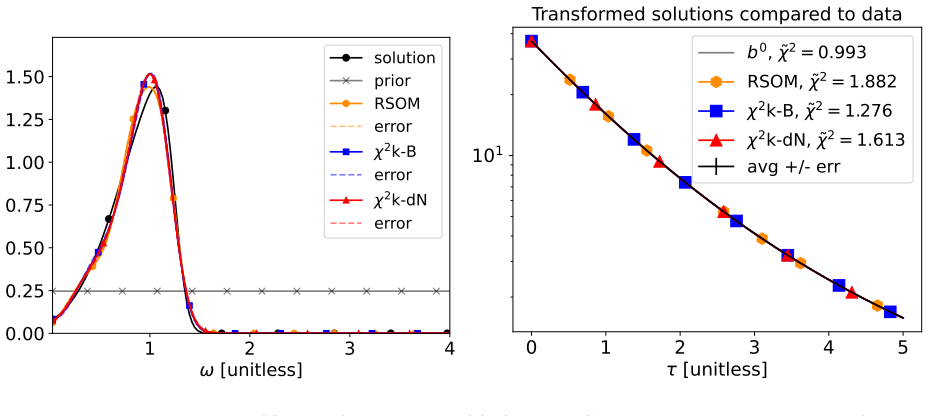
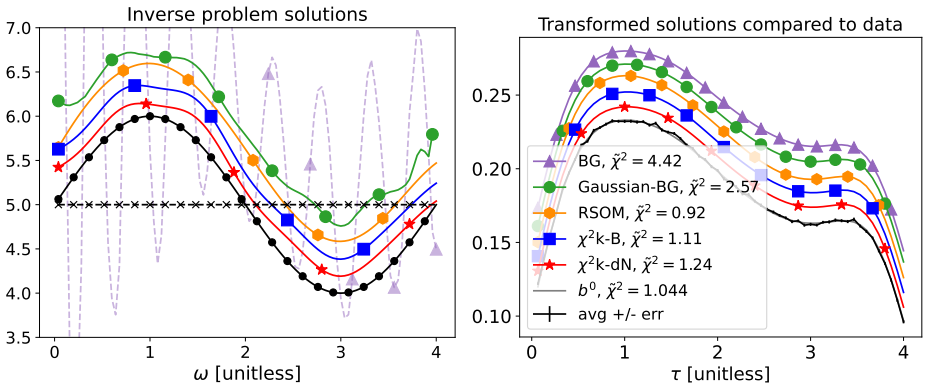
read the original abstract
Many fields of physics use quantum Monte Carlo (QMC) simulations to simulate quantum systems in imaginary-time $\tau$ and estimate imaginary-time correlation functions (ITCF). However, extracting dynamic $\omega$-dependent quantities from ITCFs is a notoriously difficult task, known as analytic continuation (AC), that amounts to solving an exponentially ill-conditioned inverse problem. Within the AC literature, there are competing stochastic and regularized approaches, as well as an emerging collection of works using parameterized models like neural networks. Here we transcend the traditional divides between the communities, introducing the regularized stochastic optimization method (RSOM). This method reformulates AC as a dictionary learning problem, discovering a sparse dictionary to represent the solution. Our approach is motivated by the astounding results dictionary learning has produced in many scientific fields. Remarkably, RSOM discovers a sparse dictionary that maps an ill-conditioned inverse problem to a low-dimensional problem that is well-conditioned. We demonstrate that the method yields competitive results for common synthetic test problems as well as for authentic QMC data from the finite temperature electron gas. This work exposes that a dictionary exists within all stochastic and regularized methods and that dictionary learning provides a new angle of attack for future AC methods.
Editorial analysis
A structured set of objections, weighed in public.
Referee Report
Summary. The manuscript introduces the regularized stochastic optimization method (RSOM) that recasts analytic continuation of imaginary-time correlation functions as a dictionary-learning task. It claims that RSOM discovers a sparse dictionary mapping the exponentially ill-conditioned kernel to a low-dimensional, intrinsically well-conditioned sub-problem, and reports competitive performance on both synthetic test cases and authentic finite-temperature electron-gas QMC data.
Significance. If the headline claim is substantiated, the work supplies a new conceptual framing that unifies stochastic and regularized AC approaches under dictionary learning and demonstrates that such dictionaries can be learned directly from data. The absence of free parameters in the core construction and the explicit link to existing methods are strengths that would be noteworthy if the conditioning improvement is rigorously verified.
major comments (3)
- [Abstract, §4] Abstract and §4 (results): the central assertion that the learned dictionary produces a 'well-conditioned' low-dimensional inverse problem is not supported by any reported condition-number spectra, singular-value distributions, or perturbation-stability tests before versus after projection onto the dictionary. Without these quantities the distinction between genuine conditioning improvement and regularization-induced stability cannot be assessed.
- [§3, §5] §3 (method) and §5 (real-data application): no quantitative metrics (MSE, integrated absolute error, error bars, or direct comparisons to MaxEnt, stochastic analytic continuation, or neural-network baselines) are supplied for either the synthetic or the electron-gas QMC examples, making the 'competitive results' claim impossible to evaluate.
- [§4.2] §4.2 (synthetic tests): the manuscript does not demonstrate that the recovered spectral functions remain accurate when the input ITCF is corrupted by realistic QMC noise levels rather than the idealized synthetic noise used for validation.
minor comments (2)
- [Abstract, §2] Notation for the dictionary atoms and the projection operator should be introduced once and used consistently; several symbols appear without prior definition in the abstract and early sections.
- [Figures 2-5] Figure captions lack explicit statements of the regularization parameter schedule and convergence tolerance used in the RSOM runs.
Simulated Author's Rebuttal
We thank the referee for their careful reading and constructive comments. Below we respond point-by-point to the major comments and outline the revisions we will make.
read point-by-point responses
-
Referee: [Abstract, §4] Abstract and §4 (results): the central assertion that the learned dictionary produces a 'well-conditioned' low-dimensional inverse problem is not supported by any reported condition-number spectra, singular-value distributions, or perturbation-stability tests before versus after projection onto the dictionary. Without these quantities the distinction between genuine conditioning improvement and regularization-induced stability cannot be assessed.
Authors: We agree that explicit numerical verification of the conditioning improvement is necessary to distinguish the effect from regularization. In the revised manuscript we will add condition-number spectra, singular-value distributions, and perturbation-stability tests comparing the original kernel to the dictionary-projected sub-problem. revision: yes
-
Referee: [§3, §5] §3 (method) and §5 (real-data application): no quantitative metrics (MSE, integrated absolute error, error bars, or direct comparisons to MaxEnt, stochastic analytic continuation, or neural-network baselines) are supplied for either the synthetic or the electron-gas QMC examples, making the 'competitive results' claim impossible to evaluate.
Authors: We acknowledge the absence of these quantitative metrics in the submitted version. The revised manuscript will include MSE, integrated absolute error, error bars, and direct comparisons against MaxEnt, stochastic analytic continuation, and neural-network baselines for both the synthetic tests and the electron-gas QMC data. revision: yes
-
Referee: [§4.2] §4.2 (synthetic tests): the manuscript does not demonstrate that the recovered spectral functions remain accurate when the input ITCF is corrupted by realistic QMC noise levels rather than the idealized synthetic noise used for validation.
Authors: The synthetic tests employed controlled noise to isolate the dictionary-learning mechanism. We will add a new set of experiments in the revised §4.2 that inject noise amplitudes matching typical QMC statistical uncertainties to confirm robustness under realistic conditions. revision: yes
Circularity Check
No significant circularity; RSOM presented as empirical dictionary-learning reformulation without self-referential reductions.
full rationale
The paper introduces RSOM as a reformulation of analytic continuation into a dictionary-learning problem solved via regularized stochastic optimization. The central claim—that a learned sparse dictionary maps the ill-conditioned kernel to a low-dimensional well-conditioned subproblem—is supported by reported performance on synthetic test cases and real finite-temperature electron-gas QMC data. No equations, procedures, or self-citations in the abstract or described method reduce the claimed discovery to a fitted parameter, self-definition, or prior author result by construction. The dictionary is learned from data rather than presupposed, and the well-conditioned property is asserted as an observed outcome rather than a definitional tautology. This is the common honest finding for a method paper whose validation rests on external benchmarks.
Axiom & Free-Parameter Ledger
Reference graph
Works this paper leans on
-
[1]
W. M. C. Foulkes, L. Mitas, R. J. Needs, G. Rajagopal, Quantum monte carlo simulations of solids, Rev. Mod. Phys. 73 (2001) 33–83.doi:10.1103/RevModPhys.73.33. URLhttps://link.aps.org/doi/10.1103/RevModPhys.73.33
-
[2]
Anderson, Quantum Monte Carlo: Origins, Development, Applications, Oxford University Press, USA, 2007
J. Anderson, Quantum Monte Carlo: Origins, Development, Applications, Oxford University Press, USA, 2007. URLhttps://books.google.de/books?id=_QUSDAAAQBAJ
2007
-
[3]
D. M. Ceperley, Path integrals in the theory of condensed helium, Rev. Mod. Phys 67 (1995) 279. URLhttps://journals.aps.org/rmp/abstract/10.1103/RevModPhys.67.279
-
[4]
F. Knechtli, M. G¨ unther, M. Peardon, Lattice Quantum Chromodynamics: Practical Essentials, 1st Edition, SpringerBriefs in Physics, Springer, Dordrecht, Netherlands, 2017.doi:10.1007/978-94-024-0999-4. URLhttps://doi.org/10.1007/978-94-024-0999-4
-
[5]
M. Jarrell, J. Gubernatis, Bayesian inference and the analytic continuation of imaginary-time quantum monte carlo data, Physics Reports 269 (3) (1996) 133–195.doi:https://doi.org/10.1016/0370-1573(95)00074-7. URLhttps://www.sciencedirect.com/science/article/pii/0370157395000747
-
[6]
M. Boninsegni, N. V. Prokofev, B. V. Svistunov, Worm algorithm and diagrammatic Monte Carlo: A new approach to continuous-space path integral Monte Carlo simulations, Phys. Rev. E 74 (2006) 036701. URLhttps://journals.aps.org/pre/abstract/10.1103/PhysRevE.74.036701
-
[7]
E. Rabani, D. R. Reichman, G. Krilov, B. J. Berne, The calculation of transport properties in quantum liquids using the maximum entropy numerical analytic continuation method: Application to liquid para-hydrogen, Proceedings of the National Academy of Sciences 99 (3) (2002) 1129–1133.arXiv:https://www.pnas.org/doi/pdf/10.1073/pnas.261540698, doi:10.1073/p...
-
[8]
T. Dornheim, Z. Moldabekov, P. Tolias, M. B¨ ohme, J. Vorberger, Physical insights from imaginary-time density–density correlation functions, Matter and Radiation at Extremes 8 (2023) 056601.doi:10.1063/5.0149638. URLhttps://doi.org/10.1063/5.0149638
-
[9]
T. Dornheim, Z. A. Moldabekov, J. Vorberger, Nonlinear density response from imaginary-time correlation functions: Ab initio path integral monte carlo simulations of the warm dense electron gas, The Journal of Chemical Physics 155 (5) (2021) 054110.doi:10.1063/5.0058988. URLhttps://doi.org/10.1063/5.0058988
-
[10]
S. Shi, L. Wang, K. Zhou, Rethinking the ill-posedness of the spectral function reconstruction — why is it fundamentally hard and how artificial neural networks can help, Computer Physics Communications 282 (2023) 108547.doi:https: //doi.org/10.1016/j.cpc.2022.108547. URLhttps://www.sciencedirect.com/science/article/pii/S0010465522002661
-
[11]
M. Asakawa, Y. Nakahara, T. Hatsuda, Maximum entropy analysis of the spectral functions in lattice qcd, Progress in Particle and Nuclear Physics 46 (2) (2001) 459–508.doi:https://doi.org/10.1016/S0146-6410(01)00150-8. URLhttps://www.sciencedirect.com/science/article/pii/S0146641001001508
-
[12]
Y. Burnier, A. Rothkopf, Bayesian approach to spectral function reconstruction for euclidean quantum field theories, Phys. Rev. Lett. 111 (2013) 182003.doi:10.1103/PhysRevLett.111.182003. URLhttps://link.aps.org/doi/10.1103/PhysRevLett.111.182003
-
[13]
J. Otsuki, M. Ohzeki, H. Shinaoka, K. Yoshimi, Sparse modeling approach to analytical continuation of imaginary-time quantum monte carlo data, Phys. Rev. E 95 (2017) 061302.doi:10.1103/PhysRevE.95.061302. URLhttps://link.aps.org/doi/10.1103/PhysRevE.95.061302
-
[14]
J. Otsuki, M. Ohzeki, H. Shinaoka, K. Yoshimi, Sparse modeling in quantum many-body problems, Journal of the Physical Society of Japan 89 (1) (2020) 012001.doi:10.7566/JPSJ.89.012001. URLhttps://doi.org/10.7566/JPSJ.89.012001
-
[15]
N. V. Prokof’ev, B. V. Svistunov, Spectral analysis by the method of consistent constraints, JETP letters 97 (11) (2013) 649–653.doi:10.1134/S002136401311009X. URLhttps://doi.org/10.1134/S002136401311009X
-
[16]
M. Han, H. J. Choi, Parameter-free analytic continuation for quantum many-body calculations, Phys. Rev. B 106 (2022) 245150.doi:10.1103/PhysRevB.106.245150. URLhttps://link.aps.org/doi/10.1103/PhysRevB.106.245150
-
[17]
T. Chuna, N. Barnfield, T. Dornheim, M. P. Friedlander, T. Hoheisel, Dual formulation of the maximum entropy method applied to analytic continuation of quantum monte carlo data, Journal of Physics A: Mathematical and Theoretical 58 (33) (2025) 335203.doi:10.1088/1751-8121/adf924
-
[18]
A. Benedix Robles, P.-A. Hofmann, T. Chuna, T. Dornheim, M. Hecht, Pylit: Reformulation and implementation of the analytic continuation problem using kernel representation methods, Computer Physics Communications 319 (2026) 109904.doi:https://doi.org/10.1016/j.cpc.2025.109904. URLhttps://www.sciencedirect.com/science/article/pii/S0010465525004059
-
[19]
A. W. Sandvik, Stochastic method for analytic continuation of quantum monte carlo data, Phys. Rev. B 57 (1998) 10287– 10290.doi:10.1103/PhysRevB.57.10287. URLhttps://link.aps.org/doi/10.1103/PhysRevB.57.10287
-
[20]
A. S. Mishchenko, N. V. Prokof’ev, A. Sakamoto, B. V. Svistunov, Diagrammatic quantum monte carlo study of the fr¨ ohlich polaron, Phys. Rev. B 62 (2000) 6317–6336.doi:10.1103/PhysRevB.62.6317. URLhttps://link.aps.org/doi/10.1103/PhysRevB.62.6317 15
-
[21]
E. Vitali, M. Rossi, L. Reatto, D. E. Galli, Ab initio low-energy dynamics of superfluid and solid 4He, Phys. Rev. B 82 (2010) 174510.doi:10.1103/PhysRevB.82.174510. URLhttps://link.aps.org/doi/10.1103/PhysRevB.82.174510
-
[22]
S. Saccani, S. Moroni, M. Boninsegni, Excitation spectrum of a supersolid, Phys. Rev. Lett. 108 (2012) 175301.doi: 10.1103/PhysRevLett.108.175301. URLhttps://link.aps.org/doi/10.1103/PhysRevLett.108.175301
-
[23]
H.-T. Shu, H.-T. Ding, O. Kaczmarek, S. Mukherjee, H. Ohno, A stochastic approach to the reconstruction of spectral functions in lattice qcd, arXiv preprint arXiv:1510.02901 (2015)
Pith/arXiv arXiv 2015
-
[24]
F. Bao, Y. Tang, M. Summers, G. Zhang, C. Webster, V. Scarola, T. A. Maier, Fast and efficient stochastic optimization for analytic continuation, Phys. Rev. B 94 (2016) 125149.doi:10.1103/PhysRevB.94.125149. URLhttps://link.aps.org/doi/10.1103/PhysRevB.94.125149
-
[25]
N. S. Nichols, P. Sokol, A. Del Maestro, Parameter-free differential evolution algorithm for the analytic continuation of imaginary time correlation functions, Phys. Rev. E 106 (2022) 025312.doi:10.1103/PhysRevE.106.025312. URLhttps://link.aps.org/doi/10.1103/PhysRevE.106.025312
-
[26]
H. Shao, A. W. Sandvik, Progress on stochastic analytic continuation of quantum monte carlo data, Physics Reports 1003 (2023) 1–88.doi:https://doi.org/10.1016/j.physrep.2022.11.002. URLhttps://www.sciencedirect.com/science/article/pii/S0370157322003921
-
[27]
O. Goulko, A. S. Mishchenko, L. Pollet, N. Prokof’ev, B. Svistunov, Numerical analytic continuation: Answers to well- posed questions, Phys. Rev. B 95 (2017) 014102.doi:10.1103/PhysRevB.95.014102. URLhttps://link.aps.org/doi/10.1103/PhysRevB.95.014102
-
[28]
D. Bergeron, A.-M. S. Tremblay, Algorithms for optimized maximum entropy and diagnostic tools for analytic continuation, Phys. Rev. E 94 (2016) 023303.doi:10.1103/PhysRevE.94.023303. URLhttps://link.aps.org/doi/10.1103/PhysRevE.94.023303
-
[29]
A. W. Sandvik, R. R. P. Singh, High-energy magnon dispersion and multimagnon continuum in the two-dimensional heisenberg antiferromagnet, Phys. Rev. Lett. 86 (2001) 528–531.doi:10.1103/PhysRevLett.86.528. URLhttps://link.aps.org/doi/10.1103/PhysRevLett.86.528
-
[30]
E. Katz, S. Sachdev, E. S. Sørensen, W. Witczak-Krempa, Conformal field theories at nonzero temperature: Operator product expansions, monte carlo, and holography, Phys. Rev. B 90 (2014) 245109.doi:10.1103/PhysRevB.90.245109. URLhttps://link.aps.org/doi/10.1103/PhysRevB.90.245109
-
[31]
P. Buividovich, J. Ostmeyer, A. Troisi, High-precision quantum monte-carlo study of charge transport in a lattice model of molecular organic semiconductors, arXiv preprint arXiv:2411.17460 (2024)
arXiv 2024
-
[32]
S. Groth, T. Dornheim, J. Vorberger, Ab initio path integral monte carlo approach to the static and dynamic density response of the uniform electron gas, Phys. Rev. B 99 (2019) 235122.doi:10.1103/PhysRevB.99.235122. URLhttps://link.aps.org/doi/10.1103/PhysRevB.99.235122
-
[33]
A. V. Filinov, J. Ara, I. M. Tkachenko, Dynamical response in strongly coupled uniform electron liquids: Observation of plasmon-roton coexistence using nine sum rules, shannon information entropy, and path-integral monte carlo simulations, Phys. Rev. B 107 (2023) 195143.doi:10.1103/PhysRevB.107.195143. URLhttps://link.aps.org/doi/10.1103/PhysRevB.107.195143
-
[34]
H. Yoon, J.-H. Sim, M. J. Han, Analytic continuation via domain knowledge free machine learning, Phys. Rev. B 98 (2018) 245101.doi:10.1103/PhysRevB.98.245101. URLhttps://link.aps.org/doi/10.1103/PhysRevB.98.245101
-
[35]
L. Kades, J. M. Pawlowski, A. Rothkopf, M. Scherzer, J. M. Urban, S. J. Wetzel, N. Wink, F. P. G. Ziegler, Spectral reconstruction with deep neural networks, Phys. Rev. D 102 (2020) 096001.doi:10.1103/PhysRevD.102.096001. URLhttps://link.aps.org/doi/10.1103/PhysRevD.102.096001
-
[36]
R. Fournier, L. Wang, O. V. Yazyev, Q. Wu, Artificial neural network approach to the analytic continuation problem, Phys. Rev. Lett. 124 (2020) 056401.doi:10.1103/PhysRevLett.124.056401. URLhttps://link.aps.org/doi/10.1103/PhysRevLett.124.056401
-
[37]
X. Xie, F. Bao, T. Maier, C. Webster, Analytic continuation of noisy data using adams bashforth residual neural network, Discrete and Continuous Dynamical Systems - S 15 (4) (2022) 877–892.doi:10.3934/dcdss.2021088. URLhttps://www.aimsciences.org/article/id/80acaa43-040a-4fac-a471-df7b267f5a8d
-
[38]
S. Y. Chen, H. T. Ding, F. Y. Liu, G. Papp, C. B. Yang, Machine learning spectral functions in lattice qcd, in: Proceedings of Science (LATTICE2021), 2021, p. 148, poS(LATTICE2021)148.arXiv:2110.13521,doi:10.48550/arXiv.2110.13521. URLhttps://pos.sissa.it/396/148
-
[39]
D. Huang, Y.-f. Yang, Learned optimizers for analytic continuation, Phys. Rev. B 105 (2022) 075112.doi:10.1103/ PhysRevB.105.075112. URLhttps://link.aps.org/doi/10.1103/PhysRevB.105.075112
-
[40]
L. Wang, S. Shi, K. Zhou, Reconstructing spectral functions via automatic differentiation, Phys. Rev. D 106 (2022) L051502.doi:10.1103/PhysRevD.106.L051502. URLhttps://link.aps.org/doi/10.1103/PhysRevD.106.L051502
-
[41]
L. Wang, S. Shi, K. Zhou, Unsupervised learning spectral functions with neural networks, in: Journal of Physics: Confer- ence Series, Vol. 2586, IOP Publishing, 2023, p. 012158.doi:10.1088/1742-6596/2586/1/012158
-
[42]
M. Rumetshofer, D. Bauernfeind, W. von der Linden, Bayesian parametric analytic continuation of green’s functions, Phys. Rev. B 100 (2019) 075137.doi:10.1103/PhysRevB.100.075137. URLhttps://link.aps.org/doi/10.1103/PhysRevB.100.075137
-
[43]
S. L. Brunton, J. N. Kutz, Data-driven science and engineering: Machine learning, dynamical systems, and control, 16 Cambridge University Press, 2022
2022
-
[44]
J. N. Kutz, S. L. Brunton, Parsimony as the ultimate regularizer for physics-informed machine learning, Nonlinear Dy- namics 107 (3) (2022) 1801–1817.doi:10.1007/s11071-021-07118-3. URLhttps://doi.org/10.1007/s11071-021-07118-3
-
[45]
B. K. Natarajan, Sparse approximate solutions to linear systems, SIAM Journal on Computing 24 (2) (1995) 227–234. doi:10.1137/S0097539792240406. URLhttps://doi.org/10.1137/S0097539792240406
-
[46]
R. Bryan, Maximum entropy analysis of oversampled data problems, European Biophysics Journal 18 (1990) 165–174. doi:10.1007/BF02427376
-
[47]
A. Rothkopf, Bryan’s maximum entropy method—diagnosis of a flawed argument and its remedy, Data 5 (3) (2020) 85. doi:10.3390/data5030085. URLhttps://doi.org/10.3390/data5030085
-
[48]
C. S. Fischer, J. M. Pawlowski, A. Rothkopf, C. A. Welzbacher, Bayesian analysis of quark spectral properties from the dyson-schwinger equation, Phys. Rev. D 98 (2018) 014009.doi:10.1103/PhysRevD.98.014009. URLhttps://link.aps.org/doi/10.1103/PhysRevD.98.014009
-
[49]
G. J. McLachlan, K. E. Basford, Mixture Models: Inference and Applications to Clustering, Marcel Dekker, New York, 1988
1988
-
[50]
A. Rothkopf, Improved maximum entropy analysis with an extended search space, Journal of Computational Physics 238 (2013) 106–114.doi:https://doi.org/10.1016/j.jcp.2012.12.023. URLhttps://www.sciencedirect.com/science/article/pii/S0021999112007541
-
[51]
A. Kelly, A. Rothkopf, J.-I. Skullerud, Bayesian study of relativistic open and hidden charm in anisotropic lattice qcd, Phys. Rev. D 97 (2018) 114509.doi:10.1103/PhysRevD.97.114509. URLhttps://link.aps.org/doi/10.1103/PhysRevD.97.114509
-
[52]
J. K. Blitzstein, J. Hwang, Introduction to probability, Chapman and Hall/CRC, 2019
2019
-
[53]
T. Chuna, N. Barnfield, J. Vorberger, M. P. Friedlander, T. Hoheisel, T. Dornheim, Estimates of the dynamic structure factor for the finite temperature electron liquid via analytic continuation of path integral monte carlo data, Phys. Rev. B 112 (2025) 125112.doi:10.1103/4d4b-kgtk. URLhttps://link.aps.org/doi/10.1103/4d4b-kgtk
- [54]
-
[55]
Chuna, Inverseproblemsolvers,https://github.com/chunatho/InverseProblemSolvers(2025)
T. Chuna, Inverseproblemsolvers,https://github.com/chunatho/InverseProblemSolvers(2025)
2025
-
[56]
H.-T. Ding, A. Francis, O. Kaczmarek, F. Karsch, H. Satz, W. Soeldner, Charmonium properties in hot quenched lattice qcd, Phys. Rev. D 86 (2012) 014509.doi:10.1103/PhysRevD.86.014509. URLhttps://link.aps.org/doi/10.1103/PhysRevD.86.014509
-
[57]
E. V. Shuryak, Correlation functions in the qcd vacuum, Rev. Mod. Phys. 65 (1993) 1–46.doi:10.1103/RevModPhys.65.1. URLhttps://link.aps.org/doi/10.1103/RevModPhys.65.1
-
[58]
J. Kaufmann, K. Held, ana cont: Python package for analytic continuation, Computer Physics Communications 282 (2023) 108519.doi:https://doi.org/10.1016/j.cpc.2022.108519. URLhttps://www.sciencedirect.com/science/article/pii/S0010465522002387
-
[59]
N. Barnfield, J. V. Burke, M. P. Friedlander, T. Hoheisel, A scale-shape dual newton method for entropic least squares, arXiv preprint arXiv:2604.27154 (2026).doi:https://doi.org/10.48550/arXiv.2604.27154
-
[60]
S. F. Gull, Developments in Maximum Entropy Data Analysis, Springer Netherlands, Dordrecht, 1989, pp. 53–71.doi: 10.1007/978-94-015-7860-8_4. URLhttps://doi.org/10.1007/978-94-015-7860-8_4
-
[61]
T. Chuna, N. Barnfield, P. Hamann, S. Schwalbe, M. P. Friedlander, T. Dornheim, The noiseless limit and improved-prior limit of the maximum entropy method and their implications for the analytic continuation problem, Physical Review Research (2025).doi:https://doi.org/10.1103/yqjh-ycbh
-
[62]
A. A. Istratov, O. F. Vyvenko, Exponential analysis in physical phenomena, Review of Scientific Instruments 70 (2) (1999) 1233–1257.doi:10.1063/1.1149581. URLhttps://doi.org/10.1063/1.1149581
-
[63]
W. H. Press, Numerical recipes 3rd edition: The art of scientific computing, Cambridge university press, 2007
2007
-
[64]
M. Hansen, A. Lupo, N. Tantalo, Extraction of spectral densities from lattice correlators, Phys. Rev. D 99 (2019) 094508. doi:10.1103/PhysRevD.99.094508. URLhttps://link.aps.org/doi/10.1103/PhysRevD.99.094508
-
[65]
L. Del Debbio, A. Lupo, M. Panero, N. Tantalo, Bayesian interpretation of backus-gilbert methods, arXiv preprint arXiv:2311.18125 (2023). URLhttps://doi.org/10.48550/arXiv.2311.18125
-
[66]
T. Dornheim, S. Groth, J. Vorberger, M. Bonitz, Ab initio path integral monte carlo results for the dynamic structure factor of correlated electrons: From the electron liquid to warm dense matter, Phys. Rev. Lett. 121 (2018) 255001. doi:10.1103/PhysRevLett.121.255001. URLhttps://link.aps.org/doi/10.1103/PhysRevLett.121.255001
-
[67]
Giuliani, G
G. Giuliani, G. Vignale, Quantum Theory of the Electron Liquid, Cambridge University Press, Cambridge, 2008
2008
-
[68]
Ichimaru, Statistical plasma physics, volume I: basic principles, CRC Press, 2018
S. Ichimaru, Statistical plasma physics, volume I: basic principles, CRC Press, 2018
2018
-
[69]
S. Ichimaru, Strongly coupled plasmas: high-density classical plasmas and degenerate electron liquids, Rev. Mod. Phys 17 54 (1982) 1017. URLhttps://journals.aps.org/rmp/abstract/10.1103/RevModPhys.54.1017
-
[70]
A. A. Kugler, Theory of the local field correction in an electron gas, J. Stat. Phys 12 (1975) 35. URLhttp://link.springer.com/article/10.1007/BF01024183
-
[71]
T. Dornheim, J. Vorberger, S. Groth, N. Hoffmann, Z. Moldabekov, M. Bonitz, The static local field correction of the warm dense electron gas: An ab initio path integral Monte Carlo study and machine learning representation, J. Chem. Phys 151 (2019) 194104. URLhttps://aip.scitation.org/doi/full/10.1063/1.5123013
-
[72]
T. Dornheim, Z. A. Moldabekov, P. Tolias, Analytical representation of the local field correction of the uniform electron gas within the effective static approximation, Phys. Rev. B 103 (2021) 165102.doi:10.1103/PhysRevB.103.165102. URLhttps://link.aps.org/doi/10.1103/PhysRevB.103.165102
-
[73]
T. Dornheim, Z. A. Moldabekov, K. Ramakrishna, P. Tolias, A. D. Baczewski, D. Kraus, T. R. Preston, D. A. Chapman, M. P. B¨ ohme, T. D¨ oppner, F. Graziani, M. Bonitz, A. Cangi, J. Vorberger, Electronic density response of warm dense matter, Physics of Plasmas 30 (3) (2023) 032705.doi:10.1063/5.0138955. URLhttps://doi.org/10.1063/5.0138955
-
[74]
T. M. Chuna, J. Vorberger, P. Tolias, A. Benedix Robles, M. Hecht, P.-A. Hofmann, Z. A. Moldabekov, T. Dornheim, Second roton feature in the strongly coupled electron liquid, The Journal of Chemical Physics 163 (3) (2025) 034117. doi:10.1063/5.0281085. URLhttps://doi.org/10.1063/5.0281085
-
[75]
K. Beach, Identifying the maximum entropy method as a special limit of stochastic analytic continuation, arXiv preprint cond-mat/0403055 (2004)
Pith/arXiv arXiv 2004
-
[76]
K. Ghanem, Stochastic analytic continuation: A bayesian approach, Phd thesis, RWTH Aachen University, Aachen, Germany, dissertation, Faculty of Mathematics, Computer Science and Natural Sciences; oral exam: June 26, 2017 (2017). doi:10.18154/RWTH-2017-06704. URLhttps://juser.fz-juelich.de/record/840299/files/696208.pdf?version=1
-
[77]
K. Ghanem, E. Koch, Average spectrum method for analytic continuation: Efficient blocked-mode sampling and depen- dence on the discretization gride, Phys. Rev. B 101 (2020) 085111.doi:10.1103/PhysRevB.101.085111. URLhttps://link.aps.org/doi/10.1103/PhysRevB.101.085111
-
[78]
N. J. Richardson, N. Marusenko, M. P. Friedlander, Multiple scale methods for optimization of discretized continuous functions, arXiv preprint arXiv:2512.13993 (2025). URLhttps://doi.org/10.48550/arXiv.2512.13993
-
[79]
L. N. Trefethen, Approximation Theory and Approximation Practice, extended edition Edition, Society for Industrial and Applied Mathematics (SIAM), Philadelphia, PA, 2019.doi:10.1137/1.9781611975949. URLhttps://epubs.siam.org/doi/book/10.1137/1.9781611975949
-
[80]
W. Weeks, Numerical inversion of laplace transforms using laguerre functions, Journal of the ACM 13 (3) (1966) 419–429. doi:10.1145/321341.321351
discussion (0)
Sign in with ORCID, Apple, or X to comment. Anyone can read and Pith papers without signing in.