Whose Alignment? Comparing LLM Process Alignment Across Diverse Organizational Decision Contexts
Pith reviewed 2026-06-30 00:17 UTC · model grok-4.3
The pith
Process alignment measurement is needed to determine when LLM calibration to an organization's decision policy is desirable or requires auditing.
A machine-rendered reading of the paper's core claim, the machinery that carries it, and where it could break.
Core claim
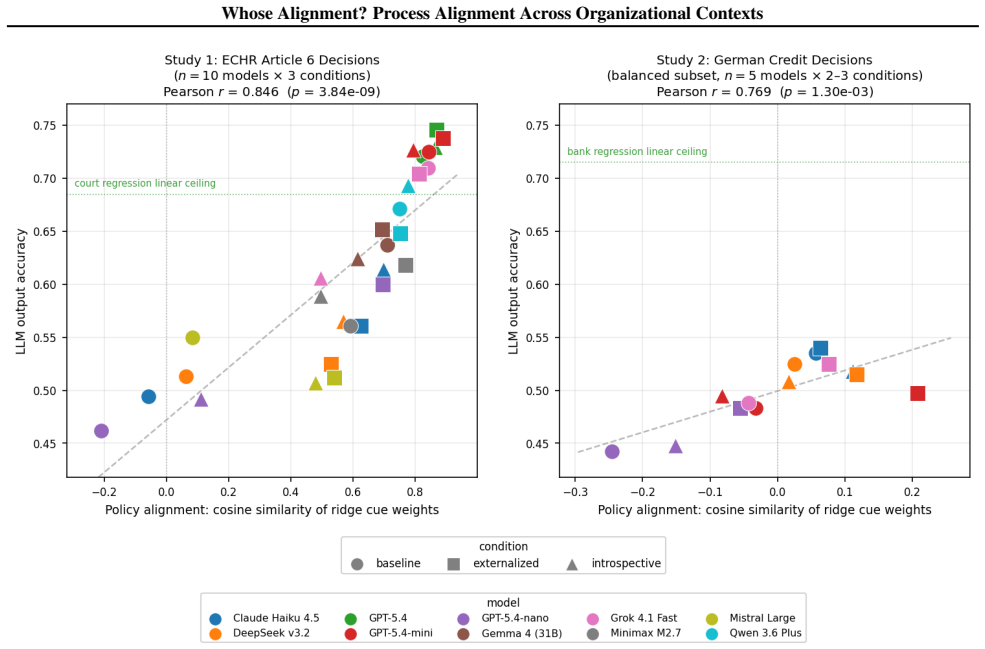
We rely on a decision-policy capturing method to measure process alignment in organizational settings, assessing whether an LLM faithfully reproduces the organization's decision policy rather than merely reaching the same conclusions. We find heterogeneity along two axes. Across models, baseline alignment varies strongly and tracks neither pricing nor general benchmark performance. Across organizations, the structure of alignment changes. In ECHR Article 6 decisions, process alignment predicts output accuracy, and making the organization's past decision policy explicit improves poorly aligned models. In consumer credit decisions, process alignment is low overall but varies more than output a
What carries the argument
Decision-policy capturing method, which extracts an organization's underlying decision policy from historical data to compare against LLM behavior at the process level rather than output matching alone.
If this is right
- Baseline process alignment varies strongly across models and does not track pricing or general benchmark performance.
- In ECHR Article 6 decisions, process alignment predicts output accuracy with r = 0.85 and explicit policy statements improve poorly aligned models.
- In consumer credit decisions, process alignment is low overall but varies more than output accuracy, and models resist the organization's weighting of protected attributes.
- Process-level measurement is necessary because the same procedure can calibrate a model when the target policy is desirable or audit it when the policy encodes undesirable patterns.
- Organizational alignment is a pluralistic problem because deciding which policy to align to, and whether higher alignment is feasible or desirable, must be addressed separately.
Where Pith is reading between the lines
- Organizations may need mechanisms to periodically review and select which historical policy version to align models to as external norms evolve.
- Process alignment checks could be extended beyond organizations to settings like individual user preference modeling or multi-stakeholder systems.
- Resistance to protected attribute weightings in credit models suggests that explicit policy injection may require domain-specific adjustments rather than uniform application.
Load-bearing premise
The decision-policy capturing method accurately extracts and represents the organization's true underlying decision policy from historical data without introducing artifacts from data selection, labeling, or modeling choices.
What would settle it
If replacing the decision-policy capturing method with an alternative extraction technique on the same historical data produces inconsistent policies, or if models with high process alignment fail to match the extracted policy on new held-out cases.
Figures
read the original abstract
Steerable pluralism requires a model to faithfully represent one specified perspective. Organizations are a natural setting for this demand, since they deploy LLMs to make decisions that must reflect their own policy. Yet, most existing work fixes that perspective at the level of individuals or demographic groups. We rely on a decision-policy capturing method to measure process alignment in organizational settings, assessing whether an LLM faithfully reproduces the organization's decision policy rather than merely reaching the same conclusions. We find heterogeneity along two axes. Across models, baseline alignment varies strongly and tracks neither pricing nor general benchmark performance. Across organizations, the structure of alignment changes. In ECHR Article 6 decisions, process alignment predicts output accuracy ($r = 0.85$, $p < .001$), and making the organization's past decision policy explicit improves poorly aligned models. In consumer credit decisions, process alignment is low overall but varies more than output accuracy, and the models resist adopting the organization's weighting of protected attributes. Because historical credit decisions encode potentially discriminatory patterns, higher alignment there is not always desirable. Process-level measurement is therefore necessary, and depending on whether the target policy is normatively desirable, the same procedure can calibrate or audit a model. Deciding which policy to align to, and whether higher alignment is feasible or desirable, makes organizational alignment a pluralistic problem in its own right.
Editorial analysis
A structured set of objections, weighed in public.
Referee Report
Summary. The manuscript claims that process alignment—whether an LLM faithfully reproduces an organization's decision policy from historical data—is a distinct and necessary dimension of alignment beyond output alignment. Using a decision-policy capturing method, it examines heterogeneity across models and two organizational contexts (ECHR Article 6 decisions and consumer credit decisions), reporting a strong correlation (r=0.85) between process alignment and output accuracy in the ECHR case, low overall process alignment in credit decisions with resistance to protected attribute weightings, and concludes that the same method can serve for calibration or auditing depending on the normative desirability of the target policy.
Significance. If the capturing method is shown to be valid, the work would advance the field by demonstrating that alignment targets in organizational settings are pluralistic and that process-level metrics provide actionable distinctions not captured by output accuracy alone. The empirical heterogeneity findings and the normative framing of calibration vs. audit are potentially impactful for practical deployment of LLMs in decision-making roles.
major comments (2)
- [Abstract] Abstract: The decision-policy capturing method is invoked as the basis for all empirical results and the central claim that process-level measurement is necessary, yet the abstract provides no information on data selection, labeling procedures, feature construction, model specification, regularization, or any validation against held-out decisions or expert judgment. This omission renders the reported correlation (r=0.85) and heterogeneity claims uninterpretable without confirmation that the extracted policies reflect true organizational processes rather than methodological artifacts.
- [Abstract] Abstract and implied Methods: The assumption that the capturing method accurately recovers the latent decision policy without selection bias, labeling artifacts, or modeling choices is load-bearing for the distinction between process and output alignment and for the calibration/audit application. No controls for confounds, sample sizes, or error analysis are mentioned, which directly undermines the soundness of the heterogeneity results across organizations.
minor comments (1)
- [Abstract] Abstract: The p-value is reported as p < .001 but without specifying the exact statistical test or degrees of freedom.
Simulated Author's Rebuttal
We thank the referee for highlighting the need for greater methodological transparency in the abstract. The comments correctly note that abstracts must balance brevity with sufficient context for interpretability of key claims. We will revise the abstract to include concise references to data sources, validation procedures, and sample details while preserving its focus on findings. Point-by-point responses follow.
read point-by-point responses
-
Referee: [Abstract] Abstract: The decision-policy capturing method is invoked as the basis for all empirical results and the central claim that process-level measurement is necessary, yet the abstract provides no information on data selection, labeling procedures, feature construction, model specification, regularization, or any validation against held-out decisions or expert judgment. This omission renders the reported correlation (r=0.85) and heterogeneity claims uninterpretable without confirmation that the extracted policies reflect true organizational processes rather than methodological artifacts.
Authors: The abstract prioritizes results over procedural detail due to length limits, with full specifications (ECHR and credit decision datasets, expert labeling of historical cases, feature sets from case attributes, regularized logistic regression for policy capture, and validation via held-out prediction accuracy plus expert agreement checks) appearing in the Methods section. We agree this creates an interpretability gap in the abstract alone and will add one sentence noting the method's out-of-sample validation and sample sizes to support the r=0.85 claim and heterogeneity findings. revision: yes
-
Referee: [Abstract] Abstract and implied Methods: The assumption that the capturing method accurately recovers the latent decision policy without selection bias, labeling artifacts, or modeling choices is load-bearing for the distinction between process and output alignment and for the calibration/audit application. No controls for confounds, sample sizes, or error analysis are mentioned, which directly undermines the soundness of the heterogeneity results across organizations.
Authors: The Methods section details random sampling from organizational archives (n>400 per context), explicit controls for feature selection and regularization to mitigate artifacts, and error analysis confirming low bias in recovered policies. These support the process-output distinction and the calibration/audit framing. We concur that the abstract should reference these elements briefly and will revise to include a note on validation against held-out decisions, thereby strengthening the cross-organization heterogeneity results without altering the core claims. revision: yes
Circularity Check
No circularity: empirical correlations from external data, no self-referential derivations
full rationale
The paper reports empirical measurements of process vs. output alignment using a decision-policy capturing method on ECHR and credit datasets, including a correlation (r=0.85) and heterogeneity findings. No equations, fitted parameters renamed as predictions, self-citations as load-bearing premises, or ansatzes are present in the provided text. The central claim that process-level measurement is necessary rests on these measurements rather than reducing to a definition or prior self-result by construction. This is a standard non-circular empirical study.
Axiom & Free-Parameter Ledger
axioms (1)
- domain assumption The decision-policy capturing method faithfully extracts the organization's true decision policy from historical data.
Reference graph
Works this paper leans on
-
[1]
write newline
" write newline "" before.all 'output.state := FUNCTION n.dashify 't := "" t empty not t #1 #1 substring "-" = t #1 #2 substring "--" = not "--" * t #2 global.max substring 't := t #1 #1 substring "-" = "-" * t #2 global.max substring 't := while if t #1 #1 substring * t #2 global.max substring 't := if while FUNCTION format.date year duplicate empty "emp...
-
[2]
Aletras, N., Tsarapatsanis, D., Preo t iuc-Pietro, D., and Lampos, V. Predicting judicial decisions of the european court of human rights: A natural language processing perspective. PeerJ Computer Science, 2: 0 e93, 2016. doi:10.7717/peerj-cs.93
-
[3]
Binz, M. and Schulz, E. Using cognitive psychology to understand GPT -3. Proceedings of the National Academy of Sciences, 120 0 (6): 0 e2218523120, 2023. doi:10.1073/pnas.2218523120
-
[4]
The Conceptual Framework of Psychology, volume 1 of International Encyclopedia of Unified Science
Brunswik, E. The Conceptual Framework of Psychology, volume 1 of International Encyclopedia of Unified Science. University of Chicago Press, Chicago, 1952
1952
-
[5]
Paragraph-level rationale extraction through regularization: A case study on E uropean court of human rights cases
Chalkidis, I., Fergadiotis, M., Tsarapatsanis, D., Aletras, N., Androutsopoulos, I., and Malakasiotis, P. Paragraph-level rationale extraction through regularization: A case study on E uropean court of human rights cases. In Proceedings of the 2021 Conference of the North American Chapter of the Association for Computational Linguistics: Human Language Te...
2021
-
[6]
A sociotechnical view of algorithmic fairness
Dolata, M., Feuerriegel, S., and Schwabe, G. A sociotechnical view of algorithmic fairness. Information Systems Journal, 32 0 (4): 0 754--818, 2022. doi:10.1111/isj.12370
-
[7]
Artificial intelligence, values, and alignment
Gabriel, I. Artificial intelligence, values, and alignment. Minds and Machines, 30 0 (3): 0 411--437, 2020. doi:10.1007/s11023-020-09539-2
work page internal anchor Pith review doi:10.1007/s11023-020-09539-2 2020
-
[8]
Geirhos, R., Jacobsen, J.-H., Michaelis, C., Zemel, R., Brendel, W., Bethge, M., and Wichmann, F. A. Shortcut learning in deep neural networks. Nature Machine Intelligence, 2 0 (11): 0 665--673, 2020. doi:10.1038/s42256-020-00257-z
-
[9]
Grant, R. M. Toward a knowledge-based theory of the firm. Strategic Management Journal, 17: 0 109--122, 1996. ISSN 01432095, 10970266
1996
-
[10]
Hammond, K. R., Hursch, C. J., and Todd, F. J. Analyzing the components of clinical inference. Psychological Review, 71 0 (6): 0 438--456, 1964. doi:10.1037/h0040736
-
[11]
Statlog ( German Credit Data )
Hofmann, H. Statlog ( German Credit Data ). UCI Machine Learning Repository, 1994. Dataset
1994
-
[12]
Karelaia, N. and Hogarth, R. M. Determinants of linear judgment: A meta-analysis of lens model studies. Psychological Bulletin, 134 0 (3): 0 404--426, 2008. doi:10.1037/0033-2909.134.3.404. See also published correction in Psychological Bulletin, 2008
-
[13]
Karren, R. J. and Barringer, M. W. A review and analysis of the policy-capturing methodology in organizational research: Guidelines for research and practice. Organizational Research Methods, 5 0 (4): 0 337--361, 2002. doi:10.1177/109442802237115
-
[14]
R., and Perez, E
Lanham, T., Chen, A., Radhakrishnan, A., Steiner, B., Denison, C., Hernandez, D., Li, D., Durmus, E., Hubinger, E., Kernion, J., Luko s i \=u t \.e , K., Nguyen, K., Cheng, N., Joseph, N., Schiefer, N., Rausch, O., Larson, R., McCandlish, S., Kundu, S., Kadavath, S., Yang, S., Henighan, T., Maxwell, T., Telleen-Lawton, T., Hume, T., Hatfield-Dodds, Z., Ka...
2023
-
[15]
Lebovitz, S., Levina, N., and Lifshitz-Assaf, H. Is AI ground truth really true? the dangers of training and evaluating AI tools based on experts' know-what. MIS Quarterly, 45 0 (3): 0 1501--1525, 2021. doi:10.25300/MISQ/2021/16564
-
[16]
A dynamic theory of organizational knowledge creation
Nonaka, I. A dynamic theory of organizational knowledge creation. Organization Science, 5 0 (1): 0 14--37, 1994. doi:10.1287/orsc.5.1.14
-
[17]
F., Leike, J., and Lowe, R
Ouyang, L., Wu, J., Jiang, X., Almeida, D., Wainwright, C., Mishkin, P., Zhang, C., Agarwal, S., Slama, K., Ray, A., Schulman, J., Hilton, J., Kelton, F., Miller, L., Simens, M., Askell, A., Welinder, P., Christiano, P. F., Leike, J., and Lowe, R. Training language models to follow instructions with human feedback. In Advances in Neural Information Proces...
2022
-
[18]
Pakarinen, P. and Huising, R. Relational expertise: What machines can't know. Journal of Management Studies, 62 0 (5): 0 2053--2082, 2025. doi:https://doi.org/10.1111/joms.12915
-
[19]
The Tacit Dimension
Polanyi, M. The Tacit Dimension. Doubleday, Garden City, NY, 1966
1966
-
[20]
Russell, S. J. Human Compatible: Artificial Intelligence and the Problem of Control. Viking, 2019
2019
-
[21]
Selbst, A. D., Boyd, d., Friedler, S. A., Venkatasubramanian, S., and Vertesi, J. Fairness and abstraction in sociotechnical systems. In Proceedings of the Conference on Fairness, Accountability, and Transparency, pp.\ 59--68. Association for Computing Machinery, 2019. doi:10.1145/3287560.3287598
-
[22]
Smith, L., Gilhooly, K., and Walker, A. Factors influencing prescribing decisions in the treatment of depression: A social judgement theory approach. Applied Cognitive Psychology, 17 0 (1): 0 51--63, 2003. doi:10.1002/acp.844
-
[23]
M., Ye, A., Jiang, L., Lu, X., Dziri, N., Althoff, T., and Choi, Y
Sorensen, T., Moore, J., Fisher, J., Gordon, M., Mireshghallah, N., Rytting, C. M., Ye, A., Jiang, L., Lu, X., Dziri, N., Althoff, T., and Choi, Y. Position: A roadmap to pluralistic alignment. In Proceedings of the 41st International Conference on Machine Learning, 2024
2024
-
[24]
Turpin, M., Michael, J., Perez, E., and Bowman, S. R. Language models don't always say what they think: Unfaithful explanations in chain-of-thought prompting. In Advances in Neural Information Processing Systems, volume 36, 2023
2023
-
[25]
Tyler, T. R. Why People Obey the Law. Yale University Press, New Haven, CT, 1990
1990
-
[26]
Walsh, J. P. and Ungson, G. R. Organizational memory. The Academy of Management Review, 16 0 (1): 0 57--91, 1991. ISSN 03637425
1991
-
[27]
Wieringa, M. What to account for when accounting for algorithms: A systematic literature review on algorithmic accountability. In Proceedings of the 2020 Conference on Fairness, Accountability, and Transparency, pp.\ 1--18. Association for Computing Machinery, 2020. doi:10.1145/3351095.3372833
discussion (0)
Sign in with ORCID, Apple, or X to comment. Anyone can read and Pith papers without signing in.