Symmetry-Selective Strain Control of Spin-Momentum Locking and Spin Transport in Two-Dimensional Pentagonal Altermagnets
Pith reviewed 2026-06-29 04:00 UTC · model grok-4.3
The pith
Strain selectively preserves, reconstructs or destroys spin-momentum locking in two-dimensional pentagonal altermagnets.
A machine-rendered reading of the paper's core claim, the machinery that carries it, and where it could break.
Core claim
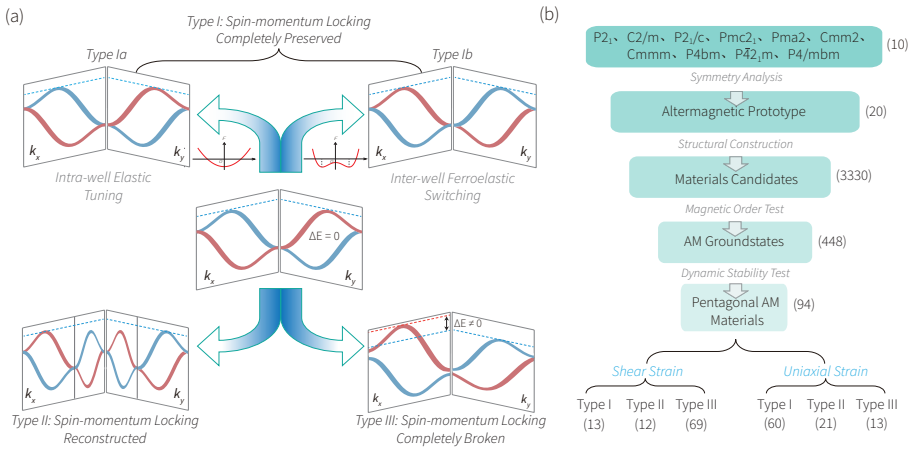
The central claim is that a symmetry-based analysis of strain tensors on two-dimensional pentagonal altermagnets allows classification into three strain-response types for the altermagnetic spin-momentum locking, and first-principles screening identifies 94 stable candidates across all relevant spin Laue groups, with specific materials demonstrating ferroelastic switching, g- to d-wave reconstruction, and spin-valley selection.
What carries the argument
The strain-resolved symmetry framework classifying uniaxial and shear strain tensors as preserving, reconstructing, or eliminating the spin-momentum locking.
If this is right
- Type-I materials preserve the SML under applied strain.
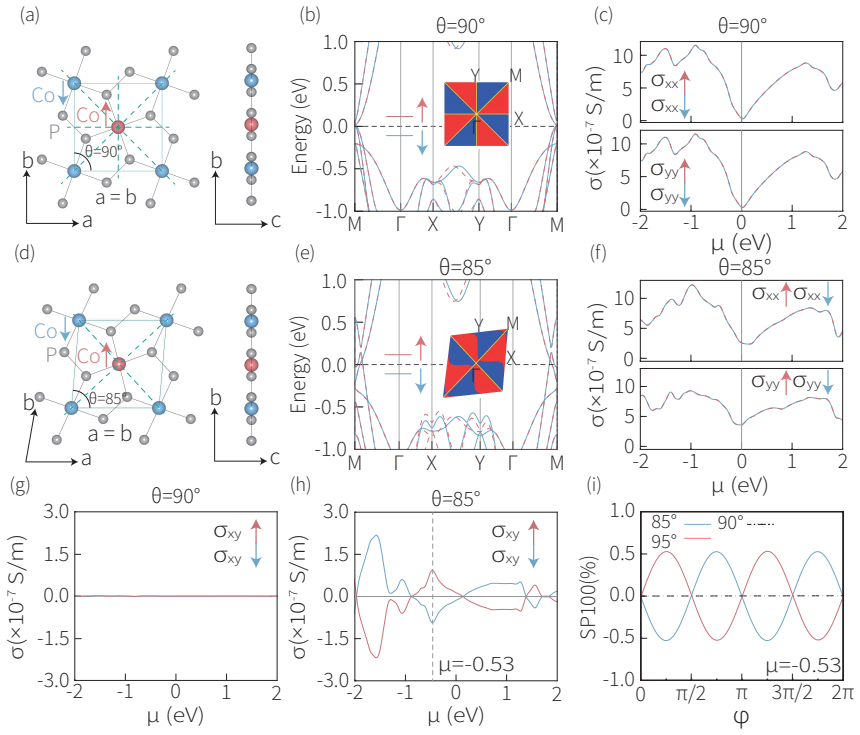
- Type-II materials reconstruct the SML through partial symmetry breaking while retaining altermagnetic features, sometimes activating off-diagonal spin conductivity.
- Type-III materials destroy the altermagnetic SML under strain.
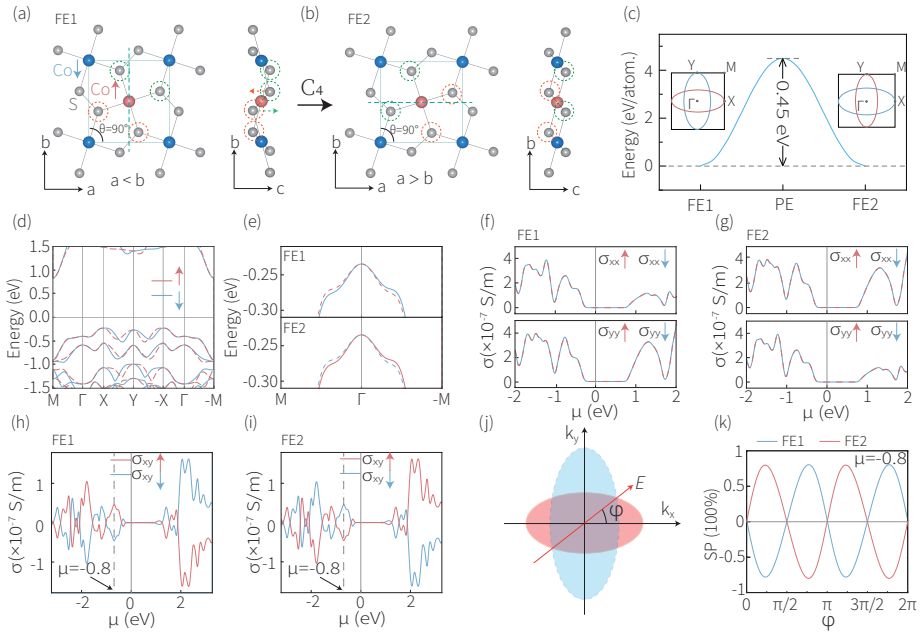
- α-CoS2 exhibits ferroelastically switchable SML that reverses the sign of off-diagonal spin conductivity.
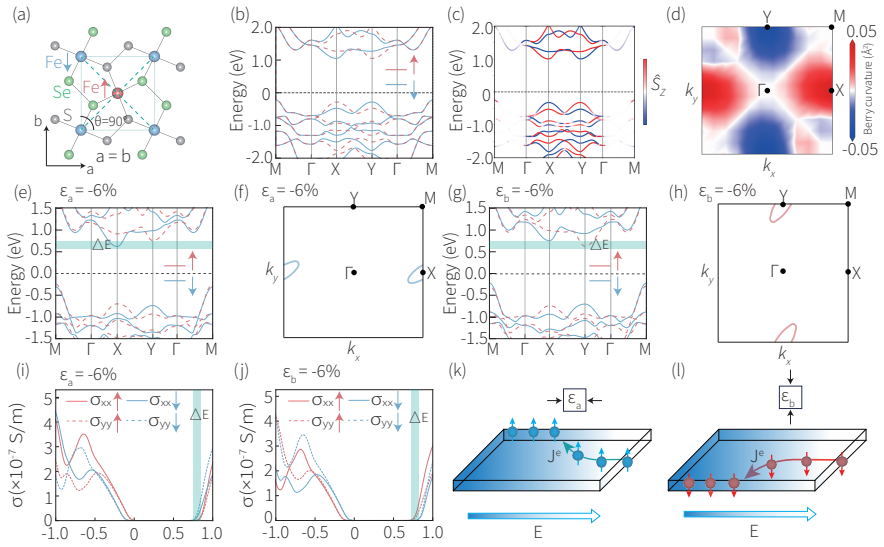
- Uniaxially strained FeSSe realizes strain-selected spin-valley transport.
Where Pith is reading between the lines
- The same symmetry criterion could be tested on non-pentagonal or three-dimensional altermagnets to check generality.
- Strain control of spin conductivity might enable altermagnet-based transistors or sensors without net magnetization.
- The 94 candidates provide a concrete list for experimental growth and strain tests in 2D heterostructures.
Load-bearing premise
The first-principles calculations used for stability screening and electronic structure accurately capture the altermagnetic spin-momentum locking and its response to strain without significant errors from exchange-correlation functionals or neglected relativistic effects.
What would settle it
Observation that a material classified as Type-I loses its SML under strain, or that a Type-III material retains the SML, would falsify the three-type classification.
Figures
read the original abstract
Altermagnets are compensated magnets featuring momentum-dependent nonrelativistic spin splitting generated by nontrivial operations connecting opposite-spin sublattices. A direct symmetry-based route to control this spin splitting is to modify the real-space operations that define the altermagnetic spin-momentum locking (SML). Here, we develop a strain-resolved symmetry framework for two-dimensional pentagonal altermagnets, classifying whether uniaxial and shear strain tensors preserve, reconstruct, or eliminate the SML. Using the above criterion combined with first-principles screening, we identify 94 stable altermagnetic candidates from 3330 materials. These candidates cover all type-III spin Laue groups of orthorhombic lattices and are classified into three strain-response types: Type-I preserves the SML; Type-II reconstructs the SML through partial symmetry breaking while retaining essential altermagnetic features; and Type-III destroys the altermagnetic SML. Representative materials further demonstrate this classification: ferroelastic $\alpha$-CoS$_2$ exhibits ferroelastically switchable SML and reverses the sign of the off-diagonal spin conductivity; shear-strained \(\alpha\)-CoP\(_2\) undergoes a \(g\)- to \(d\)-wave reconstruction of the SML, activating off-diagonal spin conductivity; and uniaxially strained FeSSe realizes strain-selected spin-valley transport. This work provides theoretical and material guidance for strain-controlled transport in two-dimensional orthorhombic altermagnets.
Editorial analysis
A structured set of objections, weighed in public.
Referee Report
Summary. The manuscript develops a strain-resolved symmetry framework for two-dimensional pentagonal altermagnets that classifies how uniaxial and shear strains preserve, reconstruct, or eliminate the altermagnetic spin-momentum locking (SML). Combining this analytic criterion with first-principles screening of 3330 materials yields 94 stable orthorhombic altermagnetic candidates spanning all type-III spin Laue groups; these are partitioned into Type-I (SML preserved), Type-II (SML reconstructed via partial symmetry breaking), and Type-III (SML destroyed). Representative cases (α-CoS_{2}, α-CoP_{2}, FeSSe) illustrate ferroelastic switching of spin conductivity, g-to-d-wave reconstruction, and strain-selected spin-valley transport.
Significance. If the DFT-based assignments hold, the work supplies a concrete, symmetry-derived route to strain engineering of spin transport in a large set of 2D altermagnets. The purely analytic symmetry classification and the explicit enumeration of 94 candidates constitute reusable material guidance; the three-type taxonomy directly links crystal operations to measurable spin-conductivity tensors.
major comments (2)
- [first-principles screening and results sections] The assignment of each of the 94 candidates to Type-I/II/III (and the reported signs of off-diagonal spin conductivity) rests on the computed momentum dependence of the altermagnetic splitting under strain. No tests with hybrid or meta-GGA functionals are reported, nor are error bars on the splitting magnitude provided; standard semilocal functionals are known to alter both the size and qualitative k-dependence of such splittings, which could change the Type classification for a non-negligible fraction of the screened set.
- [methods and candidate selection] The stability screening criterion (energy above hull, phonon stability, etc.) is not stated quantitatively; without explicit thresholds or convergence data it is impossible to assess how many of the 94 candidates would remain under modest changes in the computational protocol.
minor comments (2)
- [introduction] Notation for the three strain-response types is introduced in the abstract but should be restated with a short table or diagram in the main text for immediate reference.
- [results] The manuscript would benefit from a supplementary table listing the 94 candidates together with their space groups, computed magnetic moments, and assigned strain-response type.
Simulated Author's Rebuttal
We thank the referee for the constructive comments and positive evaluation of the symmetry framework and material enumeration. Below we respond point-by-point to the major comments, indicating the revisions we will incorporate.
read point-by-point responses
-
Referee: [first-principles screening and results sections] The assignment of each of the 94 candidates to Type-I/II/III (and the reported signs of off-diagonal spin conductivity) rests on the computed momentum dependence of the altermagnetic splitting under strain. No tests with hybrid or meta-GGA functionals are reported, nor are error bars on the splitting magnitude provided; standard semilocal functionals are known to alter both the size and qualitative k-dependence of such splittings, which could change the Type classification for a non-negligible fraction of the screened set.
Authors: We acknowledge that semilocal functionals can affect the quantitative details of spin splitting. However, the Type-I/II/III classification is anchored in the analytic symmetry criterion that determines whether strain preserves, reconstructs, or eliminates the altermagnetic operations; the DFT results are used only to confirm the existence of the splitting and to assign the type for each candidate. To strengthen the manuscript we will add (i) a short discussion of this limitation, (ii) error-bar estimates from k-point and energy-cutoff convergence for representative cases, and (iii) hybrid-functional (HSE06) calculations for at least one material from each type to verify that the symmetry-based assignments remain unchanged. These additions will be placed in the revised Results and Methods sections. revision: yes
-
Referee: [methods and candidate selection] The stability screening criterion (energy above hull, phonon stability, etc.) is not stated quantitatively; without explicit thresholds or convergence data it is impossible to assess how many of the 94 candidates would remain under modest changes in the computational protocol.
Authors: The quantitative thresholds (energy above hull < 0.1 eV/atom, no imaginary phonon modes, and mechanical stability criteria) together with the convergence parameters are provided in the Supplementary Information and referenced in the Methods section. We agree that explicit restatement in the main text improves clarity. In the revised manuscript we will insert a dedicated paragraph in the Methods section that lists the numerical thresholds, reports the convergence settings used for the 3330-material screen, and notes how many candidates survive under a 20 % variation of the hull-energy cutoff. revision: yes
Circularity Check
No significant circularity in symmetry framework or material screening
full rationale
The paper develops an analytic strain-resolved symmetry framework from standard crystal symmetry operations to classify how uniaxial and shear strains preserve, reconstruct, or eliminate altermagnetic SML. This criterion is then combined with first-principles screening of 3330 materials to enumerate 94 candidates and assign them to Type-I/II/III categories. No derivation step reduces by construction to its inputs: the symmetry analysis is independent of the screened materials, the classification follows directly from symmetry without fitted parameters, and no load-bearing self-citations or ansatzes are invoked. The result is a computational enumeration resting on external first-principles methods rather than self-referential reduction.
Axiom & Free-Parameter Ledger
axioms (1)
- domain assumption Nontrivial operations connecting opposite-spin sublattices generate momentum-dependent nonrelativistic spin splitting in altermagnets.
Reference graph
Works this paper leans on
-
[1]
H.; Liu, J.; Chen, X.; Pan, F.Nat
Song, C.; Bai, H.; Zhou, Z.; Han, L.; Reichlova, H.; Dil, J. H.; Liu, J.; Chen, X.; Pan, F.Nat. Rev. Mater.2025, 473–485
2025
-
[2]
Wei, C.-C.; Lawrence, E.; Tran, A.; Ji, H.ACS Org. Inorg. Au2024,4, 604–619
-
[3]
Bai, L.; Feng, W.; Liu, S.; Šmejkal, L.; Mokrousov, Y.; Yao, Y.Adv. Funct. Mater.2024,34, 2409327
2024
-
[4]
Xiao, Z.; Zhao, J.; Li, Y.; Shindou, R.; Song, Z.-D.Phys. Rev. X2024,14, 031037
-
[5]
Chen, X.; Ren, J.; Zhu, Y.; Yu, Y.; Zhang, A.; Liu, P.; Li, J.; Liu, Y.; Li, C.; Liu, Q.Phys. Rev. X 2024,14, 031038
2024
-
[6]
Jiang, Y.; Song, Z.; Zhu, T.; Fang, Z.; Weng, H.; Liu, Z.-X.; Yang, J.; Fang, C.Phys. Rev. X2024,14, 031039
-
[7]
Šmejkal, L.; Sinova, J.; Jungwirth, T.Phys. Rev. X2022,12, 040501
-
[8]
Šmejkal, L.; Sinova, J.; Jungwirth, T.Phys. Rev. X2022,12, 031042
-
[9]
et al.Nat
Feng, Z. et al.Nat. Electron.2022,5, 735–743
2022
-
[10]
Bai, H.; Han, L.; Feng, X.; Zhou, Y.; Su, R.; Wang, Q.; Liao, L.; Zhu, W.; Chen, X.; Pan, F.; Xiao- long, F.; Song, C.Phys. Rev. Lett.2022,128, 197202
2022
-
[11]
González-Hernández, R.; Šmejkal, L.; Výborný, K.; Yahagi, Y.; Sinova, J.; Jungwirth, T.; Železný, J. Phys. Rev. Lett.2021,126, 127701
2021
-
[12]
Shao, D.-F.; Zhang, S.-H.; Li, M.; Eom, C.-B.; Tsymbal, E. Y.Nat. Commun.2021,12, 7061
2021
-
[13]
B.; González-Hernández, R.; Sinova, J.; Jungwirth, T.Phys
Šmejkal, L.; Hellenes, A. B.; González-Hernández, R.; Sinova, J.; Jungwirth, T.Phys. Rev. X2022, 12, 011028
-
[14]
Cui, Q.; Zeng, B.; Cui, P.; Yu, T.; Yang, H.Phys. Rev. B2023,108, L180401
-
[15]
Weißenhofer, M.; Marmodoro, A.Phys. Rev. B2024,110, 094427
-
[16]
H.; Aldosary, M.; Chen, C.; Aji, V.; Wei, P.; Shi, J.Phys
Li, J.; Shi, Z.; Ortiz, V. H.; Aldosary, M.; Chen, C.; Aji, V.; Wei, P.; Shi, J.Phys. Rev. Lett.2019,122, 217204
2019
-
[17]
Commun.2021,12, 2846
Ma, H.-Y.; Hu, M.; Li, N.; Liu, J.; Yao, W.; Jia, J.-F.; Liu, J.Nat. Commun.2021,12, 2846
2021
-
[18]
Adv.2020,6, eaaz8809
Šmejkal, L.; González-Hernández, R.; Jungwirth, T.; Sinova, J.Sci. Adv.2020,6, eaaz8809
2020
-
[19]
Gu, M.; Liu, Y.; Zhu, H.; Yananose, K.; Chen, X.; Hu, Y.; Stroppa, A.; Liu, Q.Phys. Rev. Lett.2025, 134, 106802
2025
-
[20]
Wang, S.; Wang, W.-W.; Fan, J.; Zhou, X.; Li, X.-P.; Wang, L.Nano Lett.2025,25, 14618–14624
2025
-
[21]
et al.Nature2024,626, 517–522
Krempaský, J. et al.Nature2024,626, 517–522. 12
-
[22]
et al.Nat
Badura, A. et al.Nat. Commun.2025,16, 7111
2025
-
[23]
et al.Nat
Zhang, F. et al.Nat. Phys.2025, 1–8
2025
-
[24]
He, T.; Li, L.; Cui, C.; Zhang, R.-W.; Yu, Z.-M.; Liu, G.; Zhang, X.Phys. Rev. Lett.2024,133, 146602
2024
-
[25]
Commun.2025,16, 3114
Xu, C.; Wu, S.; Zhi, G.-X.; Cao, G.; Dai, J.; Cao, C.; Wang, X.; Lin, H.-Q.Nat. Commun.2025,16, 3114
2025
-
[26]
W.npj Quantum Mater.2025,10, 98
León, A.; Autieri, C.; Brumme, T.; González, J. W.npj Quantum Mater.2025,10, 98
2025
-
[27]
Xie, Y.; Hao, Y.; Wang, D.; Zhang, J.Nano Lett.2026,
2026
-
[28]
Qu, S.; Hou, X.-Y.; Liu, Z.-X.; Guo, P.-J.; Lu, Z.-Y.Phys. Rev. B2025,111, 195138
-
[29]
Kong, W.; Wan, C.; Wang, X.; Tao, B.; Huang, L.; Fang, C.; Guo, C.; Guang, Y.; Irfan, M.; Han, X. Nat. Commun.2019,10, 233
2019
-
[30]
China Mater.2026,69, 492–503
Zhang, K.; Li, Y.; Wang, D.; Lv, H.; Wu, X.Sci. China Mater.2026,69, 492–503
2026
-
[31]
Zhou, Z.; Cheng, X.; Hu, M.; Chu, R.; Bai, H.; Han, L.; Liu, J.; Pan, F.; Song, C.Nature2025,638, 645–650
-
[32]
Chen, R.; Wang, Z.-M.; Wu, K.; Sun, H.-P.; Zhou, B.; Wang, R.; Xu, D.-H.Phys. Rev. Lett.2025,135, 096602
2025
-
[33]
Gao, Z.-F.; Qu, S.; Zeng, B.; Liu, Y.; Wen, J.-R.; Sun, H.; Guo, P.-J.; Lu, Z.-Y.Natl. Sci. Rev.2025, 12, nwaf066
2025
-
[34]
S.; Gonzalez, O.; Bediako, D
Fender, S. S.; Gonzalez, O.; Bediako, D. K.J. Am. Chem. Soc2025,147, 2257–2274
-
[35]
Fang, N.; Wu, C.; Zhang, Y.; Li, Z.; Zhou, Z.ACS Nano2024,18, 8600–8625
-
[36]
P.; Park, J.-G.; Yuan, H.; Deng, L.Nat
Peng, B.; Li, Z.; Wang, H.; You, S.; Wu, Y.; Liu, W.; Xie, J.; Lu, H.; Zhou, P.; Loh, K. P.; Park, J.-G.; Yuan, H.; Deng, L.Nat. Rev. Phys.2026,
2026
-
[37]
Fan, A.-D.; Wang, Y.-K.; Li, J.-Y.; Li, S.Phys. Rev. B2025,112, 235135
-
[38]
Guo, S.-D.; Liu, Y.; Yu, J.; Liu, C.-C.Phys. Rev. B2024,110, L220402
-
[39]
Li, S.; Zhang, Y.; Bahri, A.; Zhang, X.; Jia, C.npj Quantum Mater.2025,10, 83
2025
-
[40]
Huang, Y.; Hua, C.; Xu, R.; Liu, J.; Zheng, Y.; Lu, Y.Phys. Rev. Lett.2025,135, 266701
2025
-
[41]
Ding, N.; Ye, H.; Wang, S.-S.; Dong, S.Phys. Rev. B2025,112, L220410
-
[42]
Ma, D.; Liu, D.; Lv, Z.; Yang, Z.; Ma, W.; Liu, Z.Appl. Phys. Lett.2025,127
2025
-
[43]
Chen, Z.; Li, R.; Bai, Y.; Mao, N.; Zeer, M.; Go, D.; Dai, Y.; Huang, B.; Mokrousov, Y.; Niu, C.Nano Lett.2024,24, 4826–4833
2024
-
[44]
Li, R.; Mao, N.; Wu, X.; Huang, B.; Dai, Y.; Niu, C.Nano Lett.2023,23, 91–97
2023
-
[45]
Li, D.; Wang, S.; Li, Z.; Cui, C.; Li, L.; Wang, L.; Yu, Z.-M.; Zhou, X.; Li, X.-P.; othersarXiv preprint arXiv:2601.015642026,
-
[46]
S.; Cheng, Z.; Fang, S.Adv
Wang, J.; Yang, X.; Yang, Z.; Lu, J.; Ho, P.; Wang, W.; Ang, Y. S.; Cheng, Z.; Fang, S.Adv. Funct. Mater.2026,36, 2505145
2026
-
[47]
Rep.2022,964, 1–42
Shen, Y.; Wang, Q.Phys. Rep.2022,964, 1–42
2022
-
[48]
Wang, S.; Lv, X.; Li, F.The Journal of Physical Chemistry C2024,128, 3064–3073. 13
-
[49]
Zhang, S.; Zhou, J.; Wang, Q.; Chen, X.; Kawazoe, Y.; Jena, P.Proc. Nat. Acad. Sci.2015,112, 2372–2377
2015
-
[50]
A.; Hassan, A.; Shen, Y.; Wang, Q.Nano Today2022,44, 101501
Nazir, M. A.; Hassan, A.; Shen, Y.; Wang, Q.Nano Today2022,44, 101501
-
[51]
Guo, D.; Dai, J.; Wang, R.; Wang, C.; Ji, W.Phys. Rev. B2025,112, 195410
-
[52]
Huang, F.; He, S.; Chen, K.-Q.; Tang, L.-M.Phys. Rev. B2026,113, L020411
-
[53]
Sødequist, J.; Olsen, T.Appl. Phys. Lett.2024,124
2024
-
[54]
Jiang, J.-K.; Cao, S.-H.; Guo, H.-Z.; Zeng, Z.-Y.; Zhang, C.; Chen, X.-R.Phys. Rev. B2026,113, 144405
-
[55]
Zhang, Z.; Sun, H.; Liu, K.; Zhang, L.; Dong, M.; Wang, A.; Shao, X.; Zhao, M.Phys. Rev. B2026, 113, 035411
-
[56]
Zeng, S.; Liu, D.; Peng, H.; He, C.-C.; Yang, X.-B.; Zhao, Y.-J.arXiv preprint arXiv:2601.101832026,
-
[57]
M.; Agterberg, D
Roig, M.; Kreisel, A.; Yu, Y.; Andersen, B. M.; Agterberg, D. F.Phys. Rev. B2024,110, 144412
-
[58]
Aizu, K.J. Phys. Soc. Jpn.1969,27, 387–396
1969
-
[59]
A.; Abrikosov, I
Korzhavyi, P. A.; Abrikosov, I. A.; Johansson, B.; Ruban, A. V.; Skriver, H. L.Phys. Rev. B1999,59, 11693–11703
-
[60]
Kresse, G.; Furthmüller, J.Phys. Rev. B1996,54, 11169–11186
-
[61]
P.; Burke, K.; Ernzerhof, M.Phys
Perdew, J. P.; Burke, K.; Ernzerhof, M.Phys. Rev. Lett.1996,77, 3865–3868
1996
-
[62]
L.; Botton, G
Dudarev, S. L.; Botton, G. A.; Savrasov, S. Y.; Humphreys, C. J.; Sutton, A. P.Phys. Rev. B1998, 57, 1505–1509
-
[63]
P.; Jónsson, H.J
Henkelman, G.; Uberuaga, B. P.; Jónsson, H.J. Chem. Phys.2000,113, 9901–9904
2000
-
[64]
Giannozzi, P.; de Gironcoli, S.; Pavone, P.; Baroni, S.Phys. Rev. B1991,43, 7231–7242
-
[65]
Gonze, X.; Lee, C.Phys. Rev. B1997,55, 10355–10368
-
[66]
Togo, A.; Tanaka, I.Scripta Materialia2015,108, 1–5
-
[67]
Wang, V.; Xu, N.; Liu, J.-C.; Tang, G.; Geng, W.-T.Comput. Phys. Commun.2021,267, 108033
2021
-
[68]
Kim, S.-W.; Kim, H.-J.; Cheon, S.; Kim, T.-H.Phys. Rev. Lett.2022,128, 046401
2022
-
[69]
Callaway, J.Quantum theory of the solid state; Academic press, 2013
2013
-
[70]
A.; Yates, J
Mostofi, A. A.; Yates, J. R.; Lee, Y.-S.; Souza, I.; Vanderbilt, D.; Marzari, N.Comput. Phys. Commun. 2008,178, 685–699
2008
-
[71]
Dou, M.; Wang, X.; Tao, L.Phys. Rev. B2025,111, 224423
-
[72]
Liu, L.; Ren, X.; Xie, J.; Cheng, B.; Liu, W.; An, T.; Qin, H.; Hu, J.Appl. Surf. Sci.2019,480, 300–307. 14
2019
discussion (0)
Sign in with ORCID, Apple, or X to comment. Anyone can read and Pith papers without signing in.