Powder Spreading and Layer Deposition in Metal Powder Bed Fusion
Pith reviewed 2026-06-26 06:27 UTC · model grok-4.3
The pith
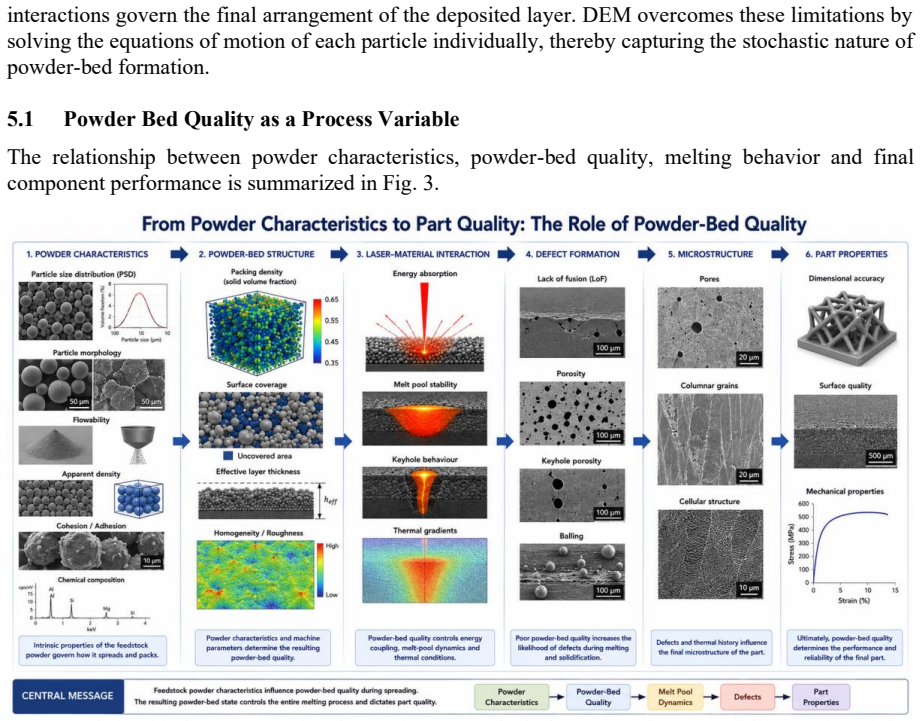
Powder-bed packing density, coverage, and homogeneity directly govern energy absorption, melt-pool stability, and defect formation in metal PBF.
A machine-rendered reading of the paper's core claim, the machinery that carries it, and where it could break.
Core claim
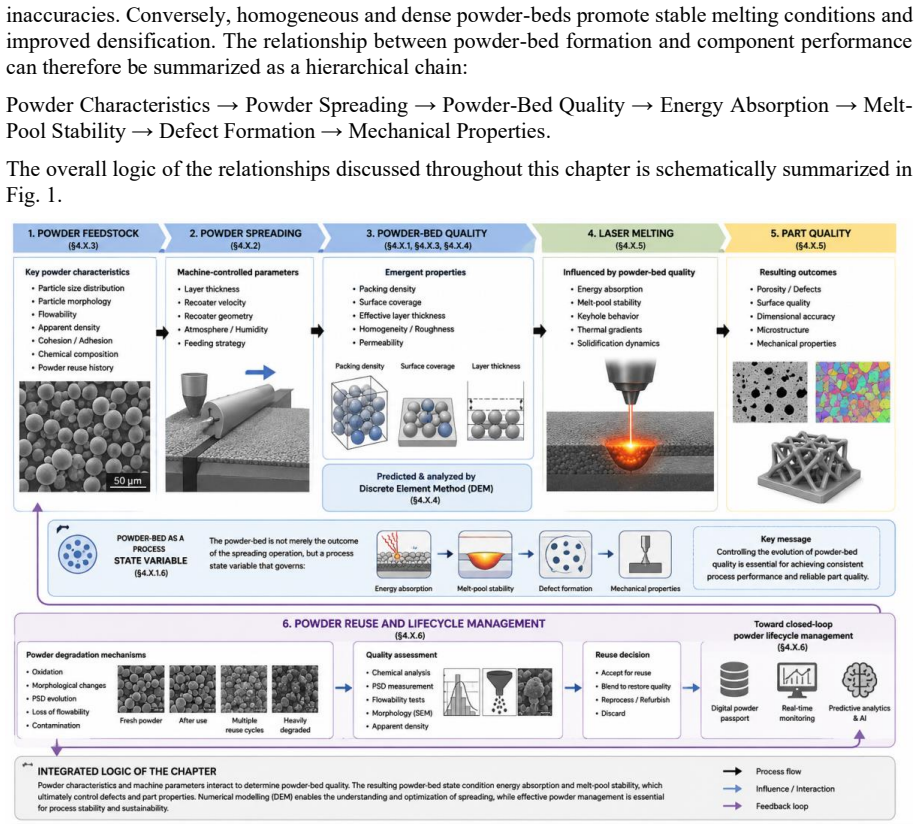
The powder-bed formed during spreading and deposition functions as a process state variable. Its characteristics, including packing density, surface coverage, effective layer thickness, and spatial homogeneity, directly affect energy absorption, melt-pool stability, defect formation, and mechanical performance of the final component.
What carries the argument
The powder-bed as a process state variable whose quality metrics link powder characteristics, process parameters, and machine architecture to energy absorption and part outcomes.
If this is right
- Adjusting particle size distribution and morphology can raise packing density and surface coverage to stabilize the melt pool.
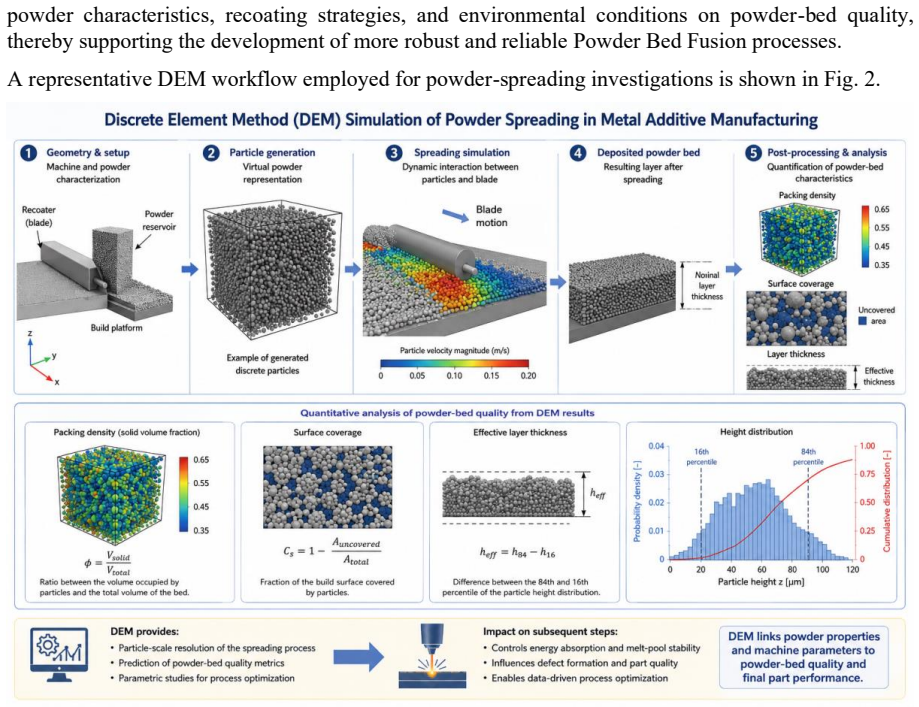
- DEM simulations can predict bed quality metrics from input parameters and thereby reduce trial-and-error in parameter selection.
- Powder reuse cycles alter flowability and cohesion, requiring updated spreading parameters to maintain bed homogeneity.
- Embedding bed-quality sensors into machines enables real-time adjustment of recoater velocity or layer thickness.
- Digital-twin models that track the powder-bed state variable can support data-driven optimization of entire build cycles.
Where Pith is reading between the lines
- Treating the powder bed as an explicit state variable suggests that future process control loops could optimize spreading settings on the fly rather than relying on fixed recipes.
- If bed metrics prove dominant, powder suppliers might need to certify batches against standardized packing-density targets instead of only particle-size specs.
- Extending the same logic to non-metal powders would require checking whether cohesion and flowability play analogous roles in polymer or ceramic PBF.
Load-bearing premise
Powder characteristics, process parameters, and machine architecture interact in systematically quantifiable and modelable ways that allow reliable prediction of bed quality metrics without needing new experimental validation for each combination.
What would settle it
A controlled comparison in which two machines using identical powder, layer thickness, and recoater velocity produce beds with statistically different packing density or homogeneity that then show no corresponding difference in measured energy absorption or defect rates.
Figures
read the original abstract
Powder spreading and layer deposition are fundamental stages of Powder Bed Fusion (PBF) technologies and play a critical role in determining process stability and final component quality. This chapter examines the mechanisms governing powder-bed formation, highlighting the interactions between powder characteristics, process parameters, and machine architecture. Particular attention is devoted to the influence of particle size distribution, morphology, cohesion, flowability, layer thickness, recoater velocity, and environmental conditions on powder-bed quality. The resulting powder-bed is discussed as a process state variable whose characteristics, including packing density, surface coverage, effective layer thickness, and spatial homogeneity, directly affect energy absorption, melt-pool stability, defect formation, and mechanical performance. The chapter also reviews the application of the Discrete Element Method (DEM) for modelling powder spreading phenomena and quantifying powder-bed quality metrics. Finally, the role of powder reuse, lifecycle management, and future developments involving process monitoring, digital twins, and data-driven optimization strategies is discussed, emphasizing the growing importance of powder engineering in advanced metal additive manufacturing.
Editorial analysis
A structured set of objections, weighed in public.
Referee Report
Summary. This review chapter synthesizes literature on powder spreading and layer deposition in metal Powder Bed Fusion (PBF) additive manufacturing. It examines interactions among powder characteristics (particle size distribution, morphology, cohesion, flowability), process parameters (layer thickness, recoater velocity, environmental conditions), and machine architecture, and frames the resulting powder bed as a process state variable whose metrics—packing density, surface coverage, effective layer thickness, and spatial homogeneity—directly influence energy absorption, melt-pool stability, defect formation, and mechanical performance. The chapter reviews Discrete Element Method (DEM) simulations for quantifying these metrics and discusses powder reuse, lifecycle management, and future directions including process monitoring, digital twins, and data-driven optimization.
Significance. If the synthesis accurately captures the cited literature, the review consolidates established knowledge on powder-bed formation as a controlling factor in PBF process stability and part quality. This could serve as a useful reference for researchers modeling or optimizing metal AM processes, particularly by linking upstream powder engineering to downstream defect mitigation and performance outcomes.
minor comments (2)
- The abstract and introduction would benefit from explicit statements on the review's scope (e.g., time period of cited literature or inclusion criteria for DEM studies) to help readers assess completeness.
- Notation for powder-bed metrics (packing density, effective layer thickness) should be defined consistently when first introduced and cross-referenced to any tables or figures summarizing quantitative ranges from the literature.
Simulated Author's Rebuttal
We thank the referee for their positive review and recommendation to accept the manuscript. The referee's summary accurately captures the scope of our review chapter on powder spreading and layer deposition in metal PBF additive manufacturing.
Circularity Check
Review synthesis with no internal derivation chain
full rationale
The manuscript is explicitly a literature review chapter that synthesizes mechanisms, DEM modeling results, and correlations from prior cited studies. No original equations, first-principles derivations, fitted parameters, or predictions are introduced that could reduce to inputs by construction. The central claim that powder-bed metrics act as a process state variable is presented as established knowledge drawn from external references rather than derived within the paper itself.
Axiom & Free-Parameter Ledger
Reference graph
Works this paper leans on
-
[1]
Cundall, P.A., Strack, O.D.L. (1979). A discrete numerical model for granular assemblies. Géotechnique, 29, 47–65. https://doi.org/10.1680/geot.1979.29.1.47
-
[2]
Lampitella, V., Trofa, M., Astarita, A., D’Avino, G. (2021). Discrete Element Method Analysis of the Spreading Mechanism and Its Influence on Powder Bed Characteristics in Additive Manufacturing. Micromachines, 12, 392. https://doi.org/10.3390/mi12040392
-
[3]
Chen, H., Wei, Q., Zhang, Y., Chen, F., Shi, Y., Yan, W. (2019). Powder-spreading mechanisms in powder -bed-based additive manufacturing: Experiments and computational modeling. Acta Materialia, 179, 158–171. https://doi.org/10.1016/j.actamat.2019.08.030
-
[4]
Meier, C., Weissbach, R., Weinberg, J., Wall, W.A., Hart, A.J. (2019). Critical influences of particle size and adhesion on the powder layer uniformity in metal additive 19 manufacturing. Journal of Materials Processing Technology , 266, 484 –
2019
-
[5]
https://doi.org/10.1016/j.jmatprotec.2018.10.037
-
[6]
Parteli, E.J.R., Pöschel, T. (2016). Particle -based simulation of powder application in additive manufacturing. Powder Technology, 288, 96–102. https://doi.org/10.1016/j.powtec.2015.10.035
-
[7]
Srivastava S., Garg R.K., Sharma V.S., Alba -Baena N.G., Sachdeva A., Chand R., Singh S. (2020) Multi-physics continuum modelling approaches for metal powder additive manufacturing: a review. Rapid Prototyping Journal, 26 (4), pp. 737 – 764 DOI: 10.1108/RPJ-07-2019-0189
-
[8]
Singh A., Kapil S., Das M. (2021) Discrete Element Analysis of Gravity-Driven Powder Flow in Coaxial Nozzles for Directed Energy Deposition. Springer Proceedings in Materials, 9, pp. 313 – 332 DOI: 10.1007/978-981-16-0182-8_24
-
[9]
Chuchuay P., Khemabulkul K., Ninpetch P., Kowitwarangkul P. (2024) Selective Laser Melting of Titanium Alloys: Simulation of Scanning Speed Effects with High Layer Thickness. Materials Science Forum, 1141, pp. 11 – 18 DOI: 10.4028/p-W5xr6A
-
[10]
(2018) DEM extensions: Electrically driven deposition of polydisperse particulate powder mixtures
Zohdi T.I. (2018) DEM extensions: Electrically driven deposition of polydisperse particulate powder mixtures. Lecture Notes in Applied and Computational Mechanics, 60, pp. 121 – 134 DOI: 10.1007/978-3-319-70079-3_7
-
[11]
Bouabbou A., Vaudreuil S. (2022) Understanding laser -metal interaction in selective laser melting additive manufacturing through numerical modelling and simulation: a review. Virtual and Physical Prototyping, 17 (3), pp. 543 – 562 DOI: 10.1080/17452759.2022.2052488
-
[12]
Abdelkrim B., Vaudreuil S. (2024) An Open -Source Discrete Element Model for SS316L Alloy Powder Characterization Using a Virtual Hall -Flow Meter to Study the Flowability in Powder Bed Fusion Additive Manufacturing. Springer Tracts in Additive Manufacturing, Part F3253, pp. 151 – 159 DOI: 10.1007/978-3-031-32927-2_14
-
[13]
Tong M. (2023) Review of Particle-Based Computational Methods and Their Application in the Computational Modelling of Welding, Casting and Additive Manufacturing Metals, 13 (8), art. no. 1392 DOI: 10.3390/met13081392
discussion (0)
Sign in with ORCID, Apple, or X to comment. Anyone can read and Pith papers without signing in.