Exact vacuum FLRW solutions in q-deformed Brans-Dicke cosmology
Pith reviewed 2026-06-26 19:51 UTC · model grok-4.3
The pith
In matter-free q-deformed Brans-Dicke cosmology, exact FLRW solutions exist where the scalar field behaves as an effective fluid with constant equation-of-state parameter fixed by the coupling and deformation.
A machine-rendered reading of the paper's core claim, the machinery that carries it, and where it could break.
Core claim
In the matter-free sector we obtain exact analytic solutions for the scale factor and the Brans-Dicke scalar field, and recast the scalar contribution as an effective fluid. We show that the corresponding equation-of-state parameter and the deceleration parameter are constants and depend only on the Brans-Dicke coupling ω and the deformation function, allowing the scalar sector to mimic radiation-, matter-, or dark-energy-like behavior for a restricted region of parameter space.
What carries the argument
The q-deformed coupling function that modifies the effective gravitational strength and yields the generalized Friedmann equations.
If this is right
- The deceleration parameter remains exactly constant throughout the vacuum evolution.
- The equation-of-state parameter of the effective fluid is fixed solely by ω and the deformation function.
- Exact closed-form expressions exist for both the scale factor a(t) and the scalar field φ(t).
- Suitable choices of the parameters let the vacuum scalar sector reproduce the expansion law of radiation (w=1/3), dust (w=0), or a cosmological constant (w=-1).
Where Pith is reading between the lines
- The same constant-w effective fluid could serve as an analytic background for studying linear perturbations or for matching to late-time acceleration data.
- Relaxing the strict vacuum assumption to include dust or radiation would test whether the deformation still permits simple power-law solutions.
- The restricted parameter region that yields dark-energy-like behavior might be further constrained by requiring consistency with solar-system tests of the Brans-Dicke parameter.
Load-bearing premise
The spacetime is taken to be spatially flat FLRW and completely matter-free, while the q-deformation is supplied by a specific coupling function whose form is not derived from a deeper principle.
What would settle it
A direct observation that the deceleration parameter changes with time during a vacuum-dominated epoch, or that no choice of ω and deformation reproduces the observed constant w values for radiation, matter, or dark energy.
Figures
read the original abstract
We study a $q$-deformed extension of Brans-Dicke gravity in a spatially flat Friedmann-Lema\^itre-Robertson-Walker space-time. The deformation enters through a coupling function that modifies the effective gravitational strength and leads to generalized Friedmann equations. In the matter-free sector, we obtain exact analytic solutions for the scale factor and the Brans-Dicke scalar field, and recast the scalar contribution as an effective fluid. We show that the corresponding equation-of-state parameter and the deceleration parameter are constants and depend only on the Brans-Dicke coupling $\omega$ and the deformation function, allowing the scalar sector to mimic radiation-, matter-, or dark-energy-like behavior for a restricted region of parameter space.
Editorial analysis
A structured set of objections, weighed in public.
Referee Report
Summary. The paper claims that in a q-deformed extension of Brans-Dicke gravity on spatially flat FLRW spacetime, where the deformation enters via a chosen coupling function modifying the effective gravitational strength, exact analytic solutions exist for the scale factor and scalar field in the strictly matter-free sector. These solutions are recast as an effective fluid whose equation-of-state parameter w and deceleration parameter q are constants depending only on the Brans-Dicke parameter ω and the deformation function, allowing the scalar sector to mimic radiation-, matter- or dark-energy-like behavior in restricted regions of parameter space.
Significance. If the derivations hold, the work supplies exact analytic solutions in a modified-gravity setting, a feature that is uncommon and analytically useful. The demonstration that w and q are strictly constant (and therefore directly tied to ω and the deformation function) is a clear, falsifiable structural result that facilitates the mimicking analysis without additional assumptions.
minor comments (2)
- [Abstract] The abstract states that the deformation 'enters through a coupling function' but does not display its explicit functional form; adding this (or a reference to the defining equation in §2) would make the generalized Friedmann equations immediately reproducible from the abstract alone.
- [§3] The manuscript should include a brief statement confirming that the derived solutions satisfy the original field equations by direct substitution, even if only for the vacuum case.
Simulated Author's Rebuttal
We thank the referee for the positive summary and significance assessment of our work on exact vacuum FLRW solutions in q-deformed Brans-Dicke cosmology, as well as the recommendation for minor revision. No specific major comments were listed in the report.
Circularity Check
Derivation is self-contained; no circular steps identified
full rationale
The paper defines a q-deformed Brans-Dicke model via an explicit coupling function (an input ansatz), derives the modified Friedmann equations for flat vacuum FLRW, solves those ODEs exactly for a(t) and the scalar field, then substitutes the solutions into the effective stress-energy tensor to obtain constant w and q. These constants are direct algebraic consequences of the solved functions and the input parameters ω and the deformation; they are not fitted, renamed, or presupposed. No self-citation chain, uniqueness theorem, or self-definitional loop is invoked. The result is an internal mathematical property of the stated model, fully independent of external data or prior author results.
Axiom & Free-Parameter Ledger
free parameters (2)
- deformation function
- Brans-Dicke parameter ω
axioms (2)
- domain assumption Spatially flat FLRW metric
- domain assumption Matter-free (vacuum) sector
invented entities (1)
-
q-deformed coupling function
no independent evidence
Reference graph
Works this paper leans on
-
[1]
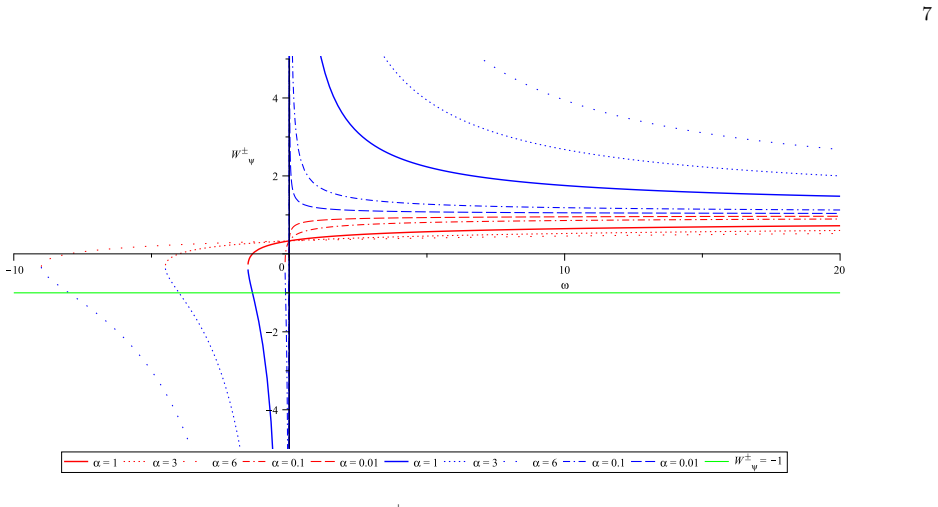
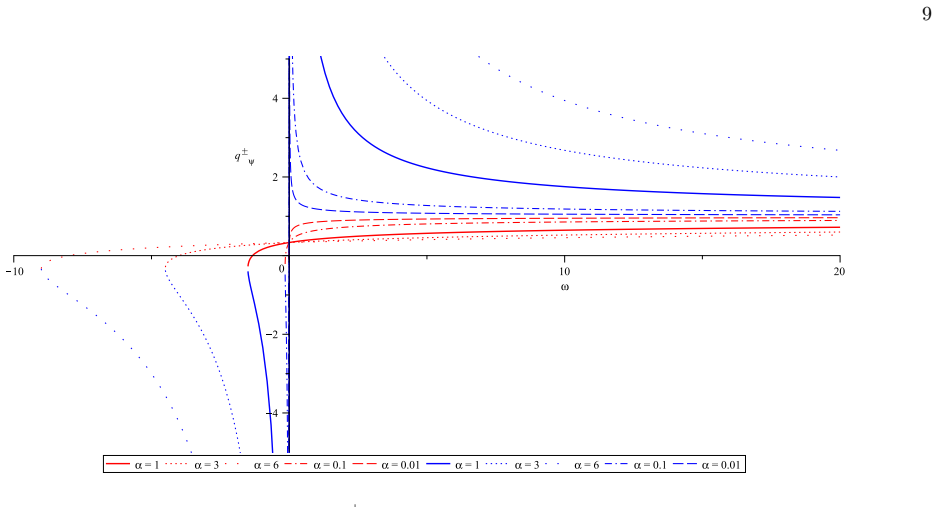
In the limit ofω→0;W − ψ becomes an undefined function whileW+ ψ stabilizes at 1 3,
-
[2]
For the positive values ofω;1≤W − ψ ≤ ∞and 1 3 < W + ψ ≤1,
-
[3]
For the negative values ofω;−∞ ≤W − ψ ≤ − 1 3 and− 1 3 ≤W + ψ < 1 3. Physically, the plot indicates that theq-deformation (encoded inα) acts as a control parameter that shifts the scalar sector between standard cosmological behaviors:W ψ ≃1/3(radiation-like),W ψ ≃0(matter-like), andW ψ ≃ −1 (dark-energy-like). In particular, theW − ψ branch accesses the n...
-
[4]
Nojiri and S
S. Nojiri and S. D. Odintsov, Unified cosmic history in modified gravity: from F(R) theory to Lorentz non-invariant models, Phys. Rept.505, 59 (2011)
2011
-
[5]
Capozziello and M
S. Capozziello and M. De Laurentis, Extended Theories of Gravity, Phys. Rept.509, 167 (2011)
2011
-
[6]
Clifton, P
T. Clifton, P. G. Ferreira, A. Padilla, and C. Skordis, Modified Gravity and Cosmology, Phys. Rept.513, 1 (2012)
2012
-
[7]
Nojiri, S
S. Nojiri, S. D. Odintsov, and V. K. Oikonomou, Modified Gravity Theories on a Nutshell: Inflation, Bounce and Late-time Evolution, Phys. Rept.692, 1 (2017)
2017
-
[8]
Brans and R
C. Brans and R. H. Dicke, Mach’s principle and a relativistic theory of gravitation, Phys. Rev.124, 925 (1961)
1961
-
[9]
S. W. Hawking, Black holes in the Brans-Dicke theory of gravitation, Commun. Math. Phys.25, 167 (1972)
1972
-
[10]
T. P. Sotiriou and V. Faraoni, Black holes in scalar-tensor gravity, Phys. Rev. Lett.108, 081103 (2012)
2012
-
[11]
M. Adak, T. Dereli, and Y. Senikoglu, Non-Riemannian description of Robinson–Trautman spacetimes in Brans–Dicke theory of gravity, Int. J. Mod. Phys. D28, 1950070 (2019)
2019
-
[12]
Dereli and R
T. Dereli and R. W. Tucker, Weyl scalings and spinor matter interactions in scalar-tensor theories of gravitation, Phys. Lett. B110, 206 (1982)
1982
-
[13]
Damour, G
T. Damour, G. W. Gibbons, and C. Gundlach, Dark Matter, Time VaryingG, and a Dilaton Field, Phys. Rev. Lett.64, 123 (1990)
1990
-
[14]
M. R. Setare, The Holographic dark energy in non-flat Brans-Dicke cosmology, Phys. Lett. B644, 99 (2007). 11
2007
-
[15]
M. Shaposhnikov and D. Zenhausern, Scale invariance, unimodular gravity and dark energy, Phys. Lett. B671, 187 (2009), arXiv:0809.3395 [hep-th]
Pith/arXiv arXiv 2009
-
[16]
G. K. Karananas and M. Shaposhnikov, Scale invariant alternatives to general relativity. II. Dilaton properties, Phys. Rev. D93, 084052 (2016)
2016
-
[17]
P. G. Ferreira, C. T. Hill, J. Noller, and G. G. Ross, Inflation in a scale invariant universe, Phys. Rev. D97, 123516 (2018)
2018
-
[18]
Casas, G
S. Casas, G. K. Karananas, M. Pauly, and J. Rubio, Scale-invariant alternatives to general relativity. III. The inflation-dark energy connection, Phys. Rev. D99, 063512 (2019)
2019
-
[19]
D. M. Ghilencea, Gauging scale symmetry and inflation: Weyl versus Palatini gravity, Eur. Phys. J. C81, 510 (2021)
2021
-
[20]
Dereli and Y
T. Dereli and Y. Senikoglu, Gravitational plane waves in a non-Riemannian description of Brans–Dicke gravity, Phys. Scripta95, 045223 (2020)
2020
-
[21]
Dereli and Y
T. Dereli and Y. Şenikoğlu, Dark Range ofωIn Brans-Dicke Gravity, J. Phys. Conf. Ser.2191, 012010 (2022)
2022
-
[22]
J. D. Bekenstein, Black holes and entropy, Phys. Rev. D7, 2333 (1973)
1973
-
[23]
S. W. Hawking, Particle Creation by Black Holes, Commun. Math. Phys.43, 199 (1975), [Erratum: Commun.Math.Phys. 46, 206 (1976)]
1975
-
[24]
Jacobson, Thermodynamics of space-time: The Einstein equation of state, Phys
T. Jacobson, Thermodynamics of space-time: The Einstein equation of state, Phys. Rev. Lett.75, 1260 (1995)
1995
-
[25]
Padmanabhan, Gravity and the thermodynamics of horizons, Phys
T. Padmanabhan, Gravity and the thermodynamics of horizons, Phys. Rept.406, 49 (2005)
2005
-
[26]
Padmanabhan, Thermodynamical Aspects of Gravity: New insights, Rept
T. Padmanabhan, Thermodynamical Aspects of Gravity: New insights, Rept. Prog. Phys.73, 046901 (2010)
2010
-
[27]
Cai and S
R.-G. Cai and S. P. Kim, First law of thermodynamics and Friedmann equations of Friedmann-Robertson-Walker universe, JHEP02, 050
-
[28]
Akbar and R.-G
M. Akbar and R.-G. Cai, Thermodynamic Behavior of Friedmann Equations at Apparent Horizon of FRW Universe, Phys. Rev. D75, 084003 (2007)
2007
-
[29]
Cai and L.-M
R.-G. Cai and L.-M. Cao, Unified first law and thermodynamics of apparent horizon in FRW universe, Phys. Rev. D75, 064008 (2007)
2007
-
[30]
Nojiri, S
S. Nojiri, S. D. Odintsov, and T. Paul, Modified cosmology from the thermodynamics of apparent horizon, Phys. Lett. B 835, 137553 (2022)
2022
-
[31]
Nojiri, S
S. Nojiri, S. D. Odintsov, and T. Paul, Early and late universe holographic cosmology from a new generalized entropy, Phys. Lett. B831, 137189 (2022)
2022
-
[32]
Nojiri, S
S. Nojiri, S. D. Odintsov, and T. Paul, Different Aspects of Entropic Cosmology, Universe10, 352 (2024)
2024
-
[33]
E. P. Verlinde, On the Origin of Gravity and the Laws of Newton, JHEP04, 029
-
[34]
E. P. Verlinde, Emergent Gravity and the Dark Universe, SciPost Phys.2, 016 (2017)
2017
-
[35]
Şenay and S
M. Şenay and S. Kibaroğlu,q-Deformed Einstein equations from entropic force, Int. J. Mod. Phys. A33, 1850218 (2019)
2019
-
[36]
Kibaroğlu and M
S. Kibaroğlu and M. Senay, Effects of bosonic and fermionicq-deformation on the entropic gravity, Mod. Phys. Lett. A 34, 1950249 (2019)
2019
-
[37]
Kibaroğlu and M
S. Kibaroğlu and M. Senay, Friedmann equations for deformed entropic gravity, Int. J. Mod. Phys. D29, 2050042 (2020)
2020
-
[38]
Senay, M
M. Senay, M. M. Sabet, and H. Moradpour, Heat capacity of holographic screen inspires mond theory, Physica Scripta96, 075001 (2021)
2021
-
[39]
Senay, Entropic gravity corrected byq-statistics, and its implications to cosmology, Physics Letters B820, 136536 (2021)
M. Senay, Entropic gravity corrected byq-statistics, and its implications to cosmology, Physics Letters B820, 136536 (2021)
2021
-
[40]
Senay, Jeans mass and gamow temperature: insights fromq-deformed systems, Physica Scripta99, 105001 (2024)
M. Senay, Jeans mass and gamow temperature: insights fromq-deformed systems, Physica Scripta99, 105001 (2024)
2024
-
[41]
Senay, Implications of q-deformed statistics on stellar stability, Physica A , 130163 (2024)
M. Senay, Implications of q-deformed statistics on stellar stability, Physica A , 130163 (2024)
2024
-
[42]
Kibaroğlu and M
S. Kibaroğlu and M. Senay, Generalized Brans-Dicke theory from Verlinde’s entropic gravity, Nucl. Phys. B1017, 116974 (2025)
2025
-
[43]
Algin and M
A. Algin and M. Senay, High temperature behavior of a deformed Fermi gas obeying interpolating statistics, Phys. Rev. E 85, 041123 (2012)
2012
-
[44]
Algin and M
A. Algin and M. Senay, Fermionic q -deformation and its connection to thermal effective mass of a quasiparticle, Physica A447, 232 (2016)
2016
-
[45]
Algin and M
A. Algin and M. Senay, General thermostatistical properties of aq-deformed fermion gas in two dimensions, Journal of Physics: Conference Series766, 012008 (2016)
2016
-
[46]
L. O. Pimentel, Exact cosmological solutions in the scalar-tensor theory with cosmological constant, Astrophysics and space science112, 175 (1985)
1985
-
[47]
Banerjee and D
N. Banerjee and D. Pavon, Holographic dark energy in Brans-Dicke theory, Phys. Lett. B647, 477 (2007). 12
2007
-
[48]
Sheykhi, Interacting new agegraphic dark energy in nonflat Brans-Dicke cosmology, Phys
A. Sheykhi, Interacting new agegraphic dark energy in nonflat Brans-Dicke cosmology, Phys. Rev. D81, 023525 (2010)
2010
-
[49]
Khatri and C
V. Khatri and C. P. Singh, Brans–Dicke cosmology with cosmological termΛ(H)=c0+3νH2, Phys. Dark Univ.42, 101300 (2023)
2023
-
[50]
Solà Peracaula, Brans–Dicke gravity: From Higgs physics to (dynamical) dark energy, Int
J. Solà Peracaula, Brans–Dicke gravity: From Higgs physics to (dynamical) dark energy, Int. J. Mod. Phys. D27, 1847029 (2018)
2018
-
[51]
de Cruz Pérez and J
J. de Cruz Pérez and J. Solà Peracaula, Brans–Dicke cosmology mimicking running vacuum, Mod. Phys. Lett. A33, 1850228 (2018)
2018
-
[52]
H. W. Lee, K. Y. Kim, and Y. S. Myung, Equations of State in the Brans-Dicke cosmology, Eur. Phys. J. C71, 1585 (2011)
2011
-
[53]
A. R. Liddle, A. Mazumdar, and J. D. Barrow, Radiation matter transition in Jordan-Brans-Dicke theory, Phys. Rev. D 58, 027302 (1998)
1998
-
[54]
Nagata, T
R. Nagata, T. Chiba, and N. Sugiyama, WMAP constraints on scalar- tensor cosmology and the variation of the gravita- tional constant, Phys. Rev. D69, 083512 (2004)
2004
-
[55]
Acquaviva, C
V. Acquaviva, C. Baccigalupi, S. M. Leach, A. R. Liddle, and F. Perrotta, Structure formation constraints on the Jordan- Brans-Dicke theory, Phys. Rev. D71, 104025 (2005)
2005
-
[56]
Avilez and C
A. Avilez and C. Skordis, Cosmological constraints on Brans-Dicke theory, Phys. Rev. Lett.113, 011101 (2014)
2014
-
[57]
Alsing, E
J. Alsing, E. Berti, C. M. Will, and H. Zaglauer, Gravitational radiation from compact binary systems in the massive Brans-Dicke theory of gravity, Phys. Rev. D85, 064041 (2012)
2012
-
[58]
Kofinas, E
G. Kofinas, E. Papantonopoulos, and E. N. Saridakis, Modified Brans–Dicke cosmology with matter-scalar field interaction, Class. Quant. Grav.33, 155004 (2016)
2016
-
[59]
Nojiri, S
S. Nojiri, S. D. Odintsov, and V. Faraoni, From nonextensive statistics and black hole entropy to the holographic dark universe, Phys. Rev. D105, 044042 (2022)
2022
-
[60]
Nojiri and S
S. Nojiri and S. D. Odintsov, The correspondence of generalised entropic cosmology theory with F(T) and F(Q) modified gravity and gravitational waves, Phys. Dark Univ.48, 101899 (2025)
2025
-
[61]
S. D. Odintsov, D. Sáez-Chillón Gómez, and G. S. Sharov, Modified gravity/dynamical dark energy vsΛCDM: is the game over?, Eur. Phys. J. C85, 298 (2025)
2025
-
[62]
S. D. Odintsov and V. K. Oikonomou, GW170817 Viable Einstein-Gauss-Bonnet inflation compatible with the atacama cosmology telescope data, Phys. Lett. B868, 139779 (2025)
2025
-
[63]
S. D. Odintsov, V. K. Oikonomou, and G. S. Sharov, Dynamical dark energy from F(R) gravity models unifying inflation with dark energy: Confronting the latest observational data, JHEAp50, 100471 (2026)
2026
-
[64]
S. D. Odintsov, V. K. Oikonomou, and G. S. Sharov, Viable F(R) scenarios unifying inflation with realistic dynamical dark energy, JHEAp52, 100579 (2026)
2026
discussion (0)
Sign in with ORCID, Apple, or X to comment. Anyone can read and Pith papers without signing in.