REVIEW 3 major objections 6 minor 73 references
Floquet composite Dirac semimetals
T0 review · 3 major / 6 minor · reviewed 2026-08-06 · deepseek-v4-flash
Pith's one-line read Periodic driving can force a single crystal to host all three Dirac-point types at once.
desk verdict A plausible new Floquet phase with coexisting Dirac types, but the paper overstates the generality of its band-touching criterion. read the letter →
The pith
A machine-rendered reading of the paper's core claim, the machinery that carries it, and where it could break.
The reading
What carries the argument
The argument rests on two objects. First is the band-touching criterion of Eq. (2): when $H(t)$ commutes with itself at all times, a crossing appears exactly when the integral of an instantaneous eigenvalue over one driving period equals an even multiple of $\pi$ (quasienergy zero) or an odd multiple of $\pi$ (quasienergy $\pi/T$). Second is the symmetric-time-frame effective Hamiltonian $H'_{\mathrm{eff}} = (i/T)\ln[e^{-iH_1 T/2} e^{-iH_2 T} e^{-iH_1 T/2}]$, which restores the inversion and time-reversal symmetries that the naively defined effective Hamiltonian loses. The $k_z$-dependent phase is classified by spin winding numbers $W_{\alpha/T}(k_z)$ and dynamical spin winding numbers $V_{\alpha/T}(k_z)$; their difference $|W|-|V|$ counts the corner states at quasienergy $\alpha/T$, and their parity fixes whether first-order gapless edge states exist. The transitions between normal, first-order, and second-order slices are precisely the Dirac points that the criterion locates.
What would settle it
A numerical scan of the full three-dimensional quasienergy spectrum, covering all $(k_x, k_y)$ points rather than only the four symmetry lines, would either reproduce the paper's Dirac-point count or expose additional crossings that Eq. (2) cannot predict.
Extended reading notes
Core claim
The paper's central claim is that periodic driving converts a four-band Hamiltonian, made from a second-order topological insulator and a semimetal term, into Floquet composite Dirac semimetals that contain all three Dirac-point types. The authors work in a symmetric time frame, where the effective Hamiltonian recovers the inversion and time-reversal symmetries of the static pieces. Applying their band-touching criterion, they locate Dirac points in four symmetry classes: on the lines $k_x=k_y=0$, $k_x=k_y=\pi$, $k_x=0$ with $k_y=\pi$ (and the swapped partner), and $k_x=\arccos(-\lambda)$ with $k_y=-\arccos(-\lambda)$. For the delta-function driven example they classify these as type-I, type-II, and type-III Dirac points, with each type separating a different pair of $k_z$-dependent two-dimensional phases: normal insulator to first-order topological insulator, normal insulator to second-order topological insulator, and first-order to first-order topological insulator. Boundary-state calculations show gapless edge modes and corner modes in the appropriate $k_z$ windows, so the Dirac points carry surface Fermi arcs, hinge Fermi arcs, or both. The same structure is found for harmonic driving, where the paper counts thirty-two Dirac points in the Brillouin zone at zero and $\pi/T$ quasienergies.
Load-bearing premise
The band-touching criterion used to locate every Dirac point assumes the driven Hamiltonian commutes with itself at all times, but the model satisfies this only on the four high-symmetry lines where the commuting term is proportional to $\sigma_z$, not in the full Brillouin zone.
Editorial extensions
If this is right
- A single Floquet phase can host type-I, type-II, and type-III Dirac points simultaneously, instead of confining each type to a different static material.
- Both delta-function and harmonic driving realize the composite phase, so the result does not depend on a particular pulse shape.
- The location, number, and type of Dirac points can be tuned through $\lambda$, $t_1$, $t_2$, and the driving period; harmonic driving yields thirty-two Dirac points across both quasienergy gaps.
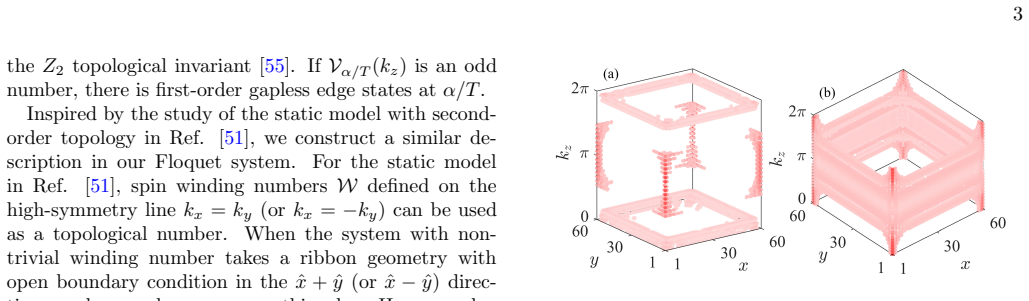
- Surface Fermi arcs and hinge Fermi arcs appear together, connecting the Dirac points, because first-order and second-order topology coexist in different $k_z$ slices.
- Three distinct Dirac-semimetal phases appear in the phase diagram, and each phase transition is accompanied by the creation of a new pair of Dirac points.
Reading between the lines
- The exact Dirac-point count depends on the commutativity assumption holding globally; a numerical scan over the full three-dimensional Brillouin zone outside the four high-symmetry lines would either confirm the count or reveal additional crossings.
- Because both drive forms are standard experimental controls in engineered lattices, the same composite phase could be probed in driven photonic, acoustic, or atomic systems, where boundary Fermi arcs appear as intensity or density patterns.
- The same strategy of restoring symmetries in a symmetric time frame could classify composite nodal-line or Weyl phases in driven systems, although the paper does not pursue this extension.
Signed reviews
Editorial analysis
A structured set of objections, weighed in public.
Referee Report
Summary. The paper proposes a Floquet protocol to realize three-dimensional Dirac semimetals in a four-band model with time-reversal and space-inversion symmetry. Using a band-touching criterion for time-periodic Hamiltonians and symmetric-time-frame topological invariants, it locates Dirac points along four high-symmetry points in the (kx,ky) plane and classifies them as type I, II, or III according to the kz-dependent first- and second-order topology. Both delta-function and harmonic driving are considered; the authors report coexisting type-I/II/III Dirac points and associated surface and hinge Fermi arcs. The central claim is that periodic driving can generate composite Dirac semimetals with all three Dirac-point types in a single phase.
Significance. If the results hold, this would be a useful advance: a single Floquet system with coexisting type-I, type-II, and type-III Dirac points, tunable by drive parameters, and a framework for characterizing Floquet Dirac semimetals with higher-order topology. The paper provides analytic criteria for Dirac-point locations and topological invariants, and it shows numerical boundary-state distributions consistent with the proposed classification. The delta-function and harmonic driving cases together suggest a degree of universality. However, the central analytical criterion is applied without stating its domain of validity, so the Dirac-point inventory and the resulting phase diagram need strengthening before the central claim is fully supported.
major comments (3)
- [Floquet composite Dirac semimetals, Eq. (2)] The band-touching criterion in Eq. (2) requires [H(t),H(t')]=0 for all t,t'. For the drive in Eq. (3), this condition holds only when the coefficients of the s0σy and szσx terms in H1(k) vanish, i.e., at the four (kx,ky) points used in Cases I-IV of Eqs. (5)-(8). The paper does not state this restriction and presents Eq. (2) as a general criterion. Since Eqs. (5)-(8) are derived from Eq. (2), the paper has not excluded additional band touchings away from these high-symmetry points. This is load-bearing because the phase diagram of Fig. 4 and the claimed coexistence of type-I/II/III points assume a complete inventory of Dirac points. Please state the commutativity restriction explicitly, and either prove that no other touchings occur or scan the full three-dimensional Brillouin zone numerically to confirm exhaustiveness.
- [Floquet composite Dirac semimetals, Eq. (9)] The harmonic drive in Eq. (9) suffers from the same issue. The Hamiltonian H(k,t)=H1(k)+t1[cos kz+cos(ω t)]s0σz does not commute with itself at different times except on the same high-symmetry (kx,ky) points where H1 is proportional to s0σz. Equations (10)-(13) and the count of thirty-two Dirac points are therefore derived under an unstated restriction, and the possibility of additional Dirac points away from these lines is not addressed. A full-Brillouin-zone numerical check is needed to support the claimed completeness of the Dirac-point inventory for the harmonic drive as well.
- [Floquet composite Dirac semimetals, paragraph after Eq. (4)] The type I/II/III assignment is inferred from the kz dependence of the topological invariants W and V, but the manuscript does not show the quasienergy dispersion in the vicinity of the claimed Dirac points to confirm the linear dispersion and tilt that distinguish the three types. The text states that numerical results show linear dispersion, yet no such plot or detailed calculation is presented. Given that the central claim is coexistence of all three Dirac-point types, please provide explicit dispersion plots near representative Dirac points or a clear argument that the topological-slice classification uniquely determines the standard type-I/II/III characterization.
minor comments (6)
- [Eq. (2) and surrounding text] The condition '[H(t),H(t')] = 0,∀ ∈ t, t′' should read '∀t,t′'; the symbol '∈' is misplaced.
- [Floquet composite Dirac semimetals, after Eq. (3)] The sentence 'Both H1(k) and H2(k) describe a second-order topological insulator and a semimetal, respectively' is unclear because H2(k) as written is a σz mass term with no kx,ky dispersion; please clarify what 'semimetal' means here.
- [Floquet composite Dirac semimetals, harmonic driving paragraph] There are typographical errors: 'harmnonic' should be 'harmonic', and 'π/Tgap' should be 'π/T gap'.
- [Fig. 1 caption] The caption contains 'The Schematic of of'; please remove the duplicated word.
- [Reference [42]] The title of Ref. [42] contains a garbled character (shown as '𭟋'); please correct it.
- [Phase diagram paragraph, Fig. 4] The phase boundaries at λ=0.0940 and λ=0.2812 are quoted without derivation; a short explanation of how they follow from Eq. (2) would improve readability.
Circularity Check
No circularity: Dirac-point locations and phase boundaries are computed from the stated model and verified numerically, not imported from the conclusions.
full rationale
The central derivation is self-contained. The band-touching condition in Eq. (2) is derived from the stated commutativity assumption, and the Dirac-point locations in Eqs. (5)-(8) and (10)-(13) are obtained by evaluating that condition on the commuting high-symmetry sectors of the model; the same locations are checked numerically in Figs. 2-5, so the inventory is not assumed. The topological classification uses independently defined winding numbers W and V, with the boundary-state counts verified explicitly in Fig. 2. Self-citations [44,50,56] supply the symmetric-time-frame construction and the corner-state counting formula, but the paper restates the construction and the counting formula and validates them numerically; they are methodological inputs, not the predicted result. The fact that the commutativity premise of Eq. (2) is not explicitly restricted to high-symmetry lines is a correctness/completeness concern, not a circularity: it does not make any predicted quantity equal to an input by construction. No fitted parameter is renamed as a prediction; the parameters lambda, t1, t2, and T are fixed inputs, and the Dirac-point locations and phase boundaries are outputs. Therefore no circular step is present.
Assumptions & free parameters
free parameters (5)
- lambda (lambda) =
0.3 in both example protocols; phase diagram scanned over lambda
- t1 =
1.5 in the delta-kick protocol, 3 in the harmonic protocol
- t2 =
1.6 in the delta-kick protocol; absent in the harmonic protocol
- T (driving period) =
1
- omega (driving frequency) =
2 pi in the harmonic protocol
assumptions (4)
- standard math Floquet theorem: the one-period evolution operator defines an effective Hamiltonian and quasienergy modulo 2 pi/T.
- domain assumption The symmetric time frame preserves the time-reversal and inversion symmetries of the effective Hamiltonian.
- ad hoc to paper The band-touching criterion in Eq. (2) is valid for the noncommuting drives used in this paper.
- domain assumption Bulk-boundary correspondence and corner-state counting 4(|W|-|V|) for Floquet higher-order phases.
Cite this review
Pith. "Pith review of Floquet composite Dirac semimetals." pith.science (2026). https://pith.science/paper/M6YUMCHB
@misc{pith2026250714618,
  author       = {Pith},
  title        = {Pith review of: Floquet composite Dirac semimetals},
  year         = {2026},
  howpublished = {\url{https://pith.science/paper/M6YUMCHB}},
  note         = {Machine review of arXiv:2507.14618}
}
read the original abstract
Dirac semimetals can be classified into types I, II, and III based on the topological charge of their Dirac points. If a three-dimensional (3D) system can be sliced into a family of kz-dependent normal and topological insulators, type I Dirac points separate a 2D normal insulator from a 2D first-order topological insulator, while type II (III) Dirac points separate a 2D normal (first-order) insulator from a 2D second-order topological insulator. To investigate the effects arising from the interplay of distinct Dirac points, one may wonder whether these Dirac points can coexist in a single system. Here, we propose a scheme to induce composite Dirac semimetals by a special Floquet driving that preserves time-reversal and space-inversion symmetries. A general description is established to characterize Dirac semimetals in Floquet systems. The results show that Dirac semimetals hosting coexisting type I, II, and III Dirac points can be induced by delta-function or harmonic driving. Our results provide a promising new avenue for exploring novel Dirac semimetals.
Figures


Figures from the paper (1 more)

Reference graph
Works this paper leans on
- [57]
-
[1]
Qi and S.-C
X.-L. Qi and S.-C. Zhang, Topological insulators and su- perconductors, Rev. Mod. Phys.83, 1057 (2011)
2011
-
[2]
N. R. Cooper, J. Dalibard, and I. B. Spielman, Topo- logical bands for ultracold atoms, Rev. Mod. Phys.91, 015005 (2019)
2019
-
[3]
C.-K. Chiu, J. C. Y. Teo, A. P. Schnyder, and S. Ryu, Classification of topological quantum matter with sym- metries, Rev. Mod. Phys.88, 035005 (2016)
2016
-
[4]
E. Cornfeld and S. Carmeli, Tenfold topology of crystals: Unified classification of crystalline topological insulators and superconductors, Phys. Rev. Res.3, 013052 (2021)
work page 2021
-
[5]
N. P. Armitage, E. J. Mele, and A. Vishwanath, Weyl and Dirac semimetals in three-dimensional solids, Rev. Mod. Phys.90, 015001 (2018)
2018
-
[6]
B. Q. Lv, T. Qian, and H. Ding, Experimental perspec- tive on three-dimensional topological semimetals, Rev. Mod. Phys.93, 025002 (2021)
work page 2021
-
[7]
Jia, Generic reduction theory for Fermi sea topology in metallic systems, Phys
W. Jia, Generic reduction theory for Fermi sea topology in metallic systems, Phys. Rev. B111, 155115 (2025)
work page 2025
Show all 73 references
-
[8]
Jiang, A
B. Jiang, A. Bouhon, Z.-K. Lin, X. Zhou, B. Hou, F. Li, R.-J. Slager, and J.-H. Jiang, Experimental observation of non-Abelian topological acoustic semimetals and their phase transitions, Nature Physics17, 1239–1246 (2021)
2021
-
[9]
C. Fang, M. J. Gilbert, X. Dai, and B. A. Bernevig, Multi-Weyl topological semimetals stabilized by point group symmetry, Phys. Rev. Lett.108, 266802 (2012)
2012
-
[10]
Wang, Z.-K
H.-X. Wang, Z.-K. Lin, B. Jiang, G.-Y. Guo, and J.-H. Jiang, Higher-order Weyl semimetals, Phys. Rev. Lett. 125, 146401 (2020)
2020
-
[11]
S. A. A. Ghorashi, T. Li, and T. L. Hughes, Higher-order Weyl semimetals, Phys. Rev. Lett.125, 266804 (2020)
2020
-
[12]
S. M. Young, S. Zaheer, J. C. Y. Teo, C. L. Kane, E. J. Mele, and A. M. Rappe, Dirac semimetal in three dimen- sions, Phys. Rev. Lett.108, 140405 (2012)
2012
-
[13]
Bouhon, Q
A. Bouhon, Q. Wu, R.-J. Slager, H. Weng, O. V. Yazyev, and T. Bzduˇ sek, Non-abelian reciprocal braiding of Weyl points and its manifestation in ZrTe, Nature Physics16, 1137–1143 (2020)
2020
-
[14]
A. A. Burkov, M. D. Hook, and L. Balents, Topological nodal semimetals, Phys. Rev. B84, 235126 (2011)
2011
-
[15]
Xu, S.-T
Y. Xu, S.-T. Wang, and L.-M. Duan, Weyl exceptional rings in a three-dimensional dissipative cold atomic gas, Phys. Rev. Lett.118, 045701 (2017)
2017
-
[16]
Yan and Z
Z. Yan and Z. Wang, Tunable Weyl points in periodi- cally driven nodal line semimetals, Phys. Rev. Lett.117, 087402 (2016)
2016
-
[17]
Q. Ma, Z. Pu, L. Ye, J. Lu, X. Huang, M. Ke, H. He, W. Deng, and Z. Liu, Observation of higher-order nodal- line semimetal in phononic crystals, Phys. Rev. Lett. 132, 066601 (2024)
2024
-
[18]
Luo, M.-J
B.-B. Luo, M.-J. Gao, and J.-H. An, Topological semimetal with coexisting nodal points and nodal lines, Phys. Rev. B112, 045126 (2025)
2025
-
[19]
Peluso, A
M. Peluso, A. De Martino, R. Egger, and F. Buccheri, Nonreciprocal Weyl semimetal waveguide, Phys. Rev. Res.7, 023195 (2025)
2025
-
[20]
W. Wu, Y. Liu, S. Li, C. Zhong, Z.-M. Yu, X.-L. Sheng, Y. X. Zhao, and S. A. Yang, Nodal surface semimetals: Theory and material realization, Phys. Rev. B97, 115125 (2018)
2018
-
[21]
H. Qiu, Y. Li, Q. Zhang, and C. Qiu, Discovery of higher- order nodal surface semimetals, Phys. Rev. Lett.132, 186601 (2024)
2024
-
[22]
Z.-R. Liu, R. Chen, and B. Zhou, Five-dimensional Floquet topological semimetals with emergent Yang monopoles and linked Weyl surfaces, Phys. Rev. B111, 045302 (2025)
2025
-
[23]
Wang, J.-X
K. Wang, J.-X. Dai, L. B. Shao, S. A. Yang, and Y. X. Zhao, Boundary criticality ofPT-invariant topol- ogy and second-order nodal-line semimetals, Phys. Rev. Lett.125, 126403 (2020)
2020
-
[24]
A. P. Sakhya, C.-Y. Huang, G. Dhakal, X.-J. Gao, S. Regmi, B. Wang, W. Wen, R.-H. He, X. Yao, R. Smith, M. Sprague, S. Gao, B. Singh, H. Lin, S.-Y. Xu, F. Tafti, A. Bansil, and M. Neupane, Observation of Fermi arcs and weyl nodes in a noncentrosymmetric magnetic weyl semimetal...
2023
-
[25]
Huang, F
S. Huang, F. Zhan, X. Ding, D.-H. Xu, D.-S. Ma, and R. Wang, Weyl nodes and Fermi arcs from Floquet en- gineering triple fermions, Phys. Rev. B110, L121118 6 (2024)
2024
-
[26]
R. Chen, B. Zhou, and D.-H. Xu, Quasicrystalline second-order topological semimetals, Phys. Rev. B108, 195306 (2023)
2023
-
[27]
Borisenko, Q
S. Borisenko, Q. Gibson, D. Evtushinsky, V. Zabolotnyy, B. B¨ uchner, and R. J. Cava, Experimental realization of a three-dimensional Dirac semimetal, Phys. Rev. Lett. 113, 027603 (2014)
2014
-
[28]
H. Qiu, M. Xiao, F. Zhang, and C. Qiu, Higher-order Dirac sonic crystals, Phys. Rev. Lett.127, 146601 (2021)
2021
-
[29]
T. V. Trevisan, P. V. Arribi, O. Heinonen, R.-J. Slager, and P. P. Orth, Bicircular light Floquet engineering of magnetic symmetry and topology and its application to the Dirac semimetal Cd 3As2, Phys. Rev. Lett.128, 066602 (2022)
2022
-
[30]
topo- logical phase transitions of Dirac magnons in honeycomb ferromagnets
Y.-M. Li, B. Wei, and K. Chang, Comment on “topo- logical phase transitions of Dirac magnons in honeycomb ferromagnets”, Phys. Rev. Lett.132, 219601 (2024)
2024
-
[31]
Pal and A
A. Pal and A. K. Ghosh, Multi-higher-order Dirac and nodal line semimetals, Phys. Rev. B111, 195429 (2025)
2025
-
[32]
Sur and C
S. Sur and C. Setty, Cubic Dirac semimetals: General theory and application to rare-earth magnets, Phys. Rev. Res.7, 013280 (2025)
2025
-
[33]
Arora, D
V. Arora, D. V. S. Muthu, R. Sankar, and A. K. Sood, Ultrafast spectroscopy of the Dirac semimetal Cd 3As2 under pressure, Phys. Rev. B111, 064101 (2025)
2025
-
[34]
Swain, A
D. Swain, A. Dey, A. Roy, K. Saha, and S. D. Das, Nontrivial phonon dynamics and significant electron- phonon coupling of the high-frequency modes in a Dirac semimetal, Phys. Rev. B111, 035143 (2025)
2025
-
[35]
H. Wang, H. Liu, Y. Liu, Y. Tang, P. Lai, H. Cheng, and S. Chen, Correspondence between dynamic higher-order topological insulator and synthetic higher-order Dirac semimetal, Phys. Rev. B111, L201408 (2025)
2025
-
[36]
Koshino, T
M. Koshino, T. Morimoto, and M. Sato, Topological zero modes and Dirac points protected by spatial symmetry and chiral symmetry, Phys. Rev. B90, 115207 (2014)
2014
-
[37]
Neupane, S.-Y
M. Neupane, S.-Y. Xu, R. Sankar, N. Alidoust, G. Bian, C. Liu, I. Belopolski, T.-R. Chang, H.-T. Jeng, H. Lin, A. Bansil, F. Chou, and M. Z. Hasan, Observation of a three-dimensional topological Dirac semimetal phase in high-mobility Cd3As2, Nature Communications5(2014)
2014
-
[38]
Pavlosiuk, P
O. Pavlosiuk, P. W. Swatek, J.-P. Wang, P. Wi´ sniewski, and D. Kaczorowski, Giant magnetoresistance, Fermi- surface topology, Shoenberg effect, and vanishing quan- tum oscillations in the type-ii Dirac semimetal candidates MoSi2 and WSi2, Phys. Rev. B105, 075141 (2022)
2022
-
[39]
Fujiyama, H
S. Fujiyama, H. Maebashi, N. Tajima, T. Tsumuraya, H.- B. Cui, M. Ogata, and R. Kato, Large diamagnetism and electromagnetic duality in two-dimensional Dirac elec- tron system, Phys. Rev. Lett.128, 027201 (2022)
2022
-
[40]
Z. Wang, H. Weng, Q. Wu, X. Dai, and Z. Fang, Three- dimensional Dirac semimetal and quantum transport in Cd3As2, Phys. Rev. B88, 125427 (2013)
2013
-
[41]
Z. Sun, A. Martinez, and F. Wang, Optical modulators with 2D layered materials, Nature Photonics10, 227–238 (2016)
2016
-
[42]
Morimoto and A
T. Morimoto and A. Furusaki, Weyl and Dirac semimet- als with𭟋 2 topological charge, Phys. Rev. B89, 235127 (2014)
2014
-
[43]
Q. Wei, X. Zhang, W. Deng, J. Lu, X. Huang, M. Yan, G. Chen, Z. Liu, and S. Jia, Higher-order topologi- cal semimetal in acoustic crystals, Nature Materials20, 812–817 (2021)
2021
-
[44]
Wu and J.-H
H. Wu and J.-H. An, Breakdown of boundary criticality and exotic topological semimetals inPT-invariant sys- tems, Phys. Rev. B112, L041101 (2025)
2025
-
[45]
L. Song, H. Yang, Y. Cao, and P. Yan, Square-root higher-order weyl semimetals, Nature Communications 13, 5601 (2022)
2022
-
[46]
Verdeny, A
A. Verdeny, A. Mielke, and F. Mintert, Accurate effec- tive hamiltonians via unitary flow in Floquet space, Phys. Rev. Lett.111, 175301 (2013)
2013
-
[47]
Kundu, H
A. Kundu, H. A. Fertig, and B. Seradjeh, Effective theory of Floquet topological transitions, Phys. Rev. Lett.113, 236803 (2014)
2014
-
[48]
L. Zhou, C. Chen, and J. Gong, Floquet semimetal with Floquet-band holonomy, Phys. Rev. B94, 075443 (2016)
2016
-
[49]
Xiong, J
T.-S. Xiong, J. Gong, and J.-H. An, Towards large- Chern-number topological phases by periodic quenching, Phys. Rev. B93, 184306 (2016)
2016
-
[50]
Wu, Y.-C
H. Wu, Y.-C. Dong, and H. Liu, Floquet topological phases with time-reversal and space-inversion symmetries and dynamical detection of topological charges, Phys. Rev. B110, 235140 (2024)
2024
-
[51]
Yan, Higher-order topological odd-parity supercon- ductors, Phys
Z. Yan, Higher-order topological odd-parity supercon- ductors, Phys. Rev. Lett.123, 177001 (2019)
2019
-
[52]
J. K. Asb´ oth, B. Tarasinski, and P. Delplace, Chiral sym- metry and bulk-boundary correspondence in periodically driven one-dimensional systems, Phys. Rev. B90, 125143 (2014)
2014
-
[53]
Y. Xue, W. Xu, B. Zhao, J. Zhang, and Z. Yang, Antifer- romagnetic quantum spin hall insulators with high spin chern numbers, Phys. Rev. B108, 075138 (2023)
2023
-
[54]
J. Yu, Y. Ge, and S. Das Sarma, Dynamical fragile topol- ogy in Floquet crystals, Phys. Rev. B104, L180303 (2021)
2021
-
[55]
S. Yao, Z. Yan, and Z. Wang, Topological invariants of floquet systems: General formulation, special properties, and floquet topological defects, Phys. Rev. B96, 195303 (2017)
2017
-
[56]
Wu and J.-H
H. Wu and J.-H. An, Hybrid-order topological odd-parity superconductors via Floquet engineering, Phys. Rev. B 107, 235132 (2023)
2023
-
[58]
Schumann, L
T. Schumann, L. Galletti, D. A. Kealhofer, H. Kim, M. Goyal, and S. Stemmer, Observation of the quan- tum Hall effect in confined films of the three-dimensional Dirac semimetal Cd 3As2, Phys. Rev. Lett.120, 016801 (2018)
2018
-
[59]
S´ anchez-Barriga, O
J. S´ anchez-Barriga, O. J. Clark, M. G. Vergniory, M. Krivenkov, A. Varykhalov, O. Rader, and L. M. Schoop, Experimental realization of a three-dimensional Dirac semimetal phase with a tunable lifshitz transition in Au2Pb, Phys. Rev. Lett.130, 236402 (2023)
2023
-
[60]
Y. Wu, D. Zhu, Y. Wang, X. Rong, and J. Du, Exper- imental observation of Dirac exceptional points, Phys. Rev. Lett.134, 153601 (2025)
2025
-
[61]
Eckardt, Colloquium: Atomic quantum gases in pe- riodically driven optical lattices, Rev
A. Eckardt, Colloquium: Atomic quantum gases in pe- riodically driven optical lattices, Rev. Mod. Phys.89, 011004 (2017)
2017
-
[62]
Meinert, M
F. Meinert, M. J. Mark, K. Lauber, A. J. Daley, and H.- C. N¨ agerl, Floquet engineering of correlated tunneling in the Bose-Hubbard model with ultracold atoms, Phys. Rev. Lett.116, 205301 (2016)
2016
-
[63]
Zhang, C.-R
J.-Y. Zhang, C.-R. Yi, L. Zhang, R.-H. Jiao, K.-Y. Shi, 7 H. Yuan, W. Zhang, X.-J. Liu, S. Chen, and J.-W. Pan, Tuning anomalous Floquet topological bands with ultra- cold atoms, Phys. Rev. Lett.130, 043201 (2023)
2023
-
[64]
Zhang, F
Z. Zhang, F. Zhang, Z. Xu, Y. Hu, H. Bao, and H. Shen, Realizing exceptional points by Floquet dissipative cou- plings in thermal atoms, Phys. Rev. Lett.133, 133601 (2024)
2024
-
[65]
Roushan, C
P. Roushan, C. Neill, A. Megrant, Y. Chen, R. Bab- bush, R. Barends, B. Campbell, Z. Chen, B. Chiaro, A. Dunsworth, A. Fowler, E. Jeffrey, J. Kelly, E. Lucero, J. Mutus, P. J. J. OHuo Heng alley, M. Neeley, C. Quin- tana, D. Sank, A. Vainsencher, J. Wenner, T. White, E. Kapit,...
2017
-
[66]
W. Chen, M. Abbasi, S. Erdamar, J. Muldoon, Y. N. Joglekar, and K. W. Murch, Engineering nonequilibrium steady states through Floquet liouvillians, Phys. Rev. Lett.134, 090402 (2025)
2025
-
[67]
S. Zhou, C. Bao, B. Fan, F. Wang, H. Zhong, H. Zhang, P. Tang, W. Duan, and S. Zhou, Floquet engineering of black phosphorus upon below-gap pumping, Phys. Rev. Lett.131, 116401 (2023)
2023
-
[68]
M. C. Rechtsman, J. M. Zeuner, Y. Plotnik, Y. Lumer, D. Podolsky, F. Dreisow, S. Nolte, M. Segev, and A. Sza- meit, Photonic Floquet topological insulators, Nature 496, 196 (2013)
2013
-
[69]
Cheng, Y
Q. Cheng, Y. Pan, H. Wang, C. Zhang, D. Yu, A. Gover, H. Zhang, T. Li, L. Zhou, and S. Zhu, Observation of anomalousπmodes in photonic Floquet engineering, Phys. Rev. Lett.122, 173901 (2019)
2019
-
[70]
Y. Pan, C. Cui, Q. Chen, F. Chen, L. Zhang, Y. Ren, N. Han, W. Li, X. Li, Z.-M. Yu, H. Chen, and Y. Yang, Real higher-order Weyl photonic crystal (2023), arXiv:2306.02321 [cond-mat.mes-Hall]
2023 arXiv
-
[71]
Z. Lin, W. Song, L.-W. Wang, H. Xin, J. Sun, S. Wu, C. Huang, S. Zhu, J.-H. Jiang, and T. Li, Observation of topological transition in Floquet non-Hermitian skin effects in silicon photonics, Phys. Rev. Lett.133, 073803 (2024)
2024
-
[72]
Cheng, R
Z. Cheng, R. W. Bomantara, H. Xue, W. Zhu, J. Gong, and B. Zhang, Observation ofπ/2 modes in an acoustic Floquet system, Phys. Rev. Lett.129, 254301 (2022)
2022
-
[73]
S. Tong, Q. Zhang, L. Qi, G. Li, X. Feng, and C. Qiu, Observation of Floquet-bloch braids in non-Hermitian spatiotemporal lattices, Phys. Rev. Lett.134, 126603 (2025)
2025
Reviewed August 6, 2026 · model on record in the stance chip above.
Discussion (0). Continue with ORCID to comment.