REVIEW 3 major objections 4 minor 61 references
SDIT: Scalable and Diverse Cross-domain Image Translation
T0 review · 3 major / 4 minor · reviewed 2026-08-14 · deepseek-v4-flash
Pith's one-line read A single generator can now produce diverse outputs across many image domains.
desk verdict Solid, honest combination of scalability and diversity in one generator; the full-image LPIPS makes the diversity claim a bit soft, but the paper holds up as a useful reference. read the letter →
The pith
A machine-rendered reading of the paper's core claim, the machinery that carries it, and where it could break.
The reading
What carries the argument
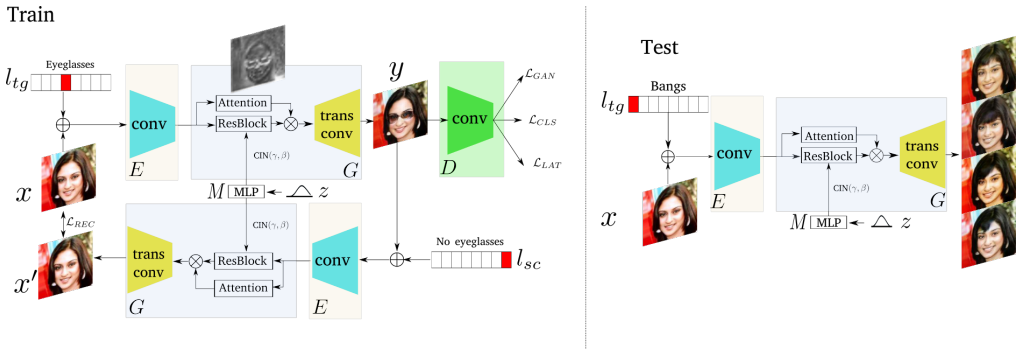
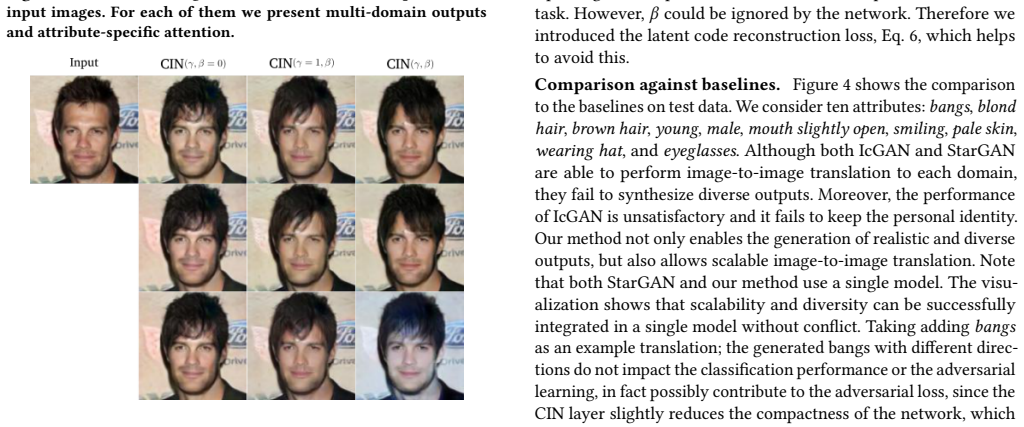
The load-bearing mechanism is Conditional Instance Normalization (CIN) placed in the generator bottleneck and driven by the latent code $z$ through a small multilayer perceptron. CIN renormalizes each feature map using affine parameters $\gamma(z)$ and $\beta(z)$; the paper's ablation shows that the bias term alone generates visible diversity while the scale term contributes little. A feature-wise attention map $a$ blends the normalized features with the untouched encoder output, keeping CIN from modifying the whole image; at bottleneck resolution no attention regularizer is needed. The discriminator has three heads: real/fake, domain class, and latent-code reconstruction, with the reconstruction loss preventing the generator from ignoring $z$. All modules are shared across domains, which is what makes the model scalable.
What would settle it
Take the same datasets and rerun SDIT and the strongest diverse baseline with multiple random seeds, then have human raters judge whether sampled outputs are both varied and domain-correct; if human rankings do not follow the LPIPS and reverse-classification ordering, or if the LPIPS gap between methods falls within one standard deviation across seeds, the central claim of superior combined diversity and scalability is not supported. A second check is to disable the latent reconstruction loss and measure output diversity; the paper predicts a collapse, so observing no collapse in that regime would contradict the role assigned to that loss.
Extended reading notes
Core claim
The paper's central claim is that diversity and scalability are orthogonal properties that can be combined in a single generator. Scalability comes from conditioning the encoder on the target-domain label, so one encoder-generator pair serves all domains. Diversity comes from a latent variable $z$, sampled from a Gaussian and injected into Conditional Instance Normalization (CIN) layers through a multilayer perceptron; the ablation identifies the additive bias $\beta(z)$ in CIN, not the multiplicative scale $\gamma(z)$, as the main driver of output variation. An attention mechanism in the bottleneck blends the unchanged encoder features $e$ with the CIN-transformed features $f$ via $h=(1-a)e + a f$, so edits are localized to attribute-relevant regions and identity is preserved. A latent reconstruction loss through the discriminator forces the generator to actually use $z$, preventing partial mode collapse. Together these components let a single model translate face attributes, object colors, and artistic styles with varied, domain-correct outputs.
Load-bearing premise
The quantitative comparisons rest on LPIPS as a measure of useful diversity and reverse-classification accuracy as a measure of realism and attribute correctness, with no error bars or human validation; if those proxies are noisy or biased, the reported advantage of SDIT is not firmly established.
Editorial extensions
If this is right
- A single generator suffices for $N$-domain translation, eliminating the $N(N-1)/2$ pairwise generators that non-scalable diverse baselines require.
- Face attribute editing can produce multiple plausible renditions of the same edit, such as bangs swept in different directions, while keeping identity distance low.
- The attention mechanism confines changes to attribute-specific regions, so unrelated parts of the image are preserved without adding an extra attention loss to the objective.
- Sampling fresh latent codes at inference time yields an unlimited number of candidate translations per input and per target domain.
- The same architecture transfers from aligned faces to objects and scenes, with attention used for local edits and omitted when a global style change is desired.
Reading between the lines
- Because the paper isolates the CIN bias term as the diversity driver, a testable extension is that perturbing only bias parameters in other conditional generators would produce multimodal outputs without retraining; this goes beyond what the paper claims.
- The bottleneck-level attention idea suggests a broader recipe: localize normalization changes in feature space rather than masking whole images, which may transfer to sequence or audio domain adaptation where spatial masks are unnatural.
- The paper's stated limitation for domains with large variations implies a concrete stress test: training SDIT jointly on faces and paintings should degrade relative to per-cluster models, and the size of that degradation would map the method's real scope.
Signed reviews
Editorial analysis
A structured set of objections, weighed in public.
Referee Report
Summary. The paper proposes SDIT, a single-generator architecture for unsupervised multi-domain image-to-image translation that combines scalability (one model for many target domains) with diversity (stochastic outputs via a latent code injected through conditional instance normalization). The encoder is conditioned on the target domain label; the generator uses CIN with an attention mechanism in bottleneck features to localize changes; the discriminator provides adversarial, classification, latent-reconstruction, and image-reconstruction losses. Experiments on CelebA, a four-color object dataset, and an artworks dataset compare against StarGAN, IcGAN, CycleGAN, and MUNIT, with ablations for attention, CIN, and latent loss. The paper claims that SDIT simultaneously achieves scalability and diversity, and that the attention mechanism improves attribute-specific translation.
Significance. The paper addresses a real gap: prior scalable methods (e.g., StarGAN) are deterministic, and diverse methods (e.g., MUNIT/DRIT) require per-domain-pair generators. SDIT's design is simple and compact, the code is publicly released, and it achieves competitive or better scores on LPIPS and reverse classification while using a single generator. The ablation showing that the CIN bias term (beta) drives diversity and the qualitative attention maps are useful analyses. If the quantitative claims hold, this is a practical contribution to multi-domain image translation. The main risk is that the diversity metric may reward untargeted image changes rather than attribute-specific diversity, which is central to the paper's claim.
major comments (3)
- [Section 4.2 and Tables 1-4] LPIPS is computed over full images without restricting to the attention region or domain-relevant area, so the higher LPIPS values for SDIT relative to StarGAN (Table 2) and MUNIT (Tables 3-4) may reflect untargeted changes (background, skin texture, lighting) rather than attribute-specific diversity. The authors themselves acknowledge in Section 5.2 and Table 1 that the variant without attention has higher LPIPS but 'could be because it is adding unwanted diversity (e.g., the red lips)'. To support the headline claim of attribute-specific diversity, the paper should report LPIPS restricted to the attention mask (or another region-based metric) or otherwise validate that the diversity is localized to the target attribute. This is especially needed for faces, where reverse classification is not reported.
- [Section 5.4, Table 4] The scene translation experiments use the variant without attention ('Differently from the model used for faces and color objects, here we consider the variant of our model without attention'), so the quantitative results in Table 4 do not test the full SDIT model including the attention mechanism. The conclusion in Section 5.2 that attention improves performance is therefore limited to face and object datasets. The paper should state this limitation explicitly in the abstract or conclusion, and either include an attention ablation on the artworks dataset or temper the claim about the attention mechanism's general benefit.
- [Tables 1-4] The paper reports mean values only, without standard deviations, error bars, or significance tests, despite the fact that 10 samples per input are generated. The key superiority claims (e.g., LPIPS 0.451 vs 0.427 in Table 2, 0.828 vs 0.779 in Table 4, reverse classification 65.1 vs 66.3 in Table 4) could be within noise. Adding variance or significance tests for the central comparisons is necessary to establish that SDIT's diversity advantage is real and not an artifact of a single random seed or small sample.
minor comments (4)
- [Section 5.2, Figure 6] The conclusion that the CIN bias term (beta) is the key factor for diversity while gamma plays a minor role is only qualitative. Since this is listed as a contribution ('experimentally proves that the bias of CIN is the key factor'), a quantitative measure (e.g., LPIPS for the three CIN variants) would strengthen the claim.
- [References] References [5] and [6] are the same paper (StarGAN), which is likely a duplicate entry; also reference [7] ('Dumoulin et al.') lacks a year and venue.
- [Section 4.2] The definition of LPIPS says 'LPIPS takes larger values if the generator has more diversity' without clarifying that it is the distance between pairs of generated samples from the same input; this should be stated explicitly for readers unfamiliar with the metric.
- [Section 3.1] In the cycle reconstruction formula, the same latent code z is used for both forward and backward translations; it would be helpful to note whether using a fresh sample z' for the backward mapping was considered, since the current choice may tie reconstruction to the specific z and affect diversity evaluation.
Circularity Check
No circularity identified: SDIT's claims are empirical and benchmarked externally, with no fitted parameter or self-citation load-bearing step that reduces the central result to its inputs.
full rationale
The paper makes no derivation-from-first-principles claim and fits no parameters that are then renamed as predictions. The central claim—that SDIT combines scalability and diversity in a single generator—is supported by the proposed architecture (domain-label conditioning, CIN with sampled latent z, attention, and reconstruction losses) and then evaluated against external quantitative benchmarks: LPIPS [57], VGGFace-based ID distance, and reverse classification accuracy on real labels. The losses in Eqs. (1)-(8) and the attention combination in Eq. (9) are architectural/training objectives; they are not derived from the evaluation metrics, nor do the evaluation metrics appear as terms in the training objective. The only self-citations are contextual: Gonzalez-Garcia et al. [12] for disentanglement background, Wang et al. [44] for the ID-distance metric, Wang et al. [45] for MMNet in related work, and Wu et al. [47]/Wang et al. [46] for reverse classification methodology. None of these citations is used to justify SDIT's own core mechanism or to forbid alternatives; the cited metrics are applied to all compared methods equally and are externally grounded (VGGFace, real-image labels). The ablations in Table 1 compare variants of the method under the same fixed metrics and therefore do not reduce to a self-referential definition. The conclusion's caveat about limited applicability for large domain variation is an empirical limitation statement, not a circularity. A skeptical concern that LPIPS may reward untargeted variation is a validity-of-metric criticism, not a circularity of derivation, and no paper quote exhibits a step where a predicted quantity is equivalent to its input by construction.
Assumptions & free parameters
free parameters (6)
- lambda_GAN =
10
- lambda_FAKE =
1
- lambda_REAL =
1
- lambda_LAT =
10
- lambda_REC =
800
- latent dimension Z =
8 (inferred from discriminator branch)
assumptions (3)
- domain assumption Cycle consistency preserves content between input and reconstructed image.
- domain assumption The auxiliary classifier in AC-GAN helps the generator produce domain-specific images.
- domain assumption The latent code reconstruction loss largely prevents partial mode collapse.
Cite this review
Pith. "Pith review of SDIT: Scalable and Diverse Cross-domain Image Translation." pith.science (2026). https://pith.science/paper/M74NQ43D
@misc{pith2026190806881,
  author       = {Pith},
  title        = {Pith review of: SDIT: Scalable and Diverse Cross-domain Image Translation},
  year         = {2026},
  howpublished = {\url{https://pith.science/paper/M74NQ43D}},
  note         = {Machine review of arXiv:1908.06881}
}
read the original abstract
Recently, image-to-image translation research has witnessed remarkable progress. Although current approaches successfully generate diverse outputs or perform scalable image transfer, these properties have not been combined into a single method. To address this limitation, we propose SDIT: Scalable and Diverse image-to-image translation. These properties are combined into a single generator. The diversity is determined by a latent variable which is randomly sampled from a normal distribution. The scalability is obtained by conditioning the network on the domain attributes. Additionally, we also exploit an attention mechanism that permits the generator to focus on the domain-specific attribute. We empirically demonstrate the performance of the proposed method on face mapping and other datasets beyond faces.
Figures


Figures from the paper (4 more)



Reference graph
Works this paper leans on
-
[1]
Amjad Almahairi, Sai Rajeswar, Alessandro Sordoni, Philip Bachman, and Aaron Courville. 2018. Augmented cyclegan: Learning many-to-many mappings from unpaired data. International Conference on Machine Learning (2018)
work page 2018
- [2]
-
[3]
Xi Chen, Yan Duan, Rein Houthooft, John Schulman, Ilya Sutskever, and Pieter Abbeel. 2016. Infogan: Interpretable representation learning by information max- imizing generative adversarial nets. In Advances in Neural Information Processing Systems. 2172–2180
work page 2016
-
[4]
Xinyuan Chen, Chang Xu, Xiaokang Yang, and Dacheng Tao. 2018. Attention- GAN for object transfiguration in wild images. In Proceedings of the European Conference on Computer Vision (ECCV) . 164–180
work page 2018
-
[6]
Yunjey Choi, Minje Choi, Munyoung Kim, Jung-Woo Ha, Sunghun Kim, and Jaegul Choo. 2018. StarGAN: Unified Generative Adversarial Networks for Multi- Domain Image-to-Image Translation. In Proceedings of the IEEE Conference on Computer Vision and Pattern Recognition
work page 2018
-
[7]
Vincent Dumoulin, Jonathon Shlens, and Manjunath Kudlur. [n. d.]. A learned representation for artistic style. ([n. d.])
-
[8]
David Eigen and Rob Fergus. 2015. Predicting depth, surface normals and seman- tic labels with a common multi-scale convolutional architecture. In Proceedings of the International Conference on Computer Vision . 2650–2658
work page 2015
-
[9]
Yaroslav Ganin and Victor Lempitsky. 2015. Unsupervised domain adaptation by backpropagation. In International Conference on Machine Learning . 1180–1189
work page 2015
Show all 61 references
-
[10]
Leon A Gatys, Alexander S Ecker, and Matthias Bethge. 2016. Image style transfer using convolutional neural networks. In Proceedings of the IEEE Conference on Computer Vision and Pattern Recognition . 2414–2423
2016
-
[11]
Boqing Gong, Yuan Shi, Fei Sha, and Kristen Grauman. 2012. Geodesic flow kernel for unsupervised domain adaptation. In Proceedings of the IEEE Conference on Computer Vision and Pattern Recognition . IEEE, 2066–2073
2012
-
[12]
Abel Gonzalez-Garcia, Joost van de Weijer, and Yoshua Bengio. 2018. Image- to-image translation for cross-domain disentanglement. In Advances in Neural Information Processing Systems. 1294–1305
2018
-
[13]
Ian Goodfellow, Jean Pouget-Abadie, Mehdi Mirza, Bing Xu, David Warde-Farley, Sherjil Ozair, Aaron Courville, and Yoshua Bengio. 2014. Generative adversarial nets. In Advances in Neural Information Processing Systems . 2672–2680
2014
-
[14]
Xun Huang, Ming-Yu Liu, Serge Belongie, and Jan Kautz. 2018. Multimodal unsu- pervised image-to-image translation. In Proceedings of the European Conference on Computer Vision. 172–189
2018
-
[15]
Phillip Isola, Jun-Yan Zhu, Tinghui Zhou, and Alexei A Efros. 2017. Image-to- image translation with conditional adversarial networks. Proceedings of the IEEE Conference on Computer Vision and Pattern Recognition (2017)
2017
-
[16]
Tomas Jakab, Ankush Gupta, Hakan Bilen, and Andrea Vedaldi. 2018. Unsuper- vised learning of object landmarks through conditional image generation. In Advances in Neural Information Processing Systems . 4020–4031
2018
-
[17]
Justin Johnson, Agrim Gupta, and Li Fei-Fei. 2018. Image generation from scene graphs. In Proceedings of the IEEE Conference on Computer Vision and Pattern Recognition. 1219–1228
2018
-
[18]
Tero Karras, Timo Aila, Samuli Laine, and Jaakko Lehtinen. 2017. Progressive growing of gans for improved quality, stability, and variation. arXiv preprint arXiv:1710.10196 (2017)
2017 arXiv
-
[19]
Taeksoo Kim, Moonsu Cha, Hyunsoo Kim, Jungkwon Lee, and Jiwon Kim. 2017. Learning to discover cross-domain relations with generative adversarial networks. International Conference on Machine Learning (2017)
2017
-
[20]
Diederik Kingma and Jimmy Ba. 2014. Adam: A method for stochastic optimiza- tion. International Conference on Learning Representations (2014)
2014
-
[21]
Christian Ledig, Lucas Theis, Ferenc Huszár, Jose Caballero, Andrew Cunning- ham, Alejandro Acosta, Andrew Aitken, Alykhan Tejani, Johannes Totz, Zehan Wang, et al. 2017. Photo-realistic single image super-resolution using a generative adversarial network. In Proceedings of th...
2017
-
[22]
Hsin-Ying Lee, Hung-Yu Tseng, Jia-Bin Huang, Maneesh Kumar Singh, and Ming-Hsuan Yang. 2018. Diverse Image-to-Image Translation via Disentangled Representations. In Proceedings of the European Conference on Computer Vision
2018
-
[23]
Jerry Li. 2018. Twin-GAN–Unpaired Cross-Domain Image Translation with Weight-Sharing GANs. arXiv preprint arXiv:1809.00946 (2018)
2018 arXiv
-
[24]
Ming-Yu Liu, Thomas Breuel, and Jan Kautz. 2017. Unsupervised Image-to-Image Translation Networks. Advances in Neural Information Processing Systems (2017)
2017
-
[25]
Ziwei Liu, Ping Luo, Xiaogang Wang, and Xiaoou Tang. 2015. Deep Learning Face Attributes in the Wild. In Proceedings of International Conference on Computer Vision (ICCV)
2015
-
[26]
Jonathan Long, Evan Shelhamer, and Trevor Darrell. 2015. Fully convolutional networks for semantic segmentation. In Proceedings of the IEEE Conference on Computer Vision and Pattern Recognition . 3431–3440
2015
-
[27]
Shuang Ma, Jianlong Fu, Chang Wen Chen, and Tao Mei. 2018. DA-GAN: Instance- level image translation by deep attention generative adversarial networks. In Proceedings of the IEEE Conference on Computer Vision and Pattern Recognition . 5657–5666
2018
-
[28]
Michael Mathieu, Camille Couprie, and Yann LeCun. 2016. Deep multi-scale video prediction beyond mean square error. International Conference on Learning Representations (2016)
2016
-
[29]
Youssef Alami Mejjati, Christian Richardt, James Tompkin, Darren Cosker, and Kwang In Kim. 2018. Unsupervised Attention-guided Image-to-Image Translation. In Advances in Neural Information Processing Systems . 3697–3707
2018
-
[30]
Mehdi Mirza and Simon Osindero. 2014. Conditional generative adversarial nets. arXiv preprint arXiv:1411.1784 (2014)
2014 arXiv
-
[31]
Augustus Odena. 2016. Semi-supervised learning with generative adversarial networks. arXiv preprint arXiv:1606.01583 (2016)
2016 arXiv
-
[32]
Augustus Odena, Christopher Olah, and Jonathon Shlens. 2017. Conditional image synthesis with auxiliary classifier gans. In International Conference on Machine Learning. JMLR. org, 2642–2651
2017
-
[33]
O. M. Parkhi, A. Vedaldi, and A. Zisserman. 2015. Deep Face Recognition. In Proceedings of the British Machine Vision Conference
2015
-
[34]
Adam Paszke, Sam Gross, Soumith Chintala, Gregory Chanan, Edward Yang, Zachary DeVito, Zeming Lin, Alban Desmaison, Luca Antiga, and Adam Lerer
-
[35]
Guim Perarnau, Joost Van De Weijer, Bogdan Raducanu, and Jose M Álvarez. 2016. Invertible conditional gans for image editing. arXiv preprint arXiv:1611.06355 (2016)
2016 arXiv
-
[36]
Albert Pumarola, Antonio Agudo, Aleix M Martinez, Alberto Sanfeliu, and Francesc Moreno-Noguer. 2018. Ganimation: Anatomically-aware facial anima- tion from a single image. In Proceedings of the European Conference on Computer Vision. 818–833
2018
-
[37]
Scott Reed, Zeynep Akata, Xinchen Yan, Lajanugen Logeswaran, Bernt Schiele, and Honglak Lee. 2016. Generative adversarial text to image synthesis. Interna- tional Conference on Machine Learning (2016)
2016
-
[38]
Oren Rippel and Lubomir Bourdev. 2047. Real-time adaptive image compression. In International Conference on Machine Learning . JMLR. org, 2922–2930
-
[39]
Kuniaki Saito, Yoshitaka Ushiku, and Tatsuya Harada. 2017. Asymmetric tri- training for unsupervised domain adaptation.International Conference on Machine Learning (2017)
2017
-
[40]
Konstantin Shmelkov, Cordelia Schmid, and Karteek Alahari. 2018. How good is my GAN?. In Proceedings of the European Conference on Computer Vision (ECCV) . 213–229
2018
-
[41]
Zhixin Shu, Ersin Yumer, Sunil Hadap, Kalyan Sunkavalli, Eli Shechtman, and Dimitris Samaras. 2017. Neural face editing with intrinsic image disentangling. In Proceedings of the IEEE Conference on Computer Vision and Pattern Recognition . 5541–5550
2017
-
[42]
Yi-Hsuan Tsai, Wei-Chih Hung, Samuel Schulter, Kihyuk Sohn, Ming-Hsuan Yang, and Manmohan Chandraker. 2018. Learning to adapt structured output space for semantic segmentation. Proceedings of the IEEE Conference on Computer Vision and Pattern Recognition (2018)
2018
-
[43]
Ting-Chun Wang, Ming-Yu Liu, Jun-Yan Zhu, Andrew Tao, Jan Kautz, and Bryan Catanzaro. 2018. High-resolution image synthesis and semantic manipulation with conditional gans. In Proceedings of the IEEE Conference on Computer Vision and Pattern Recognition. 8798–8807
2018
-
[44]
Yaxing Wang, Abel Gonzalez-Garcia, Joost van de Weijer, and Luis Herranz. 2019. Controlling biases and diversity in diverse image-to-image translation. arXiv preprint arXiv:1907.09754 (2019)
2019 arXiv
-
[45]
Yaxing Wang, Joost van de Weijer, and Luis Herranz. 2018. Mix and match net- works: encoder-decoder alignment for zero-pair image translation. InProceedings of the IEEE Conference on Computer Vision and Pattern Recognition . 5467–5476
2018
-
[46]
Yaxing Wang, Chenshen Wu, Luis Herranz, Joost van de Weijer, Abel Gonzalez- Garcia, and Bogdan Raducanu. 2018. Transferring GANs: generating images from limited data. In Proceedings of the European Conference on Computer Vision (ECCV). 218–234
2018
-
[47]
Chenshen Wu, Luis Herranz, Xialei Liu, Joost van de Weijer, Bogdan Raducanu, et al. 2018. Memory Replay GANs: Learning to Generate New Categories without Forgetting. In Advances in Neural Information Processing Systems . 5966–5976
2018
-
[48]
Zuxuan Wu, Xintong Han, Yen-Liang Lin, Mustafa Gkhan Uzunbas, Tom Gold- stein, Ser Nam Lim, and Larry S Davis. 2018. DCAN: Dual Channel-wise Align- ment Networks for Unsupervised Scene Adaptation. InProceedings of the European Conference on Computer Vision
2018
-
[49]
Zili Yi, Hao Zhang, Ping Tan Gong, et al. 2017. DualGAN: Unsupervised Dual Learning for Image-to-Image Translation. In Proceedings of the International Conference on Computer Vision
2017
-
[50]
Lu Yu, Yongmei Cheng, and Joost van de Weijer. 2018. Weakly Supervised Domain- Specific Color Naming Based on Attention.arXiv preprint arXiv:1805.04385 (2018)
2018 arXiv
-
[51]
Xiaoming Yu, Xing Cai, Zhenqiang Ying, Thomas Li, and Ge Li. 2018. SingleGAN: Image-to-Image Translation by a Single-Generator Network using Multiple Gen- erative Adversarial Learning. In Proceedings of the Asian Conference on Computer Vision
2018
-
[52]
He Zhang and Vishal M Patel. 2018. Densely Connected Pyramid Dehazing Network. In CVPR
2018
-
[53]
Han Zhang, Tao Xu, Hongsheng Li, Shaoting Zhang, Xiaogang Wang, Xiaolei Huang, and Dimitris Metaxas. 2017. Stackgan++: Realistic image synthesis with stacked generative adversarial networks. IEEE Transactions on Pattern Analysis and Machine Intelligence (2017)
2017
-
[54]
Han Zhang, Tao Xu, Hongsheng Li, Shaoting Zhang, Xiaogang Wang, Xiaolei Huang, and Dimitris N Metaxas. 2017. Stackgan: Text to photo-realistic image synthesis with stacked generative adversarial networks. In Proceedings of the International Conference on Computer Vision . 5907–5915
2017
-
[55]
Lichao Zhang, Abel Gonzalez-Garcia, Joost van de Weijer, Martin Danelljan, and Fahad Shahbaz Khan. 2019. Synthetic data generation for end-to-end thermal infrared tracking. IEEE Transactions on Image Processing 28, 4 (2019), 1837–1850
2019
-
[56]
Richard Zhang, Phillip Isola, and Alexei A Efros. 2016. Colorful image colorization. In Proceedings of the European Conference on Computer Vision . Springer, 649–666
2016
-
[57]
Richard Zhang, Phillip Isola, Alexei A Efros, Eli Shechtman, and Oliver Wang
-
[58]
Jun-Yan Zhu, Taesung Park, Phillip Isola, and Alexei A Efros. 2017. Unpaired image-to-image translation using cycle-consistent adversarial networks. In Pro- ceedings of the International Conference on Computer Vision
2017
-
[59]
Jun-Yan Zhu, Richard Zhang, Deepak Pathak, Trevor Darrell, Alexei A Efros, Oliver Wang, and Eli Shechtman. 2017. Toward multimodal image-to-image translation. In Advances in Neural Information Processing Systems . 465–476
2017
-
[60]
Vijaya Kumar, and Jinsong Wang
Yang Zou, Zhiding Yu, B.V.K. Vijaya Kumar, and Jinsong Wang. 2018. Unsu- pervised Domain Adaptation for Semantic Segmentation via Class-Balanced Self-Training. In Proceedings of the European Conference on Computer Vision
2018
-
[2017]
Automatic differentiation in PyTorch. (2017)
2017
-
[2018]
The Unreasonable Effectiveness of Deep Features as a Perceptual Metric. In CVPR
Reviewed August 14, 2026 · model on record in the stance chip above.
Discussion (0). Continue with ORCID to comment.