Model-Independent Search Discards Faint Lensed-Pairs of Gravitational Wave Events in the Sub-Threshold Candidates of GWTC-4
Pith reviewed 2026-06-28 09:09 UTC · model grok-4.3
The pith
No lensed gravitational wave pairs detected in GWTC-4 including sub-threshold events, bounding the rate at 1.5 per year or less.
A machine-rendered reading of the paper's core claim, the machinery that carries it, and where it could break.
Core claim
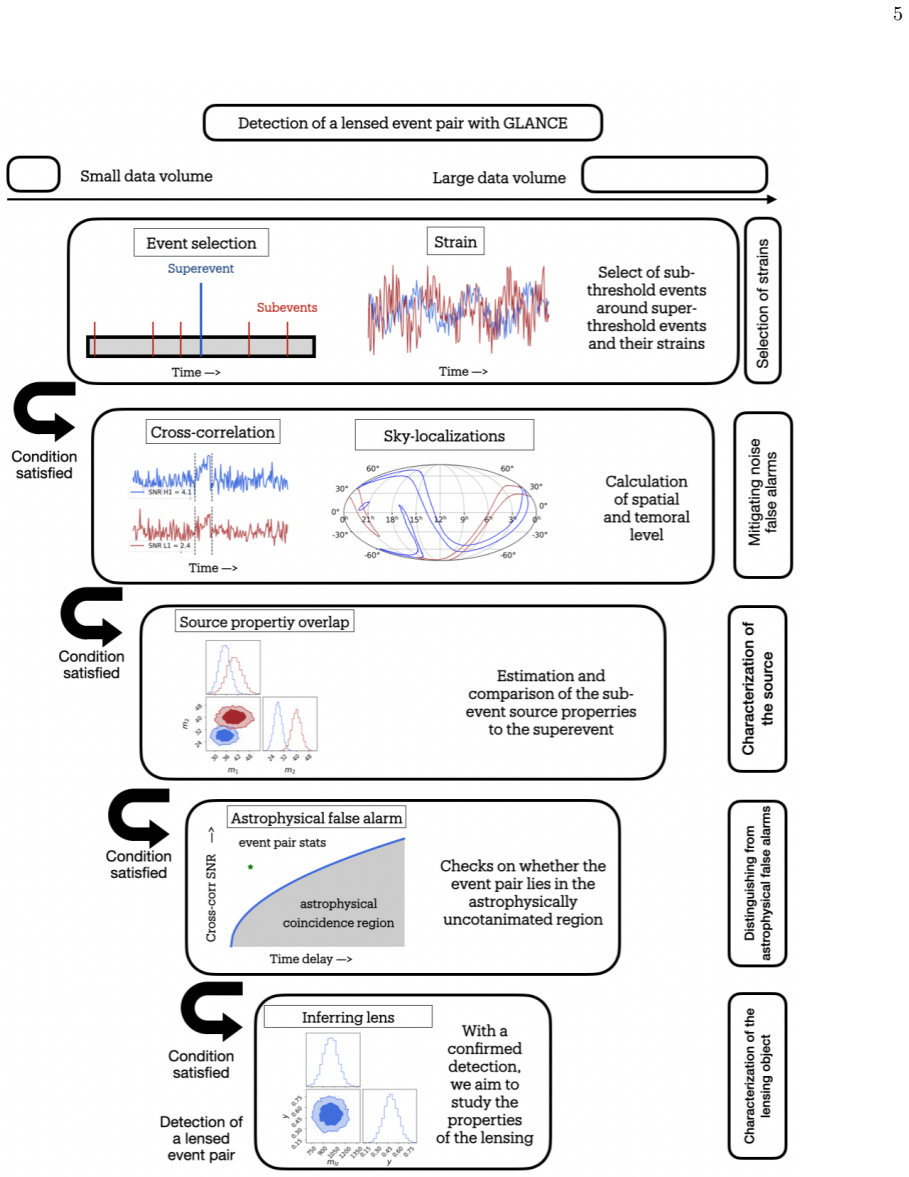
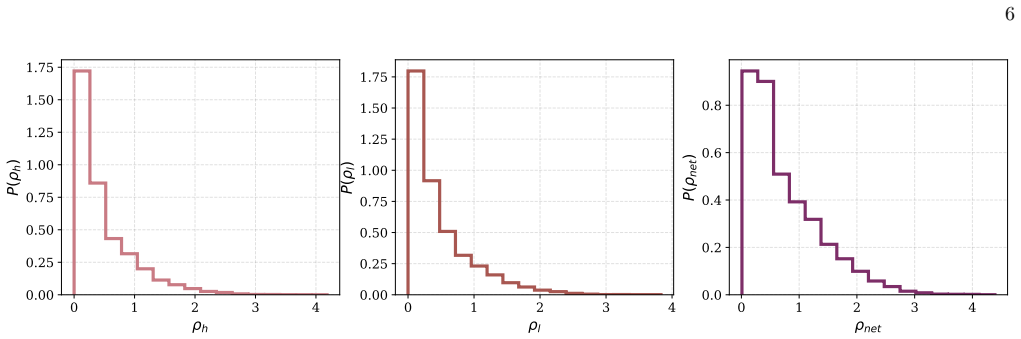
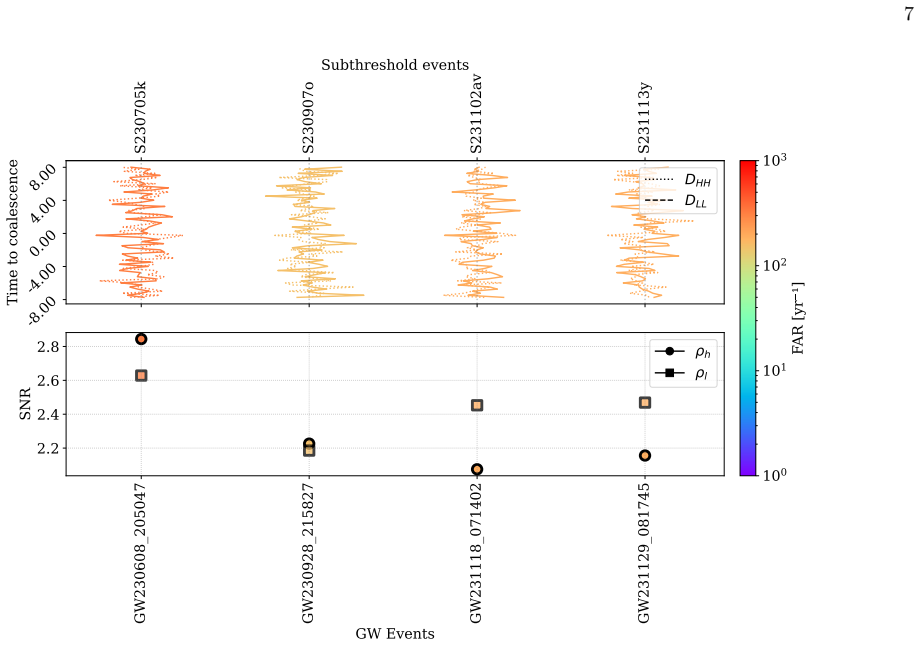
The search using the GLANCE cross-correlation technique over the entire GWTC-4 strain data, covering approximately 90 super-events and 800 sub-events, identified four pairs with cross-correlation significance of at least 2 sigma but none reached 3 sigma at both LIGO-Hanford and LIGO-Livingston. This allows the authors to rule out any statistically significant sub-threshold lensed GW events in the catalog, translating to an upper bound on the lensing detection rate of 1.5 per year or less when including sub-threshold candidates.
What carries the argument
GLANCE, a cross-correlation-based technique that identifies potential lensed pairs by measuring similarity between event signals, applied to the full set of event pairs including noise-dominated sub-threshold ones.
If this is right
- With inclusion of sub-threshold candidates the lensing rate upper bound is 1.5 per year.
- Future observations with current detectors can still lead to lensed GW detections as more time accumulates.
- The absence of significant pairs holds even after spectrogram, sky-map, and Bayesian checks on candidate pairs.
- The total of about 11,000 event pairs searched increases the statistical power for detecting rare lensing.
Where Pith is reading between the lines
- Future catalogs with higher sensitivity may require adjusted thresholds to maintain low false-negative rates for lensed pairs.
- The bound implies that lensing probability per event is low enough that thousands of detections are needed for likely observation.
- Connecting to other searches, this suggests model-independent methods can complement template-based lensing hunts.
Load-bearing premise
The combination of cross-correlation significance thresholds with spectrogram, sky-map overlap, and Bayesian parameter checks is enough to exclude true lensed pairs without missing too many in the noisy sub-threshold data.
What would settle it
Confirmation of a lensed pair through independent analysis or detection of a pair exceeding 3 sigma significance at both detectors in the same dataset would contradict the null result.
Figures
read the original abstract
Gravitational lensing of gravitational waves (GWs) can produce multiple images in the geometric optics limit. These lensed GW images arrive at different times, are amplified by different magnification factors, and are shifted by constant phases. With current understanding, the occurrence of lensed events stands at a few per thousand events, and the number of GW detections is a few hundred with the ground-based detector network. However, with the inclusion of the sub-threshold events, the total number of detections crosses a few thousand. Therefore, a search that includes both types of events yields a higher chance of lensing detection. In this work, we carry out the first model-independent lensing search using a cross-correlation-based technique GLANCE over the entire volume of the GWTC-4 strain data, containing $\sim 90$ super-events $\sim 800$ sub-events forming a total of $\sim 11,000$ event pairs with a higher False Alarm Rate (FAR) event rate allowing to search deep in the noise dominated regime. We further conduct their spectrogram checks to inspect data quality, sky-map overlap of the interesting pairs, and a Bayesian parameter exploration of the sub-event to make a robust lensing detection. Although the search indicated four pairs of potential events with cross-correlation significance $\geq 2\sigma$, none were above $3\sigma$ at both the LIGO-Hanford and LIGO-Livingston detectors. This makes it possible to strongly rule out the presence of any statistically significant sub-threshold lensed GW event in GWTC-4. The null detection translates to an upper bound on the lensing detection rate to be $\leq$ 1.5/yr with inclusion of the sub-threshold event candidates. In the future, with more observation time, the detection of lensed GW can be possible from the current generation of GW detectors.
Editorial analysis
A structured set of objections, weighed in public.
Referee Report
Summary. The manuscript reports a model-independent search for gravitationally lensed pairs among the ~90 super-threshold and ~800 sub-threshold events in GWTC-4, forming ~11,000 pairs. The GLANCE cross-correlation method is applied to LIGO strain data, followed by spectrogram, sky-map, and Bayesian checks. No pairs exceed 3σ significance at both detectors, leading to the claim of a null result that implies an upper bound on the lensing detection rate of ≤1.5/yr when sub-threshold candidates are included.
Significance. A robust null result with quantified efficiency would supply a useful model-independent constraint on the rate of lensed GW events in the current detector network, particularly by extending the search into the noise-dominated sub-threshold regime. This could help calibrate expectations for lensing detections in O4 and beyond. The direct data-driven approach and multi-stage vetoes are positive features, but the missing recovery statistics prevent the rate bound from being interpreted quantitatively.
major comments (1)
- [Abstract] Abstract: the claim that the null detection 'translates to an upper bound on the lensing detection rate to be ≤1.5/yr' is load-bearing for the central result, yet the manuscript supplies no injection-recovery statistics, efficiency curves versus SNR or magnification, or false-negative estimates for faint lensed pairs in the sub-threshold regime. Without these, the bound cannot be derived from the observed null result.
minor comments (1)
- [Abstract] The abstract contains minor grammatical issues (e.g., 'the occurrence of lensed events stands at a few per thousand events') that should be polished for clarity.
Simulated Author's Rebuttal
We thank the referee for their detailed review and for highlighting an important issue with the rate bound presented in the abstract. We address the comment below and will revise the manuscript accordingly.
read point-by-point responses
-
Referee: [Abstract] Abstract: the claim that the null detection 'translates to an upper bound on the lensing detection rate to be ≤1.5/yr' is load-bearing for the central result, yet the manuscript supplies no injection-recovery statistics, efficiency curves versus SNR or magnification, or false-negative estimates for faint lensed pairs in the sub-threshold regime. Without these, the bound cannot be derived from the observed null result.
Authors: We agree with the referee that the specific numerical upper bound of ≤1.5/yr cannot be rigorously derived without injection-recovery statistics, efficiency curves, or false-negative estimates. The bound in the current manuscript is a simple estimate based on the total observation time spanned by GWTC-4 and the number of pairs searched (~11,000), but it lacks the quantitative efficiency analysis required for a proper frequentist or Bayesian upper limit. We will revise the abstract and the relevant discussion sections to remove the unqualified numerical bound. In its place we will either (a) state only that the null result is consistent with a low lensing rate or (b) add a new subsection that reports preliminary efficiency estimates obtained by injecting simulated lensed pairs into the GLANCE pipeline (with the understanding that a full efficiency study will be required for any future quantitative claim). revision: yes
Circularity Check
Minor self-citation for GLANCE method; null-result upper bound derived directly from data search without reduction to fitted inputs
full rationale
The paper executes a model-independent cross-correlation search (GLANCE) over ~11,000 pairs in GWTC-4 strain data, reports no pairs exceeding 3σ at both detectors, and states that this null result directly translates to an upper bound ≤1.5/yr on the lensing detection rate. No equations or steps reduce the reported bound to a parameter defined by the same search or to a self-citation chain; the bound follows from counting zero significant triggers in the searched volume. Any citation to prior GLANCE development is peripheral and not load-bearing for the central claim, which remains an independent data-driven statement.
Axiom & Free-Parameter Ledger
axioms (1)
- domain assumption GLANCE cross-correlation plus post-search checks can reliably exclude lensed pairs without missing real events in noise-dominated data
Reference graph
Works this paper leans on
-
[1]
We find the cumulative cross-correlation during a timescale of the timespan within which the signal spends its time in the detector (from 20Hz till the the signal is small, as in GW231123, GWs of very different source properties can match the signal [88]. However, if the frequency range of the signal is sufficiently broad and the frequency evo- lution is ...
-
[2]
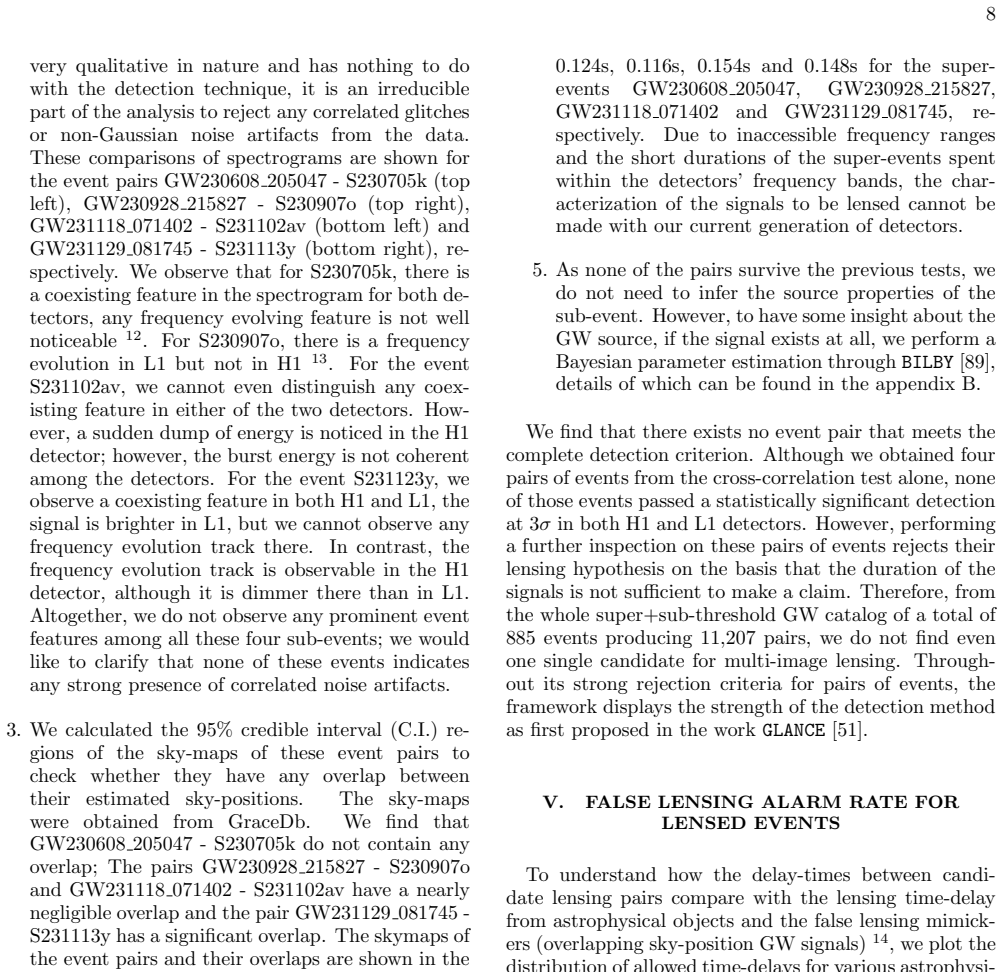
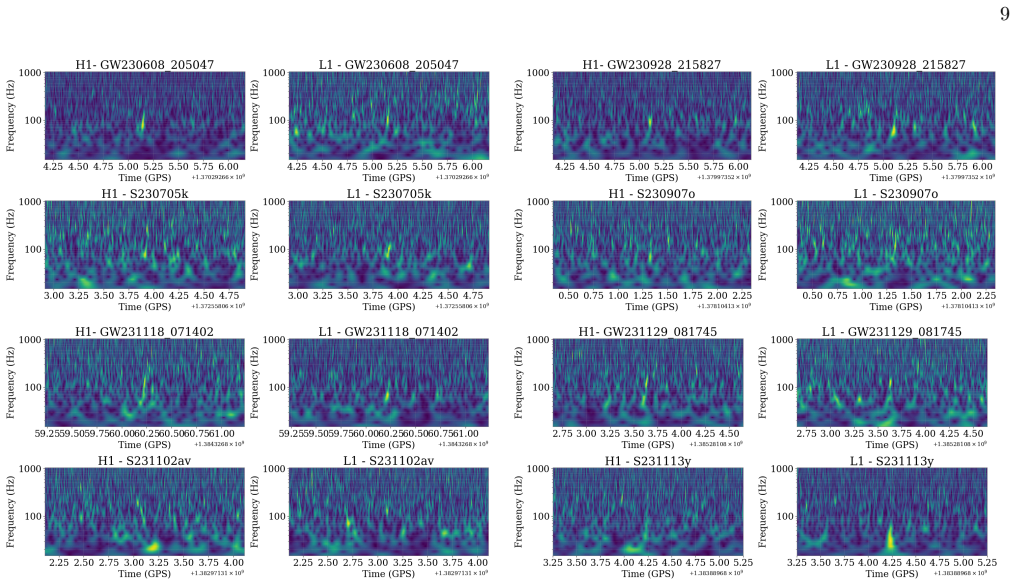
We inspect the spectrograms of these event pairs in the H1 and L1 detectors. These spectrograms of the super-events and sub-events are shown in the figure 4, with a 2s window, with the start- ing and ending time of the window at±1s from the GPS time of the alert. Although this check is 8 very qualitative in nature and has nothing to do with the detection ...
-
[3]
The sky-maps were obtained from GraceDb
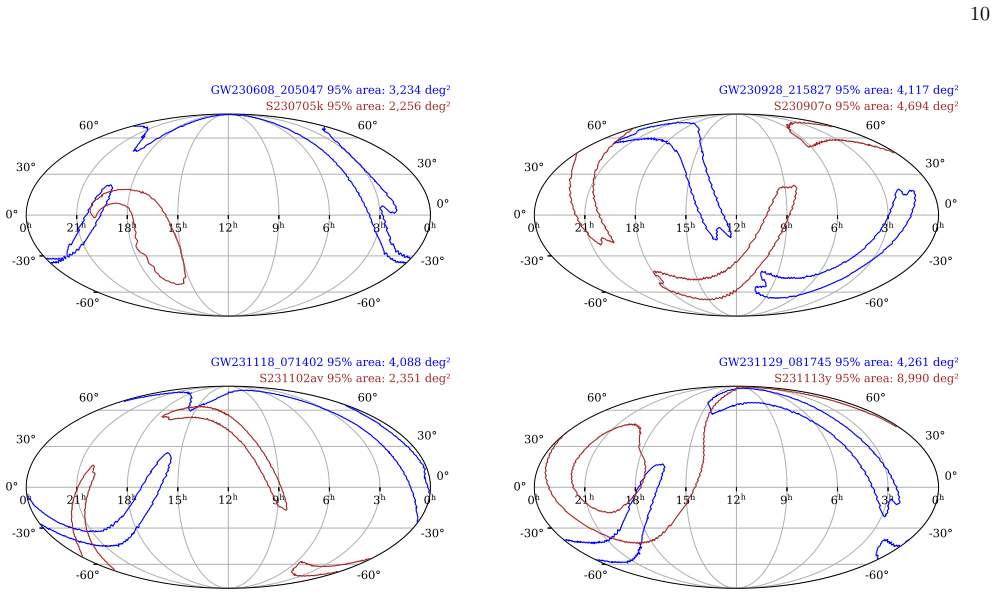
We calculated the 95% credible interval (C.I.) re- gions of the sky-maps of these event pairs to check whether they have any overlap between their estimated sky-positions. The sky-maps were obtained from GraceDb. We find that GW230608 205047 - S230705k do not contain any overlap; The pairs GW230928 215827 - S230907o and GW231118 071402 - S231102av have a ...
-
[4]
We calculate the duration of the signal in the band to find whether the GW cycles spend sufficient time within the observation period. We calculate the duration of the super-threshold signals to be within 12 This does not necessarily mean that no signal is present and only noise is there, as it might indicate a very short signal observed for the merger of...
-
[5]
As none of the pairs survive the previous tests, we do not need to infer the source properties of the sub-event. However, to have some insight about the GW source, if the signal exists at all, we perform a Bayesian parameter estimation throughBILBY[89], details of which can be found in the appendix B. We find that there exists no event pair that meets the...
-
[6]
The event GW190408 181802 from GWTC-3 showed a statis- tical significance of≥3σ, although further tests do not show that the event is a strong candidate for lensing
events with the residual cross-correlation technique µ-GLANCE[64], we found two candidates of interest. The event GW190408 181802 from GWTC-3 showed a statis- tical significance of≥3σ, although further tests do not show that the event is a strong candidate for lensing. In GWTC-4, we tested the lensing hypothesis on the most massive BBH merger GW event GW2...
-
[7]
LISA [100] would allow for many more GW detections in the coming days
or mHz e.g. LISA [100] would allow for many more GW detections in the coming days. With the current lensing observational rates of a few in a thousand, a de- tection is likely to happen in the coming years. VIII. ACKNOWLEDGEMENT The authors are thankful to Mick Wright for carefully reviewing the manuscript as part of the LIGO Publica- tion and Presentatio...
-
[8]
Einstein, The Field Equations of Gravitation, Sitzungsber
A. Einstein, The Field Equations of Gravitation, Sitzungsber. Preuss. Akad. Wiss. Berlin (Math. Phys. )1915, 844 (1915)
1915
-
[9]
Weber, Detection and generation of gravitational waves, Phys
J. Weber, Detection and generation of gravitational waves, Phys. Rev.117, 306 (1960)
1960
-
[10]
R. A. Hulse and J. H. Taylor, Discovery of a pulsar in a binary system., apjl195, L51 (1975)
1975
-
[11]
C. Cutler and E. E. Flanagan, Gravitational waves from merging compact binaries: How accurately can one extract the binary’s parameters from the inspiral wave form?, Phys. Rev. D49, 2658 (1994), arXiv:gr- qc/9402014
arXiv 1994
-
[12]
B. P. Abbottet al.(KAGRA, LIGO Scientific, Virgo), Prospects for observing and localizing gravitational- wave transients with Advanced LIGO, Advanced Virgo and KAGRA, Living Rev. Rel.19, 1 (2016), arXiv:1304.0670 [gr-qc]
Pith/arXiv arXiv 2016
-
[13]
Aasiet al.(LIGO Scientific), Advanced LIGO, Class
J. Aasiet al.(LIGO Scientific), Advanced LIGO, Class. Quant. Grav.32, 074001 (2015), arXiv:1411.4547 [gr- qc]
Pith/arXiv arXiv 2015
-
[14]
Capote, W
E. Capote, W. Jia, N. Aritomi, M. Nakano, V. Xu, R. Abbott, I. Abouelfettouh, R. X. Adhikari, A. Ananyeva, S. Appert, S. K. Apple, K. Arai, S. M. Aston, M. Ball, S. W. Ballmer, D. Barker, L. Bar- sotti, B. K. Berger, J. Betzwieser, D. Bhattachar- jee, G. Billingsley, S. Biscans, C. D. Blair, N. Bode, E. Bonilla, V. Bossilkov, A. Branch, A. F. Brooks, D. D...
2025
-
[15]
S. Soniet al.(LIGO), LIGO Detector Characterization in the first half of the fourth Observing run, Class. Quant. Grav.42, 085016 (2025), arXiv:2409.02831 [astro-ph.IM]
arXiv 2025
-
[16]
Buikema, C
A. Buikema, C. Cahillane, G. L. Mansell, C. D. Blair, R. Abbott, C. Adams, R. X. Adhikari, A. Ananyeva, S. Appert, K. Arai, J. S. Areeda, Y. Asali, S. M. As- ton, C. Austin, A. M. Baer, M. Ball, S. W. Ballmer, S. Banagiri, D. Barker, L. Barsotti, J. Bartlett, B. K. Berger, J. Betzwieser, D. Bhattacharjee, G. Billingsley, S. Biscans, R. M. Blair, N. Bode, ...
2020
-
[17]
M. Tse, H. Yu, N. Kijbunchoo, A. Fernandez-Galiana, P. Dupej, L. Barsotti, C. D. Blair, D. D. Brown, S. E. Dwyer, A. Effler, M. Evans, P. Fritschel, V. V. Frolov, A. C. Green, G. L. Mansell, F. Matichard, N. Mavalvala, D. E. McClelland, L. McCuller, T. McRae, J. Miller, A. Mullavey, E. Oelker, I. Y. Phinney, D. Sigg, B. J. J. Slagmolen, T. Vo, R. L. Ward,...
2019
-
[18]
D. V. Martynov, E. D. Hall, B. P. Abbott, R. Abbott, T. D. Abbott, C. Adams, R. X. Adhikari, R. A. An- derson, S. B. Anderson, K. Arai, M. A. Arain, S. M. Aston, L. Austin, S. W. Ballmer, M. Barbet, D. Barker, B. Barr, L. Barsotti, J. Bartlett, M. A. Barton, I. Bar- tos, J. C. Batch, A. S. Bell, I. Belopolski, J. Bergman, J. Betzwieser, G. Billingsley, J....
2016
-
[19]
N. T. Bishop, V. Kakkat, A. S. Kubeka, M. Naidoo, and P. J. van der Walt, The interaction of gravitational waves with matter, Int. J. Mod. Phys. D33, 2441012 (2024), arXiv:2405.07743 [gr-qc]
arXiv 2024
-
[20]
Maggiore, Gravitational wave experiments and early universe cosmology, Phys
M. Maggiore, Gravitational wave experiments and early universe cosmology, Phys. Rept.331, 283 (2000), arXiv:gr-qc/9909001. 14
Pith/arXiv arXiv 2000
-
[21]
R. R. L. dos Santos and L. M. van Manen, Gravitational waves from the early universe (2025), arXiv:2212.05594 [astro-ph.CO]
arXiv 2025
-
[22]
R. Abbottet al.(KAGRA, VIRGO, LIGO Scientific), Population of Merging Compact Binaries Inferred Using Gravitational Waves through GWTC-3, Phys. Rev. X 13, 011048 (2023), arXiv:2111.03634 [astro-ph.HE]
Pith/arXiv arXiv 2023
-
[24]
B. P. Abbottet al.(LIGO Scientific, Virgo), Tests of general relativity with GW150914, Phys. Rev. Lett. 116, 221101 (2016), [Erratum: Phys.Rev.Lett. 121, 129902 (2018)], arXiv:1602.03841 [gr-qc]
Pith/arXiv arXiv 2016
-
[25]
B. P. Abbottet al.(LIGO Scientific, Virgo), Tests of General Relativity with GW170817, Phys. Rev. Lett. 123, 011102 (2019), arXiv:1811.00364 [gr-qc]
Pith/arXiv arXiv 2019
-
[26]
B. P. Abbottet al.(LIGO Scientific, Virgo), Tests of General Relativity with the Binary Black Hole Signals from the LIGO-Virgo Catalog GWTC-1, Phys. Rev. D 100, 104036 (2019), arXiv:1903.04467 [gr-qc]
Pith/arXiv arXiv 2019
-
[27]
R. Abbottet al.(LIGO Scientific, Virgo), Tests of gen- eral relativity with binary black holes from the second LIGO-Virgo gravitational-wave transient catalog, Phys. Rev. D103, 122002 (2021), arXiv:2010.14529 [gr-qc]
Pith/arXiv arXiv 2021
-
[28]
The LIGO Scientific Collaboration, the Virgo Col- laboration, the KAGRA Collaboration, A. G. Abac, I. Abouelfettouh, F. Acernese, K. Ackley, C. Adam- cewicz, S. Adhicary, D. Adhikari, N. Adhikari, R. X. Ad- hikari, V. K. Adkins, S. Afroz, A. Agapito, D. Agarwal, M. Agathos, N. Aggarwal, S. Aggarwal, O. D. Aguiar, I.-L. Ahrend, L. Aiello, A. Ain, P. Ajith,...
Pith/arXiv arXiv 2026
-
[29]
R. Abbottet al.(LIGO Scientific, Virgo, KA- GRA), Constraints on the Cosmic Expansion His- tory from GWTC–3, Astrophys. J.949, 76 (2023), arXiv:2111.03604 [astro-ph.CO]
arXiv 2023
-
[30]
The LIGO Scientific Collaboration, the Virgo Col- laboration, the KAGRA Collaboration, A. G. Abac, I. Abouelfettouh, F. Acernese, K. Ackley, C. Adam- cewicz, S. Adhicary, D. Adhikari, N. Adhikari, R. X. Ad- hikari, V. K. Adkins, S. Afroz, A. Agapito, D. Agarwal, M. Agathos, N. Aggarwal, S. Aggarwal, O. D. Aguiar, I.-L. Ahrend, L. Aiello, A. Ain, P. Ajith,...
Pith/arXiv arXiv 2025
-
[31]
Einstein, Lens-Like Action of a Star by the Devia- tion of Light in the Gravitational Field, Science84, 506 (1936)
A. Einstein, Lens-Like Action of a Star by the Devia- tion of Light in the Gravitational Field, Science84, 506 (1936)
1936
-
[32]
Bartelmann, Gravitational Lensing, Class
M. Bartelmann, Gravitational Lensing, Class. Quant. Grav.27, 233001 (2010), arXiv:1010.3829 [astro- ph.CO]
Pith/arXiv arXiv 2010
-
[33]
Schneider, J
P. Schneider, J. Ehlers, and E. E. Falco,Gravitational Lenses(1992)
1992
-
[34]
R. Takahashi and T. Nakamura, Wave effects in grav- itational lensing of gravitational waves from chirping binaries, Astrophys. J.595, 1039 (2003), arXiv:astro- ph/0305055
arXiv 2003
-
[35]
G. P. Smith, M. Jauzac, J. Veitch, W. M. Farr, R. Massey, and J. Richard, What if LIGO’s gravita- tional wave detections are strongly lensed by massive galaxy clusters?, Mon. Not. Roy. Astron. Soc.475, 3823 (2018), arXiv:1707.03412 [astro-ph.HE]
Pith/arXiv arXiv 2018
-
[36]
F. Xu, J. M. Ezquiaga, and D. E. Holz, Please Repeat: Strong Lensing of Gravitational Waves as a Probe of Compact Binary and Galaxy Populations, Astrophys. J.929, 9 (2022), arXiv:2105.14390 [astro-ph.CO]
arXiv 2022
- [37]
-
[38]
Z. Chen and Y. Lu, Gravitational Lensing of Gravita- tional Waves from Astrophysical Sources: Theory, De- tection, and Applications, Res. Astron. Astrophys.26, 062001 (2026), arXiv:2605.06321 [astro-ph.HE]
Pith/arXiv arXiv 2026
-
[39]
S.-S. Li, S. Mao, Y. Zhao, and Y. Lu, Gravitational lensing of gravitational waves: A statistical perspec- tive, Mon. Not. Roy. Astron. Soc.476, 2220 (2018), arXiv:1802.05089 [astro-ph.CO]
Pith/arXiv arXiv 2018
-
[40]
Grespan and M
M. Grespan and M. Biesiada, Strong Gravitational Lensing of Gravitational Waves: A Review, Universe 9, 200 (2023)
2023
-
[41]
H. Villarrubia-Rojo, S. Savastano, M. Zumalac´ arregui, L. Choi, S. Goyal, L. Dai, and G. Tambalo, Grav- itational lensing of waves: Novel methods for wave- optics phenomena, Phys. Rev. D111, 103539 (2025), arXiv:2409.04606 [gr-qc]
arXiv 2025
-
[42]
G. P. Smithet al., Multi-messenger gravitational lens- ing, Phil. Trans. Roy. Soc. Lond. A383, 20240134 (2025), arXiv:2503.19973 [astro-ph.HE]
arXiv 2025
-
[43]
B. P. Abbottet al.(LIGO Scientific, Virgo), GWTC- 1: A Gravitational-Wave Transient Catalog of Compact Binary Mergers Observed by LIGO and Virgo during the First and Second Observing Runs, Phys. Rev. X9, 031040 (2019), arXiv:1811.12907 [astro-ph.HE]
Pith/arXiv arXiv 2019
-
[44]
R. Abbottet al.(LIGO Scientific, Virgo), GWTC-2: Compact Binary Coalescences Observed by LIGO and Virgo During the First Half of the Third Observing Run, Phys. Rev. X11, 021053 (2021), arXiv:2010.14527 [gr- qc]
Pith/arXiv arXiv 2021
-
[45]
R. Abbottet al.(LIGO Scientific, VIRGO), GWTC-2.1: Deep extended catalog of compact binary coalescences observed by LIGO and Virgo during the first half of the third observing run, Phys. Rev. D109, 022001 (2024), arXiv:2108.01045 [gr-qc]
Pith/arXiv arXiv 2024
-
[46]
R. Abbottet al.(KAGRA, VIRGO, LIGO Scientific), GWTC-3: Compact Binary Coalescences Observed by LIGO and Virgo during the Second Part of the Third Observing Run, Phys. Rev. X13, 041039 (2023), arXiv:2111.03606 [gr-qc]
Pith/arXiv arXiv 2023
-
[47]
A. Chakraborty and S. Mukherjee, The First Model- independent Chromatic Microlensing Search: No Evidence in the Gravitational Wave Catalog of LIGO–Virgo–KAGRA, Astrophys. J.990, 68 (2025), arXiv:2503.16281 [gr-qc]. 16
arXiv 2025
-
[48]
A. Chakraborty and S. Mukherjee, The First Model- independent Upper Bound on Microlensing Signature of the Highest-mass Binary Black Hole Event GW231123, Astrophys. J.1003, 20 (2026), arXiv:2512.19077 [gr-qc]
Pith/arXiv arXiv 2026
-
[49]
R. Abbottet al.(LIGO Scientific, VIRGO), Search for Lensing Signatures in the Gravitational-Wave Observations from the First Half of LIGO–Virgo’s Third Observing Run, Astrophys. J.923, 14 (2021), arXiv:2105.06384 [gr-qc]
arXiv 2021
-
[50]
R. Abbottet al.(LIGO Scientific, KAGRA, VIRGO), Search for Gravitational-lensing Signatures in the Full Third Observing Run of the LIGO–Virgo Network, As- trophys. J.970, 191 (2024), arXiv:2304.08393 [gr-qc]
arXiv 2024
-
[52]
J. Chen, A. V. Kravtsov, and C. R. Keeton, Lensing optical depth for substructure and isolated dark mat- ter halos, Astrophys. J.592, 24 (2003), arXiv:astro- ph/0302005
arXiv 2003
-
[53]
A. Robertson, G. P. Smith, R. Massey, V. Eke, M. Jauzac, M. Bianconi, and D. Ryczanowski, What does strong gravitational lensing? The mass and redshift distribution of high-magnification lenses, Mon. Not. Roy. Astron. Soc.495, 3727 (2020), arXiv:2002.01479 [astro-ph.CO]
arXiv 2020
-
[54]
S. Mukherjee, T. Broadhurst, J. M. Diego, J. Silk, and G. F. Smoot, Impact of astrophysical binary coales- cence time-scales on the rate of lensed gravitational wave events, Mon. Not. Roy. Astron. Soc.506, 3751 (2021), arXiv:2106.00392 [gr-qc]
arXiv 2021
-
[55]
J. M. Diego, Constraining the abundance of primordial black holes with gravitational lensing of gravitational waves at ligo frequencies, Phys. Rev. D101, 123512 (2020)
2020
-
[56]
S. Mukherjee, T. Broadhurst, J. M. Diego, J. Silk, and G. F. Smoot, Inferring the lensing rate of LIGO-Virgo sources from the stochastic gravitational wave back- ground, Mon. Not. Roy. Astron. Soc.501, 2451 (2021), arXiv:2006.03064 [astro-ph.CO]
arXiv 2021
-
[57]
Vallero, R
S. Vallero, R. De Pietri, R. Poulton, P. Chanial, A. Fiori, and D. Monteleone, Gravitational wave alert generation infrastructure on your laptop, in26th In- ternational Conference on Computing in High Energy and Nuclear Physics (CHEP 2023), European Physical Journal Web of Conferences, Vol. 295 (EDP, 2024) p. 04022
2023
-
[58]
A. Chakraborty and S. Mukherjee, GLANCE – Grav- itational Lensing Authenticator using Non-modelled Cross-correlation Exploration of Gravitational Wave Signals, Mon. Not. Roy. Astron. Soc.532, 4842 (2024), arXiv:2403.03982 [gr-qc]
arXiv 2024
-
[59]
R. Abbottet al.(LIGO Scientific, Virgo), Open data from the first and second observing runs of Advanced LIGO and Advanced Virgo, SoftwareX13, 100658 (2021), arXiv:1912.11716 [gr-qc]
Pith/arXiv arXiv 2021
-
[60]
R. Abbott, H. Abe, F. Acernese, K. Ackley, S. Adhicary, N. Adhikari, R. X. Adhikari, V. K. Adkins, V. B. Adya, C. Affeldt, D. Agarwal, M. Agathos, O. D. Aguiar, L. Aiello, A. Ain, P. Ajith, T. Akutsu, S. Albanesi, R. A. Alfaidi, A. Al-Jodah, C. All´ en´ e, A. Allocca, M. Almualla, P. A. Altin, A. Amato, L. Amez-Droz, A. Amorosi, S. Anand, A. Ananyeva, R. ...
Pith/arXiv arXiv 2023
-
[61]
The LIGO Scientific Collaboration, the Virgo Col- laboration, the KAGRA Collaboration, A. G. Abac, I. Abouelfettouh, F. Acernese, K. Ackley, C. Adam- cewicz, S. Adhicary, D. Adhikari, N. Adhikari, R. X. Ad- hikari, V. K. Adkins, S. Afroz, A. Agapito, D. Agarwal, M. Agathos, N. Aggarwal, S. Aggarwal, O. D. Aguiar, I.-L. Ahrend, L. Aiello, A. Ain, P. Ajith,...
Pith/arXiv arXiv 2025
-
[62]
The LIGO Scientific Collaboration, the Virgo Col- laboration, the KAGRA Collaboration, A. G. Abac, I. Abouelfettouh, F. Acernese, K. Ackley, C. Adam- cewicz, S. Adhicary, D. Adhikari, N. Adhikari, R. X. Ad- hikari, V. K. Adkins, S. Afroz, A. Agapito, D. Agarwal, M. Agathos, N. Aggarwal, S. Aggarwal, O. D. Aguiar, I.-L. Ahrend, L. Aiello, A. Ain, P. Ajith,...
arXiv 2025
-
[63]
A. Barsode, S. Goyal, and P. Ajith, Fast and Effi- cient Bayesian Method to Search for Strongly Lensed Gravitational Waves, Astrophys. J.980, 258 (2025), arXiv:2412.01278 [gr-qc]
arXiv 2025
-
[64]
J. M. Ezquiaga, W. Hu, and R. K. L. Lo, phazap: Low-latency identification of strongly lensed signals, As- trophysics Source Code Library, record ascl:2406.022 (2024), ascl:2406.022
2024
-
[65]
J. Janquart, K. Haris, O. A. Hannuksela, and C. Van Den Broeck, The return of GOLUM: improving dis- tributed joint parameter estimation for strongly lensed gravitational waves, Mon. Not. Roy. Astron. Soc.526, 3088 (2023), arXiv:2304.12148 [gr-qc]
arXiv 2023
-
[66]
R. K. L. Lo and I. Maga˜ na Hernandez, Bayesian statistical framework for identifying strongly lensed gravitational-wave signals, Phys. Rev. D107, 123015 (2023)
2023
-
[67]
McIsaac, D
C. McIsaac, D. Keitel, T. Collett, I. Harry, S. Moz- zon, O. Edy, and D. Bacon, Search for strongly lensed counterpart images of binary black hole mergers in the first two ligo observing runs, Phys. Rev. D102, 084031 (2020)
2020
-
[68]
A. K. Y. Li, J. C. L. Chan, H. Fong, A. H. Y. Chong, A. J. Weinstein, and J. M. Ezquiaga, TESLA- X: an effective method to search for subthreshold lensed gravitational waves with a targeted population model, Mon. Not. Roy. Astron. Soc.542, 998 (2025), arXiv:2311.06416 [gr-qc]
arXiv 2025
-
[69]
Wright and M
M. Wright and M. Hendry, Gravelamps: Gravitational wave lensing mass profile model selection, The Astro- physical Journal935, 68 (2022)
2022
-
[70]
R. K. L. Lo, L. Vujeva, J. M. Ezquiaga, and J. C. L. Chan, Observational signatures of highly magnified gravitational waves from compact binary coalescence, Phys. Rev. Lett.134, 151401 (2025)
2025
-
[71]
A. Chakraborty and S. Mukherjee,µ-GLANCE: A Novel Technique to Detect Chromatically and Achro- matically Lensed Gravitational-wave Signals, Astro- phys. J.984, 107 (2025), arXiv:2410.06995 [gr-qc]
arXiv 2025
-
[72]
E. Seo, X. Shan, J. Janquart, O. A. Hannuksela, M. A. Hendry, and B. Hu, Residual Test to Search for Microlensing Signatures in Strongly Lensed Grav- itational Wave Signals, Astrophys. J.988, 159 (2025), 18 arXiv:2503.02186 [gr-qc]
arXiv 2025
- [73]
-
[74]
V. Varma, S. E. Field, M. A. Scheel, J. Blackman, D. Gerosa, L. C. Stein, L. E. Kidder, and H. P. Pfeiffer, Surrogate models for precessing binary black hole sim- ulations with unequal masses, Phys. Rev. Research.1, 033015 (2019), arXiv:1905.09300 [gr-qc]
Pith/arXiv arXiv 2019
-
[75]
M. Colleoni, F. A. R. Vidal, C. Garc´ ıa-Quir´ os, S. Ak¸ cay, and S. Bera, Fast frequency-domain gravitational wave- forms for precessing binaries with a new twist (2024), arXiv:2412.16721 [gr-qc]
arXiv 2024
-
[76]
B. P. Abbottet al.(LIGO Scientific Collaboration and Virgo Collaboration), Gw150914: The advanced ligo de- tectors in the era of first discoveries, Phys. Rev. Lett. 116, 131103 (2016)
2016
-
[77]
G. M. Harry (LIGO Scientific), Advanced LIGO: The next generation of gravitational wave detectors, Class. Quant. Grav.27, 084006 (2010)
2010
-
[78]
F. Acerneseet al.(VIRGO), Advanced Virgo: a second- generation interferometric gravitational wave detector, Class. Quant. Grav.32, 024001 (2015), arXiv:1408.3978 [gr-qc]
Pith/arXiv arXiv 2015
-
[79]
Acernese, M
F. Acernese, M. Agathos, L. Aiello, A. Allocca, A. Am- ato, S. Ansoldi, S. Antier, M. Ar` ene, N. Arnaud, S. Ascenzi, P. Astone, F. Aubin, S. Babak, P. Bacon, F. Badaracco, M. K. M. Bader, J. Baird, F. Baldac- cini, G. Ballardin, G. Baltus, C. Barbieri, P. Barneo, F. Barone, M. Barsuglia, D. Barta, A. Basti, M. Bawaj, M. Bazzan, M. Bejger, I. Belahcene, S...
2019
-
[80]
F. Acerneseet al.(Virgo), Virgo detector characteriza- tion and data quality: results from the O3 run, Class. Quant. Grav.40, 185006 (2023), arXiv:2210.15633 [gr- qc]
arXiv 2023
-
[81]
Lucket al., The upgrade of GEO600, J
H. Lucket al., The upgrade of GEO600, J. Phys. Conf. Ser.228, 012012 (2010), arXiv:1004.0339 [gr-qc]
Pith/arXiv arXiv 2010
-
[82]
Affeldt, K
C. Affeldt, K. Danzmann, K. L. Dooley, H. Grote, M. Hewitson, S. Hild, J. Hough, J. Leong, H. L¨ uck, M. Prijatelj, S. Rowan, A. R¨ udiger, R. Schilling, R. Schnabel, E. Schreiber, B. Sorazu, K. A. Strain, H. Vahlbruch, B. Willke, W. Winkler, and H. Wittel, Advanced techniques in GEO 600, Classical and Quan- tum Gravity31, 224002 (2014). 19
2014
discussion (0)
Sign in with ORCID, Apple, or X to comment. Anyone can read and Pith papers without signing in.