REVIEW 3 major objections 4 minor 1 cited by
Galaxy Morphological Classification with Zernike Moments and Machine Learning Approaches
T0 review · 3 major / 4 minor · reviewed 2026-08-10 · deepseek-v4-flash
Pith's one-line read Zernike moments classify galaxy morphology with accuracy above 0.90 on Galaxy Zoo 2 samples.
desk verdict A useful, genuinely new application of Zernike moments to optical galaxy classification, but the headline TSS numbers are inflated by test-set model selection and the abstract overstates the 1D-CNN binary result. read the letter →
The pith
A machine-rendered reading of the paper's core claim, the machinery that carries it, and where it could break.
The reading
What carries the argument
The central object is the Zernike moment: the coefficient $Z^q_p = \frac{p+1}{\pi}\int I(r,\theta) ZP^{q*}_p \, r\,dr\,d\theta$ obtained by projecting the image intensity onto the complete orthogonal Zernike polynomials $ZP^q_p(r,\theta)=R^q_p(r)e^{iq\theta}$ on the unit disc. Because of the Fourier factor $e^{iq\theta}$, the magnitudes of the ZMs are invariant under image rotation, and orthogonality and completeness guarantee that the coefficient list is unique and can reconstruct the image. The paper uses the first 1081 moments ($p_{\max}=45$) per grayscale galaxy as the feature vector for an RBF-kernel SVM and a 1D-CNN, and contrasts this with activation-map features from 2D-CNN, ResNet50, and VGG16 models. The machinery also includes watershed segmentation of galaxy images to a centered 200x200 sub-image (giving translation and scale normalization) and oversampling of the minority non-galaxy class with RGB-channel ZMs.
What would settle it
Re-run the SVM and 1D-CNN pipelines with $p_{\max}$ chosen by cross-validation on training data only, then evaluate on a held-out test set untouched during model selection; if the held-out TSS for the binary classifier falls below 0.86, or the three-class accuracy falls below 0.90, the paper's high-performance claim as stated is not supported.
Extended reading notes
Core claim
The authors' discovery claim is that Zernike moments (ZMs), taken to maximum order $p_{\max}=45$, give 1081 unique, rotation-invariant descriptors that are directly usable for morphological classification. For the binary task they use 545 non-galaxies and 11,735 galaxies selected by Galaxy Zoo 2 fraction thresholds, oversample the non-galaxy minority by adding the ZMs of the red, green, and blue channels (normalized by the total-intensity moment $Z^0_0$) to reach an imbalance ratio of about 0.2, and report SVM accuracy of 0.90 with TSS of 0.86 and AUC 0.93. For the three-class task, after segmenting images to 200x200 galaxy sub-images, they report weighted TSS of 0.88 for SVM with ZMs, 0.86 for 1D-CNN with ZMs, and 0.89 for VGG16 with a vision transformer, with accuracies 0.90, 0.90, and 0.93, matching or approaching the deep image models while using far fewer features.
Load-bearing premise
The reported scores come from a test set that was also used to choose the maximum Zernike order ($p_{\max}=45$), so the headline accuracy and TSS may be optimistic for images the model has not been tuned on.
Editorial extensions
If this is right
- A single 1081-component Zernike vector is enough to separate galaxy from non-galaxy images and spiral, elliptical, and odd galaxies at the accuracy levels reported, without training a deep network on the pixels.
- Rotation invariance removes the need to align or rotationally augment galaxy images before classification, simplifying pipelines for surveys where orientation is arbitrary.
- Because the 1D-CNN and SVM operate on one-dimensional moment vectors, the trained classifiers run on CPU resources, cutting the GPU cost of ResNet50- and VGG16-style pipelines.
- For the three-class problem the ZM-based models are competitive with a VGG16 plus vision transformer on clean Galaxy Zoo 2 samples, suggesting ZMs are a viable low-cost feature set for large morphological samples.
- Performance is class-dependent: odd objects have the lowest recall (0.84 for SVM with ZMs), so the practical use needs to weigh the odd-class error against the computational savings.
Reading between the lines
- Editorial inference: the same 1081-moment representation could be tested for continuous structural regressions, since the paper shows that the $q=0$ moments are directly tied to the axisymmetric S\'ersic-like brightness profile; if the link holds, ZMs might estimate structural parameters rather than only discrete classes.
- Editorial note: the abstract says TSS exceeds 0.86 for both binary ZM models, but the body table lists TSS=0.70 for the 1D-CNN binary model; the three-class TSS values quoted in the abstract and table agree, so readers comparing models should use the table values.
- Editorial inference: transfer to other surveys is untested; retraining on GZ2 and scoring DECaLS, DES, or Euclid images would show whether the rotation invariance and compactness survive differences in seeing, depth, and bandpass.
- Editorial inference: hybridizing Zernike moments with a small CNN could combine the interpretable, low-cost geometric description with deep texture features, possibly improving the odd-object class where the reported recall is lowest.
Signed reviews
Editorial analysis
A structured set of objections, weighed in public.
Referee Report
Summary. The paper proposes using Zernike moments (ZMs) of galaxy images as compact, rotation-invariant features for morphological classification, and compares five models: SVM with ZMs, 1D-CNN with ZMs, and three image-based deep networks (2D-CNN, ResNet50, VGG16 with vision transformer). The data are drawn from GalaxyZoo 2. Two classification tasks are considered: galaxy vs. non-galaxy, and three-class galaxy morphology (spiral, elliptical, odd). The central claims are that ZM-based SVM and 1D-CNN achieve high performance (TSS > 0.86) on the galaxy/non-galaxy task, and that SVM with ZMs, 1D-CNN with ZMs, and VGG16 achieve accuracy > 0.90 and TSS > 0.86 on the three-class task. The authors also argue that the ZMs provide uniqueness, completeness, and invariances, and that the ZM-based methods have lower computational cost than deep image models.
Significance. If the reported performance estimates were unbiased, the paper would make a useful practical contribution: 1081 Zernike moments can match or approach deep image classifiers on a moderately clean Galaxy Zoo 2 sample while using far fewer parameters and less computational resources. The authors provide code and data on GitHub, which supports reproducibility. However, the headline performance numbers are currently undermined by a model-selection procedure that uses the test set to choose the maximum Zernike order p_max, and by an abstract that states TSS values inconsistent with the body. These issues are central to the paper's main claim and must be fixed before the results can be accepted as reliable.
major comments (3)
- [Section 4.2 (and Section 4.3 if p_max is scanned there too)] The maximum Zernike order p_max was selected by evaluating accuracy on the same test set later used to report all performance metrics. The text states: 'Examining the ZMs for maximum order number (pmax) ranges from 5 to 46, we calculate the performance metric (e.g., accuracy) for both the SVM and classic 1D-CNN classifiers. We obtain the highest performance for pmax = 45.' With roughly 42 candidate values, choosing the best on the test set overstates the generalization performance of the final model, even if the training/test split is repeated ten times, because the selection criterion uses test-set labels. This directly affects the headline binary TSS values (SVM 0.86, 1D-CNN 0.70) and the three-class TSS values in Table 4. Please restructure the evaluation so that p_max is selected on an independent validation set (or via nested cross-validation) and the reported metrics are computed on a held-out test set that is not used at any stage of model selection.
- [Abstract and Section 4.2] The abstract claims 'TSS greater than 0.86 for the SVM and 1D-CNN with ZMs for the oversampled galaxy-non-galaxy classifier,' but the body reports, for the oversampled binary task, SVM TSS = 0.86 +/- 0.01 and 1D-CNN TSS = 0.70 +/- 0.03. The 1D-CNN value is far below 0.86, and the SVM value is not strictly greater than 0.86 given the uncertainty. This is a factual discrepancy between the abstract and the results. Please correct the abstract and ensure all numeric claims match the tables and text.
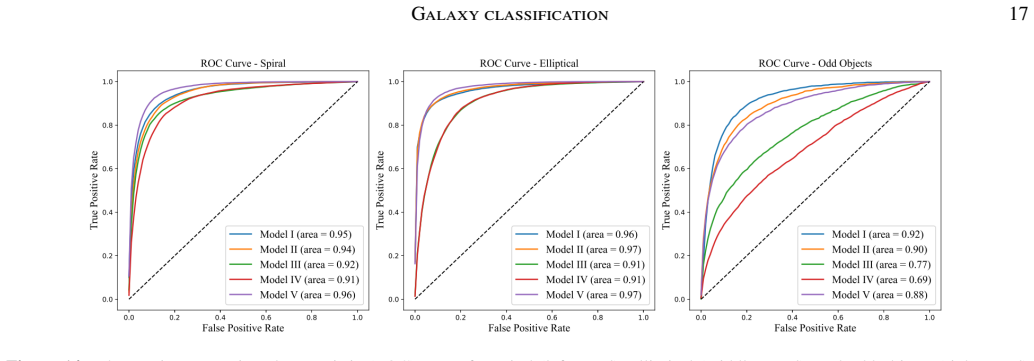
- [Section 4.3, Table 4] The text states that 'TSS is greater than 0.86 for Models I, II, and V' and the abstract says 'accuracy larger than 0.90 and TSS greater than 0.86' for SVM with ZMs, 1D-CNN with ZMs, and VGG16. Table 4 lists TSS = 0.88 +/- 0.003 (Model I), 0.86 +/- 0.01 (Model II), and 0.89 +/- 0.005 (Model V), and accuracy = 0.90 +/- 0.005, 0.90 +/- 0.01, and 0.93 +/- 0.003. For Model II, TSS is not strictly greater than 0.86, and for Models I and II accuracy is not strictly larger than 0.90. Please use phrasing consistent with the uncertainties, e.g., 'TSS at least 0.86' or report lower bounds from the confidence intervals.
minor comments (4)
- [Equation (6)] The reconstruction formula I_R(r,theta) = sum_p sum_q Z_q^p ZP_q^p(r,theta) should explicitly include the complex conjugate of the Zernike polynomial or state that the real part is taken; as written, the sum over positive and negative q may not be manifestly real for a real image.
- [Section 4.2, oversampling discussion] The oversampling procedure adds ZMs of the R, G, and B channels of the same non-galaxy images to the training set, but the test set contains only grayscale ZMs. Please clarify in the text that these augmented samples are deterministic transformations of the original minority samples and therefore do not add independent information; this affects how the uncertainty estimates and the improved TSS should be interpreted.
- [Appendix/references] There are duplicate reference entries: Shamir 2009 appears twice, and Li et al. 2022 appears three times. Please consolidate the bibliography.
- [Section 3.3 and captions] Minor wording issues: 'different architects' should be 'different architectures'; the GitHub URL in the text contains spaces and should be a proper hyperlink; and the phrase 'the task answer of GZ2' in Section 6 should be rephrased.
Circularity Check
Reported TSS is inflated by selecting p_max on the test set; the central performance claim is partially circular.
-
fitted input called prediction
[Section 4.2 (Galaxy-non-galaxy classifier), with metrics in Table 3 and the Abstract]
"Examining the ZMs for maximum order number ( pmax) ranges from 5 to 46, we calculate the performance metric (e.g., accuracy) for both the SVM and classic 1D-CNN classifiers. We obtain the highest performance for pmax = 45 for both SVM and 1D-CNN models (see the analysis details in Section 4.3)."
The pmax hyperparameter is selected by maximizing accuracy on the same 25% test split that is later used to report the headline metrics. The paper states that 'Each model uses 75 percent of both classes in the training process, and the remaining 25 percent is applied to the test set.' The reported TSS=0.86 for SVM with ZMs (Abstract) and the Table 3 accuracy/TSS values are computed on that same test set after choosing pmax=45 as the best-performing value. Thus the reported 'prediction' is not an unbiased out-of-sample estimate; it is statistically forced by the test-set selection of pmax. This is the fitted-input-called-prediction pattern: a parameter (pmax) is fitted to the test set, then the test-set metric is presented as the model's performance.
full rationale
The Zernike-moment formalism itself is not circular: Equations (1)-(7) define the moments, derive rotation invariance from the exponential phase factor, and invoke standard orthogonality/completeness results cited to Teague (1980) and Khotanzad & Hong (1990). The reconstruction demonstration (Equation 6) is an identity/illustration, not a prediction. The use of the self-cited ZEMO package (Safari et al. 2023) is a tool citation and is not load-bearing for the central claim. The one genuine circular step is the selection of pmax=45 by evaluating accuracy on the test set, followed by reporting accuracy/TSS/AUC on that same test set as the headline performance. This makes the headline 'TSS greater than 0.86' an optimistically biased, test-set-conditioned quantity rather than an independent generalization estimate. Because the broader claim that Zernike moments are useful morphological descriptors still has substantial independent empirical content (PDF separations, reconstruction fidelity, comparisons with image-based models), the circularity is partial rather than total.
Assumptions & free parameters
free parameters (4)
- p_max (maximum Zernike order) =
45
- SVM penalty C =
1.5
- Class fraction thresholds =
0.95 for spiral, 0.90 for elliptical and odd
- Oversampling factor for non-galaxy minority =
approximately 4, from grayscale plus R, G, B channels
assumptions (5)
- standard math Zernike polynomials form a complete and orthogonal basis on the unit disc
- standard math Magnitudes of Zernike moments are rotation invariant
- domain assumption The discrete approximation in Equation 5 faithfully represents the continuous ZM integral for galaxy images
- domain assumption Galaxy Zoo 2 vote fractions above the chosen thresholds provide correct class labels
- domain assumption The watershed segmentation isolates the central galaxy so that computed ZMs describe the galaxy, not the background
Cite this review
Pith. "Pith review of Galaxy Morphological Classification with Zernike Moments and Machine Learning Approaches." pith.science (2026). https://pith.science/paper/M7E5QN5G
@misc{pith2026250109816,
  author       = {Pith},
  title        = {Pith review of: Galaxy Morphological Classification with Zernike Moments and Machine Learning Approaches},
  year         = {2026},
  howpublished = {\url{https://pith.science/paper/M7E5QN5G}},
  note         = {Machine review of arXiv:2501.09816}
}
read the original abstract
Classifying galaxies is an essential step for studying their structures and dynamics. Using GalaxyZoo2 (GZ2) fractions thresholds, we collect 545 and 11,735 samples in non-galaxy and galaxy classes, respectively. We compute the Zernike moments (ZMs) for GZ2 images, extracting unique and independent characteristics of galaxies. The uniqueness due to the orthogonality and completeness of Zernike polynomials, reconstruction of the original images with minimum errors, invariances (rotation, translation, and scaling), different block structures, and discriminant decision boundaries of ZMs' probability density functions for different order numbers indicate the capability of ZMs in describing galaxy features. We classify the GZ2 samples, firstly into the galaxies and non-galaxies and secondly, galaxies into spiral, elliptical, and odd objects (e.g., ring, lens, disturbed, irregular, merger, and dust lane). The two models include the support vector machine (SVM) and one-dimensional convolutional neural network (1D-CNN), which use ZMs, compared with the other three classification models of 2D-CNN, ResNet50, and VGG16 that apply the features from original images. We find the true skill statistic (TSS) greater than 0.86 for the SVM and 1D-CNN with ZMs for the oversampled galaxy-non-galaxy classifier. The SVM with ZMs model has a high-performance classification for galaxy and non-galaxy datasets. We show that the SVM with ZMs, 1D-CNN with ZMs, and VGG16 with vision transformer are high-performance (accuracy larger than 0.90 and TSS greater than 0.86) models for classifying the galaxies into spiral, elliptical, and odd objects. We conclude that these machine-learning algorithms are helpful tools for classifying galaxy images.
Figures


Figures from the paper (12 more)



Forward citations
Cited by 1 Pith paper
-
Enhancing Galaxy Classification with U-Net Variational Autoencoders for Image Denoising
Applying a U-Net VAE denoising step to galaxy images before classification is reported to improve accuracy, reaching 97.45% with a GCNN on Galaxy10 DECaLS, although no direct noisy baseline is presented.
Reference graph
Works this paper leans on
-
[1]
N., Adelman-McCarthy, J
Abazajian, K. N., Adelman-McCarthy, J. K., Ag¨ ueros, M. A., et al. 2009, The Astrophysical Journal Supplement Series, 182, 543
2009
-
[2]
Abbott, T. M. C., Adam´ow, M., Aguena, M., et al. 2021, ApJS, 255, 20
2021
-
[3]
G., van den Bergh, S., & Nair, P
Abraham, R. G., van den Bergh, S., & Nair, P. 2003, ApJ, 588, 218
2003
-
[4]
K., & Turp, M
Ackermann, S., Schawinski, K., Zhang, C., Weigel, A. K., & Turp, M. D. 2022, VizieR Online Data Catalog, J/MNRAS/479/415
2022
-
[5]
2019, ApJS, 243, 20
Alipour, N., Mohammadi, F., & Safari, H. 2019, ApJS, 243, 20
2019
-
[6]
2015, ApJ, 807, 175
Alipour, N., & Safari, H. 2015, ApJ, 807, 175
2015
-
[7]
Alipour, N., Safari, H., & Innes, D. E. 2012, ApJ, 746, 12
2012
-
[8]
2022, A&A, 663, A128
Alipour, N., Safari, H., Verbeeck, C., et al. 2022, A&A, 663, A128
2022
Show all 106 references
-
[9]
2020, A&A, 643, A177
Angora, G., Rosati, P., Brescia, M., et al. 2020, A&A, 643, A177
2020
-
[10]
W., Dom´ınguez-Palmero, L., & Peletier, R
Balcells, M., Graham, A. W., Dom´ınguez-Palmero, L., & Peletier, R. F. 2003, ApJL, 582, L79
2003
-
[11]
K., Balogh, M
Baldry, I. K., Balogh, M. L., Bower, R., Glazebrook, K., & Nichol, R. C. 2004, in American Institute of Physics Conference Series, Vol. 743, The New Cosmology: Conference on Strings and Cosmology, ed. R. E. Allen, D. V. Nanopoulos, & C. N. Pope (AIP), 106–119
2004
-
[12]
M., Loveday, J., Fukugita, M., et al
Ball, N. M., Loveday, J., Fukugita, M., et al. 2004, Monthly Notices of the Royal Astronomical Society, 348, 1038
2004
-
[13]
J., et al
Banerji, M., Lahav, O., Lintott, C. J., et al. 2010, MNRAS, 406, 342
2010
-
[14]
O., Marra, V., Casarini, L., et al
Baqui, P. O., Marra, V., Casarini, L., et al. 2021, A&A, 645, A87
2021
-
[15]
D., Schumer, E
Barnes, G., Leka, K. D., Schumer, E. A., & Della-Rose, D. J. 2007, Space Weather, 5, S09002
2007
-
[16]
2024, MNRAS, 532, L14
Bassini, L., Feldmann, R., Gensior, J., et al. 2024, MNRAS, 532, L14
2024
-
[17]
J., & Vinci, G
Baumstark, M. J., & Vinci, G. 2024, Astronomy and Computing, 46, 100770
2024
-
[18]
R., Scarlata, C., Fortson, L
Beck, M. R., Scarlata, C., Fortson, L. F., et al. 2018, Monthly Notices of the Royal Astronomical Society, 476, 5516
2018
-
[19]
A., Jangren, A., & Conselice, C
Bershady, M. A., Jangren, A., & Conselice, C. J. 2000, AJ, 119, 2645
2000
-
[20]
2020, astropy/photutils: 1.0.0, doi:10.5281/zenodo.4044744
Bradley, L., Sip˝ocz, B., Robitaille, T., et al. 2020, astropy/photutils: 1.0.0, doi:10.5281/zenodo.4044744
2020 doi
-
[21]
2007, Image and Vision Computing, 25, 717 Cano-D´ıaz, M., ´Avila-Reese, V., S´anchez, S
Broumandnia, A., & Shanbehzadeh, J. 2007, Image and Vision Computing, 25, 717 Cano-D´ıaz, M., ´Avila-Reese, V., S´anchez, S. F., et al. 2019a, MNRAS, 488, 3929 —. 2019b, MNRAS, 488, 3929
2007
-
[22]
2024, A&A, 683, A42
Cao, J., Xu, T., Deng, Y., et al. 2024, A&A, 683, A42
2024
-
[23]
J., Arag´on-Salamanca, A., et al
Cheng, T.-Y., Conselice, C. J., Arag´on-Salamanca, A., et al. 2020, MNRAS, 493, 4209
2020
-
[24]
Conselice, C. J. 2003, ApJS, 147, 1
2003
-
[25]
J., Bershady, M
Conselice, C. J., Bershady, M. A., & Jangren, A. 2000, ApJ, 529, 886
2000
-
[26]
1995, Machine learning, 20, 273
Cortes, C., & Vapnik, V. 1995, Machine learning, 20, 273
1995
-
[27]
2005, in 2005 IEEE Computer Society Conference on Computer Vision and Pattern Recognition (CVPR’05), Vol
Dalal, N., & Triggs, B. 2005, in 2005 IEEE Computer Society Conference on Computer Vision and Pattern Recognition (CVPR’05), Vol. 1, 886–893 vol. 1
2005
-
[28]
2018, PhR, 780, 1 de Vaucouleurs, G., de Vaucouleurs, A., & Corwin, J
Dayal, P., & Ferrara, A. 2018, PhR, 780, 1 de Vaucouleurs, G., de Vaucouleurs, A., & Corwin, J. R. 1976, Second reference catalogue of bright galaxies, 1976, 0
2018
-
[29]
W., & Dambre, J
Dieleman, S., Willett, K. W., & Dambre, J. 2015, MNRAS, 450, 1441
2015
-
[30]
2020, arXiv e-prints, arXiv:2010.11929
Dosovitskiy, A., Beyer, L., Kolesnikov, A., et al. 2020, arXiv e-prints, arXiv:2010.11929
2020 arXiv
-
[31]
M., Dabour, W., & Elkafrawy, P
Eassa, M., Selim, I. M., Dabour, W., & Elkafrawy, P. 2022, Alexandria Engineering Journal, 61, 1145
2022
-
[32]
J., Duncan, K., et al
Ferreira, L., Conselice, C. J., Duncan, K., et al. 2020, ApJ, 895, 115
2020
-
[33]
2013, in 2013 International Conference on Computational and Information Sciences, IEEE, 322–325
Freed, M., & Lee, J. 2013, in 2013 International Conference on Computational and Information Sciences, IEEE, 322–325
2013
-
[34]
2006, Machine Learning, 63, 3
Geurts, P., Ernst, D., & Wehenkel, L. 2006, Machine Learning, 63, 3
2006
-
[35]
K., & Desai, S
Gupta, R., Srijith, P. K., & Desai, S. 2022, Astronomy and Computing, 38, 100543
2022
-
[36]
M., & Elisseeff, A
Guyon, I. M., & Elisseeff, A. 2003, J. Mach. Learn. Res., 3, 1157
2003
-
[37]
E., Bamford, S
Hart, R. E., Bamford, S. P., Willett, K. W., et al. 2016, Monthly Notices of the Royal Astronomical Society, 461, 3663
2016
-
[38]
2016, in 2016 IEEE Conference on Computer Vision and Pattern Recognition (CVPR), 770–778
He, K., Zhang, X., Ren, S., & Sun, J. 2016, in 2016 IEEE Conference on Computer Vision and Pattern Recognition (CVPR), 770–778
2016
-
[39]
1998, IEEE Intelligent Systems and their Applications, 13, 18
Hearst, M., Dumais, S., Osuna, E., Platt, J., & Scholkopf, B. 1998, IEEE Intelligent Systems and their Applications, 13, 18
1998
-
[40]
E., Sun, Y., & Davey, N
Hocking, A., Geach, J. E., Sun, Y., & Davey, N. 2017, Monthly Notices of the Royal Astronomical Society, 473, 1108
2017
-
[41]
2016, SoPh, 291, 941 Hosseini Rad, S., Alipour, N., & Safari, H
Honarbakhsh, L., Alipour, N., & Safari, H. 2016, SoPh, 291, 941 Hosseini Rad, S., Alipour, N., & Safari, H. 2020, ApJ, Accepted for Publishing ApJ
2016
-
[42]
2003, Department of Computer Science, National Taiwan University
Hsu, C.-W. 2003, Department of Computer Science, National Taiwan University
2003
-
[43]
Huang, G., Liu, Z., Van Der Maaten, L., & Weinberger, K. Q. 2017, in 2017 IEEE Conference on Computer Vision and Pattern Recognition (CVPR), 2261–2269
2017
-
[44]
Hubble, E. P. 1926, ApJ, 64, 321
1926
-
[45]
2008, A&A, 478, 971 22 Ghaderi, Safari, Alipour
F`evre, O. 2008, A&A, 478, 971 22 Ghaderi, Safari, Alipour
2008
-
[46]
2006, School of EECS, Washington State University, 37, 3
Jakkula, V. 2006, School of EECS, Washington State University, 37, 3
2006
-
[47]
Javadi, A., & van Loon, J. T. 2019, in IAU Symposium, Vol. 343, Why Galaxies Care About AGB Stars: A Continuing Challenge through Cosmic Time, ed. F. Kerschbaum, M. Groenewegen, & H. Olofsson, 283–290
2019
-
[48]
2014, Solar Physics, 289, doi:10.1007/s11207-014-0555-1
Javaherian, M., Safari, H., Amiri, A., & Ziaei, S. 2014, Solar Physics, 289, doi:10.1007/s11207-014-0555-1
2014 doi
-
[49]
2018, in Feature Extraction using Convolution Neural Networks (CNN) and Deep Learning, 2319–2323
Jogin, M., ., M., Madhulika, M., et al. 2018, in Feature Extraction using Convolution Neural Networks (CNN) and Deep Learning, 2319–2323
2018
-
[50]
2019, Modern Physics Letters B, 33, 1950245
Kaur, H., & Pannu, H. 2019, Modern Physics Letters B, 33, 1950245
2019
-
[51]
1990, IEEE Transactions on Pattern Analysis and Machine Intelligence, 12, 489
Khotanzad, A., & Hong, Y. 1990, IEEE Transactions on Pattern Analysis and Machine Intelligence, 12, 489
1990
-
[52]
2008, ETRI Journal, 30, 335
Kim, H.-J., & Kim, W.-Y. 2008, ETRI Journal, 30, 335
2008
-
[53]
Kohavi, R., & John, G. H. 1997, Artificial intelligence, 97, 273
1997
-
[54]
Krizhevsky, A., Sutskever, I., & Hinton, G. E. 2012, in Advances in Neural Information Processing Systems, ed. F. Pereira, C. Burges, L. Bottou, & K. Weinberger, Vol. 25 (Curran
2012
-
[55]
2011, Journal of Modern Optics, 58, 545
Lakshminarayanan, V., & Fleck, A. 2011, Journal of Modern Optics, 58, 545
2011
-
[56]
D., & Seung, H
Lee, D. D., & Seung, H. S. 1999, nature, 401, 788
1999
-
[57]
2022, Monthly Notices of the Royal Astronomical Society, 517, 808
Li, J., Tu, L., Gao, X., et al. 2022, Monthly Notices of the Royal Astronomical Society, 517, 808
2022
-
[58]
2022, MNRAS, 517, 808
Li, J., Tu, L., Gao, X., et al. 2022, MNRAS, 517, 808
2022
-
[59]
2022, IEEE Transactions on Neural Networks and Learning Systems, 33, 6999
Li, Z., Liu, F., Yang, W., Peng, S., & Zhou, J. 2022, IEEE Transactions on Neural Networks and Learning Systems, 33, 6999
2022
-
[60]
K., Masters, K
Lingard, T. K., Masters, K. L., Krawczyk, C., et al. 2020, ApJ, 900, 178
2020
-
[61]
2011, MNRAS, 410, 166
Lintott, C., Schawinski, K., Bamford, S., et al. 2011, MNRAS, 410, 166
2011
-
[62]
J., Schawinski, K., Slosar, A., et al
Lintott, C. J., Schawinski, K., Slosar, A., et al. 2008, MNRAS, 389, 1179
2008
-
[63]
T., & Tsai, J
Ma, J., Jin, H., Yang, L. T., & Tsai, J. J.-P. 2006, Ubiquitous Intelligence and Computing: Third International Conference, UIC 2006, Wuhan, China, September 3-6, 2006, Proceedings (Lecture Notes in Computer Science) (Springer-Verlag) Ma lek, K., Solarz, A., Pollo, A., et al. ...
2006
-
[64]
2011, Clinical & Experimental Ophthalmology, 39, 820
McAlinden, C., McCartney, M., & Moore, J. 2011, Clinical & Experimental Ophthalmology, 39, 820
2011
-
[65]
W., & Mayall, N
Morgan, W. W., & Mayall, N. U. 1957, PASP, 69, 291
1957
-
[66]
2024, MNRAS, 533, 292
Mukundan, K., Nair, P., Bailin, J., & Li, W. 2024, MNRAS, 533, 292
2024
-
[67]
1995, Pattern Recognition, 28, 1433
Mukundan, R., & Ramakrishnan, K. 1995, Pattern Recognition, 28, 1433
1995
-
[68]
2022, Journal of Optics, 24, 123001
Niu, K., & Tian, C. 2022, Journal of Optics, 24, 123001
2022
-
[69]
G., Weiner, B
Noeske, K. G., Weiner, B. J., Faber, S. M., et al. 2007, ApJL, 660, L43
2007
-
[70]
Noll, R. J. 1976, Journal of the Optical Society of America (1917-1983), 66, 207 O’Shea, K., & Nash, R. 2015, arXiv e-prints, arXiv:1511.08458
1976 arXiv
-
[71]
2005, IEEE Transactions on Pattern Analysis and Machine Intelligence, 27, 1226
Peng, H., Long, F., & Ding, C. 2005, IEEE Transactions on Pattern Analysis and Machine Intelligence, 27, 1226
2005
-
[72]
Raboonik, A., Safari, H., Alipour, N., & Wheatland, M. S. 2017, ApJ, 834, 11
2017
-
[73]
A., & Safari, H
Rad, N. A., & Safari, H. 2012, IJPR, 12
2012
-
[74]
P., Girshick, R., He, K., & Dollar, P
Radosavovic, I., Kosaraju, R. P., Girshick, R., He, K., & Dollar, P. 2020, in Proceedings of the IEEE/CVF Conference on Computer Vision and Pattern Recognition (CVPR)
2020
-
[75]
2021, Astronomy and Computing, 37, 100492 Rezaei kh., S., Javadi, A., Khosroshahi, H., & van Loon, J
Reza, M. 2021, Astronomy and Computing, 37, 100492 Rezaei kh., S., Javadi, A., Khosroshahi, H., & van Loon, J. T. 2014, Monthly Notices of the Royal Astronomical Society, 445, 2214
2021
-
[76]
2021, The Astronomical Journal, 161, 94
Sadeghi, M., Javaherian, M., & Miraghaei, H. 2021, The Astronomical Journal, 161, 94
2021
-
[77]
2023, Iranian Journal of Astronomy and Astrophysics, 10, 267
Safari, H., Alipour, N., Ghaderi, H., & Garavand, P. 2023, Iranian Journal of Astronomy and Astrophysics, 10, 267
2023
-
[78]
2018, in 2018 IEEE/CVF Conference on Computer Vision and Pattern Recognition, 4510–4520 Sch¨olkopf, B., Smola, A., & M¨ uller, K.-R
Sandler, M., Howard, A., Zhu, M., Zhmoginov, A., & Chen, L.-C. 2018, in 2018 IEEE/CVF Conference on Computer Vision and Pattern Recognition, 4510–4520 Sch¨olkopf, B., Smola, A., & M¨ uller, K.-R. 1998, Neural Computation, 10, 1299
2018
-
[79]
M., & Abd El Aziz, M
Selim, I. M., & Abd El Aziz, M. 2017, Experimental Astronomy, 43, 131 S´ersic, J. L. 1963, Boletin de la Asociacion Argentina de Astronomia La Plata Argentina, 6, 41
2017
-
[80]
2009, MNRAS, 399, 1367
Shamir, L. 2009, MNRAS, 399, 1367
2009
-
[81]
2009, Monthly Notices of the Royal Astronomical Society, 399, 1367
Shamir, L. 2009, Monthly Notices of the Royal Astronomical Society, 399, 1367
2009
-
[82]
L., Hong, S., & Kong, X
Shen, G., Zou, Z., Luo, A. L., Hong, S., & Kong, X. 2023, PASP, 135, 104501
2023
-
[83]
2024, arXiv e-prints, arXiv:2407.17594
Shokri, Z., Alipour, N., & Safari, H. 2024, arXiv e-prints, arXiv:2407.17594
2024 arXiv
-
[84]
2022, ApJ, 926, 42
Shokri, Z., Alipour, N., Safari, H., et al. 2022, ApJ, 926, 42
2022
-
[85]
McConnachie, A. W. 2011, ApJS, 196, 11
2011
-
[86]
D., Lintott, C., Willett, K
Simmons, B. D., Lintott, C., Willett, K. W., et al. 2017, MNRAS, 464, 4420
2017
- [87]
-
[88]
S., et al
Sreejith, S., Pereverzyev Jr, S., Kelvin, L. S., et al. 2017, Monthly Notices of the Royal Astronomical Society, 474, 5232
2017
-
[89]
2023, A&A, 680, A109
Stoppa, F., Bhattacharyya, S., Ruiz de Austri, R., et al. 2023, A&A, 680, A109
2023
-
[90]
A., Weinberg, D
Strauss, M. A., Weinberg, D. H., Lupton, R. H., et al. 2002, AJ, 124, 1810
2002
-
[91]
2015, in 2015 IEEE Conference on Computer Vision and Pattern Recognition (CVPR), 1–9 Galaxy classification 23
Szegedy, C., Liu, W., Jia, Y., et al. 2015, in 2015 IEEE Conference on Computer Vision and Pattern Recognition (CVPR), 1–9 Galaxy classification 23
2015
-
[92]
2019, in International conference on machine learning, PMLR, 6105–6114
Tan, M., & Le, Q. 2019, in International conference on machine learning, PMLR, 6105–6114
2019
-
[93]
2021, in International conference on machine learning, PMLR, 10096–10106
Tan, M., & Le, Q. 2021, in International conference on machine learning, PMLR, 10096–10106
2021
-
[94]
Tarsitano, F., Bruderer, C., Schawinski, K., & Hartley, W. G. 2022, MNRAS, 511, 3330
2022
-
[95]
G., Amara, A., et al
Tarsitano, F., Hartley, W. G., Amara, A., et al. 2018, MNRAS, 481, 2018
2018
-
[96]
Teague, M. R. 1980, J. Opt. Soc. Am., 70, 920
1980
-
[97]
T., & Safari, H
Torki, M., Javadi, A., van Loon, J. T., & Safari, H. 2019, in IAU
2019
-
[98]
343, Why Galaxies Care About AGB Stars: A Continuing Challenge through Cosmic Time, ed
Symposium, Vol. 343, Why Galaxies Care About AGB Stars: A Continuing Challenge through Cosmic Time, ed. F. Kerschbaum, M. Groenewegen, & H. Olofsson, 512–513 van den Bergh, S. 1970, Nature, 225, 503
1970
-
[99]
2020, MNRAS, 491, 1554
Walmsley, M., Smith, L., Lintott, C., et al. 2020, MNRAS, 491, 1554
2020
-
[100]
2017, International Journal of Molecular Sciences, 18, doi:10.3390/ijms18051029
Wang, Y., You, Z., Li, X., et al. 2017, International Journal of Molecular Sciences, 18, doi:10.3390/ijms18051029
2017 doi
-
[101]
2024, AJ, 167, 29
Wei, S., Lu, W., Dai, W., et al. 2024, AJ, 167, 29
2024
-
[102]
W., Lintott, C
Willett, K. W., Lintott, C. J., Bamford, S. P., et al. 2013, Monthly Notices of the Royal Astronomical Society, 435, 2835–2860
2013
-
[103]
2016, SoPh, 291, 29
Yousefzadeh, M., Safari, H., Attie, R., & Alipour, N. 2016, SoPh, 291, 29
2016
-
[104]
1934, MNRAS, 94, 377
Zernike, F. 1934, MNRAS, 94, 377
1934
-
[105]
Zheng, N., Zhang, G., Zhang, Y., & Sheykhahmad, F. R. 2023, Biomedical Signal Processing and Control, 82, 104543
2023
-
[106]
2019, Ap&SS, 364, 55
Zhu, X.-P., Dai, J.-M., Bian, C.-J., et al. 2019, Ap&SS, 364, 55
2019
Reviewed August 10, 2026 · model on record in the stance chip above.
Discussion (0). Continue with ORCID to comment.