REVIEW 3 major objections 6 minor 96 references
EveGuard: Defeating Vibration-based Side-Channel Eavesdropping with Audio Adversarial Perturbations
T0 review · 3 major / 6 minor · reviewed 2026-08-12 · deepseek-v4-flash
Pith's one-line read EveGuard scrambles speech for vibration spies, not for human ears.
desk verdict A well-engineered software-only defense against vibration eavesdropping, but the core frequency-response assumption is only validated on low-bandwidth sensors; a wideband vibrometer could bypass the main perturbation component. read the letter →
The pith
A machine-rendered reading of the paper's core claim, the machinery that carries it, and where it could break.
The reading
What carries the argument
Two learned components carry the argument. Eve-GAN is a few-shot unpaired audio-to-side-channel translator: given clean audio and one reference eavesdropped sample, it outputs what that audio would sound like after passing through a particular sensor channel, making the attacker's reconstruction differentiable for gradient-based optimization. The Perturbation Generator Model (PGM) is a two-stage network: an FIR generator produces time-varying frequency-domain filters through a VAE-GAN bottleneck for spectral reshaping, and an LFAP generator emits random low-frequency (below 500 Hz) noise normalized by SNR; a discriminator keeps the output close to natural speech and diversifies the perturbations. Together they convert the defense into an end-to-end optimizable problem whose solution is imperceptible to humans but destructive to vibration-based eavesdroppers.
What would settle it
Run EveGuard against a side channel whose sensor has a flat, high-sensitivity response below 500 Hz, such as a high-end laser vibrometer or an accelerometer mounted directly on the speaker enclosure, and measure whether reconstructed speech still exceeds the reported WER and MCD thresholds; if the eavesdropper recovers intelligible speech, the surrogate-transfer assumption fails.
Extended reading notes
Core claim
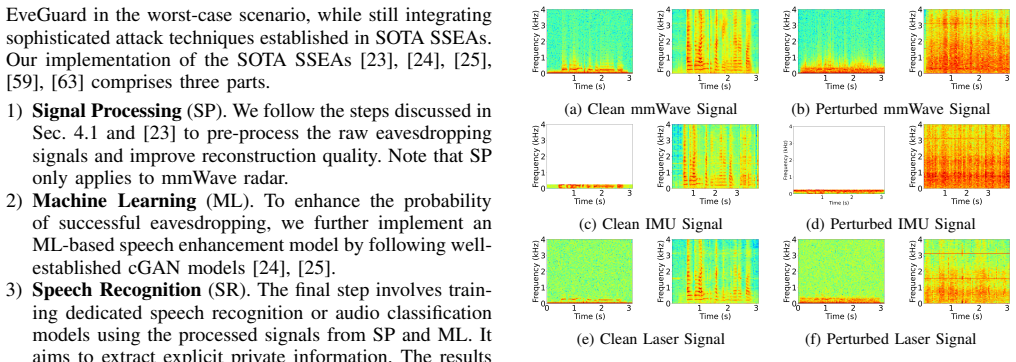
On its own terms, the paper's central claim is that the frequency-response gap between vibrometry sensors and microphones is a reliable handle for privacy: side channels capture mostly low-frequency vibration while microphones and ears perceive the full band, with minimal human sensitivity below 500 Hz. EveGuard exploits this by generating two kinds of perturbations—a VAE-GAN-driven FIR filter that reshapes the audio spectrum and low-frequency adversarial perturbations—trained end-to-end through Eve-GAN and an ensemble of ten surrogate speech recognizers and classifiers. The reported result is that eavesdropped audio becomes unintelligible: Mel-Cepstral Distortion rises from roughly 3.4 to 13.6, Word Error Rate exceeds 68 percent, digit-classifier accuracy drops below 5 percent, while PESQ stays at 3.42, meaning the perturbed audio is perceptually close to the original, confirmed by a user study. EveGuard also reports robustness to adversarial training, perturbation removal, and speech transformations, and low enough latency for VoIP. The paper explicitly scopes EveGuard to loudspeaker playback and notes that it does not cover throat-vibration eavesdropping on live human speech.
Load-bearing premise
The whole defense rests on the assumption that the differentiable Eve-GAN surrogate faithfully matches the real eavesdropping channel in the low-frequency band where perturbations live, so that perturbations optimized against it transfer to real sensors.
Editorial extensions
If this is right
- Loudspeaker privacy can be protected without hardware jammers, shields, or vibration motors, simply by preprocessing audio before playback.
- The same defense transfers across mmWave radar frequencies, sampling rates, antenna configurations, distances, angles, volumes, insulators, and reverberating materials, because perturbations are placed in the band every tested sensor hears.
- Perturbation diversity from random latent vectors makes it hard for an attacker who knows about EveGuard to train a denoiser or robust recognizer, since the perturbation distribution is not fixed.
- EveGuard is deployable in real-time voice pipelines: 50 ms segments process in 2.7 to 11.7 ms on tested hardware, under the 150 ms VoIP budget.
- Because the defense acts before playback, it also works for optical and accelerometer side channels, not just mmWave radar.
Reading between the lines
- The same low-frequency insertion principle could be ported to electromagnetic side channels and other vibration sensors if they exhibit a comparable low-frequency-dominant response, a direction the paper itself flags as future work.
- The method's success hinges on low-frequency perturbations surviving the acoustic path to the vibrating object; testing in noisier, more reverberant, or more damped rooms where LFAP energy dissipates would be a natural stress test not covered by the reported scenarios.
- If Eve-GAN's surrogate underestimates the true channel's sensitivity at higher frequencies for some sensor, the defense may need per-sensor calibration or an expanded ensemble to stay effective.
- The few-shot, unpaired translation recipe could be reused to model other sensing channels, such as through-wall radar or lidar, for other privacy defenses without collecting paired clean and eavesdropped audio.
Signed reviews
Editorial analysis
A structured set of objections, weighed in public.
Referee Report
Summary. The paper proposes EveGuard, a software-only defense that adds imperceptible low-frequency adversarial perturbations to loudspeaker audio before playback, aiming to make vibration-based side-channel eavesdropping (mmWave radar, accelerometer, optical/laser sensor) fail to recover intelligible speech. The defense is a two-stage Perturbation Generator Model (PGM) combining FIR filtering with low-frequency adversarial perturbations (LFAPs), trained end-to-end through a learned differentiable surrogate of the eavesdropping channel called Eve-GAN, which uses few-shot unpaired audio-to-SSEA translation to reduce data collection cost. Evaluation on re-implemented SSEAs across sensors, distances, angles, materials, sampling rates, and adaptive attacks reports MCD above 13.4, WER above 68%, DDR at or below 3%, PESQ 3.42, and a 24-participant user study.
Significance. If the frequency-response premise holds, EveGuard is a valuable contribution: it is a software-only, hardware-free defense against multiple vibration side channels, with a plausible transfer mechanism and unusually broad experimental coverage including unseen rooms, materials, and adaptive attackers. The few-shot Eve-GAN is a practical modeling contribution, and the explicit comparison against Gaussian noise and vanilla adversarial perturbations is informative. The paper also ships a public demo audio page, which strengthens the perceptual claims. However, the claimed generality over all vibration-based SSEAs is not yet established because the central premise that side channels are insensitive above roughly 2 kHz is untested for wideband vibrometers; with that caveat, the contribution is significant but needs additional validation.
major comments (3)
- [Section 4.1, Table 1, Table 11] The defense's load-bearing premise is that vibration-based side channels have near-zero SNR above roughly 2 kHz, so an inaudible LFAP below 500 Hz dominates the eavesdropped signal. This premise is not tested for wideband sensors. The paper itself concedes that a high-end laser vibrometer (LV-FS01) can enhance the frequency response (Section 4.1), and Table 1 lists VibSpeech with up to 16 kHz sampling. All EveGuard experiments use a 77/60 GHz mmWave radar with a 10 or 12 kHz chirp, a 500 Hz accelerometer, and a low-end optical sensor; no wideband vibrometer is evaluated. Since Table 11 shows that LFAP is the component responsible for the MCD increase (13.1 vs. 4.8 for FIR alone), an attacker who can recover the untouched bands above 500 Hz could bypass most of the defense. Please add an evaluation against a wideband sensor (e.g., a VibSpeech-class or LV-FS01-class device), or explicitly restrict the threat model to sensors with poor high-frequency response.
- [Section 6.4, Tables 5 and 9] The main quantitative claims are reported as single-point MCD, WER, and DDR values without error bars, standard deviations, or test-set sizes. Because the central claim of more than 97% protection and the comparisons to Gaussian and VAP baselines depend on these numbers, the paper should report means and confidence intervals over repeated sensor captures and over the test utterances. Without these, it is difficult to assess whether the differences between conditions and baselines are significant, and the reader cannot gauge run-to-run variability of the sensor channel.
- [Section 5.3, Section 6.7] The fidelity of the surrogate Eve-GAN is quantified only by SSIM on full spectrograms (94.02% for mmWave and 96.51% for accelerometer), which does not directly constrain the sub-500 Hz band where LFAP energy is placed. The end-to-end transfer experiments in Section 6.4 provide indirect evidence that the surrogate works for the specific sensor hardware evaluated, but they do not establish gradient alignment for unseen wideband hardware. If the surrogate diverges in the LFAP band for a different sensor, the optimized perturbations may not transfer. Please report a spectral fidelity metric focused on the LFAP band, or evaluate with a second independently built surrogate channel, to strengthen this link.
minor comments (6)
- [Section 6.1] There is a typo: "EvGuard" should be "EveGuard".
- [Figure 12(b)] The text says "WER of up to 85.5" in the caption; this should be "85.5%".
- [Equation (10)] The symbol Y^k_s is used for a probability of a class label; please use a probability notation such as P^k_s for consistency with P r^k_s.
- [Appendix H] Appendix H contains the program committee meta-review from a prior venue. This is not part of the scientific content of a journal submission and should be removed before publication.
- [Section 5.1, Equation (1)] The objective in Equation (1) is written as an arg max with hard constraints, while the training loss in Equation (7) is a weighted sum. Please clarify how the constraints are enforced or map the Lagrangian weights to the constraints.
- [Section 6.6] Please report whether all 24 participants heard the same 30 audio pairs and how the Likert-scale responses were aggregated into the reported averages.
Circularity Check
No significant circularity: EveGuard's headline protection numbers are validated against independently re-implemented SSEAs, and the differentiable Eve-GAN is a modeling tool rather than the benchmark.
full rationale
The derivation chain is self-contained with respect to the central claims. Eve-GAN (Eq. 6, Sec. 5.3) is trained on real SSEA samples but is used only as a differentiable surrogate for end-to-end PGM optimization; the reported defense results (Sec. 6.4, Table 5: MCD 13.6, WER 70.1%, DDR 2%, PESQ 3.42) are obtained by replaying perturbed audio through separately re-implemented real mmWave/IMU/optical SSEA pipelines (Sec. 6.1, Table 14) with hardware, rooms, and datasets distinct from EveGuard's training (Sec. 6.2, Appendix C). The training losses Lens and Lrec in Eqs. 10-11 are objectives, not the measured evaluation metrics, so the performance claims are not equal to the optimization objective by construction. The SNR parameter rho is tuned in Fig. 15, but rho controls perturbation power; it is not a renamed prediction of MCD or PESQ, and the defense is also tested across distances, angles, volumes, materials, sampling rates, and adaptive attacks. The one author self-citation, [10], supports the observation that diverse random perturbations make adaptive training hard; it is not load-bearing because Table 12 directly demonstrates that result. The wideband-vibrometer concern raised in Sec. 4.1 is a generalization/correctness risk, not circularity: the evaluated sensors match the low-frequency premise, and no claim in the paper asserts that LFAP is tested on a wideband LV-FS01-class sensor.
Assumptions & free parameters
free parameters (4)
- LFAP SNR rho =
16 dB
- PGM loss weights lambda_kl, lambda_ens, lambda_rec =
1, 1, 10
- Eve-GAN loss weights beta_con, beta_fm =
1, 1
- LFAP cutoff frequency =
500 Hz
assumptions (5)
- domain assumption Vibrometry-based side channels have consistently low SNR above roughly 1-2 kHz across hardware and scenarios (Sec. 4.1, Fig. 3, Appendix A).
- domain assumption Human hearing is insensitive to frequencies below 500 Hz, so perturbations there are imperceptible (Sec. 4.2, Fig. 4).
- standard math Adversarial perturbations trained on an ensemble of surrogate models transfer to black-box attacker models (Sec. 5.4, Eq. 10).
- domain assumption Eve-GAN's spectrogram SSIM of 94% (Sec. 6.7) implies the surrogate accurately models the true SSEA channel for optimization purposes.
- domain assumption The attacker's ML models (cGAN enhancement, transformer STT, digit classifier) represent realistic SOTA eavesdroppers (Sec. 6.1, Appendix B).
Cite this review
Pith. "Pith review of EveGuard: Defeating Vibration-based Side-Channel Eavesdropping with Audio Adversarial Perturbations." pith.science (2026). https://pith.science/paper/M7NQNUKG
@misc{pith2026241110034,
  author       = {Pith},
  title        = {Pith review of: EveGuard: Defeating Vibration-based Side-Channel Eavesdropping with Audio Adversarial Perturbations},
  year         = {2026},
  howpublished = {\url{https://pith.science/paper/M7NQNUKG}},
  note         = {Machine review of arXiv:2411.10034}
}
read the original abstract
Vibrometry-based side channels pose a significant privacy risk, exploiting sensors like mmWave radars, light sensors, and accelerometers to detect vibrations from sound sources or proximate objects, enabling speech eavesdropping. Despite various proposed defenses, these involve costly hardware solutions with inherent physical limitations. This paper presents EveGuard, a software-driven defense framework that creates adversarial audio, protecting voice privacy from side channels without compromising human perception. We leverage the distinct sensing capabilities of side channels and traditional microphones, where side channels capture vibrations and microphones record changes in air pressure, resulting in different frequency responses. EveGuard first proposes a perturbation generator model (PGM) that effectively suppresses sensor-based eavesdropping while maintaining high audio quality. Second, to enable end-to-end training of PGM, we introduce a new domain translation task called Eve-GAN for inferring an eavesdropped signal from a given audio. We further apply few-shot learning to mitigate the data collection overhead for Eve-GAN training. Our extensive experiments show that EveGuard achieves a protection rate of more than 97 percent from audio classifiers and significantly hinders eavesdropped audio reconstruction. We further validate the performance of EveGuard across three adaptive attack mechanisms. We have conducted a user study to verify the perceptual quality of our perturbed audio.
Figures


Figures from the paper (12 more)







Reference graph
Works this paper leans on
-
[1]
Your android’s accelerometer could be used to eavesdrop on your calls, 2019
2019
-
[2]
Normal equal-loudness-level contours
ISO Acoustics. Normal equal-loudness-level contours. ISO, 226:2003, 2003
2003
-
[3]
Robust adversarial attacks against dnn-based wireless communication systems
Alireza Bahramali, Milad Nasr, Amir Houmansadr, Dennis Goeckel, and Don Towsley. Robust adversarial attacks against dnn-based wireless communication systems. In Proceedings of the 2021 ACM SIGSAC conference on computer and communications security, pages 126–140, 2021
2021
-
[4]
mmspy: Spying phone calls using mmwave radars
Suryoday Basak and Mahanth Gowda. mmspy: Spying phone calls using mmwave radars. In 2022 IEEE Symposium on Security and Privacy (SP), pages 1211–1228. IEEE, 2022
2022
-
[5]
Interpreting and explaining deep neural networks for classification of audio signals
S ¨oren Becker, Marcel Ackermann, Sebastian Lapuschkin, Klaus- Robert M¨uller, and Wojciech Samek. Interpreting and explaining deep neural networks for classification of audio signals. arXiv preprint arXiv:1807.03418, 2018
arXiv 2018
-
[6]
Ex- perimental study on sound quality of various audio fade lengths
Jedrzej Borowski, Krzysztof Bulawski, and Krzysztof Goliasz. Ex- perimental study on sound quality of various audio fade lengths. In Audio Engineering Society Convention 144 . Audio Engineering Society, 2018
2018
-
[7]
Informational and energetic masking effects in the perception of two simultaneous talkers
Douglas S Brungart. Informational and energetic masking effects in the perception of two simultaneous talkers. The Journal of the Acoustical Society of America , 109(3):1101–1109, 2001
2001
-
[8]
Blackbox attacks via surrogate en- semble search
Zikui Cai, Chengyu Song, Srikanth Krishnamurthy, Amit Roy- Chowdhury, and Salman Asif. Blackbox attacks via surrogate en- semble search. Advances in Neural Information Processing Systems , 35:5348–5362, 2022
2022
Show all 96 references
-
[9]
Audio adversarial examples: Targeted attacks on speech-to-text
Nicholas Carlini and David Wagner. Audio adversarial examples: Targeted attacks on speech-to-text. In 2018 IEEE security and privacy workshops (SPW), pages 1–7. IEEE, 2018
2018
-
[10]
Magmaw: Modality-agnostic adversarial attacks on machine learning-based wireless communica- tion systems
Jung-Woo Chang, Ke Sun, Nasimeh Heydaribeni, Seira Hidano, Xinyu Zhang, and Farinaz Koushanfar. Magmaw: Modality-agnostic adversarial attacks on machine learning-based wireless communica- tion systems. In 2025 Network and Distributed System Security Symposium (NDSS), 2025
2025
-
[11]
Metamorph: Injecting inaudible commands into over-the-air voice controlled systems
Tao Chen, Longfei Shangguan, Zhenjiang Li, and Kyle Jamieson. Metamorph: Injecting inaudible commands into over-the-air voice controlled systems. In Network and Distributed Systems Security (NDSS) Symposium, 2020
2020
-
[12]
{Devil’s} whisper: A general approach for physical adversarial attacks against commercial black- box speech recognition devices
Yuxuan Chen, Xuejing Yuan, Jiangshan Zhang, Yue Zhao, Shengzhi Zhang, Kai Chen, and XiaoFeng Wang. {Devil’s} whisper: A general approach for physical adversarial attacks against commercial black- box speech recognition devices. In 29th USENIX Security Symposium (USENIX Securit...
2020
-
[13]
Lowkey: Leveraging adversarial attacks to protect social media users from facial recognition
Valeriia Cherepanova, Micah Goldblum, Harrison Foley, Shiyuan Duan, John Dickerson, Gavin Taylor, and Tom Goldstein. Lowkey: Leveraging adversarial attacks to protect social media users from facial recognition. arXiv preprint arXiv:2101.07922 , 2021
2021 arXiv
-
[14]
Tempest comeback: A realistic audio eavesdropping threat on mixed-signal socs
Jieun Choi, Hae-Yong Yang, and Dong-Ho Cho. Tempest comeback: A realistic audio eavesdropping threat on mixed-signal socs. In Proceedings of the 2020 ACM SIGSAC Conference on Computer and Communications Security, pages 1085–1101, 2020
2020
-
[15]
Alexa and google home devices leveraged to phish and eavesdrop on users, again, 2019
Catalin Cimpanu. Alexa and google home devices leveraged to phish and eavesdrop on users, again, 2019
2019
-
[16]
Jammer enforcement, 2020
Federal Communications Commission. Jammer enforcement, 2020
2020
-
[17]
Rf-net: A uni- fied meta-learning framework for rf-enabled one-shot human activity recognition
Shuya Ding, Zhe Chen, Tianyue Zheng, and Jun Luo. Rf-net: A uni- fied meta-learning framework for rf-enabled one-shot human activity recognition. In Proceedings of the 18th Conference on Embedded Networked Sensor Systems , pages 517–530, 2020
2020
-
[18]
Darpa timit acoustic-phonetic continous speech corpus cd-rom
John S Garofolo, Lori F Lamel, William M Fisher, Jonathan G Fiscus, and David S Pallett. Darpa timit acoustic-phonetic continous speech corpus cd-rom. nist speech disc 1-1.1. NASA STI/Recon technical report n, 93:27403, 1993
1993
-
[19]
Generative adversarial nets
Ian Goodfellow, Jean Pouget-Abadie, Mehdi Mirza, Bing Xu, David Warde-Farley, Sherjil Ozair, Aaron Courville, and Yoshua Bengio. Generative adversarial nets. Advances in neural information process- ing systems, 27, 2014
2014
-
[20]
Connectionist temporal classification: labelling unseg- mented sequence data with recurrent neural networks
Alex Graves, Santiago Fern ´andez, Faustino Gomez, and J ¨urgen Schmidhuber. Connectionist temporal classification: labelling unseg- mented sequence data with recurrent neural networks. In Proceedings of the 23rd international conference on Machine learning, pages 369– 376, 2006
2006
-
[21]
Specpatch: Human-in-the-loop adversarial audio spectrogram patch attack on speech recognition
Hanqing Guo, Yuanda Wang, Nikolay Ivanov, Li Xiao, and Qiben Yan. Specpatch: Human-in-the-loop adversarial audio spectrogram patch attack on speech recognition. In Proceedings of the 2022 ACM SIGSAC Conference on Computer and Communications Security , pages 1353–1366, 2022
2022
-
[22]
Hierarchical patch vae-gan: Generating diverse videos from a single sample
Shir Gur, Sagie Benaim, and Lior Wolf. Hierarchical patch vae-gan: Generating diverse videos from a single sample. Advances in Neural Information Processing Systems , 33:16761–16772, 2020
2020
-
[23]
mmecho: A mmwave-based acoustic eavesdropping method
Pengfei Hu, Wenhao Li, Riccardo Spolaor, and Xiuzhen Cheng. mmecho: A mmwave-based acoustic eavesdropping method. In Proceedings of the ACM Turing Award Celebration Conference-China 2023, pages 138–140, 2023
2023
-
[24]
Milliear: Millimeter-wave acoustic eavesdropping with unconstrained vocabulary
Pengfei Hu, Yifan Ma, Panneer Selvam Santhalingam, Parth H Pathak, and Xiuzhen Cheng. Milliear: Millimeter-wave acoustic eavesdropping with unconstrained vocabulary. In IEEE INFOCOM 2022-IEEE Conference on Computer Communications , pages 11–20. IEEE, 2022
2022
-
[25]
Accear: Accelerometer acoustic eavesdropping with unconstrained vocabu- lary
Pengfei Hu, Hui Zhuang, Panneer Selvam Santhalingam, Riccardo Spolaor, Parth Pathak, Guoming Zhang, and Xiuzhen Cheng. Accear: Accelerometer acoustic eavesdropping with unconstrained vocabu- lary. In 2022 IEEE Symposium on Security and Privacy (SP) , pages 1757–1773. IEEE, 2022
2022
-
[26]
Mul- timodal unsupervised image-to-image translation
Xun Huang, Ming-Yu Liu, Serge Belongie, and Jan Kautz. Mul- timodal unsupervised image-to-image translation. In Proceedings of the European conference on computer vision (ECCV), pages 172–189, 2018
2018
-
[27]
{WaveGuard}: Understanding and mitigating audio adversarial examples
Shehzeen Hussain, Paarth Neekhara, Shlomo Dubnov, Julian McAuley, and Farinaz Koushanfar. {WaveGuard}: Understanding and mitigating audio adversarial examples. In 30th USENIX Security Symposium (USENIX Security 21) , pages 2273–2290, 2021
2021
-
[28]
Awr1843boost and iwr1843boost single-chip mmwave sensing solution user’s guide (rev
Texas Instruments. Awr1843boost and iwr1843boost single-chip mmwave sensing solution user’s guide (rev. b), 2020
2020
-
[29]
Iwr6843, iwr6443 single-chip 60- to 64-ghz mmwave sensor, 2021
Texas Instruments. Iwr6843, iwr6443 single-chip 60- to 64-ghz mmwave sensor, 2021
2021
-
[30]
The lj speech dataset, 2017
Keith Ito and Linda Johnson. The lj speech dataset, 2017
2017
-
[31]
Openwifi csi fuzzer for authorized sensing and covert channels
Xianjun Jiao, Michael Mehari, Wei Liu, Muhammad Aslam, and Ingrid Moerman. Openwifi csi fuzzer for authorized sensing and covert channels. In Proceedings of the 14th ACM Conference on Security and Privacy in Wireless and Mobile Networks , pages 377– 379, 2021
2021
-
[32]
Stargan-vc: Non-parallel many-to-many voice conversion using star generative adversarial networks
Hirokazu Kameoka, Takuhiro Kaneko, Kou Tanaka, and Nobukatsu Hojo. Stargan-vc: Non-parallel many-to-many voice conversion using star generative adversarial networks. In 2018 IEEE Spoken Language Technology Workshop (SLT), pages 266–273. IEEE, 2018
2018
-
[33]
Cyclegan-vc3: Examining and improving cyclegan-vcs for mel- spectrogram conversion
Takuhiro Kaneko, Hirokazu Kameoka, Kou Tanaka, and Nobukatsu Hojo. Cyclegan-vc3: Examining and improving cyclegan-vcs for mel- spectrogram conversion. arXiv preprint arXiv:2010.11672 , 2020
2010 arXiv
-
[34]
Adam: A method for stochastic optimization
Diederik P Kingma and Jimmy Ba. Adam: A method for stochastic optimization. arXiv preprint arXiv:1412.6980 , 2014
2014 arXiv
-
[35]
Fundamentals of acoustics
Lawrence E Kinsler, Austin R Frey, Alan B Coppens, and James V Sanders. Fundamentals of acoustics . John wiley & sons, 2000
2000
-
[36]
Synthesizer voice quality of new languages calibrated with mean mel cepstral distortion
John Kominek, Tanja Schultz, and Alan W Black. Synthesizer voice quality of new languages calibrated with mean mel cepstral distortion. In SLTU, pages 63–68, 2008
2008
-
[37]
Hifi-gan: Generative adversarial networks for efficient and high fidelity speech synthesis
Jungil Kong, Jaehyeon Kim, and Jaekyoung Bae. Hifi-gan: Generative adversarial networks for efficient and high fidelity speech synthesis. Advances in neural information processing systems, 33:17022–17033, 2020
2020
-
[38]
Fool- ing end-to-end speaker verification with adversarial examples
Felix Kreuk, Yossi Adi, Moustapha Cisse, and Joseph Keshet. Fool- ing end-to-end speaker verification with adversarial examples. In 2018 IEEE international conference on acoustics, speech and signal processing (ICASSP), pages 1962–1966. IEEE, 2018
2018
-
[39]
Autoencoding beyond pixels using a learned similarity metric
Anders Boesen Lindbo Larsen, Søren Kaae Sønderby, Hugo Larochelle, and Ole Winther. Autoencoding beyond pixels using a learned similarity metric. In International conference on machine learning, pages 1558–1566. PMLR, 2016
2016
-
[40]
Magear: eavesdropping via audio recovery using magnetic side channel
Qianru Liao, Yongzhi Huang, Yandao Huang, Yuheng Zhong, Huitong Jin, and Kaishun Wu. Magear: eavesdropping via audio recovery using magnetic side channel. In MobiSys, pages 371–383, 2022
2022
-
[41]
A technique for the measurement of attitudes
Rensis Likert. A technique for the measurement of attitudes. Archives of psychology, 1932
1932
-
[42]
Few-shot unsupervised image-to- image translation
Ming-Yu Liu, Xun Huang, Arun Mallya, Tero Karras, Timo Aila, Jaakko Lehtinen, and Jan Kautz. Few-shot unsupervised image-to- image translation. In Proceedings of the IEEE/CVF international conference on computer vision , pages 10551–10560, 2019
2019
-
[43]
Delving into transferable adversarial examples and black-box attacks
Yanpei Liu, Xinyun Chen, Chang Liu, and Dawn Song. Delving into transferable adversarial examples and black-box attacks. arXiv preprint arXiv:1611.02770, 2016
2016 arXiv
-
[44]
Leakypick: Iot audio spy detector
Richard Mitev, Anna Pazii, Markus Miettinen, William Enck, and Ahmad-Reza Sadeghi. Leakypick: Iot audio spy detector. In Proceed- ings of the 36th Annual Computer Security Applications Conference , pages 694–705, 2020
2020
-
[45]
Engineering acoustics
Michael M ¨oser. Engineering acoustics. Nova York (Estados Unidos): Springer Publishing, 2009
2009
-
[46]
Lamphone: Real-time passive sound recovery from light bulb vibrations
Ben Nassi, Yaron Pirutin, Adi Shamir, Yuval Elovici, and Boris Zadov. Lamphone: Real-time passive sound recovery from light bulb vibrations. Cryptology ePrint Archive , 2020
2020
-
[47]
V oiceblock: Privacy through real-time adversarial attacks with audio-to-audio models
Patrick O’Reilly, Andreas Bugler, Keshav Bhandari, Max Morrison, and Bryan Pardo. V oiceblock: Privacy through real-time adversarial attacks with audio-to-audio models. Advances in Neural Information Processing Systems, 35:30058–30070, 2022
2022
-
[48]
Effective and inconspicuous over-the-air adversarial examples with adaptive filtering
Patrick O’Reilly, Pranjal Awasthi, Aravindan Vijayaraghavan, and Bryan Pardo. Effective and inconspicuous over-the-air adversarial examples with adaptive filtering. In ICASSP 2022-2022 IEEE In- ternational Conference on Acoustics, Speech and Signal Processing (ICASSP), pages 6...
2022
-
[49]
Librispeech: an asr corpus based on public domain audio books
Vassil Panayotov, Guoguo Chen, Daniel Povey, and Sanjeev Khu- danpur. Librispeech: an asr corpus based on public domain audio books. In 2015 IEEE international conference on acoustics, speech and signal processing (ICASSP) , pages 5206–5210. IEEE, 2015
2015
-
[50]
Audio sampling and sample rate, 2024
Picovoice. Audio sampling and sample rate, 2024
2024
-
[51]
Perceptual evaluation of speech quality (pesq): An objective method for end-to-end speech quality assessment of narrow-band telephone networks and speech codecs
ITU-T Recommendation. Perceptual evaluation of speech quality (pesq): An objective method for end-to-end speech quality assessment of narrow-band telephone networks and speech codecs. Rec. ITU-T P . 862, 2001
2001
-
[52]
Intelligent virtual assistance (iva) industry overview, 2023
Emergen Research. Intelligent virtual assistance (iva) industry overview, 2023
2023
-
[53]
Ac-vc: non-parallel low latency phonetic posteriorgrams based voice conversion
Damien Ronssin and Milos Cernak. Ac-vc: non-parallel low latency phonetic posteriorgrams based voice conversion. In 2021 IEEE Automatic Speech Recognition and Understanding Workshop (ASRU), pages 710–716. IEEE, 2021
2021
-
[54]
Lidarphone: acoustic eavesdropping using a lidar sensor
Sriram Sami, Sean Rui Xiang Tan, Yimin Dai, Nirupam Roy, and Jun Han. Lidarphone: acoustic eavesdropping using a lidar sensor. In Proceedings of the 18th Conference on Embedded Networked Sensor Systems, pages 701–702, 2020
2020
-
[55]
Transmission systems and media, digital systems and networks
G Series. Transmission systems and media, digital systems and networks. Digital sections and digital line system—Metallic access networks. ITU-T G , 993, 2003
2003
-
[56]
Fawkes: Protecting privacy against unauthorized deep learning models
Shawn Shan, Emily Wenger, Jiayun Zhang, Huiying Li, Haitao Zheng, and Ben Y Zhao. Fawkes: Protecting privacy against unauthorized deep learning models. In 29th USENIX security symposium (USENIX Security 20), pages 1589–1604, 2020
2020
-
[57]
ipet: privacy enhancing traffic per- turbations for secure iot communications
Akshaye Shenoi, Prasanna Karthik Vairam, Kanav Sabharwal, Jialin Li, and Dinil Mon Divakaran. ipet: privacy enhancing traffic per- turbations for secure iot communications. Proceedings on Privacy Enhancing Technologies, 2023
2023
-
[58]
Rf-protect: privacy against device-free human tracking
Jayanth Shenoy, Zikun Liu, Bill Tao, Zachary Kabelac, and Deepak Vasisht. Rf-protect: privacy against device-free human tracking. In Proceedings of the ACM SIGCOMM 2022 Conference , pages 588– 600, 2022
2022
-
[59]
Privacy leakage via speech-induced vibrations on room objects through remote sensing based on phased-mimo
Cong Shi, Tianfang Zhang, Zhaoyi Xu, Shuping Li, Donglin Gao, Changming Li, Athina Petropulu, Chung-Tse Michael Wu, and Yingying Chen. Privacy leakage via speech-induced vibrations on room objects through remote sensing based on phased-mimo. In Proceedings of the 2023 ACM SIGS...
2023
-
[60]
End-to-end speech recognition using a high rank lstm-ctc based model
Yangyang Shi, Mei-Yuh Hwang, and Xin Lei. End-to-end speech recognition using a high rank lstm-ctc based model. In ICASSP 2019- 2019 IEEE International Conference on Acoustics, Speech and Signal Processing (ICASSP), pages 7080–7084. IEEE, 2019
2019
-
[61]
Ir- shield: A countermeasure against adversarial physical-layer wireless sensing
Paul Staat, Simon Mulzer, Stefan Roth, Veelasha Moonsamy, Markus Heinrichs, Rainer Kronberger, Aydin Sezgin, and Christof Paar. Ir- shield: A countermeasure against adversarial physical-layer wireless sensing. In 2022 IEEE Symposium on Security and Privacy (SP) , pages 1705–17...
2022
-
[62]
Video conferencing market statistics, 2023
Kate Sukhanova. Video conferencing market statistics, 2023
2023
-
[63]
Stealthyimu: Stealing permission-protected private information from smartphone voice assistant using zero-permission sensors
Ke Sun, Chunyu Xia, Songlin Xu, and Xinyu Zhang. Stealthyimu: Stealing permission-protected private information from smartphone voice assistant using zero-permission sensors. Network and Dis- tributed System Security (NDSS) Symposium, 2023
2023
-
[64]
Sok: Secure human-centered wireless sensing
Wei Sun, Tingjun Chen, and Neil Gong. Sok: Secure human-centered wireless sensing. Proceedings on Privacy Enhancing Technologies , 2024
2024
-
[65]
A feasi- bility study of radio-frequency retroreflector attack
Satohiro Wakabayashi, Seita Maruyama, Tatsuya Mori, Shigeki Goto, Masahiro Kinugawa, Yu-ichi Hayashi, and Michael Smith. A feasi- bility study of radio-frequency retroreflector attack. In 12th USENIX Workshop on Offensive Technologies (WOOT 18) , 2018
2018
-
[66]
Sok: assessing the threat potential of vibration-based attacks against live speech using mobile sensors
Payton Walker and Nitesh Saxena. Sok: assessing the threat potential of vibration-based attacks against live speech using mobile sensors. In Proceedings of the 14th ACM Conference on Security and Privacy in Wireless and Mobile Networks , pages 273–287, 2021
2021
-
[67]
mmeve: eavesdropping on smartphone’s earpiece via cots mmwave device
Chao Wang, Feng Lin, Tiantian Liu, Kaidi Zheng, Zhibo Wang, Zhengxiong Li, Ming-Chun Huang, Wenyao Xu, and Kui Ren. mmeve: eavesdropping on smartphone’s earpiece via cots mmwave device. In Proceedings of the 28th Annual International Conference on Mobile Computing And Networki...
2022
-
[68]
Vibspeech: Exploring practical wideband eavesdropping via bandlimited signal of vibration-based side channel
Chao Wang, Feng Lin, Hao Yan, Tong Wu, Wenyao Xu, and Kui Ren. Vibspeech: Exploring practical wideband eavesdropping via bandlimited signal of vibration-based side channel. In 33rd USENIX security symposium (USENIX Security 24) , 2024
2024
-
[69]
Wireless eavesdrop- ping on wired audio with radio-frequency retroreflector attack
Genglin Wang, Zheng Shi, Yanni Yang, Zhenlin An, Guoming Zhang, Pengfei Hu, Xiuzhen Cheng, and Jiannong Cao. Wireless eavesdrop- ping on wired audio with radio-frequency retroreflector attack. IEEE Transactions on Mobile Computing , 2024
2024
-
[70]
Is word error rate a good indicator for spoken language understanding accuracy
Ye-Yi Wang, Alex Acero, and Ciprian Chelba. Is word error rate a good indicator for spoken language understanding accuracy. In 2003 IEEE workshop on automatic speech recognition and understanding (IEEE Cat. No. 03EX721) , pages 577–582. IEEE, 2003
2003
-
[71]
Image quality assessment: from error visibility to structural similarity
Zhou Wang, Alan C Bovik, Hamid R Sheikh, and Eero P Simoncelli. Image quality assessment: from error visibility to structural similarity. IEEE transactions on image processing , 13(4):600–612, 2004
2004
-
[72]
Speech commands: A dataset for limited-vocabulary speech recognition
Pete Warden. Speech commands: A dataset for limited-vocabulary speech recognition. arXiv preprint arXiv:1804.03209 , 2018
2018 arXiv
-
[73]
Status-based detection of malicious code in internet of things (iot) devices
Dongdi Wei and Xiaofeng Qiu. Status-based detection of malicious code in internet of things (iot) devices. In 2018 IEEE Conference on Communications and Network Security (CNS) , pages 1–7. IEEE, 2018
2018
-
[74]
Acoustic eavesdropping through wireless vibrometry
Teng Wei, Shu Wang, Anfu Zhou, and Xinyu Zhang. Acoustic eavesdropping through wireless vibrometry. In Proceedings of the 21st Annual International Conference on Mobile Computing and Networking, pages 130–141, 2015
2015
-
[75]
Enabling fast and universal audio adversarial attack using generative model
Yi Xie, Zhuohang Li, Cong Shi, Jian Liu, Yingying Chen, and Bo Yuan. Enabling fast and universal audio adversarial attack using generative model. In Proceedings of the AAAI conference on artificial intelligence, volume 35, pages 14129–14137, 2021
2021
-
[76]
Cstr vctk corpus: English multi-speaker corpus for cstr voice cloning toolkit (version 0.92)
Junichi Yamagishi, Christophe Veaux, Kirsten MacDonald, et al. Cstr vctk corpus: English multi-speaker corpus for cstr voice cloning toolkit (version 0.92). 2019
2019
-
[77]
Parallel wavegan: A fast waveform generation model based on generative adversarial networks with multi-resolution spectrogram
Ryuichi Yamamoto, Eunwoo Song, and Jae-Min Kim. Parallel wavegan: A fast waveform generation model based on generative adversarial networks with multi-resolution spectrogram. In ICASSP 2020-2020 IEEE International Conference on Acoustics, Speech and Signal Processing (ICASSP) ...
2020
-
[78]
The feasibility of injecting inaudible voice commands to voice assistants
Chen Yan, Guoming Zhang, Xiaoyu Ji, Tianchen Zhang, Taimin Zhang, and Wenyuan Xu. The feasibility of injecting inaudible voice commands to voice assistants. IEEE Transactions on Dependable and Secure Computing, 18(3):1108–1124, 2019
2019
-
[79]
Design of a novel drfm jamming system based on afb-sfb
Jing Yang, Xiaoxu Guo, and Yunjie Li. Design of a novel drfm jamming system based on afb-sfb. In IET International Radar Conference 2013, pages 1–5. IET, 2013
2013
-
[80]
Appcontext: Differentiating malicious and benign mobile app behaviors using context
Wei Yang, Xusheng Xiao, Benjamin Andow, Sihan Li, Tao Xie, and William Enck. Appcontext: Differentiating malicious and benign mobile app behaviors using context. In 2015 IEEE/ACM 37th IEEE international conference on software engineering , volume 1, pages 303–313. IEEE, 2015
2015
-
[81]
Rf-parrot: Wireless eavesdropping on wired audio
Yanni Yang, Genglin Wang, Zhenlin An, Guoming Zhang, Xiuzhen Cheng, and Pengfei Hu. Rf-parrot: Wireless eavesdropping on wired audio. In IEEE INFOCOM 2024-IEEE Conference on Computer Communications, pages 701–710. IEEE, 2024
2024
-
[82]
Torchaudio: Building blocks for au- dio and speech processing
Yao-Yuan Yang, Moto Hira, Zhaoheng Ni, Artyom Astafurov, Caro- line Chen, Christian Puhrsch, David Pollack, Dmitriy Genzel, Donny Greenberg, Edward Z Yang, et al. Torchaudio: Building blocks for au- dio and speech processing. In ICASSP 2022-2022 IEEE International Conference o...
2022
-
[83]
Interference-negligible privacy- preserved shield for rf sensing
Yao Yao, Yan Li, and Ting Zhu. Interference-negligible privacy- preserved shield for rf sensing. IEEE Transactions on Mobile Com- puting, 2023
2023
-
[84]
{SMACK}: Semantically meaningful adversarial audio attack
Zhiyuan Yu, Yuanhaur Chang, Ning Zhang, and Chaowei Xiao. {SMACK}: Semantically meaningful adversarial audio attack. In 32nd USENIX Security Symposium (USENIX Security 23) , pages 3799–3816, 2023
2023
-
[85]
Antifake: Using adver- sarial audio to prevent unauthorized speech synthesis
Zhiyuan Yu, Shixuan Zhai, and Ning Zhang. Antifake: Using adver- sarial audio to prevent unauthorized speech synthesis. In Proceedings of the 2023 ACM SIGSAC Conference on Computer and Communi- cations Security, pages 460–474, 2023
2023
-
[86]
I spy you: Eavesdrop- ping continuous speech on smartphones via motion sensors
Shijia Zhang, Yilin Liu, and Mahanth Gowda. I spy you: Eavesdrop- ping continuous speech on smartphones via motion sensors. Proceed- ings of the ACM on Interactive, Mobile, Wearable and Ubiquitous Technologies, 6(4):1–31, 2023
2023
-
[87]
Ra- dio2text: Streaming speech recognition using mmwave radio signals
Running Zhao, Jiangtao Yu, Hang Zhao, and Edith CH Ngai. Ra- dio2text: Streaming speech recognition using mmwave radio signals. Proceedings of the ACM on Interactive, Mobile, Wearable and Ubiq- uitous Technologies, 7(3):1–28, 2023
2023
-
[88]
Black-box adversarial attacks on commercial speech platforms with minimal information
Baolin Zheng, Peipei Jiang, Qian Wang, Qi Li, Chao Shen, Cong Wang, Yunjie Ge, Qingyang Teng, and Shenyi Zhang. Black-box adversarial attacks on commercial speech platforms with minimal information. In Proceedings of the 2021 ACM SIGSAC conference on computer and communication...
2021
-
[89]
Dehirec: Detecting hidden voice recorders via adc electromagnetic radiation
Ruochen Zhou, Xiaoyu Ji, Chen Yan, Yi-Chao Chen, Wenyuan Xu, and Chaohao Li. Dehirec: Detecting hidden voice recorders via adc electromagnetic radiation. In 2023 IEEE Symposium on Security and Privacy (SP), pages 3113–3128. IEEE, 2023
2023
-
[90]
Un- paired image-to-image translation using cycle-consistent adversarial networks
Jun-Yan Zhu, Taesung Park, Phillip Isola, and Alexei A Efros. Un- paired image-to-image translation using cycle-consistent adversarial networks. In Proceedings of the IEEE international conference on computer vision, pages 2223–2232, 2017. Appendix A. Additional Frequency Resp...
2017
-
[91]
IWR1843-Boost(with 76-81GHz)2. IWR6843-Boost(with 60-64GHz) LG V50(with 500Hz)Figure 9(b) EveGuardLogitechZ313 IWR1642-Boost(with 76-81GHz)Samsung S20(with 500Hz)Figure 9(a) TABLE 15: Training dataset used for SSEA and EveGuard. AE, STT, and AC stand for audio enhancement, spe...
-
[92]
• 18-29 • 30-39 • 40-49 • Over 50
Please select your age group. • 18-29 • 30-39 • 40-49 • Over 50
-
[93]
Please rate your intelligibility of the eavesdropped au- dio quality on a scale from 1 to 5. • 1 (None of the original speech is recovered) • 2 (Little of the original speech is recovered) • 3 (Half of the original speech is recovered) • 4 (Most of the original speech is recov...
-
[94]
• 1 (Bad) • 2 (Poor) • 3 (Fair) • 4 (Good) • 5 (Excellent) Appendix G
Please rate your perception of the audio quality on a scale from 1 to 5. • 1 (Bad) • 2 (Poor) • 3 (Fair) • 4 (Good) • 5 (Excellent) Appendix G. Details of Speech Transformation WaveGuard [27] leverages audio transformation to mit- igate adversarial perturbations. In an eavesdr...
2025
-
[95]
The methodology, particularly the use of Eve-GAN and adversarial perturbations, is robust and convincingly validated through comprehensive experimentation
Creates a New Tool to Enable Future Science: Eve- Guard presents a software-based approach for defend- ing against vibration-induced side-channel attacks. The methodology, particularly the use of Eve-GAN and adversarial perturbations, is robust and convincingly validated throu...
-
[96]
The proposed PGM and Eve-GAN end-to-end design improves both defense effectiveness and usability
Provides a Valuable Step Forward in an Established Field: EveGuard effectively addresses a recognized se- curity threat, improving the flexibility and applicability of existing defense solutions. The proposed PGM and Eve-GAN end-to-end design improves both defense effectivenes...
Reviewed August 12, 2026 · model on record in the stance chip above.
Discussion (0). Continue with ORCID to comment.