REVIEW 1 major objections 1 minor 1 cited by
Quantum Pump Depletion and Multicomponent Schr\"odinger-Cat-Like States in Doubly Pumped Intraresonance Kerr Microresonators
T0 review · 1 major / 1 minor · reviewed 2026-06-26 · grok-4.3
Pith's one-line read Treating pump modes as quantum fields in doubly pumped intraresonance Kerr microresonators produces multicomponent Schrödinger-cat-like states with Wigner negativity at strong depletion.
desk verdict The paper isolates Z3 symmetry in a reduced four-mode model to produce multicomponent cat-like states during pump depletion, then shows the full Kerr terms suppress them via phase shearing. read the letter →
The pith
A machine-rendered reading of the paper's core claim, the machinery that carries it, and where it could break.
The reading
What carries the argument
The residual Z_3 symmetry of the reduced resonant photon-conversion model, which organizes discrete phase relationships among four modes to produce multicomponent cat-like states during pump depletion.
What would settle it
Numerical evolution or an experiment in which the full Kerr dynamics at the depletion point shows no Wigner negativity or interference fringes would falsify the claim that the reduced model captures the essential non-Gaussian features.
Extended reading notes
Core claim
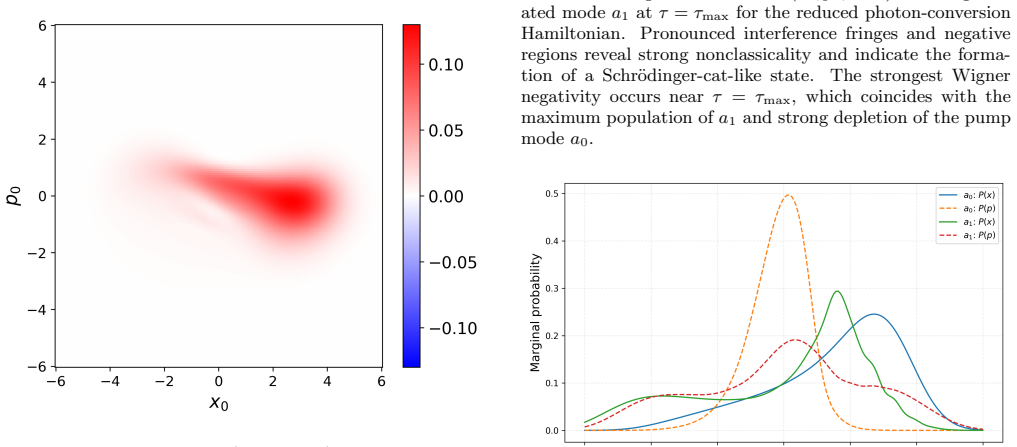
For the n=2 intraresonance branch, the four-mode reduced initial-value problem with fixed coherent pump phases has a residual Z_3 symmetry and generates cat-like Wigner structures near the interaction length at which the generated-mode population ⟨n1⟩ is maximal and the pump population ⟨n0⟩ is strongly depleted. The resulting states are multicomponent Schrödinger-cat-like states characterized by Wigner negativity, non-Poissonian statistics, pump-mode quadrature squeezing, and large single-mode Schmidt numbers. Comparison of the reduced and full Kerr dynamics shows that uncompensated SPM/XPM-induced phase shearing suppresses the interference fringes and Wigner negativity.
Load-bearing premise
The reduced photon-conversion model isolates the essential Z_{n+1} phase structure while the full Kerr Hamiltonian only adds phase shearing that suppresses but does not eliminate the cat-like signatures.
Editorial extensions
If this is right
- The states exhibit pump-mode quadrature squeezing and non-Poissonian photon-number statistics.
- Large single-mode Schmidt numbers indicate substantial mode entanglement.
- Wigner negativity and interference fringes appear near the interaction length of maximum generated-mode population.
- Uncompensated SPM and XPM in the full model suppress the clearest cat-like signatures.
Reading between the lines
- Higher-n intraresonance branches may produce states with correspondingly more components if the underlying Z_{n+1} symmetry remains intact.
- Varying the relative strength of nonlinearity versus dispersion in microresonators could map the crossover from reduced-model cat features to full-model suppression.
- The same symmetry-organized depletion route might be testable in other multimode nonlinear optical platforms that admit multiple coherent pumps.
Signed reviews
Editorial analysis
A structured set of objections, weighed in public.
Referee Report
Summary. The manuscript investigates quantum pump depletion and non-Gaussian state generation in doubly pumped intraresonance Kerr microresonators by treating the pump modes quantum mechanically. It distinguishes a reduced resonant photon-conversion model (isolating the discrete Z_{n+1} phase structure from FWM selection rules) from the full Kerr Hamiltonian (including SPM, XPM, and FWM). For the n=2 branch the reduced four-mode IVP with fixed coherent pump phases is claimed to possess a residual Z_3 symmetry that produces multicomponent Schrödinger-cat-like states (Wigner negativity, non-Poissonian statistics, pump quadrature squeezing, large Schmidt numbers) near maximal <n1> and depleted <n0>; the full model is stated to suppress the interference fringes and negativity via uncompensated SPM/XPM phase shearing.
Significance. If the separation between reduced and full dynamics is rigorously justified and the numerical comparison holds under identical truncations and initial conditions, the work would identify a concrete symmetry-based route to multicomponent cat-like states in quantum-depleted Kerr resonators, with measurable signatures in Wigner functions and entanglement measures. This could be relevant for non-Gaussian state engineering in integrated photonics.
major comments (1)
- [Abstract] Abstract: the central claim that the reduced model isolates the Z_{n+1} symmetry responsible for the cat-like features while the full Kerr Hamiltonian 'only adds suppressing phase shearing' is load-bearing for the attribution of the observed Wigner negativity and interference fringes. The abstract presents the reduced-vs-full comparison as decisive evidence, yet supplies no explicit derivation of the reduction from the multimode Hamiltonian, no verification that omitted operator-valued terms preserve the symmetry, and no error analysis or truncation details for the numerics. This directly matches the modeling-separation concern and must be addressed with concrete equations and side-by-side data before the claim can be assessed.
minor comments (1)
- [Abstract] The abstract uses escaped LaTeX (Schr"odinger) and inconsistent notation for expectation values (<n1> vs ⟨n1⟩); these should be standardized for readability.
Simulated Author's Rebuttal
We thank the referee for the careful reading and constructive comments on our manuscript. We address the major comment below and will revise the manuscript to strengthen the presentation of the modeling separation.
read point-by-point responses
-
Referee: [Abstract] Abstract: the central claim that the reduced model isolates the Z_{n+1} symmetry responsible for the cat-like features while the full Kerr Hamiltonian 'only adds suppressing phase shearing' is load-bearing for the attribution of the observed Wigner negativity and interference fringes. The abstract presents the reduced-vs-full comparison as decisive evidence, yet supplies no explicit derivation of the reduction from the multimode Hamiltonian, no verification that omitted operator-valued terms preserve the symmetry, and no error analysis or truncation details for the numerics. This directly matches the modeling-separation concern and must be addressed with concrete equations and side-by-side data before the claim can be assessed.
Authors: We agree that the abstract is concise and does not contain the explicit derivation or numerical details. The reduction is obtained in Sec. II by projecting the multimode Kerr Hamiltonian onto the resonant FWM channels selected by the intraresonance condition, retaining only the photon-conversion terms that generate the discrete Z_{n+1} phase structure while the SPM/XPM contributions appear as non-commuting operator-valued phases. We will revise the abstract to include a one-sentence reference to this projection and add a short paragraph (with the explicit reduced vs. full Hamiltonians) plus truncation details (Fock cutoff N=20 per mode, convergence to <1% in populations) and error estimates in the main text or a new methods subsection. Side-by-side Wigner and Schmidt-number comparisons already appear in Figs. 3-5; we will augment the captions with the truncation analysis. These changes will be incorporated in the revised version. revision: yes
Circularity Check
Derivation self-contained from Kerr Hamiltonian, FWM rules, and symmetry without reduction to inputs
full rationale
The paper starts from the multimode Kerr Hamiltonian, applies standard FWM selection rules to isolate the resonant photon-conversion model, identifies the residual Z_3 symmetry for the n=2 case directly from the resulting four-mode IVP, and compares reduced vs. full dynamics numerically to attribute suppression to SPM/XPM shearing. No parameters are fitted to target observables, no self-citations serve as load-bearing uniqueness theorems, and no ansatz or renaming is smuggled in. Claims are direct consequences of the stated equations and evolution, so the derivation chain does not reduce to its own inputs by construction.
Assumptions & free parameters
assumptions (2)
- domain assumption Kerr four-wave-mixing selection rule distinguishes effective resonant photon-conversion model from full Hamiltonian
- domain assumption Intraresonance regime and fixed coherent pump phases
Cite this review
Pith. "Pith review of Quantum Pump Depletion and Multicomponent Schr\"odinger-Cat-Like States in Doubly Pumped Intraresonance Kerr Microresonators." pith.science (2026). https://pith.science/paper/M7VS3KEX
@misc{pith2026260619085,
  author       = {Pith},
  title        = {Pith review of: Quantum Pump Depletion and Multicomponent Schr\"odinger-Cat-Like States in Doubly Pumped Intraresonance Kerr Microresonators},
  year         = {2026},
  howpublished = {\url{https://pith.science/paper/M7VS3KEX}},
  note         = {Machine review of arXiv:2606.19085}
}
abstract
We investigate quantum pump depletion and non-Gaussian state generation in doubly pumped Kerr microresonators operating in the intraresonance regime. The pump modes are treated quantum mechanically rather than as undepleted classical amplitudes, allowing pump depletion, back-action, entanglement generation, quadrature fluctuations, and Wigner-function negativity to emerge from the same multimode dynamics. Starting from the Kerr four-wave-mixing selection rule, we distinguish an effective resonant photon-conversion model from the full Kerr Hamiltonian containing self-phase modulation (SPM), cross-phase modulation (XPM), and four-wave mixing (FWM). The reduced model isolates the photon-conversion network responsible for the discrete $\mathbb{Z}_{n+1}$ phase structure, whereas the full model retains operator-valued nonlinear Kerr phases. For the \(n=2\) intraresonance branch, the four-mode reduced initial-value problem with fixed coherent pump phases has a residual \(\mathbb{Z}_3\) symmetry and generates cat-like Wigner structures near the interaction length at which the generated-mode population \(\langle n_1\rangle\) is maximal and the pump population \(\langle n_0\rangle\) is strongly depleted. The resulting states are not the canonical even or odd coherent states of Dodonov, Malkin, and Man'ko, but multicomponent Schr\"odinger-cat-like states characterized by Wigner negativity, non-Poissonian statistics, pump-mode quadrature squeezing, and large single-mode Schmidt numbers. Comparison of the reduced and full Kerr dynamics shows that uncompensated SPM/XPM-induced phase shearing suppresses the interference fringes and Wigner negativity responsible for the clearest cat-like signatures. These results identify quantum-depleted intraresonance Kerr dynamics as a route to symmetry-organized non-Gaussian states in Kerr resonators.
Figures


Figures from the paper (2 more)


Forward citations
Cited by 1 Pith paper
-
A new class of pure non-Gaussian quantum states
A new class of pure non-Gaussian optical states with trigonal phase-plane symmetry can be prepared by non-degenerate four-wave mixing followed by photon-number heralding.
Reference graph
Works this paper leans on
- [1]
-
[2]
Alexandrov, A
A. Alexandrov, A. Glutsyuk, and A. Gorsky, Phase- locking in dynamical systems and quantum mechanics, J. High Energ. Phys.2026, 101 (2026)
2026
-
[3]
P. T. Cochrane, G. J. Milburn, and W. J. Munro, Macroscopically distinct quantum-superposition states as a bosonic code for amplitude damping, Phys. Rev. A59, 2631 (1999)
1999
-
[4]
Mirrahimi, Z
M. Mirrahimi, Z. Leghtas, V. V. Albert, S. Touzard, R. J. Schoelkopf, L. Jiang, and M. H. Devoret, Dynamically protected cat-qubits: a new paradigm for universal quan- tum computation, New J. Phys.16, 045014 (2014)
2014
-
[5]
Singh and A
R. Singh and A. E. Teretenkov, Quantum sensitivity of squeezed Schr¨ odinger cat states, Physics Open18, 100198 (2024)
2024
-
[6]
Buˇ zek, A
V. Buˇ zek, A. Vidiella-Barranco, and P. L. Knight, Super- positions of coherent states: squeezing and dissipation, Phys. Rev. A45, 6570 (1992)
1992
-
[7]
Singh and A
R. Singh and A. E. Teretenkov, The formation of entan- gled Schr¨ odinger cat-like states in the process of spon- taneous parametric down-conversion, Phys. Lett. A574, 131382 (2026)
2026
-
[8]
V. V. Dodonov, I. A. Malkin, and V. I. Man’ko, Even and odd coherent states and excitations of a singular os- cillator, Physica72, 597 (1974)
1974
Show all 12 references
-
[9]
Singh and A
R. Singh and A. E. Teretenkov, Generation of Schr¨ odinger cat-like states via degenerate dual pump spontaneous four-wave mixing in aχ (3) microring res- onator, arXiv:2604.15275 [quant-ph] (2026)
2026 arXiv
-
[10]
Y. K. Chembo, Quantum dynamics of Kerr optical fre- quency combs below and above threshold: Spontaneous four-wave mixing, entanglement, and squeezed states of light, Phys. Rev. A93, 033820 (2016). 10
2016
-
[11]
J. R. Johansson, P. D. Nation, and F. Nori, QuTiP: An open-source Python framework for the dynamics of open quantum systems, Comput. Phys. Commun.183, 1760 (2012)
2012
-
[12]
J. R. Johansson, P. D. Nation, and F. Nori, QuTiP 2: A Python framework for the dynamics of open quantum systems, Comput. Phys. Commun.184, 1234 (2013). 11 FIG. 9. Wigner functionW 1(x1, p1;τ undepl max ) of the gen- erated modea 1 atτ=τ undepl max , computed under the undeple...
2013
Reviewed June 26, 2026 · model on record in the stance chip above.
Discussion (0). Continue with ORCID to comment.