REVIEW 4 major objections 5 minor 10 references
Zero-Shot Polygon Matching with Pre-trained Models for Pose Estimation and Polygon Cloud from Challenging Stereo
T0 review · 4 major / 5 minor · reviewed 2026-08-03 · deepseek-v4-flash
Pith's one-line read The paper claims training-free polygon-to-polygon stereo matching is achievable, reporting 68.6% precision on SceneFlow.
desk verdict The real contribution is a new task formulation—direct polygon-to-polygon stereo matching—but the headline numbers are not yet believable because the benchmark is author-built and hyperparameters are tuned on the test set. read the letter →
The pith
A machine-rendered reading of the paper's core claim, the machinery that carries it, and where it could break.
The reading
What carries the argument
The load-bearing components are the bidirectional pyramid search and LoJoGM. The bidirectional pyramid progressively narrows the search window for each source polygon across an image pyramid using template matching and epipolar constraints, converting a global many-to-many search into a small candidate set. LoJoGM (local-joint geometry and multi-feature matching) builds a bipartite graph between source and candidate polygons, weights edges by a joint geometric–texture correlation (area discrepancy, graph-based shape distance, and normalized cross-correlation), and applies the Hungarian algorithm to enforce globally optimal one-to-one matches that absorb local topological inconsistencies.
What would settle it
Take a stereo pair with strong viewpoint change where SAM produces different numbers of masks for the same building (one mask on the left, two on the right). If the pipeline still reports a clean one-to-one match for that building with high confidence, it would challenge the concern; if it yields a mismatch or fails, the claim that LoJoGM resolves topological inconsistency is bounded by SAM's consistency.
Extended reading notes
Core claim
The paper claims to be the first to solve direct polygon-to-polygon matching for stereo images without any training. The pipeline takes SAM segmentations from both views, vectorizes mask contours into graph-structured polygons, then refines a coarse global match through a bidirectional pyramid search and a local joint geometry and multi-feature matching step (LoJoGM) that solves a bipartite assignment with the Hungarian algorithm. On SceneFlow, the approach reaches 68.60% matching precision with SuperPoint+LightGlue, about 32 points above the MESA baseline, and ablation shows the area coverage ratio drops from 89.02 to 14.21 when LoJoGM is removed. The authors further use the correspondences
Load-bearing premise
The pipeline presupposes that SAM segments the same objects into comparable polygons in both views; if segmentation is topologically inconsistent between the two images, the graph structures fed to the matcher are already mismatched and a correct one-to-one correspondence is not guaranteed.
Editorial extensions
If this is right
- If the central claim holds, stereo correspondence moves from points and lines to region-level primitives, giving downstream tasks higher-level structure without labelled data.
- The pipeline is modular: any pre-trained segmentor or feature matcher can be swapped in, so improvements in those models should transfer directly to polygon matching.
- On large-format aerial imagery, the bidirectional pyramid keeps runtime nearly constant while maintaining area coverage, suggesting scalability to very high resolution stereo pairs.
- Area-level correspondences enable pose estimation that uses well-distributed, low-redundancy homologous points, improving robustness over point-only methods.
- The same matches support a 'polygon cloud' representation that preserves semantic and structural completeness beyond point and line clouds.
Reading between the lines
- The method's ceiling appears tied to SAM's segmentation consistency across viewpoints: appendix results show F1 drops from 0.79 to 0.66 when switching from vit-h to vit-l, so a segmentor with greater stereo cross-view consistency would likely raise matching precision further.
- Because LoJoGM is a generic bipartite assignment over local neighbourhoods, the same local matcher could be grafted onto other coarse correspondence problems, such as instance-level video tracking or semantic map merging across overlapping images.
- If deeper integration of learned geometry (e.g., predicted disparity) replaced the handcrafted homography-based initial registration, the global matcher's acknowledged failure mode under local disparity inconsistency might shrink.
- The proposed ground-truth generation via multi-metric similarity could be reused as a standard evaluation protocol for future polygon matching research.
Editorial analysis
A structured set of objections, weighed in public.
Referee Report
Summary. The paper proposes U(PM)2, a training-free stereo polygon-matching pipeline. It first uses SAM to segment instances, vectorizes the masks into graph-structured polygons, then applies a global bidirectional-pyramid matcher (with LoFTR/SuperPoint/LightGlue features and epipolar constraints) followed by a local joint-geometry and multi-feature matcher (LoJoGM) solved by Hungarian assignment. The author-defined ACR, SAS, and MP metrics are used to report state-of-the-art polygon-matching accuracy on SceneFlow, ScanNet, ISPRS, and KITTI, and the paper claims to be the first effective direct polygon-matching method. It also mentions pose estimation and polygon cloud generation in the abstract, although these are not developed in the body.
Significance. If the central claim is correct, the paper would extend feature matching from points and lines to polygons in a modular, training-free way, and the ablation in Table 4 (ACR 89.02→14.21 without LoJoGM) suggests the local matcher makes a substantive contribution. The modular design and use of off-the-shelf components are also practically appealing. However, the effectiveness claim rests entirely on author-defined benchmarks, author-defined metrics, and hyperparameters selected on the test set; no code or data are provided. These validity issues must be resolved before the claimed SOTA results can be accepted.
major comments (4)
- [Appendix 4.2] The statement 'all hyperparameters used in our method are empirically determined based on test' is load-bearing. It means the reported numbers in Table 1—68.60% MP on SceneFlow and the 28-point margin over MESA—are post-selection optima, not the performance of a fixed method on unseen data. Baselines were not given the same test-set tuning. The paper needs a validation protocol (e.g., train/validation split, fixed defaults, or a held-out test set) and must report the sensitivity of the comparison to hyperparameter choices.
- [Sec. 3.4, Appendix 3.1.3, Appendix 4.1] The benchmark is self-authored: GT generation uses hand-set weights (α, β, κ, δ, σ) and thresholds (λ, 0.3), and the metrics ACR/SAS/MP are defined by the authors. MP (Eq. 15) aggregates all matched polygons into one region before IoU, which can mask topological errors and reward over-coverage; SAS (Eq. 16) depends on an arbitrary scaling z=5. Without code/data or external validation, an independent reader cannot check whether the 32-point margin over MESA persists under standard evaluation practices. This directly undermines the 'SOTA' claim.
- [Abstract vs. body] The paper title and abstract claim pose estimation and 'polygon cloud' as contributions, but the body contains no method, experiment, or results for either. The Conclusion mentions only polygon matching and future work on dynamic occlusions. The authors should either add the missing methodological and experimental support or remove/reframe these claims.
- [Sec. 3.1, Sec. 3.2, Appendix Table 2] The pipeline depends on SAM providing view-consistent polygons: if SAM oversegments or undersegments differently in the two views, the graph input G (Eq. 1) is already inconsistent and the matcher cannot recover. Appendix Table 2 shows segmentation F1 varying from 0.66 (vit-l) to 0.79 (vit-h), and Sec. 3.2 concedes global matcher failure for local disparity inconsistency or texture similarity. The paper should quantify how often such failures occur and how much of the reported accuracy is attributable to SAM quality versus the matching modules.
minor comments (5)
- [Abstract and Table 1] The abstract reports '68.60% matching area score,' but Table 1 and the text call this 'Matching Precision.' The terminology should be made consistent, and the abstract should not use a different metric name than the tables.
- [Tables 1–4] Main-text tables are labeled 'Extended Data Table 1' etc. The numbering should be fixed to regular Table 1–4 with consistent caption style.
- [Eq. (6)] The index notation in Eq. (6) is unclear: l = E(v_i,k)−1 in the denominator and l = i in the summation, with v_l undefined for l outside the vertex range. Please rewrite the definition of the node embedding more carefully.
- [Sec. 4.4] Table 4 shows ACR dropping from 89.02 to 14.21 (about an 84% relative decrease), but the text says 'by approximately 80%.' Please update to the exact figure.
- [Appendix 4.2] The symbol α is used both for the IoU weight in Eq. (4) and for the thresholds (0.8, 0.5, 0.4). This reuse is confusing; please use distinct symbols.
Circularity Check
SOTA claim is a post-selection number: hyperparameters are tuned on the test set, and the author-defined benchmark is the sole support for the headline comparison.
-
fitted input called prediction
[Appendix 4.2 (Experimental Settings), supporting Table 1 and Sec. 4.2's 'optimal matching accuracy']
"We summarize the key hyperparameters used in our experiments as follows, and all hyperparameters used in our method are empirically determined based on test."
The headline claims—68.60% MP on SceneFlow in Table 1 and 'an optimal matching accuracy of 87.50% was achieved on the sceneflow dataset' in Sec. 4.2—are reported on the same test sets whose hyperparameters were selected. The main text also shows results at weights 5/6/7 and calls one value 'optimal', confirming test-set selection. The reported SOTA is therefore a post-selection optimum on the evaluation data, not a prediction of a fixed method on unseen data. Since no external polygon-matching benchmark exists, this tuned self-evaluation is the sole support for the 'first successful and effective attempt' conclusion, so the central empirical claim is forced by the tuning procedure.
full rationale
The pipeline itself is a genuine composition of independently pre-trained models (SAM, LoFTR, SuperPoint, LightGlue) with handcrafted geometric constraints; I found no load-bearing self-citation chain and no equation that reduces to its own input. The ground-truth generation (Appendix 3.1.3) and the new metrics ACR/SAS/MP are author-defined, which limits external falsifiability, but that alone is a benchmark-validity concern rather than a derivation-level circularity. The concrete circular/leakage step is Appendix 4.2: all method hyperparameters are empirically determined based on test, and the paper then reports those same test-set numbers as SOTA, even selecting an 'optimal' result across the tested weight values. The central empirical claim—a 32-point MP margin over MESA—is therefore a post-selection optimum on the data used for tuning, not an independent estimate of zero-shot generalization. The paper's admission that 'global matcher failure may occur' is a genuine limitation, not circularity. Overall, one central result is statistically forced by test-set tuning, so the score is 6.
Assumptions & free parameters
free parameters (9)
- ξ (geometric similarity weight, Eq. 8) =
5/6/7 (swept)
- k (shape-difference scaling, Eq. 8) =
not reported
- γ (deep-spectral threshold, Eq. 9) =
8
- τ (pyramid search window, Algorithm 1) =
25
- ϕ (template window size) =
15×15
- ε (epipolar band, Eq. 3) =
not reported
- ι (match threshold, Algorithm 2) =
5
- GT similarity weights α, β, κ, δ =
α∈{0.4, 0.5, 0.8}; β=κ=(1−α)/8; δ=3(1−α)/4
- GT thresholds (0.3; λ=0.1; σ=40; z=5) =
0.3 / 0.1 / 40 / 5
assumptions (6)
- standard math Hungarian algorithm returns the globally minimal-cost one-to-one assignment
- domain assumption SAM masks provide stable, view-consistent polygon candidates in both stereo images
- domain assumption Camera poses and depth are available to project polygon centers for ground truth (Eq. 11)
- domain assumption MAGSAC++ robustly estimates F and H from initial LoFTR/SuperPoint matches
- ad hoc to paper The graph-node embedding in Eqs. (5)–(6) is a valid shape descriptor
- standard math Normalized cross-correlation is radiometrically invariant
invented entities (3)
-
Polygon cloud
-
Deep-spectral factor χ (Eq. 4)
-
ACR / SAS / MP evaluation metrics and their GT-generation scheme
Cite this review
Pith. "Pith review of Zero-Shot Polygon Matching with Pre-trained Models for Pose Estimation and Polygon Cloud from Challenging Stereo." pith.science (2026). https://pith.science/paper/M7ZCVCN6
@misc{pith2026251105949,
  author       = {Pith},
  title        = {Pith review of: Zero-Shot Polygon Matching with Pre-trained Models for Pose Estimation and Polygon Cloud from Challenging Stereo},
  year         = {2026},
  howpublished = {\url{https://pith.science/paper/M7ZCVCN6}},
  note         = {Machine review of arXiv:2511.05949}
}
read the original abstract
While stereo matching has achieved maturity for 0D point and 1D line primitives, establishing correspondences for 2D polygons remains largely unexplored due to challenges including disparity discontinuity, scale variation, training dependency, and poor generalization, limiting downstream tasks such as pose estimation and 3D reconstruction. To address these issues, we are the first to propose a Zero-shot Polygon Matching paradigm with Pre-trained Models (i.e., Z(PM)2), which combines learned features and handcrafted geometric constraints through plug-and-play modules, extending matching from 0D/1D primitives to 2D polygons. The pipeline comprises three core stages: Firstly, detector leverages the pre-trained segment anything model to vectorize segmentation masks into graph-structured polygons integrating geometry and texture; Secondly, global matcher uses bidirectional-pyramid and multi-geometric constraints to handle viewpoint variation; Thirdly, local matcher leverages local-holistic bipartite graph optimization to resolve disparity discontinuity and topological inconsistency. Moreover, we develop polygon-matching-guided pose estimation using correspondences to obtain well-distributed, low-redundancy homologous points, and pioneer the polygon cloud concept with an optimal surface generation method, producing structurally complete and semantically rich 3D representations beyond point and line clouds. Since no polygon matching methods from stereo imagery are available for direct comparison, we selected state-of-the-art (SoTA) methods close to this task as baselines. Extensive experiments on five challenging datasets (ISPRS, KITTI, ScanNet, SceneFlow, DTU) show Z(PM)2 achieves a 68.60% matching area score, outperforming MESA by approximately 32% and ranking first in area-level pose estimation, with competitive speed and strong zero-shot generalization without any training requirement.
Figures


Figures from the paper (4 more)


Reference graph
Works this paper leans on
-
[2]
OmniGlue: Generalizable feature match- ing with foundation model guidance
Hanwen Jiang, Arjun Karpur, Bingyi Cao, Qixing Huang, and André Araujo. OmniGlue: Generalizable feature match- ing with foundation model guidance. In Proceedings of the IEEE/CVF Conference on Computer Vision and Pattern Recognition, pages 19865–19875, 2024. 1
2024
-
[3]
Berg, Wan-Y en Lo, Piotr Dollár, and Ross Girshick
Alexander Kirillov, Eric Mintun, Nikhila Ravi, Hanzi Mao, Chloe Rolland, Laura Gustafson, Tete Xiao, Spencer White- head, Alexander C. Berg, Wan-Y en Lo, Piotr Dollár, and Ross Girshick. Segment Anything, 2023. 1, 5 5
2023
-
[4]
Matching anything by segmenting anything
Siyuan Li, Lei Ke, Martin Danelljan, Luigi Piccinelli, Mattia Segu, Luc V an Gool, and Fisher Y u. Matching anything by segmenting anything. In Proceedings of the IEEE/CVF Conference on Computer Vision and Pattern Recognition , pages 18963–18973, 2024. 5
2024
-
[5]
LightGlue: Local feature matching at light speed
Philipp Lindenberger, Paul-Edouard Sarlin, and Marc Polle- feys. LightGlue: Local feature matching at light speed. In Proceedings of the IEEE/CVF International Conference on Computer Vision, pages 17627–17638, 2023. 1
2023
-
[6]
Isprs test project on urban classifica- tion and 3D building reconstruction: Evaluation of building reconstruction results
Franz Rottensteiner. Isprs test project on urban classifica- tion and 3D building reconstruction: Evaluation of building reconstruction results. Technical report, 2013. 5
2013
-
[7]
GIM: Learning generalizable image matcher from internet videos,
Xuelun Shen, Zhipeng Cai, Wei Yin, Matthias Müller, Zijun Li, Kaixuan Wang, Xiaozhi Chen, and Cheng Wang. GIM: Learning generalizable image matcher from internet videos,
-
[8]
LoFTR: Detector-free local feature match- ing with transformers
Jiaming Sun, Zehong Shen, Y uang Wang, Hujun Bao, and Xiaowei Zhou. LoFTR: Detector-free local feature match- ing with transformers. In 2021 IEEE/CVF Conference on Computer Vision and Pattern Recognition (CVPR) , pages 8918–8927, Nashville, TN, USA, 2021. IEEE. 1
2021
-
[9]
Qualitative results on the ScanNet dataset
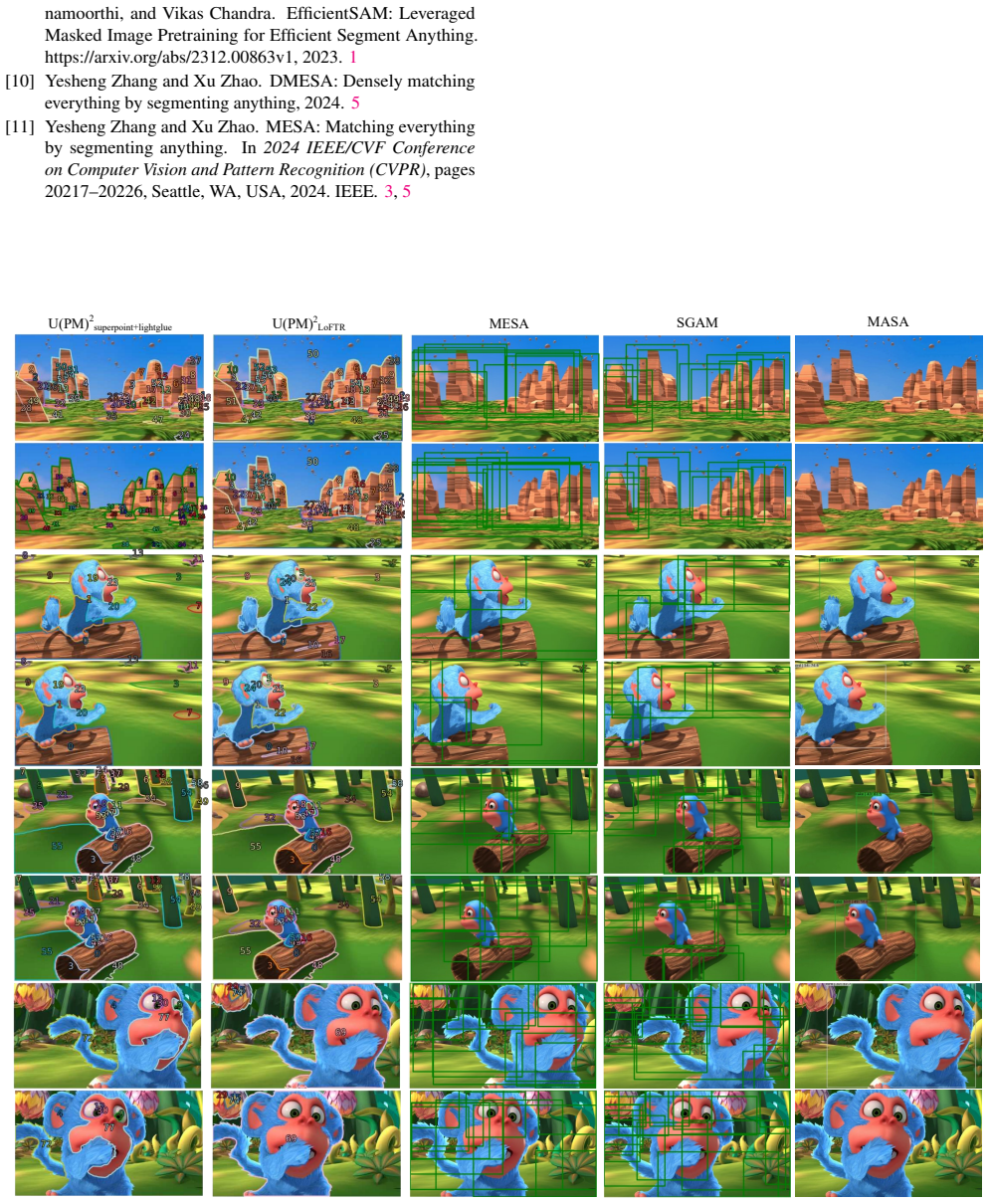
Y unyang Xiong, Bala V aradarajan, Lemeng Wu, Xi- aoyu Xiang, Fanyi Xiao, Chenchen Zhu, Xiaoliang Dai, Dilin Wang, Fei Sun, Forrest Iandola, Raghuraman Krish- U(PM) 2 superpoint+lightglue MESA SGAMU(PM) 2 LoFTR U(PM) 2 superpoint+lightglue MESA SGAMU(PM) 2 LoFTR MASA U(PM) 2 superpoint+lightglue MESA SGAMU(PM) 2 LoFTR MASA Figure 1. Qualitative results on...
arXiv 2023
Show all 10 references
-
[10]
DMESA: Densely matching everything by segmenting anything, 2024
Y esheng Zhang and Xu Zhao. DMESA: Densely matching everything by segmenting anything, 2024. 5
2024
-
[11]
MESA: Matching everything by segmenting anything
Y esheng Zhang and Xu Zhao. MESA: Matching everything by segmenting anything. In 2024 IEEE/CVF Conference on Computer Vision and Pattern Recognition (CVPR) , pages 20217–20226, Seattle, W A, USA, 2024. IEEE. 3, 5 U(PM) 2 superpoint+lightglue MESA SGAMU(PM) 2 LoFTR MASA Figure ...
2024
Reviewed August 3, 2026 · model on record in the stance chip above.
Discussion (0). Sign in to comment.