REVIEW 4 major objections 6 minor 9 references
PPO-HSC: An Exploratory Reinforcement Learning Framework Based on Wide-Area Policy Coverage Optimization
T0 review · 4 major / 6 minor · reviewed 2026-08-02 · deepseek-v4-flash
Pith's one-line read PPO-HSC rewards novel but correct solutions, broadening LLM reasoning without sacrificing accuracy or syntax.
desk verdict The KL-sign objection is a red herring — the term is a standard KL penalty — but the paper has a real reproducibility problem: Algorithm 1 contradicts the library-update rules in §3.2, and the experimental support is thin. read the letter →
The pith
A machine-rendered reading of the paper's core claim, the machinery that carries it, and where it could break.
The reading
What carries the argument
The HSC reward is the engine: a dynamic trajectory library with greedy diversity eviction supplies the reference set; min-neighbor distance (cosine or Levenshtein) measures novelty; tanh bounds the novelty bonus; a token-level KL divergence relative to the base/reference model acts as a plausibility guard; and an indicator on R_obj=1 gates the whole bonus behind correctness. Together these terms turn 'be different' into 'be different and correct'.
What would settle it
Train PPO-HSC with the KL term set to zero (or with the sign flipped) on the SVAMP code task and measure Syntax@5 and Pass@5. If syntax stays at 1.000 and Pass@5 still improves, the plausibility constraint is not what preserves syntax; if gibberish appears, the sign issue is confirmed.
Extended reading notes
Core claim
The paper's central claim is that mode collapse in reinforcement learning from verifiable rewards can be mitigated by gating exploration behind correctness. A dynamic trajectory library D stores verified unique solutions; a correct trajectory receives an intrinsic bonus tanh(d_min/sigma) based on its minimum distance to the library, plus a KL-based plausibility term relative to a frozen reference model. The total reward is R_obj + alpha * 1[R_obj=1] * (tanh(d_min/sigma) + beta * P_KL(τ)), so only correct solutions receive diversity pressure. The authors report that this beats PPO-only baselines on pass@5 and self-consistency while preserving syntax.
Load-bearing premise
The framework assumes P_KL(τ) = -Σ_t log(π_θ(a_t|s_t)/π_ref(a_t|s_t)) acts as a plausibility constraint that keeps outputs syntactically valid; with this sign, it instead rewards tokens the current policy finds less likely than the reference, so the syntax claim rests on this equation behaving as described.
Editorial extensions
If this is right
- If correct, RLVR fine-tuning can be steered toward multiple valid reasoning chains rather than a single collapsed mode.
- The gating mechanism provides a reusable template for adding novelty bonuses to other sparse-reward LLM tasks.
- The diversity-greedy library offers a bounded-memory way to track solution coverage during training.
- The reported results suggest that solution diversity and syntax integrity need not be in strong tension.
Reading between the lines
- The plausibility term as written, P_KL(τ) = -Σ_t log(π_θ(a_t|s_t)/π_ref(a_t|s_t)), is positive when the current policy assigns lower probability than the reference, so it rewards low-confidence token choices; if this sign is not a typo, the claimed syntax protection is not obviously doing what the text says.
- A clean ablation that sets beta=0 (or flips the sign of P_KL) on the SVAMP code task would reveal whether syntax integrity comes from the KL constraint or from the fact that only verified correct trajectories are rewarded.
- The same novelty-minus-similarity scheme could be carried to open-ended generation where correctness is learned rather than binary, provided a reliable verifier exists.
- The diversity gains are reported mainly through pass@5; counting exact duplicate generations would sharpen what the semantic distance metric actually buys.
Editorial analysis
A structured set of objections, weighed in public.
Referee Report
Summary. The paper proposes PPO-HSC, a modification of PPO-based RLVR in which a gated reward term is added to verified-correct trajectories. The extra reward combines a novelty bonus based on the minimum distance between the current trajectory and a dynamic library of previously verified correct trajectories, together with a token-level KL term against a frozen reference model, intended as a plausibility constraint. Experiments on GSM8K and SVAMP, including code-generation variants, compare PPO-HSC with a base model and a standard PPO-only RLVR baseline, reporting Pass@5, SC@5, and Syntax@5 metrics. The central claim is that PPO-HSC significantly improves solution diversity and state-space coverage while maintaining or improving accuracy and syntax integrity.
Significance. If properly validated, the idea would be a useful contribution: it directly targets mode collapse in RLVR, a recognized problem, and it connects quality-diversity / novelty-search ideas to gradient-based LLM fine-tuning. The gating of the exploration bonus behind the verification reward is a clean design choice, and the paper is readable enough that the intended mechanism is largely understandable. The manuscript also ships a pseudocode description and a code URL, which is helpful for reproducibility. However, in its current form the central claim is not supported by the evidence: the experiments are too thin, the evaluation protocol is biased or at least unclear, and the core library mechanism is specified inconsistently between text and pseudocode. The approach may be salvageable, but substantial additional work is needed.
major comments (4)
- [§3.2 vs. Algorithm 1] The library update rule is internally inconsistent. Section 3.2 states that a trajectory is admitted only if R_obj=1 and it is not already contained at the semantic/symbolic level, and that when |D_t| >= Nmax a diversity-greedy eviction is used. Algorithm 1 (lines 7–15), however, unconditionally executes D_k ← D_{k-1} ∪ {τ} for every correct trajectory, with no deduplication, no capacity bound, and no eviction. If the implementation follows Algorithm 1, the library becomes an unbounded bag of all correct samples, duplicates accumulate, d_min(τ,D) collapses, and the novelty signal degenerates. If the implementation follows §3.2, the published pseudocode does not describe the actual algorithm. Either way, the central mechanism is not well specified. Please reconcile the description and pseudocode, and state which update rule was used in the experiments.
- [§4.2, Table 1] The empirical evidence does not support the claim that PPO-HSC 'significantly enhances' diversity or coverage. The table reports a single number per metric, with no error bars, no multiple seeds, and no statistical tests. The footnote states that PPO-HSC is reported at the best-performing checkpoint, but it is unclear whether the Base and PPO-only baselines are also selected at their best checkpoints. If not, the comparison is biased. The raw deltas are small (e.g., GSM8K Pass@5 0.405 vs. 0.395; SVAMP Pass@5 0.685 vs. 0.665), and on GSM8K Pass@1 PPO-HSC is lower than the Base model (0.280 vs. 0.300). Moreover, the abstract claims superiority over 'state-of-the-art RL baselines,' but the only RL baseline is a standard PPO-only variant. Please provide means and standard deviations over multiple seeds, a fixed checkpoint-selection rule, and additional strong baselines, or temper the claims
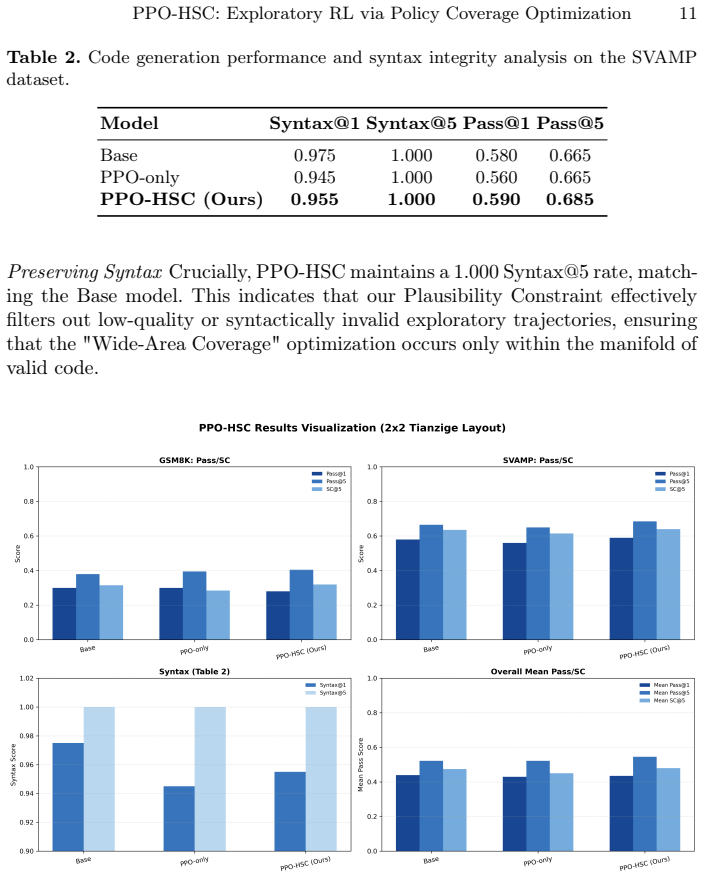
- [§4.3, Table 2] The syntax-stability claim is not demonstrated. Table 2 shows Syntax@5 = 1.000 for all models, including the Base and PPO-only models, so there is no observed degradation for PPO-HSC to 'preserve.' The statement that 'our Plausibility Constraint effectively filters out low-quality trajectories' is therefore unsupported without an ablation that removes the KL term. In addition, the 'Unique Code Ratio' is mentioned as approximately 0.333 but is never defined or tabulated, and the code-generation experiment is only reported for SVAMP even though the setup says the same datasets are processed through a code-execution verifier. Please define the metrics, report the full results, and include an ablation of α, β, and the KL term.
- [§3.3, Eq. (4) and Algorithm 1 line 9] The KL term is described as a 'constraint,' but it is a soft reward term, and its expected effect should be clarified. Maximizing +β·P_KL with P_KL = -Σ log(πθ/πref) is equivalent to maximizing -βΣ log(πθ/πref), whose expectation under πθ is -β·KL(πθ||πref); in expectation this is a standard KL penalty, so the sign is not inherently wrong. However, P_KL is written with πθ, which changes inside the PPO update loop. A reward should be a scalar fixed at sampling time, so it should be computed with the behavior policy π_old (or the reference should state that the reward is re-evaluated after each gradient step, which would be unusual). Please specify exactly which policy distribution is used in the reward computation.
minor comments (6)
- [Throughout] Key metrics are used without definitions: Pass@5, SC@5, Syntax@1, Syntax@5, and Unique Code Ratio. Please define them precisely, including whether they are computed by sampling k times per prompt at evaluation or by a different procedure.
- [Algorithm 1] The hyperparameter list includes k (samples per prompt) and Nmax, but k is never used in the pseudocode and Nmax is only mentioned in §3.2, not in the algorithm. Either use them in the pseudocode or remove them from the requirements.
- [§3.3] The section heading says 'High-k Sampling Coverage Reward,' while the paper elsewhere uses 'High-order Sampling Coverage.' The terminology should be consistent.
- [§4] Implementation details are sparse: values for α, β, σ, LoRA rank, learning rate, batch size, and number of PPO update steps are not given. Without these, the experiments are not reproducible. Please provide a full hyperparameter table in an appendix.
- [Figures] Figure 3 is not referenced in the text, and its caption ('tianzige-style visualization') is not informative for a scientific figure. Either reference and explain it, or remove it.
- [References] Reference [6] is an unusual citation for entropy regularization in LLM RL; consider citing a more standard recent treatment. Also, there are several typographical spacing issues throughout the text (e.g., 'T able').
Circularity Check
No significant circularity: the HSC reward is a standard novelty-search objective, and the reported diversity gains are assessed with independent set-level metrics rather than by construction.
full rationale
The paper's central derivation is self-contained. The HSC reward R_HSC = tanh(d_min/σ) + β·P_KL (Eq. 5–6) is computed against a dynamically maintained library of verified correct trajectories, and the library is populated by the policy's own correct samples. This is a standard co-evolving novelty-search mechanism, not a hidden fit: the reward and the library influence each other, but no prediction is defined in terms of the reward itself. The empirical claims of improved diversity are supported by Pass@5, SC@5, and unique-code-ratio metrics, which are set-level measures distinct from the per-trajectory d_min objective. Although the novelty objective and diversity metrics are related, the improvement is not logically forced—rewarding novelty could in principle reduce accuracy or Pass@5, so the positive results carry empirical content. The KL term, despite its labeling, acts as a penalty in expectation (maximizing E[+β·P_KL] is equivalent to minimizing β·KL(πθ||πref)), so it does not secretly reward gibberish. There are no self-citations; all references are external prior work. The main weaknesses are specification/reproducibility issues—e.g., d_min is undefined for an empty library in Algorithm 1, and Algorithm 1's unconditional library update conflicts with Section 3.2's deduplication and eviction rules—but these are correctness/consistency concerns, not circularity. The paper is self-contained against external benchmarks, and no load-bearing step reduces to its own inputs.
Assumptions & free parameters
free parameters (5)
- alpha (HSC reward weight)
- beta (KL penalty weight)
- sigma (novelty temperature)
- k (samples per prompt) =
5
- Nmax (library capacity)
assumptions (5)
- standard math LLM generation is modeled as an MDP with token-level actions.
- domain assumption The objective verifier R_obj returns correct binary reward for solution validity.
- domain assumption Average-pooled base-model embeddings provide a valid similarity metric for reasoning trajectories.
- domain assumption The term P_KL as defined constrains the policy to plausible language.
- domain assumption Gating HSC behind R_obj=1 prevents invalid exploration.
Cite this review
Pith. "Pith review of PPO-HSC: An Exploratory Reinforcement Learning Framework Based on Wide-Area Policy Coverage Optimization." pith.science (2026). https://pith.science/paper/MALOSAX6
@misc{pith2026260716206,
  author       = {Pith},
  title        = {Pith review of: PPO-HSC: An Exploratory Reinforcement Learning Framework Based on Wide-Area Policy Coverage Optimization},
  year         = {2026},
  howpublished = {\url{https://pith.science/paper/MALOSAX6}},
  note         = {Machine review of arXiv:2607.16206}
}
read the original abstract
This paper introduces PPO-HSC (Proximal Policy Optimization with High-order Sampling Coverage), an exploratory reinforcement learning framework designed to address the "Invisible Shackles" of mode collapse in Large Language Model (LLM) fine-tuning. While standard Reinforcement Learning from Verifiable Rewards (RLVR) effectively reinforces high-reward trajectories, it often leads models to over-optimize known solutions, sacrificing curiosity and the ability to explore broader solution manifolds. To overcome this, PPO-HSC incorporates a High-order Sampling Coverage (HSC) reward that incentivizes the discovery of "low-similarity yet high-validity" reasoning patterns. By maintaining a dynamic trajectory library of verified unique solutions, the framework provides a differentiable signal that rewards semantic novelty while ensuring structural rationality through a plausibility constraint. Empirical evaluations on mathematical reasoning (GSM8K, SVAMP) and code generation tasks demonstrate that PPO-HSC significantly enhances solution diversity and state-space coverage while maintaining or surpassing the accuracy and syntax integrity of state-of-the-art RL baselines.
Figures


Reference graph
Works this paper leans on
-
[1]
Schulman, J., et al.: Proximal Policy Optimization Algorithms. arXiv:1707.06347 (2017)
arXiv 2017
-
[2]
Advances in Neural Information Processing Systems, 36 (2023) PPO-HSC: Exploratory RL via Policy Coverage Optimization 13
Rafailov, R., et al.: Direct Preference Optimization: Your Language Model is Se- cretly a Reward Model. Advances in Neural Information Processing Systems, 36 (2023) PPO-HSC: Exploratory RL via Policy Coverage Optimization 13
2023
-
[3]
Wen, X., et al.: Reinforcement Learning with Verifiable Rewards Implicitly Incen- tivizes Correct Reasoning in Base LLMs. arXiv:2506.14245 (2025)
arXiv 2025
-
[4]
Advances in Neural Information Processing Systems, 29 (2016)
Bellemare, M., et al.: Unifying Count-Based Exploration and Intrinsic Motivation. Advances in Neural Information Processing Systems, 29 (2016)
2016
-
[5]
In: International Conference on Machine Learning, pp
Pathak, D., et al.: Curiosity-Driven Exploration by Self-Supervised Prediction. In: International Conference on Machine Learning, pp. 2771-2780. PMLR (2017)
2017
-
[6]
Connection Science, 3(3), 241-268 (1991)
Williams,R.J.,Peng,J.:FunctionOptimizationUsingConnectionistReinforcement Learning Algorithms. Connection Science, 3(3), 241-268 (1991)
1991
-
[7]
Frontiers in Robotics and AI, 3, 40 (2016)
Pugh,J.K.,etal.:QualityDiversity:ANewFrontierforEvolutionaryComputation. Frontiers in Robotics and AI, 3, 40 (2016)
2016
-
[8]
O.: Abandoning Objectives: Evolution Through the Search for Novelty Alone
Lehman, J., Stanley, K. O.: Abandoning Objectives: Evolution Through the Search for Novelty Alone. Evolutionary Computation, 19(2), 189-223 (2011)
2011
Show all 9 references
-
[9]
B., Clune, J.: Illuminating Search Spaces by Mapping Elites
Mouret, J. B., Clune, J.: Illuminating Search Spaces by Mapping Elites. arXiv:1504.04909 (2015)
2015 arXiv
Reviewed August 2, 2026 · model on record in the stance chip above.
Discussion (0). Continue with ORCID to comment.