REVIEW 2 major objections 4 minor 61 references
On the Energy and Data Storage Management in Energy Harvesting Wireless Communications
T0 review · 2 major / 4 minor · reviewed 2026-08-14 · deepseek-v4-flash
Pith's one-line read This paper derives the maximum constant data arrival rate for an energy-harvesting wireless transmitter as $-\frac{1}{N\theta}\ln(\chi^\ast)$, with $\chi^\ast$ the unique positive root of a polynomial built from the battery-state Markov…
desk verdict The overflow analysis is fine, but the main effective capacity result rests on a battery-state Markov assumption that doesn't hold; worth refereeing, not worth accepting as is. read the letter →
The pith
A machine-rendered reading of the paper's core claim, the machinery that carries it, and where it could break.
The reading
What carries the argument
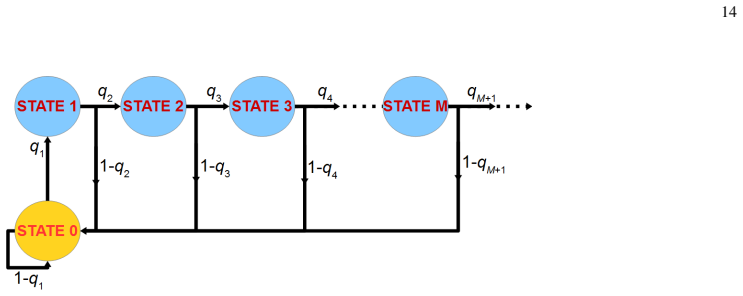
The central object is the battery-state Markov chain $\mathcal{W}=\{0,1,\dots\}$, in which state $m$ means $m$ consecutive frames have passed since the last energy outage and the transition probability $q_m$ is the probability that the battery satisfies the energy demand for the $m$-th straight frame. The load-bearing identity is the Markov-modulated spectral-radius formula, $\Lambda(\theta)/\theta = \frac{1}{\theta}\ln \operatorname{sp}\{M\Phi(\theta)\}$, applied to the data service process, with $M$ the battery-chain transition matrix and $\Phi(\theta)$ the diagonal matrix of per-state service moment generating functions $\varphi_0,\varphi_1,\dots$. Because $M\Phi(-\theta)$ is a Leslie matrix, its characteristic polynomial $z(\chi)$ has a unique positive root $\chi^\ast$, and the effective capacity is $-\ln(\chi^\ast)/(N\theta)$. This machinery collapses a two-queue energy-and-data system into a one-dimensional spectral computation.
What would settle it
Simulate the exact two-queue recursion with a finite battery, i.i.d. Weibull energy arrivals with shape $k=5$ and scale chosen so the average energy arrival is below the constant demand, Rayleigh fading, and a fixed transmission-rate policy; estimate the data-buffer overflow probability versus buffer threshold, fit its exponential decay rate, and compare the implied QoS exponent with the $\theta$ obtained from the unique positive root of $z(\chi)$ in (27). If the two disagree whenever outage histories leave different pre-outage energy levels, most visibly for small batteries, the Markov-modulated spectral-radius formula fails.
Extended reading notes
Core claim
The paper claims that, for a point-to-point energy-harvesting link with a battery and a data buffer, the effective capacity under a data QoS exponent $\theta$ and an energy decay rate $\mu$ is $C_E(\theta,\mu) = -\frac{1}{N\theta}\ln(\chi^\ast)$, where $\chi^\ast$ is the unique real positive root of the polynomial $z(\chi)$ in (27). That polynomial is assembled from the transition probabilities $q_n$ of a Markov chain whose state counts the number of frames since the last energy outage, and from per-state moment generating functions $\varphi_0$ and $\varphi_j$ of the service process, which describe data served during outages and during stretches of successful energy supply. The derivation models the service process as Markov-modulated and uses the spectral-radius formula for its asymptotic log-moment generating function; the Leslie-matrix form of the resulting matrix guarantees a unique positive root. The paper presents this root as determining the maximum constant data arrival rate that the data buffer can support while keeping its overflow probability near $\exp(-\theta d_{\mathrm{th}})$.
Load-bearing premise
The whole calculation depends on assuming that the data service distribution is fixed by the battery's current state alone, even though after an outage the energy available to serve data can vary with how the battery reached that state.
Editorial extensions
If this is right
- A designer can compute the maximum sustainable data arrival rate directly from the energy arrival statistics, the constant energy demand rate, and the QoS exponent, without running a full battery-and-buffer simulation.
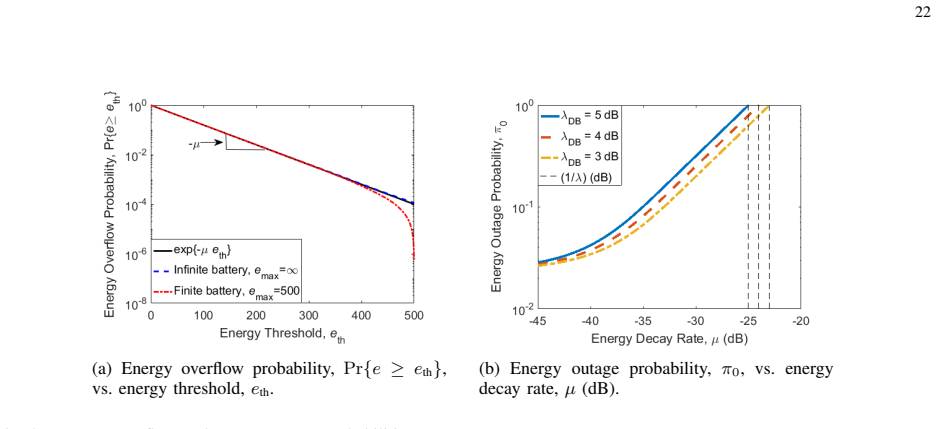
- The energy decay rate $\mu$ becomes a tunable design parameter: smaller $\mu$ lowers energy outage probability while raising overflow probability, and the effective capacity formula locates the best operating point.
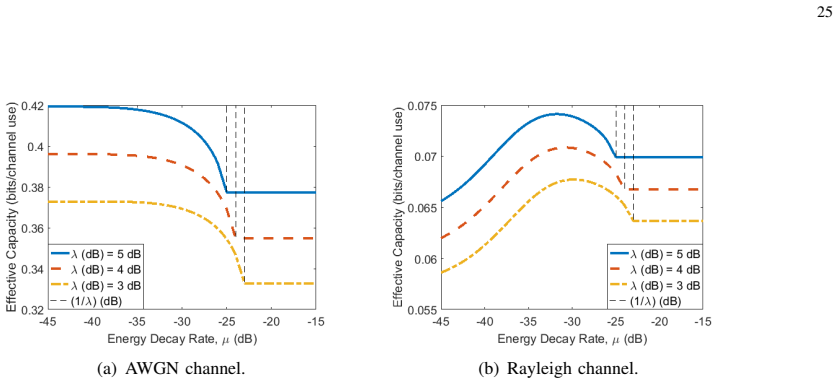
- In an AWGN channel the effective capacity is largest when $\mu$ is as small as possible, whereas in Rayleigh fading there is an interior optimum, because transmission outages and energy outages push in opposite directions.
- Truncating the Leslie matrix to $\alpha$ states gives an upper bound on effective capacity that tightens as $\alpha$ grows, yielding a finite computable approximation to the infinite-state formula.
Reading between the lines
- If the formula is right, the same Markov-modulated spectral-radius machinery should extend to adaptive transmission policies that react to instantaneous channel state, provided the per-state moment generating functions average over both energy and fading; the paper only treats a fixed transmission rate.
- The exponential overflow approximation suggests an explicit Pareto frontier between the probability of wasting energy and the probability of running dry, parameterized by $\mu$; the paper demonstrates the tradeoff numerically but does not write it as a closed-form curve.
- A natural stress test is to replace the constant energy demand with a battery-state-dependent threshold policy and check whether the effective capacity still equals the spectral radius of a Leslie-like matrix; if the service distribution during outages depends on pre-outage energy, the polynomial in (27) may need conditioning on that history.
Signed reviews
Editorial analysis
A structured set of objections, weighed in public.
Referee Report
Summary. The paper studies an energy-harvesting (EH) transmitter with a battery and a data buffer. It develops three main results: an exponential approximation for the energy overflow probability characterized by an energy decay rate µ; a Markov-chain model for energy outages based on the number of consecutive successful energy-supply frames, together with an outage-probability expression; and throughput analysis consisting of an average data service rate and an effective-capacity formula. The advertised central contribution is Theorem 1, which expresses the effective capacity as CE(θ,µ) = −1/(Nθ) ln(χ*), where χ* is the unique positive root of the characteristic function z(χ) in Eq. (27), obtained by applying the Markov-modulated spectral-radius formula from [36, Example 7.2.7] to a Leslie-type matrix.
Significance. If Theorem 1 were valid, the paper would provide a useful design tool connecting battery management (energy overflow and outage constraints) with QoS-constrained throughput in EH systems. The overflow approximation and the outage Markov-chain construction are simple and potentially useful, and the average service rate expression in Eq. (21) is derived transparently from the model. Numerical results for the overflow and outage probabilities and for the average service rate are also provided. However, the central effective-capacity result is not supported, because the service process does not satisfy the state-homogeneous Markov-modulation condition required by the cited spectral-radius formula. The paper's main advertised contribution is therefore not established, and its significance is correspondingly reduced.
major comments (2)
- [Appendix C / Theorem 1 (Eqs. (26)–(30))] The application of [36, Example 7.2.7] is not justified. In the model, when the battery enters state 0 at time i, the service is s(i) = g(ξ(i)) (when the channel supports transmission), where ξ(i) = e(i−1) + u(i) includes the residual energy accumulated during the preceding run of successful frames. The distribution of ξ(i) therefore depends on the length m of that run, i.e., on the previous state W(i−1) = m, not only on the current state W(i) = 0. The paper's φ0(θ) in Eq. (28) is an average over m, and replacing every transition into state 0 by this common average in the matrix M Φ(−θ) does not produce the correct Markov additive kernel A_{m0}(θ) = (1 − q_{m+1}) E[e^{θs(i)} | W(i−1)=m, W(i)=0]. The spectral radius of M Φ(−θ) need not equal the asymptotic log-moment generating function of the cumulative service process S(t). Consequently, the effective-capacity expression in Eq. (26) is unsupported; the proof must either derive the transition-dependent spectral radius or prove that the averaged φ0 yields the same spectral radius, which is not done.
- [Section V-C / Figs. 5 and 6] The effective-capacity curves in Figs. 5 and 6 are computed from the very formula in Theorem 1 that is in question, and no independent simulation of the actual EH system is provided to validate Eqs. (26)–(29). Given the concern in the previous major comment, these figures cannot serve as confirmation of the result. The authors should simulate the EH transmitter with a finite data buffer, measure the empirical buffer overflow decay rate or the maximum sustainable constant arrival rate, and compare those data with the theoretical CE(θ,µ).
minor comments (4)
- [Definition 1 and footnote 3] The paper discusses two different stability regimes: E[u] < E[p] is used for the overflow analysis, while E[u] > E[p] is mentioned for avoiding battery depletion. The text should state explicitly which stability condition is assumed for which result, since the outage Markov chain's positive recurrence and the expressions for π0 depend on this choice.
- [Eq. (12)] The upper bound on the outage probability relies on the monotonicity q1 ≤ q2 ≤ q3 ≤ ···, which is asserted via an inductive method but not proved. A short proof or a reference establishing this monotonicity for i.i.d. energy arrivals and demands would make the bound self-contained.
- [Eq. (38)] There is a typographical error in the display of φj(θ): an extraneous closing brace appears in E[exp(θr(i)1[r(i)≤I(i)]}|w(i)=j]. This should be corrected to E[exp(θr(i)1[r(i)≤I(i)])|w(i)=j].
- [Figure 5 caption] The caption refers to 'different data transmission delay constraints, i.e., θp', but the notation θp is not defined anywhere; the figure actually varies the QoS exponent θ. Please correct the caption and define the parameter consistently.
Circularity Check
No load-bearing circularity; the only self-citations are contextual and the effective-capacity theorem is a standard spectral-radius computation.
full rationale
Theorem 1 is not circular: it computes the effective capacity from the log-moment generating function of the service process via the Markov-modulated spectral-radius formula of [36, Example 7.2.7], with the state MGFs phi_0 and phi_j defined from the energy arrival/demand, battery state, and channel fading distributions (Eqs. (28)-(29)). No parameter is fitted to the quantity being predicted; theta and mu are design parameters, and the overflow/outage probabilities used in the state model are derived from the same energy processes rather than from the effective-capacity values. The exponential overflow approximation is validated against battery simulations, not used to fabricate a prediction. The self-citations [34], [35] appear only as context ('Apart from this paper, we invoke large deviation theory and queueing theory in [34], [35]...') and in a footnote; they do not supply a premise of Theorem 1, so they are not load-bearing. The skeptic's objection that the battery state W(i) is not truly Markov and that phi_0 depends on the previous state is a correctness risk about the applicability of [36, Example 7.2.7], not a circularity: the paper applies an external theorem rather than defining its conclusion into its assumptions. Hence the derivation is self-contained; the score reflects only minor, non-load-bearing self-citation.
Assumptions & free parameters
assumptions (7)
- domain assumption Energy arrival and demand processes are stationary, ergodic, have finite means and variances, and possess finite moment generating functions with differentiable limits.
- domain assumption Stability condition E[u] < E[p] ensures the infinite-size battery reaches a steady state with a decaying tail.
- domain assumption Energy arrival and demand processes are independent.
- domain assumption Consecutive energy arrivals and demands are independent and identically distributed (i.i.d.).
- domain assumption The battery is of infinite size for the overflow and outage analysis, approximating large finite batteries.
- domain assumption The transmitter is work-conserving and always has data to send.
- ad hoc to paper The service process is a Markov-modulated process whose per-state MGFs are independent of the previous state, so Chang's spectral radius formula applies.
Cite this review
Pith. "Pith review of On the Energy and Data Storage Management in Energy Harvesting Wireless Communications." pith.science (2026). https://pith.science/paper/MAV72NDI
@misc{pith2026190801726,
  author       = {Pith},
  title        = {Pith review of: On the Energy and Data Storage Management in Energy Harvesting Wireless Communications},
  year         = {2026},
  howpublished = {\url{https://pith.science/paper/MAV72NDI}},
  note         = {Machine review of arXiv:1908.01726}
}
read the original abstract
Energy harvesting (EH) in wireless communications has become the focus of recent transmission technology studies. Herein, energy storage modeling is one of the crucial design benchmarks that must be treated carefully. Understanding the energy storage dynamics and the throughput levels is essential especially for communication systems in which the performance depends solely on harvested energy. While energy outages should be avoided, energy overflows should also be prevented in order to utilize all harvested energy. Hence, a simple, yet comprehensive, analytical model that can represent the characteristics of a general class of EH wireless communication systems needs to be established. In this paper, invoking tools from large deviation theory along with Markov processes, a firm connection between the energy state of the battery and the data transmission process over a wireless channel is established for an EH transmitter. In particular, a simple exponential approximation for the energy overflow probability is formulated, with which the energy decay rate in the battery as a measure of energy usage is characterized. Then, projecting the energy outages and supplies on a Markov process, a discrete state model is established and an expression for the energy outage probability for given energy arrival and demand processes is provided. Finally, under energy overflow and outage constraints, the average data service (transmission) rate over the wireless channel is obtained and the effective capacity of the system, which characterizes the maximum data arrival rate at the transmitter buffer under quality-of-service (QoS) constraints imposed on the data buffer overflow probability, is derived.
Figures

Figures from the paper (3 more)


Reference graph
Works this paper leans on
-
[1]
Energy harvesting wireless communica- tions: A review of recent advances,
S. Ulukus, A. Yener, E. Erkip, O. Simeone, M. Zorzi, P. Grover, and K. Huang, “Energy harvesting wireless communica- tions: A review of recent advances,” IEEE J. Sel. Areas Commun. , vol. 33, no. 3, pp. 360–381, March 2015
work page 2015
-
[2]
Fundamental limits of energy harvesting communications,
O. Ozel, K. Tutuncuoglu, S. Ulukus, and A. Yener, “Fundamental limits of energy harvesting communications,” IEEE Commun. Mag., vol. 53, no. 4, pp. 126–132, April 2015
work page 2015
-
[3]
Designing intelligent energy harvesting communication systems,
D. Gunduz, K. Stamatiou, N. Michelusi, and M. Zorzi, “Designing intelligent energy harvesting communication systems,” IEEE Commun. Mag. , vol. 52, no. 1, pp. 210–216, January 2014
work page 2014
-
[4]
Power management in smac-based energy-harvesting wireless sensor networks using queuing analysis,
N. Tadayon, S. Khoshroo, E. Askari, H. Wang, and H. Michel, “Power management in smac-based energy-harvesting wireless sensor networks using queuing analysis,” Elsevier J. Netw. Comput. Applicat. , vol. 36, no. 3, 2013
work page 2013
-
[5]
Measuring mobile phone energy consumption for 802.11 wireless networking,
A. Rice and S. Hay, “Measuring mobile phone energy consumption for 802.11 wireless networking,” Elsevier Pervasive Mobile Comput., vol. 6, no. 6, pp. 593–606, 2010
work page 2010
-
[6]
I. Ahmed, M. M. Butt, C. Psomas, A. Mohamed, I. Krikidis, and M. Guizani, “Survey on energy harvesting wireless communications: Challenges and opportunities for radio resource allocation,” Elsevier Computer Networks , vol. 88, 2015
work page 2015
-
[7]
Energy harvesting sensor nodes: Survey and implications,
S. Sudevalayam and P. Kulkarni, “Energy harvesting sensor nodes: Survey and implications,” IEEE Commun. Surveys Tuts., vol. 13, no. 3, pp. 443–461, 2011
work page 2011
-
[8]
Transmission with energy harvesting nodes in fading wireless channels: Optimal policies,
O. Ozel, K. Tutuncuoglu, J. Yang, S. Ulukus, and A. Yener, “Transmission with energy harvesting nodes in fading wireless channels: Optimal policies,” IEEE J. Sel. Areas Commun. , vol. 29, no. 8, pp. 1732–1743, September 2011
work page 2011
Show all 61 references
-
[9]
Optimal energy allocation for wireless communications with energy harvesting constraints,
C. K. Ho and R. Zhang, “Optimal energy allocation for wireless communications with energy harvesting constraints,” IEEE Trans. Signal Process. , vol. 60, no. 9, pp. 4808–4818, September 2012
2012
-
[10]
Optimal packet scheduling in an energy harvesting communication system,
J. Yang and S. Ulukus, “Optimal packet scheduling in an energy harvesting communication system,” IEEE Trans. Commun., vol. 60, no. 1, pp. 220–230, January 2012
2012
-
[11]
Optimum transmission policies for battery limited energy harvesting nodes,
K. Tutuncuoglu and A. Yener, “Optimum transmission policies for battery limited energy harvesting nodes,” IEEE Trans. Wireless Commun., vol. 11, no. 3, pp. 1180–1189, March 2012
2012
-
[12]
A general framework for the optimization of energy harvesting communication systems with battery imperfections,
B. Devillers and D. Gunduz, “A general framework for the optimization of energy harvesting communication systems with battery imperfections,” Commun. Netw., vol. 14, no. 2, pp. 130–139, April 2012
2012
-
[13]
Optimal packet scheduling on an energy harvesting broadcast link,
M. A. Antepli, E. Uysal-Biyikoglu, and H. Erkal, “Optimal packet scheduling on an energy harvesting broadcast link,” IEEE J. Sel. Areas Commun. , vol. 29, no. 8, pp. 1721–1731, September 2011
2011
-
[14]
Optimal scheduling for energy harvesting transmitters with hybrid energy storage,
O. Ozel, K. Shahzad, and S. Ulukus, “Optimal scheduling for energy harvesting transmitters with hybrid energy storage,” in IEEE Int. Symp. Inform. Theory (ISIT) , July 2013, pp. 1784–1788
2013
-
[15]
Delay optimal scheduling for energy harvesting based communications,
J. Liu, H. Dai, and W. Chen, “Delay optimal scheduling for energy harvesting based communications,” IEEE J. Sel. Areas Commun., vol. 33, no. 3, pp. 452–466, March 2015
2015
-
[16]
Optimal policies for wireless networks with energy harvesting transmitters and receivers: Effects of decoding costs,
A. Arafa and S. Ulukus, “Optimal policies for wireless networks with energy harvesting transmitters and receivers: Effects of decoding costs,” IEEE J. Sel. Areas Commun. , vol. 33, no. 12, pp. 2611–2625, December 2015. 31
2015
-
[17]
Energy harvesting two-way channels with decoding and processing costs,
A. Arafa, A. Baknina, and S. Ulukus, “Energy harvesting two-way channels with decoding and processing costs,” IEEE Transactions on Green Communications and Networking , vol. 1, no. 1, pp. 3–16, March 2017
2017
-
[18]
Power management in energy harvesting sensor networks,
A. Kansal, J. Hsu, S. Zahedi, and M. B. Srivastava, “Power management in energy harvesting sensor networks,” ACM Trans. Embed. Comput. Syst. , vol. 6, no. 4, September 2007
2007
-
[19]
Performance analysis of battery power management schemes in wireless mobile devices,
B. Prabhu, A. Chockalingam, and V . Sharma, “Performance analysis of battery power management schemes in wireless mobile devices,” in IEEE Wireless Commun. Netw. Conf. (WCNC) , vol. 2, March 2002, pp. 825–831
2002
-
[20]
Stochastic modelling of energy harvesting for low power sensor nodes,
E. De Cuypere, K. De Turck, and D. Fiems, “Stochastic modelling of energy harvesting for low power sensor nodes,” in Int. Conf. Queueing Theory Network Applicat. , 2012, pp. 1–6
2012
-
[21]
Performance aware tasking for environmentally powered sensor networks,
A. Kansal, D. Potter, and M. B. Srivastava, “Performance aware tasking for environmentally powered sensor networks,” SIGMETRICS Perform. Eval. Rev. , vol. 32, no. 1, pp. 223–234, Jun. 2004
2004
-
[22]
Basic performance limits and tradeoffs in energy-harvesting sensor nodes with finite data and energy storage,
R. Srivastava and C. E. Koksal, “Basic performance limits and tradeoffs in energy-harvesting sensor nodes with finite data and energy storage,” IEEE/ACM Trans. Netw., vol. 21, no. 4, pp. 1049–1062, 2013
2013
-
[23]
Data backlog analysis in energy harvesting communication systems,
R. Jia, J. Zhang, P. Liu, X.-Y . Liu, X. Gan, and X. Wang, “Data backlog analysis in energy harvesting communication systems,” IEEE Access, vol. 5, pp. 5702–5712, May 2017
2017
-
[24]
Energy packet networks with energy harvesting,
E. Gelenbe and E. T. Ceran, “Energy packet networks with energy harvesting,” IEEE Access, vol. 4, pp. 1321–1331, 2016
2016
-
[25]
Product-form solution for cascade networks with intermittent energy,
Y . M. Kadioglu and E. Gelenbe, “Product-form solution for cascade networks with intermittent energy,” IEEE Systems Journal, no. 99, pp. 1–10, 2018
2018
-
[26]
Resource allocation in swipt networks under a nonlinear energy harvesting model: Power efficiency, user fairness, and channel nonreciprocity,
H.-V . Tran, G. Kaddoum, and K. T. Truong, “Resource allocation in swipt networks under a nonlinear energy harvesting model: Power efficiency, user fairness, and channel nonreciprocity,” IEEE Transactions on Vehicular Technology, vol. 67, no. 9, pp. 8466–8480, 2018
2018
-
[27]
Massive mimo downlink for wireless information and energy transfer with energy harvesting receivers,
L. Zhao and X. Wang, “Massive mimo downlink for wireless information and energy transfer with energy harvesting receivers,” IEEE Transactions on Communications , vol. 67, no. 5, pp. 3309–3322, May 2019
2019
-
[28]
Swipt-enabled relaying in iot networks operating with finite blocklength codes,
Y . Hu, Y . Zhu, M. C. Gursoy, and A. Schmeink, “Swipt-enabled relaying in iot networks operating with finite blocklength codes,” IEEE Journal on Selected Areas in Communications , vol. 37, no. 1, pp. 74–88, 2018
2018
-
[29]
Robust design of ac computing-enabled receiver architecture for swipt networks,
H. Tran and G. Kaddoum, “Robust design of ac computing-enabled receiver architecture for swipt networks,” IEEE Wireless Communications Letters, pp. 1–1, 2019
2019
-
[30]
Wireless energy harvesting in cognitive massive mimo systems with underlay spectrum sharing,
H. Al-Hraishawi and G. A. Aruma Baduge, “Wireless energy harvesting in cognitive massive mimo systems with underlay spectrum sharing,” IEEE Wireless Communications Letters , vol. 6, no. 1, pp. 134–137, Feb 2017
2017
-
[31]
Joint channel resources allocation and beamforming in energy harvesting systems,
T.-D. Le, G. Kaddoum, and O.-S. Shin, “Joint channel resources allocation and beamforming in energy harvesting systems,” IEEE Wireless Communications Letters , vol. 7, no. 5, pp. 884–887, 2018
2018
-
[32]
Energy harvesting relay-antenna selection in cooperative mimo/noma network over rayleigh fading,
T. A. Le and H. Y . Kong, “Energy harvesting relay-antenna selection in cooperative mimo/noma network over rayleigh fading,” Wireless Networks, Jun 2019. [Online]. Available: https://doi.org/10.1007/s11276-019-02051-1
2019 doi
-
[33]
Joint battery-buffer sustainable guarantees in energy-harvesting enabled wireless networks,
H. Zhang, Q. Du, P. Ren, and L. Sun, “Joint battery-buffer sustainable guarantees in energy-harvesting enabled wireless networks,” in Global Communications Conference (GLOBECOM), 2015 IEEE . IEEE, 2015, pp. 1–6
2015
-
[34]
Energy harvesting communications under energy underflow constraints,
S. Akın, “Energy harvesting communications under energy underflow constraints,” IEEE Communications Letters, vol. 21, no. 12, pp. 2646–2649, 2017
2017
-
[35]
Energy management in wireless communications with energy storage imperfections,
——, “Energy management in wireless communications with energy storage imperfections,” in 2018 30th International Teletraffic Congress (ITC 30) , vol. 2. IEEE, 2018, pp. 13–18
2018
-
[36]
Chang, Performance Guarantees in Communication Networks
C.-S. Chang, Performance Guarantees in Communication Networks . Springer-Verlag, 2000
2000
-
[37]
Jiang and Y
Y . Jiang and Y . Liu, Stochastic network calculus . Springer, 2008
2008
-
[38]
Effective bandwidth and fast simulation of atm intree networks,
C.-S. Chang, P. Heidelberger, S. Juneja, and P. Shahabuddin, “Effective bandwidth and fast simulation of atm intree networks,” Elsevier Performance Evaluation, vol. 20, no. 1, pp. 45–65, 1994. 32
1994
-
[39]
Wireless sensor and communication nodes with energy harvesting,
M. Safak, “Wireless sensor and communication nodes with energy harvesting,” Journal of Communication, Navigation, Sensing and Services (CONASENSE) , vol. 1, no. 1, pp. 47–66, 2014
2014
-
[40]
http://data.energizer.com/pdfs/e92.pdf
“http://data.energizer.com/pdfs/e92.pdf.”
-
[41]
Effective bandwidths of departure processes from queues with time varying capacities,
C.-S. Chang and T. Zajic, “Effective bandwidths of departure processes from queues with time varying capacities,” in IEEE Conf. Comput. Commun. (INFOCOM) , 1995, pp. 1001–1009
1995
-
[42]
Capacity of fading gaussian channel with an energy harvesting sensor node,
R. Rajesh, V . Sharma, and P. Viswanath, “Capacity of fading gaussian channel with an energy harvesting sensor node,” in 2011 IEEE Global Telecommunications Conference-GLOBECOM 2011 . IEEE, 2011, pp. 1–6
2011
-
[43]
Performance analysis of relaying systems with fixed and energy harvesting batteries,
A. M. Siddiqui, L. Musavian, S. Aissa, and Q. Ni, “Performance analysis of relaying systems with fixed and energy harvesting batteries,” IEEE Transactions on Communications , vol. 66, no. 4, pp. 1386–1398, 2017
2017
-
[44]
T. M. Cover and J. A. Thomas, Elements of information theory . John Wiley & Sons, 2012
2012
-
[45]
Optimum power control over fading channels,
G. Caire, G. Taricco, and E. Biglieri, “Optimum power control over fading channels,” IEEE Trans. Inf. Theory , vol. 45, no. 5, pp. 1468–1489, May 1999
1999
-
[46]
Comparing network performance for constant and variable bit rate sources,
H. Pasch and I. G. Niemegeers, “Comparing network performance for constant and variable bit rate sources,” computer communications, vol. 16, no. 1, pp. 27–38, 1993
1993
-
[47]
Effective capacity: A wireless link model for support of quality of service,
D. Wu and R. Negi, “Effective capacity: A wireless link model for support of quality of service,” IEEE Trans. Wireless Commun., vol. 2, no. 4, pp. 630–643, July 2003
2003
-
[48]
Statistical analysis of wind resources at darling for energy production,
Z. O. Olaofe and K. A. Folly, “Statistical analysis of wind resources at darling for energy production,” Int. J. Renewable Energy Research (IJRER), vol. 2, no. 2, pp. 250–261, 2012
2012
-
[49]
Bu-706: Summary of dos and donts,
“Bu-706: Summary of dos and donts,” https://batteryuniversity.com/learn/article/do and dont battery table, accessed: 2019-06-15
2019
-
[50]
Why you should stop fully charging your smartphone now,
“Why you should stop fully charging your smartphone now,” https://www.ecnmag.com/blog/2015/11/why-you-should-stop- fully-charging-your-smartphone-now, accessed: 2019-06-15
2015
-
[51]
Quality-of-service driven power and rate adaptation over wireless links,
J. Tang and X. Zhang, “Quality-of-service driven power and rate adaptation over wireless links,” IEEE Trans. Wireless Commun., vol. 6, no. 8, pp. 3058–3068, August 2007
2007
-
[52]
Effective capacity of delay-constrained cognitive radio in nakagami fading channels,
L. Musavian and S. A ¨ıssa, “Effective capacity of delay-constrained cognitive radio in nakagami fading channels,” IEEE Transactions on Wireless Communications , vol. 9, no. 3, 2010
2010
-
[53]
Cognitive radio transmission under qos constraints and interference limitations,
S. Akın and M. C. Gursoy, “Cognitive radio transmission under qos constraints and interference limitations,” EURASIP J. Wireless Commun. Netw., vol. 2012, no. 1, September 2012
2012
-
[54]
Effective capacity for interference and delay constrained cognitive radio relay channels,
L. Musavian, S. A ¨ıssa, and S. Lambotharan, “Effective capacity for interference and delay constrained cognitive radio relay channels,” IEEE Trans. Wireless Commun. , vol. 9, no. 5, pp. 1698–1707, May 2010
2010
-
[55]
Effective capacity analysis of cognitive radio channels for quality of service provisioning,
S. Akın and M. C. Gursoy, “Effective capacity analysis of cognitive radio channels for quality of service provisioning,” IEEE Trans. Wireless Commun. , vol. 9, no. 11, pp. 3354–3364, November 2010
2010
-
[56]
Effective capacity optimization for cognitive radio network based on underlay scheme in gamma fading channels,
M. Elalem and L. Zhao, “Effective capacity optimization for cognitive radio network based on underlay scheme in gamma fading channels,” in Int. Conf. Comput. Netw. Commun. (ICNC) , January 2013, pp. 714–718
2013
-
[57]
Capacity with explicit delay guarantees for generic sources over correlated rayleigh channel,
B. Soret, M. C. Aguayo-Torres, and J. T. Entrambasaguas, “Capacity with explicit delay guarantees for generic sources over correlated rayleigh channel,” IEEE Transactions on Wireless Communications , vol. 9, no. 6, 2010
2010
-
[58]
Interchanging two limits,
Z. Kadelburg and M. Marjanovic, “Interchanging two limits,” Enseign. Math, vol. 8, pp. 15–29, 2005
2005
-
[59]
Notes on effective bandwidths. stochastic networks: Theory and applications, royal statistical society lecture notes series, vol. 4,
F. Kelly, “Notes on effective bandwidths. stochastic networks: Theory and applications, royal statistical society lecture notes series, vol. 4,” 1996
1996
-
[60]
Leslie matrix models,
P. E. Hansen, “Leslie matrix models,” Mathematical Population Studies, vol. 2, no. 1, pp. 37–67, 1989
1989
-
[61]
V . V . Prasolov, Polynomials. Springer Science & Business Media, 2009, vol. 11
2009
Reviewed August 14, 2026 · model on record in the stance chip above.
Discussion (0). Continue with ORCID to comment.