Forward Searches for Heavy Neutrinos and Z' Bosons at FCC-hh
Pith reviewed 2026-06-25 19:59 UTC · model grok-4.3
The pith
The proposed Forward Physics Facility at the FCC-hh can substantially extend the discovery reach for light long-lived heavy neutrinos and light Z' bosons.
A machine-rendered reading of the paper's core claim, the machinery that carries it, and where it could break.
Core claim
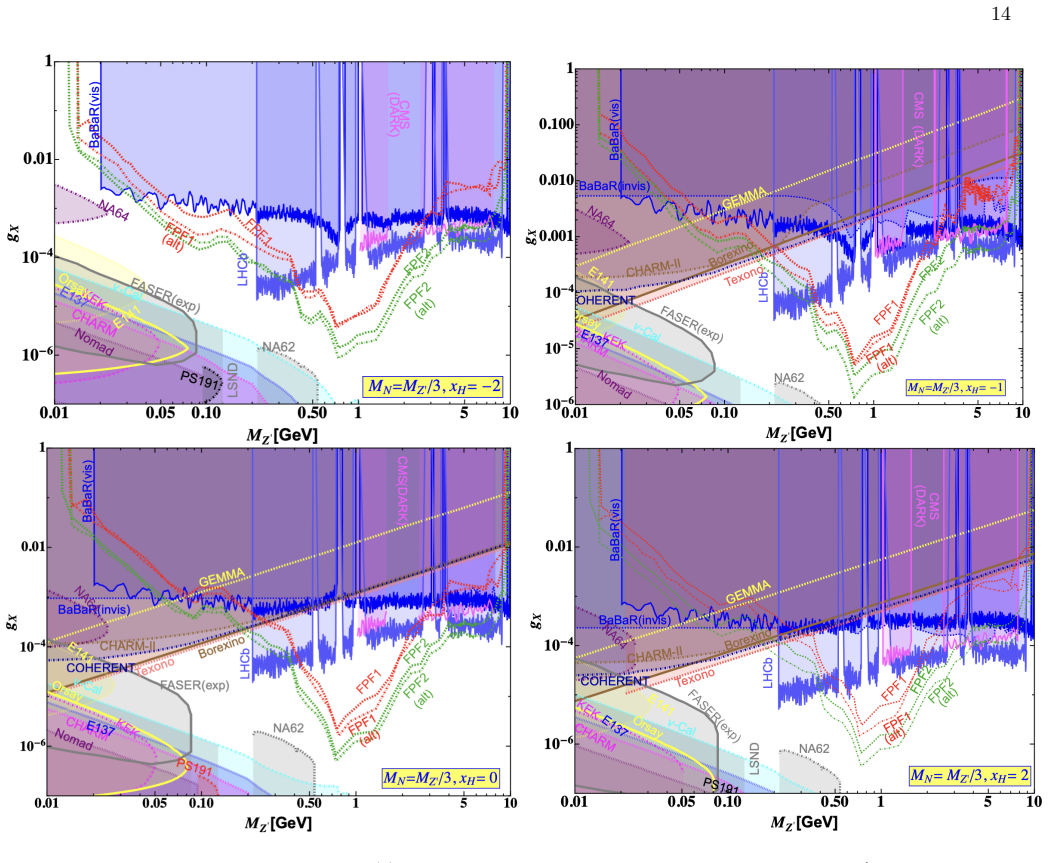
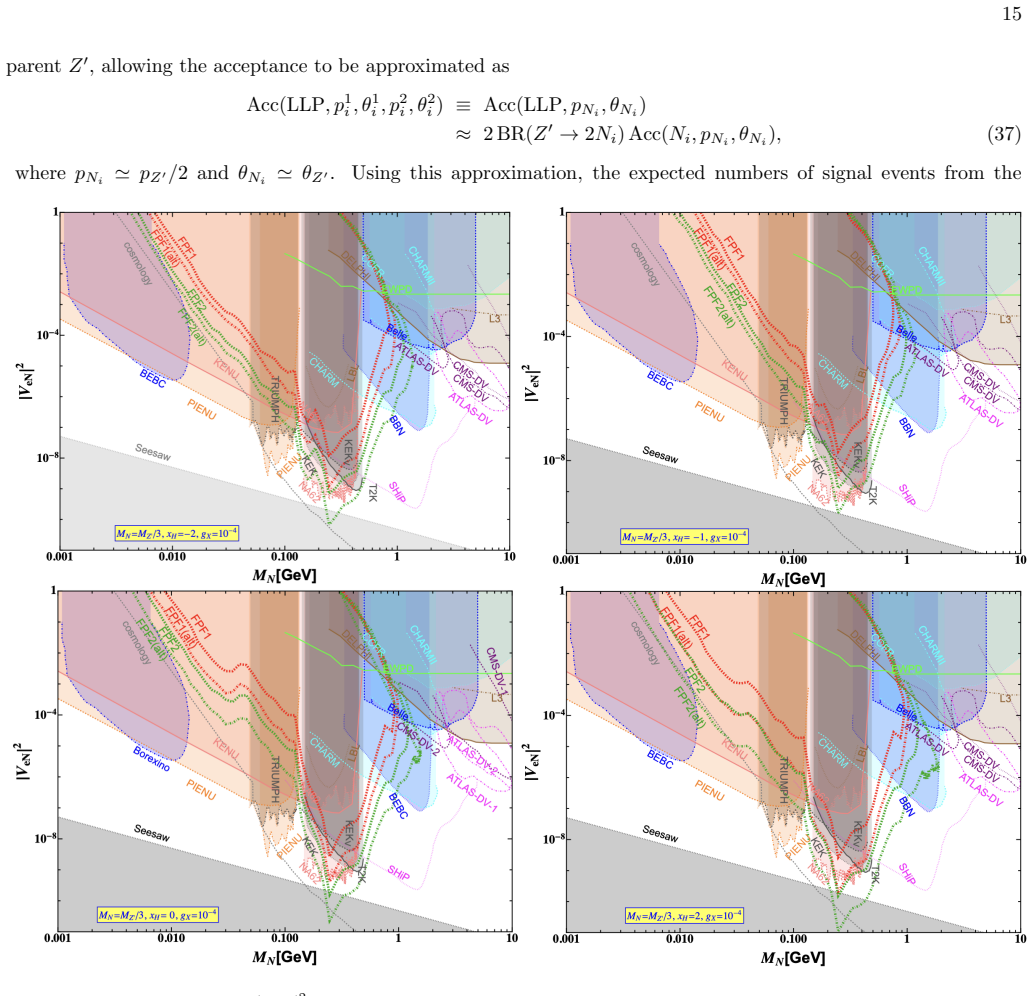
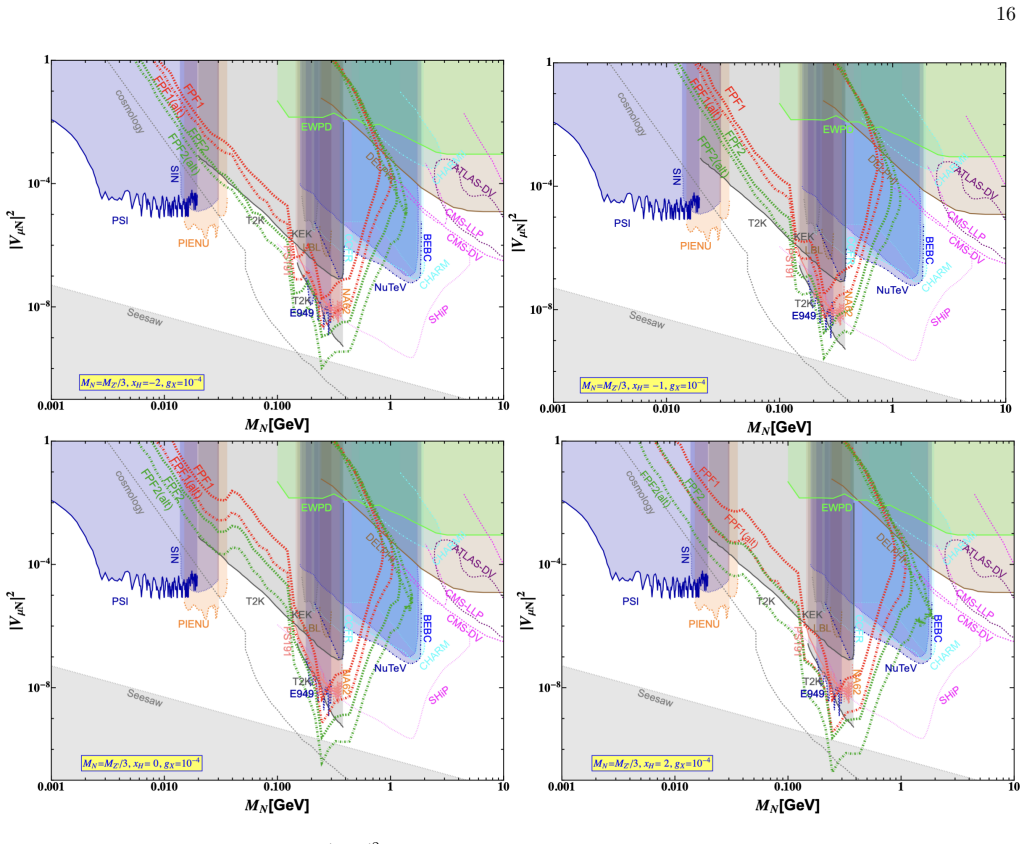
Within a class of anomaly-free chiral U(1) gauge extensions, the FPF at FCC-hh provides projected sensitivities to heavy neutrino mass and active-sterile mixing, as well as to Z' mass and gauge coupling, through analyses of long-lived heavy neutrinos from meson decays, visible decays of long-lived Z', Z' decaying to heavy neutrino pairs, and prompt Z' decays to long-lived heavy neutrinos, using realistic detector geometries and visible final states.
What carries the argument
Long-lived particle signatures arising from heavy neutrinos and Z' bosons produced in the far-forward region via meson decays and proton bremsstrahlung.
Load-bearing premise
The analysis assumes specific detector geometries, efficiencies, and background rejection capabilities at the FPF that are not yet built, along with the validity of the anomaly-free chiral U(1) models and seesaw mechanism.
What would settle it
If the constructed FPF detector achieves lower efficiencies or higher backgrounds than assumed in the projections, the claimed extension in discovery reach would not be realized.
Figures
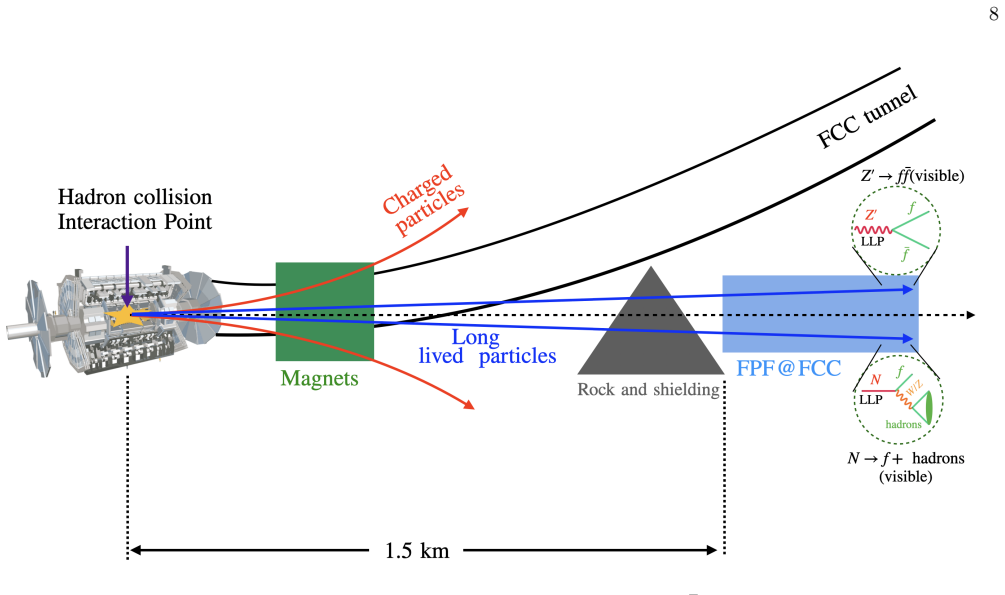
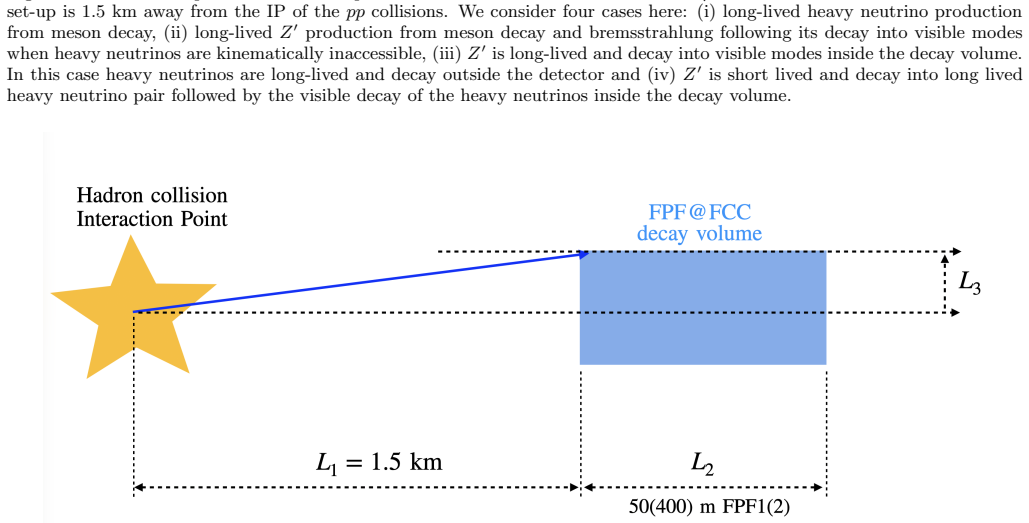
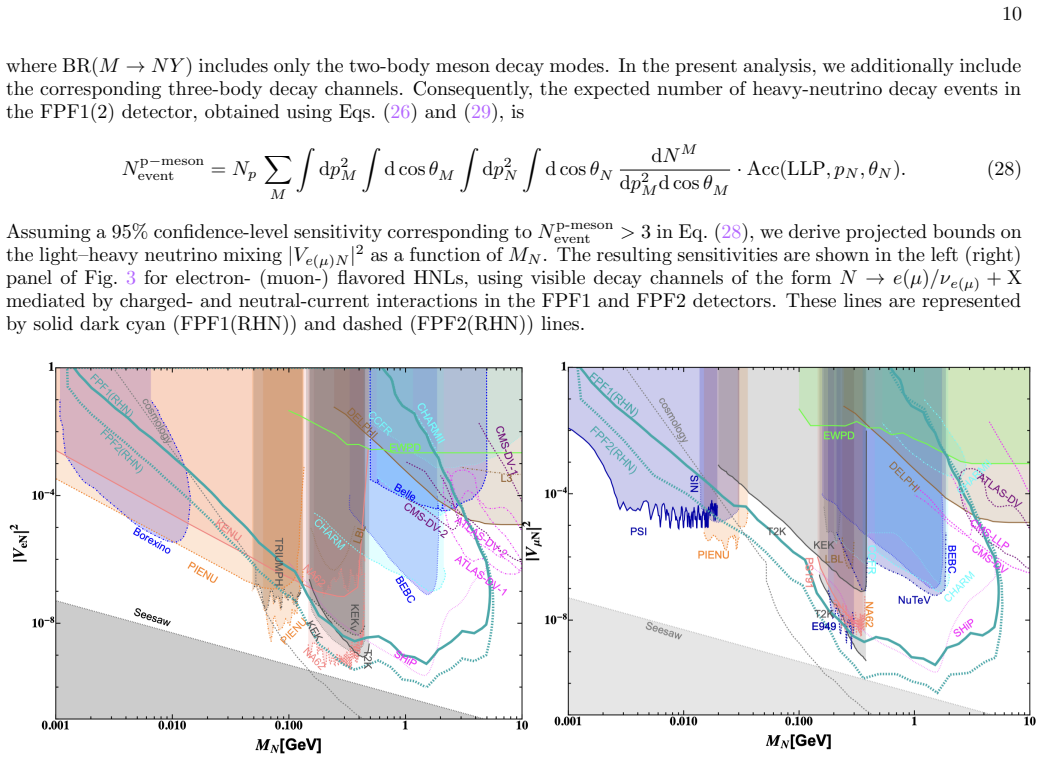
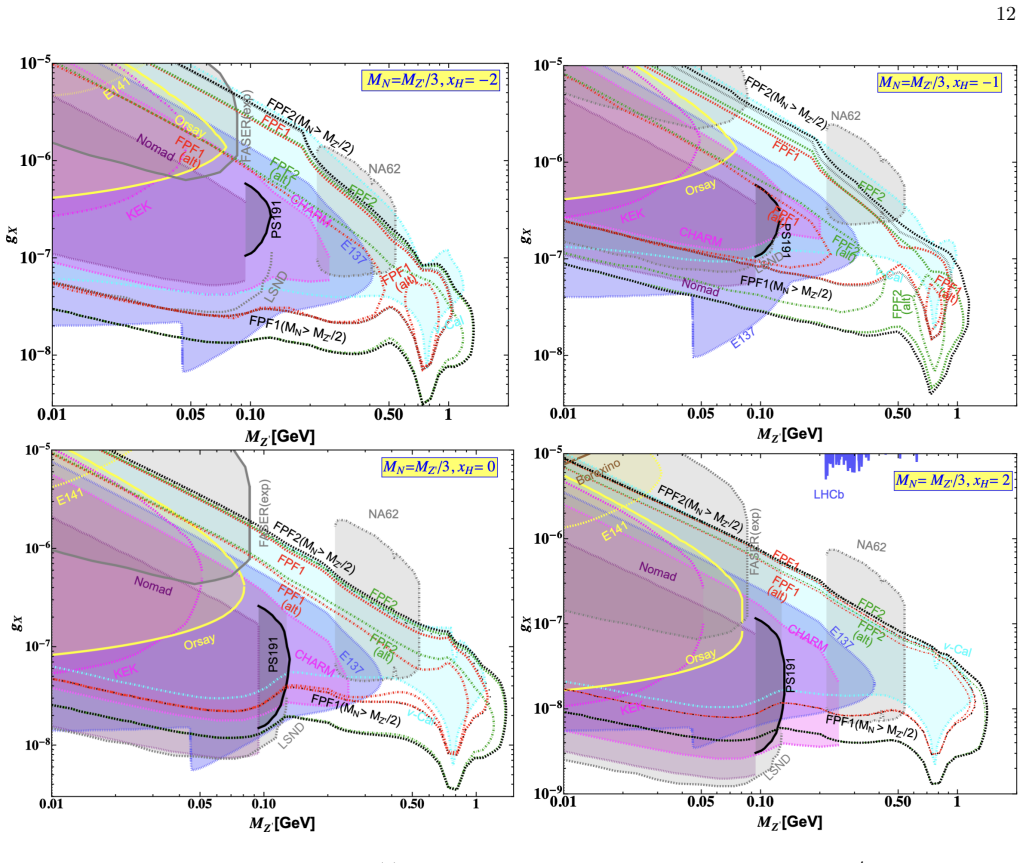
read the original abstract
The discovery of neutrino masses strongly motivates extensions of the Standard Model containing heavy neutral leptons and additional gauge interactions. We investigate the prospects for probing these states at the proposed Forward Physics Facility (FPF) of the 100 TeV Future Circular Collider (FCC-hh) within a broad class of anomaly-free chiral $U(1)$ gauge extensions. These models predict a new neutral gauge boson, $Z'$, together with right-handed neutrinos responsible for generating light neutrino masses through the seesaw mechanism. We study long-lived particle signatures arising from both heavy neutrinos and the $Z'$ boson produced in the far-forward region. In particular, we analyze heavy neutrino production from meson decays, visible decays of long-lived $Z'$ bosons produced through meson decays and proton bremsstrahlung, long-lived $Z'$ bosons decaying into heavy-neutrino pairs, and prompt $Z'$ decays yielding long-lived heavy neutrinos. The expected event rates are evaluated for the proposed FPF detector configurations, taking into account realistic detector geometry, decay probabilities, and visible final states. We derive projected sensitivities to the heavy neutrino mass and active-sterile mixing as well as to the $Z'$ mass and gauge coupling for several representative $U(1)$ charge assignments. Our results demonstrate that the FPF at FCC-hh can substantially extend the discovery reach for light long-lived heavy neutrinos and light $Z'$ bosons beyond existing and proposed experiments, providing a powerful and complementary probe of neutrino-mass models and hidden gauge sectors. https://github.com/SouvikPhD/RHN-Detection-with-FASER-2-
Editorial analysis
A structured set of objections, weighed in public.
Referee Report
Summary. The paper explores sensitivity projections for long-lived heavy neutral leptons (right-handed neutrinos) and Z' bosons at the proposed Forward Physics Facility (FPF) of the 100 TeV FCC-hh, within anomaly-free chiral U(1) gauge extensions of the Standard Model that incorporate the seesaw mechanism. It computes production rates via meson decays and bremsstrahlung, visible decay probabilities, and resulting event yields for several representative charge assignments, deriving projected reaches in the heavy-neutrino mass–mixing plane and the Z' mass–coupling plane that extend beyond current and proposed experiments.
Significance. If the central projections are robust, the work would establish the FPF as a powerful complementary probe of neutrino-mass models and hidden gauge sectors, substantially extending discovery reach for light long-lived states. The public GitHub repository containing the analysis code is a clear strength that supports reproducibility of the Monte Carlo event-rate calculations.
major comments (2)
- [Abstract and model-setup section] Abstract and model-setup section: the quoted sensitivity reaches rest on assumed FPF detector geometry, tracking/calorimeter efficiencies, and background-rejection factors that are not yet realized; no systematic variation (e.g., factor-of-two efficiency loss or order-of-magnitude background increase) is shown, which directly affects the load-bearing claim that the FPF “substantially extend[s] the discovery reach.”
- [Event-rate section] Event-rate section: background modeling, systematic uncertainties, and validation against existing data are not detailed, leaving the translation from production cross sections and branching ratios into observable signals unverified and therefore weakening the quantitative reach statements.
minor comments (1)
- The GitHub link is provided but the manuscript does not specify which version of the code corresponds to the presented figures and tables.
Simulated Author's Rebuttal
We thank the referee for the careful review and positive overall assessment of our work. We address the two major comments point by point below. Revisions have been made to improve the discussion of assumptions and uncertainties.
read point-by-point responses
-
Referee: [Abstract and model-setup section] Abstract and model-setup section: the quoted sensitivity reaches rest on assumed FPF detector geometry, tracking/calorimeter efficiencies, and background-rejection factors that are not yet realized; no systematic variation (e.g., factor-of-two efficiency loss or order-of-magnitude background increase) is shown, which directly affects the load-bearing claim that the FPF “substantially extend[s] the discovery reach.”
Authors: We agree that the projections depend on assumed detector parameters for the proposed FPF. In the revised manuscript we have added a new paragraph in Section 2 (model setup) that explicitly varies the tracking and calorimeter efficiencies by a factor of two and increases the assumed background rate by an order of magnitude. The resulting sensitivity curves are shown as dashed lines in the updated figures; the FPF still extends the reach beyond existing and proposed experiments over a substantial fraction of parameter space, although the precise boundary moves inward under the most conservative assumptions. This addition directly supports the central claim while making the dependence on detector performance transparent. revision: yes
-
Referee: [Event-rate section] Event-rate section: background modeling, systematic uncertainties, and validation against existing data are not detailed, leaving the translation from production cross sections and branching ratios into observable signals unverified and therefore weakening the quantitative reach statements.
Authors: The event-rate calculation uses standard production channels (meson decays and bremsstrahlung) whose cross sections and branching ratios are taken from the literature and the model Lagrangian; visible decay probabilities follow from the FPF geometry. We have expanded the event-rate section to include a dedicated paragraph on systematic uncertainties (primarily from meson spectra and parton distributions at 100 TeV) and a summary of background estimates drawn from existing FPF design studies. Full validation of backgrounds at FCC-hh energies against data is not possible at present, but the production-rate modules have been cross-checked against LHC measurements of forward meson production; the public GitHub repository allows independent verification of these steps. revision: partial
Circularity Check
No significant circularity; projections use external inputs without reduction to self-defined quantities
full rationale
The paper computes projected event rates and sensitivities from standard production cross sections, branching ratios, decay lengths, and assumed detector parameters for the FPF. These steps rely on external model inputs and do not reduce the claimed reach to quantities defined by the authors' own fits or self-citations. No equations or claims match the enumerated circularity patterns such as self-definitional relations or fitted inputs renamed as predictions. The derivation remains independent of the target sensitivities.
Axiom & Free-Parameter Ledger
free parameters (2)
- active-sterile mixing angle
- Z' gauge coupling
axioms (2)
- domain assumption Anomaly-free chiral U(1) charge assignments exist that allow consistent gauge interactions with right-handed neutrinos.
- standard math Standard Monte Carlo tools accurately predict meson production and decay kinematics in the forward region at 100 TeV.
invented entities (2)
-
Z' boson
no independent evidence
-
heavy neutral lepton (right-handed neutrino)
no independent evidence
Reference graph
Works this paper leans on
-
[1]
xq = 1 6 xH + 1 3 xΦ x 1 3 ui R (3,1, 2
-
[2]
xu = 2 3 xH + 1 3 xΦ −1 + 4x ˜x 3 di R (3,1,− 1
-
[3]
xd =− 1 3 xH + 1 3 xΦ 1−2x 2−˜x 3 ℓi L (1,2,− 1
-
[4]
xℓ =− 1 2 xH −x Φ −3x −1 ei R (1,1,−1) xe =−x H −x Φ 1−6x −( 2+˜x 3 ) H (1,2,− 1
-
[5]
Particle content with the charge assignments of minimalU(1) extensions of the SM
− 1 2 xH 1−3x 1−˜x 3 N j (1,1,0) xN =−x Φ −1 −4+˜x 3 Φ (1,1,0) 2x Φ 2 −2( −4+˜x 3 ) Table I. Particle content with the charge assignments of minimalU(1) extensions of the SM. New SM-singlet RHNs (N j) and scalar (Φ) are included where{i, j}represent three generations. Herex H,x Φ,xand ˜xare free real parameters. LYukawa =−Y αβ u qα LHu β R −Y αβ d qα L ˜H...
-
[6]
Owing to theU(1) X symmetry, no bilinear mixing terms among the singlet scalars are allowed, leaving two physical Nambu–Goldstone (NG) bosons in the spectrum
The Higgs-doublet sector therefore effectively reduces to a neutrinophilic two-Higgs-doublet model (2HDM). Owing to theU(1) X symmetry, no bilinear mixing terms among the singlet scalars are allowed, leaving two physical Nambu–Goldstone (NG) bosons in the spectrum. In our analysis, we assume all singlet scalars to be heavier than theZ ′ boson so that the ...
-
[7]
alternative
The resulting neutrino mass matrix takes the form mν = 0m D mT D MN ,(8) which, in the seesaw limit (m D ≪M N), yields the light neutrino mass matrix mν ≃ −m DM −1 N mT D.(9) Consequently, the light and heavy neutrino mass eigenstates are mixed by an angle of orderm D/MN, allowing the heavy neutrinos to interact with the SM gauge bosons through their smal...
2020
-
[8]
µ→eγat a Rate of One Out of 10 9 Muon Decays?,
P. Minkowski, “µ→eγat a Rate of One Out of 10 9 Muon Decays?,”Phys. Lett. B67(1977) 421–428
1977
-
[9]
Horizontal gauge symmetry and masses of neutrinos,
T. Yanagida, “Horizontal gauge symmetry and masses of neutrinos,”Conf. Proc. C7902131(1979) 95–99
1979
-
[10]
Complex Spinors and Unified Theories,
M. Gell-Mann, P. Ramond, and R. Slansky, “Complex Spinors and Unified Theories,”Conf. Proc. C790927(1979) 315–321,arXiv:1306.4669 [hep-th]
Pith/arXiv arXiv 1979
-
[11]
Neutrino Mass and Spontaneous Parity Nonconservation,
R. N. Mohapatra and G. Senjanovic, “Neutrino Mass and Spontaneous Parity Nonconservation,”Phys. Rev. Lett.44 (1980) 912
1980
-
[12]
Horizontal Symmetry and Masses of Neutrinos,
T. Yanagida, “Horizontal Symmetry and Masses of Neutrinos,”Prog. Theor. Phys.64(1980) 1103
1980
-
[13]
Neutrino Masses in SU(2) x U(1) Theories,
J. Schechter and J. W. F. Valle, “Neutrino Masses in SU(2) x U(1) Theories,”Phys. Rev. D22(1980) 2227
1980
-
[14]
B−Las the fourth color within an SU(2) L ×U(1) R ×U(1) model,
A. Davidson, “B−Las the fourth color within an SU(2) L ×U(1) R ×U(1) model,”Phys. Rev. D20(1979) 776
1979
-
[15]
U(1) as the Minimal Horizontal Gauge Symmetry,
A. Davidson, M. Koca, and K. C. Wali, “U(1) as the Minimal Horizontal Gauge Symmetry,”Phys. Rev. Lett.43(1979) 92
1979
-
[16]
Quark - Lepton Symmetry and B-L as the U(1) Generator of the Electroweak Symmetry Group,
R. E. Marshak and R. N. Mohapatra, “Quark - Lepton Symmetry and B-L as the U(1) Generator of the Electroweak Symmetry Group,”Phys. Lett. B91(1980) 222–224. 20
1980
-
[17]
Local B-L Symmetry of Electroweak Interactions, Majorana Neutrinos and Neutron Oscillations,
R. N. Mohapatra and R. E. Marshak, “Local B-L Symmetry of Electroweak Interactions, Majorana Neutrinos and Neutron Oscillations,”Phys. Rev. Lett.44(1980) 1316–1319. [Erratum: Phys.Rev.Lett. 44, 1643 (1980)]
1980
-
[18]
Nonexotic Neutral Gauge Bosons,
T. Appelquist, B. A. Dobrescu, and A. R. Hopper, “Nonexotic Neutral Gauge Bosons,”Phys. Rev.D68(2003) 035012, arXiv:hep-ph/0212073 [hep-ph]
Pith/arXiv arXiv 2003
-
[19]
C. Coriano, L. Delle Rose, and C. Marzo, “Vacuum Stability in U(1)-Prime Extensions of the Standard Model with TeV Scale Right Handed Neutrinos,”Phys. Lett. B738(2014) 13–19,arXiv:1407.8539 [hep-ph]
Pith/arXiv arXiv 2014
-
[20]
Enhanced pair production of heavy Majorana neutrinos at the LHC,
A. Das, N. Okada, and D. Raut, “Enhanced pair production of heavy Majorana neutrinos at the LHC,”Phys. Rev. D 97no. 11, (2018) 115023,arXiv:1710.03377 [hep-ph]
Pith/arXiv arXiv 2018
-
[21]
Heavy Majorana neutrino pair productions at the LHC in minimal U(1) extended Standard Model,
A. Das, N. Okada, and D. Raut, “Heavy Majorana neutrino pair productions at the LHC in minimal U(1) extended Standard Model,”Eur. Phys. J. C78no. 9, (2018) 696,arXiv:1711.09896 [hep-ph]
Pith/arXiv arXiv 2018
-
[22]
A. Das, P. S. B. Dev, Y. Hosotani, and S. Mandal, “Probing the minimal U(1)X model at future electron-positron colliders via fermion pair-production channels,”Phys. Rev. D105no. 11, (2022) 115030,arXiv:2104.10902 [hep-ph]
arXiv 2022
-
[23]
Chiral Z’ in FASER, FASER2, DUNE, and ILC beam dump experiments,
K. Asai, A. Das, J. Li, T. Nomura, and O. Seto, “Chiral Z’ in FASER, FASER2, DUNE, and ILC beam dump experiments,”Phys. Rev. D106no. 9, (2022) 095033,arXiv:2206.12676 [hep-ph]
arXiv 2022
-
[24]
Probing for chiral Z’ gauge boson through scattering measurement experiments,
K. Asai, A. Das, J. Li, T. Nomura, and O. Seto, “Probing for chiral Z’ gauge boson through scattering measurement experiments,”Phys. Rev. D109no. 7, (2024) 075026,arXiv:2307.09737 [hep-ph]
arXiv 2024
-
[25]
Probing chiral and flavoredZ ′ from cosmic bursts through neutrino interactions,
S. K. A., A. Das, G. Lambiase, T. Nomura, and Y. Orikasa, “Probing chiral and flavoredZ ′ from cosmic bursts through neutrino interactions,”arXiv:2308.14483 [hep-ph]
-
[26]
Enhancement of the Higgs decay into a Z’ pair in models with U(1)X gauge symmetry,
S. K. A., A. Das, and K. Yagyu, “Enhancement of the Higgs decay into a Z’ pair in models with U(1)X gauge symmetry,”Phys. Lett. B855(2024) 138843,arXiv:2402.00392 [hep-ph]
arXiv 2024
-
[27]
Long-lived TeV-scale right-handed neutrino production at the LHC in gauged U(1) X model,
A. Das, P. S. B. Dev, and N. Okada, “Long-lived TeV-scale right-handed neutrino production at the LHC in gauged U(1) X model,”Phys. Lett. B799(2019) 135052,arXiv:1906.04132 [hep-ph]
arXiv 2019
-
[28]
Displaced heavy neutrinos fromZ ′ decays at the LHC,
C.-W. Chiang, G. Cottin, A. Das, and S. Mandal, “Displaced heavy neutrinos fromZ ′ decays at the LHC,”JHEP12 (2019) 070,arXiv:1908.09838 [hep-ph]
arXiv 2019
-
[29]
Probing heavy neutrino oscillations in rareWboson decays,
G. Cvetiˇ c, A. Das, and J. Zamora-Sa´ a, “Probing heavy neutrino oscillations in rareWboson decays,”J. Phys. G46 (2019) 075002,arXiv:1805.00070 [hep-ph]
Pith/arXiv arXiv 2019
-
[30]
Measuring the heavy neutrino oscillations in rare W boson decays at the Large Hadron Collider,
G. Cvetiˇ c, A. Das, S. Tapia, and J. Zamora-Sa´ a, “Measuring the heavy neutrino oscillations in rare W boson decays at the Large Hadron Collider,”J. Phys. G47no. 1, (2020) 015001,arXiv:1905.03097 [hep-ph]
arXiv 2020
-
[31]
ForwArd Search ExpeRiment at the LHC,
J. L. Feng, I. Galon, F. Kling, and S. Trojanowski, “ForwArd Search ExpeRiment at the LHC,”Phys. Rev. D97no. 3, (2018) 035001,arXiv:1708.09389 [hep-ph]
Pith/arXiv arXiv 2018
-
[32]
Forward experiment sensitivity estimator for the LHC and future hadron colliders,
F. Kling and S. Trojanowski, “Forward experiment sensitivity estimator for the LHC and future hadron colliders,” Phys. Rev. D104no. 3, (2021) 035012,arXiv:2105.07077 [hep-ph]
arXiv 2021
-
[33]
Z’ mediated right-handed neutrinos from meson decays at the FASER,
J. Li, W. Liu, and H. Sun, “Z’ mediated right-handed neutrinos from meson decays at the FASER,”Phys. Rev. D109 no. 3, (2024) 035022,arXiv:2309.05020 [hep-ph]
arXiv 2024
-
[34]
Heavy Neutral Leptons at FASER,
F. Kling and S. Trojanowski, “Heavy Neutral Leptons at FASER,”Phys. Rev. D97no. 9, (2018) 095016, arXiv:1801.08947 [hep-ph]
Pith/arXiv arXiv 2018
-
[35]
J. L. Feng, A. Hewitt, D. La Rocco, and D. Whiteson, “Characterizing heavy neutral leptons: Measuring parameters, discriminating Majorana versus Dirac, and using FASER2 as a trigger for ATLAS,”Phys. Rev. D113no. 3, (2026) 035006,arXiv:2510.16107 [hep-ph]
arXiv 2026
-
[36]
Distinguishing between Dirac and Majorana neutrinos at FASER,
S. K. A., A. Datta, and D. Marfatia, “Distinguishing between Dirac and Majorana neutrinos at FASER,”JHEP01 (2026) 164,arXiv:2508.00170 [hep-ph]
arXiv 2026
-
[37]
Searching for Heavy Neutrinos with the MoEDAL-MAPP Detector at the LHC,
M. Frank, M. de Montigny, P.-P. A. Ouimet, J. Pinfold, A. Shaa, and M. Staelens, “Searching for Heavy Neutrinos with the MoEDAL-MAPP Detector at the LHC,”Phys. Lett. B802(2020) 135204,arXiv:1909.05216 [hep-ph]
arXiv 2020
-
[38]
FACET: A new long-lived particle detector in the very forward region of the CMS experiment,
S. Cerciet al., “FACET: A new long-lived particle detector in the very forward region of the CMS experiment,”JHEP 06(2022) 110,arXiv:2201.00019 [hep-ex]
arXiv 2022
-
[39]
New Detectors to Explore the Lifetime Frontier,
J. P. Chou, D. Curtin, and H. J. Lubatti, “New Detectors to Explore the Lifetime Frontier,”Phys. Lett. B767(2017) 29–36,arXiv:1606.06298 [hep-ph]
Pith/arXiv arXiv 2017
-
[40]
Searching for Long-lived Particles: A Compact Detector for Exotics at LHCb,
V. V. Gligorov, S. Knapen, M. Papucci, and D. J. Robinson, “Searching for Long-lived Particles: A Compact Detector for Exotics at LHCb,”Phys. Rev. D97no. 1, (2018) 015023,arXiv:1708.09395 [hep-ph]
Pith/arXiv arXiv 2018
-
[41]
Heavy neutral leptons at ANUBIS,
M. Hirsch and Z. S. Wang, “Heavy neutral leptons at ANUBIS,”Phys. Rev. D101no. 5, (2020) 055034, arXiv:2001.04750 [hep-ph]
arXiv 2020
-
[42]
Sensitivity of Lepton Number Violating Meson Decays in Different Experiments,
E. J. Chun, A. Das, S. Mandal, M. Mitra, and N. Sinha, “Sensitivity of Lepton Number Violating Meson Decays in Different Experiments,”Phys. Rev. D100no. 9, (2019) 095022,arXiv:1908.09562 [hep-ph]
arXiv 2019
-
[43]
Right-handed neutrino production from Z’ interactions in forward search experiments,
S. K. A., S. Das, A. Das, and S. Mandal, “Right-handed neutrino production from Z’ interactions in forward search experiments,”Phys. Rev. D112no. 11, (2025) 115045,arXiv:2508.10734 [hep-ph]
arXiv 2025
-
[44]
Dark Higgs bosons at the ForwArd Search ExpeRiment,
J. L. Feng, I. Galon, F. Kling, and S. Trojanowski, “Dark Higgs bosons at the ForwArd Search ExpeRiment,”Phys. Rev. D97no. 5, (2018) 055034,arXiv:1710.09387 [hep-ph]. [39]F ASERCollaboration, A. Arigaet al., “FASER’s physics reach for long-lived particles,”Phys. Rev. D99no. 9, (2019) 095011,arXiv:1811.12522 [hep-ph]. [40]F ASERCollaboration, A. Arigaet al...
Pith/arXiv arXiv 2018
-
[45]
M. Aleksaet al., “Calorimeters for the FCC-hh,”arXiv:1912.09962 [physics.ins-det]
arXiv 1912
-
[46]
R. Mammen Abraham, J. Adhikary, J. L. Feng, M. Fieg, F. Kling, J. Li, J. Pei, T. R. Rabemananjara, J. Rojo, and S. Trojanowski, “FPF@FCC: neutrino, QCD, and BSM physics opportunities with far-forward experiments at a 100 TeV Proton Collider,”JHEP01(2025) 094,arXiv:2409.02163 [hep-ph]. [45]SHiPCollaboration, e. a. Ahdida, C, “SHiP Experiment - Comprehensiv...
arXiv 2025
-
[47]
Z ′ gauge bosons at the Tevatron,
M. Carena, A. Daleo, B. A. Dobrescu, and T. M. P. Tait, “Z ′ gauge bosons at the Tevatron,”Phys. Rev.D70(2004) 093009,arXiv:hep-ph/0408098 [hep-ph]
Pith/arXiv arXiv 2004
-
[48]
Radiative symmetry breaking from flat potential in various U(1)’ models,
M. Hashimoto, S. Iso, and Y. Orikasa, “Radiative symmetry breaking from flat potential in various U(1)’ models,” Phys. Rev. D89no. 5, (2014) 056010,arXiv:1401.5944 [hep-ph]
Pith/arXiv arXiv 2014
-
[49]
NaturalZ ′ -portal Majorana dark matter in alternative U(1) extended standard model,
N. Okada, S. Okada, and D. Raut, “NaturalZ ′ -portal Majorana dark matter in alternative U(1) extended standard model,”Phys. Rev. D100no. 3, (2019) 035022,arXiv:1811.11927 [hep-ph]
arXiv 2019
-
[50]
How to find neutral leptons of theνMSM?,
D. Gorbunov and M. Shaposhnikov, “How to find neutral leptons of theνMSM?,”JHEP10(2007) 015, arXiv:0705.1729 [hep-ph]. [Erratum: JHEP 11, 101 (2013)]
Pith/arXiv arXiv 2007
-
[51]
Neutrinoless double beta decay versus other probes of heavy sterile neutrinos,
P. D. Bolton, F. F. Deppisch, and P. S. Bhupal Dev, “Neutrinoless double beta decay versus other probes of heavy sterile neutrinos,”JHEP03(2020) 170,arXiv:1912.03058 [hep-ph]
arXiv 2020
-
[52]
Effective portals to heavy neutral leptons,
E. Fern´ andez-Mart´ ınez, M. Gonz´ alez-L´ opez, J. Hern´ andez-Garc´ ıa, M. Hostert, and J. L´ opez-Pav´ on, “Effective portals to heavy neutral leptons,”JHEP09(2023) 001,arXiv:2304.06772 [hep-ph]
arXiv 2023
-
[53]
Gauging U(1) symmetries and the number of right-handed neutrinos,
J. C. Montero and V. Pleitez, “Gauging U(1) symmetries and the number of right-handed neutrinos,”Phys. Lett.B675 (2009) 64–68,arXiv:0706.0473 [hep-ph]
Pith/arXiv arXiv 2009
-
[54]
Naturally small seesaw neutrino mass with no new physics beyond the TeV scale,
E. Ma, “Naturally small seesaw neutrino mass with no new physics beyond the TeV scale,”Phys. Rev. Lett.86(2001) 2502–2504,arXiv:hep-ph/0011121 [hep-ph]
Pith/arXiv arXiv 2001
-
[55]
Split two-Higgs-doublet model and neutrino condensation,
F. Wang, W. Wang, and J. M. Yang, “Split two-Higgs-doublet model and neutrino condensation,”Europhys. Lett.76 (2006) 388–394,arXiv:hep-ph/0601018 [hep-ph]
Pith/arXiv arXiv 2006
-
[56]
A New two Higgs doublet model,
S. Gabriel and S. Nandi, “A New two Higgs doublet model,”Phys. Lett.B655(2007) 141–147,arXiv:hep-ph/0610253 [hep-ph]
Pith/arXiv arXiv 2007
-
[57]
Dirac neutrinos from a second Higgs doublet,
S. M. Davidson and H. E. Logan, “Dirac neutrinos from a second Higgs doublet,”Phys. Rev.D80(2009) 095008, arXiv:0906.3335 [hep-ph]
Pith/arXiv arXiv 2009
-
[58]
TeV-scale seesaw from a multi-Higgs model,
N. Haba and M. Hirotsu, “TeV-scale seesaw from a multi-Higgs model,”Eur. Phys. J.C69(2010) 481–492, arXiv:1005.1372 [hep-ph]
Pith/arXiv arXiv 2010
-
[59]
Seesaw enhancement of lepton mixing,
A. Y. Smirnov, “Seesaw enhancement of lepton mixing,”Phys. Rev.D48(1993) 3264–3270,arXiv:hep-ph/9304205 [hep-ph]
Pith/arXiv arXiv 1993
-
[60]
S. F. King, “Large mixing angle MSW and atmospheric neutrinos from single right-handed neutrino dominance and U(1) family symmetry,”Nucl. Phys.B576(2000) 85–105,arXiv:hep-ph/9912492 [hep-ph]
Pith/arXiv arXiv 2000
-
[61]
Cosmological sign of neutrino CP violation,
P. H. Frampton, S. L. Glashow, and T. Yanagida, “Cosmological sign of neutrino CP violation,”Phys. Lett.B548 (2002) 119–121,arXiv:hep-ph/0208157 [hep-ph]
Pith/arXiv arXiv 2002
-
[62]
Neutrino phenomenology: The Case of two right-handed neutrinos,
A. Ibarra and G. G. Ross, “Neutrino phenomenology: The Case of two right-handed neutrinos,”Phys. Lett.B591 (2004) 285–296,arXiv:hep-ph/0312138 [hep-ph]
Pith/arXiv arXiv 2004
-
[63]
C. Baruch, P. Ilten, Y. Soreq, and M. Williams, “Axial vectors in DarkCast,”JHEP11(2022) 124,arXiv:2206.08563 [hep-ph]
arXiv 2022
-
[64]
A facility to Search for Hidden Particles at the CERN SPS: the SHiP physics case,
S. Alekhinet al., “A facility to Search for Hidden Particles at the CERN SPS: the SHiP physics case,”Rept. Prog. Phys.79no. 12, (2016) 124201,arXiv:1504.04855 [hep-ph]. [65]SHiPCollaboration, C. Ahdidaet al., “Sensitivity of the SHiP experiment to Heavy Neutral Leptons,”JHEP04 (2019) 077,arXiv:1811.00930 [hep-ph]
Pith/arXiv arXiv 2016
-
[65]
Improved search for massive neutrinos in pi+ —>e+ neutrino decay,
D. I. Brittonet al., “Improved search for massive neutrinos in pi+ —>e+ neutrino decay,”Phys. Rev. D46(1992) R885–R887. [67]PIENUCollaboration, A. Aguilar-Arevaloet al., “Improved search for heavy neutrinos in the decayπ→eν,”Phys. Rev. D97no. 7, (2018) 072012,arXiv:1712.03275 [hep-ex]
Pith/arXiv arXiv 1992
-
[66]
Constraints on Sterile Neutrinos in the MeV to GeV Mass Range,
D. A. Bryman and R. Shrock, “Constraints on Sterile Neutrinos in the MeV to GeV Mass Range,”Phys. Rev. D100 (2019) 073011,arXiv:1909.11198 [hep-ph]. [69]PIENUCollaboration, A. Aguilar-Arevaloet al., “Search for heavy neutrinos inπ→µνdecay,”Phys. Lett. B798 (2019) 134980,arXiv:1904.03269 [hep-ex]. [70]BorexinoCollaboration, G. Belliniet al., “New limits on...
arXiv 2019
-
[67]
R. Barouki, G. Marocco, and S. Sarkar, “Blast from the past II: Constraints on heavy neutral leptons from the BEBC WA66 beam dump experiment,”SciPost Phys.13(2022) 118,arXiv:2208.00416 [hep-ph]. [76]CHARMCollaboration, F. Bergsmaet al., “A Search for Decays of Heavy Neutrinos in the Mass Range 0.5-GeV to 2.8-GeV,”Phys. Lett. B166(1986) 473–478
arXiv 2022
-
[68]
Long-lived sterile neutrinos at Belle II in effective field theory,
G. Zhou, J. Y. G¨ unther, Z. S. Wang, J. de Vries, and H. K. Dreiner, “Long-lived sterile neutrinos at Belle II in effective field theory,”JHEP04(2022) 057,arXiv:2111.04403 [hep-ph]. [78]DELPHICollaboration, P. Abreuet al., “Search for neutral heavy leptons produced in Z decays,”Z. Phys. C74 (1997) 57–71. [Erratum: Z.Phys.C 75, 580 (1997)]
arXiv 2022
-
[69]
Reinterpreting the ATLAS bounds on heavy neutral leptons in a realistic neutrino oscillation model,
J.-L. Tastet, O. Ruchayskiy, and I. Timiryasov, “Reinterpreting the ATLAS bounds on heavy neutral leptons in a realistic neutrino oscillation model,”JHEP12(2021) 182,arXiv:2107.12980 [hep-ph]. [80]A TLASCollaboration, G. Aadet al., “Search for Heavy Neutral Leptons in Decays of W Bosons Using a Dilepton Displaced Vertex in s=13 TeV pp Collisions with the ...
arXiv 2021
-
[70]
Search for Admixtures of Massive Neutrinos in the Decayπ + →µ + Neutrino,
M. Daum, B. Jost, R. M. Marshall, R. C. Minehart, W. A. Stephens, and K. O. H. Ziock, “Search for Admixtures of Massive Neutrinos in the Decayπ + →µ + Neutrino,”Phys. Rev. D36(1987) 2624
1987
-
[71]
Heavy neutral leptons below the kaon mass at hodoscopic neutrino detectors,
C. A. Arg¨ uelles, N. Foppiani, and M. Hostert, “Heavy neutral leptons below the kaon mass at hodoscopic neutrino detectors,”Phys. Rev. D105no. 9, (2022) 095006,arXiv:2109.03831 [hep-ph]
arXiv 2022
-
[72]
MicroBooNE experiment, NuMI absorber, and heavy neutral leptons,
K. J. Kelly and P. A. N. Machado, “MicroBooNE experiment, NuMI absorber, and heavy neutral leptons,”Phys. Rev. D104no. 5, (2021) 055015,arXiv:2106.06548 [hep-ph]
arXiv 2021
-
[73]
HEAVY NEUTRINO SEARCH USING K(mu2) DECAY,
R. S. Hayanoet al., “HEAVY NEUTRINO SEARCH USING K(mu2) DECAY,”Phys. Rev. Lett.49(1982) 1305. [90]BNL-E949Collaboration, A. V. Artamonovet al., “Study of the decayK + →π +ν¯νin the momentum region 140< P π <199 MeV/c,”Phys. Rev. D79(2009) 092004,arXiv:0903.0030 [hep-ex]. [91]NuT eV, E815Collaboration, A. Vaitaitiset al., “Search for neutral heavy leptons ...
Pith/arXiv arXiv 1982
-
[74]
Revisiting cosmological bounds on sterile neutrinos,
A. C. Vincent, E. F. Martinez, P. Hern´ andez, M. Lattanzi, and O. Mena, “Revisiting cosmological bounds on sterile neutrinos,”JCAP04(2015) 006,arXiv:1408.1956 [astro-ph.CO]
Pith/arXiv arXiv 2015
-
[75]
Cosmological and astrophysical bounds on a heavy sterile neutrino and the KARMEN anomaly,
A. D. Dolgov, S. H. Hansen, G. Raffelt, and D. V. Semikoz, “Cosmological and astrophysical bounds on a heavy sterile neutrino and the KARMEN anomaly,”Nucl. Phys. B580(2000) 331–351,arXiv:hep-ph/0002223
Pith/arXiv arXiv 2000
-
[76]
Restrictions on the lifetime of sterile neutrinos from primordial nucleosynthesis,
O. Ruchayskiy and A. Ivashko, “Restrictions on the lifetime of sterile neutrinos from primordial nucleosynthesis,”JCAP 10(2012) 014,arXiv:1202.2841 [hep-ph]
Pith/arXiv arXiv 2012
-
[77]
Big Bang Nucleosynthesis constraints on sterile neutrino and lepton asymmetry of the Universe,
G. B. Gelmini, M. Kawasaki, A. Kusenko, K. Murai, and V. Takhistov, “Big Bang Nucleosynthesis constraints on sterile neutrino and lepton asymmetry of the Universe,”JCAP09(2020) 051,arXiv:2005.06721 [hep-ph]
arXiv 2020
-
[78]
K. Langhoff, N. J. Outmezguine, and N. L. Rodd, “Irreducible Axion Background,”Phys. Rev. Lett.129no. 24, (2022) 241101,arXiv:2209.06216 [hep-ph]
arXiv 2022
-
[79]
An Extended Analysis of Heavy Neutral Leptons during Big Bang Nucleosynthesis,
N. Sabti, A. Magalich, and A. Filimonova, “An Extended Analysis of Heavy Neutral Leptons during Big Bang Nucleosynthesis,”JCAP11(2020) 056,arXiv:2006.07387 [hep-ph]
arXiv 2020
-
[80]
Improved big bang nucleosynthesis constraints on heavy neutral leptons,
A. Boyarsky, M. Ovchynnikov, O. Ruchayskiy, and V. Syvolap, “Improved big bang nucleosynthesis constraints on heavy neutral leptons,”Phys. Rev. D104no. 2, (2021) 023517,arXiv:2008.00749 [hep-ph]
arXiv 2021
discussion (0)
Sign in with ORCID, Apple, or X to comment. Anyone can read and Pith papers without signing in.