REVIEW 3 major objections 4 minor 1 cited by
Bounded Deep Unfolding for Joint Beamforming and Scheduling in Multi-Cell MIMO Networks
T0 review · 3 major / 4 minor · reviewed 2026-08-02 · deepseek-v4-flash
Pith's one-line read A jointly trained pair of deep-unfolded networks—one learning a bounded relaxation factor along the FastFP direction, one learning a priority order for RBG selection—can beat the FastFP+Hungarian baseline in weighted sum-rate and runtime wh
desk verdict Useful empirical recipe, but the headline convergence guarantee is broken: Appendix B concludes V*=V_FP* from α>0 while the architecture allows α→0. read the letter →
The pith
A machine-rendered reading of the paper's core claim, the machinery that carries it, and where it could break.
The reading
What carries the argument
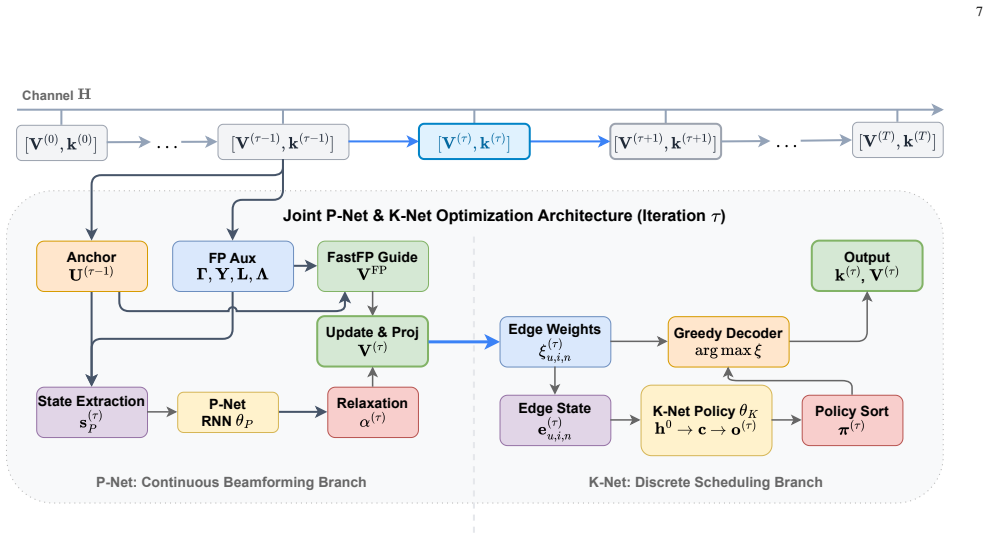
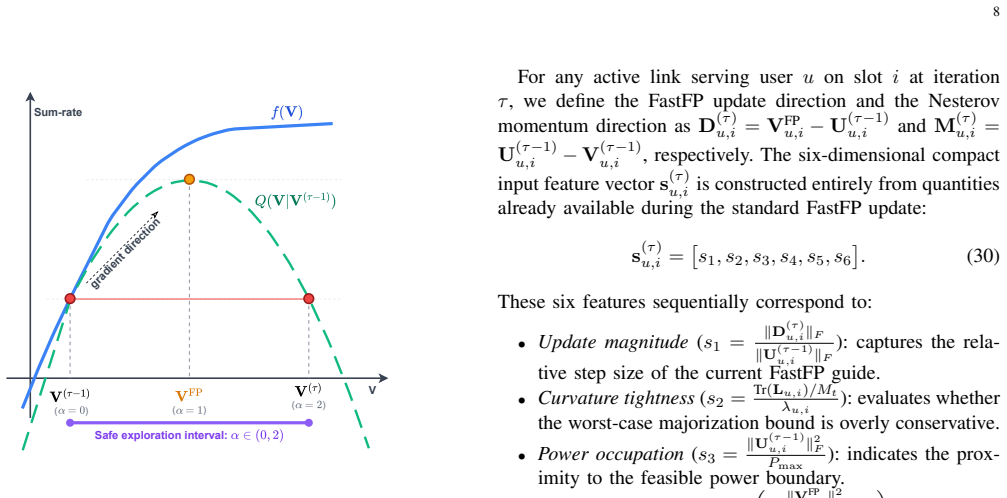
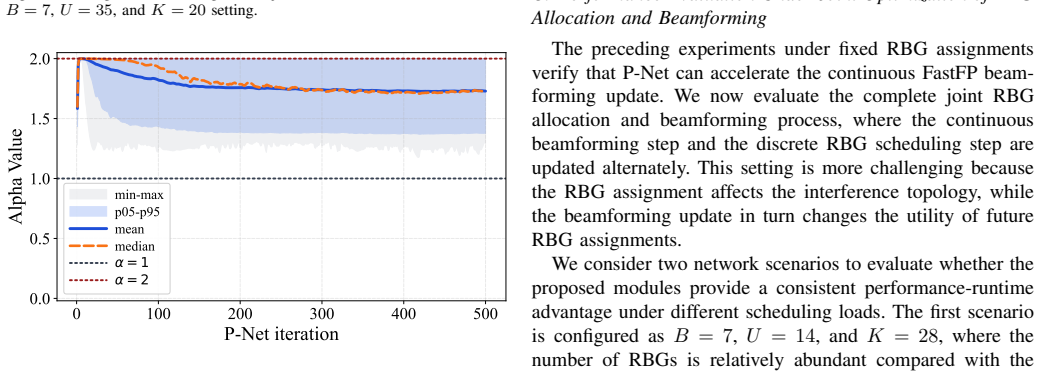
The load-bearing object is the learned relaxation factor α(τ) ∈ (0,2), a single scalar per active link generated by a shared recurrent network from six optimization-state features (update magnitude, curvature tightness, power occupation, projection risk, momentum consistency, and iteration stage). Because α is strictly bounded within the ascent-preserving interval of the quadratic surrogate, each update is an MM step, giving the paper's monotonic-ascent and stationary-point proofs. The second mechanism is K-Net, a permutation policy over user slots trained by REINFORCE with the terminal-WSR advantage over Hungarian matching as reward; inference sorts slots by logit and greedily assigns them
What would settle it
Run P-Net inference for 500+ iterations on a scenario with tight per-beamformer power constraints so the projection in (17) frequently activates, and log the minimum α(τ) across all links and any decrease in the weighted sum-rate sequence. If min α approaches zero at a limit point, or if any projected update yields f(V(τ)) < f(V(τ−1)), the paper's monotonic-ascent and stationary-point claims for the projected update are refuted.
Extended reading notes
Core claim
The central claim is that the conservative step size of FastFP—dictated by a worst-case spectral-radius curvature bound—and the combinatorial cost of exact bipartite matching are both replaceable by learned controls that leave the algorithm's analytical structure intact. P-Net's update V(τ) = U(τ−1) + α(τ)(V_FP − U(τ−1)) with α(τ) ∈ (0,2) is proven to be a valid minorization-maximization step: Lemma 2 shows the surrogate elevation equals λα(2−α)||ΔV||^2, and Theorem 1 asserts convergence to a stationary point. K-Net abandons Hungarian matching entirely, instead learning a permutation over each user's slots via REINFORCE with the terminal-WSR advantage over the Hungarian baseline as reward; a
Load-bearing premise
The learned relaxation factor α must stay strictly positive along the entire trajectory, and the power projection step must not break the surrogate-ascent inequality; the paper's proof of Lemma 2 omits the projection, and Appendix B's limiting argument (V* = V_FP*) requires α > 0 at the limit, which α = 2·Sigmoid(...) can approach zero and violate.
Editorial extensions
If this is right
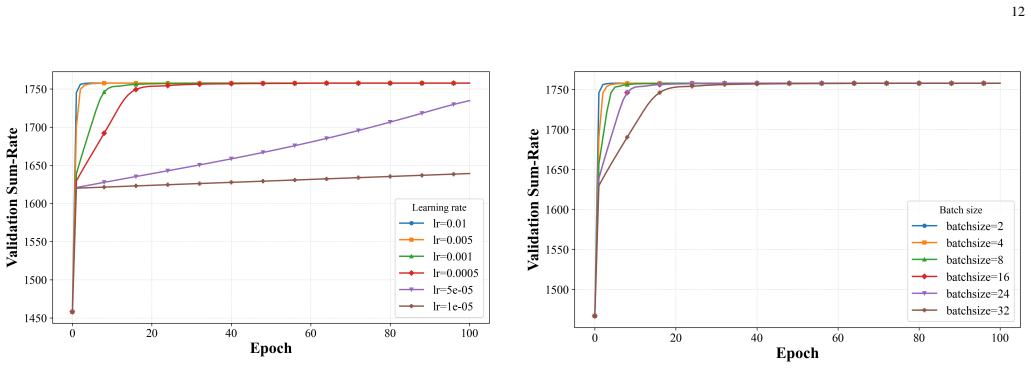
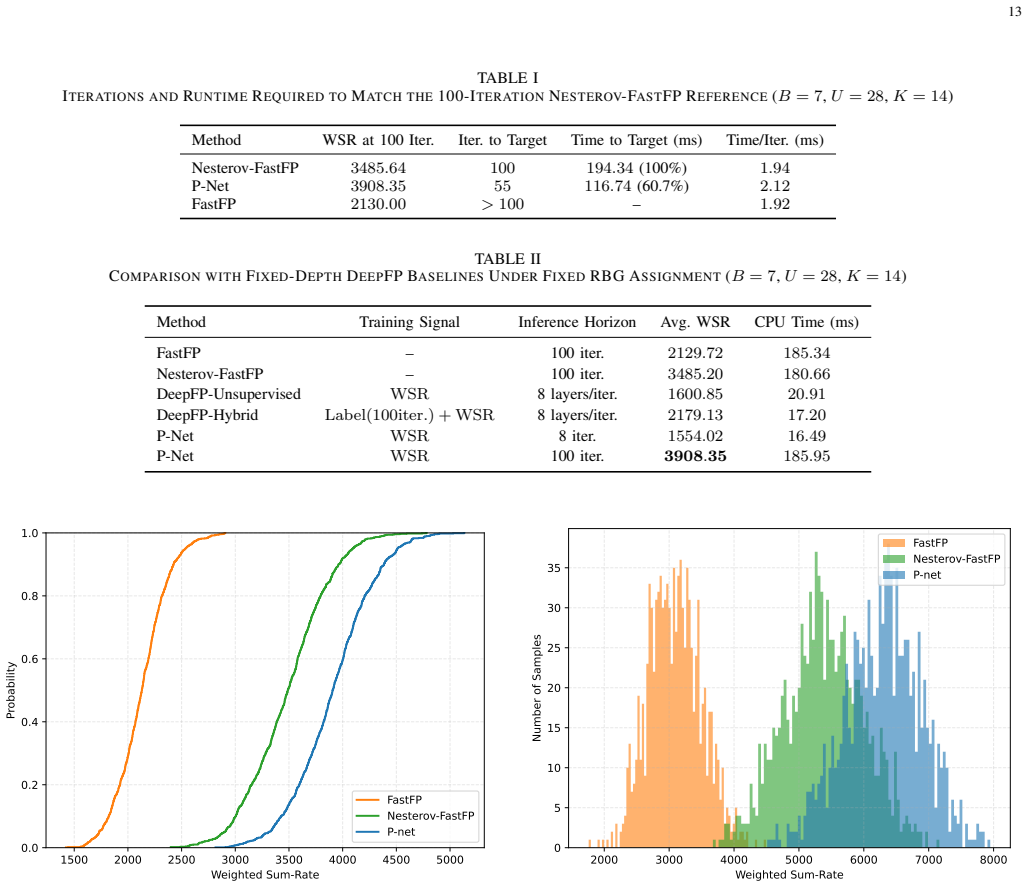
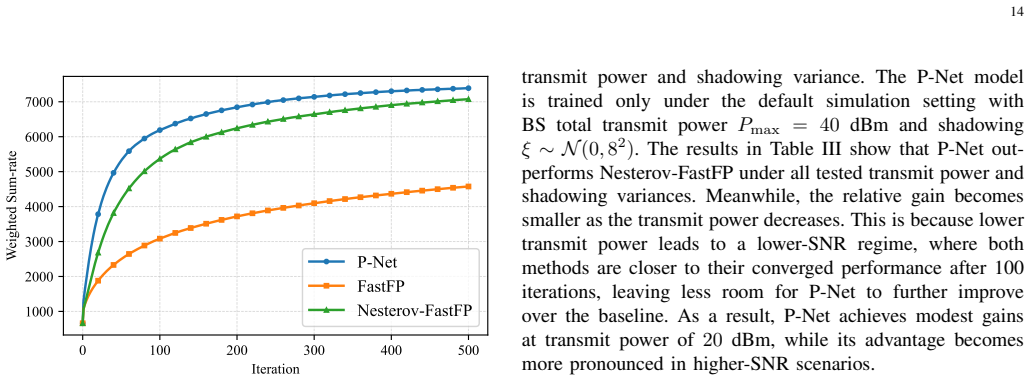
- P-Net reaches the 100-iteration Nesterov-FastFP WSR target in 55 iterations and about 60.7% of the runtime in the tested 7-cell, 28-user, 14-RBG scenario, while improving the final WSR by roughly 12%.
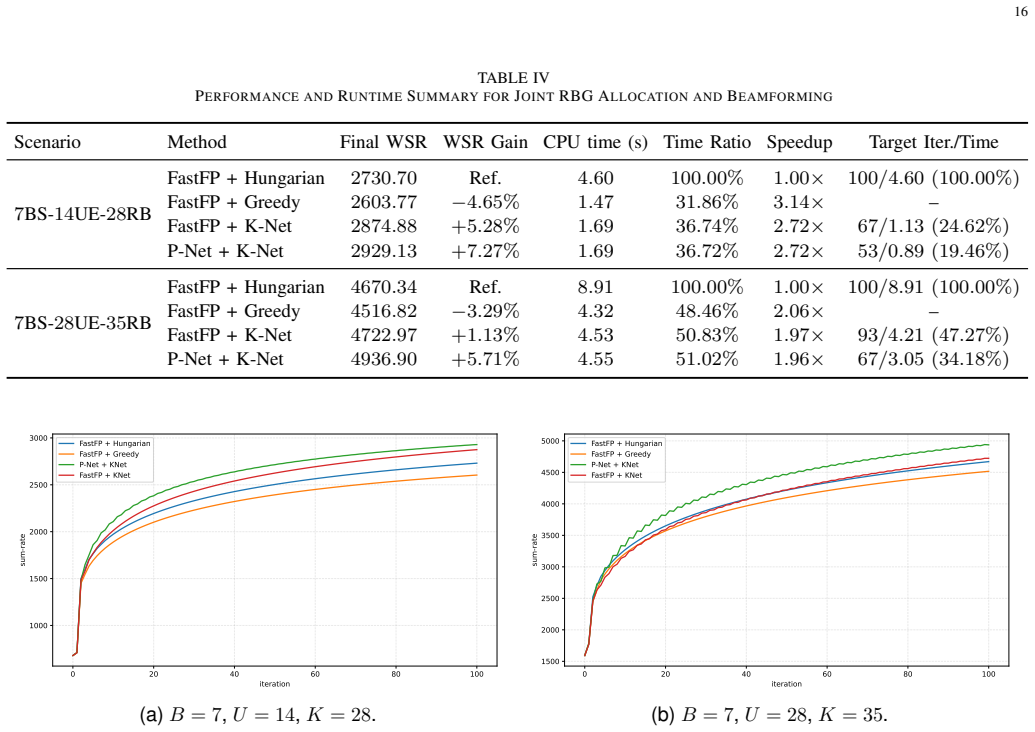
- K-Net alone lifts performance above the FastFP+Hungarian baseline (e.g., +5.28% WSR in one scenario) while using about 37% of the runtime, showing the gain comes from the learned priority order rather than a more expensive solver.
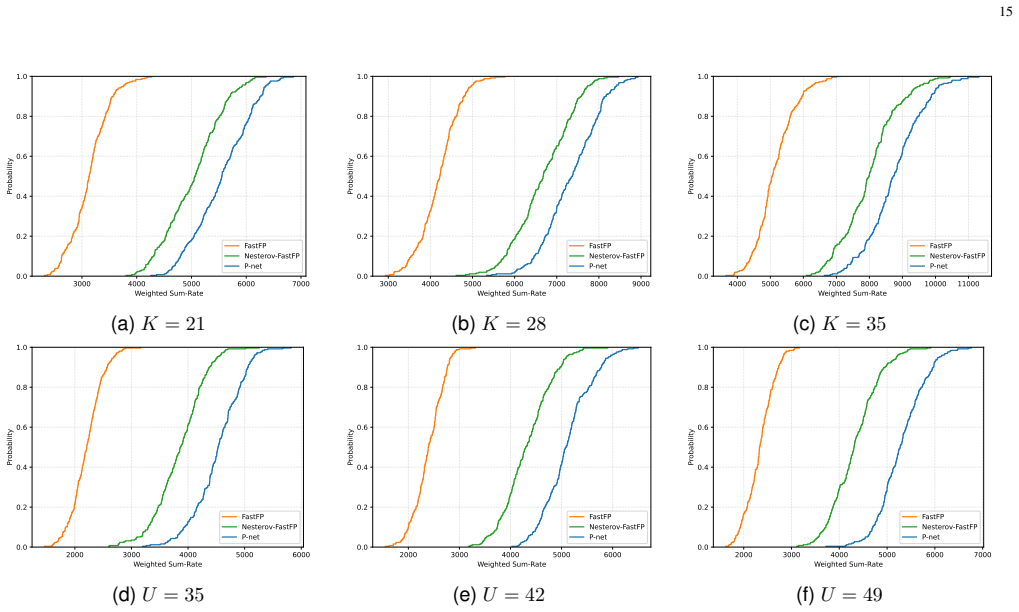
- The full P-Net+K-Net framework reaches the Hungarian baseline's target in 19–34% of the runtime across the two joint scenarios, with final WSR gains of 7.27% and 5.71%.
- Learned α statistics show values exceeding 1 on average in early iterations and decreasing later, implying the network behaves as an adaptive step-size controller rather than a black-box beamformer predictor.
- Recurrent parameter sharing decouples training depth from inference horizon, and the trained models generalize across different user counts, RBG counts, transmit powers, and shadowing variances without retraining.
Reading between the lines
- The bounded-relaxation recipe likely transfers to other MM-type algorithms (e.g., WMMSE or proximal gradient methods) whose worst-case curvature bounds make updates conservative; the key is learning only the step along the analytic direction, not the direction itself.
- K-Net demonstrates a general 'learn the permutation, keep the utility' approach to combinatorial assignment: rather than learning the assignment or running exact matching, one learns only the order in which greedy decisions are made, which could apply to other wireless scheduling problems with physics-driven edge weights.
- Because the stationary-point proof relies on α remaining strictly positive in the limit, a simple robustness test is to add a positive floor (e.g., α ≥ ε) and check whether performance or convergence changes; this would also close the gap in the limiting argument.
- The advantage-based reward design implicitly bounds K-Net's ceiling by the quality of the FastFP edge metric—if the metric misranks assignments, no priority ordering can fully compensate, suggesting a natural extension where the edge metric itself is also learned or corrected.
Editorial analysis
A structured set of objections, weighed in public.
Referee Report
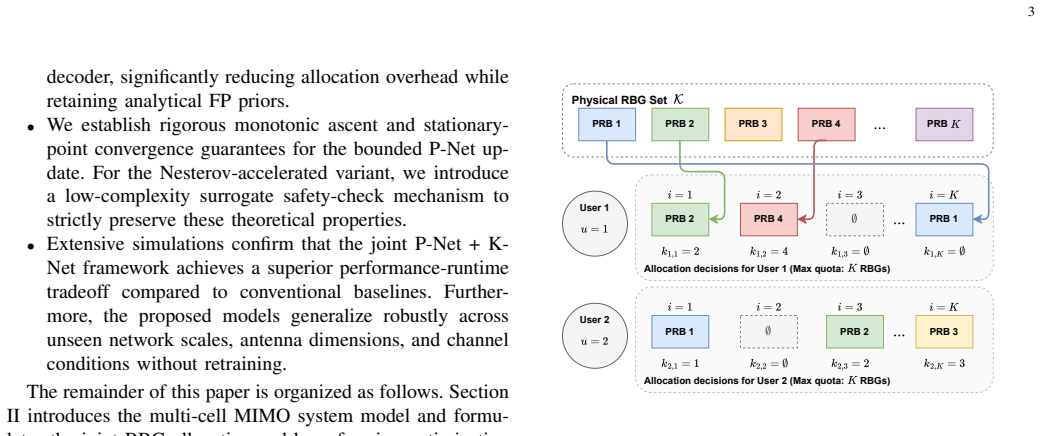
Summary. The paper proposes a joint deep-unfolding framework, P-Net + K-Net, for weighted-sum-rate maximization with joint RBG scheduling and beamforming in multi-cell MIMO downlink networks. P-Net learns a relaxation factor α(τ) ∈ (0,2) along the analytical FastFP update direction, with the goal of accelerating convergence while preserving the monotonic-ascent and stationarity guarantees of the underlying MM/FP solver. K-Net learns a priority ordering that drives a greedy RBG decoder using the original FastFP edge weights, replacing the Hungarian matching step and reducing the allocation complexity from O(U K^3) to O(U K^2). The paper claims that the combined method achieves higher WSR and lower runtime than FastFP+Hungarian baselines, with generalization across network sizes and channel conditions. The theoretical cores are Lemma 2 (monotonic ascent) and Theorem 1 (stationary-point convergence), proved in Appendices A and B.
Significance. If the theoretical guarantees and the numerical comparisons are both correct, the paper would be a valuable contribution to model-driven deep unfolding for wireless resource allocation: the parameterization is compact, the recurrent parameter sharing decouples training from inference depth, and the K-Net design preserves the physics-informed edge utilities instead of replacing them with a black-box assignment predictor. The empirical study is also more extensive than typical for this area, with CDFs, convergence trajectories, cross-scale generalization, and a comparison against DeepFP baselines. However, the central theoretical claim is load-bearing and, as written, is not established: the proof of Theorem 1 contains an invalid limiting inference, and Lemma 2 is proved for an update that differs from the one executed in Algorithm 3. These issues affect the paper's core message and therefore the significance is conditional on a substantial revision.
major comments (3)
- [Appendix B / Theorem 1, Eq. (31), Alg. 3 line 9] The proof of Theorem 1 takes the limit of the P-Net update (28) as V* = V* + α(V_FP* − V*) and concludes V* = V_FP* from 'α > 0'. This inference is invalid because the architecture (31) gives α(τ) = 2·Sigmoid(F_θ(...)) ∈ (0,2) only; α may approach 0. If α→0, the limiting equality holds for every V*, and the trajectory can freeze at a non-stationary point. Moreover, Algorithm 3 (line 9) applies the projection (17), so the correct fixed-point condition is V* = P_W(V* + α*(V_FP* − V*)); this does not imply V* = V_FP*. A concrete one-dimensional example is v_{τ+1} = v_τ + α_τ(1−v_τ) with α_τ = 1/(τ+1)^2, which converges to a non-stationary point of maximize −(v−1)^2. To repair the theorem, the authors need an explicit uniform lower bound α(τ) ≥ ε > 0 (e.g., α = ε + (2−2ε)·Sigmoid) and a proof that uses the projected fixed-point condition rather than V* = V_FP*.
- [Appendix A / Lemma 2, Eq. (28)-(29), Alg. 3 line 9] The proof of Lemma 2 in Appendix A establishes surrogate ascent for the unconstrained update V(τ) = V(τ−1) + α(V_FP − V(τ−1)). The actual inference procedure in Algorithm 3 applies the power projection (17) after the update, and the Nesterov variant (29) uses the extrapolated anchor U(τ−1). The proof does not account for the projection, so monotonicity of the true objective f for the executed update is not established. The projection might leave the surrogate's superlevel set; this may be repairable under additional assumptions, but it is not shown. Therefore, the claimed 'rigorous monotonic ascent' guarantee for the P-Net inference procedure is unproven as it stands.
- [Section IV-A-3 / Nesterov safety-check] The paper asserts that the Nesterov-accelerated P-Net with the surrogate safety-check and restart mechanism 'remain[s] valid' for Lemma 2 and Theorem 1, but no proof is provided. The safety check compares f_P3(V_cand) with f_P3(V_prev); since f_P3 is the transformed FP surrogate, not the original objective f, a separate argument is needed to show that accepting a step based on f_P3 implies monotonic progress of f, and that the fallback update after restart preserves the stationarity property. This is a load-bearing claim because the Nesterov variant is an advertised feature of P-Net.
minor comments (4)
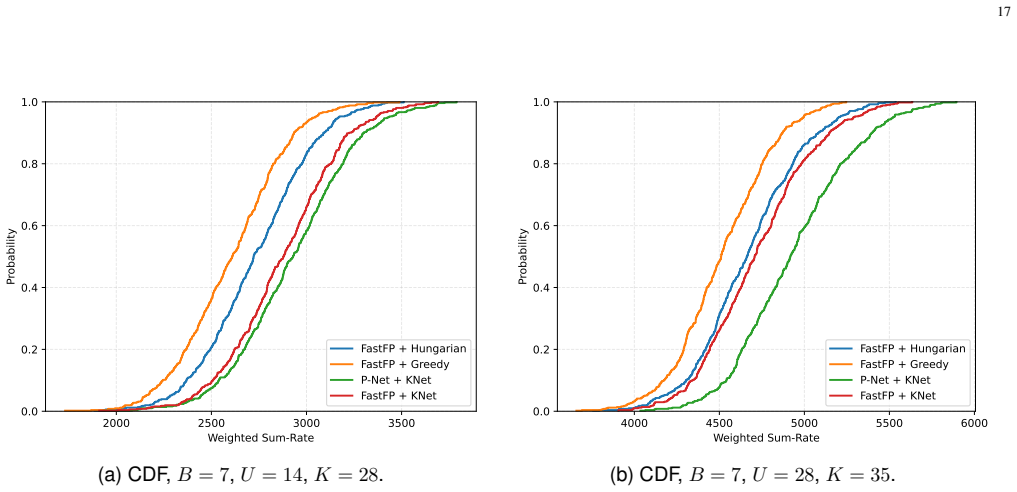
- [Tables I-IV] All numerical tables report point estimates without confidence intervals or standard deviations. The CDFs in Figs. 6, 7, 10, and 12 partially mitigate this, but adding error bars on the mean/median values would make the comparisons more convincing.
- [Section IV-A-2] In the paragraph introducing Theorem 1, the text says 'Building upon Lemma 1' but the statement clearly relies on Lemma 2. This should be corrected.
- [Section V-B] The fixed-RBG evaluation temporarily replaces the per-beamformer power constraint (4b) with a BS-level sum-power constraint. Since the theoretical statements in Lemma 2 and Theorem 1 concern the per-beamformer constraint, it is unclear whether the numerical results in Section V-B validate the theoretical claims or a different problem instance. Please clarify.
- [Algorithm 3 line 20] The condition f_P3(V_cand) ≥ f_P3(V_prev) is not fully specified: f_P3 depends on the auxiliary variables Γ and Y. The authors should state at which values of Γ and Y the comparison is made.
Circularity Check
No significant circularity; the learned modules are trained and evaluated on the same WSR objective, but this is standard supervised/RL optimization on unseen test data, and the FP/FastFP priors are externally published. The theoretical gap in Appendix B is a correctness issue, not a circular reduction.
full rationale
The paper's central claims do not reduce to their inputs by construction. P-Net's relaxation factor is trained with the negative terminal-WSR loss (32) and then evaluated by WSR; this is ordinary end-to-end training with held-out test channels, not a fitted input being relabeled as a prediction. K-Net's REINFORCE reward (35) is the terminal WSR gain over the Hungarian baseline, and Table IV reports gains over FastFP+Hungarian, but a learned policy is not guaranteed to achieve that gain on test samples, so this is a standard RL objective rather than a statistically forced prediction. The main algorithmic priors — FastFP [33], FP [15,17], and the DeepFP baseline [31] — are co-authored by K. Shen, but they are externally published, parameter-free algorithm papers with their own derivations; the present paper's contribution (bounded learned alpha and learned priority order) is not equivalent to those results. No uniqueness theorem is imported, and no ansatz is hidden behind a citation. The notable weakness is Appendix B: from V* = V* + alpha(V_FP* - V*) and "alpha > 0" the proof concludes V* = V_FP*, but alpha(tau) = 2*Sigmoid(F_theta(...)) can approach 0, so the fixed-point relation is vacuous; additionally Lemma 2 analyzes (28) without the projection (17) used in Algorithm 3. This is an unproven convergence claim, not a circular derivation, so it does not raise the circularity score. The score 2 reflects the presence of numerous self-citations for the underlying FP framework, none of which is load-bearing in a way that makes the new results true by definition.
Assumptions & free parameters
free parameters (4)
- P-Net GRU parameters θ
- K-Net MLP parameters θ
- Learned relaxation factor α(τ) =
bounded in (0,2), no lower bound
- Iteration-stage constants c and c_K =
unspecified
assumptions (4)
- standard math Nonhomogeneous quadratic bound (Lemma 1) from [32,33]
- domain assumption MM minorant property of the FP surrogate
- ad hoc to paper Unstated positive lower bound on learned α(τ)
- ad hoc to paper Power projection preserves surrogate ascent
Cite this review
Pith. "Pith review of Bounded Deep Unfolding for Joint Beamforming and Scheduling in Multi-Cell MIMO Networks." pith.science (2026). https://pith.science/paper/MB7ZJOCA
@misc{pith2026260605246,
  author       = {Pith},
  title        = {Pith review of: Bounded Deep Unfolding for Joint Beamforming and Scheduling in Multi-Cell MIMO Networks},
  year         = {2026},
  howpublished = {\url{https://pith.science/paper/MB7ZJOCA}},
  note         = {Machine review of arXiv:2606.05246}
}
read the original abstract
This paper investigates the joint resource block group (RBG) scheduling and beamforming optimization problem for weighted sum-rate (WSR) maximization in multi-cell multiuser multiple-input multiple-output (MU-MIMO) downlink networks. While the Fast Fractional Programming (FastFP) framework provides a reliable model-driven solution, it suffers from conservative continuous beamforming updates and prohibitive computational overhead during the discrete RBG matching phase. To address these bottlenecks, we propose a joint deep unfolding framework comprising two core modules: P-Net and K-Net. Specifically, P-Net learns an adaptive relaxation factor along the FastFP direction, strictly bounded within an ascent-preserving interval to accelerate convergence while retaining stationary-point guarantees. Meanwhile, K-Net learns a long-horizon priority policy to guide a low-complexity greedy assignment, maintaining high assignment quality while bypassing the computationally expensive Hungarian matching. Both networks leverage analytical algorithmic priors and utilize recurrent parameter sharing, enabling flexible inference beyond the training horizon. Extensive simulations demonstrate that the proposed joint framework achieves higher WSR and faster execution times than conventional model-driven baselines, while generalizing robustly across unseen network scales and channel conditions without retraining.
Figures
Figures from the paper (7 more)
Forward citations
Cited by 1 Pith paper
-
Rethinking Fractional Programming for Joint Uplink Scheduling and Power Control in Multicell Wireless Networks
Proposes SEFP algorithm using a new reciprocal-inversion transform for improved weighted sum-rate maximization via joint uplink scheduling and power control in multicell networks.
Reference graph
Works this paper leans on
-
[1]
Framework and overall objectives of the future development of imt for 2030 and beyond,
ITU Radiocommunication Sector, “Framework and overall objectives of the future development of imt for 2030 and beyond,” International Telecommunication Union, Recommendation ITU-R M.2160-0, November 2023. [Online]. Available: https://itu.int
-
[2]
Ericsson mobility report june 2024,
Ericsson, “Ericsson mobility report june 2024,” Ericsson, Tech. Rep., Jun. 2024. [Online]. Available: https://www.ericsson.com/en/ reports-and-papers/mobility-report
2024
-
[3]
6G wireless systems: Vision, requirements, challenges, insights, and opportunities,
H. Tataria, M. Shafi, A. F. Molisch, M. Dohler, H. Sj ¨oland, and F. Tufvesson, “6G wireless systems: Vision, requirements, challenges, insights, and opportunities,”Proceedings of the IEEE, vol. 109, no. 7, pp. 1166–1199, 2021
2021
-
[4]
The roadmap to 6g: Ai empowered wireless networks,
K. B. Letaief, W. Chen, Y . Shi, J. Zhang, and Y .-J. A. Zhang, “The roadmap to 6g: Ai empowered wireless networks,”IEEE communica- tions magazine, vol. 57, no. 8, pp. 84–90, 2019
2019
-
[5]
Multi-cell MIMO cooperative networks: A new look at interference,
D. Gesbert, S. Hanly, H. Huang, S. Shamai, O. Simeone, and W. Yu, “Multi-cell MIMO cooperative networks: A new look at interference,” IEEE Journal on Selected Areas in Communications, vol. 28, no. 9, pp. 1380–1408, 2010
2010
-
[6]
Optimal resource allocation in coordi- nated multi-cell systems,
E. Bj ¨ornson and E. Jorswieck, “Optimal resource allocation in coordi- nated multi-cell systems,”Foundations and Trends in Communications and Information Theory, vol. 9, no. 2–3, pp. 113–381, 2013
2013
-
[7]
Downlink scheduling and resource allocation for ofdm systems,
J. Huang, V . G. Subramanian, R. Agrawal, and R. A. Berry, “Downlink scheduling and resource allocation for ofdm systems,”IEEE Transac- tions on Wireless Communications, vol. 8, no. 1, pp. 288–296, 2009
2009
-
[8]
On the complexity of joint subcarrier and power allocation for multi-user ofdma systems,
Y .-F. Liu and Y .-H. Dai, “On the complexity of joint subcarrier and power allocation for multi-user ofdma systems,”IEEE Transactions on Signal Processing, vol. 62, no. 3, pp. 583–596, 2014
2014
Show all 37 references
-
[9]
Weighted max-min fair beam- forming, power control, and scheduling for a miso downlink,
B. Song, Y .-H. Lin, and R. L. Cruz, “Weighted max-min fair beam- forming, power control, and scheduling for a miso downlink,”IEEE Transactions on Wireless Communications, vol. 7, no. 2, pp. 464–469, 2008
2008
-
[10]
Multicell coordination via joint schedul- ing, beamforming, and power spectrum adaptation,
W. Yu, T. Kwon, and C. Shin, “Multicell coordination via joint schedul- ing, beamforming, and power spectrum adaptation,” inProceedings IEEE INFOCOM, 2011, pp. 2570–2578
2011
-
[11]
Downlink beamforming and resource al- location in multicell MISO-OFDMA systems,
N. U. Hassan and M. Assaad, “Downlink beamforming and resource al- location in multicell MISO-OFDMA systems,”Transactions on Emerg- ing Telecommunications Technologies, vol. 25, no. 2, pp. 173–182, 2014
2014
-
[12]
MIMO-OFDMA rate allocation and beamformer design using a multi-access channel framework,
A. Khanafer, T. J. Lim, R. Doostnejad, and T. Tang, “MIMO-OFDMA rate allocation and beamformer design using a multi-access channel framework,” inIEEE International Conference on Communications, 2012, pp. 2553–2558
2012
-
[13]
Weighted sum-rate maximization using weighted mmse for mimo-bc beamforming design,
S. S. Christensen, R. Agarwal, E. De Carvalho, and J. M. Cioffi, “Weighted sum-rate maximization using weighted mmse for mimo-bc beamforming design,”IEEE Transactions on Wireless Communications, vol. 7, no. 12, pp. 4792–4799, 2008
2008
-
[14]
An iteratively weighted MMSE approach to distributed sum-utility maximization for a MIMO interfering broadcast channel,
Q. Shi, M. Razaviyayn, Z.-Q. Luo, and C. He, “An iteratively weighted MMSE approach to distributed sum-utility maximization for a MIMO interfering broadcast channel,”IEEE Transactions on Signal Processing, vol. 59, no. 9, pp. 4331–4340, 2011
2011
-
[15]
Fractional programming for communication systems—part I: Power control and beamforming,
K. Shen and W. Yu, “Fractional programming for communication systems—part I: Power control and beamforming,”IEEE Transactions on Signal Processing, vol. 66, no. 10, pp. 2616–2630, 2018
2018
-
[16]
Rethinking WMMSE: Can its complexity scale linearly with the number of BS antennas?
X. Zhao, S. Lu, Q. Shi, and Z.-Q. Luo, “Rethinking WMMSE: Can its complexity scale linearly with the number of BS antennas?”IEEE Transactions on Signal Processing, vol. 71, pp. 433–446, 2023
2023
-
[17]
Fractional programming for communication systems—part II: Uplink scheduling via matching,
K. Shen and W. Yu, “Fractional programming for communication systems—part II: Uplink scheduling via matching,”IEEE Transactions on Signal Processing, vol. 66, no. 10, pp. 2631–2644, 2018. [Online]. Available: https://arxiv.org/abs/1802.10197
2018 arXiv
-
[18]
Optimizing downlink resource al- location in multiuser mimo networks via fractional programming and the hungarian algorithm,
A. A. Khan, R. S. Adve, and W. Yu, “Optimizing downlink resource al- location in multiuser mimo networks via fractional programming and the hungarian algorithm,”IEEE Transactions on Wireless Communications, vol. 19, no. 8, pp. 5162–5175, 2020
2020
-
[19]
Learning to optimize: Training deep neural networks for wireless re- source management,
H. Sun, X. Chen, Q. Shi, M. Hong, X. Fu, and N. D. Sidiropoulos, “Learning to optimize: Training deep neural networks for wireless re- source management,”IEEE Transactions on Signal Processing, vol. 66, no. 20, pp. 5438–5453, 2018
2018
-
[20]
Deep-learning-based wireless resource allocation with application to vehicular networks,
L. Liang, H. Ye, G. Yu, and G. Y . Li, “Deep-learning-based wireless resource allocation with application to vehicular networks,”Proceedings of the IEEE, vol. 108, no. 2, pp. 341–356, 2019
2019
-
[21]
Deep reinforcement learning for radio resource allocation and management in next generation heterogeneous wireless networks: A survey,
A. Alwarafy, M. Abdallah, B. S. Ciftler, A. Al-Fuqaha, and M. Hamdi, “Deep reinforcement learning for radio resource allocation and management in next generation heterogeneous wireless networks: A survey,”arXiv preprint arXiv:2106.00574, 2021. [Online]. Available: https://arxi...
2021 arXiv
-
[22]
Lorm: Learning to optimize for resource management in wireless networks with few training sam- ples,
Y . Shen, Y . Shi, J. Zhang, and K. B. Letaief, “Lorm: Learning to optimize for resource management in wireless networks with few training sam- ples,”IEEE Transactions on Wireless Communications, vol. 19, no. 1, pp. 665–679, 2020
2020
-
[23]
Spatial deep learning for wireless schedul- ing,
W. Cui, K. Shen, and W. Yu, “Spatial deep learning for wireless schedul- ing,”IEEE Journal on Selected Areas in Communications, vol. 37, no. 6, pp. 1248–1261, 2019
2019
-
[24]
Graph neural networks for scalable radio resource management: Architecture design and theoretical analysis,
Y . Shen, Y . Shi, J. Zhang, and K. B. Letaief, “Graph neural networks for scalable radio resource management: Architecture design and theoretical analysis,”IEEE Journal on Selected Areas in Communications, vol. 39, no. 1, pp. 101–115, 2021
2021
-
[25]
Learning decentralized wireless resource allocations with graph neural networks,
Z. Wang, M. Eisen, and A. Ribeiro, “Learning decentralized wireless resource allocations with graph neural networks,”IEEE Transactions on Signal Processing, vol. 70, pp. 1850–1863, 2022
2022
-
[26]
Learning-based massive beamforming,
S. Lu, S. Zhao, and Q. Shi, “Learning-based massive beamforming,” inGLOBECOM 2020-2020 IEEE Global Communications Conference. IEEE, 2020, pp. 1–6
2020
-
[27]
Algorithm unrolling: Interpretable, efficient deep learning for signal and image processing,
V . Monga, Y . Li, and Y . C. Eldar, “Algorithm unrolling: Interpretable, efficient deep learning for signal and image processing,”IEEE Signal Processing Magazine, vol. 38, no. 2, pp. 18–44, 2021
2021
-
[28]
Iterative algorithm induced deep-unfolding neural networks: Precoding design for mul- tiuser MIMO systems,
Q. Hu, Y . Cai, Q. Shi, K. Xu, G. Yu, and Z. Ding, “Iterative algorithm induced deep-unfolding neural networks: Precoding design for mul- tiuser MIMO systems,”IEEE Transactions on Wireless Communications, vol. 20, no. 2, pp. 1394–1410, 2021
2021
-
[29]
Matrix-inverse-free deep unfolding of the weighted mmse beamforming algorithm,
L. Pellaco, M. Bengtsson, and J. Jald ´en, “Matrix-inverse-free deep unfolding of the weighted mmse beamforming algorithm,”IEEE Open Journal of the Communications Society, vol. 3, pp. 65–81, 2021
2021
-
[30]
Deep graph unfolding for beamforming in MU-MIMO interference networks,
A. Chowdhury, G. Verma, A. Swami, and S. Segarra, “Deep graph unfolding for beamforming in MU-MIMO interference networks,”IEEE Transactions on Wireless Communications, vol. 23, no. 5, pp. 4889– 4903, 2024
2024
-
[31]
Deepfp: Deep-unfolded fractional programming for mimo beamforming,
J. Zhu, T.-H. Chang, L. Xiang, and K. Shen, “Deepfp: Deep-unfolded fractional programming for mimo beamforming,”IEEE Transactions on Communications, 2026
2026
-
[32]
Majorization-minimization algo- rithms in signal processing, communications, and machine learning,
Y . Sun, P. Babu, and D. P. Palomar, “Majorization-minimization algo- rithms in signal processing, communications, and machine learning,” IEEE Transactions on Signal Processing, vol. 65, no. 3, pp. 794–816, 2017
2017
-
[33]
Accelerating quadratic transform and WMMSE,
K. Shen, Z. Zhao, Y . Chen, Z. Zhang, and H. V . Cheng, “Accelerating quadratic transform and WMMSE,”IEEE Journal on Selected Areas in Communications, vol. 42, no. 11, pp. 3110–3124, 2024
2024
-
[34]
Alista: Analytic weights are as good as learned weights in lista,
J. Liu, X. Chen, Z. Wang, and W. Yin, “Alista: Analytic weights are as good as learned weights in lista,” inInternational conference on learning representations, 2019
2019
-
[35]
Deep unfolding of a proximal interior point method for image restoration,
C. Bertocchi, E. Chouzenoux, M.-C. Corbineau, J.-C. Pesquet, and M. Prato, “Deep unfolding of a proximal interior point method for image restoration,”Inverse Problems, vol. 36, no. 3, p. 034005, 2020
2020
-
[36]
Learned reconstruction methods with convergence guaran- tees: A survey of concepts and applications,
S. Mukherjee, A. Hauptmann, O. ¨Oktem, M. Pereyra, and C.-B. Sch¨onlieb, “Learned reconstruction methods with convergence guaran- tees: A survey of concepts and applications,”IEEE Signal Processing Magazine, vol. 40, no. 1, pp. 164–182, 2023
2023
-
[37]
Policy gradi- ent methods for reinforcement learning with function approximation,
R. S. Sutton, D. McAllester, S. Singh, and Y . Mansour, “Policy gradi- ent methods for reinforcement learning with function approximation,” Advances in neural information processing systems, vol. 12, 1999
1999
Reviewed August 2, 2026 · model on record in the stance chip above.
Discussion (0). Continue with ORCID to comment.