Entanglement engineering in magnomechanical system via cross-Kerr interaction and mechanical parametric amplification
Pith reviewed 2026-06-26 13:51 UTC · model grok-4.3
The pith
Phonon hopping and mechanical parametric amplification generate quantum entanglement even with weak cross-Kerr coupling in magnomechanical systems.
A machine-rendered reading of the paper's core claim, the machinery that carries it, and where it could break.
Core claim
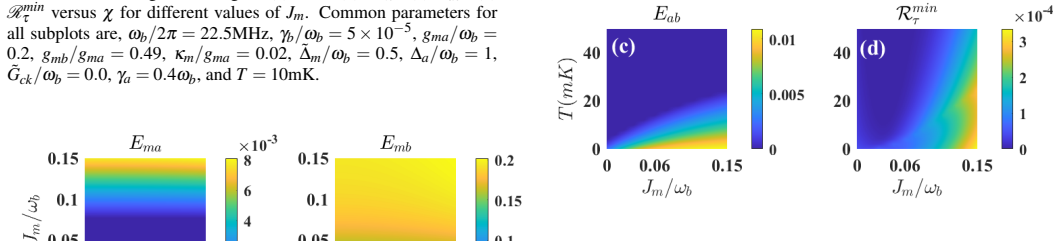
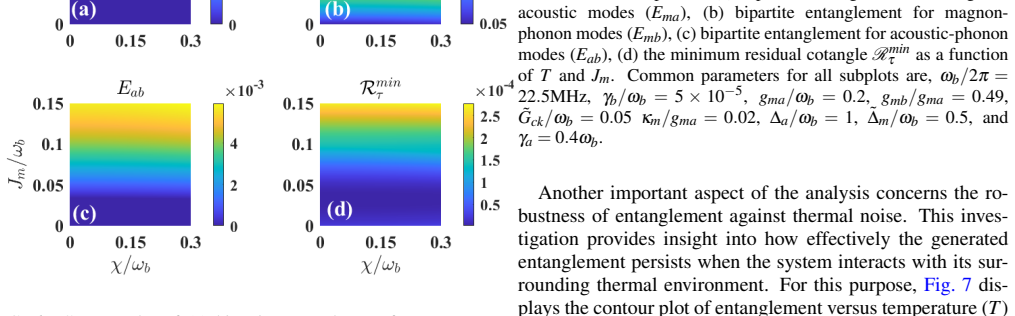
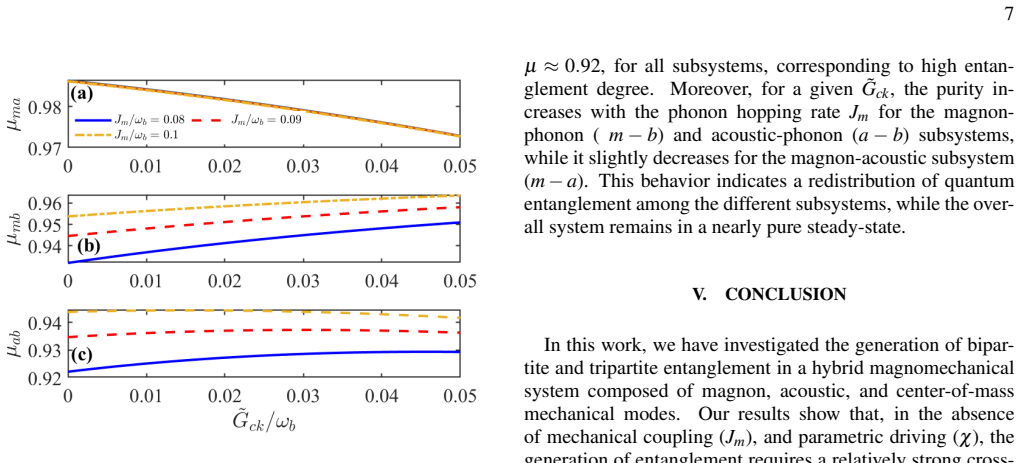
The authors claim that when phonon hopping and mechanical parametric amplification are accounted for in the magnomechanical system, quantum entanglement can be generated even for weak values of the cross-Kerr coupling strength. They further show that the purity of the generated entangled states remains high in the same parameter regime, revealing that the entanglement is established without significantly increasing the mixing of the involved states.
What carries the argument
The combination of cross-Kerr interaction, phonon hopping rate J_m, and mechanical parametric amplification drive within the system Hamiltonian.
If this is right
- Entanglement among the magnonic, acoustic phononic, and CMM modes becomes accessible at weaker cross-Kerr coupling than required without phonon hopping and MPA.
- The purity of the entangled states stays high when phonon hopping and MPA are used.
- Robust and stable quantum correlations can be engineered in magnomechanical structures based on nonlinear interactions.
- The scheme supports applications in quantum information processing, quantum communication, and quantum computational tasks.
Where Pith is reading between the lines
- Mechanical parameters such as hopping and amplification can compensate for limited nonlinear coupling strengths in hybrid systems.
- The same combination of interactions might enhance entanglement in other magnon-phonon platforms where direct cross-Kerr terms are weak.
- Experimental tests in YIG spheres could map the exact threshold where entanglement switches on as a function of J_m and MPA strength.
Load-bearing premise
The physical system can be accurately described by a Hamiltonian containing the stated cross-Kerr term, phonon hopping J_m, and mechanical parametric amplification drive, with all other interactions and decoherence channels either negligible or controllable under the weak-coupling regime described.
What would settle it
An experiment measuring entanglement (such as logarithmic negativity) and purity between the magnonic, acoustic, and CMM modes while varying cross-Kerr strength, both with and without J_m and MPA active, to determine whether entanglement appears at weak cross-Kerr coupling only when the additional terms are present.
Figures
read the original abstract
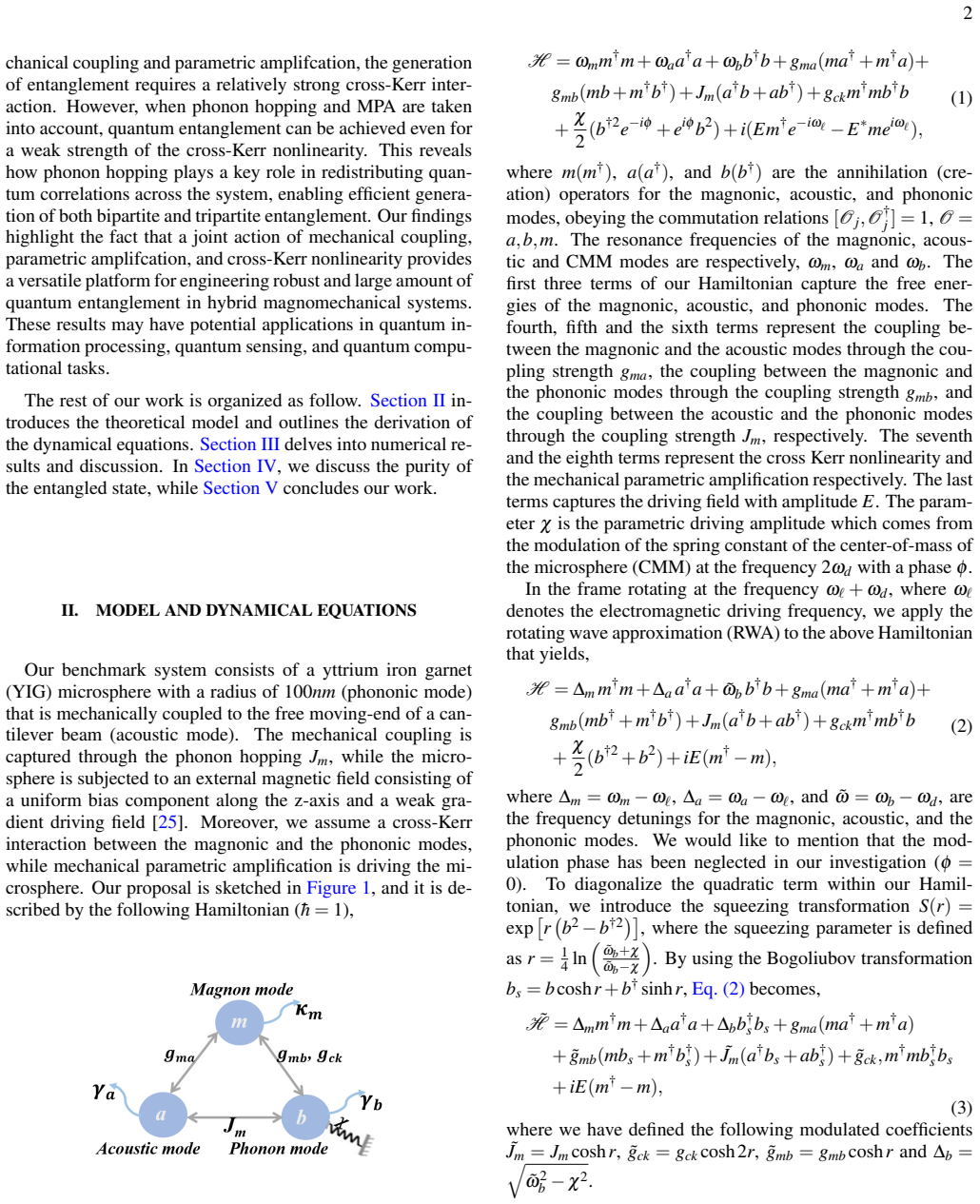
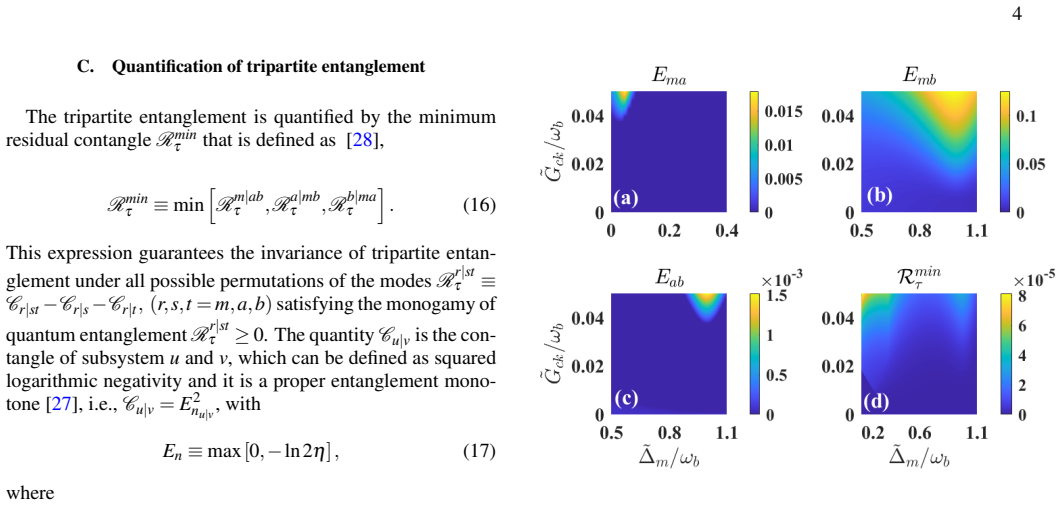
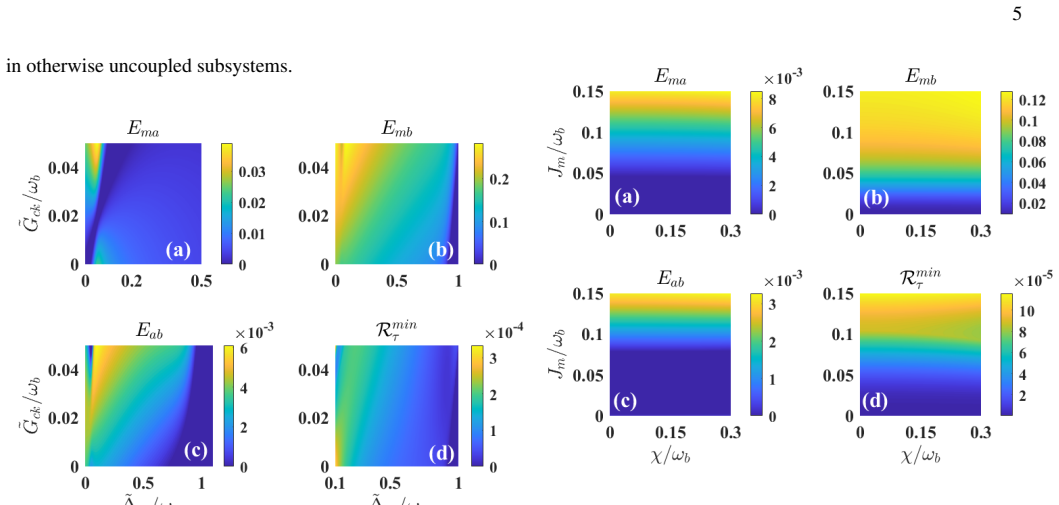
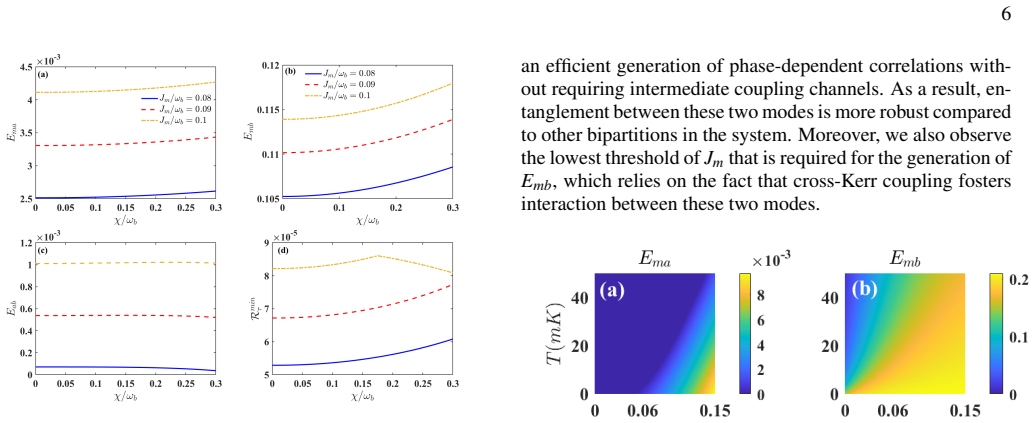
Quantum entanglement in cavity magnomechanical system has a wide range of applications in modern quantum technologies. In this work, we propose a theoretical scheme to generate and enhance quantum entanglement through cross-Kerr nonlinearity and mechanical parametric amplification (MPA) in a magnomechanical system. Our system is made of a magnonic mode that is simultaneously driving the acoustic phononic and the center-of-mass motion (CMM) phonon in a yttrium iron garnet sphere. The acoustic mode and the center-of-mass mechanical (CMM) mode are weakly coupled via the phonon hopping rate $J_m$. Moreover, the magnonic and phononic modes interact through cross-Kerr interaction, while the phononic mode is additionally driven via a Mechanical Parametric Amplification (MPA). Without the mechanical coupling ($J_m = 0$) and the MPA, the generation of entanglement among the subsystems requires a relatively strong effective cross-Kerr coupling. However, when phonon hopping and MPA are accounted, quantum entanglement can be generated even for weak values of the cross-Kerr coupling strength, revealing the key role of these interactions in the engineering of quantum correlations in our proposal. Furthermore, the related purity of the generated entangled states remains high for the same parameter's regime, revealing that the generated quantum entanglement is established without significantly increasing the mixing of the involved states in the system. Our work suggests how robust and stable quantum correlations can be engineered in magnomechanical structures based on nonlinear interactions. These results are useful for modern quantum applications including quantum information processing, quantum communication, and quantum computational tasks.
Editorial analysis
A structured set of objections, weighed in public.
Referee Report
Summary. The manuscript proposes a scheme for generating and enhancing quantum entanglement in a magnomechanical system consisting of a magnonic mode coupled to acoustic and center-of-mass mechanical (CMM) modes in a YIG sphere. The model includes cross-Kerr interaction between magnon and phonon modes, weak phonon hopping J_m between acoustic and CMM modes, and a mechanical parametric amplification (MPA) drive on the phononic mode. The central claim is that, unlike the case with J_m = 0 and no MPA (which requires strong cross-Kerr), the inclusion of J_m and MPA enables entanglement generation even for weak cross-Kerr strengths, while the purity of the resulting entangled states remains high.
Significance. If the central claim holds under the stated approximations, the work demonstrates a practical route to engineering robust quantum correlations in magnomechanical platforms by leveraging linear hopping and parametric drive to relax the requirements on nonlinear coupling strength. This could be relevant for quantum information tasks where strong cross-Kerr interactions are experimentally challenging.
major comments (2)
- [Hamiltonian and master equation (model section)] The manuscript's central claim—that entanglement appears for weak cross-Kerr once J_m and MPA are added—rests on the effective Hamiltonian remaining an accurate truncation in the weak-coupling regime. However, MPA is a parametric drive whose amplitude is typically comparable to the mechanical frequency; its inclusion can generate higher-order terms or necessitate a displaced-frame treatment whose validity is not guaranteed by the same weak-coupling condition applied to the magnon-phonon interaction. This approximation is load-bearing for both the entanglement and purity results.
- [Results and discussion (entanglement and purity plots)] No explicit derivation or numerical evidence is provided showing that the reported entanglement (e.g., logarithmic negativity) and purity remain high specifically when the MPA drive strength is varied while keeping cross-Kerr weak; the parameter regime where the weak-coupling truncation holds must be quantified to support the claim that J_m and MPA are the key enabling factors.
minor comments (2)
- [Abstract] The abstract states that 'the related purity of the generated entangled states remains high' but does not specify the purity measure (e.g., linear entropy, von Neumann entropy) or the precise threshold used; this should be clarified in the main text.
- [Model] Notation for the phonon hopping rate is introduced as J_m in the abstract; consistency with the Hamiltonian definition in the model section should be verified.
Simulated Author's Rebuttal
We thank the referee for their careful reading of our manuscript and for the constructive comments. We address each major point below, indicating where revisions will be made to strengthen the presentation of our approximations and results.
read point-by-point responses
-
Referee: [Hamiltonian and master equation (model section)] The manuscript's central claim—that entanglement appears for weak cross-Kerr once J_m and MPA are added—rests on the effective Hamiltonian remaining an accurate truncation in the weak-coupling regime. However, MPA is a parametric drive whose amplitude is typically comparable to the mechanical frequency; its inclusion can generate higher-order terms or necessitate a displaced-frame treatment whose validity is not guaranteed by the same weak-coupling condition applied to the magnon-phonon interaction. This approximation is load-bearing for both the entanglement and purity results.
Authors: We acknowledge the referee's concern regarding the validity of the effective Hamiltonian when including the MPA term. Our derivation employs the standard rotating-frame treatment and rotating-wave approximation for the parametric drive, consistent with prior literature on mechanical parametric amplification. However, we agree that an explicit discussion of the conditions under which higher-order terms can be neglected is needed to support the weak-coupling truncation. In the revised manuscript we will add a dedicated paragraph (and, if space permits, a short appendix) deriving the effective model and stating the parameter bounds (e.g., MPA amplitude relative to mechanical frequency) under which the truncation remains accurate for the reported entanglement and purity values. revision: yes
-
Referee: [Results and discussion (entanglement and purity plots)] No explicit derivation or numerical evidence is provided showing that the reported entanglement (e.g., logarithmic negativity) and purity remain high specifically when the MPA drive strength is varied while keeping cross-Kerr weak; the parameter regime where the weak-coupling truncation holds must be quantified to support the claim that J_m and MPA are the key enabling factors.
Authors: We agree that additional numerical evidence and quantification of the valid parameter regime would strengthen the central claim. In the revised version we will include new figures (or panels) that explicitly vary the MPA drive strength while holding the cross-Kerr coupling fixed at weak values, showing the resulting logarithmic negativity and purity. We will also add text quantifying the regime of validity (e.g., bounds on MPA amplitude and J_m relative to the mechanical frequencies) together with a brief perturbative estimate confirming that neglected terms remain small in the plotted parameter window. revision: yes
Circularity Check
No significant circularity; derivation follows from explicit Hamiltonian dynamics
full rationale
The paper advances a theoretical proposal by writing an effective Hamiltonian that includes the cross-Kerr term, phonon hopping J_m, and MPA drive, then computing entanglement measures from the resulting master equation or covariance matrix. This is a standard forward modeling step; the reported enhancement of entanglement at weak cross-Kerr is a numerical or analytic consequence of the added terms, not a redefinition or fit of the same quantities. No self-citations, uniqueness theorems, or ansatzes are invoked as load-bearing premises in the abstract or described chain. The entanglement metric is computed from the state, not defined in terms of the parameters used to generate it.
Axiom & Free-Parameter Ledger
free parameters (3)
- cross-Kerr coupling strength
- phonon hopping rate J_m
- MPA drive strength
axioms (1)
- domain assumption The system dynamics are captured by a closed Hamiltonian containing magnon-phonon cross-Kerr, phonon hopping, and mechanical parametric amplification terms under the rotating-wave and weak-coupling approximations.
Reference graph
Works this paper leans on
-
[1]
Amgain, M
N. Amgain, M. Rahman, U. Arshad, F. R. Consuegra, E. Sayahi, and I. M. Mirza, Physical Review A112, 042423 (2025), ISSN 2469-9934
2025
-
[2]
Meesala, D
S. Meesala, D. Lake, S. Wood, P. Chiappina, C. Zhong, A. D. Beyer, M. D. Shaw, L. Jiang, and O. Painter, Physical Review X14, 031055 (2024), ISSN 2160-3308
2024
-
[3]
Governale, C
M. Governale, C. Schönenberger, P. Scarlino, and G. Rastelli, PRX Quantum6, 020339 (2025), ISSN 2691-3399
2025
-
[4]
E. K. Berinyuy, J.-X. Peng, A. Sohail, P. Djorwé, A.-H. Abdel- Aty, N. Alessa, K. Nisar, and S. N. Engo, Physica B: Condensed Matter713, 417313 (2025), ISSN 0921-4526
2025
-
[5]
P. Liu, X. Y . Zhang, X. Z. Hao, Y . H. Zhou, and X. X. Yi, Phys- ical Review A112, 053503 (2025), ISSN 2469-9934
2025
-
[6]
Chen, D.-W
P. Chen, D.-W. Luo, and T. Yu, Physical Review Research7, 013161 (2025), ISSN 2643-1564
2025
-
[7]
E. K. Berinyuy, D. K. Massembele, P. Djorwé, R. Altuijri, S. Abdel-Khalek, A.-H. Abdel-Aty, and S. N. Engo, Chaos, Solitons and Fractals205, 117820 (2026), ISSN 0960-0779
2026
-
[8]
Z.-Y . Fan, H. Qian, X. Zuo, and J. Li, Physical Review A108, 023501 (2023), ISSN 2469-9934
2023
-
[9]
Hu and H
N. Hu and H. Tan, Physical Review A112, 053708 (2025), ISSN 2469-9934
2025
-
[10]
W. Li, C. Li, and H. Song, Phys. Rev. E95, 022204 (2017), URLhttps://link.aps.org/doi/10.1103/ PhysRevE.95.022204
2017
-
[11]
Wendin, Reports on Progress in Physics80, 106001 (2017), ISSN 1361-6633
G. Wendin, Reports on Progress in Physics80, 106001 (2017), ISSN 1361-6633
2017
-
[12]
Djorwe, Y
P. Djorwe, Y . Pennec, and B. Djafari-Rouhani, Physical Review Applied12, 024002 (2019), ISSN 2331-7019
2019
-
[13]
Y . Xia, A. R. Agrawal, C. M. Pluchar, A. J. Brady, Z. Liu, Q. Zhuang, D. J. Wilson, and Z. Zhang, Nature Photonics17, 470 (2023), ISSN 1749-4893
2023
-
[14]
Huang, M
J. Huang, M. Zhuang, and C. Lee, Applied Physics Reviews11, 031302 (2024), ISSN 1931-9401
2024
-
[15]
Djorwé, M
P. Djorwé, M. Asjad, Y . Pennec, D. Dutykh, and B. Djafari- Rouhani, Physical Review Research6, 033284 (2024), ISSN 2643-1564
2024
-
[16]
Zidan, H
M. Zidan, H. Eleuch, and M. Abdel-Aty, Results in Physics21, 103536 (2021), ISSN 2211-3797
2021
-
[17]
L. R. Walker, Physical Review105, 390 (1957), ISSN 0031- 899X
1957
-
[18]
D. D. Awschalom, C. R. Du, R. He, F. J. Heremans, A. Hoff- mann, J. Hou, H. Kurebayashi, Y . Li, L. Liu, V . Novosad, et al., IEEE Transactions on Quantum Engineering2, 1 (2021), ISSN 2689-1808
2021
-
[19]
Yuan,Quantum magnonics: when magnon spintronics meets quantum information science(2022)
H. Yuan,Quantum magnonics: when magnon spintronics meets quantum information science(2022)
2022
-
[20]
Liu, Z.-G
J.-F. Liu, Z.-G. Hu, Y .-X. Zhang, and B.-B. Li, Physical Review A112(2025), ISSN 2469-9926
2025
-
[21]
G.-T. Xu, M. Zhang, Y . Wang, Z. Shen, G.-C. Guo, and C.- H. Dong, Physical Review Letters131, 243601 (2023), ISSN 0031-9007
2023
-
[22]
J. Rao, C. Wang, B. Yao, Z. Chen, K. Zhao, and W. Lu, Physical Review Letters131, 106702 (2023), ISSN 0031-9007
2023
-
[23]
J. T. Hou and L. Liu, Physical Review Letters123, 107702 (2019), ISSN 0031-9007
2019
-
[24]
H. Pan, Y . Yang, Z. H. An, and C.-M. Hu, Physical Review B 106, 054425 (2022), ISSN 2469-9950
2022
-
[25]
Huo, S.-N
X.-W. Huo, S.-N. Yang, X.-L. Hei, J.-Q. Chen, Y .-F. Qiao, X.- F. Pan, X.-Y . Yao, J.-C. Zheng, Y .-M. Ren, G.-Y . Shu, et al., Physical Review A112(2025), ISSN 2469-9926
2025
-
[26]
E. X. DeJesus and C. Kaufman, Phys. Rev. A35, 5288 (1987), URLhttps://link.aps.org/doi/10.1103/ PhysRevA.35.5288
1987
-
[27]
M. B. Plenio, Phys. Rev. Lett.95, 090503 (2005), URLhttps://link.aps.org/doi/10.1103/ PhysRevLett.95.090503
2005
-
[28]
Coffman, J
V . Coffman, J. Kundu, and W. K. Wootters, Physical Review A 61, 052306 (2000), ISSN 1094-1622
2000
-
[29]
Kosen, A
S. Kosen, A. F. van Loo, D. A. Bozhko, L. Mihalceanu, and A. D. Karenowska, APL Materials7(2019), ISSN 2166-532X
2019
-
[30]
Gonzalez-Ballestero, D
C. Gonzalez-Ballestero, D. Hümmer, J. Gieseler, and O. Romero-Isart, Physical Review B101(????), ISSN 2469- 9950
-
[31]
Poot and H
M. Poot and H. S. J. van der Zant, Physics Reports511, 273 (2012), ISSN 0370-1573
2012
-
[32]
Perdriat, C
M. Perdriat, C. Pellet-Mary, P. Huillery, L. Rondin, and G. Hétet, Micromachines12, 651 (????), ISSN 2072-666X
2072
-
[33]
Yang and Y
S. Yang and Y . Guo,Noise effects on purity and quantum en- tanglement in terms of physical implementability(2022)
2022
-
[34]
Zhang, G
T. Zhang, G. Smith, J. A. Smolin, L. Liu, X.-J. Peng, Q. Zhao, D. Girolami, X. Ma, X. Yuan, and H. Lu, npj Quantum Infor- mation10, 718 (2024), ISSN 2056-6387
2024
-
[35]
Dania, O
L. Dania, O. S. Kremer, J. Piotrowski, D. Candoli, J. Vi- jayan, O. Romero-Isart, C. Gonzalez-Ballestero, L. Novotny, and M. Frimmer, Nature Physics21, 1603 (2025), ISSN 1745- 2473
2025
-
[36]
S. Bose, I. Fuentes-Guridi, P. L. Knight, and V . Vedral, Physical Review Letters87, 050401 (2001), ISSN 0031-9007
2001
-
[37]
M. J. Woolley and A. A. Clerk, Physical Review A89, 063805 (2014), ISSN 1050-2947
2014
-
[38]
Wang, X.-Y
M. Wang, X.-Y . Lü, Y .-D. Wang, J. Q. You, and Y . Wu, Physical Review A94, 053807 (2016), ISSN 2469-9926
2016
discussion (0)
Sign in with ORCID, Apple, or X to comment. Anyone can read and Pith papers without signing in.