REVIEW 4 major objections 5 minor 37 references
Developing a Simple Model for Sand-Tool Interaction and Autonomously Shaping Sand
T0 review · 4 major / 5 minor · reviewed 2026-08-14 · deepseek-v4-flash
Pith's one-line read A height-map sand simulator with two local rules predicts wheel-trench profiles to about 2 mm and turns sand shaping into minimum-step path planning.
desk verdict A cheap height-map simulator matches wheel-trench data well, but the planning results depend on an unvalidated blade rule; worth a revision, not a desk reject. read the letter →
The pith
A machine-rendered reading of the paper's core claim, the machinery that carries it, and where it could break.
The reading
What carries the argument
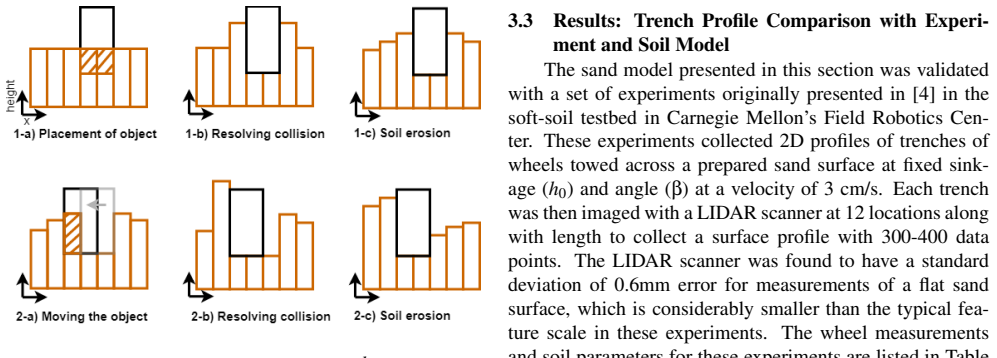
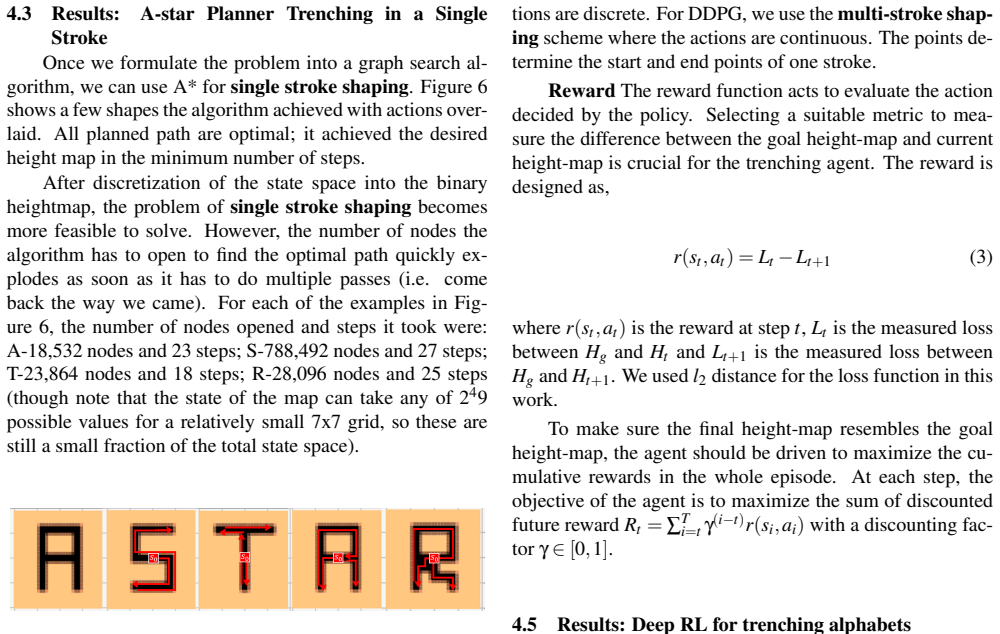
The central object is the height-map surface model: the sand volume is represented only by a two-dimensional grid of column heights, so the state has hundreds to thousands of dimensions instead of billions of particles. Two local update rules carry the argument. Soil erosion relaxes any local slope steeper than the angle of repose by flowing material downhill, with a flow rate chosen so a single update step reaches equilibrium (for eight-point connectivity, $k = \Delta x^2/8$). Tool interaction moves the volume of sand that overlaps a moving tool into an adjacent cell in the direction of motion, then lets erosion re-settle the profile. For planning, the A* formulation reduces the state to a binary height map (dug or not dug) and uses the admissible heuristic $\hat h(x) = \alpha \sum |H_g - H_t|$, which sums the remaining displacement needed, so the planner provably reaches the goal in the minimum number of strokes.
What would settle it
Measure the steady-state cross-section of a trench carved by a flat blade pushed at constant depth and speed through prepared sand with the same angle of repose (29 degrees), and compare it to the simulator's prediction; if the profile error substantially exceeds the 2.2 mm average and 0.9 mm depth error reported for the wheel case, or if the pile volume next to the trench does not match, then the unvalidated blade-interaction rule is wrong and the planning results do not transfer to real sand.
Extended reading notes
Core claim
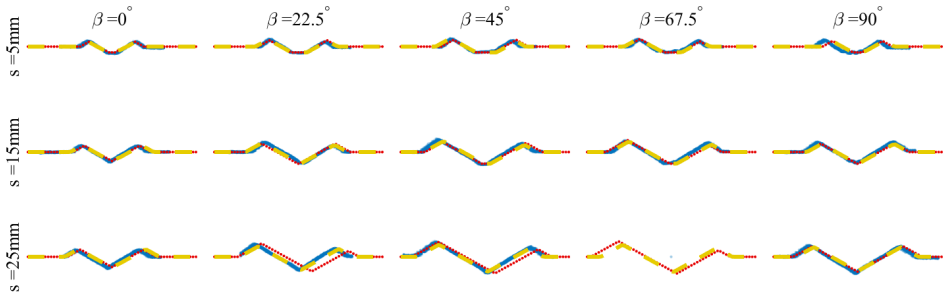
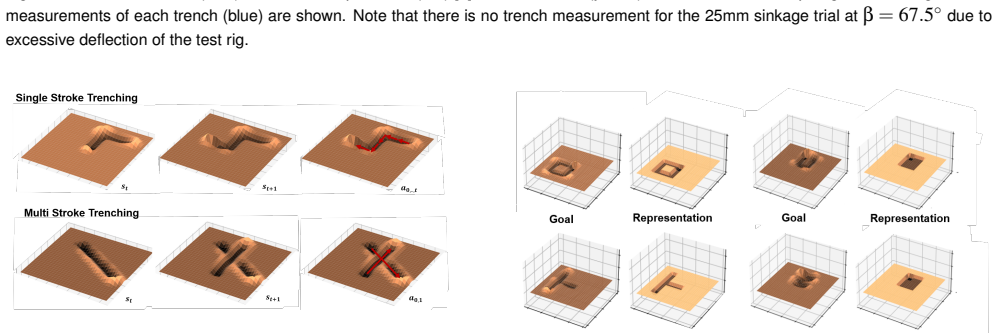
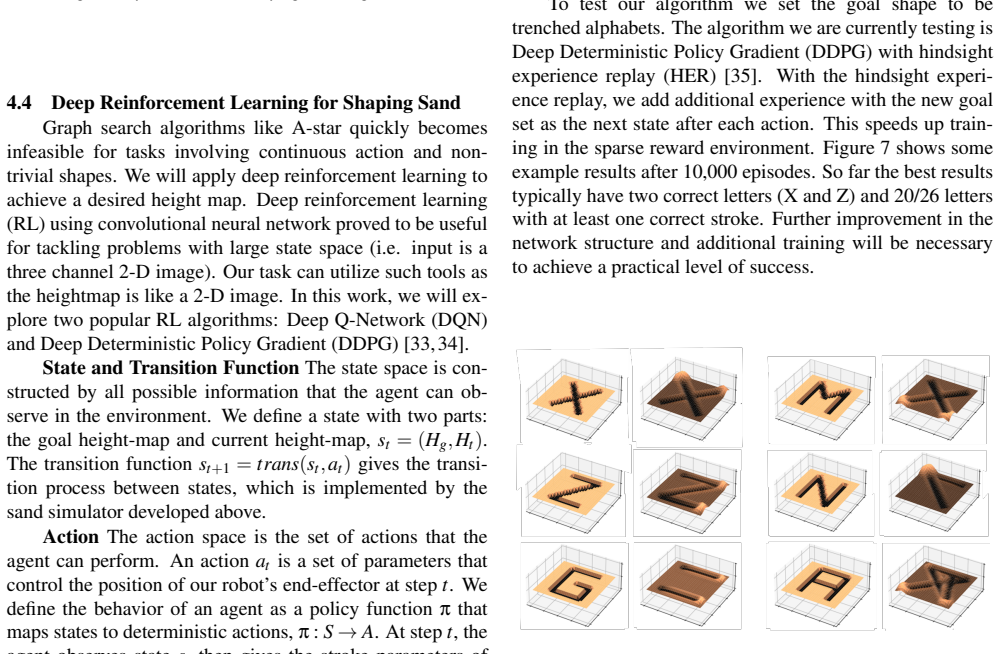
The central claim is that the shape of sand after tool interaction can be computed from the surface alone, without simulating individual grains, by alternating two local operations: an erosion step that moves material downhill wherever the local slope exceeds the angle of repose, and a tool-interaction step that moves sand overlapping a moving tool into the adjacent cell in the direction of travel. The paper reports that this two-rule height-map model predicts the steady-state profile of a wheel towed through prepared sand with an average error of 2.2 mm and a median error of 1.7 mm against LIDAR scans, and a depth error of 0.9 mm. For shaping, the paper claims that if the robot pushes a flat blade at constant depth in single strokes, the sand state can be reduced to a binary map (dug or not dug), allowing A* to find the minimum-step sequence of strokes that produces a desired trench shape. The authors also claim that the same simulator can serve as the transition function for deep reinforcement learning agents that shape sand through continuous strokes, with preliminary DDPG results producing two correct letters and at least one correct stroke for 20 of 26 alphabet-shaped goals after 10,000 episodes.
Load-bearing premise
The load-bearing premise is that the tool-interaction rule, which moves sand overlapping a moving tool into adjacent cells in the direction of motion, produces realistic steady-state profiles for a flat blade pushing sand, even though the paper only validates the model on a towed wheel's trench, not on blade pushing.
Editorial extensions
If this is right
- A robot could plan a trench-shaping sequence in advance with A* and execute it with a flat blade, since the planner is admissible and finds a minimum-step path on the binary representation.
- The same height-map simulator can be reused as a transition model for deep reinforcement learning agents, removing the need for expensive discrete-element or fluid simulations while learning to shape sand.
- Because the simulator matches wheel-trench data across slip angles from 0 to 90 degrees and sinkages from 5 to 25 mm, terrain-modification tasks for planetary rovers can be simulated at planning speed.
- The simulator can be combined with existing force-interaction or terramechanics models to account for robot-soil forces, as the authors note, making it useful not only for planning but for control.
Reading between the lines
- The blade-pushing rule is the unvalidated link: the paper demonstrates accuracy for a towed wheel, not for a flat blade, so the A* and reinforcement-learning trenching results should be read as conditional on the interaction rule transferring to blade geometry, and a direct blade-push experiment would settle that.
- The binary height-map used by A* deliberately discards the pile that accumulates next to the trench, so for goals that care about the pile, such as building a ramp, the planner would need a richer state representation that the same simulator could supply.
- The erosion-and-shift model should transfer to other granular materials by substituting the material's measured angle of repose, suggesting a comparably cheap planning route for soil, gravel, or regolith.
- The reward structure of the deep reinforcement learning agent, maximizing the decrease in height-map loss per stroke, is the natural objective for any shaping agent and could be combined with more advanced off-policy algorithms or curriculum goals.
Signed reviews
Editorial analysis
A structured set of objections, weighed in public.
Referee Report
Summary. The manuscript proposes a height-map simulator for sand-tool interaction: after each robot action, an erosion step relaxes local slopes to the angle of repose, and tool overlap volume is shifted to adjacent cells in the direction of motion. The simulator is validated for a towed wheel by comparing predicted trench profiles to LIDAR measurements from [4], reporting average error 2.2 mm and depth error 0.9 mm. The paper then formulates sand shaping as a planning problem, solves a discretized single-stroke version with A*, and reports preliminary DDPG results for multi-stroke alphabet trenching. The central claim is that this simple model is accurate enough to plan sand-shaping trajectories.
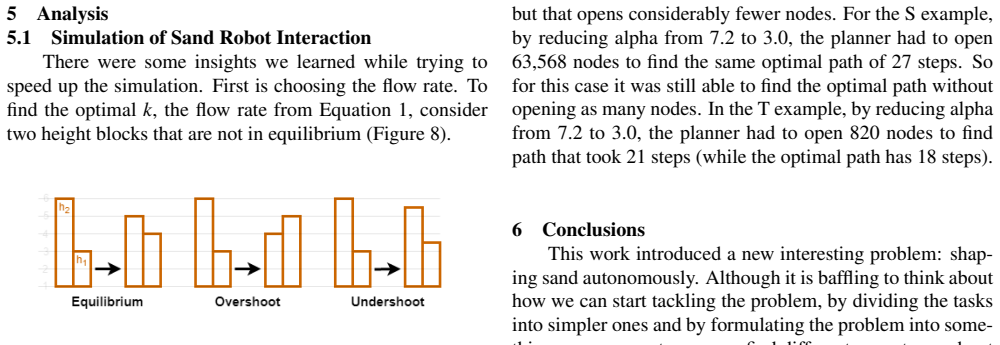
Significance. The wheel-trench validation is a genuine strength: it compares against independent external measurements, reports scanner noise, and quantifies errors across slip angles and sinkages. The derivation of the flow-rate parameter k in Section 5.1 is also a useful design rule. If the blade-push interaction rule were validated, the planning framework could be a practical starting point for autonomous sand shaping. However, as presented, the planning claims are only verified in simulation with an unvalidated blade rule, so the significance is conditional on additional experimental support.
major comments (4)
- [§3.2, §3.3, §4] The only quantitative validation of the simulator is for a towed wheel at fixed sinkage and slip angle, using data from [4]. The planning contributions in Section 4 replace the wheel with a flat blade pushed perpendicularly, and all A* and DDPG results are generated by applying the Section 3.2 overlap-displacement rule to that blade. No experiment, external dataset, or sensitivity study is presented for blade pushing. The 2.2 mm mean error from Section 3.3 therefore cannot be transferred to the blade-trenching scenario, and the claim that the planner 'achieved the desired height map' is a claim about the simulated sand only. The authors should either validate the blade rule against physical measurements or explicitly re-scope the planning claims as simulator-internal.
- [§4.2] The admissibility of the heuristic is asserted rather than proved: 'Our approximation is admissible as hhat(x) < h(x) since we can not achieve the goal shape with less than ΔH left.' This argument does not account for the binary-map simplification, which ignores the pile next to the trench, nor for the effect of the weight α on the relative scale of g and hhat. Without a proof, the statement in §4.3 that 'all planned path are optimal' is unsupported. Please provide a formal argument or an empirical check, for example by comparing A* costs with an exhaustive search on small maps.
- [§4.2] The binary height-map representation explicitly discards the pile that accumulates adjacent to the trench. The paper acknowledges this loss of expressivity but then uses the representation to claim optimality for real trenching. In multi-pass or backtracking strokes, the discarded pile could change the amount of sand available for subsequent pushes and thus change the resulting terrain. The authors should justify, with simulation or experiment, that the binary model is sufficient for the constant-depth single-stroke setting they consider.
- [§4.5] The DDPG results are reported as preliminary, but the evaluation is entirely qualitative: the paper states that the best results typically have two correct letters and 20/26 letters with at least one correct stroke, without giving a numerical metric, a baseline, or a comparison to the A* planner on the same task. This makes it difficult to assess whether the learning approach is making meaningful progress toward the shaping objective.
minor comments (5)
- [§2.4] The word 'terrachmechanics' appears in the text; it should be 'terramechanics'.
- [§5.2] The claim that the number of opened nodes grows by '4n order' for each backtracking step is not defined precisely; please specify what n denotes and provide a derivation or reference for this complexity claim.
- [Figures 4 and 5] Figures 4 and 5 are referenced in the text, but the captions describe environments and maps that are not fully explained in the body; please expand the captions or add the missing details in the text.
- [References] Reference [7] is titled 'A discrete numerical mode for granular assemblies'; 'mode' should be 'model'.
- [§4.3] The sentence 'All planned path are optimal' should read 'All planned paths are optimal'.
Circularity Check
No circularity: the simulator is validated against external LIDAR trench data, and the planning results are internal demonstrations rather than disguised predictions.
full rationale
The paper's central quantitative claim, the 2.2 mm average error in Section 3.3, is checked against LIDAR trench scans originally reported in [4]. Reference [4] is prior work by two of the present authors, so this is a self-citation, but the cited evidence consists of experimental LIDAR measurements and independently measured wheel and soil parameters. Those data are external to the simulator and are not the simulator's fitted outputs, so per the hard rules this self-citation does not raise the circularity score. The comparison to the [4] model is likewise an external benchmark, not an input to the simulator. The tool-interaction rule in Section 3.2 is an assumption, but no fitted parameter is renamed as a prediction and no equation reduces to its own input. The A* planner's claim in Section 4.3 that it 'achieved the desired height map in the minimum number of steps' is a property of A* with an admissible heuristic applied to the simulator's transition function; it is a known algorithmic guarantee, not a physical prediction derived from the model, so it is not circular. The absence of a blade-pushing experiment for the Section 4 planners is a correctness and transferability risk, not a circularity, because the paper does not claim to have validated the blade rule against external data. No specific circular step can be exhibited from the paper's equations or citations.
Assumptions & free parameters
free parameters (2)
- flow rate k =
dx^2/8 for 2D, dx/2 for 1D
- A* heuristic weight alpha =
Set so that delta_s = alpha * delta_H
assumptions (4)
- domain assumption Local angle-of-repose relaxation
- ad hoc to paper Tool overlap displacement rule
- domain assumption Quasi-static robot assumption
- domain assumption Binary height map sufficiency
Cite this review
Pith. "Pith review of Developing a Simple Model for Sand-Tool Interaction and Autonomously Shaping Sand." pith.science (2026). https://pith.science/paper/MCJUGYGP
@misc{pith2026190802745,
  author       = {Pith},
  title        = {Pith review of: Developing a Simple Model for Sand-Tool Interaction and Autonomously Shaping Sand},
  year         = {2026},
  howpublished = {\url{https://pith.science/paper/MCJUGYGP}},
  note         = {Machine review of arXiv:1908.02745}
}
read the original abstract
Autonomy for robots interacting with sand will enable a wide range of beneficial behaviors, from earth moving for construction and farming vehicles to navigating rough terrain for Mars rovers. The goal of this work is to shape sand into desired forms. Unlike other common autonomous tasks of achieving desired state of a robot, achieving a desired shape of a continuously deformable environment like sand is a much more challenging task. The state of robot can be described with a couple of states-x, y, z, roll, pitch, yaw-but the desired shape of sand can not be described with just a few values. Sand is an aggregation of billions of small particles. After simplifying the model of sand and tool interaction by looking only at the surface of the heightmap, we can formulate the problems into something that is still high dimensional (hundreds to thousands of state dimensions) but much more solvable. We show how this problem can be formulated into a graph search problem and solve it with the A-star algorithm and report preliminary results on using deep reinforcement learning methods like Deep Q-Network and Deep Deterministic Policy Gradient.
Figures

Figures from the paper (6 more)


Reference graph
Works this paper leans on
-
[4]
Soil displace- ment terramechanics for wheel-based trenching with a planetary rover
Pavlov, C., and Johnson, A. M., 2019. “Soil displace- ment terramechanics for wheel-based trenching with a planetary rover”. In 2019 IEEE International Confer- ence on Robotics and Automation (ICRA)
work page 2019
-
[1]
Waste dumps - the new frontier
R. G. Adam, R. A., and Bertinshaw, 1992. “Waste dumps - the new frontier”. Third Large Open Pit Min- ing Conference, pp. 255–259
work page 1992
-
[2]
Gross domestic product by industry: Third quarter 2018, February
Bureau of Economic Analysis, 2019. Gross domestic product by industry: Third quarter 2018, February
work page 2019
-
[3]
Acute Market Reports, 2018. Global earthmoving equipment market size, market share, application anal- ysis, regional outlook, growth trends, key players, com- petitive strategies and forecasts, 2018 to 2026, April
work page 2018
-
[5]
G. Bekker, M., 1969. Introduction to Terrain–Vehicle Systems. University of Michigan Press, 05
work page 1969
- [6]
-
[7]
A discrete numerical mode for granular assemblies
Cundall, P., and Strack, O., 1979. “A discrete numerical mode for granular assemblies”. Geotechnique, 29, 01, pp. 47–65
work page 1979
-
[8]
Simulation of rover locomotion on sandy terrain modeling verifica- tion and validation
Krenn, R., and Hirzinger, G., 2008. “Simulation of rover locomotion on sandy terrain modeling verifica- tion and validation”. In 10th ESA Workshop on Ad- vanced Space Technologies for Robotics and Automa- tion
work page 2008
Show all 37 references
-
[9]
Scm - a novel approach for soil deformation in a modular soil contact model for multibody simulation
Buse, F., Lichtenheldt, R., and Krenn, R., 2016. “Scm - a novel approach for soil deformation in a modular soil contact model for multibody simulation”. In 4th Joint International Conference on Multibody System Dynamics, V ol. 4
2016
-
[10]
Pla-Castells, M., Garca-Fernndez, I., and Martnez, R.,
-
[11]
Force fluctuations in a pushed granular ma- terial
Nouguier, C., Bohatier, C., Moreau, J. J., and Radjai, F., 2000. “Force fluctuations in a pushed granular ma- terial”. Granular Matter,2(4), Oct, pp. 171–178
2000
-
[12]
A model for pre- dicting soil-tool interaction
Swick, W., and Perumpral, J., 1988. “A model for pre- dicting soil-tool interaction”. Journal of Terramechan- ics, 25(1), pp. 43 – 56
1988
-
[13]
Soil de- formation models for real-time simulation: A hybrid approach
Holz, D., Beer, T., and Kuhlen, T., 2009. “Soil de- formation models for real-time simulation: A hybrid approach”. In Workshop on Virtual Reality Interaction and Physical Simulation
2009
-
[14]
3-d dem sim- ulation of cohesive soil-pushing behavior by bulldozer blade
Tsuji, T., Nakagawa, Y ., Matsumoto, N., Kadono, Y ., Takayama, T., and Tanaka, T., 2012. “3-d dem sim- ulation of cohesive soil-pushing behavior by bulldozer blade”. Journal of Terramechanics,49(1), pp. 37 – 47
2012
-
[15]
A particle method for history-dependent materials
D. Sulsky, Z. Chen, H. S., 1994. “A particle method for history-dependent materials”. Computer Meth- ods in Applied Mechanics and Engineering, 118(1-2), pp. 179–196
1994
-
[16]
Multi-species simu- lation of porous sand and water mixtures
Tampubolon, A. P., Gast, T., Kl´ar, G., Fu, C., Teran, J., Jiang, C., and Museth, K., 2017. “Multi-species simu- lation of porous sand and water mixtures”.ACM Trans. Graph., 36(4), July, pp. 105:1–105:11
2017
-
[17]
A physi- cist’s sandbox
Wiesenfeld, K., Tang, C., and Bak, P., 1989. “A physi- cist’s sandbox”. Journal of Statistical Physics, 54(5), Mar, pp. 1441–1458
1989
-
[18]
Dissipative transport in open systems: An investigation of self-organized criticality
Hwa, T., and Kardar, M., 1989. “Dissipative transport in open systems: An investigation of self-organized criticality”. Phys. Rev. Lett., 62, Apr, pp. 1813–1816
1989
-
[19]
Scaling theory of self-organized criticality
Zhang, Y .-C., 1989. “Scaling theory of self-organized criticality”. Phys. Rev. Lett., 63, Jul, pp. 470–473
1989
-
[20]
Self-orgainzed criticality and sin- gular diffusion
Carlson, J. M., Chayes, J. T., Grannan, E. R., and Swin- dle, G. H., 1990. “Self-orgainzed criticality and sin- gular diffusion”. Phys. Rev. Lett., 65, Nov, pp. 2547– 2550
1990
-
[21]
A model for the dynamics of sand- pile surfaces
Bouchaud, J. P., Cates, M. E., Prakash, J. R., and Ed- wards, S., 1994. “A model for the dynamics of sand- pile surfaces”. Journal de Physique I, 4(10), pp. 1383– 1410
1994
-
[22]
Virtual sandbox
Onoue, K., and Nishita, T., 2003. “Virtual sandbox”. In 11th Pacific Conference on Computer Graphics and Applications, pp. 252–259
2003
-
[23]
Theoretical Soil Mechanics
Terzaghi, K., 1943. Theoretical Soil Mechanics. John Wiley & Sons
1943
-
[24]
The state of the art in automation of earthmoving
Singh, S., 1997. “The state of the art in automation of earthmoving”. ASCE Journal of Aerospace Engineer- ing, 10(4), October
1997
-
[25]
A master-slave manipulator for excavation and construction tasks
M. Ostoja-Starzewski, M. S., 1989. “A master-slave manipulator for excavation and construction tasks”. Robotics and Autonomous Systems, 4, pp. 333–337
1989
-
[26]
A strategic planner for robot excavation
Romero-Lois, H., Hendrickson, C., and Oppenheim, I. J., 1989. “A strategic planner for robot excavation”. In Sixth International Symposium on Automation and Robotics in Construction
1989
-
[27]
Developing plans for robotic exca- vators
Singh, S., 1994. “Developing plans for robotic exca- vators”. In Proc. ASCE Conference on Robotics for Challenging Environments
1994
-
[28]
An optimized approach for automatic material distribution operations of bulldozers
Hirayama, M., Whitty, M., Katupitiya, J., and Guiv- ant, J., 2018. “An optimized approach for automatic material distribution operations of bulldozers”. Inter- national Journal of Advanced Robotic Systems, 15(2), p. 1729881418764716
2018
-
[29]
Path planning for autonomous bulldozers
Hirayama, M., Guivant, J., Katupitiya, J., and Whitty, M., 2019. “Path planning for autonomous bulldozers”. Mechatronics, 58, pp. 20 – 38
2019
-
[30]
Key challenges in automation of earth-moving machines
Dadhich, S., Bodin, U., and Andersson, U., 2016. “Key challenges in automation of earth-moving machines”. Automation in Construction, 68, pp. 212 – 222
2016
-
[31]
Clarke, S., Rhodes, T., Atkeson, C., and Kroemer, O.,
-
[32]
A formal basis for the heuristic determination of mini- mum cost paths
Hart, P. E., Nilsson, N. J., and Raphael, B., 1968. “A formal basis for the heuristic determination of mini- mum cost paths”. IEEE Transactions on Systems Sci- ence and Cybernetics, 4(2), July, pp. 100–107
1968
-
[33]
Playing atari with deep reinforcement learning
Mnih, V ., Kavukcuoglu, K., Silver, D., Graves, A., Antonoglou, I., Wierstra, D., and Riedmiller, M., 2013. “Playing atari with deep reinforcement learning”.arXiv preprint arXiv:1312.5602
2013 arXiv
-
[34]
Continuous control with deep reinforcement learn- ing
Lillicrap, T. P., Hunt, J. J., Pritzel, A., Heess, N., Erez, T., Tassa, Y ., Silver, D., and Wierstra, D., 2015. “Continuous control with deep reinforcement learn- ing”. arXiv preprint arXiv:1509.02971
2015 arXiv
-
[35]
Hindsight experience replay
Andrychowicz, M., Wolski, F., Ray, A., Schneider, J., Fong, R., Welinder, P., McGrew, B., Tobin, J., Abbeel, O. P., and Zaremba, W., 2017. “Hindsight experience replay”. In Advances in Neural Information Processing Systems, pp. 5048–5058. Appendix A: Sand model comparison Figu...
2017
-
[2015]
Modelling and simulation of several interacting cellular automata
“Modelling and simulation of several interacting cellular automata”. International Journal of Computer Aided Engineering and Technology,7, 01, pp. 192–206
-
[2018]
Learning audio feedback for estimating amount and flow of granular material
“Learning audio feedback for estimating amount and flow of granular material”. In Conference on Robot Learning, V ol. 87, Proceedings of Machine Learning Research, pp. 529–550
Reviewed August 14, 2026 · model on record in the stance chip above.
Discussion (0). Continue with ORCID to comment.