REVIEW 4 major objections 4 minor 40 references
SCAR: Spatial-/Channel-wise Attention Regression Networks for Crowd Counting
T0 review · 4 major / 4 minor · reviewed 2026-08-14 · deepseek-v4-flash
Pith's one-line read Adding non-local spatial and channel attention to a regression CNN improves crowd-counting accuracy.
desk verdict Known attention blocks applied to crowd counting with an honest but confounded ablation; worth refereeing if the baseline is fixed. read the letter →
The pith
A machine-rendered reading of the paper's core claim, the machinery that carries it, and where it could break.
The reading
What carries the argument
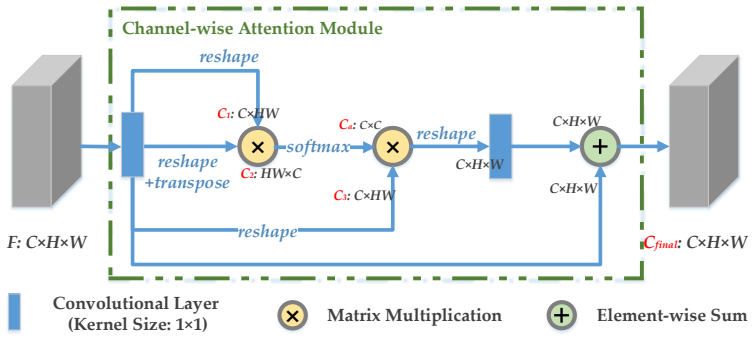
The central machinery is a pair of non-local attention modules built on the dilated convolutional features: SAM computes an HW-by-HW spatial attention map that encodes pixel-wise context over the whole image, and CAM computes a C-by-C channel attention map that models dependencies between feature channels, each with a learnable scaling parameter (lambda and mu). The two attention outputs are concatenated with the original feature map and regressed to a one-channel density map by a 1x1 convolution and 8x upsampling, trained with mean squared error. This mechanism is what lets the network use large-range context and head-region channel selectivity rather than relying only on local appearance.
What would settle it
Re-run SCAR and the closest baselines (especially CSRNet and ic-CNN) from their public implementations on ShanghaiTech Part A and Part B using the same image sizes, optimizer settings, and multiple random seeds, then check whether SCAR's reported MAE/MSE advantages persist across seeds; if the gaps shrink below the seed-to-seed variation or reverse, the claimed state-of-the-art result would not survive a controlled comparison.
Extended reading notes
Core claim
SCAR claims that placing two non-local self-attention modules on top of a dilated VGG-16 feature extractor reduces crowd-counting error. The Spatial-wise Attention Model computes a softmax-normalized HW-by-HW map relating every spatial position to every other, then reweights the feature map with a learnable scale; the Channel-wise Attention Model computes a C-by-C map relating every channel pair and reweights channels, so the network learns to trust head-related channels and suppress background response. The outputs of both modules are concatenated with the backbone features and passed through a 1x1 convolutional regressor followed by 8x upsampling to produce the density map. On ShanghaiTech Part A this yields MAE 66.3 versus CSRNet's 68.2, on Part B 9.5 versus 10.6, and on UCF_CC_50 259.0, the best MAE in the reported comparison. Ablation on Part B shows FCN baseline MAE 13.2, FCN+SAM 11.0, FCN+CAM 11.5, and the full SCAR 9.5, which the paper reads as evidence that both attention streams contribute and that their combination is additive.
Load-bearing premise
The state-of-the-art claim assumes that the published MAE/MSE numbers from other papers were obtained under directly comparable training and evaluation conditions, so that small differences, like the 1.9 MAE gap over CSRNet on Part A, are meaningful rather than protocol or training noise.
Editorial extensions
If this is right
- On ShanghaiTech Part A and Part B, SCAR reports lower MAE/MSE than the listed baselines including CSRNet and ic-CNN, with MAE 66.3/9.5 versus CSRNet's 68.2/10.6.
- On the synthetic GCC dataset, SCAR reports the best MAE among the compared methods under all three evaluation protocols: 31.7 for random splitting, 55.8 for cross-camera, and 87.2 for cross-location.
- On UCF_CC_50, SCAR reports the best MAE of 259.0 among the compared methods, improving on ic-CNN's 260.9 and CSRNet's 266.1.
- The ablation on ShanghaiTech Part B shows each attention module reduces error on its own and that SAM outperforms CAM, while the full model improves density map quality as measured by PSNR and SSIM.
- The paper's architecture is backbone-agnostic in principle, so the attention modules could be attached to other feature extractors or other pixel-wise regression heads wherever long-range context and background suppression matter.
Reading between the lines
- Beyond the paper: if the attention modules are truly task-agnostic, they could be dropped into saliency detection or semantic segmentation networks to test whether the same spatial-context and channel-selectivity gains transfer; the paper names these applications as future work but does not test them.
- Beyond the paper: the Part B fusion experiment compares concatenation with element-wise sum, but a direct extension would test weighted fusion or multi-scale fusion of SAM and CAM to see whether the two streams carry complementary information that a learned weighting could exploit further.
- Beyond the paper: because the paper reports single-run results, a direct extension would add multiple random seeds and report means and standard deviations; this would reveal whether the reported gaps, such as the 1.9 MAE difference on Part A, persist beyond training noise.
- Beyond the paper: the cross-location GCC results still show a large absolute MAE gap relative to random splitting, which suggests that even with attention, synthetic-to-real or cross-camera generalization remains a bottleneck; a natural extension is to measure how much of that gap attention modules close compared with a no-attention baseline.
Signed reviews
Editorial analysis
A structured set of objections, weighed in public.
Referee Report
Summary. This manuscript proposes SCAR, a crowd-counting network that appends a Spatial-wise Attention Module (SAM) and a Channel-wise Attention Module (CAM) to a VGG-16 backbone with a dilation module, fuses the two attention streams by concatenation, and regresses a density map. The paper reports MAE/MSE and PSNR/SSIM on ShanghaiTech Part A/B, UCF_CC_50, and GCC, and claims state-of-the-art results. An ablation on ShanghaiTech Part B reports that both SAM and CAM improve the baseline FCN, with the full model reaching 9.5 MAE.
Significance. The application of non-local attention to crowd counting is plausible, and the two-module design is simple and clearly specified at the architectural level. If the empirical claims are correct, the paper provides a useful baseline and evidence that spatial and channel attention transfer to density regression. The use of density-map quality metrics (PSNR/SSIM) in addition to MAE/MSE is a strength. However, the central SOTA and ablation claims rest on a baseline configuration that does not match the strongest published comparator, and no code or training repeatability information is provided.
major comments (4)
- [Section 5.1 (Table 5) and Table 1] The ablation baseline is confounded with the dilation-head design. Table 1 specifies a dilation module of six dilated conv layers (c512, c512, c512, c256, c128, c64), while the CSRNet architecture cited in Section 3.1 as the source of the dilation conv uses four dilated layers ending at 256 channels; Section 3.1 confirms that the proposed module outputs 64-channel 1/8-size maps. The published CSRNet Part B MAE is 10.6, while the FCN baseline in Table 5 is 13.2, so the 3.7-point improvement attributed to the attention modules is measured against a weaker network. Please rerun the ablation with a faithful CSRNet configuration, or separately ablate the dilation-head design from the attention modules, so the contribution of SAM and CAM is isolated.
- [Section 4.5 (Table 4)] The cross-location GCC results are not clearly attributed. In Table 4 the row with MAE 87.2 in the cross-location section is labeled 'SFCN' rather than SCAR, while the text states that SCAR achieves 87.2 for cross-location. As printed, the table does not actually show SCAR's cross-location MAE, which invalidates the 'best MAE' claim for that protocol unless the row is relabeled. Please correct the label and verify the reported values.
- [Sections 4.2, 4.3, and 5.1 (Tables 2-5)] All reported results appear to come from a single training run with no standard deviation. Tables 2 through 5 report only point estimates; on ShanghaiTech Part A the gap between SCAR (66.3 MAE) and CSRNet (68.2 MAE) is 1.9, which is within the typical run-to-run variation of crowd-counting models. Please report mean plus/minus standard deviation over at least three independent runs for the main tables and at least for the Part B ablation, and state whether test-time augmentation or multi-scale evaluation was used.
- [Section 4.2] The construction of the ground-truth density maps is not specified. Section 4.2 states that images are resized to 576 by 768 and density maps are generated under the same size, but it does not describe how the head annotations are converted to density maps, for example fixed Gaussian sigma versus geometry-adaptive kernels, normalization, or how resizing affects the density values. Without this information, the quantitative comparisons are not reproducible and may not be comparable to the cited baselines. Please specify the generation procedure explicitly.
minor comments (4)
- [Table 1] The conv3 row of the VGG-16 backbone lists c128, but VGG-16 conv3 has 256 channels; this is likely a typo and should be corrected for reproducibility.
- [Figure 5 caption] The caption repeats 'Column 3 and 4' and does not correctly map the five displayed columns to the spatial and channel attention maps; please update the column labels.
- [Section 4.5] The sentence claiming '8 best places from the 12 metrics' is hard to verify because Table 4 lists four metrics for each of three protocols; please state precisely which cells are being counted.
- [Section 5.3] The phrase 'different different fusion strategies' contains a duplicated word and should be reworded.
Circularity Check
No significant circularity: SCAR’s contribution is an empirical architecture comparison whose results are measured on external benchmarks, not derived from its own inputs.
full rationale
The paper’s derivation chain is an architecture design followed by standard supervised training and evaluation. SAM and CAM are explicitly presented as variants of the non-local/self-attention modules of [24,25] and are applied to crowd counting; the equations (1)–(4) are the ordinary self-attention computations, not a hidden restatement of the evaluation metric. No fitted parameter is renamed as a prediction: the model minimizes MSE during training and is assessed with independently computed MAE/MSE/PSNR/SSIM on standard train/test splits. The state-of-the-art claim rests on Table 2–4 comparisons against published numbers from other groups (CSRNet, MCNN, CP-CNN, etc.), so the result is externally falsifiable rather than forced by construction. Self-citations do appear—[16] supplies the GCC dataset and the FCN/SFCN baselines, [28] supplies code, and [15] is related prior work—but none of these carries the central claim; even if the GCC baselines come from the authors’ own prior paper, they are measured results on a public benchmark and the full model is also compared against CSRNet and MCNN in the same table. The ablation in Section 5.1 defines its baseline as “the combination of a single-column VGG-16 FCN and the dilation conv in CSRNet,” while Table 1 specifies a six-layer dilation head ending in 64 channels, which differs from CSRNet’s four-layer head ending in 256 channels. That is a genuine experimental comparability concern about whether the ablation isolates the attention modules, but it is not circularity: the reported MAE values are measurements, not consequences of the method’s definitions. Under the requested taxonomy, no step reduces the claimed prediction to the method’s inputs by definition or by self-citation.
Assumptions & free parameters
free parameters (5)
- Input image size 576x768 =
576x768
- Attention feature channel count C=64 =
64
- Initial learning rate 1e-5 with 0.995 per-epoch decay =
1e-5, decay 0.995
- Training duration 400 epochs and batch size 4 =
400, batch 4
- Dilation rate 2 in all dilation convolutions =
2
assumptions (5)
- domain assumption VGG-16 layers pretrained on ImageNet provide a good feature extractor for crowd counting
- domain assumption Dot annotations can be converted into density maps that serve as valid regression targets
- domain assumption PSNR and SSIM on density maps measure density map quality
- standard math Non-local matrix multiplication with softmax captures useful long-range dependencies in this task
- ad hoc to paper Results from one ablation dataset, ShanghaiTech Part B, generalize to GCC and UCF_CC_50
Cite this review
Pith. "Pith review of SCAR: Spatial-/Channel-wise Attention Regression Networks for Crowd Counting." pith.science (2026). https://pith.science/paper/MCNUQVFE
@misc{pith2026190803716,
  author       = {Pith},
  title        = {Pith review of: SCAR: Spatial-/Channel-wise Attention Regression Networks for Crowd Counting},
  year         = {2026},
  howpublished = {\url{https://pith.science/paper/MCNUQVFE}},
  note         = {Machine review of arXiv:1908.03716}
}
read the original abstract
Recently, crowd counting is a hot topic in crowd analysis. Many CNN-based counting algorithms attain good performance. However, these methods only focus on the local appearance features of crowd scenes but ignore the large-range pixel-wise contextual and crowd attention information. To remedy the above problems, in this paper, we introduce the Spatial-/Channel-wise Attention Models into the traditional Regression CNN to estimate the density map, which is named as "SCAR". It consists of two modules, namely Spatial-wise Attention Model (SAM) and Channel-wise Attention Model (CAM). The former can encode the pixel-wise context of the entire image to more accurately predict density maps at the pixel level. The latter attempts to extract more discriminative features among different channels, which aids model to pay attention to the head region, the core of crowd scenes. Intuitively, CAM alleviates the mistaken estimation for background regions. Finally, two types of attention information and traditional CNN's feature maps are integrated by a concatenation operation. Furthermore, the extensive experiments are conducted on four popular datasets, Shanghai Tech Part A/B, GCC, and UCF_CC_50 Dataset. The results show that the proposed method achieves state-of-the-art results.
Figures


Figures from the paper (3 more)


Reference graph
Works this paper leans on
-
[1]
M. S. Zitouni, H. Bhaskar, J. Dias, M. Al-Mualla, Advances and trends in visual crowd analysis: A systematic survey and evaluation of crowd modelling techniques, Neurocomputing 186 (2016) 139 – 159
work page 2016
-
[2]
W. Lu, X. Wei, W. Xing, W. Liu, Trajectory-based motion pattern analysis of crowds, Neurocomputing 247 (2017) 213 – 223
work page 2017
-
[3]
X. Wei, J. Du, Z. Xue, M. Liang, Y. Geng, X. Xu, J. Lee, A very deep two-stream network for crowd type recognition, Neurocomputing
- [4]
- [5]
-
[6]
Y. Li, X. Zhang, D. Chen, Csrnet: Dilated convolutional neural networks for understanding the highly congested scenes, in: Proceedings of the IEEE Conference on Computer Vision and Pattern Recognition, 2018, pp. 1091–1100. 16
work page 2018
-
[7]
L. Wang, B. Yin, X. Tang, Y. Li, Removing background interference for crowd counting via de-background detail convolutional network, Neuro- computing 332 (2019) 360 – 371
work page 2019
-
[8]
J. Ma, Y. Dai, Y.-P. Tan, Atrous convolutions spatial pyramid network for crowd counting and density estimation, Neurocomputing 350 (2019) 91 – 101
work page 2019
Show all 40 references
-
[9]
X. Lu, W. Zhang, X. Li, A hybrid sparsity and distance-based discrim- ination detector for hyperspectral images, IEEE Transactions on Geo- science and Remote Sensing 56 (3) (2017) 1704–1717
2017
-
[10]
X. Lu, B. Wang, X. Zheng, X. Li, Exploring models and data for remote sensing image caption generation, IEEE Transactions on Geoscience and Remote Sensing 56 (4) (2017) 2183–2195
2017
-
[11]
B. Zhao, X. Li, X. Lu, Hierarchical recurrent neural network for video summarization, in: Proceedings of the 25th ACM international confer- ence on Multimedia, ACM, 2017, pp. 863–871
2017
-
[12]
B. Zhao, X. Li, X. Lu, Cam-rnn: Co-attention model based rnn for video captioning, IEEE Transactions on Image Processing
-
[13]
J. Gao, Q. Wang, Y. Yuan, Convolutional regression network for multi- oriented text detection, IEEE Access 7 (2019) 96424–96433
2019
-
[14]
Q. Wang, J. Gao, X. Li, Weakly supervised adversarial domain adapta- tion for semantic segmentation in urban scenes, IEEE Transactions on Image Processing 28 (9) (2019) 4376–4386
2019
-
[15]
J. Gao, Q. Wang, X. Li, Pcc net: Perspective crowd counting via spatial convolutional network, IEEE Transactions on Circuits and Systems for Video Technology
-
[16]
Q. Wang, J. Gao, W. Lin, Y. Yuan, Learning from synthetic data for crowd counting in the wild, in: Proceedings of IEEE Conference on Computer Vision and Pattern Recognition (CVPR), 2019
2019
-
[17]
Zhang, D
Y. Zhang, D. Zhou, S. Chen, S. Gao, Y. Ma, Single-image crowd count- ing via multi-column convolutional neural network, in: Proceedings of the IEEE conference on computer vision and pattern recognition, 2016, pp. 589–597. 17
2016
-
[18]
D. B. Sam, S. Surya, R. V. Babu, Switching convolutional neural net- work for crowd counting, in: Proceedings of the IEEE Conference on Computer Vision and Pattern Recognition, Vol. 1, 2017, p. 6
2017
-
[19]
Idrees, M
H. Idrees, M. Tayyab, K. Athrey, D. Zhang, S. Al-Maadeed, N. Rajpoot, M. Shah, Composition loss for counting, density map estimation and localization in dense crowds, arXiv preprint arXiv:1808.01050
-
[20]
V. A. Sindagi, V. M. Patel, Cnn-based cascaded multi-task learning of high-level prior and density estimation for crowd counting, in: Ad- vanced Video and Signal Based Surveillance (AVSS), 2017 14th IEEE International Conference on, IEEE, 2017, pp. 1–6
2017
-
[21]
V. A. Sindagi, V. M. Patel, Generating high-quality crowd density maps using contextual pyramid cnns, in: 2017 IEEE International Conference on Computer Vision (ICCV), IEEE, 2017, pp. 1879–1888
2017
-
[22]
L. Liu, H. Wang, G. Li, W. Ouyang, L. Lin, Crowd counting using deep recurrent spatial-aware network, arXiv preprint arXiv:1807.00601
-
[23]
Simonyan, A
K. Simonyan, A. Zisserman, Very deep convolutional networks for large- scale image recognition, arXiv preprint arXiv:1409.1556
-
[24]
Vaswani, N
A. Vaswani, N. Shazeer, N. Parmar, J. Uszkoreit, L. Jones, A. N. Gomez, L. Kaiser, I. Polosukhin, Attention is all you need, in: Advances in Neural Information Processing Systems, 2017, pp. 5998–6008
2017
-
[25]
X. Wang, R. Girshick, A. Gupta, K. He, Non-local neural networks, in: The IEEE Conference on Computer Vision and Pattern Recognition (CVPR), 2018
2018
-
[26]
W. Qi, W. Jia, Y. Yuan, Deep metric learning for crowdedness regres- sion, IEEE Transactions on Circuits and Systems for Video Technology PP (99) (2017) 1–1
2017
-
[27]
Zhang, F
Y. Zhang, F. Chang, M. Wang, F. Zhang, C. Han, Auxiliary learning for crowd counting via count-net, Neurocomputing 273 (2018) 190 – 198
2018
-
[28]
J. Gao, W. Lin, B. Zhao, D. Wang, C. Gao, J. Wen, C 3 frame- work: An open-source pytorch code for crowd counting, arXiv preprint arXiv:1907.02724. 18
1907 arXiv
-
[29]
V. Mnih, N. Heess, A. Graves, et al., Recurrent models of visual atten- tion, in: Advances in neural information processing systems, 2014, pp. 2204–2212
2014
-
[30]
Sutskever, O
I. Sutskever, O. Vinyals, Q. V. Le, Sequence to sequence learning with neural networks, in: Advances in neural information processing systems, 2014, pp. 3104–3112
2014
-
[31]
X. Lu, Y. Chen, X. Li, Hierarchical recurrent neural hashing for image retrieval with hierarchical convolutional features, IEEE Transactions on Image Processing 27 (1) (2017) 106–120
2017
-
[32]
K. Xu, J. Ba, R. Kiros, K. Cho, A. Courville, R. Salakhutdinov, R. Zemel, Y. Bengio, Show, attend and tell: Neural image caption gen- eration with visual attention, arXiv preprint arXiv:1502.03044
-
[33]
L. Chen, H. Zhang, J. Xiao, L. Nie, J. Shao, W. Liu, T.-S. Chua, Sca- cnn: Spatial and channel-wise attention in convolutional networks for image captioning, in: Proceedings of the IEEE conference on computer vision and pattern recognition, 2017, pp. 5659–5667
2017
-
[34]
S. Woo, J. Park, J.-Y. Lee, I. So Kweon, Cbam: Convolutional block attention module, in: Proceedings of the European Conference on Com- puter Vision (ECCV), 2018, pp. 3–19
2018
-
[35]
Z. Wang, A. C. Bovik, H. R. Sheikh, E. P. Simoncelli, Image quality assessment: from error visibility to structural similarity, IEEE transac- tions on image processing 13 (4) (2004) 600–612
2004
-
[36]
Paszke, S
A. Paszke, S. Gross, S. Chintala, G. Chanan, Pytorch: Tensors and dynamic neural networks in python with strong gpu acceleration (2017)
2017
-
[37]
Zhang, H
C. Zhang, H. Li, X. Wang, X. Yang, Cross-scene crowd counting via deep convolutional neural networks, in: Computer Vision and Pattern Recognition (CVPR), 2015 IEEE Conference on, IEEE, 2015, pp. 833– 841
2015
-
[38]
X. Ding, Z. Lin, F. He, Y. Wang, Y. Huang, A deeply-recursive convo- lutional network for crowd counting, arXiv preprint arXiv:1805.05633. 19
-
[39]
Ranjan, H
V. Ranjan, H. Le, M. Hoai, Iterative crowd counting, arXiv preprint arXiv:1807.09959
-
[40]
Idrees, I
H. Idrees, I. Saleemi, C. Seibert, M. Shah, Multi-source multi-scale counting in extremely dense crowd images, in: Computer Vision and Pattern Recognition (CVPR), 2013 IEEE Conference on, IEEE, 2013, pp. 2547–2554. 20
2013
Reviewed August 14, 2026 · model on record in the stance chip above.
Discussion (0). Continue with ORCID to comment.