Instabilities in a Non-KAM System via Information Scrambling: A Note
Pith reviewed 2026-06-27 07:04 UTC · model grok-4.3
The pith
Out-of-time-ordered correlators grow quadratically near resonances in the quantized kicked harmonic oscillator, revealing a number-theoretic structure.
A machine-rendered reading of the paper's core claim, the machinery that carries it, and where it could break.
Core claim
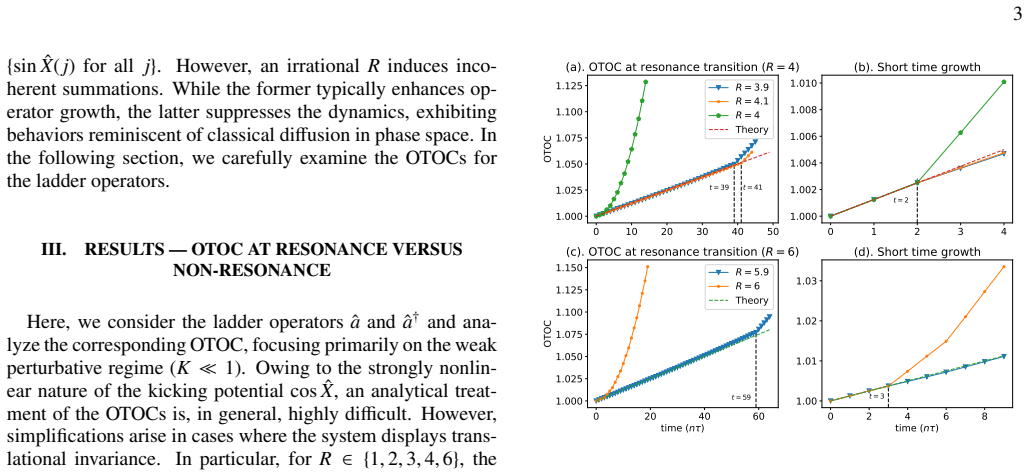
Near resonances where the ratio of oscillator and driving frequencies is integer, the OTOCs of the kicked harmonic oscillator exhibit quadratic-in-time growth, in contrast to linear growth off resonance. Although the classical Lyapunov exponent remains small, a perturbative treatment yields closed-form OTOC expressions whose structure is governed by the Euler totient function of the frequency ratio, exposing a number-theoretic organization in the scrambling dynamics.
What carries the argument
Perturbative evaluation of out-of-time-ordered correlators near integer frequency ratios, whose closed-form expressions depend on the Euler totient function of the frequency ratio.
If this is right
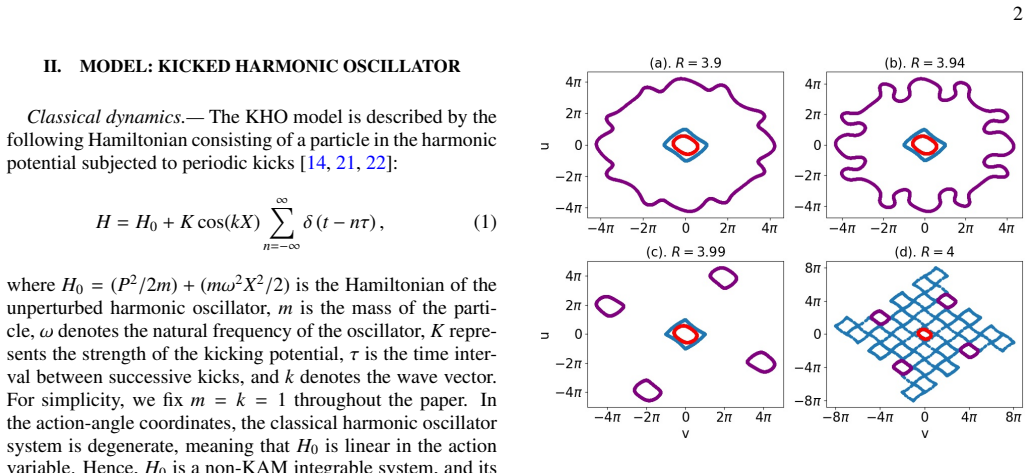
- Resonances produce strong phase-space restructuring even in the absence of conventional chaos.
- OTOCs serve as sensitive detectors of these resonant instabilities through their distinct growth rates.
- The number-theoretic structure in the OTOCs is organized by the Euler totient function of the frequency ratio.
- Resonant structures play an important role in controlling information spreading in non-KAM systems.
Where Pith is reading between the lines
- The same resonance-driven quadratic growth may appear in other degenerate quantum maps where standard KAM theory does not apply.
- The appearance of the totient function suggests that arithmetic properties of frequency ratios can be used to predict scrambling rates.
- Quantum simulators could directly test whether quadratic OTOC growth occurs precisely at integer ratios while remaining linear elsewhere.
Load-bearing premise
The perturbative treatment remains valid and captures the leading resonance effect on OTOCs even though the classical Lyapunov exponent is small.
What would settle it
Numerical computation of OTOCs for the kicked oscillator at an exact integer frequency ratio that fails to display quadratic growth or deviates from the predicted dependence on the Euler totient function.
Figures
read the original abstract
We study operator growth in quantized non-KAM systems using out-of-time-ordered correlators (OTOCs), focusing on the kicked harmonic oscillator as a representative example. Since the classical harmonic oscillator is degenerate, the dynamics fall outside the usual Kolmogorov-Arnold-Moser (KAM) framework, and resonances play a central role in shaping the phase space. We examine the system near resonances, where the ratio between the oscillator and driving frequencies takes integer values. Even though the classical Lyapunov exponent remains small at these points, and hence no conventional chaos, the phase space still undergoes strong structural changes. The OTOCs are particularly sensitive to these resonances, with a quadratic-in-time growth at resonance compared to linear growth away from it. Within a perturbative treatment, we derive closed-form expressions for the OTOCs and uncover a number-theoretic structure emerging in the behavior of OTOCs, governed by the Euler totient function of the frequency ratio. Overall, the results we present in this short note imply that resonant structures can play an important role in controlling information spreading.
Editorial analysis
A structured set of objections, weighed in public.
Referee Report
Summary. The manuscript examines operator growth via out-of-time-ordered correlators (OTOCs) in the quantized kicked harmonic oscillator, a non-KAM system. It focuses on dynamics near resonances (integer ratios of oscillator to driving frequency). The central claims are that OTOCs exhibit quadratic-in-time growth at resonance versus linear growth off-resonance, that closed-form perturbative expressions for the OTOCs can be derived, and that these expressions reveal an emergent number-theoretic structure controlled by the Euler totient function of the frequency ratio. The classical Lyapunov exponent remains small, so conventional chaos is absent, yet resonances still induce strong phase-space reorganization to which the OTOCs are sensitive.
Significance. If the perturbative closed-form expressions and the totient dependence are rigorously established, the result would demonstrate that resonant structures can govern information spreading in non-KAM systems even in the absence of positive Lyapunov exponents. The explicit link between OTOC growth rates and the Euler totient function would constitute a novel connection between quantum dynamics and number theory. The work is a short note, so its impact would be primarily conceptual rather than providing exhaustive benchmarks or applications.
major comments (2)
- [Abstract] Abstract (and the statement of the perturbative treatment): The claim that closed-form OTOC expressions are obtained perturbatively near integer frequency ratios is load-bearing for the quadratic-growth and totient-structure results, yet no explicit small parameter, radius of convergence, or error estimate is supplied. Given the manuscript's own remark that resonances produce 'strong structural changes' in phase space while the Lyapunov exponent stays small, the validity of truncating the expansion at the order needed for the claimed closed forms requires justification (e.g., via comparison to exact numerics or an explicit expansion parameter).
- The derivation of the closed-form OTOCs: Without the explicit perturbative steps, the order at which the totient function appears, or any check that higher-order terms remain negligible at resonance, it is impossible to confirm that the quadratic growth is a genuine resonance signature rather than an artifact of the truncation.
Simulated Author's Rebuttal
We thank the referee for their careful reading and for highlighting the need for greater clarity on the perturbative framework. The comments correctly identify that the manuscript, as a short note, does not supply sufficient detail on the expansion parameter or intermediate steps. We will address both points by expanding the presentation in a revised version.
read point-by-point responses
-
Referee: [Abstract] Abstract (and the statement of the perturbative treatment): The claim that closed-form OTOC expressions are obtained perturbatively near integer frequency ratios is load-bearing for the quadratic-growth and totient-structure results, yet no explicit small parameter, radius of convergence, or error estimate is supplied. Given the manuscript's own remark that resonances produce 'strong structural changes' in phase space while the Lyapunov exponent stays small, the validity of truncating the expansion at the order needed for the claimed closed forms requires justification (e.g., via comparison to exact numerics or an explicit expansion parameter).
Authors: We agree that an explicit small parameter and supporting checks are required. The perturbative expansion is performed in the frequency detuning from exact integer resonance; this detuning is the natural small parameter controlling the strength of the resonant reorganization. In the revision we will state this parameter explicitly, estimate its radius of convergence from the scale at which non-resonant terms become comparable, and add direct numerical comparisons between the closed-form expressions and exact OTOC computations to quantify truncation error. These additions will confirm that the leading-order quadratic growth is a genuine resonance signature. revision: yes
-
Referee: [—] The derivation of the closed-form OTOCs: Without the explicit perturbative steps, the order at which the totient function appears, or any check that higher-order terms remain negligible at resonance, it is impossible to confirm that the quadratic growth is a genuine resonance signature rather than an artifact of the truncation.
Authors: We acknowledge that the short-note format omitted the intermediate perturbative steps. The Euler totient function arises when summing the resonant Fourier components that survive at each order because of the integer frequency ratio. The revision will include an appendix that (i) writes the perturbative series for the OTOC operator, (ii) shows the order at which the totient counting appears, and (iii) demonstrates via both analytic bounds and numerical checks that higher-order corrections remain sub-dominant on the time scales where quadratic growth is reported. This will establish that the quadratic growth is not an artifact of truncation. revision: yes
Circularity Check
No circularity: perturbative derivation of OTOC closed forms stands as independent calculation
full rationale
The paper presents a perturbative treatment that derives closed-form OTOC expressions near integer frequency ratios and identifies an emergent Euler-totient dependence as a derived feature of that calculation. No load-bearing self-citations, fitted parameters re-labeled as predictions, self-definitional steps, or ansatzes smuggled via prior work appear in the text. The quadratic-in-time growth is stated as an output of the perturbative analysis rather than an input assumption, and the overall chain remains self-contained against external benchmarks.
Axiom & Free-Parameter Ledger
axioms (2)
- domain assumption Perturbative expansion around integer frequency ratios remains accurate for the leading OTOC behavior
- standard math Standard canonical quantization of the kicked harmonic oscillator
Reference graph
Works this paper leans on
-
[1]
P ¨oschel, A lecture on the classical kam theorem, arXiv preprint arXiv:0908.2234 (2009)
J. P ¨oschel, A lecture on the classical kam theorem, arXiv preprint arXiv:0908.2234 (2009)
Pith/arXiv arXiv 2009
-
[2]
Sankaranarayanan, A
R. Sankaranarayanan, A. Lakshminarayan, and V . B. Sheorey, Quantum chaos of a particle in a square well: Competing length scales and dynamical localization, Phys. Rev. E64, 046210 (2001)
2001
-
[3]
Sankaranarayanan, A
R. Sankaranarayanan, A. Lakshminarayan, and V . Sheorey, Chaos in a well: effects of competing length scales, Physics Letters A279, 313 (2001)
2001
-
[4]
Larkin and Y
A. Larkin and Y . N. Ovchinnikov, Quasiclassical method in the theory of superconductivity, Sov Phys JETP28, 1200 (1969)
1969
-
[5]
Nahum, S
A. Nahum, S. Vijay, and J. Haah, Operator spreading in random unitary circuits, Phys. Rev. X8, 021014 (2018)
2018
-
[6]
Lin and O
C.-J. Lin and O. I. Motrunich, Out-of-time-ordered correlators in a quantum ising chain, Phys. Rev. B97, 144304 (2018)
2018
-
[7]
S. H. Shenker and D. Stanford, Black holes and the butterfly effect, Journal of High Energy Physics2014, 67 (2014)
2014
-
[8]
Maldacena, S
J. Maldacena, S. H. Shenker, and D. Stanford, A bound on chaos, Journal of High Energy Physics2016, 106 (2016)
2016
-
[9]
Hosur, X.-L
P. Hosur, X.-L. Qi, D. A. Roberts, and B. Yoshida, Chaos in quantum channels, Journal of High Energy Physics2016, 4 (2016)
2016
-
[10]
Seshadri, V
A. Seshadri, V . Madhok, and A. Lakshminarayan, Tripartite mutual information, entanglement, and scrambling in permuta- tion symmetric systems with an application to quantum chaos, Phys. Rev. E98, 052205 (2018)
2018
-
[11]
Lakshminarayan, Out-of-time-ordered correlator in the quantum bakers map and truncated unitary matrices, Physical Review E99, 012201 (2019)
A. Lakshminarayan, Out-of-time-ordered correlator in the quantum bakers map and truncated unitary matrices, Physical Review E99, 012201 (2019)
2019
-
[12]
Prakash and A
R. Prakash and A. Lakshminarayan, Scrambling in strongly chaotic weakly coupled bipartite systems: Universality beyond the ehrenfest timescale, Physical Review B101, 121108 (2020)
2020
-
[13]
N. D. Varikuti and V . Madhok, Out-of-time ordered correlators in kicked coupled tops: Information scrambling in mixed phase space and the role of conserved quantities, Chaos: An Interdis- ciplinary Journal of Nonlinear Science34(2024)
2024
-
[14]
N. D. Varikuti, A. Sahu, A. Lakshminarayan, and V . Madhok, Probing dynamical sensitivity of a non-kolmogorov-arnold- moser system through out-of-time-order correlators, Phys. Rev. E109, 014209 (2024)
2024
-
[15]
D. P. Solis, A. Windey, S. Bandyopadhyay, A. Legramandi, and P. Hauke, From single-particle to many-body chaos in the yukawa-sachdev-ye-kitaev model: Theory and a cavity-qed proposal, Phys. Rev. B113, 184121 (2026)
2026
-
[16]
G ¨arttner, P
M. G ¨arttner, P. Hauke, and A. M. Rey, Relating out-of-time- order correlations to entanglement via multiple-quantum coher- ences, Phys. Rev. Lett.120, 040402 (2018)
2018
-
[17]
Hauke and L
P. Hauke and L. Tagliacozzo, Spread of correlations in long- range interacting quantum systems, Phys. Rev. Lett.111, 207202 (2013)
2013
-
[18]
B. Yan, L. Cincio, and W. H. Zurek, Information scrambling and loschmidt echo, Physical review letters124, 160603 (2020)
2020
-
[19]
Leone, S
L. Leone, S. F. E. Oliviero, and A. Hamma, Stabilizer r ´enyi entropy, Phys. Rev. Lett.128, 050402 (2022)
2022
-
[20]
N. D. Varikuti, S. Bandyopadhyay, and P. Hauke, Deep thermal- ization and measurements of quantum resources, arXiv preprint arXiv:2512.09999 (2025)
arXiv 2025
-
[21]
T. P. Billam and S. A. Gardiner, Quantum resonances in an atom-opticalδ-kicked harmonic oscillator, Phys. Rev. A80, 023414 (2009)
2009
-
[22]
Kells,Quantum Chaos in the Delta Kicked Harmonic Os- cillator, Ph.D
G. Kells,Quantum Chaos in the Delta Kicked Harmonic Os- cillator, Ph.D. thesis, National University of Ireland, Maynooth (2005)
2005
-
[23]
Berman, V
G. Berman, V . Y . Rubaev, and G. Zaslavsky, The problem of quantum chaos in a kicked harmonic oscillator, Nonlinearity4, 543 (1991)
1991
-
[24]
Shepelyansky and C
D. Shepelyansky and C. Sire, Quantum evolution in a dynami- cal quasi-crystal, EPL (Europhysics Letters)20, 95 (1992)
1992
-
[25]
M. V . Daly,Classical and quantum chaos in a non-linearly kicked harmonic oscillator, Ph.D. thesis, Dublin City Univer- sity (1994)
1994
-
[26]
G. A. Kells, J. Twamley, and D. M. Heffernan, Dynamical prop- erties of the delta-kicked harmonic oscillator, Phys. Rev. E70, 015203(R) (2004)
2004
-
[27]
S. A. Gardiner, J. Cirac, and P. Zoller, Quantum chaos in an ion trap: the delta-kicked harmonic oscillator, Physical review letters79, 4790 (1997)
1997
-
[28]
A. R. R. Carvalho and A. Buchleitner, Web-assisted tunneling in the kicked harmonic oscillator, Phys. Rev. Lett.93, 204101 (2004)
2004
-
[29]
S. A. Gardiner, D. Jaksch, R. Dum, J. I. Cirac, and P. Zoller, Nonlinear matter wave dynamics with a chaotic potential, Phys. Rev. A62, 023612 (2000)
2000
-
[30]
G. J. Duffy, A. S. Mellish, K. J. Challis, and A. C. Wilson, Non- linear atom-opticalδ-kicked harmonic oscillator using a bose- einstein condensate, Phys. Rev. A70, 041602(R) (2004)
2004
-
[31]
Borgonovi and L
F. Borgonovi and L. Rebuzzini, Translational invariance in the kicked harmonic oscillator, Phys. Rev. E52, 2302 (1995)
1995
-
[32]
Frasca, Quantum kicked dynamics and classical diffusion, Physics Letters A231, 344 (1997)
M. Frasca, Quantum kicked dynamics and classical diffusion, Physics Letters A231, 344 (1997). 6 Appendix A: Derivation of[ˆa(t),ˆa†] The Heisenberg evolution of the bosonic creation and annihilation operators is obtained as ˆa(t)eiωτt =ˆa+iK r ω 2 t−1X j=0 ei jωτ sin ˆX(j) (A1) =ˆa+ K 2 r ω 2 t−1X j=0 ei jωτ ( U†j " D i√ 2ω ! −D −i√ 2ω !# U j ) .(A2) We u...
1997
discussion (0)
Sign in with ORCID, Apple, or X to comment. Anyone can read and Pith papers without signing in.