REVIEW 2 major objections 5 minor 54 references
Deformable Triangle Splatting: Flexible Primitives for Real-Time Radiance Field Rendering
T0 review · 2 major / 5 minor · reviewed 2026-08-01 · deepseek-v4-flash
Pith's one-line read This paper claims that adding K learnable edge displacements to each triangle in a splatting renderer produces a single primitive that can represent non-convex shapes and improves novel-view quality over rigid triangle splatting.
desk verdict DETRIS is a credible incremental extension of Triangle Splatting with plausible gains, but the 'exactly view-independent by construction' claim does not hold under perspective projection. read the letter →
The pith
A machine-rendered reading of the paper's core claim, the machinery that carries it, and where it could break.
The reading
What carries the argument
The load-bearing machinery is the barycentric coordinate map b = T^{-1}(p - p1) with T = [p2 - p1, p3 - p1], which sends every pixel inside the projected triangle to the unit triangle in (u,v) space. Control points are placed at b_{i,k} = b_start + (k/(K+1)) e_i + d_{i,k} nhat_i, where d_{i,k} is the single learnable scalar displacement along the edge normal nhat_i; this is the entire shape-adaptation mechanism, and it preserves the three base vertices that define the 3D plane. Inside/outside decisions use a non-zero winding-number rule via ray casting; the opacity falloff uses a polynomial smooth minimum over point-to-segment distances with smoothing radius g = delta * r_bary, followed by a
What would settle it
Render a single deformed primitive (e.g., a heart or arrow) with fixed displacements and corner smoothness from several camera angles spanning 0°–60° slant, extract the screen-space silhouette each time, and unproject it to 3D using the rendered depth. If the reconstructed 3D boundary differs between views beyond numerical precision, the claimed view-independence fails; equivalently, compute the 3D barycentric coordinates of the ray–plane intersection and compare them to the 2D pixel barycentric coordinates used by the rasterizer, and show the discrepancy grows with slant.
Extended reading notes
Core claim
On its own terms, the paper's discovery is that convexity is not a necessary property of a splatting primitive. By placing K control points per edge and letting each move by a single scalar displacement along the edge normal in barycentric coordinates, the boundary of a triangle becomes a piecewise-linear polygon that can bend inward and outward while the three base vertices still define a 3D plane. The rasterizer classifies pixels with a winding-number test, computes a C1-continuous distance field via a polynomial smooth minimum with a learnable corner-rounding radius, and converts it to opacity through a power-law window normalized by the deformed polygon's inradius. Because all deformatio
Load-bearing premise
The load-bearing premise is that the 2D barycentric coordinates of a pixel, computed from the projected triangle, are an intrinsic and view-independent parameterization of the primitive's surface; because perspective projection is projective, not affine, a fixed deformed polygon in this coordinate space does not correspond to a fixed 3D region when the triangle is viewed obliquely.
Editorial extensions
If this is right
- A single deformable triangle can reproduce both convex and concave 2D targets (circle, square, Gaussian, clover, arrow, Pac-Man, heart) that require three rigid triangles or eight Gaussians.
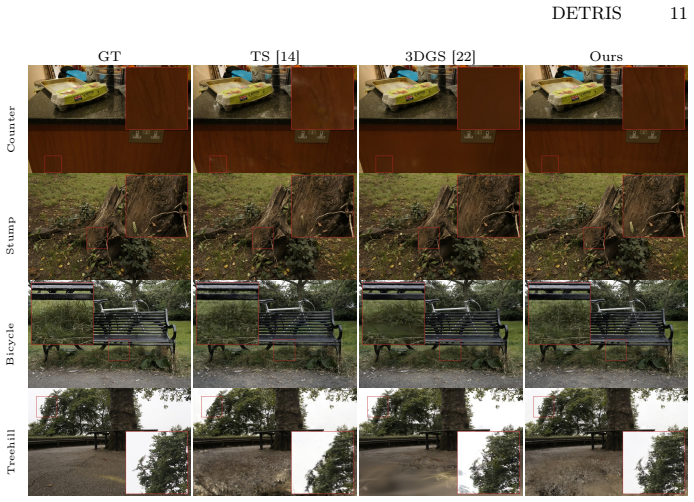
- On average over Mip-NeRF 360, the method improves LPIPS to 0.183 from Triangle Splatting's 0.191, and on Tanks & Temples to 0.133 from 0.143, with best-in-class perceptual quality among non-volumetric primitives.
- Zeroing the learned displacements after training increases mean absolute error by +0.052 on Bonsai and +0.029 on Bicycle, showing the deformations are what sharpen fine boundary structures.
- The per-primitive overhead is small (3K+1 = 10 extra floats, about +17% per primitive), and rendering stays real-time though slower than rigid triangles (47/33 FPS vs. 63/49 on Bonsai/Garden), with the cost tunable through K.
- Rendered normal maps are geometrically coherent as a by-product, enabling TSDF-based mesh extraction on DTU with Chamfer distance 1.01, better than the rigid-triangle baseline's 1.06.
Reading between the lines
- Inference: The paper leaves implicit that its view-independence claim holds for the affine barycentric map, but perspective projection is projective, not affine; the 2D barycentric coordinates of a pixel do not equal the 3D barycentric coordinates of the point where the viewing ray meets the triangle plane, so a direct slant test would quantify the approximation.
- Inference: Because each primitive carries a well-defined face normal and a piecewise-linear boundary, the representation could be reused for surface editing, relighting, or level-of-detail by decimating control points; these are natural next steps the paper does not explore.
- Inference: The curvature regularizer and the tolerance for self-intersecting boundaries suggest the primitive can act as a deformable template in optimization problems beyond radiance fields, such as image segmentation or shape fitting; the paper demonstrates only 2D shape fitting as a proof of concept.
- Inference: The reported gains over Triangle Splatting are mostly perceptual (LPIPS) rather than PSNR, which the paper attributes to sharper boundaries; an evaluation protocol that weights high-frequency structure would be a more sensitive test of the advantage.
Editorial analysis
A structured set of objections, weighed in public.
Referee Report
Summary. The paper proposes DETRIS, a differentiable radiance-field renderer whose primitives are triangles with deformable edges. Each edge carries K learnable control points, each with a scalar displacement along the edge normal, defined in the barycentric coordinate system of the projected triangle. Rendering uses a winding-number inside test, a polynomial smooth-minimum distance field, and a power-law opacity falloff. The authors report improved LPIPS/PSNR/SSIM over Triangle Splatting on Mip-NeRF 360 and Tanks & Temples, improved Chamfer distance on DTU, and ablations showing that the deformation and regularization components contribute.
Significance. Non-convex, deformable triangle primitives are a useful step beyond fixed triangles and convex primitives. The paper is strong on empirical validation: per-scene tables, deformation contribution maps, control-point statistics, and a clear ablation suite. It also describes an efficient CUDA implementation and discusses stability under self-intersection. However, a central theoretical claim—that the barycentric-space formulation is exactly view-independent—is not correct under perspective, so the paper's main conceptual justification needs substantial rework.
major comments (2)
- [Sec. 3.1, Eq. (1), ‘Why Barycentric Space?’] The claim that the formulation is ‘exactly view-independent by construction’ is invalid. The map b=T^{-1}(p-p_1) is built from the 2D projected vertices p_i. Under perspective, a fixed 3D point X on the base triangle has 2D barycentric coordinates that change with viewpoint (b_i are projective, not affine, in the 3D barycentrics λ). A fixed deformed polygon in (u,v) therefore corresponds to different 3D regions on the primitive for different cameras. This is exactly the view-dependence the paper attributes to image-space deformations. The Abstract’s ‘view-consistent rendering’, §3.1’s ‘eliminating multi-view gradient conflict’, and the Conclusion’s ‘strictly view-independent’ are therefore unsupported. Figure 3 does not test 3D consistency: it compares two image-space parameterizations. The authors should either formulate the deformation in true 3D barycentric coordinates of the base tri
- [Eq. (5)] R=2A/P is not, as stated, the inradius of a general convex polygon; it equals the inradius only for tangential polygons. For a 2×1 rectangle, R=2A/P=4/6≈0.667 while the inradius is 0.5. For non-convex polygons the claim that R is an upper bound on interior distances is not established, and φ≤1 is trivial because of the min(1,·) clamp. Since R sets the spatial scale of the opacity falloff in Eq. (6), the paper should either compute the true polygon inradius or explicitly present R as an area-perimeter heuristic and discuss the consequences.
minor comments (5)
- [Sec. 3.3 and Table S1] The loss in Eq. (7) includes L_d with weight λ3, but Table S1 sets λ_dist=0. If the distortion term is disabled, this should be stated in the main text.
- [Table 2 and Table S2] FPS and training-time footnotes are ambiguous: TS is reported with two FPS/Train values, and the paper’s average Mip-NeRF 360 FPS (55) is hard to reconcile with the per-scene Bonsai/Garden values (47/33). Please clarify hardware and averaging protocol.
- [Fig. 3] The units and color scale for |Δ| are not defined, and Fig. 3-right should state quantitatively what ‘consistent shape’ means; visual comparison alone is not a test of 3D consistency.
- [Fig. 5 and Fig. S2] Zeroing δ together with d means the figure does not isolate the displacement contribution; Table 3 is the cleaner ablation. The caption should acknowledge this.
- [Sec. 3.1] The statement that barycentric displacements are ‘scale-invariant with respect to the triangle’s image-space size’ is true only for uniform scaling of the projected triangle, not under perspective; the sentence should be qualified.
Circularity Check
No significant circularity: DETRIS's claims rest on fitted parameters and external benchmarks; the view-independence defect is a correctness issue, not a circular derivation.
full rationale
The paper's derivation chain does not reduce any prediction to its inputs. Eq. (1) defines control-point positions from learnable scalar displacements d_i,k; Eqs. (3), (5), and (6) define opacity from learnable sharpness delta, polygon inradius, opacity o, and falloff sigma. These are optimized against photometric losses on external benchmarks (Mip-NeRF 360, Tanks & Temples, DTU), with ablations (w/o Deformation, w/o Lcurv, w/o Delay) isolating component contributions. The view-independence claim in Sec. 3.1 is asserted rather than derived from fitted values, and the paper's own critique of image-space windows (perspective is projective, not affine) applies to its barycentric frame, which is itself built from projected vertices via T = [p2-p1, p3-p1]. That is a correctness/validity risk, not a circularity: no equation used to support the claim is definitionally equivalent to the target result. Citations to prior work [14,15,48] supply baselines and inspiration but are not used to force the central result. Self-citations appear only in related work. Therefore no load-bearing circular step is present.
Assumptions & free parameters
free parameters (6)
- Boundary displacement d_{i,k} =
learned scalars; mean |d|=0.083 r_bary across scenes
- Falloff exponent sigma =
per-primitive learned; init 1.16
- Corner smoothness delta =
per-primitive learned; mean 0.075
- Base opacity o =
per-primitive learned; init 0.28
- K control points per edge =
K=3 (ablation 0-5)
- Initialization and loss hyperparameters =
2.23 r scale, lr rates, lambda_1-6 in Table S1
assumptions (5)
- standard math Non-zero winding rule (ray casting) classifies inside/outside for non-convex and self-intersecting polygons.
- standard math Polynomial smooth minimum (Eq. 3) is C1 and produces localized corner rounding.
- ad hoc to paper R=2A/P is a valid opacity normalization: it is the true inradius for convex polygons and upper-bounds interior distances for non-convex polygons.
- ad hoc to paper The affine image-space map b=T^{-1}(p-p1) is an intrinsic, view-independent coordinate system for the primitive.
- domain assumption SfM point clouds provide reliable triangle initializations and the scenes satisfy photometric consistency.
Cite this review
Pith. "Pith review of Deformable Triangle Splatting: Flexible Primitives for Real-Time Radiance Field Rendering." pith.science (2026). https://pith.science/paper/MCXMD3ZN
@misc{pith2026260722446,
  author       = {Pith},
  title        = {Pith review of: Deformable Triangle Splatting: Flexible Primitives for Real-Time Radiance Field Rendering},
  year         = {2026},
  howpublished = {\url{https://pith.science/paper/MCXMD3ZN}},
  note         = {Machine review of arXiv:2607.22446}
}
abstract
Recent radiance field methods represent scenes with 2D primitives that offer surface alignment and efficient rasterization, from Gaussian disks to triangles, yet all rely on convex boundaries: curved and concave structures demand excessive primitives. We introduce Deformable Triangle Splatting, which augments each triangle with $K$ control points per edge, each parameterized by a single learnable scalar displacement that shifts the boundary inward or outward, enabling non-convex shape representation while preserving the three base vertices that define the 3D plane. To render these non-convex primitives differentiably, we design a rasterization pipeline in the triangle's barycentric coordinate space, ensuring view-consistent rendering. A winding number test determines whether each pixel lies inside the deformed primitive, and a window function controlled by two learnable parameters, sharpness and corner smoothness, together with a per-primitive scalar opacity, produces the smooth opacity transition from interior to boundary. Validation is done in a variety of real-world scenes, outperforming recent works based on non-volumetric primitives in terms of visual quality and versatility while still achieving competitive rendering efficiency.
Figures


Figures from the paper (4 more)


Reference graph
Works this paper leans on
-
[1]
In: ECCV (2024)
Bae, J., Kim, S., Yun, Y., Lee, H., Bang, G., Uh, Y.: Per-gaussian embedding- based deformation for deformable 3D gaussian splatting. In: ECCV (2024)
2024
-
[2]
In: CVPR (2022)
Barron, J.T., Mildenhall, B., Verbin, D., Srinivasan, P.P., Hedman, P.: Mip-NeRF 360: Unbounded anti-aliased neural radiance fields. In: CVPR (2022)
2022
-
[3]
In: ICCV (2023)
Barron, J.T., Mildenhall, B., Verbin, D., Srinivasan, P.P., Hedman, P.: Zip-NeRF: Anti-aliased grid-based neural radiance fields. In: ICCV (2023)
2023
-
[4]
In: CVPR (2022)
Chan, E., Lin, C., Chan, M., Nagano, K., Pan, B., de Mello, S., Gallo, O., Guibas, L., Tremblay, J., Khamis, S., Karras, T., Wetzstein, G.: Efficient geometry-aware 3D generative adversarial networks. In: CVPR (2022)
2022
-
[5]
In: ECCV (2022)
Chen, A., Xu, Z., Geiger, A., Yu, J., Su, H.: Tensorf: Tensorial radiance fields. In: ECCV (2022)
2022
-
[6]
arXiv preprint arXiv:2411.12440 (2024)
Chen, H., Chen, R., Qu, Q., Wang, Z., Liu, T., Chen, X., Chung, Y.: Beyond gaussians: Fast and high-fidelity 3D splatting with linear kernels. arXiv preprint arXiv:2411.12440 (2024)
arXiv 2024
-
[7]
In: CVPR (2023)
Chen, Z., Funkhouser, T., Hedman, P., Tagliasacchi, A.: MobileNeRF: Exploiting the polygon rasterization pipeline for efficient neural field rendering on mobile architectures. In: CVPR (2023)
2023
-
[8]
In: CVPR (2023)
Du, Y., Smith, C., Tewari, A., Sitzmann, V.: Learning to render novel views from wide-baseline stereo pairs. In: CVPR (2023)
2023
Show all 54 references
-
[9]
In: CVPR (2025)
Fan, C.D., Chang, C.W., Liu, Y.R., Lee, J.Y., Huang, J.L., Tseng, Y.C., Liu, Y.L.: SpectroMotion: Dynamic 3D reconstruction of specular scenes. In: CVPR (2025)
2025
-
[10]
In: CVPR (2023)
Fridovich-Keil, S., Meanti, G., Warburg, F., Recht, B., Kanazawa, A.: K-planes: Explicit radiance fields in space, time, and appearance. In: CVPR (2023)
2023
-
[11]
In: CVPR (2022)
Fridovich-Keil, S., Yu, A., Tancik, M., Chen, Q., Recht, B., Kanazawa, A.: Plenox- els: Radiance fields without neural networks. In: CVPR (2022)
2022
-
[12]
In: ECCV (2024)
Gue´don, A., Lepetit, V.: Gaussianfrosting: Editable complex radiance fields with real-time rendering. In: ECCV (2024)
2024
-
[13]
In: CVPR (2024)
Hamdi, A., Melas-Kyriazi, L., Mai, J., Qian, G., Liu, R., Vondrick, C., Ghanem, B., Vedaldi, A.: GES: Generalized exponential splatting for efficient radiance field rendering. In: CVPR (2024)
2024
-
[14]
In: 3DV (2026)
Held, J., Vandeghen, R., Deliege, A., Hamdi, A., Giancola, S., Cioppa, A., Vedaldi, A., Ghanem, B., Tagliasacchi, A., Droogenbroeck, M.V.: Triangle splatting for real- time radiance field rendering. In: 3DV (2026)
2026
-
[15]
In: CVPR (2025)
Held, J., Vandeghen, R., Hamdi, A., Deliege, A., Cioppa, A., Giancola, S., Vedaldi, A., Ghanem, B., Droogenbroeck, M.V.: 3D convex splatting: Radiance field ren- dering with 3D smooth convexes. In: CVPR (2025)
2025
-
[16]
In: CVPR (2024)
Hu, S., Hu, T., Liu, Z.: Articulated gaussian splatting from monocular human videos. In: CVPR (2024)
2024
-
[17]
SIGGRAPH (2024)
Huang, B., Yu, Z., Chen, A., Geiger, A., Gao, S.: 2D gaussian splatting for geo- metrically accurate radiance fields. SIGGRAPH (2024)
2024
-
[18]
In: CVPR (2025)
Huang, Y.H., Lin, M.X., Sun, Y.T., Yang, Z., Lyu, X., Cao, Y.P., Qi, X.: De- formable radial kernel splatting. In: CVPR (2025)
2025
-
[19]
SIGGRAPH (2013)
Jacobson, A., Kavan, L., Sorkine-Hornung, O.: Robust inside-outside segmentation using generalized winding numbers. SIGGRAPH (2013)
2013
-
[20]
In: CVPR (2014)
Jensen, R., Dahl, A., Vogiatzis, G., Tola, E., Aanæs, H.: Large scale multi-view stereopsis evaluation. In: CVPR (2014)
2014
-
[21]
In: CVPR (2018) 16 O
Kato, H., Ushiku, Y., Harada, T.: Neural 3D mesh renderer. In: CVPR (2018) 16 O. Jiménez-Ayguadé and A. Agudo
2018
-
[22]
TOG (2023)
Kerbl, B., Kopanas, G., Leimkühler, T., Drettakis, G.: 3D gaussian splatting for real-time radiance field rendering. TOG (2023)
2023
-
[23]
In: NeurIPS (2024)
Kheradmand, S., Rebain, D., Sharma, G., Sun, W., Tseng, J., Isack, H., Kar, A., Tagliasacchi, A., Yi, K.M.: 3D gaussian splatting as markov chain monte carlo. In: NeurIPS (2024)
2024
-
[24]
In: ICLR (2015)
Kingma, D., Ba, J.: Adam: A method for stochastic optimization. In: ICLR (2015)
2015
-
[25]
TOG (2017)
Knapitsch, A., Park, J., Zhou, Q.Y., Koltun, V.: Tanks and temples: Benchmarking large-scale scene reconstruction. TOG (2017)
2017
-
[26]
In: ICCV (2023)
Kulhanek, J., Sattler, T.: Tetra-NeRF: Representing neural radiance fields using tetrahedra. In: ICCV (2023)
2023
-
[27]
In: CVPR (2024)
Lee,J.C.,Rho,D.,Sun,X.,Ko,J.H.,Park,E.:Compact3Dgaussianrepresentation for radiance field. In: CVPR (2024)
2024
-
[28]
ICLR (2026)
Liu, R., Gao, Z., Planche, B., Chen, M., Nguyen, V.N., Zheng, M., Choudhuri, A., Chen, T., Wang, Y., Feng, A., Wu, Z.: Universal beta splatting. ICLR (2026)
2026
-
[29]
In: SIGGRAPH (2025)
Liu, R., Sun, D., Chen, M., Wang, Y., Feng, A.: Deformable beta splatting. In: SIGGRAPH (2025)
2025
-
[30]
In: ICCV (2019)
Liu, S., Chen, W., Li, T., Li, H.: Soft rasterizer: A differentiable renderer for image- based 3D reasoning. In: ICCV (2019)
2019
-
[31]
In: CVPR (2024)
Lu, T., Yu, M., Xu, L., Xiangli, Y., Wang, L., Lin, D., Dai, B.: Scaffold-GS: Struc- tured 3D gaussians for view-adaptive rendering. In: CVPR (2024)
2024
-
[32]
In: NeurIPS (2025)
von Lützow, N., Nießner, M.: Linprim: Linear primitives for differentiable volu- metric rendering. In: NeurIPS (2025)
2025
-
[33]
A K Peters/CRC Press (2021)
Marschner, S., Shirley, P.: Fundamentals of Computer Graphics. A K Peters/CRC Press (2021)
2021
-
[34]
In: CVPR (2021)
Martin-Brualla, R., Radwan, N., Sajjadi, M., Barron, J., Dosovitskiy, A., Duck- worth, D.: NeRF in the wild: Neural radiance fields for unconstrained photo col- lections. In: CVPR (2021)
2021
-
[35]
In: ECCV (2020)
Mildenhall, B., Srinivasan, P.P., Tancik, M., Barron, J.T., Ramamoorthi, R., Ng, R.: NeRF: Representing scenes as neural radiance fields for view synthesis. In: ECCV (2020)
2020
-
[36]
SIGGRAPH (2022)
Müller, T., Evans, A., Schied, C., Keller, A.: Instant neural graphics primitives with a multiresolution hash encoding. SIGGRAPH (2022)
2022
-
[37]
In: CVPR (2022)
Niemeyer, M., Barron, J., Mildenhall, B., Sajjadi, M., Geiger, A., Radwan, N.: RegNeRF:Regularizingneuralradiancefieldsforviewsynthesisfromsparseinputs. In: CVPR (2022)
2022
-
[38]
Cambridge university press (1998)
O’Rourke, J.: Computational geometry in C. Cambridge university press (1998)
1998
-
[39]
In: ACCV (2024)
de Paco, S., Agudo, A.: 4DPV: 4D pet from videos by coarse-to-fine non-rigid radiance fields. In: ACCV (2024)
2024
-
[40]
Park, K., Sinha, U., Barron, J.T., Bouaziz, S., Goldman, D.B., Seitz, S.M., Martin- Brualla, R.: Nerfies: Deformable neural radiance fields (2021)
2021
-
[41]
Quilez, I.: Smooth minimum.https://iquilezles.org/articles/smin/(2013), accessed: 2025-01-15
2013
-
[42]
TOG (2023)
Reiser, C., Szeliski, R., Verbin, D., Srinivasan, P., Mildenhall, B., Geiger, A., Bar- ron, J., Hedman, P.: MERF: Memory-efficient radiance fields for real-time view synthesis in unbounded scenes. TOG (2023)
2023
-
[43]
In: WACV (2025)
Rong, V., Chen, J., Bahmani, S., Kutulakos, K., Lindell, D.B.: Gstex: Per-primitive texturing of 2D gaussian splatting for decoupled appearance and geometry model- ing. In: WACV (2025)
2025
-
[44]
In: ISBI (2026) DETRIS 17
Salort-Benejam, L., Agudo, A.: Nerfscopy: Neural radiance fields for in-vivo time- varying tissues from endoscopy. In: ISBI (2026) DETRIS 17
2026
-
[45]
In: CVPR (2016)
Schönberger, J.L., Frahm, J.M.: Structure-from-motion revisited. In: CVPR (2016)
2016
-
[46]
In: ECCV (2022)
Shen, J., Agudo, A., Moreno-Noguer, F., Ruiz, A.: Conditional-flow NeRF: Accu- rate 3D modelling with reliable uncertainty quantification. In: ECCV (2022)
2022
-
[47]
In: ICCV (2025)
Svitov, D., Morerio, P., Agapito, L., Del Bue, A.: Billboard splatting (BBSplat): Learnable textured primitives for novel view synthesis. In: ICCV (2025)
2025
-
[48]
In: SIGGRAPH (1987)
Terzopoulos, D., Platt, J., Barr, A., Fleischer, K.: Elastically deformable models. In: SIGGRAPH (1987)
1987
-
[49]
In: NeurIPS (2023)
Uy, M.A., Nakayama, G.K., Yang, G., Thomas, R.K., Guibas, L., Li, K.: NeRF revisited: Fixing quadrature instability in volume rendering. In: NeurIPS (2023)
2023
-
[50]
In: CVPR (2022)
Verbin, D., Hedman, P., Mildenhall, B., Zickler, T., Barron, J., Srinivasan, P.: Ref-NeRF: Structured view-dependent appearance for neural radiance fields. In: CVPR (2022)
2022
-
[51]
In: AAAI (2026)
Wu, R., Zhang, Z., Chen, M., Yan, Z., Zuo, W.: Deblur4dgs: 4D gaussian splatting from blurry monocular video. In: AAAI (2026)
2026
-
[52]
In: CVPR (2022)
Xu,Q.,Xu,Z.,Philip,J.,Bi,S.,Shu,Z.,Sunkavalli,K.,Neumann,U.:Point-NeRF: Point-based neural radiance fields. In: CVPR (2022)
2022
-
[53]
In: CVPR (2022)
Zhang, X., Bi, S., Sunkavalli, K., Su, H., Xu, Z.: NeRFusion: Fusing radiance fields for large-scale scene reconstruction. In: CVPR (2022)
2022
-
[54]
In: ICCV (2025) 18 O
Zhang, Z., Huang, B., Jiang, H., Zhou, L., Xiang, X., Shen, S.: Quadratic gaussian splatting: High quality surface reconstruction with second-order geometric primi- tives. In: ICCV (2025) 18 O. Jiménez-Ayguadé and A. Agudo Supplementary Material Deformable Triangle Splatting: ...
2025
Reviewed August 1, 2026 · model on record in the stance chip above.
Discussion (0). Continue with ORCID to comment.