REVIEW 1 major objections 2 minor 100 references
Static and Dynamic Strategies for Influencing Opinions in Social Networks
T0 review · 1 major / 2 minor · reviewed 2026-06-30 · grok-4.3
Pith's one-line read Dynamic strategies for stubborn agents shift network opinions more effectively than static ones by recruiting intermediate agents.
desk verdict Dynamic stubborn-agent strategies beat static ones at shifting opinions in HK simulations on LFR networks, mainly because they avoid early splits. read the letter →
The pith
A machine-rendered reading of the paper's core claim, the machinery that carries it, and where it could break.
The reading
What carries the argument
The comparison between static and dynamic stubborn agent interventions within the Hegselmann-Krause bounded-confidence opinion dynamics model, applied to weighted LFR networks using centrality-based node selection.
What would settle it
Running the same experiments on actual social network topologies extracted from online platforms and checking if the superiority of dynamic strategies persists.
Extended reading notes
Core claim
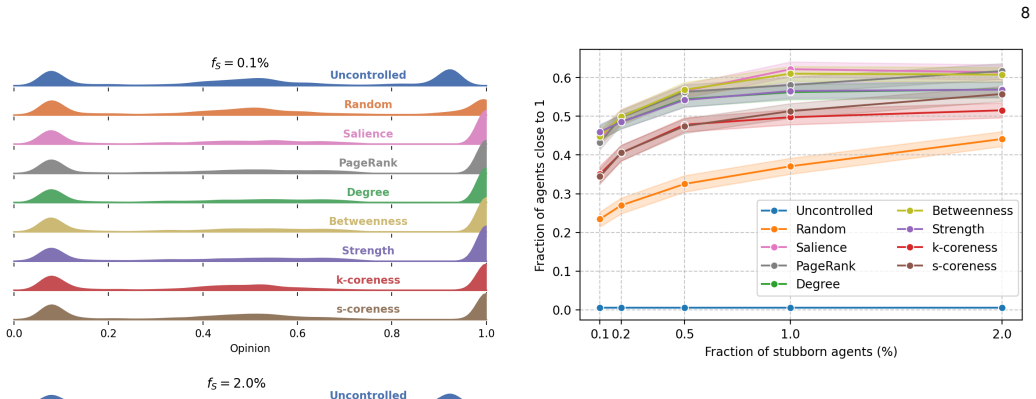
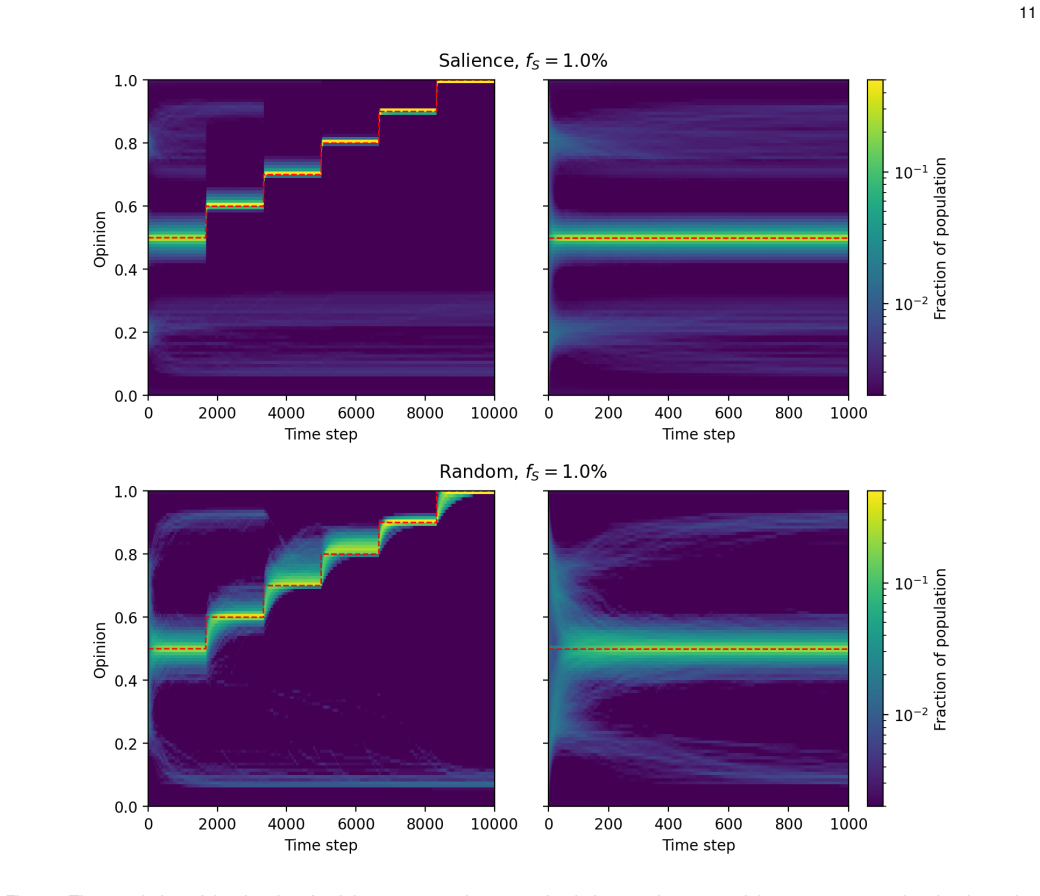
In experiments on weighted LFR benchmark networks, dynamic interventions where stubborn agents' opinions evolve gradually from moderate to extreme values prove substantially more effective at shifting the network's average opinion than static interventions with fixed extreme opinions. This effectiveness comes from exploiting the bounded-confidence dynamics to progressively recruit intermediate agents and extend influence across the network, whereas static strategies lead to early opinion separation and limited reach. Dynamic approaches can perform well even with simple or random selection of targets, while some centrality measures help more in static cases.
Load-bearing premise
Weighted LFR benchmark networks with community structure sufficiently represent the topological and weighted properties of real social networks where opinion dynamics occur.
Editorial extensions
If this is right
- Dynamic strategies achieve strong performance even with simple or random node selection.
- Static strategies tend to create early opinion separation and therefore have more limited reach.
- Some centrality measures offer advantages in static settings but dynamic interventions reduce the need for sophisticated targeting.
- Intervention design and target selection interact in shaping collective opinions.
Reading between the lines
- If dynamic strategies succeed even with random selection, identifying manipulation may require monitoring for gradual opinion shifts rather than fixed extremes.
- Countermeasures could involve deploying opposing agents that use dynamic tactics to block progressive recruitment.
- The superiority of dynamic approaches might be tested on empirical social network data from real platforms to check generalizability beyond benchmarks.
- This pattern of interaction between strategy type and network structure could apply to other opinion dynamics models.
Signed reviews
Editorial analysis
A structured set of objections, weighed in public.
Referee Report
Summary. The paper investigates targeted stubborn-agent interventions to shift average opinions in networks governed by the Hegselmann-Krause bounded-confidence model. Experiments on weighted LFR benchmark networks with community structure compare static interventions (fixed extreme opinions) against dynamic ones (gradual evolution from moderate to extreme) using node-selection heuristics based on degree, strength, PageRank, betweenness, k-coreness, s-coreness, and salience. The central claim is that dynamic strategies are substantially more effective than static ones because they progressively recruit intermediate agents without triggering early opinion separation, and that dynamic interventions can succeed even with simple or random selection.
Significance. If the simulation results prove robust, the work clarifies an important interaction between intervention design and bounded-confidence dynamics, showing how timing of opinion shifts can extend influence across community-structured networks. The use of multiple standard centrality measures on reproducible LFR benchmarks is a strength that supports comparative claims. The findings have direct implications for modeling and countering opinion manipulation in social networks.
major comments (1)
- [Abstract / Experiments] Abstract and Experiments section: the claim that dynamic strategies are 'substantially more effective' is presented as a clear directional result, yet the manuscript provides no information on the number of simulation runs, statistical tests, error bars, exact network sizes (N and community parameters), or the specific value of the bounded-confidence threshold ε. These details are load-bearing for verifying whether the reported difference between static and dynamic interventions is statistically reliable.
minor comments (2)
- [Experiments] The representativeness of weighted LFR graphs for real social networks is noted as a modeling choice but could be addressed with a brief sensitivity discussion or citation to empirical validation studies of LFR for opinion dynamics.
- A summary table listing quantitative performance (e.g., final average opinion shift) for each heuristic under static vs. dynamic conditions would improve readability of the comparative results.
Simulated Author's Rebuttal
We thank the referee for the constructive comment highlighting the need for greater experimental transparency. We address the point below and will revise the manuscript accordingly.
read point-by-point responses
-
Referee: [Abstract / Experiments] Abstract and Experiments section: the claim that dynamic strategies are 'substantially more effective' is presented as a clear directional result, yet the manuscript provides no information on the number of simulation runs, statistical tests, error bars, exact network sizes (N and community parameters), or the specific value of the bounded-confidence threshold ε. These details are load-bearing for verifying whether the reported difference between static and dynamic interventions is statistically reliable.
Authors: We agree that these details are essential for assessing statistical reliability and reproducibility. In the revised manuscript we will add: the number of independent simulation runs (100 per configuration), statistical tests (paired t-tests with reported p-values), error bars (standard deviation) on all plots, exact LFR parameters (N=1000, average degree=10, max degree=50, μ=0.1, min community size=50), and the bounded-confidence threshold (ε=0.25). These will appear in the Experiments section and be referenced in the abstract. revision: yes
Circularity Check
No significant circularity: simulation-based comparison on standard benchmarks
full rationale
The paper reports comparative simulation outcomes for static vs. dynamic stubborn-agent interventions inside the established Hegselmann-Krause bounded-confidence model on weighted LFR networks. No equations, fitted parameters, or derived predictions are described that reduce to the inputs by construction. Node-selection heuristics (degree, PageRank, etc.) are applied directly to the benchmark graphs; the reported effectiveness difference follows from running the update rule rather than from any self-referential definition or self-citation chain. The representativeness of LFR graphs is noted as a modeling choice but does not create circularity in the within-model comparison itself. The central claim therefore remains independent of the paper's own inputs.
Assumptions & free parameters
assumptions (2)
- domain assumption Opinion updates follow the Hegselmann-Krause bounded-confidence rule (agents only average with sufficiently close neighbors)
- domain assumption Weighted LFR networks with community structure are appropriate proxies for real social networks
Cite this review
Pith. "Pith review of Static and Dynamic Strategies for Influencing Opinions in Social Networks." pith.science (2026). https://pith.science/paper/MDDS27GX
@misc{pith2026260514918,
  author       = {Pith},
  title        = {Pith review of: Static and Dynamic Strategies for Influencing Opinions in Social Networks},
  year         = {2026},
  howpublished = {\url{https://pith.science/paper/MDDS27GX}},
  note         = {Machine review of arXiv:2605.14918}
}
read the original abstract
The ability of a small set of coordinated actors to manipulate opinions in online social networks poses a serious challenge to the fairness and integrity of public debate. We investigate this problem by studying how targeted stubborn agents can shift the average opinion of a network governed by the Hegselmann-Krause bounded-confidence dynamics. Experiments are conducted on weighted LFR benchmark networks with community structure, using multiple node-selection strategies based on degree, strength, PageRank, betweenness, k-coreness, s-coreness, and salience. We compare static interventions, in which stubborn agents keep a fixed extreme opinion, with dynamic interventions, in which their opinion gradually evolves from moderate to extreme values. Results show that dynamic strategies are substantially more effective than static ones, as they exploit bounded-confidence dynamics to progressively recruit intermediate agents and extend influence across the network. In contrast, static strategies tend to create early opinion separation and therefore have a more limited reach. We also find that while some centrality measures offer advantages in static settings, dynamic interventions can achieve strong performance even with simple or random node selection. Overall, the study clarifies how intervention design and target selection interact in shaping collective opinions, with implications for understanding and countering manipulation in social networks.
Figures


Figures from the paper (6 more)


Reference graph
Works this paper leans on
-
[1]
The spread of true and false news online,
S. Vosoughi, D. Roy, and S. Aral, “The spread of true and false news online,”Science, vol. 359, no. 6380, pp. 1146– 1151, 2018
work page 2018
-
[2]
The role of social media news usage and platforms in civic and political participation,
S. Boulianne, K. Koc-Michalska, and B. Bimber, “The role of social media news usage and platforms in civic and political participation,”Computers in Human Behavior, vol. 146, p. 107822, 2023
work page 2023
-
[3]
Delivering trust: Impartiality and objec- tivity in the digital age,
R. Sambrook, “Delivering trust: Impartiality and objec- tivity in the digital age,”Reuters Institute for the Study of Journalism, Department of Politics, 2012
work page 2012
-
[4]
Unveiling the veiled threat: the impact of bots on COVID-19 health communication,
A. Unlu, S. Truong, N. Sawhney, and T. Tammi, “Unveiling the veiled threat: the impact of bots on COVID-19 health communication,”Social Science Computer Review, 2024
work page 2024
-
[5]
Bots and misinformation spread on social media: implications for COVID-19,
M. Himelein-Wachowiak, S. Giorgi, A. Devoto, M. Rah- man, L. Ungar, H. A. Schwartz, D. H. Epstein, L. Leggio, and B. Curtis, “Bots and misinformation spread on social media: implications for COVID-19,”Journal of Medical Internet Research, vol. 23, no. 5, p. e26933, 2021
work page 2021
-
[6]
Fake news and covid-19: modelling the predictors of fake news sharing among social media users,
O. D. Apuke and B. Omar, “Fake news and covid-19: modelling the predictors of fake news sharing among social media users,”Telematics and Informatics, vol. 56, p. 101475, 2021
work page 2021
-
[7]
Inoc- ulating against fake news about COVID-19,
S. van Der Linden, J. Roozenbeek, and J. Compton, “Inoc- ulating against fake news about COVID-19,”Frontiers in Psychology, vol. 11, p. 566790, 2020
work page 2020
-
[8]
V . Balakrishnan, W. Z. Ng, M. C. Soo, G. J. Han, and C. J. Lee, “Infodemic and fake news–a comprehensive overview of its global magnitude during the COVID-19 pandemic in 2021: A scoping review,”International Journal of Disaster Risk Reduction, vol. 78, p. 103144, 2022
work page 2021
Show all 100 references
-
[9]
Fighting an infodemic: Covid-19 fake news dataset,
P . Patwa, S. Sharma, S. Pykl, V . Guptha, G. Kumari, M. S. Akhtar, A. Ekbal, A. Das, and T. Chakraborty, “Fighting an infodemic: Covid-19 fake news dataset,” inCombating Online Hostile Posts in Regional Languages during Emergency Situation: First International Workshop, CONST...
2021
-
[10]
The impact of fake news on social media and its influence on health during the COVID-19 pandemic: A systematic review,
Y. M. Rocha, G. A. De Moura, G. A. Desid ´erio, C. H. De Oliveira, F. D. Lourenc ¸o, and L. D. de Figueiredo Nico- lete, “The impact of fake news on social media and its influence on health during the COVID-19 pandemic: A systematic review,”Journal of Public Health, pp. 1–10, 2021
2021
-
[11]
Fake news and Covid-19 in Italy: results of a quantitative observational study,
A. Moscadelli, G. Albora, M. A. Biamonte, D. Gior- getti, M. Innocenzio, S. Paoli, C. Lorini, P . Bonanni, and G. Bonaccorsi, “Fake news and Covid-19 in Italy: results of a quantitative observational study,”International Journal of Environmental Research and Public Health, vol...
2020
-
[12]
Flow of online misinformation during the peak of the COVID-19 pandemic in Italy,
G. Caldarelli, R. De Nicola, M. Petrocchi, M. Pratelli, and F. Saracco, “Flow of online misinformation during the peak of the COVID-19 pandemic in Italy,”EPJ Data Science, vol. 10, no. 1, p. 34, 2021
2021
-
[13]
Misinformation and Polarization around COVID-19 vac- cines in France, Germany, and Italy,
G. Nogara, F. Pierri, S. Cresci, L. Luceri, and S. Giordano, “Misinformation and Polarization around COVID-19 vac- cines in France, Germany, and Italy,” inProceedings of the 16th ACM Web Science Conference, 2024, pp. 119–128
2024
-
[14]
Study Confirms Influence of Russian Internet “Trolls
D. Almond, X. Du, and A. Vogel, “Study Confirms Influence of Russian Internet “Trolls” on 2016 Election,”Columbia SIP A, 29 Mar. 2022. [Online]. Available: https://www.sipa.columbia.edu/news/study- confirms-influence-russian-internet-trolls-2016-election
2016
-
[15]
How Russian Twitter bots pumped out fake news during the 2016 election,
G. O’Connor and A. Schneider, “How Russian Twitter bots pumped out fake news during the 2016 election,” NPR: All Things Considered, 2017. [Online]. Available: https://www.npr.org/sections/alltechconsidered/2017/ 04/03/522503844/how-russian-twitter-bots-pumped- out-fake-news-du...
2016
-
[16]
Analyzing the digital traces of political manipulation: The 2016 Russian interference Twitter campaign,
A. Badawy, E. Ferrara, and K. Lerman, “Analyzing the digital traces of political manipulation: The 2016 Russian interference Twitter campaign,” in2018 IEEE/ACM Inter- national Conference on Advances in Social Networks Analysis and Mining (ASONAM). IEEE, 2018, pp. 258–265
2016
-
[17]
K. H. Jamieson,Cyberwar: how Russian hackers and trolls helped elect a president: what we don’t, can’t, and do know. Oxford University Press, 2020
2020
-
[18]
Characterizing social media manipulation in the 2020 US presidential election,
E. Ferrara, H. Chang, E. Chen, G. Muric, and J. Patel, “Characterizing social media manipulation in the 2020 US presidential election,”First Monday, 2020
2020
-
[19]
Final Say: The misinformation that was told about Brexit during and after the referendum,
S. Khan, “Final Say: The misinformation that was told about Brexit during and after the referendum,” 2020, https://www.independent.co.uk/news/uk/politics/final- say-brexit-referendum-lies-boris-johnson-leave- campaign-remain-a8466751.html
2020
-
[20]
The human component in social media and fake news: the performance of UK opinion leaders on Twitter during the Brexit campaign,
M. H ¨oller, “The human component in social media and fake news: the performance of UK opinion leaders on Twitter during the Brexit campaign,”European Journal of English Studies, vol. 25, no. 1, pp. 80–95, 2021
2021
-
[21]
Here’s the first evidence Russia used Twitter to influence Brexit,
M. Burgess, “Here’s the first evidence Russia used Twitter to influence Brexit,”Retrieved from Wired: http://www. wired. co. uk/article/brexit-russia-influence-twitter-botsinternet- research-agency, 2017
2017
-
[22]
Social media ’bots’ used to boost political messages during Brexit referendum,
M. Bastos, “Social media ’bots’ used to boost political messages during Brexit referendum,”City St George’s University of London, Dec. 2022. [Online]. Available: https://www.citystgeorges.ac.uk/research/impact/case- studies/social-media-bots-used-to-boost-political- messages-d...
2022
-
[23]
Social media warfare: investigating human-bot engage- ment in English, Japanese and German during the Russo- Ukrainian war on Twitter and Reddit,
W. Xu, K. Sasahara, J. Chu, B. Wang, W. Fan, and Z. Hu, “Social media warfare: investigating human-bot engage- ment in English, Japanese and German during the Russo- Ukrainian war on Twitter and Reddit,”EPJ Data Science, vol. 14, no. 1, p. 10, 2025
2025
-
[24]
Social media, propaganda and the Ukrainian conflict,
R. L. Weaver, “Social media, propaganda and the Ukrainian conflict,”Journal of International Media & Enter- tainment Law, vol. 10, pp. 93–115, 2024
2024
-
[25]
Analyzing digital propaganda and conflict rhetoric: a study on Rus- sia’s bot-driven campaigns and counter-narratives during 13 the Ukraine crisis,
R. Marigliano, L. H. X. Ng, and K. M. Carley, “Analyzing digital propaganda and conflict rhetoric: a study on Rus- sia’s bot-driven campaigns and counter-narratives during 13 the Ukraine crisis,”Social Network Analysis and Mining, vol. 14, no. 1, p. 170, 2024
2024
-
[26]
#IStandWithPutin versus #IStand- WithUkraine: the interaction of bots and humans in discussion of the Russia/Ukraine war,
B. Smart, J. Watt, S. Benedetti, L. Mitchell, and M. Roughan, “#IStandWithPutin versus #IStand- WithUkraine: the interaction of bots and humans in discussion of the Russia/Ukraine war,” inInternational Conference on Social Informatics. Springer, 2022, pp. 34–53
2022
-
[27]
Russian disinformation campaign “DoppelG¨anger
U. C. Command, “Russian disinformation campaign “DoppelG¨anger” unmasked: a web of deception,”
-
[28]
Available: https://www.cybercom.mil/ Media/News/Article/3895345/russian-disinformation- campaign-doppelgnger-unmasked-a-web-of-deception/
[Online]. Available: https://www.cybercom.mil/ Media/News/Article/3895345/russian-disinformation- campaign-doppelgnger-unmasked-a-web-of-deception/
-
[29]
The political effects of X’s feed algorithm,
G. Gauthier, R. Hodler, P . Widmer, and E. Zhuravskaya, “The political effects of X’s feed algorithm,”Nature, pp. 1–8, Feb. 2026. [Online]. Available: https://www.nature. com/articles/s41586-026-10098-2
2026
-
[30]
Mathematical models in social psychol- ogy,
R. P . Abelson, “Mathematical models in social psychol- ogy,” inAdvances in experimental social psychology. Elsevier, 1967, vol. 3, pp. 1–54
1967
-
[31]
Reaching a consensus,
M. H. DeGroot, “Reaching a consensus,”Journal of the American Statistical association, vol. 69, no. 345, pp. 118– 121, 1974
1974
-
[32]
A discrete nonlinear and non-autonomous model of consensus formation,
U. Krause, “A discrete nonlinear and non-autonomous model of consensus formation,”Communications in Differ- ence Equations, vol. 2000, pp. 227–236, 2000
2000
-
[33]
Opinion dynamics and bounded confidence: Models, analysis and simulation,
R. Hegselmann and U. Krause, “Opinion dynamics and bounded confidence: Models, analysis and simulation,” Journal of Artificial Societies and Social Simulation, vol. 5, no. 3, 2002
2002
-
[34]
Sociophysics: A review of Galam models,
S. Galam, “Sociophysics: A review of Galam models,” International Journal of Modern Physics C, vol. 19, no. 03, pp. 409–440, 2008
2008
-
[35]
Network science on belief system dynamics under logic constraints,
N. E. Friedkin, A. V . Proskurnikov, R. Tempo, and S. E. Parsegov, “Network science on belief system dynamics under logic constraints,”Science, vol. 354, no. 6310, pp. 321–326, 2016
2016
-
[36]
Opinion dy- namics in social networks with heterogeneous Markovian agents,
P . Bolzern, P . Colaneri, and G. De Nicolao, “Opinion dy- namics in social networks with heterogeneous Markovian agents,” in2018 IEEE Conference on Decision and Control (CDC). IEEE, 2018, pp. 6180–6185
2018
-
[37]
How to make an efficient propaganda,
T. Carletti, D. Fanelli, S. Grolli, and A. Guarino, “How to make an efficient propaganda,”Europhysics Letters, vol. 74, no. 2, p. 222, 2006
2006
-
[38]
Political manipulation and internet advertising infrastructure,
M. Crain and A. Nadler, “Political manipulation and internet advertising infrastructure,”Journal of Information Policy, vol. 9, pp. 370–410, 2019
2019
-
[39]
Behavior modeling of internet water army in online forums,
K. Zeng, X. Wang, Q. Zhang, X. Zhang, and F.-Y. Wang, “Behavior modeling of internet water army in online forums,”IFAC Proceedings Volumes, vol. 47, no. 3, pp. 9858– 9863, 2014
2014
-
[40]
Network modularity controls the speed of information diffusion,
H. Peng, A. Nematzadeh, D. M. Romero, and E. Ferrara, “Network modularity controls the speed of information diffusion,”Physical Review E, vol. 102, no. 5, p. 052316, 2020
2020
-
[41]
Optimal network modularity for information diffusion,
A. Nematzadeh, E. Ferrara, A. Flammini, and Y.-Y. Ahn, “Optimal network modularity for information diffusion,” Physical Review Letters, vol. 113, no. 8, p. 088701, 2014
2014
-
[42]
Binary opinion dynamics with stubborn agents,
E. Yildiz, A. Ozdaglar, D. Acemoglu, A. Saberi, and A. Scaglione, “Binary opinion dynamics with stubborn agents,”ACM Transactions on Economics and Computation (TEAC), vol. 1, no. 4, pp. 1–30, 2013
2013
-
[43]
Adversarial attacks on voter model dynamics in complex networks,
K. Chiyomaru and K. Takemoto, “Adversarial attacks on voter model dynamics in complex networks,”Physical Review E, vol. 106, no. 1, p. 014301, 2022
2022
-
[44]
Manipulating opinion diffusion in social networks,
R. Bredereck and E. Elkind, “Manipulating opinion diffusion in social networks,” inProceedings of the Twenty- Sixth International Joint Conference on Artificial Intelligence, IJCAI-17, 2017, pp. 894–900. [Online]. Available: https: //doi.org/10.24963/ijcai.2017/124
2017 doi
-
[45]
Maximizing the spread of influence through a social network,
D. Kempe, J. Kleinberg, and ´E. Tardos, “Maximizing the spread of influence through a social network,” inProceed- ings of the ninth ACM SIGKDD international conference on Knowledge discovery and data mining, 2003, pp. 137–146
2003
-
[46]
A survey on influence maximization in a social network,
S. Banerjee, M. Jenamani, and D. K. Pratihar, “A survey on influence maximization in a social network,”Knowledge and Information Systems, vol. 62, pp. 3417–3455, 2020
2020
-
[47]
A tutorial on modeling and analysis of dynamic social networks. Part I,
A. V . Proskurnikov and R. Tempo, “A tutorial on modeling and analysis of dynamic social networks. Part I,”Annual Reviews in Control, vol. 43, pp. 65–79, 2017
2017
-
[48]
Opinion influence and evolution in social networks: A Markovian agents model,
P . Bolzern, P . Colaneri, and G. De Nicolao, “Opinion influence and evolution in social networks: A Markovian agents model,”Automatica, vol. 100, pp. 219–230, 2019
2019
-
[49]
Opinion dynamics in social networks: The effect of centralized interaction tuning on emerging behaviors,
——, “Opinion dynamics in social networks: The effect of centralized interaction tuning on emerging behaviors,” IEEE Transactions on Computational Social Systems, vol. 7, no. 2, pp. 362–372, 2020
2020
-
[50]
Effect of social influence on a two-party election: A Markovian multiagent model,
——, “Effect of social influence on a two-party election: A Markovian multiagent model,”IEEE Transactions on Control of Network Systems, vol. 9, no. 3, pp. 1056–1067, 2021
2021
-
[51]
Multi-opinion Markovian agent networks: Parametrization, second order moment and social power,
——, “Multi-opinion Markovian agent networks: Parametrization, second order moment and social power,”Automatica, vol. 153, p. 111026, 2023
2023
-
[52]
Manipulat- ing opinions in social networks With community struc- ture,
P . Bolzern, A. Colombo, and C. Piccardi, “Manipulat- ing opinions in social networks With community struc- ture,”IEEE Transactions on Network Science and Engineering, vol. 11, no. 1, pp. 185–196, 2023
2023
-
[53]
The architecture of complex weighted networks,
A. Barrat, M. Barthelemy, R. Pastor-Satorras, and A. Vespignani, “The architecture of complex weighted networks,”Proceedings of the National Academy of Sciences, vol. 101, no. 11, pp. 3747–3752, 2004
2004
-
[54]
Analysis of weighted networks,
M. E. Newman, “Analysis of weighted networks,”Physical Review E, vol. 70, no. 5, p. 056131, 2004
2004
-
[55]
On Krause’s multi-agent consensus model with state- dependent connectivity,
V . D. Blondel, J. M. Hendrickx, and J. N. Tsitsiklis, “On Krause’s multi-agent consensus model with state- dependent connectivity,”IEEE Transactions on Automatic Control, vol. 54, no. 11, pp. 2586–2597, 2009
2009
-
[56]
On the convergence of the Hegselmann-Krause system,
A. Bhattacharyya, M. Braverman, B. Chazelle, and H. L. Nguyen, “On the convergence of the Hegselmann-Krause system,” inProceedings of the 4th conference on Innovations in Theoretical Computer Science. ACM, 2013, pp. 61–66
2013
-
[57]
A stabilization theorem for dynamics of con- tinuous opinions,
J. Lorenz, “A stabilization theorem for dynamics of con- tinuous opinions,”Physica A: Statistical Mechanics and its Applications, vol. 355, no. 1, pp. 217–223, 2005
2005
-
[58]
Opinion dynamics in het- erogeneous networks: Convergence conjectures and theo- rems,
A. Mirtabatabaei and F. Bullo, “Opinion dynamics in het- erogeneous networks: Convergence conjectures and theo- rems,”SIAM Journal on Control and Optimization, vol. 50, no. 5, pp. 2763–2785, 2012
2012
-
[59]
Protecting elections from social media manipulation,
S. Aral and D. Eckles, “Protecting elections from social media manipulation,”Science, vol. 365, no. 6456, pp. 858– 861, 2019
2019
-
[60]
Social bots and their coordination during online campaigns: a survey,
T. Khaund, B. Kirdemir, N. Agarwal, H. Liu, and F. Morstatter, “Social bots and their coordination during online campaigns: a survey,”IEEE Transactions on Compu- tational Social Systems, vol. 9, no. 2, pp. 530–545, 2021
2021
-
[61]
Dynamic mechanism of social bots interfering with public opinion in network,
C. Cheng, Y. Luo, and C. Yu, “Dynamic mechanism of social bots interfering with public opinion in network,” Physica A: Statistical Mechanics and its Applications, vol. 551, p. 124163, 2020
2020
-
[62]
The dark side of news 14 community forums: Opinion manipulation trolls,
T. Mihaylov, T. Mihaylova, P . Nakov, L. M `arquez, G. D. Georgiev, and I. K. Koychev, “The dark side of news 14 community forums: Opinion manipulation trolls,”Internet Research, vol. 28, no. 5, pp. 1292–1312, 2018
2018
-
[63]
Controlling opinion propagation in online networks,
C. J. Kuhlman, V . A. Kumar, and S. Ravi, “Controlling opinion propagation in online networks,”Computer Net- works, vol. 57, no. 10, pp. 2121–2132, 2013
2013
-
[64]
Zealotry and influence maximization in the voter model: When to target partial zealots?
G. Romero Moreno, E. Manino, L. Tran-Thanh, and M. Brede, “Zealotry and influence maximization in the voter model: When to target partial zealots?” inComplex Networks XI: Proceedings of the 11th Conference on Complex Networks CompleNet 2020. Springer, 2020, pp. 107–118
2020
-
[65]
A model for the influence of media on the ideology of content in online social net- works,
H. Z. Brooks and M. A. Porter, “A model for the influence of media on the ideology of content in online social net- works,”Physical Review Research, vol. 2, no. 2, p. 023041, 2020
2020
-
[66]
A formal theory of social power,
J. R. French Jr, “A formal theory of social power,”Psycho- logical review, vol. 63, no. 3, p. 181, 1956
1956
-
[67]
Recent advances in opinion propagation dynamics: A 2020 survey,
H. Noorazar, “Recent advances in opinion propagation dynamics: A 2020 survey,”The European Physical Journal Plus, vol. 135, no. 6, p. 521, 2020
2020
-
[68]
Virality prediction and community structure in social networks,
L. Weng, F. Menczer, and Y.-Y. Ahn, “Virality prediction and community structure in social networks,”Scientific Reports, vol. 3, no. 1, p. 2522, 2013
2013
-
[69]
On the interplay between social and topical structure,
D. Romero, C. Tan, and J. Ugander, “On the interplay between social and topical structure,” inProceedings of the international AAAI conference on web and social media, vol. 7.1, 2013, pp. 516–525
2013
-
[70]
Effects of multiple spreaders in community networks,
Z.-L. Hu, Z.-M. Ren, G.-Y. Yang, and J.-G. Liu, “Effects of multiple spreaders in community networks,”International Journal of Modern Physics C, vol. 25, no. 05, p. 1440013, 2014
2014
-
[71]
Susceptible user search for defending opinion manipulation,
W. Tang, L. Tian, X. Zheng, G. Luo, and Z. He, “Susceptible user search for defending opinion manipulation,”Future Generation Computer Systems, vol. 115, pp. 531–541, 2021
2021
-
[72]
Cultural and opinion dynamics in small-world “social
Y. Lee, “Cultural and opinion dynamics in small-world “social” networks,”The Journal of Mathematical Sociology, vol. 49, no. 2, pp. 83–108, 2025
2025
-
[73]
Majority opinion diffusion in social networks: An adversarial approach,
A. N. Zehmakan, “Majority opinion diffusion in social networks: An adversarial approach,” inProceedings of the AAAI Conference on Artificial Intelligence, vol. 35.6, 2021, pp. 5611–5619
2021
-
[74]
Clus- ters and the entropy in opinion dynamics on complex net- works,
W. Han, Y. Feng, X. Qian, Q. Yang, and C. Huang, “Clus- ters and the entropy in opinion dynamics on complex net- works,”Physica A: Statistical Mechanics and its Applications, vol. 559, p. 125033, 2020
2020
-
[75]
Trust and manipulation in social networks,
M. F ¨orster, A. Mauleon, and V . J. Vannetelbosch, “Trust and manipulation in social networks,”Network Science, vol. 4, no. 1, pp. 95–116, 2016
2016
-
[76]
Mass media and heteroge- neous bounds of confidence in continuous opinion dy- namics,
M. Pineda and G. Buend ´ıa, “Mass media and heteroge- neous bounds of confidence in continuous opinion dy- namics,”Physica A: Statistical Mechanics and its Applications, vol. 420, pp. 73–84, 2015
2015
-
[77]
Mitigating opinion polarization in social networks using adversarial attacks,
M. Ninomiya, G. Ichinose, K. Chiyomaru, and K. Take- moto, “Mitigating opinion polarization in social networks using adversarial attacks,”Scientific Reports, vol. 15, no. 1, p. 9033, 2025
2025
-
[78]
Voter and majority dynamics with biased and stubborn agents,
A. Mukhopadhyay, R. R. Mazumdar, and R. Roy, “Voter and majority dynamics with biased and stubborn agents,” Journal of Statistical Physics, vol. 181, no. 4, pp. 1239–1265, 2020
2020
-
[79]
On the role of zealotry in the voter model,
M. Mobilia, A. Petersen, and S. Redner, “On the role of zealotry in the voter model,”Journal of Statistical Mechan- ics: Theory and Experiment, vol. 2007, no. 08, p. P08029, 2007
2007
-
[80]
Naive learning in social networks and the wisdom of crowds,
B. Golub and M. O. Jackson, “Naive learning in social networks and the wisdom of crowds,”American Economic Journal: Microeconomics, vol. 2, no. 1, pp. 112–149, 2010
2010
-
[81]
Benchmarks for test- ing community detection algorithms on directed and weighted graphs with overlapping communities,
A. Lancichinetti and S. Fortunato, “Benchmarks for test- ing community detection algorithms on directed and weighted graphs with overlapping communities,”Physical Review E, vol. 80, no. 1, p. 016118, 2009
2009
-
[82]
Community structure in directed networks,
E. A. Leicht and M. E. Newman, “Community structure in directed networks,”Physical Review Letters, vol. 100, no. 11, p. 118703, 2008
2008
-
[83]
Lancichinetti and S
A. Lancichinetti and S. Fortunato. [Online]. Available: https://github.com/andrealancichinetti/LFRbenchmarks
-
[84]
The centrality index of a graph,
G. Sabidussi, “The centrality index of a graph,”Psychome- trika, vol. 31, no. 4, pp. 581–603, 1966
1966
-
[85]
A set of measures of centrality based on betweenness,
L. C. Freeman, “A set of measures of centrality based on betweenness,”Sociometry, pp. 35–41, 1977
1977
-
[86]
Power and centrality: A family of measures,
P . Bonacich, “Power and centrality: A family of measures,” American Journal of Sociology, vol. 92, no. 5, pp. 1170–1182, 1987
1987
-
[87]
A graph-theoretic per- spective on centrality,
S. P . Borgatti and M. G. Everett, “A graph-theoretic per- spective on centrality,”Social Networks, vol. 28, no. 4, pp. 466–484, 2006
2006
-
[88]
Node centrality in weighted networks: Generalizing degree and shortest paths,
T. Opsahl, F. Agneessens, and J. Skvoretz, “Node centrality in weighted networks: Generalizing degree and shortest paths,”Social Networks, vol. 32, no. 3, pp. 245–251, 2010
2010
-
[89]
Network structure and minimum degree,
S. B. Seidman, “Network structure and minimum degree,” Social networks, vol. 5, no. 3, pp. 269–287, 1983
1983
-
[90]
The anatomy of a large-scale hyper- textual Web search engine,
S. Brin and L. Page, “The anatomy of a large-scale hyper- textual Web search engine,”Computer Networks and ISDN Systems, vol. 30, pp. 107–117, 1998
1998
-
[91]
Robust clas- sification of salient links in complex networks,
D. Grady, C. Thiemann, and D. Brockmann, “Robust clas- sification of salient links in complex networks,”Nature Communications, vol. 3, no. 1, p. 864, 2012
2012
-
[92]
Emergence of scaling in random networks,
A.-L. Barab ´asi and R. Albert, “Emergence of scaling in random networks,”Science, vol. 286, no. 5439, pp. 509–512, 1999
1999
-
[93]
Opinion amplification causes extreme polarization in social networks,
S. L. Lim and P . J. Bentley, “Opinion amplification causes extreme polarization in social networks,”Scientific Reports, vol. 12, no. 1, p. 18131, 2022
2022
-
[94]
Silence or expression? Spiral of silence in social networks,
S. W.-J. Liang and K.-C. Chung, “Silence or expression? Spiral of silence in social networks,”International Journal of Innovative Research and Scientific Studies, vol. 7, no. 2, pp. 343–353, 2024
2024
-
[95]
Rise of social bots: The impact of social bots on public opinion dynamics in public health emergencies from an information ecology perspective,
H. Luo, X. Meng, Y. Zhao, and M. Cai, “Rise of social bots: The impact of social bots on public opinion dynamics in public health emergencies from an information ecology perspective,”Telematics and Informatics, vol. 85, p. 102051, 2023
2023
-
[96]
Bots influence opinion dynamics without direct human-bot interaction: the mediating role of recommender systems,
N. Pescetelli, D. Barkoczi, and M. Cebrian, “Bots influence opinion dynamics without direct human-bot interaction: the mediating role of recommender systems,”Applied Net- work Science, vol. 7, no. 1, p. 46, 2022
2022
-
[97]
N. E. Friedkin and E. C. Johnsen,Social influence network theory: A sociological examination of small group dynamics. Cambridge University Press, 2011, vol. 33
2011
-
[98]
N. E. Friedkin,A structural theory of social influence.Cam- bridge University Press, 1998
1998
-
[99]
The spiral of silence. A theory of public opinion,
E. Noelle-Neumann, “The spiral of silence. A theory of public opinion,”Journal of Communication, vol. 24, no. 2, pp. 43–51, 1974
1974
-
[100]
Norm formation in social influence net- works,
N. E. Friedkin, “Norm formation in social influence net- works,”Social Networks, vol. 23, no. 3, pp. 167–189, 2001. 1 SUPPLEMENTARY MATERIAL Static and Dynamic Strategies for Influencing Opinions in Social Networks Paolo Tarantino, Fabio Mazza, Carlo Piccardi, and Francesco Pi...
2001
Reviewed June 30, 2026 · model on record in the stance chip above.
Discussion (0). Continue with ORCID to comment.