REVIEW 4 major objections 5 minor 44 references
SkinningGS: Editable Dynamic Human Scene Reconstruction Using Gaussian Splatting Based on a Skinning Model
T0 review · 4 major / 5 minor · reviewed 2026-08-06 · deepseek-v4-flash
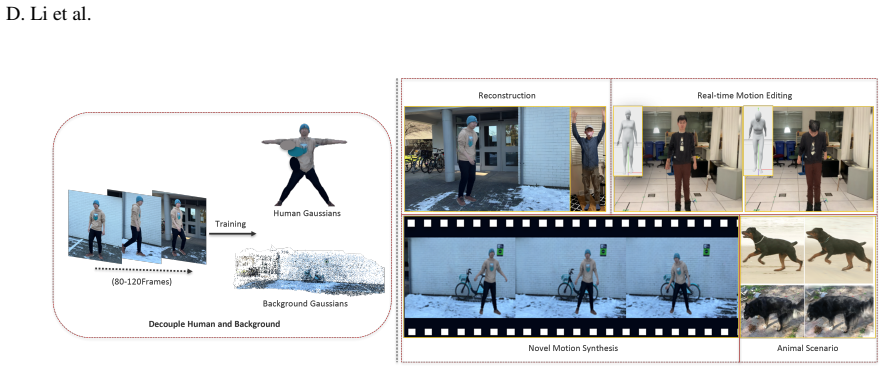
Pith's one-line read SkinningGS claims that an editable human avatar and its background can be rebuilt from one monocular video with half the Gaussian points and up to six times the rendering speed of HUGS, at matching or better reconstruction quality.
desk verdict A plausible engineering integration with real efficiency gains, but the quantitative evidence as printed is too inconsistent to support the 'surpasses HUGS' claim. read the letter →
The pith
A machine-rendered reading of the paper's core claim, the machinery that carries it, and where it could break.
The reading
What carries the argument
The load-bearing object is the position texture, a UV map $\tau \in \mathbb{R}^{H \times W \times 3}$ in which each pixel stores a 3D vertex position of the SMPL body model; points inside each mesh triangle are generated by barycentric interpolation, and their skinning weights come from the same interpolation. Because the texture grid is regular, the attribute predictor can be a simple CNN: it consumes an optimizable feature tensor $F \in \mathbb{R}^{H \times W \times D}$ aligned with the position texture and emits the geometry offset $\Delta x$, color $c_h$, and scale $s_h$ for every human Gaussian. Linear Blend Skinning, with weights $w_{ij}$, carries the canonical Da-pose points to world coordinates per frame, replacing the deformation field and densification heuristics of prior work with a fixed, resolution-controlled point budget.
What would settle it
Run the published pipeline on a monocular video in which the person is not standing on a planar surface, for example sitting with feet off a detected floor line or moving on stairs, and check whether the scale factor computed from the fitted ground plane keeps the reconstructed feet registered with the visible ground contact. A visible misregistration would show that the reported gains depend on the ground-plane prior rather than on the texture-based point growth; conversely, an independent reimplementation of the Tables 2-4 comparisons would verify whether the PSNR and LPIPS gaps over HUGS reproduce.
Extended reading notes
Core claim
The central claim, stated on the paper's own terms, is that a skinning-driven Gaussian representation can decouple a human from its background and jointly optimize both from monocular video more accurately and far faster than the deformation-field approach of HUGS. Instead of adapting the point cloud during training, SkinningGS bakes point generation into the SMPL model: every texel of the position texture $\tau \in \mathbb{R}^{H \times W \times 3}$ stores a 3D location on the body surface, barycentric interpolation fills the space inside each mesh triangle and derives matching LBS weights, and a CNN maps an optimizable feature tensor $F$ to per-point geometry offsets $\Delta x$, colors, and scales in a canonical spread-leg (Da) pose. Linear Blend Skinning then transports the canonical points to each frame, requiring no per-frame deformation network. The reported consequence is higher PSNR/SSIM and lower LPIPS than HUGS on both benchmarks, with the paper's own caveat of a slight regression on the citron sequence, at a reduced point budget and with real-time rendering measured at about 190 FPS on an RTX 4090 and 135 FPS on an RTX 3070.
Load-bearing premise
The whole method assumes the person is standing on a flat ground that can be detected reliably from the video, because the scale factor that aligns the SMPL body to the scene is solved from the fitted ground plane before any optimization begins.
Editorial extensions
If this is right
- At the reported point budget of about 200k human Gaussians, the method halves the memory and deformation-cost footprint of HUGS while keeping or improving rendered fidelity.
- Rendering at roughly 135-190 FPS makes interactive joint editing and novel-motion synthesis practical on consumer-grade GPUs, not only on high-end hardware.
- Because the human points are anchored to the SMPL skeleton through LBS, retargeting an edited or newly synthesized motion to the reconstructed avatar does not require retraining the scene.
- The position-texture resolution sets a direct quality-versus-training-time trade-off, from about 15 minutes at $128 \times 128$ up to 45 minutes at $512 \times 512$, so practitioners can choose a budget before training.
- The same pipeline transfers to quadruped scenes by substituting the SMAL model for SMPL, as the paper demonstrates on animal sequences.
Reading between the lines
- A fairer comparison would map both methods across matched point budgets and training times rather than at a single settings point, to isolate when texture-based point growth actually beats adaptive densification.
- Because the predictor operates in a canonical Da-pose, the learned texture could plausibly be re-driven at inference time by an external motion source to retarget the avatar to poses never seen in the training video; the paper demonstrates joint editing but not this test-time retargeting.
- The metric tables list identical numbers for the HumanCap_0 and HumanCap_2 samples of the proposed method, so the reported deltas should be re-verified from raw outputs before they are treated as settled.
Editorial analysis
A structured set of objections, weighed in public.
Referee Report
Summary. The paper proposes SkinningGS, a method for editable dynamic human-scene reconstruction from monocular video based on 3D Gaussian Splatting and an SMPL skinning model. The key idea is to use a position texture to generate a dense canonical human point cloud and a CNN (PoP) to predict per-point attributes, then jointly optimize the human and background point clouds while using LBS for pose-driven deformation. The authors claim that this representation uses roughly half the points of HUGS, renders at over 100 FPS, and surpasses HUGS in reconstruction quality on the Neuman and HumanCap datasets. An extension to animal scenes via SMAL is also demonstrated.
Significance. If the reported results are correct, the method offers a meaningful efficiency improvement over HUGS for editable dynamic human reconstruction from monocular video, with a compact point cloud, real-time rendering, and a natural extension to animals. The position-texture growing strategy and the texture-driven CNN feature predictor are sensible contributions. However, the central quantitative claim—that the method surpasses HUGS in reconstruction metrics—is not consistently supported by the printed tables. The duplicate entries in Table 4, the contradictory Citron results in Table 2, and the ablation tables that sometimes show the full method underperforming its own ablated variants all undermine confidence in the headline claim. No code or checkpoints are provided, so the discrepancies cannot be resolved by inspection. The paper's core ideas are promising, but the evidence as presented needs substantial correction and clarification before the main claim can be accepted.
major comments (4)
- [Abstract and Section 4.2, Table 2] The abstract states that the method 'surpasses HUGS in reconstruction metrics' without qualification, but Table 2 (Citron) reports that Ours is worse than HUGS on scene SSIM (0.846 vs. 0.860), scene LPIPS (0.125 vs. 0.095), human SSIM (0.694 vs. 0.707), and human LPIPS (0.139 vs. 0.133). Section 4.2 itself acknowledges 'a slightly worse performance on the citron dataset,' which contradicts the unqualified abstract claim. Please either qualify the abstract or provide an aggregate result (e.g., mean across sequences) that supports the claim.
- [Table 4] The Ours rows for HumanCap_0 and HumanCap_2 are numerically identical: scene PSNR/SSIM/LPIPS = 26.461/0.903/0.072 and human PSNR/SSIM/LPIPS = 22.331/0.792/0.141, even though the HUGS rows differ across these two sequences. Since these are distinct test sequences, the duplicated numbers indicate a copy-paste error. As a result, the claimed improvement over HUGS on HumanCap_2 (and any aggregate HumanCap conclusion) is not supported by the printed data. Please correct the table and re-evaluate the corresponding claims.
- [Section 4.4, Tables 5 and 6] The text states that 'combining both enhances overall performance,' but the full method is not consistently the best. In Table 5 (Citron), Ours is worse than the 'w/o LBS' variant on scene PSNR (25.539 vs. 26.051), scene SSIM (0.846 vs. 0.864), scene LPIPS (0.125 vs. 0.093), human SSIM (0.694 vs. 0.696), and human LPIPS (0.139 vs. 0.135). In Table 6, Ours has lower scene PSNR than the 'w/o opacities' variant on Lab (26.378 vs. 26.391) and Seattle (27.267 vs. 27.397). The ablation conclusion should be revised to reflect the actual pattern, or the results should be corrected.
- [Section 3.1.2, Eq. (4)] The global scale factor s is solved from a ground plane fitted to COLMAP points under the assumption that the SMPL model is standing on a planar ground. If the fitted plane is noisy or the scene is not planar, the human and background coordinate systems will be misaligned before any optimization begins, which would invalidate the joint reconstruction. This assumption is not discussed in the Limitations section, and no robustness analysis is provided. Please add a discussion of failure cases or an experiment on scenes that violate the planar-ground assumption.
minor comments (5)
- [Abstract and Section 4.3] The speed claim is inconsistent: the abstract says '~6x the HUGS speed,' while Section 4.3 reports ~5x faster on an RTX 4090 and ~6x on an RTX 3070. Please specify the hardware associated with the number used in the abstract, or present the claim as hardware-dependent.
- [Table 4 caption] The header contains a typo: 'HumamCap' should be 'HumanCap'.
- [First-page footnote] The footnote on the first page contains an unfinished placeholder citation ('DOI:000000/11111') that should be completed or removed.
- [Section 4.3 and Table 7] The training time of 45 minutes at 512×512 resolution in Table 7 is inconsistent with the '1–2 hours' typical training time stated in Section 4.3; please clarify which configuration the 1–2 hour figure refers to.
- [Section 3.4] The 'Da-Pose' canonical initialization is not illustrated or formally defined; adding a figure or a clear definition would improve reproducibility.
Circularity Check
No significant circularity; central claims are empirical fits and forward passes with external architectural citations, though reported metric inconsistencies hurt verifiability.
full rationale
The paper's derivation chain is not circular. The position texture (Section 3.3) generates dense SMPL vertices via UV mapping and barycentric interpolation, and the optimizable feature tensor F (Section 3.4) is an input to a CNN attribute predictor; neither quantity is defined in terms of the target reconstruction metrics. Novel-pose rendering applies LBS to the fitted canonical attributes and is a genuine forward pass, not a fitted quantity renamed as a prediction. The PoP network and position-texture idea are presented with explicit external attributions ([18], [19], [20]) and adapted with a stated difference from GaussianAvatar, so no ansatz is smuggled in via self-citation. No load-bearing uniqueness theorem or self-citation is invoked. The empirical comparison with HUGS rests on reported tables that are internally inconsistent (Table 4 duplicates the Ours HumanCap_0 and HumanCap_2 rows, and Table 2 shows Ours below HUGS on Citron scene SSIM/LPIPS and human SSIM/LPIPS despite the text claiming general superiority), but inconsistency, missing code/checkpoints, and an assumption-sensitive ground-plane alignment (Section 3.1.2) are correctness and verifiability concerns, not evidence that any claim reduces to its inputs by construction. Accordingly, no circular step can be quoted or exhibited.
Assumptions & free parameters
free parameters (4)
- Position texture resolution =
512 x 512
- Loss weights (lambda_1..lambda_6) =
0.7, 0.3, 1.0, 1.0, 1.0, 1.0
- Da-pose canonical pose =
not specified
- Feature tensor dimension D =
not reported
assumptions (5)
- domain assumption SMPL model parameters from ROMP approximate the true human pose and shape in each frame
- domain assumption A ground plane can be robustly fit from the COLMAP background and the human stands on it
- domain assumption SMPL UV mapping provides a consistent 2D parameterization for densification and CNN prediction
- domain assumption The PoP network (from [18,19,20]) transfers to this joint human-scene setting
- standard math Gaussian splatting rendering equations and LBS skinning are valid scene models
invented entities (2)
-
Position texture (tau)
-
Optimizable feature tensor F
Cite this review
Pith. "Pith review of SkinningGS: Editable Dynamic Human Scene Reconstruction Using Gaussian Splatting Based on a Skinning Model." pith.science (2026). https://pith.science/paper/MDELUYVV
@misc{pith2026250621632,
  author       = {Pith},
  title        = {Pith review of: SkinningGS: Editable Dynamic Human Scene Reconstruction Using Gaussian Splatting Based on a Skinning Model},
  year         = {2026},
  howpublished = {\url{https://pith.science/paper/MDELUYVV}},
  note         = {Machine review of arXiv:2506.21632}
}
abstract
Reconstructing an interactive human avatar and the background from a monocular video of a dynamic human scene is highly challenging. In this work we adopt a strategy of point cloud decoupling and joint optimization to achieve the decoupled reconstruction of backgrounds and human bodies while preserving the interactivity of human motion. We introduce a position texture to subdivide the Skinned Multi-Person Linear (SMPL) body model's surface and grow the human point cloud. To capture fine details of human dynamics and deformations, we incorporate a convolutional neural network structure to predict human body point cloud features based on texture. This strategy makes our approach free of hyperparameter tuning for densification and efficiently represents human points with half the point cloud of HUGS. This approach ensures high-quality human reconstruction and reduces GPU resource consumption during training. As a result, our method surpasses the previous state-of-the-art HUGS in reconstruction metrics while maintaining the ability to generalize to novel poses and views. Furthermore, our technique achieves real-time rendering at over 100 FPS, $\sim$6$\times$ the HUGS speed using only Linear Blend Skinning (LBS) weights for human transformation. Additionally, this work demonstrates that this framework can be extended to animal scene reconstruction when an accurately-posed model of an animal is available.
Figures


Figures from the paper (10 more)


Reference graph
Works this paper leans on
-
[1]
Nerf: Representing scenes as neural radiance fields for view synthesis.Communications of the ACM, 65(1):99–106, 2021
Ben Mildenhall, Pratul P Srinivasan, Matthew Tancik, Jonathan T Barron, Ravi Ramamoorthi, and Ren Ng. Nerf: Representing scenes as neural radiance fields for view synthesis.Communications of the ACM, 65(1):99–106, 2021
2021
-
[2]
Point-nerf: Point-based neural radiance fields
Qiangeng Xu, Zexiang Xu, Julien Philip, Sai Bi, Zhixin Shu, Kalyan Sunkavalli, and Ulrich Neumann. Point-nerf: Point-based neural radiance fields. InProceedings of the IEEE/CVF conference on computer vision and pattern recognition, pages 5438–5448, 2022
2022
-
[3]
Mip-nerf: A multiscale representation for anti-aliasing neural radiance fields
Jonathan T Barron, Ben Mildenhall, Matthew Tancik, Peter Hedman, Ricardo Martin-Brualla, and Pratul P Srinivasan. Mip-nerf: A multiscale representation for anti-aliasing neural radiance fields. InProceedings of the IEEE/CVF international conference on computer vision, pages 5855–5864, 2021
2021
-
[4]
Keunhong Park, Utkarsh Sinha, Peter Hedman, Jonathan T Barron, Sofien Bouaziz, Dan B Goldman, Ricardo Martin-Brualla, and Steven M Seitz. Hypernerf: A higher-dimensional representation for topologically varying neural radiance fields.arXiv preprint arXiv:2106.13228, 2021. 10 D. Li et al
arXiv 2021
-
[5]
Neural scene flow fields for space-time view synthesis of dynamic scenes
Zhengqi Li, Simon Niklaus, Noah Snavely, and Oliver Wang. Neural scene flow fields for space-time view synthesis of dynamic scenes. InProceedings of the IEEE/CVF Conference on Computer Vision and Pattern Recognition, pages 6498–6508, 2021
work page 2021
-
[6]
Neural 3d video synthesis from multi-view video
Tianye Li, Mira Slavcheva, Michael Zollhoefer, Simon Green, Christoph Lassner, Changil Kim, Tanner Schmidt, Steven Lovegrove, Michael Goesele, Richard Newcombe, et al. Neural 3d video synthesis from multi-view video. InProceedings of the IEEE/CVF Conference on Computer Vision and Pattern Recognition, pages 5521–5531, 2022
work page 2022
-
[7]
Nerfies: Deformable neural radiance fields
Keunhong Park, Utkarsh Sinha, Jonathan T Barron, Sofien Bouaziz, Dan B Goldman, Steven M Seitz, and Ricardo Martin-Brualla. Nerfies: Deformable neural radiance fields. InProceedings of the IEEE/CVF International Conference on Computer Vision, pages 5865–5874, 2021
2021
-
[8]
3d gaussian splatting for real-time radiance field rendering.ACM Trans
Bernhard Kerbl, Georgios Kopanas, Thomas Leimkühler, and George Drettakis. 3d gaussian splatting for real-time radiance field rendering.ACM Trans. Graph., 42(4):139–1, 2023
2023
Show all 44 references
-
[9]
Deformable 3d gaussians for high-fidelity monocular dynamic scene reconstruction
Ziyi Yang, Xinyu Gao, Wen Zhou, Shaohui Jiao, Yuqing Zhang, and Xiaogang Jin. Deformable 3d gaussians for high-fidelity monocular dynamic scene reconstruction. InProceedings of the IEEE/CVF Conference on Computer Vision and Pattern Recognition, pages 20331–20341, 2024
2024
-
[10]
Gaussian-flow: 4d reconstruction with dynamic 3d gaussian particle
Youtian Lin, Zuozhuo Dai, Siyu Zhu, and Yao Yao. Gaussian-flow: 4d reconstruction with dynamic 3d gaussian particle. InProceedings of the IEEE/CVF Conference on Computer Vision and Pattern Recognition, pages 21136–21145, 2024
2024
-
[11]
Motion-aware 3d gaussian splatting for efficient dynamic scene reconstruction.arXiv preprint arXiv:2403.11447, 2024
Zhiyang Guo, Wengang Zhou, Li Li, Min Wang, and Houqiang Li. Motion-aware 3d gaussian splatting for efficient dynamic scene reconstruction.arXiv preprint arXiv:2403.11447, 2024
2024 arXiv
-
[12]
Real-time photorealistic dynamic scene representation and rendering with 4d gaussian splatting.arXiv preprint arXiv:2310.10642, 2023
Zeyu Yang, Hongye Yang, Zijie Pan, and Li Zhang. Real-time photorealistic dynamic scene representation and rendering with 4d gaussian splatting.arXiv preprint arXiv:2310.10642, 2023
2023 arXiv
-
[13]
Dynamic 3d gaussians: Tracking by persistent dynamic view synthesis.arXiv preprint arXiv:2308.09713, 2023
Jonathon Luiten, Georgios Kopanas, Bastian Leibe, and Deva Ramanan. Dynamic 3d gaussians: Tracking by persistent dynamic view synthesis.arXiv preprint arXiv:2308.09713, 2023
2023 arXiv
-
[14]
Editable free-viewpoint video using a layered neural representation.ACM Transactions on Graphics, 40(4):1–18, July 2021
Jiakai Zhang, Xinhang Liu, Xinyi Ye, Fuqiang Zhao, Yanshun Zhang, Minye Wu, Yingliang Zhang, Lan Xu, and Jingyi Yu. Editable free-viewpoint video using a layered neural representation.ACM Transactions on Graphics, 40(4):1–18, July 2021
2021
-
[15]
Neuman: Neural human radiance field from a single video
Wei Jiang, Kwang Moo Yi, Golnoosh Samei, Oncel Tuzel, and Anurag Ranjan. Neuman: Neural human radiance field from a single video. InEuropean Conference on Computer Vision, pages 402–418. Springer, 2022
2022
-
[16]
Hugs: Human gaussian splats
Muhammed Kocabas, Jen-Hao Rick Chang, James Gabriel, Oncel Tuzel, and Anurag Ranjan. Hugs: Human gaussian splats. InProceedings of the IEEE/CVF conference on computer vision and pattern recognition, pages 505–515, 2024
2024
-
[17]
Smpl: A skinned multi-person linear model.ACM Transactions on Graphics, 34(6), 2015
Matthew Loper, Naureen Mahmood, Javier Romero, Gerard Pons-Moll, and Michael J Black. Smpl: A skinned multi-person linear model.ACM Transactions on Graphics, 34(6), 2015
2015
-
[18]
Gaussianavatar: Towards realistic human avatar modeling from a single video via animatable 3d gaussians
Liangxiao Hu, Hongwen Zhang, Yuxiang Zhang, Boyao Zhou, Boning Liu, Shengping Zhang, and Liqiang Nie. Gaussianavatar: Towards realistic human avatar modeling from a single video via animatable 3d gaussians. In Proceedings of the IEEE/CVF Conference on Computer Vision and Patte...
2024
-
[19]
The power of points for modeling humans in clothing
Qianli Ma, Jinlong Yang, Siyu Tang, and Michael J Black. The power of points for modeling humans in clothing. In2021 IEEE/CVF International Conference on Computer Vision (ICCV), pages 10954–10964. IEEE, 2021
2021
-
[20]
Qianli Ma, Shunsuke Saito, Jinlong Yang, Siyu Tang, and Michael J. Black. SCALE: Modeling clothed humans with a surface codec of articulated local elements. InProceedings IEEE/CVF Conf. on Computer Vision and Pattern Recognition (CVPR), June 2021
2021
-
[21]
The lumigraph
Steven J Gortler, Radek Grzeszczuk, Richard Szeliski, and Michael F Cohen. The lumigraph. InProceedings of the 23rd annual conference on Computer graphics and interactive techniques, pages 43–54, 1996
1996
-
[22]
Light field rendering
Marc Levoy and Pat Hanrahan. Light field rendering. InSeminal Graphics Papers: Pushing the Boundaries, V olume 2, pages 441–452. 2023
2023
-
[23]
Photo tourism: exploring photo collections in 3d
Noah Snavely, Steven M Seitz, and Richard Szeliski. Photo tourism: exploring photo collections in 3d. InACM siggraph 2006 papers, pages 835–846. 2006
2006
-
[24]
Structure-from-motion revisited
Johannes L Schonberger and Jan-Michael Frahm. Structure-from-motion revisited. InProceedings of the IEEE conference on computer vision and pattern recognition, pages 4104–4113, 2016
2016
-
[25]
Pixelwise view selection for unstructured multi-view stereo
Johannes L Schönberger, Enliang Zheng, Jan-Michael Frahm, and Marc Pollefeys. Pixelwise view selection for unstructured multi-view stereo. InComputer Vision–ECCV 2016: 14th European Conference, Amsterdam, The Netherlands, October 11-14, 2016, Proceedings, Part III 14, pages 50...
2016
-
[26]
Dynibar: Neural dynamic image-based rendering
Zhengqi Li, Qianqian Wang, Forrester Cole, Richard Tucker, and Noah Snavely. Dynibar: Neural dynamic image-based rendering. InProceedings of the IEEE/CVF Conference on Computer Vision and Pattern Recognition, pages 4273–4284, 2023
2023
-
[27]
Expressive body capture: 3d hands, face, and body from a single image
Georgios Pavlakos, Vasileios Choutas, Nima Ghorbani, Timo Bolkart, Ahmed AA Osman, Dimitrios Tzionas, and Michael J Black. Expressive body capture: 3d hands, face, and body from a single image. InProceedings of the IEEE/CVF conference on computer vision and pattern recognition...
2019
-
[28]
Detailed human avatars from monocular video
Thiemo Alldieck, Marcus Magnor, Weipeng Xu, Christian Theobalt, and Gerard Pons-Moll. Detailed human avatars from monocular video. In2018 International Conference on 3D Vision (3DV), pages 98–109. IEEE, 2018
2018
-
[29]
Vid2actor: Free-viewpoint animatable person synthesis from video in the wild.arXiv preprint arXiv:2012.12884, 2020
Chung-Yi Weng, Brian Curless, and Ira Kemelmacher-Shlizerman. Vid2actor: Free-viewpoint animatable person synthesis from video in the wild.arXiv preprint arXiv:2012.12884, 2020
2012 arXiv
-
[30]
Humannerf: Free-viewpoint rendering of moving people from monocular video
Chung-Yi Weng, Brian Curless, Pratul P Srinivasan, Jonathan T Barron, and Ira Kemelmacher-Shlizerman. Humannerf: Free-viewpoint rendering of moving people from monocular video. InProceedings of the IEEE/CVF conference on computer vision and pattern Recognition, pages 16210–16220, 2022
2022
-
[31]
3dgs-avatar: Animatable avatars via deformable 3d gaussian splatting
Zhiyin Qian, Shaofei Wang, Marko Mihajlovic, Andreas Geiger, and Siyu Tang. 3dgs-avatar: Animatable avatars via deformable 3d gaussian splatting. InProceedings of the IEEE/CVF Conference on Computer Vision and Pattern Recognition, pages 5020–5030, 2024
2024
-
[32]
Animatable gaussians: Learning pose-dependent gaussian maps for high-fidelity human avatar modeling
Zhe Li, Zerong Zheng, Lizhen Wang, and Yebin Liu. Animatable gaussians: Learning pose-dependent gaussian maps for high-fidelity human avatar modeling. InProceedings of the IEEE/CVF Conference on Computer Vision and Pattern Recognition, pages 19711–19722, 2024
2024
-
[33]
Detectron2.https://github
Yuxin Wu, Alexander Kirillov, Francisco Massa, Wan-Yen Lo, and Ross Girshick. Detectron2.https://github. com/facebookresearch/detectron2, 2019
2019
-
[34]
Monocular, one-stage, regression of multiple 3d people
Yu Sun, Qian Bao, Wu Liu, Yili Fu, Michael J Black, and Tao Mei. Monocular, one-stage, regression of multiple 3d people. InProceedings of the IEEE/CVF international conference on computer vision, pages 11179–11188, 2021
2021
-
[35]
Image quality assessment: from error visibility to structural similarity.IEEE transactions on image processing, 13(4):600–612, 2004
Zhou Wang, Alan C Bovik, Hamid R Sheikh, and Eero P Simoncelli. Image quality assessment: from error visibility to structural similarity.IEEE transactions on image processing, 13(4):600–612, 2004
2004
-
[36]
The unreasonable effectiveness of deep features as a perceptual metric
Richard Zhang, Phillip Isola, Alexei A Efros, Eli Shechtman, and Oliver Wang. The unreasonable effectiveness of deep features as a perceptual metric. InProceedings of the IEEE conference on computer vision and pattern recognition, pages 586–595, 2018
2018
-
[37]
Articulated mesh animation from multi-view silhouettes
Daniel Vlasic, Ilya Baran, Wojciech Matusik, and Jovan Popovi´c. Articulated mesh animation from multi-view silhouettes. InAcm Siggraph 2008 papers, pages 1–9. 2008
2008
-
[38]
Monoperfcap: Human performance capture from monocular video.ACM Transactions on Graphics (ToG), 37(2):1–15, 2018
Weipeng Xu, Avishek Chatterjee, Michael Zollhöfer, Helge Rhodin, Dushyant Mehta, Hans-Peter Seidel, and Christian Theobalt. Monoperfcap: Human performance capture from monocular video.ACM Transactions on Graphics (ToG), 37(2):1–15, 2018
2018
-
[39]
A benchmark dataset and evaluation methodology for video object segmentation
Federico Perazzi, Jordi Pont-Tuset, Brian McWilliams, Luc Van Gool, Markus Gross, and Alexander Sorkine- Hornung. A benchmark dataset and evaluation methodology for video object segmentation. InProceedings of the IEEE conference on computer vision and pattern recognition, page...
2016
-
[40]
Reconstructing animatable categories from videos
Gengshan Yang, Chaoyang Wang, N Dinesh Reddy, and Deva Ramanan. Reconstructing animatable categories from videos. InProceedings of the IEEE/CVF Conference on Computer Vision and Pattern Recognition, pages 16995–17005, 2023
2023
-
[41]
3d menagerie: Modeling the 3d shape and pose of animals
Silvia Zuffi, Angjoo Kanazawa, David W Jacobs, and Michael J Black. 3d menagerie: Modeling the 3d shape and pose of animals. InProceedings of the IEEE conference on computer vision and pattern recognition, pages 6365–6373, 2017
2017
-
[42]
Creatures great and smal: Recovering the shape and motion of animals from video
Benjamin Biggs, Thomas Roddick, Andrew Fitzgibbon, and Roberto Cipolla. Creatures great and smal: Recovering the shape and motion of animals from video. InComputer Vision–ACCV 2018: 14th Asian Conference on Computer Vision, Perth, Australia, December 2–6, 2018, Revised Selecte...
2018
-
[43]
Common pets in 3d: Dynamic new-view synthesis of real-life deformable categories
Samarth Sinha, Roman Shapovalov, Jeremy Reizenstein, Ignacio Rocco, Natalia Neverova, Andrea Vedaldi, and David Novotny. Common pets in 3d: Dynamic new-view synthesis of real-life deformable categories. In Proceedings of the IEEE/CVF Conference on Computer Vision and Pattern R...
2023
-
[44]
Ash: Animatable gaussian splats for efficient and photoreal human rendering
Haokai Pang, Heming Zhu, Adam Kortylewski, Christian Theobalt, and Marc Habermann. Ash: Animatable gaussian splats for efficient and photoreal human rendering. InProceedings of the IEEE/CVF Conference on Computer Vision and Pattern Recognition, pages 1165–1175, 2024. 12 D. Li ...
2024
Reviewed August 6, 2026 · model on record in the stance chip above.
Discussion (0). Sign in to comment.