REVIEW 4 major objections 5 minor 82 references
E$^3$mo-Bench: A Scalable Benchmark for Multimodal Evoked and Expressed Emotion Understanding via Bayesian Pairwise Alignment
T0 review · 4 major / 5 minor · reviewed 2026-08-12 · deepseek-v4-flash
Pith's one-line read A unified benchmark, E3mo-Bench, measures both evoked and expressed emotion understanding in MLLMs and finds models handle the two perspectives unevenly.
desk verdict Genuinely new audio-visual benchmark for expressed and evoked emotion, but the headline expressed-vs-evoked gap is confounded by face-based content routing; referee-worthy if the data ships. read the letter →
The pith
A machine-rendered reading of the paper's core claim, the machinery that carries it, and where it could break.
The reading
What carries the argument
The engine of the paper is Bayesian Pairwise Alignment (BPA), a framework for turning sparse "which video is higher / lower / similar?" judgments into continuous valence-arousal-dominance (VAD) scores on a 1–9 scale. Each sample carries a latent score $\mu$ and an uncertainty $\sigma$; Golden Anchors (383 human-consensus videos) are fixed references, and candidates are initialized from percentile-mapped model bootstraps. Comparisons are scheduled by a tripartite policy — TrueSkill-inspired exploration (50%), anchor calibration (30%), and bridge sampling (20%) — and periodically a global maximum a posteriori optimization fits a Rao–Kupper tie-aware pairwise model with per-annotator reliability weights, using an adaptive quadratic prior that weakens as evidence accumulates. Uncertainty is estimated by a diagonal empirical-Fisher approximation, temporally smoothed, and used as the stopping criterion. E3mo-Score is BPA's model-based instantiation: five MLLMs vote on each pairwise comparison, weighted by per-task reliability calibrated on held-out anchors, and the same BPA optimizer yields the final VAD predictions.
What would settle it
Re-annotate a matched subset of the same videos under both affective perspectives and compare model performance on perspective-matched pairs; if the expressed/evoked gap disappears or reverses when content and difficulty are equalized, the reported skew is an artifact of video routing rather than a genuine property of the models. Concretely, the paper's own proposed 'dual-perspective subset' (stated as future work in the Limitations section) would settle this directly.
Extended reading notes
Core claim
On its own terms, the paper establishes that a single benchmark can test expressed and evoked emotion understanding under a shared taxonomy, and that doing so exposes a reliable imbalance in today's models. Using eight source datasets and a two-tier annotation design — a 383-sample Golden Anchor Set with strict human consensus and a 2,141-sample Broad-Coverage Set validated by a human-in-the-loop pipeline — the authors construct 12,314 QA pairs. They report that the best open and proprietary MLLMs score around 60–70% on perception tasks, cluster near random on pairwise video comparisons, and show a pronounced skew: expressed perception is easier than evoked perception (best models: ~62% vs ~60%), while open-vocabulary recognition is stronger for evoked than expressed emotion (best: 61.52% vs 53.31% on the paper's F_VAD metric). The paper also claims that BPA recovers anchor-aligned VAD scores from sparse comparisons at roughly 60% of the cost of conventional mean-opinion-score annotation, and that the training-free E3mo-Score committee outperforms every individual model it aggregates.
Load-bearing premise
The entire expressed-versus-evoked comparison rests on treating face presence as an operational proxy: videos with a detected face are labeled expressed and videos without one are labeled evoked, with the assumption that the two pools differ only in affective perspective rather than in content, source dataset, or difficulty.
Editorial extensions
If this is right
- A single 'emotional intelligence' score is misleading: E3mo-Bench implies MLLMs should be evaluated separately for expressed and evoked understanding, since the two are not learned in tandem.
- Pairwise-comparison annotation with Bayesian calibration could replace expensive absolute-rating protocols for other subjective continuous labels, such as aesthetics or humor, at a reported ~60% of conventional cost.
- The persistent dominance deficit points to a concrete training target: models need explicit cues of agency, control, and submissiveness, which current emotion datasets mostly ignore.
- The redundancy-aware VAD set similarity metric (F_VAD) makes open-vocabulary emotion errors comparable by severity, not just by semantic category, which could become a standard grading scheme for emotion generation.
- The dual-perspective design (evoked vs expressed) sets a template for future benchmarks that want to separate a model's theory of mind about others from its own affective response.
Reading between the lines
- One testable extension is to re-annotate a matched subset of videos under both perspectives; if the expressed/evoked gap persists with content and difficulty held constant, it is a genuine model limitation, while if it shrinks the gap is partly an artifact of face-detection routing.
- Because the preliminary VAD bootstrap relies on English lexical norms (13,915 lemmas), the benchmark likely inherits English-language affective biases; re-norming with multilingual or cross-cultural emotion lexicons could shift both the scores and the model rankings.
- The success of a training-free 'committee that compares rather than scores' suggests a general recipe for subjective estimation: replace direct regression with pairwise preference aggregation, which may transfer to other fine-grained LLM evaluation dimensions.
- The paper's own limitations list admits that no video has annotations for both perspectives, so the benchmark cannot yet say how expressed and evoked emotions interact within a single clip; a dual-perspective subset would be the natural next release.
Signed reviews
Editorial analysis
A structured set of objections, weighed in public.
Referee Report
Summary. The paper introduces E$^3$mo-Bench, a benchmark of 12,314 question-answer pairs over 2,524 videos intended to evaluate both expressed and evoked emotion understanding in multimodal large language models (MLLMs). The benchmark organizes evaluation into three tasks: emotion perception, open-vocabulary recognition, and valence-arousal-dominance (VAD) assessment. To obtain scalable continuous VAD labels, the authors propose Bayesian Pairwise Alignment (BPA), which aggregates sparse pairwise human judgments into anchor-referenced scores, and an automated variant, E$^3$mo-Score, which uses a five-model committee as virtual annotators. The paper reports an evaluation of 16 MLLMs and claims that the framework is effective, that BPA-based annotation is reliable and cost-efficient, and that current models exhibit a performance skew between expressed and evoked emotion paradigms.
Significance. If the benchmark and annotation method hold up, this is a potentially useful contribution: it is among the first audio-visual benchmarks to combine expressed and evoked perspectives with open-vocabulary and dimensional annotations, and the pairwise-comparison approach to VAD annotation is a plausible route to scalable affective labels. The Golden Anchor human annotation effort, with 15 annotators and reported ICC values, is a real strength, as is the BPA validation on the expressed-valence subtask (SRCC 0.91, PLCC 0.90). The E$^3$mo-Score committee agent also shows improvements over individual models in several subtasks. However, the central expressed-versus-evoked comparison is currently confounded by the face-based routing rule, and several validation claims outrun the evidence reported in the paper. The benchmark is not released, which limits independent verification.
major comments (4)
- [Video Collection and Candidate Curation; Supp. H.1] The central claim that MLLMs are better at expressed than evoked emotion is not identifiable from the reported comparisons. The expressed pool is selected by YOLO11n face detection and drawn almost entirely from DFEW, MELD, CAER, and MAFW, whereas the evoked pool is drawn from VGGSound, LIRIS-ACCEDE, VideoEmotion, and MediaEval. Face presence therefore correlates with source dataset, genre, shot composition, and labeling difficulty, so the differences in Tables 1 and 2 (e.g., GPT-5.4: 58.32% evoked vs. 61.69% expressed overall perception) can be explained by content shift rather than by affective perspective. Supp. H.1 explicitly states that the design 'does not provide paired annotations for both perspectives on every video,' so the expressed/evoked comparison cannot separate perspective from content. The authors should either add a dual-perspective subset with identical videos annotated under both perspectives, or restrict the benchmark's claims to perspective-conditioned evaluation and remove the causal-sounding skew conclusions.
- [Human Pairwise Annotation; Supp. C.6] BPA validation is reported only for the expressed-valence subtask (SRCC 0.91, PLCC 0.90), while the benchmark and E$^3$mo-Score cover six subtasks (evoked/expressed times valence/arousal/dominance). Since dominance shows markedly lower annotator consistency (ICC(3,k)=0.56) and E$^3$mo-Score's gains are smallest on dominance in Table 3, the claim that BPA 'reliably scales continuous dimensional annotations' across all dimensions is not established. Please provide anchor-recovery or other validation for each of the six subtasks, or explicitly scope the reliability claim.
- [The E3mo-Score Agent; Supp. E.1; Table 3] The evaluation of E$^3$mo-Score is potentially circular. Committee reliability weights are estimated on the Golden Anchor Set (Supp. E.1), and the reported correlations in Table 3 are then computed by masking scores from the same Golden Anchor Set (14 fixed anchors, 369 candidates). If the anchor subset used for weight calibration overlaps the candidate subset used for evaluation, the committee weights are fit to the evaluation data. In addition, candidate scores in BPA are initialized from model-generated bootstrap VAD estimates and pulled toward those values by the adaptive prior in Eq. (8), so E$^3$mo-Score's margin over baselines that predict VAD directly may partly reflect prior information from the same model family. Please clarify the exact disjointness of calibration and evaluation anchors, and add an ablation that removes the model-initialized prior.
- [Evaluation on Assessment Task; Supp. F.2] The main text states that 'Evaluation on the full E$^3$mo-Bench yields consistent findings, with detailed results... provided in Supp.' However, Supp. Table 5 reports only the five individual models on the full benchmark and does not include E$^3$mo-Score, so the claimed generalization of E$^3$mo-Score's superiority to the full benchmark is not supported by any reported result.
minor comments (5)
- [Overall Analysis in Experiments] The statement that 'models perceive expressed emotions slightly better than evoked emotions' should be scoped to the Perception task, because the Recognition results in Tables 1 and 2 often show the opposite direction; as written, the two paragraphs appear inconsistent.
- [Supp. C.7] The cost comparison reports 'approximately 64%' of conventional MOS cost and then says 'roughly 60% when reported at a coarse level'; the abstract and main text use only the 60% figure, so please reconcile these numbers or present a single estimate with its uncertainty.
- [Tables 1 and 2] The row label 'Random guess w/o recognition' is confusing because recognition scores are listed as NA; please clarify that the random baseline applies only to the Perception task.
- [General] The benchmark itself is not released and no URL or data-access statement is provided, which prevents independent verification of the QA pairs, VAD scores, and the reported model evaluations; please add an availability statement.
- [Eq. (4) and Supp. E.1] The F_VAD metric depends on several data-adaptive parameters (tau_dup, sigma_s, gamma, beta); please state whether the reported conclusions are robust to reasonable perturbations of these parameters.
Circularity Check
No significant circularity: BPA and E3mo-Score are validated against independent human anchors, though the expressed/evoked performance gap is a validity confound rather than a circular derivation.
full rationale
The paper's central methodological claims are not circular. BPA recovers continuous VAD scores from sparse pairwise judgments, and its key validation relaxes Golden Anchor constraints and compares re-estimated scores against independent human MOS ratings (Supp. C.6, SRCC 0.91 / PLCC 0.90). Although BPA initializes candidate scores from model-generated preliminary VAD estimates and applies an adaptive prior (Eq. 8), that prior is not the predicted quantity and its strength decays with the number of comparisons; the reported anchor-recovery experiment therefore constitutes genuinely independent support rather than a fitted-input-renamed-as-prediction. E3mo-Score's committee weights are calibrated on Golden Anchor screening items, but the reported evaluation infers scores for candidate samples from committee pairwise judgments through the BPA pipeline and compares them with human ratings, so the output is not forced to equal the calibration values by construction. The paper's self-citations (EEmo-Logic, EEmo-Bench, EEmo-Logic in the committee) are not load-bearing for the core derivation; EEmo-Logic is evaluated as a baseline rather than invoked as proof of correctness. The most significant caveat is the expressed/evoked comparison itself: YOLO11n face screening routes face-present videos from DFEW/MELD/CAER/MAFW into the expressed pool and face-free videos from VGGSound/LIRIS-ACCEDE/VideoEmotion/MediaEval into the evoked pool, and Supp. H.1 concedes that no paired annotations exist for both perspectives on the same video. This confounds affective perspective with content type and source dataset, which threatens the external validity of the 'pronounced performance skew' finding, but it is a validity limitation, not a circular derivation from the benchmark's own definitions. Overall, no circular step meeting the evidence bar is present.
Assumptions & free parameters
free parameters (5)
- BPA prior strength λ0 and decay γ =
Human: λ0=1.0, γ=0.01; E3mo-Score: λ0=0.05, γ=0.25
- Percentile mapping bounds and thresholds =
L=2, U=8, 5th/95th percentiles
- Committee reliability screening weights =
Eq. 27: 0.40/0.25/0.10/0.10/0.15, invalid penalty 0.50; tier multipliers 0.75/1.00/1.25
- F_VAD metric parameters =
τ_dup=10th percentile, σ_s=25th percentile, γ=2.0, β=0.3
- Difficulty sampling weights =
(ω_v, ω_a, ω_d) = (0.50, 0.35, 0.15)
assumptions (4)
- domain assumption Each video is assigned exactly one affective perspective, expressed or evoked, even though both emotions may coexist.
- domain assumption Face detection with YOLO11n reliably separates expressed from evoked emotion videos.
- domain assumption Golden Anchor MOS ratings are valid ground truth for VAD, and the normative VAD lexicon (Warriner) maps OV words to coordinates.
- standard math Standard Bayesian pairwise models (Rao-Kupper, Crowd-BT, TrueSkill) and Fisher information approximations are appropriate.
Cite this review
Pith. "Pith review of E$^3$mo-Bench: A Scalable Benchmark for Multimodal Evoked and Expressed Emotion Understanding via Bayesian Pairwise Alignment." pith.science (2026). https://pith.science/paper/MDFHNJJ3
@misc{pith2026260810796,
  author       = {Pith},
  title        = {Pith review of: E$^3$mo-Bench: A Scalable Benchmark for Multimodal Evoked and Expressed Emotion Understanding via Bayesian Pairwise Alignment},
  year         = {2026},
  howpublished = {\url{https://pith.science/paper/MDFHNJJ3}},
  note         = {Machine review of arXiv:2608.10796}
}
abstract
Understanding both expressed and evoked emotions is critical for multimodal large language models (MLLMs) to achieve comprehensive affect-aware interactions. However, existing benchmarks typically examine expressed and evoked emotions in isolation or are constrained to coarse-grained and incomplete affective characterizations. To bridge this gap, we introduce E$^3$mo-Bench, a scalable benchmark comprising $12{,}314$ question-answer pairs across $2{,}524$ videos with predefined affective perspectives. It evaluates evoked and expressed emotion understanding via $3$ complementary tasks: emotion perception, open-vocabulary recognition, and valence-arousal-dominance (VAD) assessment. To efficiently scale reliable continuous annotations, we propose Bayesian Pairwise Alignment, which aggregates sparse, low-burden pairwise judgments into anchor-referenced VAD estimates. Furthermore, we develop E$^3$mo-Score, a training-free agent that aggregates complementary judgments from a five-model committee to improve VAD estimation. Extensive experiments validate the effectiveness of our framework and expose a pronounced performance skew between evoked and expressed emotion paradigms. These findings, coupled with MLLMs' persistent deficits in fine-grained recognition and dimensional assessment, chart a clear course for advancing multimodal emotional intelligence.
Figures


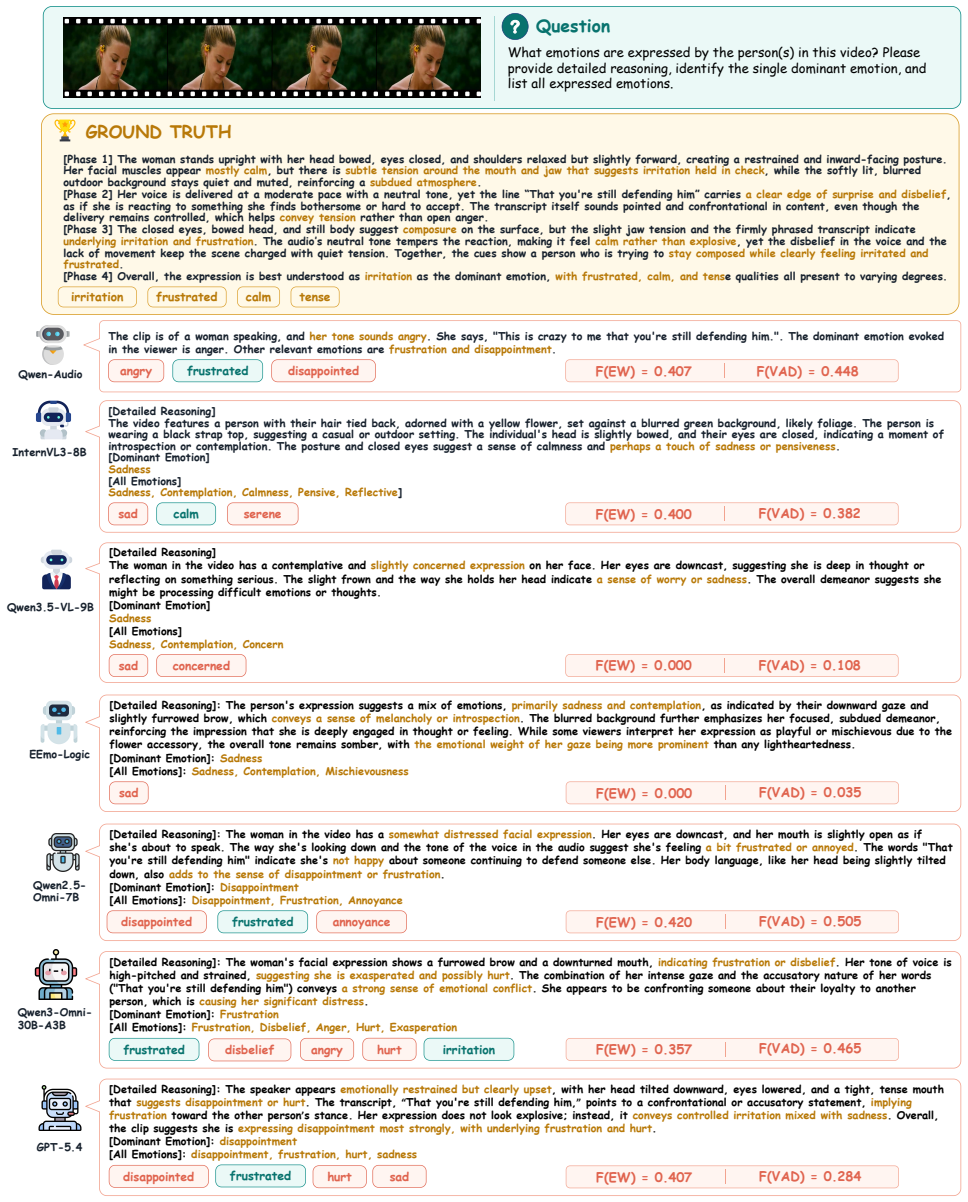
Figures from the paper (10 more)


Reference graph
Works this paper leans on
-
[1]
Proceedings of the 28th ACM International Conference on Multimedia (ACM MM) , pages=
Dfew: A large-scale database for recognizing dynamic facial expressions in the wild , author=. Proceedings of the 28th ACM International Conference on Multimedia (ACM MM) , pages=
-
[2]
Proceedings of the 57th Annual Meeting of the Association for Computational Linguistics (ACL) , pages=
Meld: A multimodal multi-party dataset for emotion recognition in conversations , author=. Proceedings of the 57th Annual Meeting of the Association for Computational Linguistics (ACL) , pages=
-
[3]
Proceedings of the IEEE/CVF international conference on computer vision (ICCV) , pages=
Context-aware emotion recognition networks , author=. Proceedings of the IEEE/CVF international conference on computer vision (ICCV) , pages=
-
[4]
Proceedings of the 30th ACM International Conference on Multimedia (ACM MM) , pages=
Mafw: A large-scale, multi-modal, compound affective database for dynamic facial expression recognition in the wild , author=. Proceedings of the 30th ACM International Conference on Multimedia (ACM MM) , pages=
-
[5]
IEEE Transactions on Affective Computing (TAFFC) , volume=
LIRIS-ACCEDE: A video database for affective content analysis , author=. IEEE Transactions on Affective Computing (TAFFC) , volume=. 2015 , publisher=
work page 2015
-
[6]
Proceedings of the AAAI conference on artificial intelligence (AAAI) , volume=
Predicting emotions in user-generated videos , author=. Proceedings of the AAAI conference on artificial intelligence (AAAI) , volume=
-
[7]
Vggsound: A large-scale audio-visual dataset , author=. Proceedings of the 2020 IEEE International Conference on Acoustics, Speech and Signal Processing (ICASSP) , pages=
work page 2020
-
[8]
Proceedings of the CEUR Workshop Proceedings (CEUR-WS) , volume=
The MediaEval 2017 emotional impact of movies task , author=. Proceedings of the CEUR Workshop Proceedings (CEUR-WS) , volume=
work page 2017
Show all 82 references
-
[9]
Journal of behavior therapy and experimental psychiatry , volume=
Measuring emotion: the self-assessment manikin and the semantic differential , author=. Journal of behavior therapy and experimental psychiatry , volume=. 1994 , publisher=
1994
-
[10]
arXiv preprint arXiv:2410.17725 , year=
Yolov11: An overview of the key architectural enhancements , author=. arXiv preprint arXiv:2410.17725 , year=
-
[11]
arXiv preprint arXiv:2501.16566 , year=
Affectgpt: A new dataset, model, and benchmark for emotion understanding with multimodal large language models , author=. arXiv preprint arXiv:2501.16566 , year=
-
[12]
arXiv preprint arXiv:2511.21631 , year=
Qwen3-vl technical report , author=. arXiv preprint arXiv:2511.21631 , year=
-
[13]
arXiv preprint arXiv:2507.08128 , year=
Audio Flamingo 3: Advancing Audio Intelligence with Fully Open Large Audio Language Models , author=. arXiv preprint arXiv:2507.08128 , year=
-
[14]
2026 , month = mar, howpublished =
Introducing. 2026 , month = mar, howpublished =
2026
-
[15]
Behavior Research Methods (BRM) , volume=
Norms of valence, arousal, and dominance for 13,915 English lemmas , author=. Behavior Research Methods (BRM) , volume=. 2013 , publisher=
2013
-
[16]
and Fleiss, Joseph L
Shrout, Patrick E. and Fleiss, Joseph L. , title =. Psychological Bulletin , volume =. 1979 , doi =
1979
-
[17]
Recommendation ITU-R BT , pages=
Methodology for the subjective assessment of the quality of television pictures , author=. Recommendation ITU-R BT , pages=
-
[18]
arXiv preprint arXiv:2410.01495 , year=
Ov-mer: Towards open-vocabulary multimodal emotion recognition , author=. arXiv preprint arXiv:2410.01495 , year=
-
[19]
In Proceedings of Advances in Neural Information Processing Systems (NeurIPS) , volume=
TrueSkill™: a Bayesian skill rating system , author=. In Proceedings of Advances in Neural Information Processing Systems (NeurIPS) , volume=
-
[20]
In Proceedings of Advances in Neural Information Processing Systems (NeurIPS) , volume=
Hybrid-MST: A hybrid active sampling strategy for pairwise preference aggregation , author=. In Proceedings of Advances in Neural Information Processing Systems (NeurIPS) , volume=
-
[21]
Applied Psychological Measurement (APM) , volume=
Evaluating anchor-item designs for concurrent calibration with the GGUM , author=. Applied Psychological Measurement (APM) , volume=. 2017 , publisher=
2017
-
[22]
Journal of the American Statistical Association (JASA) , volume=
Ties in paired-comparison experiments: A generalization of the Bradley-Terry model , author=. Journal of the American Statistical Association (JASA) , volume=. 1967 , publisher=
1967
-
[23]
Proceedings of the 6th ACM international conference on Web search and data mining (WSDM) , pages=
Pairwise ranking aggregation in a crowdsourced setting , author=. Proceedings of the 6th ACM international conference on Web search and data mining (WSDM) , pages=
-
[24]
In Proceedings of Advances in Neural Information Processing Systems (NeurIPS) , volume=
Limitations of the empirical fisher approximation for natural gradient descent , author=. In Proceedings of Advances in Neural Information Processing Systems (NeurIPS) , volume=
-
[25]
Neural Computation , volume=
A practical Bayesian framework for backpropagation networks , author=. Neural Computation , volume=. 1992 , publisher=
1992
-
[26]
arXiv preprint arXiv:2509.17765 , year=
Qwen3-omni technical report , author=. arXiv preprint arXiv:2509.17765 , year=
-
[27]
arXiv preprint arXiv:2503.20215 , year=
Qwen2.5-Omni Technical Report , author=. arXiv preprint arXiv:2503.20215 , year=
-
[28]
arXiv preprint arXiv:2510.13747 , year=
Interactiveomni: A unified omni-modal model for audio-visual multi-turn dialogue , author=. arXiv preprint arXiv:2510.13747 , year=
-
[29]
arXiv preprint arXiv:2602.01173 , year=
EEmo-Logic: A Unified Dataset and Multi-Stage Framework for Comprehensive Image-Evoked Emotion Assessment , author=. arXiv preprint arXiv:2602.01173 , year=
-
[30]
arXiv preprint arXiv:2505.06685 , year=
Emotion-qwen: A unified framework for emotion and vision understanding , author=. arXiv preprint arXiv:2505.06685 , year=
-
[31]
arXiv preprint arXiv:2501.17811 , year=
Janus-pro: Unified multimodal understanding and generation with data and model scaling , author=. arXiv preprint arXiv:2501.17811 , year=
-
[32]
arXiv preprint arXiv:2503.05379 , year=
R1-omni: Explainable omni-multimodal emotion recognition with reinforcement learning , author=. arXiv preprint arXiv:2503.05379 , year=
-
[33]
arXiv preprint arXiv:2311.07919 , year=
Qwen-audio: Advancing universal audio understanding via unified large-scale audio-language models , author=. arXiv preprint arXiv:2311.07919 , year=
-
[34]
Proceedings of the International Conference on Learning Representations (ICLR) , volume=
Salmonn: Towards generic hearing abilities for large language models , author=. Proceedings of the International Conference on Learning Representations (ICLR) , volume=
-
[35]
Proceedings of the IEEE/CVF Conference on Computer Vision and Pattern Recognition (CVPR) , pages=
Mvbench: A comprehensive multi-modal video understanding benchmark , author=. Proceedings of the IEEE/CVF Conference on Computer Vision and Pattern Recognition (CVPR) , pages=
-
[36]
arXiv preprint arXiv:2407.07895 , year=
Llava-next-interleave: Tackling multi-image, video, and 3d in large multimodal models , author=. arXiv preprint arXiv:2407.07895 , year=
-
[37]
arXiv preprint arXiv:2504.10479 , year=
Internvl3: Exploring advanced training and test-time recipes for open-source multimodal models , author=. arXiv preprint arXiv:2504.10479 , year=
-
[38]
arXiv preprint arXiv:2406.07476 , year=
Videollama 2: Advancing spatial-temporal modeling and audio understanding in video-llms , author=. arXiv preprint arXiv:2406.07476 , year=
-
[39]
2026 , month=
Introducing. 2026 , month=
2026
-
[40]
arXiv preprint arXiv:2309.14181 , year=
Q-bench: A benchmark for general-purpose foundation models on low-level vision , author=. arXiv preprint arXiv:2309.14181 , year=
-
[41]
1988 , publisher=
Society of mind , author=. 1988 , publisher=
1988
-
[42]
Frontiers in Robotics and AI , volume=
Emotion recognition for human-robot interaction: Recent advances and future perspectives , author=. Frontiers in Robotics and AI , volume=. 2020 , publisher=
2020
-
[43]
International Journal of Service Science, Management, Engineering, and Technology (IJSSMET) , volume=
Multimodal sentiment analysis: A survey and comparison , author=. International Journal of Service Science, Management, Engineering, and Technology (IJSSMET) , volume=. 2019 , publisher=
2019
-
[44]
Imagination, Cognition and Personality , volume=
Emotional intelligence , author=. Imagination, Cognition and Personality , volume=. 1990 , publisher=
1990
-
[45]
arXiv preprint arXiv:2508.09210 , year=
Mme-emotion: A holistic evaluation benchmark for emotional intelligence in multimodal large language models , author=. arXiv preprint arXiv:2508.09210 , year=
-
[46]
arXiv preprint arXiv:2502.04424 , year=
Emobench-m: Benchmarking emotional intelligence for multimodal large language models , author=. arXiv preprint arXiv:2502.04424 , year=
-
[47]
Proceedings of the 8th International Conference on Affective Computing and Intelligent Interaction (ACII) , pages=
PAGAN: Video affect annotation made easy , author=. Proceedings of the 8th International Conference on Affective Computing and Intelligent Interaction (ACII) , pages=
-
[48]
Journal of Research in Personality (JRP) , volume=
Evidence for a three-factor theory of emotions , author=. Journal of Research in Personality (JRP) , volume=. 1977 , publisher=
1977
-
[49]
IEEE Transactions on Affective Computing (TAFFC) , volume=
VAD: A video affective dataset with danmu , author=. IEEE Transactions on Affective Computing (TAFFC) , volume=. 2024 , publisher=
2024
-
[50]
Proceedings of the Findings of the Association for Computational Linguistics: ACL 2026 (ACL) , pages=
AICA-Bench: Holistically Examining the Capabilities of VLMs in Affective Image Content Analysis , author=. Proceedings of the Findings of the Association for Computational Linguistics: ACL 2026 (ACL) , pages=
2026
-
[51]
Proceedings of the 33rd ACM International Conference on Multimedia (ACM MM) , pages=
Eemo-bench: a benchmark for multi-modal large language models on image evoked emotion assessment , author=. Proceedings of the 33rd ACM International Conference on Multimedia (ACM MM) , pages=
-
[52]
In Proceedings of Advances in Neural Information Processing Systems (NeurIPS) , volume=
Adaptive image quality assessment via teaching large multimodal model to compare , author=. In Proceedings of Advances in Neural Information Processing Systems (NeurIPS) , volume=
-
[53]
Proceedings of the 56th Annual Meeting of the Association for Computational Linguistics (ACL) , pages=
Obtaining reliable human ratings of valence, arousal, and dominance for 20,000 English words , author=. Proceedings of the 56th Annual Meeting of the Association for Computational Linguistics (ACL) , pages=
-
[54]
arXiv preprint arXiv:2602.07054 , year=
Avere: Improving audiovisual emotion reasoning with preference optimization , author=. arXiv preprint arXiv:2602.07054 , year=
-
[55]
Scaling , pages=
A law of comparative judgment , author=. Scaling , pages=. 2017 , publisher=
2017
-
[56]
arXiv preprint arXiv:2606.19348 , year=
Deepseek-v4: Towards highly efficient million-token context intelligence , author=. arXiv preprint arXiv:2606.19348 , year=
-
[57]
Proceedings of the CEUR Workshop (CEUR-WS) , volume=
The MediaEval 2017 emotional impact of movies task , author=. Proceedings of the CEUR Workshop (CEUR-WS) , volume=
2017
-
[58]
In Proceedings of Advances in Neural Information Processing Systems (NeurIPS) , volume=
TrueSkill: a Bayesian skill rating system , author=. In Proceedings of Advances in Neural Information Processing Systems (NeurIPS) , volume=
-
[59]
Theories of emotion , pages=
A general psychoevolutionary theory of emotion , author=. Theories of emotion , pages=. 1980 , publisher=
1980
-
[60]
2001 , publisher=
Emotions in social psychology: Essential readings , author=. 2001 , publisher=
2001
-
[61]
, author=
Emotion knowledge: further exploration of a prototype approach. , author=. Journal of personality and social psychology (JPSP) , volume=. 1987 , publisher=
1987
-
[62]
2013 , publisher=
The GRID meets the Wheel: Assessing emotional feeling via self-report , author=. 2013 , publisher=
2013
-
[63]
Center for Person, Kommunikation, Aalborg University, NCCR Affective Sciences
Geneva emotion wheel rating study , author=. Center for Person, Kommunikation, Aalborg University, NCCR Affective Sciences. Aalborg University, Aalborg , volume=
-
[64]
, author=
A circumplex model of affect. , author=. Journal of personality and social psychology , volume=. 1980 , publisher=
1980
-
[65]
arXiv preprint arXiv:2507.14533 , year=
Artimuse: Fine-grained image aesthetics assessment with joint scoring and expert-level understanding , author=. arXiv preprint arXiv:2507.14533 , year=
-
[66]
, author=
Measuring nominal scale agreement among many raters. , author=. Psychological bulletin , volume=. 1971 , publisher=
1971
-
[67]
Proceedings of the 31st ACM international conference on multimedia (ACM MM) , pages=
Mer 2023: Multi-label learning, modality robustness, and semi-supervised learning , author=. Proceedings of the 31st ACM international conference on multimedia (ACM MM) , pages=
2023
-
[68]
Proceedings of the 2nd International Workshop on Multimodal and Responsible Affective Computing (MRAC) , pages=
Mer 2024: Semi-supervised learning, noise robustness, and open-vocabulary multimodal emotion recognition , author=. Proceedings of the 2nd International Workshop on Multimodal and Responsible Affective Computing (MRAC) , pages=
2024
-
[69]
Cognition & emotion , volume=
An argument for basic emotions , author=. Cognition & emotion , volume=. 1992 , publisher=
1992
-
[70]
Behavior Research Methods (BRM) , volume=
Emotional category data on images from the International Affective Picture System , author=. Behavior Research Methods (BRM) , volume=. 2005 , publisher=
2005
-
[71]
Proceedings of the International Conference on Machine Learning (ICML) , pages=
Robust speech recognition via large-scale weak supervision , author=. Proceedings of the International Conference on Machine Learning (ICML) , pages=. 2023 , organization=
2023
-
[72]
arXiv preprint arXiv:2309.16609 , year=
Qwen technical report , author=. arXiv preprint arXiv:2309.16609 , year=
-
[73]
Proceedings of the International Conference on Machine Learning (ICML) , pages=
Blip-2: Bootstrapping language-image pre-training with frozen image encoders and large language models , author=. Proceedings of the International Conference on Machine Learning (ICML) , pages=. 2023 , organization=
2023
-
[74]
arXiv preprint arXiv:2212.09058 , year=
Beats: Audio pre-training with acoustic tokenizers , author=. arXiv preprint arXiv:2212.09058 , year=
-
[75]
See https://vicuna
Vicuna: An open-source chatbot impressing gpt-4 with 90\ author=. See https://vicuna. lmsys. org (accessed 14 April 2023) , volume=
2023
-
[76]
arXiv preprint arXiv:2305.18290 , year=
Direct preference optimization: Your language model is secretly a reward model , author=. arXiv preprint arXiv:2305.18290 , year=
-
[77]
Proceedings of the IEEE/CVF International Conference on Computer Vision (ICCV) , pages=
Unmasked teacher: Towards training-efficient video foundation models , author=. Proceedings of the IEEE/CVF International Conference on Computer Vision (ICCV) , pages=
-
[78]
arXiv preprint arXiv:2401.02954 , year=
Deepseek llm: Scaling open-source language models with longtermism , author=. arXiv preprint arXiv:2401.02954 , year=
-
[79]
Proceedings of the IEEE/CVF International Conference on Computer Vision (ICCV) , pages=
Sigmoid loss for language image pre-training , author=. Proceedings of the IEEE/CVF International Conference on Computer Vision (ICCV) , pages=
-
[80]
Proceedings of the 38th International Conference on Machine Learning (ICML) , pages=
Learning transferable visual models from natural language supervision , author=. Proceedings of the 38th International Conference on Machine Learning (ICML) , pages=. 2021 , organization=
2021
-
[81]
arXiv preprint arXiv:2501.15111 , year=
Humanomni: A large vision-speech language model for human-centric video understanding , author=. arXiv preprint arXiv:2501.15111 , year=
-
[82]
arXiv preprint arXiv:2412.10117 , year=
Cosyvoice 2: Scalable streaming speech synthesis with large language models , author=. arXiv preprint arXiv:2412.10117 , year=
Reviewed August 12, 2026 · model on record in the stance chip above.
Discussion (0). Continue with ORCID to comment.