REVIEW 60 references
Outstanding: A Multi-Perspective Travel Approach for Virtual Reality Games
T0 review · reviewed 2026-08-14 · deepseek-v4-flash
Pith's one-line read Dynamic perspective switching in VR navigation improves self-reported spatial orientation over arc-based teleport while maintaining presence and comfort, at the cost of longer play time.
The pith
A machine-rendered reading of the paper's core claim, the machinery that carries it, and where it could break.
The reading
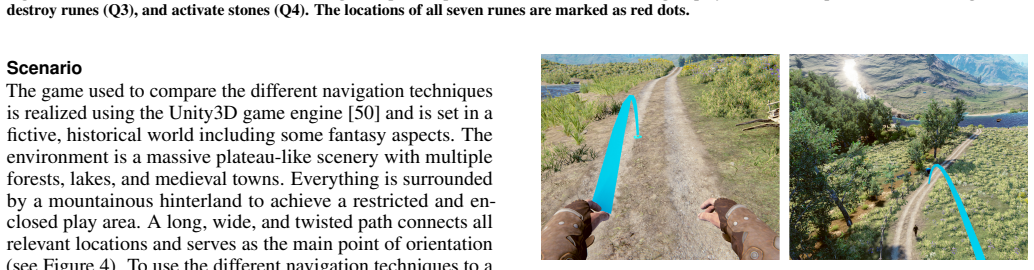
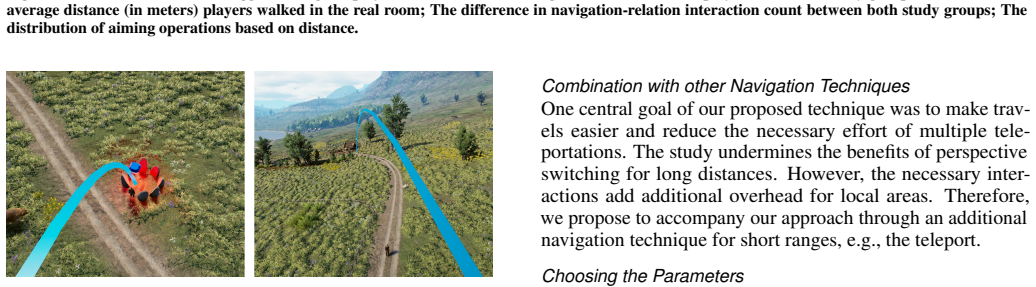
To see if it works, the authors built a fantasy game with a two-kilometer path and compared Outstanding against the usual arc-based teleport in a study with 30 players. Players using Outstanding reported significantly better orientation and needed less time to reorient after moving. They did not report more motion sickness, and their presence, enjoyment, and competence scores were similar to the teleport group. The tradeoff was speed: the Outstanding group played about 66 percent longer because they often waited for their avatar to walk.
The paper has limitations. Orientation was measured only by two self-report questions, not by asking players to point toward landmarks. The comparison used only teleport, not the world-in-miniature technique that also targets long distances. And the motion-sickness result is an absence of a difference in a small sample, which is weaker evidence than proving equality. Still, the technique and its design guidelines are concrete and could be useful for open-world VR games.
Extended reading notes
Core claim
The paper's central claim, stated in the abstract, is that the proposed perspective-switching technique 'reveals a significant increase in spatial orientation while avoiding cybersickness and preserving presence, enjoyment, and competence' compared with arc-based teleport. If the paper is correct, players using this technique in open-world VR games maintain better orientation over long distances without paying a comfort or presence cost, at the price of longer travel time and a somewhat less intuitive control scheme.
Load-bearing premise
The load-bearing premise is that two custom self-report items (CQ7, 'I could orient myself well in the game world', and CQ8, 'After each relocation, I needed a moment to orient myself') validly measure spatial orientation. This premise enters at the 'Custom Questions and Logging Data' paragraph and is the primary support for hypothesis H1. If these items measure something other than navigational ability (for instance, general satisfaction or demand characteristics), the claimed orientation advantage is not established. A secondary fragile premise is that a non-significant SSQ result with N=15 per group and high variance (teleport nausea SD = 33.02 vs mean 14.63) supports the claim that the technique 'avoids' cybersickness.
Signed reviews
Editorial analysis
A structured set of objections, weighed in public.
Assumptions & free parameters
free parameters (4)
- Travel mode scale factor =
10x
- Transition duration =
~0.5 s
- Horizontal backward offset =
45 degree viewing angle
- Stereo eye-distance scaling =
proportional to body scale
assumptions (5)
- domain assumption The standardized questionnaires (IPQ, PQ, PENS, IMI, SSQ) validly measure presence, competence, enjoyment, and simulator sickness.
- domain assumption The custom self-report items CQ7 and CQ8 measure spatial orientation.
- domain assumption Arc-based teleport is an appropriate baseline for long-distance VR navigation.
- domain assumption Scaling stereo eye distance with body size prevents cybersickness in travel mode.
- domain assumption The custom Unity game environment is representative of open-world VR navigation tasks.
Cite this review
Pith. "Pith review of Outstanding: A Multi-Perspective Travel Approach for Virtual Reality Games." pith.science (2026). https://pith.science/paper/MDM5TK3Z
@misc{pith2026190800379,
  author       = {Pith},
  title        = {Pith review of: Outstanding: A Multi-Perspective Travel Approach for Virtual Reality Games},
  year         = {2026},
  howpublished = {\url{https://pith.science/paper/MDM5TK3Z}},
  note         = {Machine review of arXiv:1908.00379}
}
read the original abstract
In virtual reality games, players dive into fictional environments and can experience a compelling and immersive world. State-of-the-art VR systems allow for natural and intuitive navigation through physical walking. However, the tracking space is still limited, and viable alternatives are required to reach further virtual destinations. Our work focuses on the exploration of vast open worlds - an area where existing local navigation approaches such as the arc-based teleport are not ideally suited and world-in-miniature techniques potentially reduce presence. We present a novel alternative for open environments: Our idea is to equip players with the ability to switch from first-person to a third-person bird's eye perspective on demand. From above, players can command their avatar and initiate travels over large distance. Our evaluation reveals a significant increase in spatial orientation while avoiding cybersickness and preserving presence, enjoyment, and competence. We summarize our findings in a set of comprehensive design guidelines to help developers integrate our technique.
Figures


Figures from the paper (3 more)

Reference graph
Works this paper leans on
-
[1]
Parastoo Abtahi, Mar Gonzalez-Franco, Eyal Ofek, and Anthony Steed. 2019. I’m a Giant: Walking in Large Virtual Environments at High Speed Gains. In Proceedings of the 2019 CHI Conference on Human Factors in Computing Systems. ACM, 522
work page 2019
-
[2]
Ferran Argelaguet and Morgant Maignant. 2016. GiAnt: stereoscopic-compliant multi-scale navigation in VEs. In Proceedings of the 22nd ACM Conference on Virtual Reality Software and Technology. ACM, 269–277
work page 2016
-
[3]
Laurenz Berger and Katrin Wolf. 2018. WIM: Fast Locomotion in Virtual Reality with Spatial Orientation Gain & without Motion Sickness. In Proceedings of the 17th International Conference on Mobile and Ubiquitous Multimedia. ACM, 19–24
work page 2018
-
[4]
Scot Best. 1996. Perceptual and oculomotor implications of interpupillary distance settings on a head-mounted virtual display. In Aerospace and Electronics Conference, 1996. NAECON 1996., Proceedings of the IEEE 1996 National, V ol. 1. IEEE, 429–434
work page 1996
-
[5]
Jiwan Bhandari, Sam Tregillus, and Eelke Folmer. 2017. Legomotion: Scalable Walking-based Virtual Locomotion. In Proceedings of the 23rd ACM Symposium on Virtual Reality Software and Technology (VRST ’17). ACM, New York, NY , USA, Article 18, 8 pages. DOI:http://dx.doi.org/10.1145/3139131.3139133
arXiv 2017
-
[6]
Frank Biocca and Ben Delaney. 1995. Communication in the Age of Virtual Reality. L. Erlbaum Associates Inc., Hillsdale, NJ, USA, Chapter Immersive Virtual Reality Technology, 57–124. http://dl.acm.org/citation.cfm?id=207922.207926
arXiv 1995
-
[7]
Benjamin Bolte, Frank Steinicke, and Gerd Bruder
-
[8]
Paul Cairns, Anna Cox, and A Imran Nordin. 2014. Immersion in digital games: review of gaming experience research. Handbook of digital games (2014), 337–361
2014
Show all 60 references
-
[9]
Isaac Cho, Jialei Li, and Zachary Wartell. 2014. Evaluating dynamic-adjustment of stereo view parameters in a multi-scale virtual environment. In 3D User Interfaces (3DUI), 2014 IEEE Symposium on. IEEE, 91–98
2014
-
[10]
HTC Corporation. 2018. HTC Vive. Website. (2018). Retrieved July 14, 2018 from https://www.vive.com/us/ product/vive-virtual-reality-system/
2018
-
[11]
U. Q.O. Cyberpsychology Lab. 2004. Presence Questionnaire: Revised by the UQO Cyberpsychology Lab. (2004). http://w3.uqo.ca/cyberpsy/docs/qaires/pres/PQ_va.pdf
2004
-
[12]
David Engel, Cristóbal Curio, Lili Tcheang, Betty Mohler, and Heinrich H Bülthoff. 2008. A psychophysically calibrated controller for navigating through large environments in a limited free-walking space. In Proceedings of the 2008 ACM symposium on Virtual reality software and...
2008
-
[13]
Ajoy S Fernandes and Steven K Feiner. 2016. Combating VR sickness through subtle dynamic field-of-view modification. In 3D User Interfaces (3DUI), 2016 IEEE Symposium on. IEEE, 201–210
2016
-
[14]
Julian Frommel, Sven Sonntag, and Michael Weber
-
[15]
Geoffrey Gorisse, Olivier Christmann, Etienne Amato, and Simon Richir. 2017. First-and Third-Person Perspectives in immersive Virtual Environments: Presence and Performance analysis of embodied Users. Frontiers in Robotics and AI (2017)
2017
-
[16]
Timofey Grechkin, Jerald Thomas, Mahdi Azmandian, Mark Bolas, and Evan Suma. 2016. Revisiting Detection Thresholds for Redirected Walking: Combining Translation and Curvature Gains. In Proceedings of the ACM Symposium on Applied Perception (SAP ’16). ACM, New York, NY , USA, 1...
2016
-
[17]
Jacob Habgood, David Wilson, David Moore, and Sergio Alapont
M.P. Jacob Habgood, David Wilson, David Moore, and Sergio Alapont. 2017. HCI Lessons From PlayStation VR. In Extended Abstracts Publication of the Annual Symposium on Computer-Human Interaction in Play (CHI PLAY ’17 Extended Abstracts). ACM, New York, NY , USA, 125–135.DOI: ht...
2017
-
[18]
Carrie Heeter. 1992. Being there: The subjective experience of presence. Presence: Teleoperators & Virtual Environments1, 2 (1992), 262–271
1992
-
[19]
Kennedy, William P
Larry Hettinger, Kevin Berbaum, Robert S. Kennedy, William P. Dunlap, and Margaret Nolan. 1990. Vection and simulator sickness. 2 (02 1990), 171–81
1990
-
[20]
Lawrence J Hettinger and Gary E Riccio. 1992. Visually induced motion sickness in virtual environments. Presence: Teleoperators & Virtual Environments1, 3 (1992), 306–310
1992
-
[21]
IJsselsteijn, Huib de Ridder, Jonathan Freeman, and Steve E
Wijnand A. IJsselsteijn, Huib de Ridder, Jonathan Freeman, and Steve E. Avons. 2000. Presence: concept, determinants, and measurement. (2000). DOI: http://dx.doi.org/10.1117/12.387188
2000 doi
-
[22]
Kennedy, Norman E
Robert S. Kennedy, Norman E. Lane, Kevin S. Berbaum, and Michael G. Lilienthal. 1993a. Simulator Sickness Questionnaire: An Enhanced Method for Quantifying Simulator Sickness. The International Journal of Aviation Psychology 3, 3 (1993). DOI: http://dx.doi.org/10.1207/s1532710...
1993 doi
-
[23]
Robert S Kennedy, Norman E Lane, Kevin S Berbaum, and Michael G Lilienthal. 1993b. Simulator sickness questionnaire: An enhanced method for quantifying simulator sickness. The international journal of aviation psychology 3, 3 (1993)
1993
-
[24]
Robert S Kennedy, Michael G Lilienthal, Kevin S Berbaum, DR Baltzley, and ME McCauley. 1989. Simulator sickness in US Navy flight simulators. Aviation, Space, and Environmental Medicine60, 1 (1989), 10–16
1989
-
[25]
Eugenia M Kolasinski. 1995. Simulator Sickness in Virtual Environments.Technical Report. Army Research Inst. for the Behavioral and Social Sciences, Alexandria, V A
1995
-
[26]
Regis Kopper, Tao Ni, Doug A Bowman, and Marcio Pinho. 2006. Design and evaluation of navigation techniques for multiscale virtual environments. In Virtual Reality Conference, 2006. Ieee, 175–182
2006
-
[27]
Andrey Krekhov, Sebastian Cmentowski, Katharina Emmerich, Maic Masuch, and Jens Krüger. 2018. GulliVR: A Walking-Oriented Technique for Navigation in Virtual Reality Games Based on Virtual Body Resizing. In Proceedings of the 2018 Annual Symposium on Computer-Human Interaction...
2018
-
[28]
Eike Langbehn, Gerd Bruder, and Frank Steinicke. 2016. Subliminal reorientation and repositioning in virtual reality during eye blinks. In Proceedings of the 2016 Symposium on Spatial User Interaction. ACM, 213–213
2016
-
[29]
Joseph J LaViola Jr. 2000. A discussion of cybersickness in virtual environments. ACM SIGCHI Bulletin 32, 1 (2000), 47–56
2000
-
[30]
Joseph J LaViola Jr, Daniel Acevedo Feliz, Daniel F Keefe, and Robert C Zeleznik. 2001. Hands-free multi-scale navigation in virtual environments. In Proceedings of the 2001 symposium on Interactive 3D graphics. ACM, 9–15
2001
-
[31]
Jiun-Yu Lee, Ping-Hsuan Han, Ling Tsai, Rih-Ding Peng, Yang-Sheng Chen, Kuan-Wen Chen, and Yi-Ping Hung. 2017. Estimating the Simulator Sickness in Immersive Virtual Reality with Optical Flow Analysis. In SIGGRAPH Asia 2017 Posters (SA ’17). ACM, New York, NY , USA, Article 16...
2017
-
[32]
JJ-W Lin, Henry Been-Lirn Duh, Donald E Parker, Habib Abi-Rached, and Thomas A Furness. 2002. Effects of field of view on presence, enjoyment, memory, and simulator sickness in a virtual environment. In Virtual Reality, 2002. Proceedings. IEEE. IEEE, 164–171
2002
-
[33]
Matthew Lombard and Theresa Ditton. 1997. At the heart of it all: The concept of presence. Journal of Computer-Mediated Communication 3, 2 (1997), 0–0
1997
-
[34]
Daniel Medeiros, Eduardo Cordeiro, Daniel Mendes, Maurício Sousa, Alberto Raposo, Alfredo Ferreira, and Joaquim Jorge. 2016. Effects of speed and transitions on target-based travel techniques. In Proceedings of the 22nd ACM Conference on Virtual Reality Software and Technology...
2016
-
[35]
K E Money. 1970. Motion sickness. Physiological Reviews 50, 1 (1970), 1–39
1970
-
[36]
Seizo Ohyama, Suetaka Nishiike, Hiroshi Watanabe, Katsunori Matsuoka, Hironori Akizuki, Noriaki Takeda, and Tamotsu Harada. 2007. Autonomic responses during motion sickness induced by virtual reality. Auris Nasus Larynx 34, 3 (2007), 303–306
2007
-
[37]
Sharif Razzaque. 2005. Redirected walking. University of North Carolina at Chapel Hill
2005
-
[38]
Sharif Razzaque, Zachariah Kohn, and Mary C Whitton
-
[39]
James T Reason and Joseph John Brand. 1975. Motion sickness. Academic press
1975
-
[40]
Roy A Ruddle and Simon Lessels. 2009. The benefits of using a walking interface to navigate virtual environments. ACM Transactions on Computer-Human Interaction (TOCHI) 16, 1 (2009), 5
2009
-
[41]
Richard M Ryan and Edward L Deci. 2000. Self-determination theory and the facilitation of intrinsic motivation, social development, and well-being. American psychologist 55, 1 (2000), 68
2000
-
[42]
Richard M. Ryan, C. Scott Rigby, and Andrew Przybylski. 2006. The Motivational Pull of Video Games: A Self-Determination Theory Approach. Motivation and Emotion 30, 4 (2006), 344–360. DOI: http://dx.doi.org/10.1007/s11031-006-9051-8
2006 doi
-
[43]
Patrick Salamin, Daniel Thalmann, and Frédéric Vexo
-
[44]
T. W. Schubert, Frank Friedmann, and H. T. Regenbrecht. 1999. Decomposing the sense of presence: Factor analytic insights. In 2nd international workshop on presence, V ol. 1999
1999
-
[45]
William R Sherman and Alan B Craig. 2002. Understanding virtual reality: Interface, application, and design. Elsevier
2002
-
[46]
Mel Slater. 2003. A note on presence terminology. Presence connect 3, 3 (2003), 1–5
2003
-
[47]
Mel Slater, Martin Usoh, and Anthony Steed. 1995. Taking steps: the influence of a walking technique on presence in virtual reality. ACM Transactions on Computer-Human Interaction (TOCHI) 2, 3 (1995), 201–219
1995
-
[48]
Stanney, Robert S
Kay M. Stanney, Robert S. Kennedy, and Julie M. Drexler. 1997. Cybersickness is Not Simulator Sickness. Proceedings of the Human Factors and Ergonomics Society Annual Meeting 41, 2 (1997), 1138–1142. DOI: http://dx.doi.org/10.1177/107118139704100292
1997 doi
-
[49]
Richard Stoakley, Matthew J Conway, and Randy Pausch. 1995. Virtual reality on a WIM: interactive worlds in miniature. In Proceedings of the SIGCHI conference on Human factors in computing systems. ACM Press, 265–272
1995
-
[50]
Unity Technologies. 2018. Unity. Website. (2018). Retrieved March 29, 2018 from https://unity3d.com/
2018
-
[51]
Sam Tregillus and Eelke Folmer. 2016. Vr-step: Walking-in-place using inertial sensing for hands free navigation in mobile vr environments. In Proceedings of the 2016 CHI Conference on Human Factors in Computing Systems. ACM, 1250–1255
2016
-
[52]
Martin Usoh, Kevin Arthur, Mary C Whitton, Rui Bastos, Anthony Steed, Mel Slater, and Frederick P Brooks Jr. 1999. Walking> walking-in-place> flying, in virtual environments. In Proceedings of the 26th annual conference on Computer graphics and interactive techniques. ACM Press...
1999
-
[53]
Sebastian V on Mammen, Andreas Knote, and Sarah Edenhofer. 2016. Cyber sick but still having fun. In Proceedings of the 22nd ACM Conference on Virtual Reality Software and Technology. ACM, 325–326
2016
-
[54]
Witmer and Michael J
Bob G. Witmer and Michael J. Singer. 1998. Measuring presence in virtual environments: A presence questionnaire. Presence 7, 3 (1998), 225–240
1998
-
[55]
Richard Yao, Tom Heath, Aaron Davies, Tom Forsyth, Nate Mitchell, and Perry Hoberman. 2014. Oculus vr best practices guide. Oculus VR (2014), 27–39
2014
-
[56]
Xiaolong Zhang and George W. Furnas. 2002. Social Interactions in Multiscale CVEs. In Proceedings of the 4th International Conference on Collaborative Virtual Environments (CVE ’02). ACM, New York, NY , USA, 31–38. DOI:http://dx.doi.org/10.1145/571878.571884
2002
-
[2001]
In Proceedings of EUROGRAPHICS, V ol
Redirected walking. In Proceedings of EUROGRAPHICS, V ol. 9. Citeseer, 105–106
-
[2006]
In Proceedings of the ACM symposium on Virtual reality software and technology
The benefits of third-person perspective in virtual and augmented reality?. In Proceedings of the ACM symposium on Virtual reality software and technology. ACM, 27–30
-
[2011]
In Proceedings of Virtual Reality International Conference
The jumper metaphor: an effective navigation technique for immersive display setups. In Proceedings of Virtual Reality International Conference
-
[2017]
In Proceedings of the 12th International Conference on the Foundations of Digital Games
Effects of controller-based locomotion on player experience in a virtual reality exploration game. In Proceedings of the 12th International Conference on the Foundations of Digital Games
Reviewed August 14, 2026 · model on record in the stance chip above.
Discussion (0). Continue with ORCID to comment.