REVIEW 3 major objections 5 minor 48 references
Learning Optical Flow Field via Neural Ordinary Differential Equation
T0 review · 3 major / 5 minor · reviewed 2026-08-07 · deepseek-v4-flash
Pith's one-line read The paper replaces the fixed-iteration GRU refinement in optical flow estimation with a neural ODE layer and reports that this continuous, single-pass refinement improves accuracy over the GMFlow baseline on Sintel and KITTI.
desk verdict A sensible NODE-for-optical-flow idea whose main result rests on an uncontrolled comparison, with the adaptive-compute benefit asserted but never measured. read the letter →
The pith
A machine-rendered reading of the paper's core claim, the machinery that carries it, and where it could break.
The reading
What carries the argument
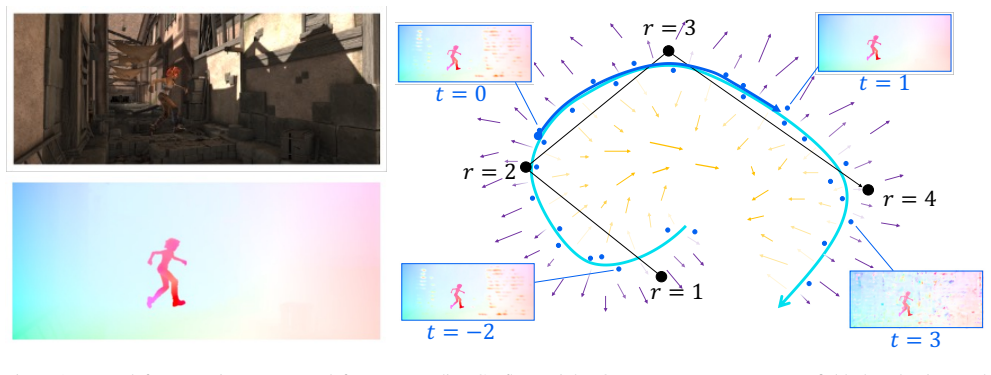
The key object is the neural ODE block that replaces the GRU update. The discrete recurrence $h_{t+1}=h_t+g(h_t,\theta_t)$ is replaced by the differential equation $dh(t)/dt = g(h(t),t,\theta)$, where $g$ is implemented as a single-head transformer with a convolutional mixing network that projects the concatenated context, flow, and correlation volume into a latent space. A black-box solver (midpoint by default, Fehlberg as an alternative) integrates from $t=0$ to $t=1$ with tolerance $10^{-3}$, and the decoded result is added to the flow estimate. This machinery lets the number of internal integration steps vary with the input through the solver's error control, and it turns backpropagation into an adjoint-style computation rather than backpropagation through a fixed unrolled sequence.
What would settle it
Retrain the original GMFlow model with the exact same batch sizes, learning rates, scheduler, image resolutions, and number of iterations used for NODE-GMFlow, then compare on the same Sintel and KITTI splits; if the retrained GMFlow matches or beats NODE-GMFlow, the central improvement claim fails. A second check is to log the number of internal solver function evaluations per image and compare against a fixed-step midpoint run with the same architecture: if the fixed-step run matches the adaptive version, then adaptivity is not the source of the gain.
Extended reading notes
Core claim
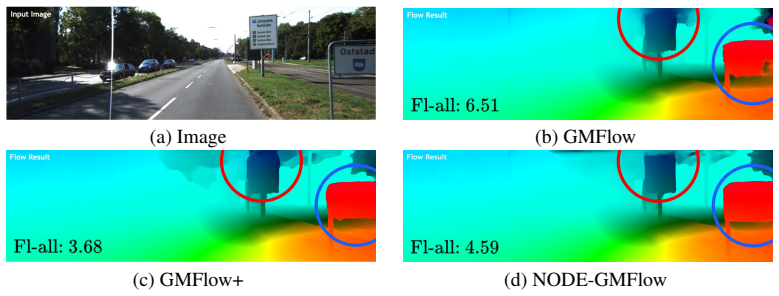
The paper's central claim is that the discrete, fixed-iteration refinement of optical flow can be replaced by a continuous neural ODE block that predicts the derivative of a latent flow field. On the GMFlow architecture, the authors swap the ConvGRU updater for a transformer-based neural ODE block, integrate from $t=0$ to $t=1$ with a midpoint or Fehlberg solver, and keep the outer refinement count at one. They report that this NODE-GMFlow model reduces the KITTI test Fl-all from 9.32 to 5.41 and improves on Sintel test clean and final EPE relative to the GMFlow baseline, with results comparable to or better than several recent models. The authors also argue that neural ODE refinement is more general than recurrent refinement, because fixing the solver, step rule, and iteration count reproduces the exact GRU updates, so the proposed block is a superset of existing update modules.
Load-bearing premise
The load-bearing premise is that the accuracy gain comes from the ODE module rather than from the different training schedule used in the experiments, since the original GMFlow baseline was not retrained under the same scaled settings and the solver's claimed adaptive stepping is not directly measured.
Editorial extensions
If this is right
- If the reported accuracy holds, optical flow systems can drop the manually tuned iteration count and let a solver convergence tolerance decide how much computation is spent on each image.
- Because the neural ODE block is claimed to be a strict generalization of a GRU update, existing recurrent refinement modules can be replaced by it without losing the ability to reproduce their behavior.
- With only one outer refinement step, the model avoids the multiple forward passes used by multistep refinement methods such as GMFlow+, so the accuracy gain is achieved with a lower architectural repeat count.
- Solver choice and tolerance become training and inference hyperparameters that trade speed against accuracy, decoupling that tuning from retraining the flow estimator.
Reading between the lines
- My inference: the reported comparison may partly reflect the different training schedule used in the experiments, since the original GMFlow baseline was not retrained under the same scaled batch sizes, learning rates, and image resolutions.
- My inference: the adaptive-step claim could be tested directly by logging solver function evaluations per image; if a fixed-step discretization with the same architecture performs identically, the benefit lies in the continuous parametrization rather than in adaptivity.
- My inference: the same neural ODE refinement block could plausibly be attached to other optical flow encoders, such as RAFT-style or FlowFormer-style architectures, based on the paper's argument that the ODE formulation subsumes GRU updates.
- My inference: the observed extrapolation behavior, where accuracy saturates around $t=0.5$ and degrades for $t>1$, suggests the learned dynamics are not a stable global vector field; a practical extension would keep integration within the trained time range or regularize the dynamics.
Editorial analysis
A structured set of objections, weighed in public.
Referee Report
Summary. The paper proposes NODE-GMFlow, an optical flow architecture that replaces the ConvGRU refinement module of GMFlow with a Neural Ordinary Differential Equation (NODE) block. The NODE block predicts the derivative of a latent flow representation, and the flow estimate is obtained by integrating this derivative with a black-box ODE solver, using a transformer-based right-hand side and a mixing network. The authors claim improved accuracy over GMFlow on Sintel and KITTI benchmarks while using only one outer refinement step, together with adaptive, data-dependent compute and greater generality than recurrent update cells. The experiments in Tables 1 and 2 report improvements, e.g., KITTI test Fl-all from 9.32 (GMFlow) to 5.41 (NODE-GMFlow), and ablations cover solver choice, training iterations, mixing-network depth, and time-scale extrapolation.
Significance. If the reported gains were tightly controlled, the paper would make a useful contribution by connecting continuous-depth models to optical flow refinement and potentially enabling adaptive compute. The paper has concrete strengths: it builds on a reproducible public baseline (GMFlow), evaluates on standard benchmarks, and includes ablations for several design choices. However, the central empirical claim is not yet supported because the comparison to GMFlow uses published numbers rather than a matched baseline, and the architectural changes are confounded with capacity and training schedule. The adaptive-compute benefit is asserted but never directly measured, and the claimed generality over recurrent cells is only stated, not demonstrated. These issues are fixable within the manuscript's scope, but they are load-bearing for the paper's main conclusions.
major comments (3)
- [§4, Tables 1 and 2] The main improvement claim is not controlled. Section 4 states: 'Due to computational restrictions, we could not run the experiments with the hyperparameters from original GMFlow paper and had to scale the batch size and learning rates accordingly.' The GMFlow numbers in Tables 1 and 2 are taken from the original publication, whereas NODE-GMFlow uses a different training schedule, a larger model (9.2M vs 4.7M parameters per Table 1), a transformer-based right-hand side, and a two-convolution mixing network. Therefore the reported KITTI test improvement from 9.32 to 5.41 cannot be attributed to the ODE formulation. Please retrain GMFlow under the exact scaled recipe used for NODE-GMFlow, or ablate the NODE block against a ConvGRU in the same codebase and training protocol.
- [§3.4 and Table 4] The adaptive-compute claim is not supported by any measurement. The abstract and Section 3.4 emphasize that the solver dynamically adjusts the number of compute steps per input, but the paper never reports internal solver step counts, function evaluations, or runtime per sample. Moreover, Table 4 shows that the adaptive Fehlberg solver and the fixed-step midpoint solver give nearly identical accuracy on Things, Sintel, and KITTI, with Fehlberg better on KITTI EPE but worse on Fl-all. This is not evidence that adaptive termination drives the gains. Please report the distribution of internal steps, compare compute budgets, and state whether the midpoint solver uses a fixed number of steps.
- [§6 and footnote 1] The generality claim that 'the proposed model can generate the exact same updates' as recurrent cells is only asserted. The paper cites GRU-ODE-Bayes [7] and gives a one-sentence footnote, but it does not provide a concrete construction within the proposed architecture (transformer RHS, mixing network, specific solver) that reproduces a ConvGRU update, nor does it verify this reproduction experimentally. Either give an explicit parameterization and solver choice that yields the recurrent update, or weaken the generality statement to a qualitative similarity.
minor comments (5)
- [§3.1, Eq. (1)] Equation (1) uses f for both the optical flow and the image intensity: f(x) = f(x + Δx) should presumably be I(x) = I(x + Δx). Please fix the notation.
- [§3.1] The phrase 'go beyond beyond ConvGRUs' contains a duplicated word.
- [§4.1 and §4.2] The text in Section 4.1 says NODE-GMFlow shows 'state-of-the-art performance on KITTI dataset,' but Table 1 lists FlowFormer with lower KITTI train EPE, and Table 2 lists FlowFormer and GMFlow+ with lower KITTI test Fl-all. The claim should be aligned with the reported tables.
- [Table 3] The caption 'Number of iterations' refers to training iterations (400K vs 800K), not refinement iterations. Please rename it to avoid confusion with the paper's main claim about a single refinement step.
- [Tables 1, 4, and 5] No error bars or multiple-seed results are reported, so it is unclear whether the differences between the two NODE-GMFlow versions and between solver choices are statistically meaningful. Reporting variance or at least stating that runs are single-seed would strengthen the empirical section.
Circularity Check
No significant circularity: the accuracy claims rest on external benchmark comparisons, and the main weaknesses are experimental-control and evidence gaps, not circular derivation.
full rationale
The paper's central empirical claim is that replacing GMFlow's ConvGRU refinement with a Neural ODE block improves optical flow accuracy on Sintel and KITTI. This is supported by comparisons with published GMFlow numbers and official benchmark evaluations, i.e., external reference points, not by quantities derived from the model's own fitted parameters. The training loss (Eq. 4) is a standard weighted L1 loss against ground truth flow, and no parameter is defined in terms of the target result. The claimed generality that NODE-GMFlow 'can generate the exact same updates' as recurrent cells is justified by citing GRU-ODE-Bayes [7], an external prior work, and by a construction sketch in footnote 1; it is unsupported or under-specified, but not circular, because it does not assume the paper's own conclusion as a premise. The only self-citation, reference [20], appears in a general related-work list and is not load-bearing. The lack of a retrained GMFlow baseline under the same scaled hyperparameters, the increased parameter count, and the absence of measured solver step counts are legitimate experimental-rigor concerns, but they concern whether the improvement is attributable to the ODE formulation, not whether the derivation reduces to its inputs. No circular step is present, so the circularity score is 0.
Assumptions & free parameters
free parameters (5)
- Solver tolerance =
1e-3
- Integration time interval =
[0, 1]
- Number of outer refinement steps =
1
- Mixing network architecture =
two conv layers, kernel 5, padding 3
- Transformer RHS configuration =
one head, hidden dim 128
assumptions (5)
- domain assumption Brightness constancy assumption (Eq. 1) underlies optical flow prediction
- standard math Neural ODE training with adjoint method provides O(1) memory backpropagation
- domain assumption A GRU-ODE can represent GRU dynamics, so NODE is more general
- ad hoc to paper The transformer-based RHS network can parameterize the flow derivative adequately with a single block
- domain assumption The midpoint ODE solver with tolerance 1e-3 gives a good speed-accuracy tradeoff
Cite this review
Pith. "Pith review of Learning Optical Flow Field via Neural Ordinary Differential Equation." pith.science (2026). https://pith.science/paper/MEBJV2P3
@misc{pith2026250603290,
  author       = {Pith},
  title        = {Pith review of: Learning Optical Flow Field via Neural Ordinary Differential Equation},
  year         = {2026},
  howpublished = {\url{https://pith.science/paper/MEBJV2P3}},
  note         = {Machine review of arXiv:2506.03290}
}
read the original abstract
Recent works on optical flow estimation use neural networks to predict the flow field that maps positions of one image to positions of the other. These networks consist of a feature extractor, a correlation volume, and finally several refinement steps. These refinement steps mimic the iterative refinements performed by classical optimization algorithms and are usually implemented by neural layers (e.g., GRU) which are recurrently executed for a fixed and pre-determined number of steps. However, relying on a fixed number of steps may result in suboptimal performance because it is not tailored to the input data. In this paper, we introduce a novel approach for predicting the derivative of the flow using a continuous model, namely neural ordinary differential equations (ODE). One key advantage of this approach is its capacity to model an equilibrium process, dynamically adjusting the number of compute steps based on the data at hand. By following a particular neural architecture, ODE solver, and associated hyperparameters, our proposed model can replicate the exact same updates as recurrent cells used in existing works, offering greater generality. Through extensive experimental analysis on optical flow benchmarks, we demonstrate that our approach achieves an impressive improvement over baseline and existing models, all while requiring only a single refinement step.
Figures

Figures from the paper (2 more)


Reference graph
Works this paper leans on
-
[7]
Gru-ode-bayes: Continuous modeling of sporadically-observed time series
Edward De Brouwer, Jaak Simm, Adam Arany, and Yves Moreau. Gru-ode-bayes: Continuous modeling of sporadically-observed time series. Advances in Neural Infor- mation Processing Systems (NeurIPS), 32, 2019. 2
work page 2019
-
[1]
Deep equilibrium optical flow estimation
Shaojie Bai, Zhengyang Geng, Yash Savani, and J Zico Kolter. Deep equilibrium optical flow estimation. In Proceedings of the IEEE/CVF conference on computer vision and pattern recognition, pages 620–630, 2022. 3
work page 2022
-
[2]
Learn- ing long-term dependencies with gradient descent is difficult
Yoshua Bengio, Patrice Simard, and Paolo Frasconi. Learn- ing long-term dependencies with gradient descent is difficult. IEEE transactions on neural networks, 5(2):157–166, 1994. 1
work page 1994
-
[3]
Lu- cas/kanade meets horn/schunck: Combining local and global 8 optic flow methods
Andrés Bruhn, Joachim Weickert, and Christoph Schnörr. Lu- cas/kanade meets horn/schunck: Combining local and global 8 optic flow methods. International Journal of Computer Vision (IJCV), 61:211–231, 2005. 3
work page 2005
-
[4]
A naturalistic open source movie for optical flow evaluation
Daniel J Butler, Jonas Wulff, Garrett B Stanley, and Michael J Black. A naturalistic open source movie for optical flow evaluation. In Proceedings of the European Conference on Computer Vision, pages 611–625. Springer, 2012. 4, 5
work page 2012
-
[5]
Neural ordinary differential equa- tions
Ricky TQ Chen, Yulia Rubanova, Jesse Bettencourt, and David K Duvenaud. Neural ordinary differential equa- tions. In Advances in Neural Information Processing Systems (NeurIPS), 2018. 3, 4, 5
work page 2018
-
[6]
Empirical evaluation of gated recurrent neural networks on sequence modeling
Junyoung Chung, Caglar Gulcehre, KyungHyun Cho, and Yoshua Bengio. Empirical evaluation of gated recurrent neural networks on sequence modeling. arXiv preprint arXiv:1412.3555, 2014. 3
arXiv 2014
-
[8]
Flownet: Learning optical flow with convolutional networks
Alexey Dosovitskiy, Philipp Fischer, Eddy Ilg, Philip Hausser, Caner Hazirbas, Vladimir Golkov, Patrick Van Der Smagt, Daniel Cremers, and Thomas Brox. Flownet: Learning optical flow with convolutional networks. In Proceedings of the IEEE/CVF International Conference on Computer Vision , pages 2758–2766, 2015. 3, 4
work page 2015
Show all 48 references
-
[9]
Two-frame motion estimation based on polynomial expansion
Gunnar Farnebäck. Two-frame motion estimation based on polynomial expansion. In Image Analysis: 13th Scandinavian Conference, SCIA 2003 Halmstad, Sweden, June 29–July 2, 2003 Proceedings 13, pages 363–370. Springer, 2003. 3
2003
-
[10]
Vision meets robotics: The kitti dataset
Andreas Geiger, Philip Lenz, Christoph Stiller, and Raquel Urtasun. Vision meets robotics: The kitti dataset. The Inter- national Journal of Robotics Research, 32(11):1231–1237,
-
[11]
On robustness of neural ordinary differential equations
YAN Hanshu, DU Jiawei, TAN Vincent, and FENG Jiashi. On robustness of neural ordinary differential equations. In In- ternational Conference on Learning Representations (ICLR),
-
[12]
Determining optical flow
Berthold KP Horn and Brian G Schunck. Determining optical flow. InTechniques and Applications of Image Understanding, pages 319–331. International Society for Optics and Photon- ics, 1981. 3
1981
-
[13]
(Implicit)2: Implicit layers for implicit representations
Zhichun Huang, Shaojie Bai, and J Zico Kolter. (Implicit)2: Implicit layers for implicit representations. In Advances in Neural Information Processing Systems (NeurIPS) , pages 9639–9650, 2021. 3
2021
-
[14]
Flowformer: A transformer architecture for optical flow
Zhaoyang Huang, Xiaoyu Shi, Chao Zhang, Qiang Wang, Ka Chun Cheung, Hongwei Qin, Jifeng Dai, and Hongsheng Li. Flowformer: A transformer architecture for optical flow. In Proceedings of the European Conference on Computer Vision, 2022. 1, 3, 4, 6
2022
-
[15]
Lite- flownet: A lightweight convolutional neural network for op- tical flow estimation
Tak-Wai Hui, Xiaoou Tang, and Chen Change Loy. Lite- flownet: A lightweight convolutional neural network for op- tical flow estimation. In Proceedings of the IEEE/CVF Con- ference on Computer Vision and Pattern Recognition, pages 8981–8989, 2018. 3, 6
2018
-
[16]
A lightweight optical flow cnn-revisiting data fidelity and regu- larization
Tak-Wai Hui, Xiaoou Tang, and Chen Change Loy. A lightweight optical flow cnn-revisiting data fidelity and regu- larization. arXiv preprint arXiv:1903.07414, 2019. 3
1903 arXiv
-
[17]
A lightweight optical flow cnn—revisiting data fidelity and regu- larization
Tak-Wai Hui, Xiaoou Tang, and Chen Change Loy. A lightweight optical flow cnn—revisiting data fidelity and regu- larization. IEEE transactions on pattern analysis and machine intelligence, 43(8):2555–2569, 2020. 6
2020
-
[18]
Flownet 2.0: Evolution of optical flow estimation with deep networks
Eddy Ilg, Nikolaus Mayer, Tonmoy Saikia, Margret Keu- per, Alexey Dosovitskiy, and Thomas Brox. Flownet 2.0: Evolution of optical flow estimation with deep networks. In Proceedings of the IEEE conference on computer vision and pattern recognition, pages 2462–2470, 2017. 6
2017
-
[19]
Perceiver io: A general architecture for structured inputs & outputs
Andrew Jaegle, Sebastian Borgeaud, Jean-Baptiste Alayrac, Carl Doersch, Catalin Ionescu, David Ding, Skanda Kop- pula, Daniel Zoran, Andrew Brock, Evan Shelhamer, et al. Perceiver io: A general architecture for structured inputs & outputs. In International Conference on Learni...
2022
-
[20]
Imposing consistency for optical flow estimation
Jisoo Jeong, Jamie Menjay Lin, Fatih Porikli, and Nojun Kwak. Imposing consistency for optical flow estimation. In Proceedings of the IEEE/CVF Conference on Computer Vision and Pattern Recognition, pages 3181–3191, 2022. 3
2022
-
[21]
Learning to estimate hidden motions with global motion aggregation
Shihao Jiang, Dylan Campbell, Yao Lu, Hongdong Li, and Richard Hartley. Learning to estimate hidden motions with global motion aggregation. In Proceedings of the IEEE/CVF International Conference on Computer Vision, pages 9772– 9781, 2021. 4, 6
2021
-
[22]
Beitrag zur näherungsweisen Integration totaler Differentialgleichungen
Wilhelm Kutta. Beitrag zur näherungsweisen Integration totaler Differentialgleichungen. Teubner, 1901. 4
1901
-
[23]
Recurrent convolutional neural network for object recognition
Ming Liang and Xiaolin Hu. Recurrent convolutional neural network for object recognition. In Proceedings of the IEEE conference on computer vision and pattern recognition, pages 3367–3375, 2015. 3
2015
-
[24]
Decoupled weight decay regularization
Ilya Loshchilov and Frank Hutter. Decoupled weight decay regularization. arXiv preprint arXiv:1711.05101, 2017. 5
2017 arXiv
-
[25]
An iterative image reg- istration technique with an application to stereo vision
Bruce D Lucas and Takeo Kanade. An iterative image reg- istration technique with an application to stereo vision. In International Joint Conference on Artificial Intelligence (IJ- CAI), pages 674–679, 1981. 3
1981
-
[26]
A large dataset to train convolutional networks for disparity, optical flow, and scene flow estimation
Nikolaus Mayer, Eddy Ilg, Philip Hausser, Philipp Fischer, Daniel Cremers, Alexey Dosovitskiy, and Thomas Brox. A large dataset to train convolutional networks for disparity, optical flow, and scene flow estimation. In Proceedings of the IEEE/CVF Conference on Computer Vision ...
2016
-
[27]
Object scene flow for autonomous vehicles
Moritz Menze and Andreas Geiger. Object scene flow for autonomous vehicles. In Proceedings of the IEEE/CVF Con- ference on Computer Vision and Pattern Recognition, pages 3061–3070, 2015. 4, 5, 8
2015
-
[28]
Implicit sur- face representations as layers in neural networks
Mateusz Michalkiewicz, Jhony K Pontes, Dominic Jack, Mahsa Baktashmotlagh, and Anders Eriksson. Implicit sur- face representations as layers in neural networks. In Interna- tional Conference on Computer Vision (ICCV), pages 4743– 4752, 2019. 3
2019
-
[29]
Mathematical theory of optimal processes
Lev Semenovich Pontryagin. Mathematical theory of optimal processes. Routledge, 2018. 4
2018
-
[30]
Optical flow estima- tion using a spatial pyramid network
Anurag Ranjan and Michael J Black. Optical flow estima- tion using a spatial pyramid network. In Proceedings of the IEEE/CVF Conference on Computer Vision and Pattern Recognition, pages 4161–4170, 2017. 3 9
2017
-
[31]
Yulia Rubanova, Ricky T. Q. Chen, and David K Duvenaud. Latent ordinary differential equations for irregularly-sampled time series. In Advances in Neural Information Processing Systems (NeurIPS). Curran Associates, Inc., 2019. 3
2019
-
[32]
Über die numerische auflösung von differential- gleichungen
Carl Runge. Über die numerische auflösung von differential- gleichungen. Mathematische Annalen, 46(2):167–178, 1895. 4
-
[33]
The surprising effectiveness of diffusion models for optical flow and monocular depth estimation
Saurabh Saxena, Charles Herrmann, Junhwa Hur, Abhishek Kar, Mohammad Norouzi, Deqing Sun, and David J Fleet. The surprising effectiveness of diffusion models for optical flow and monocular depth estimation. In Advances in Neural Information Processing Systems (NeurIPS), 2023. 3
2023
-
[34]
Convolutional lstm network: A machine learning approach for precipitation now- casting
Xingjian Shi, Zhourong Chen, Hao Wang, Dit-Yan Yeung, Wai-Kin Wong, and Wang-chun Woo. Convolutional lstm network: A machine learning approach for precipitation now- casting. Advances in neural information processing systems, 28, 2015. 3
2015
-
[35]
Implicit neural representa- tions with periodic activation functions
Vincent Sitzmann, Julien Martel, Alexander Bergman, David Lindell, and Gordon Wetzstein. Implicit neural representa- tions with periodic activation functions. Advances in Neural Information Processing Systems (NeurIPS), 33:7462–7473,
-
[36]
Physics-informed implicit represen- tations of equilibrium network flows
Kevin D Smith, Francesco Seccamonte, Ananthram Swami, and Francesco Bullo. Physics-informed implicit represen- tations of equilibrium network flows. Advances in Neural Information Processing Systems (NeurIPS), 35:7211–7221,
-
[37]
Super-convergence: Very fast training of neural networks using large learning rates
Leslie N Smith and Nicholay Topin. Super-convergence: Very fast training of neural networks using large learning rates. In Artificial intelligence and machine learning for multi-domain operations applications, pages 369–386. SPIE, 2019. 5
2019
-
[38]
Pwc-net: Cnns for optical flow using pyramid, warping, and cost volume
Deqing Sun, Xiaodong Yang, Ming-Yu Liu, and Jan Kautz. Pwc-net: Cnns for optical flow using pyramid, warping, and cost volume. In Proceedings of the IEEE/CVF Conference on Computer Vision and Pattern Recognition, pages 8934–8943,
-
[39]
Models matter, so does training: An empirical study of cnns for optical flow estimation
Deqing Sun, Xiaodong Yang, Ming-Yu Liu, and Jan Kautz. Models matter, so does training: An empirical study of cnns for optical flow estimation. IEEE transactions on pattern analysis and machine intelligence, 42(6):1408–1423, 2019. 3, 6
2019
-
[40]
Raft: Recurrent all-pairs field transforms for optical flow
Zachary Teed and Jia Deng. Raft: Recurrent all-pairs field transforms for optical flow. In Proceedings of the European Conference on Computer Vision, pages 402–419. Springer,
-
[41]
Attention is all you need
Ashish Vaswani, Noam Shazeer, Niki Parmar, Jakob Uszko- reit, Llion Jones, Aidan N Gomez, Łukasz Kaiser, and Illia Polosukhin. Attention is all you need. Advances in neural information processing systems, 30, 2017. 3
2017
-
[42]
Backpropagation through time: what it does and how to do it.Proceedings of the IEEE, 78(10):1550–1560,
Paul J Werbos. Backpropagation through time: what it does and how to do it.Proceedings of the IEEE, 78(10):1550–1560,
-
[43]
Gmflow: Learning optical flow via global matching
Haofei Xu, Jing Zhang, Jianfei Cai, Hamid Rezatofighi, and Dacheng Tao. Gmflow: Learning optical flow via global matching. In Proceedings of the IEEE/CVF conference on computer vision and pattern recognition, pages 8121–8130,
-
[44]
Unifying flow, stereo and depth estimation
Haofei Xu, Jing Zhang, Jianfei Cai, Hamid Rezatofighi, Fisher Yu, Dacheng Tao, and Andreas Geiger. Unifying flow, stereo and depth estimation. IEEE Transactions on Pattern Analysis and Machine Intelligence, 2023. 3, 4, 6
2023
-
[45]
V olumetric correspon- dence networks for optical flow
Gengshan Yang and Deva Ramanan. V olumetric correspon- dence networks for optical flow. In Advances in neural infor- mation processing systems, pages 794–805, 2019. 3
2019
-
[46]
Separable flow: Learning motion cost volumes for optical flow estimation
Feihu Zhang, Oliver J Woodford, Victor Adrian Prisacariu, and Philip HS Torr. Separable flow: Learning motion cost volumes for optical flow estimation. In Proceedings of the IEEE/CVF International Conference on Computer Vision , pages 10807–10817, 2021. 3, 4
2021
-
[47]
Global matching with overlapping at- tention for optical flow estimation
Shiyu Zhao, Long Zhao, Zhixing Zhang, Enyu Zhou, and Dimitris Metaxas. Global matching with overlapping at- tention for optical flow estimation. In Proceedings of the IEEE/CVF Conference on Computer Vision and Pattern Recognition, pages 17592–17601, 2022. 6
2022
-
[48]
Adaptive checkpoint adjoint method for gradient estimation in neural ode
Juntang Zhuang, Nicha Dvornek, Xiaoxiao Li, Sekhar Tatikonda, Xenophon Papademetris, and James Duncan. Adaptive checkpoint adjoint method for gradient estimation in neural ode. In International Conference on Machine Learning, pages 11639–11649. PMLR, 2020. 3, 8 10
2020
Reviewed August 7, 2026 · model on record in the stance chip above.
Discussion (0). Sign in to comment.